Most people spend longer interviewing a plumber than they spend interviewing the stranger who is about to trade their savings. That is not an exaggeration. We have watched traders hand over MT4 credentials after a fifteen-minute Telegram chat with someone whose profile photo was a rented Lamborghini, and we have watched the same traders spend three weekends reading reviews before buying a £400 washing machine.
So here is the fix. Below are the questions to ask a forex account manager before a single pound of yours is exposed to their decisions, all 21 of them, grouped so the conversation flows rather than feeling like a deposition. And because a list of questions is useless without knowing what the answers should sound like, each one comes with an answer key: the good answer, the bad answer, and the answer that should make you stand up, thank them for their time, and leave.
One more thing before we start. We run an account management service ourselves, so you could reasonably ask whether this article is a sales pitch wearing a trench coat. Fair challenge. Our response is to answer all 21 questions for our own service near the end of the piece, in public, in writing. If a manager you are vetting cannot do the same, that tells you most of what you need to know.
How to run the conversation: order and tone
A vetting call is not an interrogation, and it should not feel like one. Managers who are any good have sat through hundreds of these conversations and they do not mind them. The ones who bristle at basic questions are telling you something important, and they are telling it to you for free, before you have lost anything.
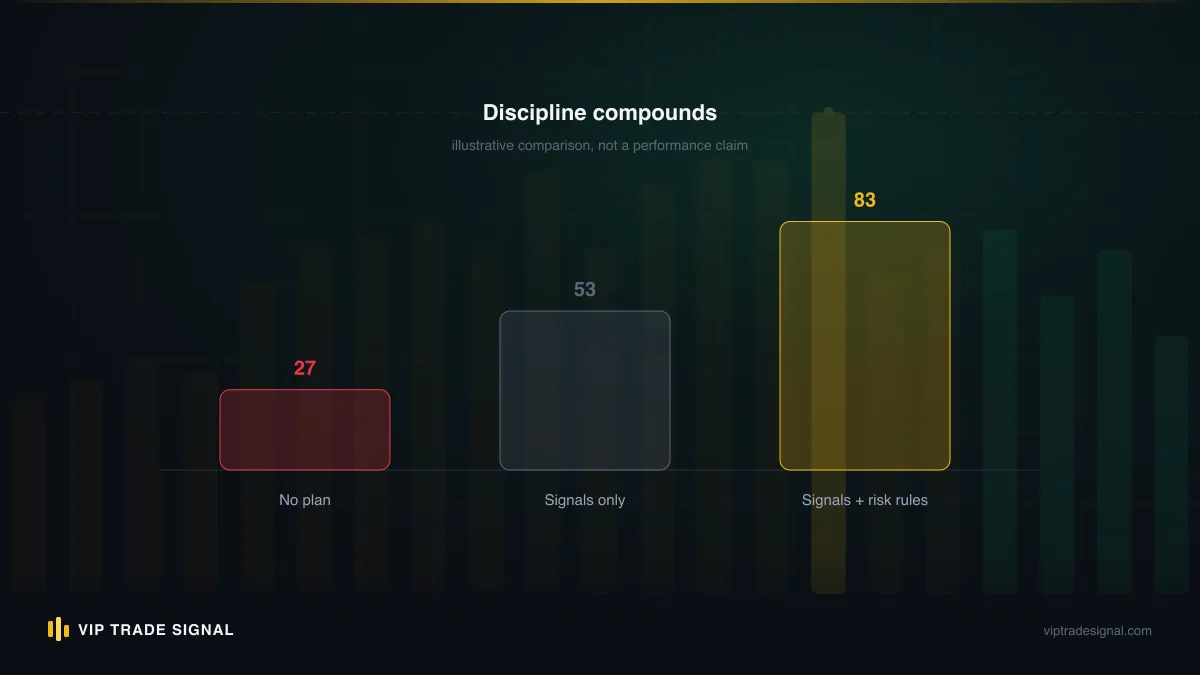
Run it in the order we have grouped the questions. Track record first, because if that fails there is no point discussing fees. Custody and passwords second, because that is where the outright theft happens. Strategy and risk third, fees fourth, losses fifth, exit terms last. The order matters more than people think: if you open with "what's your fee split?", you have signalled that you are shopping on price, and a sharp salesperson will simply undercut whatever number you mention and win the deal without ever proving they can trade.
Tone-wise, be pleasant and be slow. Take notes visibly. Ask follow-ups. When you get a vague answer, do not argue with it; just ask the same question again with slightly different words. Vague answers survive one asking. They rarely survive three. A trader we will call Dana did exactly this on a call we heard about later: she asked "what's your worst month?" three times in ten minutes, got three different numbers, and closed her laptop. Total cost of that due diligence: nothing. Total cost of skipping it: whatever her account was worth.
And do it in writing where you can. A voice call is fine for rapport, but ask them to confirm the key answers by email afterwards. Honest managers will. Dishonest ones suddenly become very busy.
Expect the whole process to take a week or two, not an afternoon. That is deliberate. Fraudulent operations run on momentum; their pitch is calibrated to move you from first contact to funded account before doubt has time to compound. Stretch the timeline and much of their machinery stops working. A real manager loses nothing by you taking ten days to decide, because the account they want to manage will still exist in ten days. A fake one loses everything, because in ten days you might have searched their company name alongside the word "scam", asked in a trading forum, or simply cooled off. Time is the cheapest due-diligence tool you own, and it is the one high-pressure sellers work hardest to take away from you.
Questions 1-4: track record and verification
1. Can I see your full trading history, including losing trades, on a third-party verified platform?
The single most important question on the list, which is why it goes first. A good answer is a link, sent while you are still on the call, to a Myfxbook, FX Blue, or broker-side investor-access record showing every trade, wins and losses, over at least twelve months. A bad answer is screenshots. Screenshots of MT4 history can be fabricated by anyone with twenty minutes and a demo account, and polished PDF "performance reports" are worse, because someone spent design effort on the deception. The disqualifying answer is "our results are confidential for regulatory reasons". No regulation on earth prevents a manager from showing you their own track record. That sentence is fiction, delivered confidently.
2. Is that track record from a live account or a demo?
You would be amazed how often the glossy 90% win rate turns out to be demo, or a $100 cent account run with lottery-ticket risk. Ask directly. Good answer: live, real money, and here is the broker statement to prove it. Bad answer: "the strategy performs identically on live". It does not. Spreads, slippage and the manager's own nerves all behave differently when the money is real.
3. How long is the record, and does it include at least one rough market period?
Six months of history in a trending market proves nearly nothing. Gold ran hundreds of dollars in some recent years; a golden retriever holding longs would have printed money. You want twelve months minimum, ideally more, and you specifically want to see how the account behaved during a period when the manager's style was out of favour. Good answer: "here's the record, and here's the stretch where we were down 9% for six weeks, and here's what we did about it." Disqualifying answer: a track record that starts fresh every few months. Serial account resets are how blown accounts get laundered into clean marketing.
4. Will you give me investor (read-only) access to a live account you currently manage?
Investor passwords exist on MT4 and MT5 precisely for this. Read-only access lets you watch a real account trade in real time without being able to touch it, and it is the closest thing to ground truth you will get. A good manager will hand over investor access to a reference account without hesitation. If they claim no such account exists, or that clients would object to anonymous read-only viewing, treat the track record as unverified, because it is.
We wrote a longer piece on how to verify a signal seller's track record and nearly all of it transfers directly to vetting a forex manager; the tricks used to fake performance are identical in both industries.
Questions 5-8: custody, access, and passwords
This group is where the catastrophic losses happen. Bad trading loses you money over months. Bad custody loses you everything in an afternoon.
5. Whose name is the account in, and who holds the master password?
There is exactly one acceptable structure for retail account management: the account is yours, at your broker, opened by you, and you hold the master password. The manager receives trading access only. Full stop. A good answer states this unprompted. A disqualifying answer is any version of "you send funds to us and we allocate them", or "we pool client money for efficiency". The moment your money leaves an account in your name, you no longer have an account manager. You have made an unsecured loan to a stranger.
6. Can I withdraw my own money at any time without asking you?
The answer must be an unconditional yes. Withdrawals happen through your broker portal, under your login, and the manager finds out afterwards, not before. Bad answer: "withdrawals need 30 days' notice so we can unwind positions". Open positions can be closed in seconds on a liquid instrument; the notice period exists to trap the money. Disqualifying answer: any arrangement where the manager processes withdrawals on your behalf.
7. Which broker will the account sit with, and can I choose my own?
Good managers work at established, regulated brokers and will generally accept the reputable broker you already use. Be alert when a manager insists on one specific obscure broker you have never heard of, especially one registered somewhere exotic with no regulatory footprint. Sometimes that is an innocent rebate arrangement. Sometimes the "broker" and the "manager" are the same people, and the platform showing your balance is a website that displays whatever numbers they type into it. If you cannot independently verify the broker's regulation, the answer is disqualifying regardless of how good everything else sounds.
8. What access, exactly, do you need from me, and what will you never ask for?
Listen carefully here, because the shape of the answer reveals the operation. The correct list is short: trading password (or a linked trade-copier), and nothing else. A good manager will volunteer the negative space too: we never need your master password, your broker portal login, your email access, or your card details. If anyone managing money asks for the master password, end the conversation. There is no legitimate operational reason for it. None has ever existed.
Questions 9-12: strategy, instruments, and risk limits
9. What do you trade, and why that instrument?
You are not testing whether the strategy is clever. You are testing whether the manager can explain it like someone who actually runs it. A good answer is specific and a little boring: "XAU/USD only, London and New York sessions, structure-based entries, hard stop on every position." A bad answer is a fruit salad: forex majors plus gold plus indices plus crypto plus "whatever is moving". Nobody has an edge in everything. Breadth in a retail manager's pitch is usually a tell that the real strategy is generating commissions, not returns.
10. What is the maximum risk on a single trade, in percent of the account?
There has to be a number. Not a philosophy, a number. Good answers live somewhere between 0.5% and 2% per trade, and the manager should be able to translate it instantly into lots for your account size: on a $10,000 account risking 1% with a 200-pip stop on gold, that is $100 of risk, roughly 0.05 lots. If the person proposing to manage your money cannot do that arithmetic on the call, that is not a small red flag. Disqualifying answer: "risk depends on the setup" with no ceiling. No ceiling means no floor under your account.
11. Do you use stop losses on every position, and do you ever average into losers?
Averaging down without a hard limit, often dressed up as "grid" or "hedging" strategies, is the strategy behind most of the smooth equity curves that end in a single vertical cliff. Martingale variants can win for eighteen months and then delete the account in a night; the curve looks beautiful right up until it does not. Good answer: hard stop on every trade, no exceptions, and here is the history proving it. Bad answer: "we manage positions dynamically". That phrase, in our experience, translates to "we hold losers and pray".
12. What is the maximum drawdown at which you stop trading and call me?
A serious manager has a pre-agreed circuit breaker: if the account falls a defined percentage from its high-water mark, trading pauses and a human conversation happens. Good answers are in the 15-25% region for retail-style accounts, stated before you ask. The disqualifying answer is a blank look, because it means nobody has thought about the scenario where things go wrong, and things always, eventually, go wrong. Our article on risk management rules for managed accounts goes through what a sane rule set looks like line by line, and it is worth reading before this part of the call so you know what normal is.
Questions 13-16: fees, splits, and settlement
13. How exactly do you get paid, and is there any fee I pay before results exist?
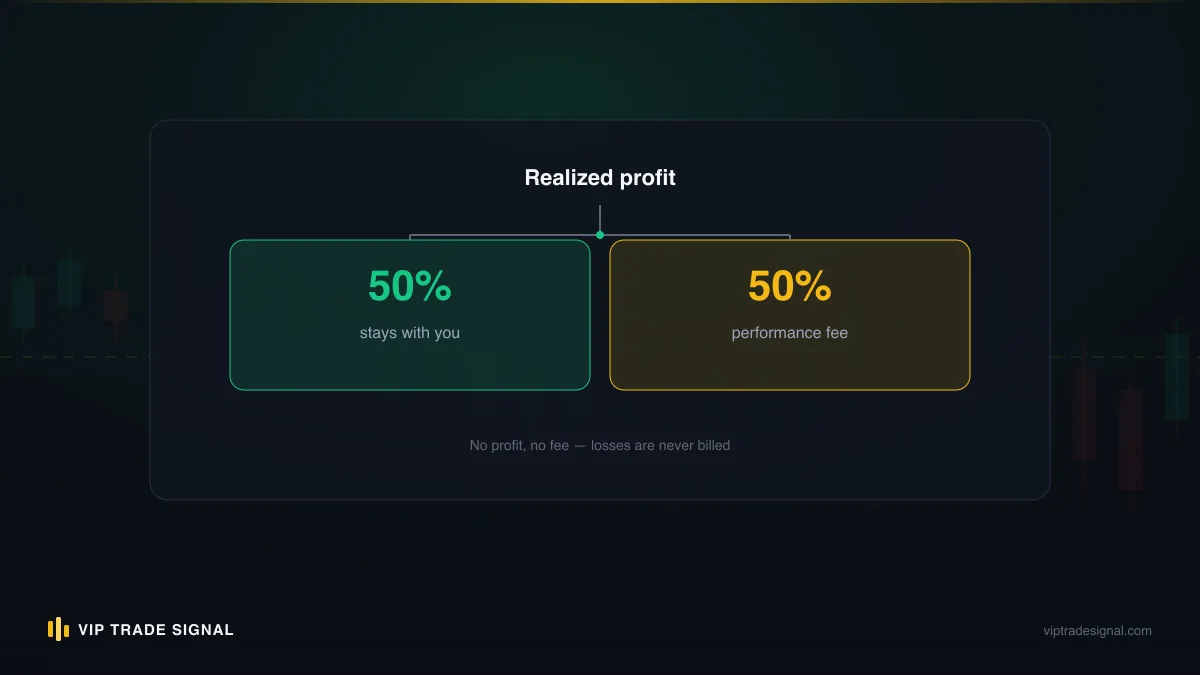
The clean model is performance-only: a percentage of realized profit, nothing else. Common splits in retail run from 20-30% at the polished asset-management end up to 50% at the pay-as-you-go end. Higher splits are not automatically a scam; they usually reflect low minimums and no lock-in, and we say that as a service charging 50% ourselves, which is the expensive end and we are upfront about it. What matters more than the number is the structure. Bad answer: a monthly "management fee" charged whether you profit or not, stacked on top of a performance cut. Disqualifying answer: any upfront payment described as "activation", "insurance", "licensing" or, the classic, a fee required to release your profits. Real profit sits in your broker account already. Nobody needs paying to release it.
14. Is the split on realized profit or floating profit, and against a high-water mark?
This one separates people who have thought about fairness from people who have not. Realized profit means closed trades only; floating paper gains can evaporate and should never be billable. And the high-water mark question matters enormously over time: if the account makes $1,000, loses $800, then makes $500 back, a manager without a high-water mark charges you on $1,500 of "profit" while your account is up $700. Good answer: realized only, above the previous peak, and here is a worked example. Bad answer: visible confusion at the phrase "high-water mark".
15. When and how is your cut settled, and what happens if I simply do not pay?
Mechanics matter. The good structure: at agreed intervals, the manager shows you the closed-trade statement, you verify it against your own broker records, and then you pay them, from money you control. Notice the order. You hold the money; they invoice you. If the structure is reversed, where the manager deducts their share before you see anything, you have quietly lost custody. And the "what if I don't pay" question is genuinely revealing: a good manager says "then we stop trading for you and part ways", because that is the only leverage an honest operator has or needs.
16. Are there any other costs: subscriptions, broker rebates, spread markups, copier fees?
Ask this as an open question and then sit in the silence. Some managers earn quiet rebates from the broker on your trading volume, which puts their incentive at war with yours: rebates pay per lot, so overtrading your account becomes profitable for them even while it bleeds you. That is not automatically disqualifying if disclosed, but undisclosed, it is a second salary you are paying without knowing. Good answer: full disclosure, including "yes, we get an IB rebate from broker X and here is roughly what it is worth". Disqualifying answer: discovering a rebate arrangement later that was denied on the call.
Questions 17-19: losses, drawdowns, and worst months
17. Tell me about your worst month. What happened, and what did you change?
This is a job interview question, and it works for the same reason it works in job interviews. Everyone who has traded real money through real markets has a scar and remembers it in detail. A good answer is specific and slightly uncomfortable: the month, the rough percentage, the mistake, the rule that exists now because of it. A bad answer is smooth: "we've had drawdowns but our system recovers quickly". The disqualifying answer is "we don't really have losing months". Nobody trades leveraged markets for years without losing months. Nobody. A manager claiming otherwise is either lying about the record or has not been trading long enough to have one.
18. What should I realistically expect to make, and what would you consider a bad year?
You are hunting for two things: a sane number and a two-sided answer. Sane, in leveraged retail trading, means single-digit monthly returns in good stretches, flat and losing months mixed in, and honest acknowledgement that any year can end negative. We have written at length about realistic monthly returns in forex, and the short version is that consistent double-digit monthly performance, promised in advance, does not survive contact with arithmetic; compound 20% a month and a $5,000 account passes $44 million in five years, which is roughly how you can tell the promise is fiction. Good answer: a modest range plus an unprompted "and some months we will lose". Disqualifying answer: any guaranteed figure. The word "guaranteed" attached to trading returns should end the meeting mid-sentence.
19. Walk me through what happens, hour by hour, when a trade goes badly against the account.
The rehearsed-disaster question. Good managers have an actual procedure: the stop takes the trade out at a known cost, the loss was pre-sized at 1% or whatever the agreed limit is, nothing else happens, trading continues under the same rules. Bad managers improvise: "we'd probably hedge it, or hold it until it comes back". Holding until it comes back is not a plan. It is the absence of one, and on a leveraged account it is the specific absence that produces margin calls.
A manager's quality is not what they promise you about winning. It is what they can describe, precisely and without flinching, about losing.
Questions 20-21: exit terms and references
20. How do I leave? Notice period, penalties, and what happens to open trades?
You are asking about the divorce before the wedding, which feels awkward and is exactly why you must. The good answer: no lock-in, no exit penalty, you revoke the trading password whenever you like, and open positions get closed or handed over at your instruction within a day. Because the account is yours, leaving should be a technical detail, not a negotiation. Bad answer: minimum terms of six or twelve months. Disqualifying answer: exit fees, or profits "held back" until some future date. If leaving is expensive, that is not a service agreement, it is a trap with paperwork.
While you are on exit terms, ask the small practical follow-up most people forget: what happens to my account history when I leave? The answer should be "nothing, it lives in your broker account, because the account was always yours". If any part of your statement history sits on the manager's side, on their portal, their dashboard, their monthly PDFs, you will lose access to your own records the day the relationship sours, and disputed final invoices get very hard to argue without them. Keep your own copies of broker statements monthly regardless of who you hire. Paper you hold beats promises anyone makes.
21. Can I speak to two current clients, and will you confirm all of this in writing?
References in this industry are imperfect; happy clients can be cherry-picked and, at the fraudulent end, invented. But watch how the request lands. A good manager says yes to at least one of the two, usually both, and the written confirmation matters more than the references: a plain email restating custody, risk limits, fee structure, settlement mechanics and exit terms. Honest operators put it in writing because writing protects them too. The disqualifying response is a refusal to commit anything to email combined with pressure to fund quickly, "before the current intake closes". Legitimate account management does not have intakes closing on Friday. Urgency is a sales tool, and in this specific industry it is the sales tool of people whose offer cannot survive a week of thinking.
Why these questions to ask a forex account manager actually work
Notice what the 21 questions have in common. Almost none of them ask the manager to predict the future, and none of them require you to judge whether a strategy is clever. You are not qualified to assess whether someone's order-flow model has edge, and neither are we, most days. What you can assess, with no trading knowledge whatsoever, is verifiability, custody, arithmetic, and candour.
That is the whole trick of this forex manager interview. Every question is designed so the good answer is checkable and the bad answer is structural. "Can I see a verified record" is checkable within minutes. "Who holds the master password" has exactly one correct answer. "What is your worst month" cannot be answered well by someone without a real history. You are not trying to catch a liar in the act, which is hard; you are building a situation where lying requires producing forgeries, refusing reasonable requests, or contradicting themselves across three phrasings of the same question, all of which are visible.
There is a second layer to it, too. The interview does not only test the answers; it tests the relationship you are about to enter. How a manager behaves when you ask for investor access is a preview of how they will behave when you ask why the account is down 12%. Someone who is patient, specific and unbothered under polite scrutiny before your money arrives will usually stay that way after. Someone who deflects, flatters, or gets prickly at question six is showing you the exact personality you will be negotiating with during a losing streak, except later they will also be holding your trading password. You are not just verifying a forex account manager. You are auditioning them for the worst month you will spend together.
It also means the vetting scales down honestly. Maybe you do not have the patience for a full 21-question interview over a $2,000 account. Fine. The compressed version is questions 1, 5, 10, 13 and 20: verified record, custody, per-trade risk, fee structure, exit. Five questions, ten minutes, and they filter out the large majority of bad operators on their own. The other sixteen exist to catch the sophisticated minority who have rehearsed answers to the famous five.
Instant-fail answers, ranked
Some answers are yellow flags that want a follow-up. Others end the process on the spot. Here is our ranking of the disqualifiers, worst first, because knowing the ranking helps when a manager fails one item but aces everything else and you are tempted to rationalise.
| Rank | The answer | Why it ends the meeting |
|---|---|---|
| 1 | "Send the funds to us / we pool client money" | Custody transfer. This is where money vanishes entirely, not just gets traded badly. |
| 2 | "We need your master password" | Full control of your account, including withdrawals to their card. No legitimate use exists. |
| 3 | "Returns are guaranteed" (any figure) | Nobody can guarantee leveraged trading returns. The claim itself is the proof of dishonesty. |
| 4 | "Pay a fee to release your profits" | The advance-fee scam in its purest form. Real profit needs no ransom. |
| 5 | "Our track record is confidential / screenshots only" | Unverifiable performance is indistinguishable from invented performance. Treat it as invented. |
| 6 | "We don't have losing months" | Either a lie or an account too young to matter. Both disqualify. |
| 7 | "No fixed risk limit, it depends on the setup" | Uncapped risk means your worst case is everything. |
| 8 | "Twelve-month lock-in, exit fees apply" | Honest managers keep clients with results, not contracts. |
The dangerous scenario is the manager who fails item 5 or 6 while being charming, responsive, and cheaper than everyone else. Charm is not collateral. Rank 1 through 4 are theft indicators; 5 through 8 are incompetence-or-worse indicators; none of the eight is survivable by an otherwise pleasant conversation.
One aside on the theft end of that table: the same structures show up constantly in the signal world too, and the anatomy of Telegram forex scams overlaps almost completely with fake account management. Same actors, different product page.
Our own answers to all 21
We said at the top that we would sit our own account management service in the interview chair. Here it is, condensed but complete, and if any manager you are vetting will not produce the equivalent in writing, ask yourself why.
Track record (1-4). Every closed signal we have issued is public at /signals/history, wins and losses both, and it stays public through drawdowns because a record you can prune is not a record. Managed-account performance follows the same trades. It is live trading, not demo. And yes, read-only investor access to a reference account is available on request before you commit anything.
Custody (5-8). The account is yours, at your broker, and you keep the master password from day one to the last day; we ask for trading access only and nothing else, ever. You withdraw whenever you like through your own broker portal without telling us first. We work with your existing regulated broker in most cases. The full access list, and the never-ask list, is written out on the service page and in our FAQ.
Strategy and risk (9-12). Gold, XAU/USD, only. One instrument, traded deep, rather than six traded shallow; that is a deliberate opinion about where edge comes from, and we accept that it is not everyone's. Hard stop on every position. Per-trade risk is capped and agreed with you at onboarding, and there is a drawdown level at which we stop and talk rather than trade on hoping.
Fees (13-16). Flat 50% of realized profit, high-water mark applied, nothing charged on floating gains and nothing charged in losing periods beyond a $200 minimum advance that exists to filter for seriousness, and which we will happily explain the mechanics of before you pay it. You see the closed-trade statement, you verify it against your own broker records, then settlement happens. Fifty percent is the high end of the market and we do not pretend otherwise; it is the price of a low minimum, no lock-in, and pay-on-results, and if you have $50,000 or more and want a 25% split with a licensed asset manager and a proper mandate, that is genuinely the better product for you and you should go and buy it.
Losses (17-19). We have losing months. They are visible in the public history, which is the point of keeping one. Expectations we will put our name to: variable months, losing stretches included, and no guaranteed anything, because trading gold with leverage is high-risk and money you cannot afford to lose does not belong in it. When a trade goes wrong, the stop executes, the loss is the pre-sized loss, and the next trade follows the same rules.
Exit and references (20-21). No lock-in, no exit fee, revoke the trading password whenever you like and it is over that day. Everything above goes in writing before you fund anything. More on who we actually are, names included, is on the about page; we would rather you read it sceptically than not at all.
One honest addendum, since profits create paperwork: whatever a manager earns you is generally taxable income in your jurisdiction, and how depends on where you live and how you trade. We covered the broad strokes in our piece on tax on managed forex account profits, but a manager who starts giving you confident tax advice on a sales call is answering questions outside their competence, which should make you wonder about the ones inside it.
The printable checklist
Print this, or copy it into your notes app, and physically tick it during the call. The act of ticking matters; it stops a charismatic manager steering you past the questions you meant to ask. Every vetting a forex manager conversation we have ever heard go wrong went wrong because the buyer let the seller set the agenda.
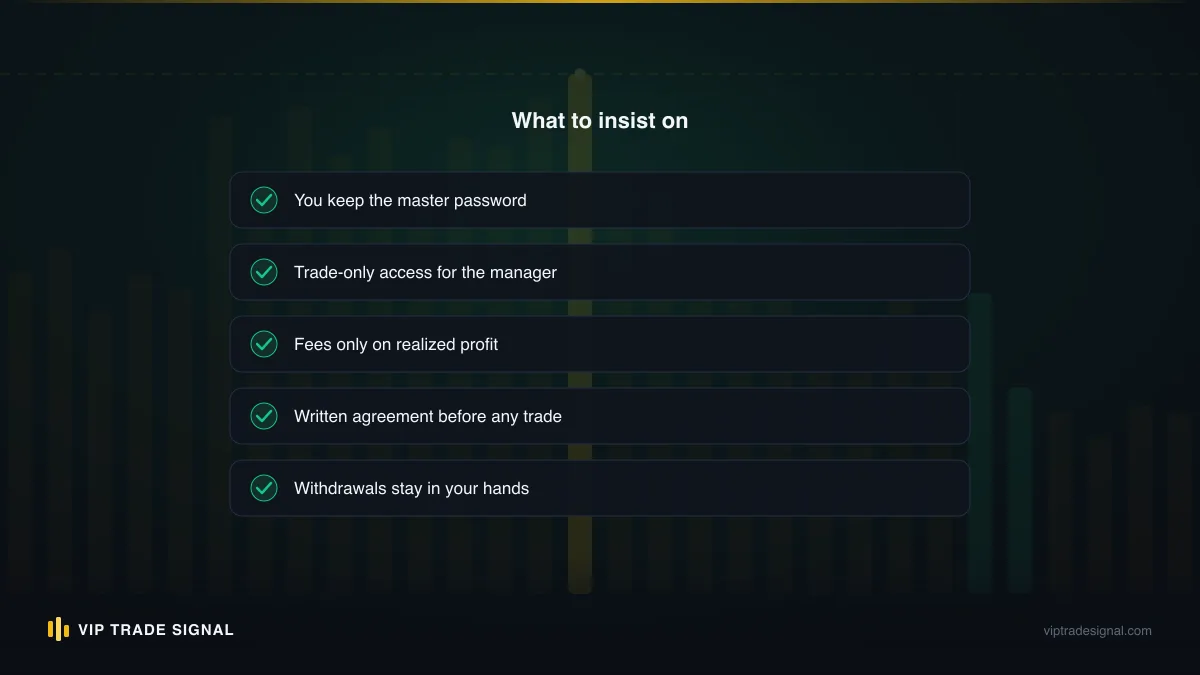
Track record: third-party verified history seen ☐ · live not demo ☐ · 12+ months including a rough patch ☐ · investor access offered ☐
Custody: account in my name at my broker ☐ · I keep the master password ☐ · I withdraw without permission ☐ · access list confirmed, nothing extra requested ☐
Strategy and risk: instruments named and narrow ☐ · per-trade risk cap stated as a number ☐ · stops on every trade, no averaging into losers ☐ · drawdown circuit-breaker defined ☐
Fees: performance-only or all fees disclosed ☐ · realized profit, high-water mark ☐ · I verify, then I pay, from money I hold ☐ · rebates and side costs disclosed ☐
Losses: worst month described specifically ☐ · realistic expectations, losses said out loud ☐ · losing-trade procedure exists ☐
Exit: no lock-in, no exit fee, same-day revocation ☐ · reference offered and everything confirmed by email ☐
Scoring is blunt. Any single instant-fail from the ranked table above: walk away, regardless of the other twenty answers. Three or more unticked boxes anywhere: pause, get the written answers, and re-run the missing questions by email. All boxes ticked: you have found someone worth a small first allocation, and small is the operative word, because the final layer of due diligence is not a question at all. It is starting with an amount whose total loss you could shrug off, watching real statements arrive for two or three months, and only then deciding whether the person on the other end of the password deserves more.
No manager, ourselves included, is owed your trust at question 21. The questions get you to the starting line. The statements do the rest.