Nobody reads the agreement. That's not cynicism, it's observation. A trader spends three weeks researching managers, grills two of them on video calls, checks track records, asks smart questions about drawdown — and then, when the PDF arrives, skims it in four minutes and signs on the strength of a good feeling from the calls.
The problem is that the calls and the contract are describing two different futures. The sales conversation describes what the manager hopes will happen: steady months, sensible risk, a happy split of profits. The forex account management agreement describes what happens when it doesn't — when the account is down 22% in a bad month, when you want out mid-trade, when the fee calculation lands on a number you don't recognise, when the manager simply stops answering. Every ugly scenario you can imagine has a clause governing it, or a silence where a clause should be. Both tell you a great deal.
We've read a lot of these documents over the years, on both sides of the table. Some were tight, fair, and boring in the best possible way. Others were two pages of vibes with a signature line. This piece walks through a complete agreement the way a practitioner reads one: the eight clauses that decide everything, what each should actually say, the trap language that should make you push back, and what it means when a clause is missing entirely. It is contract literacy, not legal advice — we're traders, not solicitors, and where real money and real jurisdictions collide you'll want the real thing. More on when that's worth paying for at the end.
Why the agreement matters more than the sales conversation
Here's a scenario we'll come back to. A trader we'll call Dan hands a $6,000 account to a manager he found through a friend. The pitch was gold and indices, tight risk, 40% profit share. Three months in, Dan opens MT5 and finds his account holding a grid of eleven averaged-down positions in a currency pair the manager never mentioned, floating $1,900 against him. He messages the manager, who replies that the strategy "sometimes builds positions" and that closing now would "lock in unnecessary loss."
Now the only question that matters: what does the agreement say? If it limits the manager to specific instruments, caps open risk, and defines a drawdown level at which trading stops, Dan has a clear breach and a clean exit. If it says the manager may trade "at his discretion using his proprietary strategy" — which is what Dan's actually said — then technically nothing has gone wrong. The manager is doing exactly what Dan agreed to. The document was the risk control, and the document had none.
That's the whole argument in one story. Verbal assurances are worth roughly nothing once money is moving. A manager who says "I never risk more than 2% per trade" but won't put that number in the contract is telling you the number is decorative. And a manager who does put it in writing has just handed you something enforceable, or at least arguable, which changes their incentives from day one. People behave differently when the promise is on paper.
There's a second reason the agreement outranks the conversation: the agreement was written when the manager was calm, careful, and thinking about edge cases. The conversation was a performance. You want to deal with the calm, careful version — and the contract is the only place you'll meet them.
The eight essential clauses every agreement needs
Every managed forex account contract worth signing covers the same eight things. The wording varies, the order varies, but the substance shouldn't. When we review an agreement, this is the checklist we run before reading a single clause in detail:
- Parties and account identification. Who, exactly, is managing, and which account, exactly, are they managing. Legal names, the broker, the account number.
- Scope of authority. What the manager may and may not do inside the account: instruments, position limits, prohibited actions.
- Fee calculation and settlement. How the fee is computed, on what base, over what period, paid when and how.
- Drawdown limits and stop conditions. The equity level at which trading pauses or stops, and what happens next.
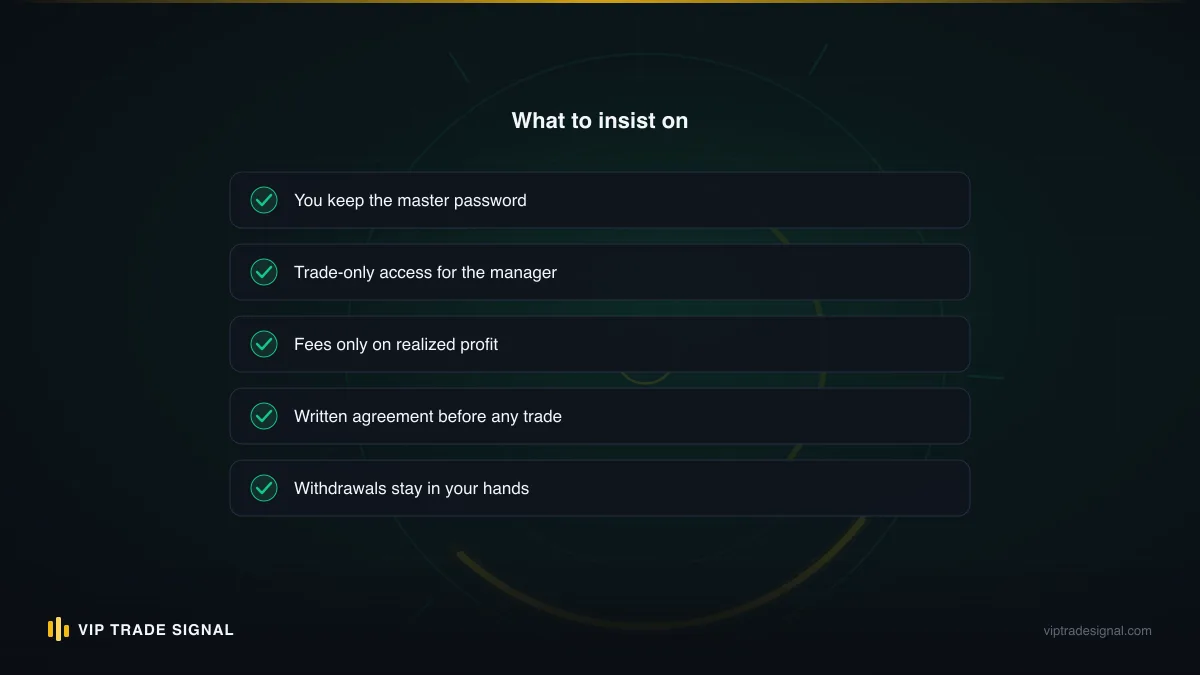
- Access and control. Who holds the master password, who controls withdrawals, what access the manager receives.
- Term and termination. How long this runs, how either side ends it, and what happens to open positions on exit.
- Risk disclosure and no-guarantee language. A plain statement that losses are possible and nothing is promised.
- Dispute handling and governing law. What law applies and where a disagreement goes.
Eight clauses. That's the skeleton. A good agreement might run to twelve or fifteen sections once you add definitions and notices, but strip the padding and these eight are load-bearing. In the next few sections we'll open up the four that generate nearly all the real-world disputes: scope, fees, drawdown, and termination. The other four matter, but they fail loudly and early — a missing risk disclosure or a refusal to let you keep the master password is the kind of red flag you spot in the first read. The dangerous clauses are the ones that look fine and fail quietly, eight weeks in.
One note on access before we move on, because it's the clause with the least ambiguity. You should keep the master password. The manager gets investor access or a trading-only login; you keep withdrawal control at the broker. Any structure where the manager can move money out of the account isn't account management, it's custody, and retail managers offering custody without a licence are a different article — a shorter, angrier one. This is the arrangement we use ourselves for account management, and it's non-negotiable in either direction: we don't want your withdrawal rights any more than you should want to give them away.
Scope of authority: the clause that decides what "managed" means
Scope is where vague language does the most damage, because it's the clause that defines the entire activity. Everything else regulates the edges; scope regulates the middle.
A weak scope clause reads like this: "The Manager shall trade the Account using the Manager's trading strategy at the Manager's sole discretion." That sentence authorises literally anything. Martingale grids, 100-lot punts on NFP, holding a losing position for six months, switching from gold to exotic crosses on a whim. If it goes wrong, you agreed to it.
A strong scope clause names things. Instruments first: "The Manager shall trade only XAU/USD" or "only the following instruments: [list]". Then risk per position, in numbers: maximum lot size relative to equity, or maximum risk per trade as a percentage. Then a cap on aggregate exposure — total open lots, or total open risk if every stop were hit at once. Then the prohibited list, which is where experience shows. Ours would include, at minimum: no removing or widening stop losses after entry, no averaging into losing positions beyond a stated limit, no use of the account for any instrument or purpose not listed, no depositing or withdrawing (which the broker should already prevent, but belt and braces).
The specificity test
Here's a quick test for any scope clause. Ask: could two honest people disagree about whether a given trade breached it? "Sensible risk management" fails the test instantly — one person's sensible is another's grid. "No single position shall risk more than 2% of account equity at its stop loss" passes; either the trade risked more than 2% or it didn't. Run every sentence of the scope clause through that filter. Anything that fails is decoration, and decoration in a contract is worse than nothing because it feels like protection.
We'd also push for a line that seems petty until you need it: the strategy described in marketing materials, or in your conversations, is the strategy to be used, and material changes require your written consent. Managers pivot. Sometimes sensibly, sometimes because the old approach blew up and they're chasing a new one with your money. A strategy-change clause means the pivot happens with your knowledge instead of appearing in your trade history as a surprise.
Does all this specificity annoy some managers? Yes. Good. A manager confident in their approach can describe it in enforceable terms without breaking a sweat. The ones who bristle at being pinned down are telling you that flexibility — theirs, not yours — is the product.
Fee calculation and settlement: where the arithmetic hides
Every profit sharing agreement in forex sounds simple on a call. "We take 30% of profits." Fine. Thirty percent of what, measured when, calculated how? Those three questions are where the money actually moves, and a fee clause that doesn't answer all three precisely is a fee clause the manager gets to interpret later.
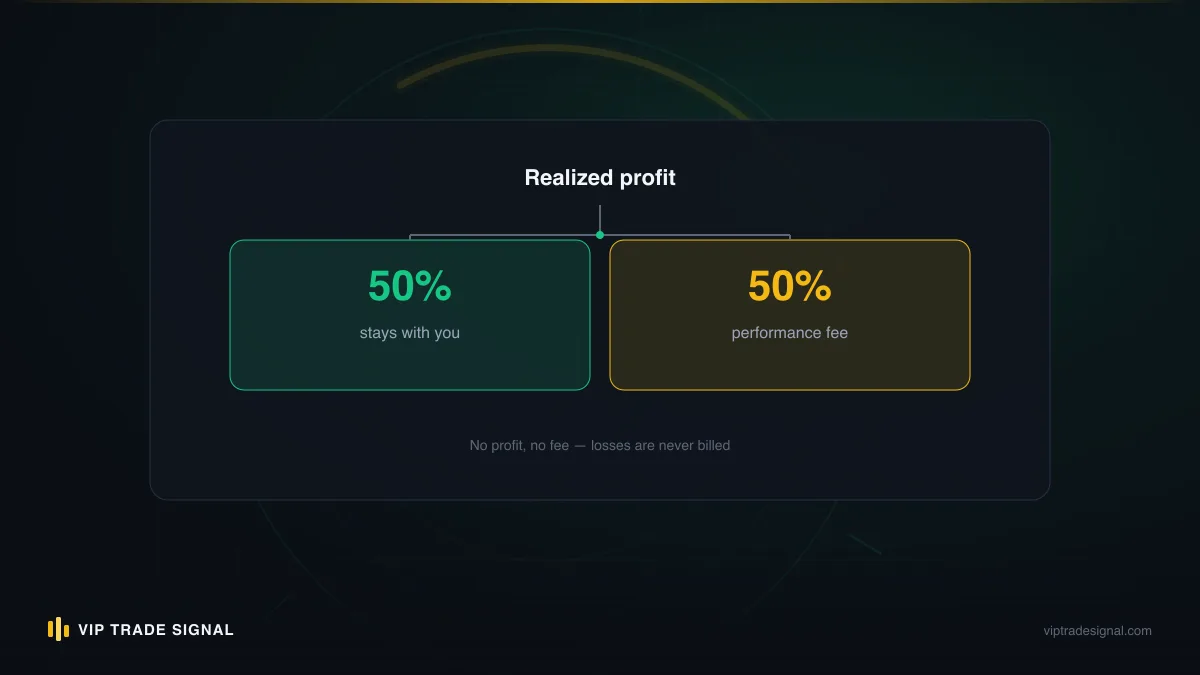
Start with the base. Profit share should be calculated on realized profit — closed trades, banked gains — never on floating equity. A fee charged on open profit is a fee charged on money that doesn't exist yet and may never exist. It also creates a genuinely perverse incentive: the manager profits by opening positions that show paper gains at the measurement date, regardless of how they eventually close. If you see "calculated on account equity including open positions," strike it or walk.
Next, the high-water mark, which is the single most important piece of fee machinery and the one most often missing from retail agreements. A high-water mark means the manager only earns on profit above the account's previous peak. Concrete version: your $10,000 account grows to $12,000, and the manager takes their share of the $2,000. The account then falls to $10,500 and climbs back to $12,000. Without a high-water mark, the manager charges you again on that same $1,500 of recovery — profit you already paid for once. With one, they earn nothing until equity clears $12,000. Over a couple of drawdown cycles the difference is not small. On a choppy account it can double the effective fee rate. Any managed forex account contract without high-water-mark language is either written by someone who doesn't know the industry standard or by someone who does and hopes you don't.
Then the mechanics, each of which needs one clear sentence:
- Period. Fees calculated monthly is typical. The clause should name the day and the data source (the broker's statement, not the manager's spreadsheet).
- Deposits and withdrawals. Mid-period cash flows must adjust the calculation, otherwise your own deposit can masquerade as trading profit. It sounds absurd. We've seen it charged.
- Settlement. How you pay — invoice and transfer, usually — and within how many days. And what happens if a losing period follows before you've paid: does the fee stand, or net against the loss?
- Worked example. The best agreements include one, with real numbers, right in the schedule. If the manager can't produce a worked example of their own fee, that's your answer on whether the formula is clean.
For calibration: our own structure is a flat 50% of realized profit above the starting balance, with a $200 minimum advance that nets against the first profit split. That 50% is the high end of the market, and we say so plainly — the trade-off is a low minimum and no other fees, and the arithmetic of how no-upfront-fee management actually works is a piece of its own. The point here isn't our number. The point is that whatever the number, the formula around it should survive hostile reading. Fifty percent calculated honestly on realized profit above a high-water mark can cost you less than "twenty percent" calculated creatively on equity.
Drawdown limits and stop conditions: the clause you're really paying for
If scope defines what the manager does, the drawdown clause defines what they're not allowed to keep doing. It is the emergency brake, and an agreement without one is a car without one.
The core is a single number: the equity level, expressed as a percentage decline from starting balance or from the most recent high-water mark, at which trading stops. Not "the manager will endeavour to limit drawdown." Stops. A typical retail arrangement might set this at 20-30%; aggressive strategies sometimes ask for more room, conservative ones less. The number itself is a negotiation between your pain tolerance and the strategy's genuine needs. What isn't negotiable is that a number exists.
The clause needs four moving parts to actually function:
- The measurement. Equity, not balance. A grid strategy can hold balance flat while equity craters under floating losses; a balance-based limit is a limit the worst strategies never trigger. The clause should say equity, and say whether it's measured continuously or at daily close.
- The trigger action. What literally happens at the line: all positions closed and trading halted is the clean version. "Trading paused pending review" is acceptable if open positions are also addressed — otherwise a manager can "pause" while eleven open trades keep digging.
- The notification. You get told, in writing, within a stated time. You'd be amazed how often clients discover a stop-out three weeks later.
- The restart condition. Trading resumes only with your written consent. Not automatically, not at the manager's judgment. The whole point of the brake is that you decide whether the car moves again.
Say it with numbers, because that's the only honest way. A $8,000 account with a 25% equity stop halts at $6,000. That's a real loss of $2,000 that the agreement openly contemplates — and it should, because managed accounts lose money sometimes, and a contract that pretends otherwise is lying to you in a friendly font. The drawdown clause isn't there to prevent losses. It's there to prevent unbounded losses, which is a different and achievable goal.
A missing drawdown clause doesn't mean the manager expects no drawdown. It means they expect one and would rather it had no consequences.
One refinement worth requesting if the strategy justifies it: a soft limit and a hard limit. At the soft line (say 15%), risk is cut — position sizes halve, no new positions beyond a reduced cap. At the hard line (say 25%), everything stops. This mirrors how disciplined desks actually manage losing periods, and a manager who understands the idea immediately is showing you something about how they trade. A manager who's never heard of it is showing you something too.
Termination and exit: how you actually get your account back
Getting in is easy. Every agreement handles onboarding beautifully. The exit is where drafting quality shows, because exits happen under stress — you've lost confidence, or money, or both — and stress is exactly when vague language turns into leverage against you.
The termination clause needs to answer five questions with no gaps:
Can you leave at will? The answer should be yes, with written notice measured in days, not months. A 7-day notice period is reasonable; it gives the manager time to unwind positions in an orderly way. Anything beyond 30 days should make you ask who the lock-in is protecting. Some agreements allow immediate termination for cause (breach of scope, breach of drawdown limit) alongside notice-based termination without cause. That two-track structure is a sign of careful drafting.
What happens to open positions? This is the detail almost everyone misses. On the day notice lands, the account might hold six open trades. Who closes them, when, and who eats the result? The clean answer: the manager closes all positions within the notice period, and no new positions may be opened after notice is given. That last part matters more than it looks. Without it, a manager working through a notice period can size up aggressively — one last swing with your money, heads they earn a final fee, tails you were leaving anyway.
How is the final fee settled? Same formula as always, calculated on realized profit at the moment all positions are flat, paid on the same terms. Watch for exit-specific fee language; there shouldn't be any.
What access is revoked, and when? The manager's login is removed at termination. Since you kept the master password (didn't you?), this is a five-minute job at the broker: change the trading password or delete the investor access. If the agreement's exit mechanics involve the manager returning control to you, the agreement is describing a structure you should never have been in.
Can the manager quit? Yes, and symmetrically — same notice, same wind-down duties, same final settlement. Managers exit too, usually when an account is deep in drawdown and no longer worth their time. The clause should make them leave the account flat and settled, not abandoned mid-grid.
Test any termination clause against Dan from earlier. He wants out today, with eleven positions floating $1,900 down. Under a good clause: written notice, no new trades from that moment, positions closed within seven days, fee calculated on the realized result (nothing, since the account is down), access revoked. Under a bad clause, or no clause: an argument, conducted over messaging apps, with the losing positions still open the whole time. The difference between those two weeks is the difference the paperwork makes.
Trap language: the clauses that should stop you cold
So far we've covered what should be present. Now the reverse: language that shows up in real agreements and works against you, sometimes by design, sometimes because a template got copied by someone who never thought about it. When we mark up an agreement, these are the highlights that come back in red.
Broad indemnities. "The Client shall indemnify the Manager against all losses, claims and liabilities arising from the management of the Account." Read that twice. It says that if the manager's trading creates a problem, you pay for it. Indemnities have legitimate narrow uses — you indemnifying the manager against your own misrepresentations, say. An indemnity covering the manager's own trading conduct is upside-down and should be struck without discussion.
Unilateral amendment. "The Manager may amend these terms at any time upon notice." This clause makes every other clause provisional. The 25% drawdown stop, the fee formula, the exit terms — all of it holds only until the manager mails you a new version. Amendments should require both signatures. Full stop.
Fee resets and high-water-mark erosion. Sneakier. Language that resets the high-water mark annually, or after any withdrawal, or "upon strategy revision." A resetting high-water mark lets the manager re-charge for recovering ground you already paid for. Related: clauses that convert unpaid performance fees into debt that survives termination and compounds. Fees should crystallise on the agreed dates from broker statements, and that's the end of the machinery.
Liability disclaimers that swallow the contract. Every agreement will, fairly, disclaim liability for market losses — the market is nobody's fault. Watch instead for disclaimers covering "any act or omission of the Manager howsoever arising," including breach of the agreement itself. If the manager isn't liable even when they break the contract, the contract is a menu, not a deal. Reasonable middle ground: liability excluded for market outcomes within scope, preserved for breach, negligence, and fraud.
Confidentiality gags pointed at you. Mutual confidentiality over strategy details and account figures is normal. A clause preventing you from discussing the manager's conduct — with a lawyer, a regulator, or a forum full of prospective clients — is not confidentiality, it's reputation management pre-purchased at your expense. It pairs, in our experience, with services whose track records won't survive discussion. Any service should be relaxed about scrutiny; every closed trade we take sits in public at /signals/history, wins and losses alike, and honestly that transparency costs nothing when the numbers are real.
Jurisdiction shopping. Governing law in a jurisdiction with no connection to either party, no realistic enforcement, and — coincidentally — no functioning route for you to sue. Offshore managers will have offshore law, that's structural (the Dubai management scene is its own case study in how jurisdiction shapes your options). But an agreement between a UK client and a UK-facing service governed by the law of a microstate is a choice, and the choice was made against you.
None of these clauses appear with a skull and crossbones. They sit in dense paragraphs near the back, past the point where most readers are still reading. Which is, of course, the point.
What a missing clause tells you
An absent clause is evidence, and it's worth learning to read the silences as fluently as the text.
Missing drawdown limit: the manager has thought about drawdown — every manager has — and decided the agreement works better without a consequence attached. Missing high-water mark: either amateur drafting or a fee model that quietly depends on double-charging recoveries. Missing open-position rules at termination: exits will be improvised, and improvised exits favour whoever holds the trading password at the time. Missing risk disclosure: possibly the most revealing absence of all, because honest operators are eager to put loss language in writing. It protects them. A service that won't write "you can lose money" into its own contract is running a pitch that depends on you not hearing it.
The pattern behind all of these: a clause is missing either because nobody competent drafted the document, or because somebody competent removed it. Neither is good, but they fail differently. Incompetent drafting shows up everywhere at once — a two-page agreement with no definitions, no governing law, fee terms in a WhatsApp message. Selective removal shows up as an otherwise professional document with one strange gap, and that gap will map, with surprising precision, onto the way the service makes its real money.
There's a version of this that surfaces before you ever see the contract. Ask a prospective manager three questions: what's the drawdown limit, is there a high-water mark, and what happens to open positions if I terminate? A good manager answers all three in under a minute, in numbers, because the answers are in their agreement and they wrote it. Vague answers now predict vague clauses later. We keep a longer version of that question list in our FAQ, and the pattern of which questions make a salesperson uncomfortable is diagnostic all by itself.
An annotated walkthrough of a clean agreement
Words are one thing; shape is another. Here's the structure of a management agreement we'd consider signable, section by section, with the note we'd scribble next to each. Treat it as a forex account management agreement template in outline form — the skeleton to compare any real document against, not a substitute for one drafted for your jurisdiction.
| # | Section | What it must nail down | Margin note |
|---|---|---|---|
| 1 | Parties & recitals | Legal names, addresses, the specific account and broker | If the manager is a company, check it exists |
| 2 | Definitions | Equity, realized profit, high-water mark, business day | Fee disputes are usually definition disputes |
| 3 | Appointment & access | Trading-only access granted; client retains master password and withdrawals | Non-negotiable, both directions |
| 4 | Scope of authority | Instruments, per-trade risk cap, aggregate exposure cap, prohibited actions | Must pass the two-honest-people test |
| 5 | Fees | Base (realized profit), rate, high-water mark, period, cash-flow adjustments, worked example | The worked example is the tell |
| 6 | Drawdown & stop | Equity-based limit, trigger action, notification, consent to restart | The clause you're really buying |
| 7 | Reporting | What you receive, how often; broker statements as source of truth | You can also just log in and look |
| 8 | Term & termination | Notice days, no new trades after notice, position wind-down, final settlement, access revocation | Stress-test it against a bad month |
| 9 | Risk disclosure | Losses possible, no guarantees, past results not predictive | Its presence is the point |
| 10 | Liability & indemnity | Market outcomes excluded; breach, negligence, fraud preserved | Strike anything broader |
| 11 | Amendment & assignment | Changes need both signatures; no assignment without consent | Kills the moving-target problem |
| 12 | Governing law & disputes | A jurisdiction with a real connection to the parties | Ask "could I actually sue here?" |
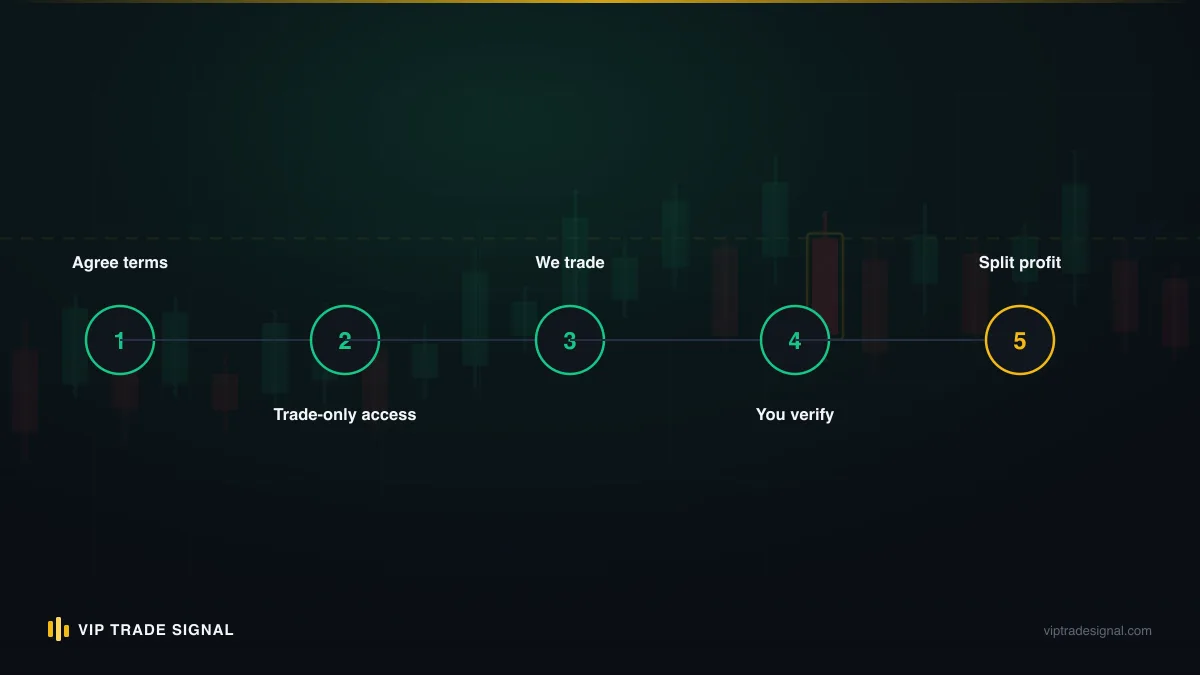
A practical note on reading order, because nobody absorbs a contract front to back. Read sections 5, 6, and 8 first — fees, drawdown, termination. Those three carry perhaps ninety percent of the risk and take fifteen minutes. If any of the three fails, you've saved yourself the other nine sections. Then scope, then the liability and amendment clauses hunting for the trap language above, then the rest. Print it. Annotate by hand. A contract you've marked up is a contract you've actually read, and the physical act of writing "what does this mean?" in a margin has killed more bad deals than any regulator.
Length, for calibration: this document lands at six to ten pages. Two pages cannot contain the machinery described above. Twenty-five pages of dense boilerplate is usually concealment by volume. Six to ten, in plain sentences, is the range where someone thought about your situation specifically.
Negotiating changes: what providers will actually amend
A common belief stops people from asking: the agreement is standard, they'll never change it for me. Sometimes true. Often not. And the asking itself is free information.
What providers will usually amend, in our experience: the drawdown number (it's a risk-appetite dial, and moving it from 30% to 20% costs a reasonable manager nothing but honesty about reduced strategy room); notification terms (adding "written notice within 24 hours of a stop-out" is trivial to accept and only awkward for managers who planned on silence); the notice period on exit (30 days to 7 is a normal ask); and instrument restrictions (narrowing scope to the instruments actually pitched — a manager who pitched gold should be delighted to be limited to gold). We trade XAU/USD only, so that particular line costs us nothing to sign; a manager who pitched gold but resists a gold-only clause was planning to trade something else.
What providers will rarely amend: the fee rate itself (it's the business model; a manager who drops from 40% to 25% because you asked once has told you the price was fiction), the strategy's mechanics, and settlement timing. Fair enough. You're negotiating the guardrails, not the engine.
The useful frame: every requested amendment is a probe. You're not only trying to change the document — you're watching how the counterparty responds to being pinned down. A good manager treats "can we add a high-water mark clause?" as an easy yes, because their fee model already assumed one. An evasive answer to a reasonable, industry-standard request is the cheapest due diligence you will ever run. It costs one email. Compare that with the usual approach of wiring the money and finding out experimentally.
And if a provider says the agreement is take-it-or-leave-it? That's an answer too, and not automatically a bad one — our own terms are largely fixed, because a flat structure with low minimums doesn't leave much to haggle over, and we'd rather say that upfront than pantomime a negotiation. Fixed terms from a service whose terms are good is fine. Fixed terms as a way of protecting the trap language is the version to walk away from. By this point in the article, you can tell the difference by reading.
When to pay a lawyer to look at it
Honest answer: not always. Legal review of a contract runs £200-£500 for a competent hour or two, and on a $2,000 account that's an absurd ratio — 15% of your capital spent reviewing the paperwork for the other 85%. For small accounts, the checklist in this article, applied slowly with a printed copy and a pen, is the economically sane version of diligence. You are not trying to litigate; you're trying to select, and selection mostly means walking away from bad documents, which requires no licence.
The calculus flips at three thresholds. First, size: once the account is $25,000 or more, a few hundred pounds of review is under 2% of capital protecting all of it, and you'd happily pay a 2% insurance premium on most things you own. Second, jurisdiction: if the manager sits offshore, or the governing law is somewhere you couldn't point to on a map, a lawyer's real value isn't redrafting clauses — it's telling you bluntly whether the contract is enforceable at all. Sometimes the most valuable legal advice is "this document is ornamental; treat the arrangement as trust-based and size it accordingly." Third, structure: the moment an arrangement involves anything beyond trading-access to your own account — pooled funds, transferring money to the manager, powers of attorney, anything with the word "custody" — you've left the territory this article covers and entered regulated-activity land, where DIY reading is genuinely dangerous.
If you do hire one, hire narrow. You don't need a full redraft; you need an hour on three questions: is this enforceable against this counterparty in practice, which clauses are unusual for this kind of arrangement, and what's my realistic remedy if it goes wrong? A solicitor with any commercial contracts background can answer those quickly. Bring your marked-up copy — the annotations halve the billable time and double the quality of the conversation.
And keep the finding in proportion. A clean contract with a bad manager still loses your money; it just loses it inside the agreed limits, with a documented exit. The agreement is one layer of a stack that also includes verifying the track record, checking the broker, and sizing the allocation so that a total loss is survivable — the full stack is laid out in our account management guide, and the contract chapter is exactly one chapter.
The thirty-minute read that beats a month of research
Where this leaves you is somewhere uncomfortable but useful: the document you were planning to skim is the most information-dense artefact in the entire process. A month of research tells you what a manager says. Thirty minutes with the contract tells you what they've committed to, what they've carefully avoided committing to, and how they expect the relationship to end. People lie fluently in conversation and reluctantly in writing.
So, the short version of everything above, as the sequence we'd actually run:
- Get the agreement before any money conversation gets serious. A service that won't send the contract until you've paid has inverted the process on purpose.
- Check the eight clauses exist. Any missing one is a finding, not an oversight.
- Read fees, drawdown, and termination line by line, with the specificity test in hand: could two honest people disagree about what this sentence permits?
- Hunt the trap list — indemnities, unilateral amendment, high-water-mark resets, contract-swallowing disclaimers, gag clauses, alien jurisdictions.
- Ask for two amendments you actually want. Judge the response as hard as the result.
- On accounts above $25k or anything offshore, buy the hour of legal review. Below that, your printed copy and pen are the review.
None of this guarantees a good outcome, because nothing does — the account can be perfectly papered and still have a losing year, and any manager who implies otherwise has failed step three already. What it guarantees is smaller: that when something goes wrong, you'll know within a day whether it's a breach or just a bad month, and you'll have a documented, dated, enforceable way out. In this business, that's not a small thing. It might be the whole thing.
The next agreement that lands in your inbox, print it. Pen in hand, fees first. Thirty minutes. It's the best-paid half hour in retail trading, and almost nobody clocks in.