Here is the sentence nobody wants to read in January: the profits in your managed forex account are your profits, and your tax authority thinks so too. Not your account manager's. Not the broker's. Yours. The trades happened in your name, on your account, under your login, and when the tax year closes, the tax on managed forex account profits lands squarely on your return, whether you understood a single position or not.
We run managed accounts for a living, and this is the question clients ask us least often and should ask first. People will interrogate us for an hour about drawdown limits and profit splits, which is sensible, and then never once ask what the year-end statement means for their tax return. Then April arrives, or January if you're in the UK, and there's a mild panic and an email with seven attachments.
So this is the unsexy article. No trade setups, no charts of gold ripping through a resistance level. Just a plain-language primer on how profits from a managed account are generally treated, what records you and not your manager are responsible for keeping, whether that 50% performance fee is deductible, and where the tripwires are. One thing before we start, and we'll repeat it at the end because it matters: we are traders, not accountants, and nothing here is tax advice for your situation. Treat this as the briefing you read before you talk to a professional, so the conversation costs you less and goes better.
The tax bill is yours, even when someone else trades
A managed forex account, done properly, works like this: the account sits at a broker in your name, funded with your money, and you grant a manager trading authority. That's the model we use: you keep the master password and withdrawal rights, we get trade-only access. If you want the full anatomy of the arrangement, we've written it up separately in what a managed forex account actually is.
The tax consequence of that structure is simple and non-negotiable. Legally, you traded. Every buy and sell executed under your account is attributed to you, the account holder, in almost every jurisdiction we're aware of. The manager is, in the eyes of the tax office, closer to a very involved contractor than a separate taxpayer. They pay tax on their fee income. You pay tax on the trading profits, gross, before their fee came out.
Read that last part again, because it trips people constantly. If your account made $10,000 in realized profit and you paid a $5,000 performance fee, your starting point for tax is usually the $10,000, not the $5,000 that stayed with you. Whether and how you can then account for the $5,000 fee is a separate question, and we'll spend a whole section on it, because the answer is messier than anyone would like.
There's a second implication that's easy to miss. Because the trades are yours, the reporting obligations are yours too. Some countries want a summary figure. Some want detail. Some want foreign-account disclosures the moment your money sits with an offshore broker, entirely separate from whether you made a penny. Your manager will not file any of this for you. Ours won't either. We provide the statements; the tax return is your job, and no honest manager will pretend otherwise.
And if a manager ever tells you the opposite, that tax is "handled" or "not your problem" or "the account is offshore so nothing is reportable", treat that exactly like you'd treat a guaranteed-returns pitch. It's a red flag with paperwork attached. We've catalogued that species of operator in our piece on Telegram account management scams, and casual tax denial is one of their reliable tells.
Capital gains or income? The question that decides everything
Before you can ask "how much tax", you have to ask "what kind of profit is this", and that question is older and murkier than forex itself. Most tax systems draw some line between capital gains, which often get gentler rates or annual exemptions, and ordinary income, which gets your full marginal rate. Where forex trading falls depends on the country, the instrument, and sometimes on how the activity looks in the round.
Three factors show up again and again when tax authorities classify trading profits:
- The instrument. Spot forex, CFDs, futures and spread bets can each carry different treatment in the same country. A managed account trading gold CFDs is not automatically taxed like one trading currency futures.
- The frequency and character of the activity. A handful of positions a year looks like investing. Hundreds of short-term trades can look like a business, and some jurisdictions will tax business-like trading as income even for an individual.
- Who you are. An individual, a company, a pension wrapper and a trust holding the same account can face four different outcomes.
Here's the wrinkle specific to managed accounts, and it cuts both ways. The activity in your account is frequent and professional, because a professional is running it. Does that make you a trader in the business sense, taxed on income account? Or are you a passive investor who happened to hire someone, keeping capital treatment where it exists? Different countries, and honestly different case officers, answer that differently. The activity is high-frequency; your personal involvement is nearly zero. There is genuine grey here, and grey is precisely where a one-hour conversation with an accountant earns its fee many times over.
What you should take from this section is not an answer. It's the shape of the question. When you sit down with a professional, the useful framing is: "I hold a personal brokerage account, a third-party manager trades gold CFDs on it with high frequency, I am otherwise passive, here are the statements. Capital or income?" Ask it that precisely and you'll get a precise answer back.
Tax on managed forex account profits by jurisdiction: the US first
Now the tour. Primer level only, current rules shift, and every sentence in the next few sections comes with an implicit "generally" attached.
The United States is the most intricate of the lot, which will surprise nobody. US traders live with a split regime. Certain foreign-currency contracts fall under rules (the ones tax people call Section 988) that treat gains and losses as ordinary income and loss. Certain regulated futures and contracts get a blended capital treatment instead (the famous 60/40 split between long-term and short-term rates under Section 1256), which is often kinder. There are elections that can move some activity from one bucket to the other, and the timing of those elections matters, because they generally can't be made retroactively after a profitable year, which is exactly when everyone suddenly wants them.
For a managed account, the practical questions for a US taxpayer are: what instruments did the manager actually trade, at what kind of broker, and which regime do those instruments default into? Note also that most offshore CFD brokers don't accept US clients at all, precisely because of the regulatory perimeter, so the broker choice often answers itself.
Then there's disclosure. US persons face foreign-account reporting (FBAR and, above higher thresholds, FATCA-related forms) once foreign financial accounts exceed modest aggregate values. These filings are separate from tax owed. You can lose money all year and still be required to file them, and the penalties for silence are famously disproportionate. If you're a US person with a managed account at any non-US broker, this is the first thing to raise with your CPA, before you even mention profit.
The UK: three instruments, three answers
The UK manages to give the same trade three different tax lives depending on the wrapper it's dressed in.
Spread betting sits in its own odd corner: gains are generally free of capital gains tax for a typical retail punter, because the activity is treated as betting. That sounds glorious until you remember the mirror: losses aren't relievable either, and if trading is effectively your trade or vocation, the analysis can change. Managed accounts are rarely run on spread-bet platforms anyway, so for most readers this is trivia.
CFDs and spot forex through a broker are, for the typical private individual, usually within capital gains tax. Each disposal is a taxable event, gains above the annual exempt amount (which has shrunk hard in recent years, so don't assume the allowance you remember from 2020 still applies) are taxed at CGT rates, and losses can be offset against gains and carried forward if registered with HMRC in time.
Then the income question: could HMRC treat you as trading, taxed under income tax instead? The bar for an individual is historically high — courts have been reluctant to call speculation a trade — but "I hired a professional manager who executes hundreds of positions" is not the standard fact pattern the old cases had in mind. Most UK clients with a managed account will, in practice, be in CGT land. But "most" and "in practice" are the kinds of words your accountant exists to firm up.
One more UK-specific habit worth building: HMRC's systems increasingly receive data from platforms and banks, and the discovery window for undeclared gains is long. Declare properly the first year and every year after is a copy-paste job. Skip a year and you've created a compounding problem for a tax bill that was probably manageable.
The EU, Australia, and the offshore wrinkle
Europe is not one tax system, whatever the brochures imply. A few sketches to show the spread. Germany generally taxes private investment gains, including CFD results, at a flat withholding-style rate, and has had contentious rules limiting how much derivative loss can be offset in a year, which matters enormously for an actively traded account with plenty of losing legs. France offers different regimes depending on instrument and status. Italy taxes financial gains at a flat rate with its own reporting forms for foreign accounts. Spain folds gains into a savings-income band with progressive steps. Portugal, long marketed as a tax haven for traders, has tightened considerably, and short-term gains can be taxed at meaningful rates now. If you're an EU resident, the only responsible summary is: your country has a specific regime, it is probably flat-rate-ish on financial gains, it probably has a foreign-account declaration form with its own deadline, and you should know both numbers.
Australia is more unified. For an ordinary resident individual, forex and CFD results generally land as either capital gains or assessable income depending on whether the activity looks like investing or carrying on a business, and the ATO has published guidance walking through the factors. The 50% CGT discount for assets held over twelve months almost never helps an actively managed forex account, because nothing in it is held for twelve months. Which quietly means the capital-versus-income distinction is less financially dramatic in Australia for this kind of account than people assume. The rate outcomes can converge.
Now the offshore wrinkle, because most managed forex accounts live at offshore or lightly-regulated brokers, ours included among the partner options. Here is the sentence to tattoo somewhere visible: the location of the broker does not change where you owe tax. Nearly every country taxes residents on worldwide income and gains. A Seychelles-registered broker doesn't launder the obligation away; it just adds a disclosure form. Since the Common Reporting Standard rolled out, financial institutions across a very long list of countries report account data to your home tax authority automatically. The era in which "offshore" meant "invisible" ended years ago, and the people still selling that idea are selling something else too.
| Region | Typical treatment for a private individual | The extra thing people forget |
|---|---|---|
| US | Split regimes: ordinary treatment for certain FX contracts, blended 60/40 capital for certain futures; elections matter | FBAR/FATCA disclosure of foreign accounts, even in losing years |
| UK | CFDs/spot usually capital gains; spread bets usually tax-free but losses non-relievable | Annual CGT exemption is now small; register losses on time |
| EU (varies) | Commonly flat-rate tax on financial gains, country-specific | Foreign-account declaration forms with separate deadlines |
| Australia | Capital or income depending on facts; actively traded accounts rarely get the 12-month discount | ATO guidance on investor vs trader status |
| Offshore broker | No change to where you owe tax | CRS means your home authority likely already knows the account exists |
Table's rough by design. It's a map of which questions to ask, not a substitute for asking them.
Are performance fees and profit splits deductible?
Here's the section that decides real money, so let's be precise about what's actually at stake. Our account management fee is a flat 50% of realized profit, $200 minimum advance, and you can see the full mechanics on our pricing page. Say your $8,000 account has a good run and finishes the year with $6,000 of realized gains, and you've paid us $3,000. Is your taxable profit $6,000 or $3,000? On a 20% capital gains rate, that's a $600 swing. On a 45% income rate, it's $1,350. Not trivia.
The honest answer: it depends on your jurisdiction and on how the gain is characterized, and the trend in several major countries has been against easy deductibility of investment management fees for individuals.
In the US, miscellaneous itemized deductions, which is where investment advisory fees used to live for individuals, were suspended for tax years 2018 through 2025 under the 2017 tax act. So for a US individual investor during that window, a management fee on a personal investment account has generally not been deductible at all, which stings. If the activity qualifies for trader tax status, or runs through an entity, the analysis changes materially, and that's exactly the kind of structural question professionals get paid for.
In the UK, CGT allows deduction of the incidental costs of acquisition and disposal, dealing commissions being the classic example, but a general portfolio management fee has historically not been deductible against capital gains. A performance fee that's contractually tied to realized results sits awkwardly between those stools. Some advisers will argue a position; many will say no. Get the answer in writing either way.
Elsewhere, flat-rate systems often tax a defined gain figure with limited room for expense deductions, while income characterization usually opens the door wider, since income regimes typically allow expenses incurred in earning the income. Notice the irony: the less favourable characterization (income) often comes with the more generous expense treatment. Sometimes the two effects partially cancel.
Three practical rules fall out of all this. First, never assume the fee is deductible; ask specifically. Second, keep every fee invoice regardless, because a deduction you can't evidence is a deduction you don't have. Third, when you compare managers, compare on gross-to-net honestly: a 50% profit split like ours is at the high end of the market, we've said so plainly elsewhere, and if the fee isn't deductible in your country, the effective cost is higher still. Price that in with open eyes rather than discovering it at filing time.
Realized versus unrealized: what actually triggers tax
Trading platforms make this confusing on purpose, or at least by accident of design. Your MT5 window shows one glowing equity number that blends closed results with floating profit and loss. Tax law does not blend them.
In most systems, for most private individuals, the taxable event is realization: a position closes, a gain or loss crystallises, the clock stamps it. An open trade sitting $2,000 in profit on 31 December is generally not taxable that year. Close it on 2 January and it belongs to the next tax year entirely. The reverse holds for losses: a floating loss relieves nothing until it's realized.
For a managed gold account this matters more than you'd think, for two reasons. First, turnover is high. A manager might close two hundred positions in a year, which means two hundred small taxable events, not one big one, and your reporting needs to reflect the aggregate of realized results, ideally reconciled from the broker's closed-trade history rather than eyeballed from the equity curve. Second, year-end timing is real. An account that's up $4,000 realized and floating $3,000 down in open positions has a taxable gain of roughly $4,000 that year, even though your withdrawable equity says $1,000. You can genuinely owe tax on money that, by the time you file, the market has taken back. That's not a flaw in your manager. It's how realization-based tax works, and it's one more reason we bang on about only trading money you can afford to lock up and lose.
Two caveats to keep the primer honest. A few regimes apply mark-to-market treatment in specific situations (certain US elections and instruments, some corporate contexts) where open positions are deemed closed at year end. And swap/financing charges, which accrue daily on held positions, may be treated distinctly from the trading result in some places. Both are flag-it-to-the-accountant items, not do-it-yourself items.
Withdrawals are not profits, and profits are not withdrawals
This is the single most common confusion we untangle in client conversations, so it gets its own short section.
A withdrawal is you moving your own money from the broker to your bank. It is not, in itself, a taxable event in a standard personal brokerage setup. Withdrawing $2,000 of your original deposit triggers no tax, because it isn't gain, it's your capital coming home. Equally, and this is the side that bites, not withdrawing anything does not defer tax. Realized profits left sitting in the account, compounding away, are still taxable in the year they were realized. The tax office does not wait for the money to touch your bank account. Plenty of people have quietly assumed otherwise and built themselves a nasty multi-year surprise.
So when your accountant asks "what did the account make", the answer is the realized net result from the broker statements, not the sum of your withdrawals. Keep the two ideas in separate boxes:
The bank transfer is when you get your money. The closed trade is when the taxman gets interested.
A worked example, since this one deserves it. A trader we'll call Sam deposits $5,000 in February. By December the manager has realized $2,400 of profit, Sam has paid $1,200 in performance fees, and he's withdrawn $500 in August to cover a car repair. What does Sam report? The realized $2,400 (gross, pending the fee-deductibility conversation), in that tax year. The $500 withdrawal appears nowhere on the tax side; it was his own money moving. And if Sam had withdrawn nothing at all, the answer would be identical. The equity screen, the withdrawal history and the taxable figure are three different numbers that only occasionally coincide, and the sooner you stop expecting them to match, the fewer bad assumptions you'll make.
One caution for the pattern-matchers at your bank: a stream of transfers to and from an offshore broker can trigger source-of-funds questions entirely separate from tax. Clean records answer those questions in one email. Which brings us to records.
The records to keep, and why the client keeps them
Your manager keeps records for their own business. You need your own file, because the obligations are yours, and because managers, brokers and platforms all outlive their usefulness eventually: brokers get acquired, portals get "upgraded" and lose history, managers retire. Five years from now, in an enquiry, the only archive you can rely on is the one on your own drive.
Here's the file we tell our own clients to keep. None of it is exotic:
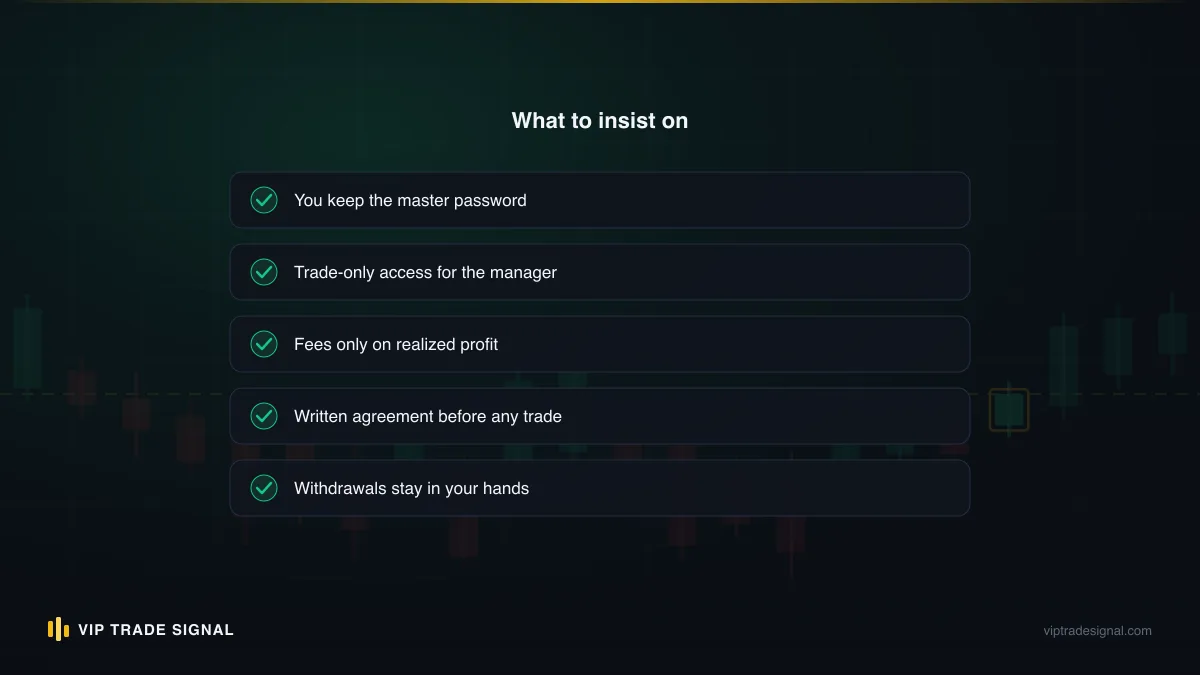
- The management agreement, signed, with the fee terms visible. This is your evidence of what the relationship was, that the account was yours, and what the fees were for.
- Monthly or quarterly broker statements, downloaded as PDFs, not bookmarked. These show deposits, withdrawals, closed trades and fees at source.
- The full closed-trade history exported at least annually. MT4/MT5 will export account history to a file in a couple of clicks, and that export is the ground truth your tax figures reconcile to.
- Fee invoices or receipts for every performance fee paid, with dates and amounts. Deductible or not, you want them.
- Deposit and withdrawal confirmations, matched to your bank statements, so capital movements are cleanly separated from trading results.
- A one-page running log in your own words: date opened, amounts in, amounts out, fees paid, anything odd. Ten minutes a quarter. Worth its weight during any enquiry, because it shows contemporaneous care.
If a manager can't or won't support this, meaning no statements, no invoices, results reported only as screenshots in a chat app, then you have a bigger problem than tax, and we'd politely suggest reading our piece on what a verified track record actually looks like before wiring anyone another dollar. Real operations produce paper. Paper is the point.
While we're here: currency conversion. If your tax return is in pounds but the account is denominated in dollars, gains generally need translating at appropriate exchange rates, and jurisdictions differ on whether that's per-transaction or an average rate. Keep the raw data in account currency and let the accountant choose the method. Converting early, sloppily, is how people end up with figures nobody can reproduce.
Losses: the offset rules, briefly and without sugar
Losing years happen. We say this everywhere because it's true everywhere: no manager wins every year, ours included, and any pitch implying otherwise is fiction. So when people ask about tax on managed forex account profits, half the real answer is about years with no profits at all. The treatment of losses is not a footnote. It's half the story.
The broad pattern, primer level. Capital-characterized losses usually offset capital gains, in the same year first, then carry forward, sometimes indefinitely, sometimes with registration deadlines; the UK, for instance, expects losses to be claimed within a set window or they evaporate. They typically do not offset your salary. Income-characterized losses are sometimes more flexible and sometimes fenced off into their own category; several countries ring-fence derivative or speculative losses so they only ever offset similar gains. Germany's recent history with capped derivative loss offset is the cautionary tale: rules can arrive that make an active account's gross losing trades painful in ways the net result doesn't show. And spread-bet losses in the UK, as mentioned, relieve nothing at all.
The operational takeaway is to report loss years with exactly the same care as profit years. It feels pointless. Nobody enjoys documenting a drawdown. But an unregistered loss is a wasted asset: a $3,000 loss carried forward properly might shelter $3,000 of next year's gains, and at a 20% rate that's $600 you either claimed or donated. File the paperwork in the bad year and the good year gets cheaper. Skip it and you've paid twice, once to the market and once to the revenue.
There's also a defensive angle. A declared, documented losing year sitting in your filing history makes you boring to a tax authority. Gaps and silences make you interesting. In tax, you want to be boring.
Should you wrap the account in a company?
Somebody always asks, usually after their first genuinely good quarter: should I set up a company and run the managed account through that? The internet is full of confident answers, most of them written by people selling incorporation packages, so here's the sober version.
An entity can change three things. It can change the rate, because corporate rates on trading profit differ from personal rates, sometimes helpfully and sometimes not once you count the tax on getting money back out of the company and into your pocket. It can change deductibility, because a company incurring a management fee in the course of its activity generally has a much stronger claim to deduct it than a private individual does. And it can change the character question entirely, since a company's trading results are usually just profits of the company, full stop, with no capital-versus-income philosophy to argue about.
But entities cost money to run. Accounts, filings, possibly audit, registered office, the annual accountant's bill that now covers a company return as well as your personal one. On a $5,000 managed account, that overhead will eat any conceivable tax saving and then start eating the capital. As a very rough rule of thumb, and it is rough, entity structures start being worth a serious look somewhere in the tens of thousands of account size, in high-tax residence countries, for people who already have other business income and an accountant on retainer. Below that, they're mostly a way to feel professional while paying for the privilege.
Two extra warnings. Moving an existing personal account into a company is itself a transaction with possible tax consequences, so don't do it mid-year on a whim. And an offshore company owned by an onshore you rarely achieves anything except paperwork; most countries have controlled-foreign-company and management-and-control rules that pull the profits straight back into your net anyway. If the structure is being sold to you as a tax disappearing act, it isn't one. It's a future enquiry with your name on it.
Working with an accountant: how to make the hour count
You don't need a Big Four partner. You need a competent local accountant, ideally one who has seen trading clients before, and you need to arrive prepared, because a prepared client turns a three-hour engagement into a one-hour one and gets better answers besides.
Bring the file from the records section above, plus the year's closed-trade export, and then ask these questions verbatim if it helps:
- How is this activity characterized for me: capital or income, and why?
- Is the manager's performance fee deductible against those profits in any form?
- What foreign-account disclosures does this broker relationship trigger, and by when?
- How should I handle currency conversion on the reporting?
- Do my losing trades or losing years need registering to preserve offsets?
- Is my current structure (personal account) sensible, or is there a better wrapper for what I'm doing at this size?
Two pieces of etiquette that make the relationship work. First, don't ask the accountant to bless the investment; that isn't their job, and the good ones will refuse. Their job is the reporting and the structure. Whether a 50% profit split at a gold-only desk is a good deal for you is a separate diligence exercise, one our FAQ tries to make easier by answering the awkward questions in public. Second, tell them everything, including the offshore broker, including the losing trades, including the withdrawal you made in March and forgot about. Accountants can only protect you from what they can see, and the professional privilege conversation goes much better before a problem than after one.
On cost: a straightforward personal return with trading activity is usually a modest few hundred in fees in most countries. Against the downside of a botched characterization or a missed disclosure penalty, it's the cheapest hedge in this entire business.
Where this leaves you
Let's land the plane with the short version, because articles about tax on managed forex account profits have a way of leaving readers with fog instead of a to-do list.
The profits in a managed forex account are taxed to you, on the realized results, in your country of residence, regardless of where the broker sits and regardless of whether you withdrew a cent. The characterization question, capital gains versus income, is the pivotal one and it's jurisdiction-specific, made genuinely interesting by the fact that a professional traded your account at high frequency while you did nothing. The performance fee may or may not be deductible, the modern trend for individuals is unhelpfully often "not", and you should get your answer in writing. Losses deserve the same paperwork as gains, because offsets are real money. And the records burden is yours: agreement, statements, trade history, fee invoices, transfer confirmations, all downloaded and kept, every year, boring as that is.
Here's our opinionated close. We think tax preparedness is a legitimate filter for choosing a manager in the first place. A desk that hands you clean monthly statements, proper fee invoices, and a full closed-trade export on request is a desk that runs like a business. A "manager" who goes vague when you mention your accountant is telling you something important about everything else too. We built our own operation to pass that filter, with statements, invoices, your own broker account and your own passwords, and if you want to check how the arrangement handles the paperwork side before you commit money to it, ask us directly and we'll walk you through what a client file looks like.
And the disclaimer, stated plainly rather than buried: this article is general education, written by traders, at primer level, about rules that change. It is not tax advice, it is not personalized to you, and in places we have simplified deliberately. If you have a managed account with real money in it, in any jurisdiction, a session with a qualified tax professional is not optional, it's part of the cost of doing this properly. Budget for it the way you budget for spread and swap. Then get back to worrying about the thing that actually decides your year, which is whether the trading itself is any good.