A man messages you on Instagram. Clean profile, charts everywhere, a photo of him at an airport lounge with a laptop showing MetaTrader. He manages accounts, he says. Minimum $500. He'll send you last month's statement if you want proof. You want proof, so he sends it, and it shows 34% for the month with a drawdown you could live with. All you have to do is send the deposit to his "funding wallet" and he handles the rest.
You already know how this ends. But here's the uncomfortable part: most managed forex account scams don't look like that one. That's the entry-level version, the one that catches people in their first month of googling. The versions that catch experienced people are quieter, better dressed, and often technically legal right up until the moment they aren't. Some of them will genuinely trade your money for months before taking it.
We run an account management desk, which means we spend a lot of time on the other side of this conversation, explaining to burned people why our structure is built the way it is. And after enough of those conversations you notice something useful: there is no infinite variety of fraud here. Practically every managed account scam is one of seven playbooks. Different actors, different accents, different logos. Same seven scripts. Once you can name the playbook, you can see the tell, and once you see the tell you stop being the mark. That's what this piece is for.
Why managed forex account scams outnumber the real thing
Signal scams are annoying but survivable. A bad signal seller costs you a subscription fee and whatever you lose following rubbish calls with your own hand on the button. A bad account manager costs you the account. The whole thing. That asymmetry is why this corner of retail forex attracts a nastier class of operator than any other.
Three ingredients make it perfect for fraud, and they compound.
First, custody. Account management, by definition, involves someone else's hands near your money. Every other trading service keeps a wall between the seller and your balance. This one, done wrong, removes it. Scammers are drawn to that missing wall the way water finds a crack.
Second, opacity. Trading results are genuinely hard for an outsider to verify. A screenshot proves nothing. A PDF statement proves nothing. Even a live account view can be a demo dressed up in production clothing. The average client has no reliable way to distinguish a real 20% year from a fabricated one, and the scammers know exactly how wide that gap is.
Third, the emotional state of the buyer. Nobody searches for account management from a position of calm strength. People arrive here after losing money trading themselves, or with savings they feel guilty about leaving idle, or having watched a friend claim returns that made their pension look insulting. Greed plus urgency plus a bit of shame is the exact psychological cocktail every con in history has been built on. Forex just industrialised it.
None of this means managed accounts are inherently a scam. The structure is legitimate and old; funds and professional money managers have run other people's capital for a century. What it means is that the burden of proof sits entirely, permanently, on the manager. A legitimate one accepts that burden and builds their whole service around answering it. A scammer builds their service around avoiding it. Watch which direction the structure leans and you've done half your due diligence before anyone shows you a single number.
Playbook 1: "deposit to our account", the custody theft
This is the oldest and simplest, and it still harvests more money than any of the sophisticated versions because it requires no skill at all. The manager asks you to send funds to them: their bank account, their crypto wallet, their "company brokerage pool", their payment agent. They will then, they say, trade it on your behalf and pay out your share of profits.
There is nothing to analyse here. The moment your money lands in an account you don't control, the scam is complete. Everything after that (the dashboard they show you, the WhatsApp updates, the first small "profit payment") is theatre performed on money that is already gone. Some operators keep the theatre running for a year. It changes nothing. You stopped owning that money on day one; you just hadn't been told yet.
The wrapper varies. Sometimes it's a "pooled account" with a slick pitch about institutional spreads. Sometimes it's a PAMM structure at a broker you've never heard of, where the broker and the manager are the same person wearing two hats. The crypto era gave it a fresh coat of paint: send USDT to this address, watch your balance grow on our portal. Same play. The portal is a web page displaying numbers someone typed.
The tell: any request, however politely worded, to move money out of your own custody. Not "a red flag to weigh against the positives". The end of the conversation. A real manager trades an account that sits in your name at a regulated broker you chose, funded by you, withdrawable by you. We've written before about how legitimate structures differ across jurisdictions in our piece on managed forex accounts in the UK, but the custody rule doesn't vary by country. It's universal. If you remember one sentence from this entire article, make it this one: your money never travels to the manager. Ever. For any reason. However good the story.
And the stories are good. "Our institutional account gets better spreads." "Pooling lets small clients access our strategy." "It's just for the first month while we verify you." Each has a reasonable ring to it. Each is a hand reaching for your wallet.
Playbook 2: the fake broker with rigged numbers
One step up in effort. Here the scammer doesn't ask you to send money to them personally; that would be crude. Instead they direct you to open an account at a specific broker. The broker has a website, a live-chat widget, a deposit page that takes cards and crypto. What it doesn't have is any connection to a real market.
The "broker" is the scammer, or the scammer's partner, or a white-label platform rented for a few hundred dollars a month from outfits that exist specifically to serve this trade. Your deposit goes into their pocket. The platform then shows you whatever numbers keep you happiest: steady wins, a growing balance, the occasional plausible loss for realism. The trading history is generated, not executed. Nobody bought or sold anything, anywhere, at any point.
This playbook is effective because it borrows the shape of the correct answer. You kept custody, sort of. The account is in your name, sort of. You can log in and see your money, sort of. Every box a cautious person checks appears ticked. It's just that the boxes themselves are counterfeit.
The rigged platform also enables the con's cruellest phase. When you eventually try to withdraw, the balance you see is a number on their screen, backed by nothing. So you get the runaround: verification fees, tax pre-payments, "liquidity windows". More on that in playbook seven, because the exit is where this one always lands.
The tell: the manager cares which broker you use, and the broker they insist on is one you cannot independently verify. Legitimate managers work at major, regulated brokers with long public histories, and mostly they don't care much which one, because the strategy doesn't depend on the venue. Our own desk trades client accounts at whatever regulated MT4/MT5 broker the client already uses. A manager who says "it only works at FinexProGlobal500" is telling you the trade lives inside FinexProGlobal500's software rather than in any market. Check the regulator's public register yourself (FCA, ASIC and CySEC all have searchable databases) and check that the entity on the register is the same legal entity on the website, because cloned names are their own cottage industry. Ten minutes of boring reading defeats this entire playbook.
Playbook 3: doctored screenshots and rented Lamborghinis
Now we get to the marketing layer, the playbook that feeds all the others. Before any scammer can steal your deposit they have to convince you they can trade, and since most of them can't, they manufacture the evidence.
The inventory is familiar if you've spent a week on trading Twitter or Telegram. Screenshots of MT4 trade histories showing improbable win rates, trivially forged with an investor-password demo, a photo editor, or one of the several apps built for exactly this purpose. Myfxbook links where the track record is real but the account is a $100 punt run at lunatic leverage until one lucky month, then screenshotted forever. "Verified" results on the scammer's own website, verified by nobody. Lifestyle proof: the watch, the car, the business-class seat. Some of the cars are genuinely rented by the hour. There are companies in Dubai whose customer base is significantly composed of men who need a Lamborghini for forty-five minutes of content.
Here's the part worth sitting with: fabricated results are not a distinct scam so much as the front door to every scam. Nobody deposits into playbooks one, two, four or seven without first walking through playbook three. Which means learning to audit a track record is the highest-leverage skill in this whole area.
A track record you should take seriously has, at minimum: third-party verification you can click through to yourself (not a screenshot of a verification), a duration of a year or more, visible losses, visible drawdown, and position sizes consistent with a survivable strategy. A record with a 96% win rate is not impressive, it's diagnostic — that shape almost always means martingale or grid sizing, which wins small forever and then loses everything once. And any performance claim that arrives without losses attached is an advert, not a record. Real trading has losing weeks. We publish every closed signal at our signals history page, reds included, precisely because a results page with no red on it is the surest sign someone is lying to you.
The tell: perfection. Real records limp. Fake ones glide.
A results page with no losses on it isn't a track record. It's a confession.
Playbook 4: the ponzi split, paying old clients with new deposits
This is the one that fools intelligent people, because for a long stretch it produces something none of the cruder scams can: real, withdrawable money.
The structure is a century old. The operator collects deposits, does little or no actual trading, and pays "profits" to earlier clients out of later clients' capital. The returns are usually calibrated to be enticing but not absurd: 5% to 10% a month is the classic band, high enough to excite, low enough that a client can tell themselves it's plausible. Payouts arrive on schedule. Withdrawals, in the early and middle phases, actually work. Clients become recruiters, because nothing markets a con like a genuine bank transfer landing in a genuine account, and word-of-mouth from paid-out early clients is the engine that scales the thing.
The mathematics is a countdown. The scheme needs deposit inflow to exceed payout outflow, forever, and forever never comes. Growth slows, or a market shock triggers a rush of withdrawal requests, and the pyramid inverts in weeks. The operator's endgame options are: vanish, or announce a "hacking incident", or blame a broker collapse, or occasionally get arrested. Clients who joined early and withdrew more than they deposited sometimes even face clawback claims from liquidators. Everyone else eats the loss.
How do you detect a ponzi from the outside when the payouts are demonstrably real? Structure, not results. Watch for these:
- Smooth, fixed, or "guaranteed" returns. Real trading is lumpy. Gold, our own market, can hand you a flat fortnight and then move 3% in a session. A manager crediting 8% every single month like clockwork is running a spreadsheet, not a strategy.
- Returns paid on the pool, not on your account's trades. If your statement shows a percentage credited rather than individual positions opened and closed on your own account, you're looking at accounting, not trading.
- Referral commissions for bringing in depositors. Multi-level recruitment bolted onto an "investment" is the classic ponzi drivetrain. Real managers don't need you to recruit your family.
- Pressure to compound. Withdrawal friction dressed as opportunity: "roll it for a bigger tier". Every pound you don't withdraw is a pound the scheme doesn't have to find.
The tell: returns too smooth to be markets, paid from a pool you can't see into. And notice that the custody rule kills this playbook too. A ponzi is structurally impossible when funds sit in individual client accounts at real brokers, because there is no pool to pay old clients from. The trades on your account either happened or they didn't.
Playbook 5: master password theft and the drained account
This playbook is the dark mirror of good practice, and it's the one that catches people who half-learned the custody rule. They know not to send money to a stranger. So they open their own account at their own regulated broker, fund it themselves, and feel safe. Then the "manager" asks for the login and the client hands over the master password, the one that controls everything.
Understand the two-password system, because the entire defence lives inside it. MT4 and MT5 accounts have a master password, which can trade, change settings, and at most brokers request or redirect withdrawals, and an investor password, which is read-only. Brokers also separate platform credentials from the client-portal login where the actual money moves. A manager needs precisely one thing to trade for you: trade-level access to the platform. They never, under any honest arrangement, need portal access, withdrawal rights, or your master credentials.
Give away the master password and the failure paths multiply. The blunt version: the scammer changes your withdrawal details in the portal (if you were careless enough to share that too) and empties the account. The slower version: they trade it recklessly because it isn't their money and blown clients are replaceable. The spiteful version we've heard more than once: a client tries to fire a bad manager, and the manager, still holding the master password, revenge-trades the balance to zero in an afternoon before access can be revoked.
There's a subtler variant worth flagging: the "manager" who asks you to install remote-access software (AnyDesk, TeamViewer) "to help you set up the platform". That's credential theft with a customer-service smile. Once they've watched you log into your broker portal, they don't need to ask for anything.
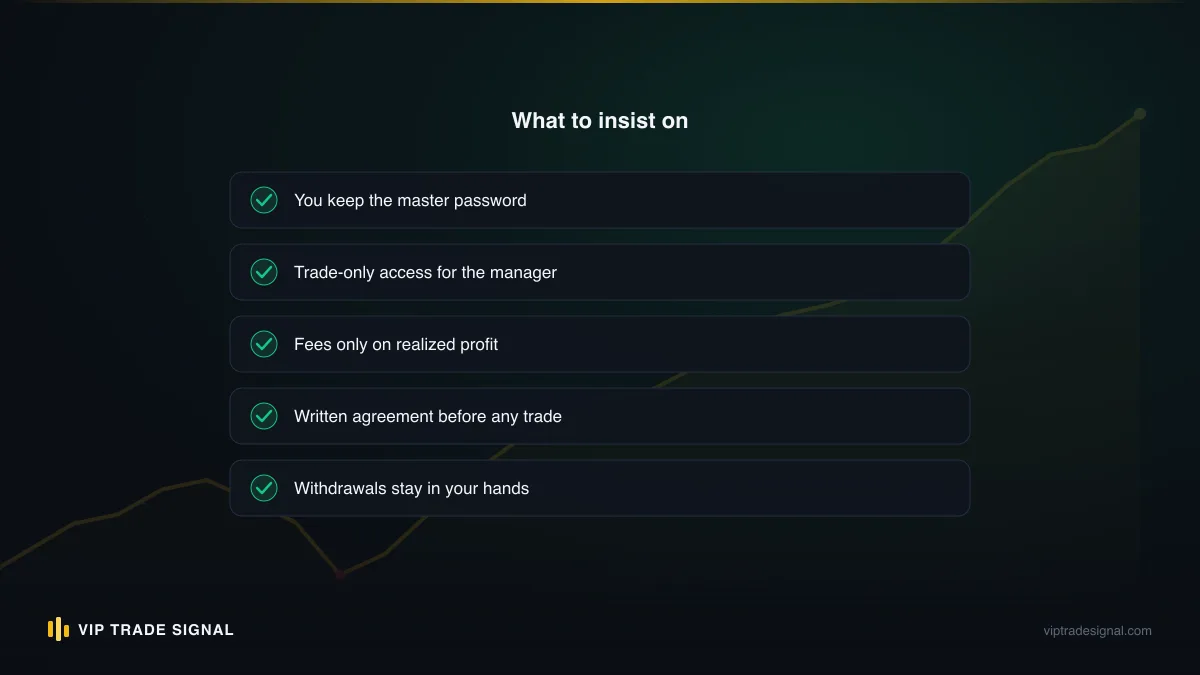
The tell: any request for more access than trading requires. Master password, portal login, email access, remote desktop, 2FA codes. On our desk the account management rule is fixed and non-negotiable in the other direction: you keep the master password and the withdrawal rights, we get trading access only, and you can lock us out in two minutes by changing one password. Any manager who resists that structure is telling you which playbook they're running. Change your master password the day any management relationship starts and the day it ends. Both days. No exceptions.
Playbook 6: fee harvesting on churned trades
Now for the respectable-looking one. Playbook six is often run by real companies, with real offices, sometimes even with regulatory permissions. Nothing about it is illegal on its face. It will still hollow out your account as surely as theft, just slower and with better paperwork.
The mechanism is the incentive structure. The manager earns per trade (a share of spread, a rebate from the broker for volume, a fixed commission per lot) rather than from your profit. The moment that's true, your account stops being capital to grow and becomes a resource to burn. The manager's income rises with trade count, not trade quality. So they churn: dozens of positions a week, in and out, scalps that never needed to exist, each one shaving spread and commission off your balance and depositing a rebate into theirs. Your equity bleeds 1-2% a month in costs while the trading itself roughly breaks even, and the statement looks busy. Busy enough that an untrained eye reads activity as effort.
Run the arithmetic once and it stops being abstract. Say you've got $10,000 under management and the manager trades one standard lot of EUR/USD per day at a round-trip cost of roughly $12 in spread and commission, half of which flows back to them as rebate. Twenty trading days is $240 a month in costs off your account, $120 of it into their pocket, before a single pip of edge is demonstrated. Scale the lot size or the frequency (and they will, since that's the whole point) and the harvest outpaces any realistic strategy's returns. The account doesn't crash. It erodes. Most clients take six months to notice, because there's no single loss to point at.
The related version is the introducing-broker conflict: the "manager" is paid by a specific broker for every lot their clients trade, which is why (echoing playbook two) they insist you open an account at that particular broker. Not because the platform is rigged this time. Because the meter is running.
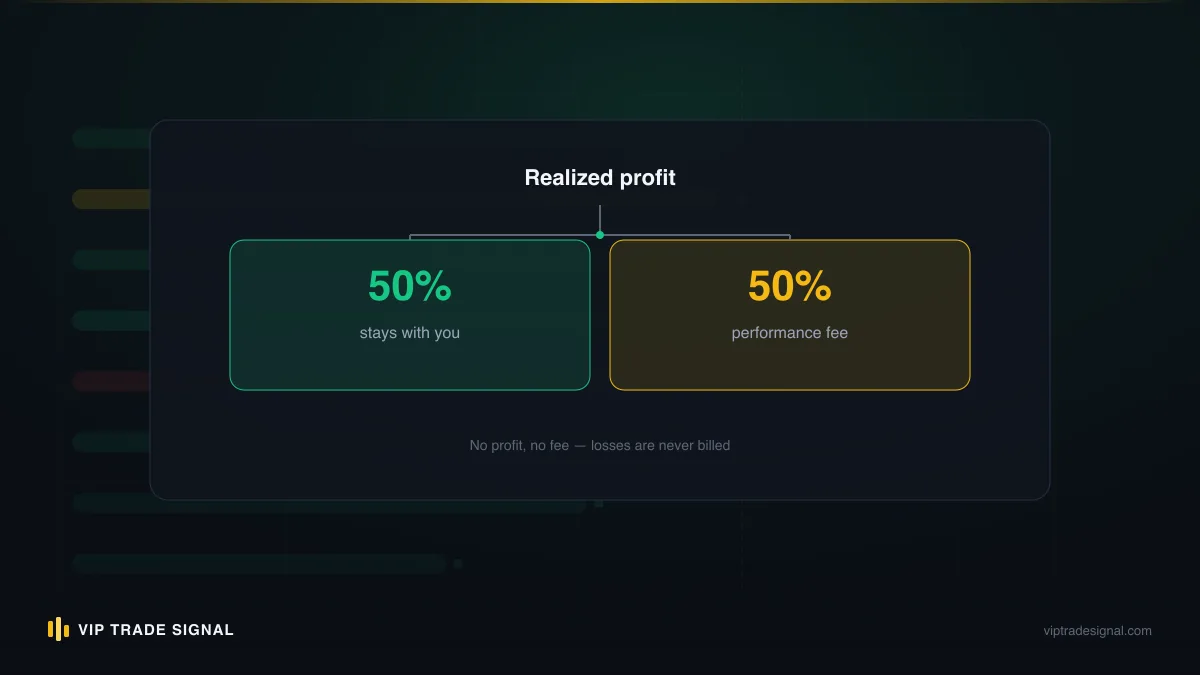
The tell: compensation that doesn't require you to make money. Ask one question and insist on a written answer: exactly how, and from whom, do you get paid? If any part of the answer involves per-trade income, volume rebates, or broker kickbacks, the incentives point at your balance like a straw points at a milkshake. Profit-share models cost more when things go well. Our own desk charges a flat 50% of realized profit, which is the expensive end of the industry, and we say so plainly on our about page. But a manager paid only from realized profit makes nothing by churning you. The fee that stings is usually the one that's aligned.
Playbook 7: the exit rug, profits on screen and withdrawals in limbo
The last playbook isn't really a separate scheme. It's the final act of most of the others, and it deserves its own entry because recognising it early, during the first withdrawal delay rather than the fifth, is worth real money.
The setup: your dashboard shows profit. Maybe fabricated (playbooks two and three), maybe pooled fiction (playbook four), occasionally even real. You request a withdrawal. And now the machinery changes gear, because this is the moment the operation was always going to fail, and everything that follows is choreography to extract more money on the way down or buy time for the exit.
The stalls come in a recognisable sequence. First, process: "withdrawals take 10-14 business days", then a compliance review, then a re-verification of documents you already verified. Next, and this is the signature move, fees payable before release: a "withdrawal tax", an "anti-money-laundering clearance charge", a "profit release fee" of 10% payable, always, as a fresh deposit, never deductible from the balance they're supposedly holding for you. Think about that construction for a second. If they actually held your $12,000, they could deduct any fee imaginable from it. The demand for new money is a plain admission that the old money no longer exists. People pay anyway, sometimes twice, because the screen still shows the balance and walking away from a number that big feels impossible.
Then the endgame: your account is "flagged for suspicious activity". Support goes quiet. The Telegram contact blocks you. In the full-service version, the website simply stops resolving one Tuesday, and reappears eight weeks later under a new name with the same page templates, harvesting the next cohort.
The tell: any fee that must be paid in before profits can be paid out. There is no legitimate version of this anywhere in retail brokerage. None. Real brokers deduct their charges from your balance and remit the rest; that's what holding your money means. The pre-test worth doing on every arrangement, ours included: withdraw something small in the first month. $100, whatever. Not because you need it, but because a withdrawal is the only claim a dashboard can't fake. If pulling out $100 triggers friction, a phone call from a "senior account manager", or a pitch to reconsider, then you've learned everything, cheaply, while leaving is still an option.
The one structural defence that beats all seven
Seven playbooks sounds like seven things to defend against. It isn't. Line them up and look at what every single one requires to function: a gap between you and your own money that the manager controls.
Custody theft needs your money in their account. The fake broker needs your money on their platform. Doctored results only pay off when they lead your money somewhere fake. The ponzi needs a pool. Password theft needs your credentials. Fee harvesting needs opaque, unaccountable access to your order flow. The exit rug needs your withdrawals to pass through their hands. One gap, seven costumes.
So the defence is one structure, not seven checklists. We call it own-broker custody, and it has four planks:
- Your account, your name, your chosen regulated broker. You open it, directly, at a broker with a verifiable licence you checked on the regulator's own register. The manager gets no say beyond "must support MT4/MT5".
- You fund it and only you can withdraw. Deposits go from your bank to your broker. Withdrawal rights and portal access are never shared, and payouts go only to accounts in your name.
- The manager gets trading access only. They can open and close positions. They cannot touch the money. You hold the master password, and changing it fires them instantly, unilaterally, at any hour.
- You can watch everything, live. Every position, every fee, every swap, visible in your own platform in real time. Not on the manager's dashboard; on your broker's record.
Walk it back through the playbooks. Deposit-to-me can't start, because nothing is deposited to anyone but your broker. The fake platform can't exist, because you picked the venue and verified it. Fake screenshots lose their sting, because the only record that matters is the live one on your own account. The ponzi is structurally impossible with no pool. Master-password theft fails because the password was never shared. Churning is still attemptable (this is the one playbook custody alone doesn't fully kill), but it's naked and visible in your own trade history within a week, and fixable by pairing custody with profit-only compensation. And the exit rug has nothing to grip, because your profits were never in the manager's hands to withhold.
This is not a proprietary insight, and we'd rather you hold every manager to it than take our word for anything. It's simply how our desk is built: your MT4/MT5 account at your broker, we take trading access only, 50% of realized profit with a $200 minimum advance, and you keep the master password and the withdrawal rights from the first day to the last. Not because we're saints. Because a structure where we can't run any of the seven playbooks is worth more to a sceptical client than any promise that we won't. Trust that depends on character is hope. Trust that depends on structure is engineering.
One honest caveat, since this article is about honesty. Own-broker custody protects you from theft. It does not protect you from losses. A legitimate manager trading your real account at your real broker can still have a losing quarter, and in a leveraged market like gold or forex, will sooner or later. Anyone who tells you otherwise has simply moved the lie from the custody column to the performance column. If you're weighing whether management suits you at all versus running your own trades, we've laid that comparison out properly in managed accounts versus self-trading, and the honest answer is that neither path deletes risk, they just relocate it.
The ten-minute pre-deposit check
Before any money moves, run this. Every item is free and none requires expertise:
| Check | Pass looks like | Fail looks like |
|---|---|---|
| Where does my money sit? | My account, my name, my broker | Their account, a pool, "our platform" |
| Is the broker real? | Found on FCA/ASIC/CySEC register, entity name matches | Unknown brand, "regulated" in a mailbox jurisdiction, name mismatch |
| What access do they want? | Trading access only | Master password, portal login, remote desktop |
| How are they paid? | Share of realized profit only | Per-lot, rebates, volume, "spread share" |
| Can I see live results? | Third-party verified, losses visible, 12+ months | Screenshots, perfect months, "trust me" |
| Can I leave right now? | Change one password, done | Lock-ins, exit fees, notice periods |
| Test withdrawal works? | Small withdrawal lands in days, no fuss | Delays, release fees, retention calls |
Any single fail is a walk-away. Not a negotiation point. Scam structures are load-bearing; the operator can't concede the broken plank because the broken plank is where the money comes from. Which, usefully, means your refusal to bend costs you nothing with legitimate managers and everything with the other kind.
Already inside one? Do this today
If you've read this far with a sinking feeling because three of the tells match something you're currently in, move quickly and in this order. Speed matters far more than certainty; every one of these schemes rewards early movers and punishes the patient.
First, stop the bleeding silently. Do not confront the manager, post in the group chat, or announce your suspicions. The moment an operator knows you've woken up, you move to the top of the exit-rug queue. If it's your own broker account, change the master password and the portal password right now, today, and revoke any PAMM/MAM allocation from the broker's side. If remote-access software was ever installed at their suggestion, uninstall it and change every password you entered while it was on the machine.
Second, attempt a full withdrawal immediately. Not a partial one to "test the waters". At this stage you want your capital out, and a pending withdrawal request also creates a dated paper trail. If it's paid, excellent, you were maybe early or maybe wrong, and either way you can re-assess from a position of safety. If it stalls, you've confirmed the diagnosis and, crucially, do not pay any fee, tax, or clearance charge demanded to release it. Not one. Every payment after the first stall is money thrown into a hole, and "recovery" pressure is precisely how these operations double their take from each victim.
Third, document everything while it still exists. Screenshots of the dashboard, the full chat history exported, every transaction reference, wallet address, account number, and the names and handles involved. Scam infrastructure evaporates fast (pages get deleted, groups get purged) and your evidence is worth most in the first week.
Fourth, report through real channels. Your bank or card issuer first, since chargeback and recall windows are short and banks recover more scam money than anyone else. Then the broker (if a real one is involved), the relevant regulator, and the police fraud route for your country: Action Fraud in the UK, IC3 in the US, ReportCyber in Australia. Recovery rates are honestly poor, particularly with crypto rails, and you should hear that plainly rather than from a stranger promising otherwise. Which brings us to the last point.
Fifth, beware the second wave. Fraud victims get listed, and those lists get sold. Within weeks you may be contacted by "fund recovery agents", "blockchain forensics teams", or even fake regulators offering to retrieve your money for an upfront fee. This is playbook one wearing a hi-vis jacket. Nobody legitimate recovers scam losses for advance payment. The people who contact you about recovery are, with dismal reliability, the same ecosystem that took the money in the first place.
And separately, quietly, be kind to yourself about it. These operations are professionally engineered by people who do nothing else all day, and they catch accountants, engineers, and, more often than anyone admits, experienced traders. The shame that stops people reporting is itself part of the scam's design.
Where this leaves you
So, is a forex managed account investment a scam? The category isn't, but the burden never leaves the manager, and the honest base rate is grim: if you took a random sample of every "account manager" who slides into DMs or runs ads this month, the majority would map onto one of the seven playbooks above. That's not cynicism, it's just what an unregulated, high-custody, low-verification corner of finance produces when demand is desperate and supply is anonymous. US readers face an extra layer of jurisdictional mess on top, which we've covered separately in our guide to managed forex accounts for US clients.
But pattern recognition changes the odds completely, because scams are cheap theatre and theatre can't survive structural questions. You now know the seven scripts: custody theft, the rigged platform, manufactured results, the ponzi pool, the password grab, the churn skim, the exit rug. You know the tell for each. And you know the single defence that beats them all at once — money in your own account, at your own verified broker, with trading access only, paid from profit only, tested with an early withdrawal.
Hold every manager to that standard with no exceptions and no negotiation. Including us. Especially us, frankly: we're the ones asking for trading access to your account, so we should be the easiest to audit, and if anything in our structure ever fails the checklist above, walk. Our terms are public, our closed signals sit at /signals/history with the losses showing, and the common questions about how the management arrangement actually works are answered plainly on our FAQ. High-risk market, real losses possible, no guarantees. That's the truthful pitch, and it's the only kind worth hearing.
The seven playbooks all end the same way for the operator: they need you to stop asking structural questions and start trusting the story. Don't. The moment someone needs your trust more than your scrutiny, you already have your answer.