There is a warehouse somewhere — several, probably — where a room full of people run thousands of Telegram accounts from racks of cheap phones. Their job is to make you believe a trading channel is real. They post the "just withdrew $4,300, thank you admin" messages. They react with fire emojis to every signal. They fill the member count. And when you finally DM the admin, the person who answers is reading from a script that has been refined across tens of thousands of victims before you.
That's the thing people get wrong about telegram forex scams. They imagine a lone chancer with a stolen chart screenshot. What's actually on the other end is an industry — organised, staffed, A/B tested, and better at its job than most legitimate marketing departments. The lone chancer exists too, but he's copying the industry's homework.
We run a signal service ourselves, which means we spend a lot of time inside this ecosystem watching it operate. We've been impersonated. We've had clone channels lift our branding wholesale. We've sat in fake groups taking notes on the scripts. This article is those notes, organised. By the end you should be able to look at any trading channel and know, within a few minutes, which category it belongs to. Not because you memorised a list of scammer names — those lists are nearly useless, and we'll explain why — but because you'll recognise the machinery itself.
Why Telegram is the scammer's platform of choice
Scammers didn't end up on Telegram by accident. The platform is almost purpose-built for what they do, and it's worth understanding exactly which features do the heavy lifting, because each one maps to a defence.
Start with identity. A Telegram account needs a phone number, and a phone number costs pennies from a virtual SIM provider. There's no real-name policy, no verification of who runs a channel, and — crucially — a username can be changed in seconds. The channel that scammed forty people last week as @GoldKingSignals is this week's @XAUEmpireVIP, same admin, same subscriber base of bots, clean slate. Compare that with a website, where a domain has an age, a registration history, and a paper trail. Telegram channels have none of that visible.
Then there's the broadcast structure. A Telegram channel is one-way by default: the admin posts, you watch. Comments can be disabled entirely, or funnelled into a linked group where moderators delete anything inconvenient in seconds. We've watched someone post "this admin took my $500 and blocked me" in a scam group and counted the seconds until it vanished. Eight. The poster was banned before most members' apps had even rendered the message.
Add disappearing messages, no public post history requirements, forwarding that strips context, and — the big one — no meaningful moderation of financial content. Telegram will act on child abuse material and terrorism. A channel that's stolen half a million dollars from retail traders across three continents? It'll sit there for years, and if it's ever removed, the operator opens a new one in the time it takes to boil a kettle.
None of this means every Telegram trading channel is a scam. We publish on Telegram ourselves; so do plenty of honest providers, because that's where the audience is. It means the platform gives you no protection whatsoever, so the burden of verification is entirely on you. Telegram is a street market, not a regulated exchange. Some stalls are legitimate. The market itself vouches for nobody.
The cloned-channel scam: impersonating real providers
Of everything in this article, cloning is the scam most likely to catch a careful person, because it borrows real credibility instead of manufacturing fake credibility. Here's how it works, from the inside — because it has happened to us.
A scammer finds a signal provider with a decent reputation. They copy the profile photo. They copy the channel description, word for word. They forward or screenshot months of the real channel's posts so the clone has a plausible-looking history. Then they pick a username that is one keystroke away from the real one: an extra letter, an underscore, a capital I standing in for a lowercase l, "official" bolted on the end. @RealProvider becomes @ReaIProvider or @RealProvider_Official or @RealProviderVIP.
Then they go hunting. And here's the part that catches people: the clone comes to you. Anyone who comments in the real provider's group, or in any large trading group, gets a DM from "the admin" — the cloned account, wearing the real provider's face. The message is friendly and slightly flattering. You've been selected for the VIP tier. There's a discount ending tonight. Payment is in USDT, wallet address attached.
The victim thinks they're upgrading with a provider they already half-trust. The real provider finds out when angry people start posting about the money they sent. We know because we field those messages. Someone paid a clone of us, in crypto, an amount larger than our actual monthly price, for a "lifetime deal" we've never offered. There's no way to claw that back. Crypto sent is crypto gone.
The defences here are mechanical, not intuitive, so make them habits:
- Admins do not DM first. Write that on your monitor. Virtually every legitimate provider states this somewhere, and it's true of us: we will never open a DM with you. If "the admin" messages you first, it is a clone. Not probably. Is.
- Check the exact username, character by character. Not the display name — that's freely editable and clones match it perfectly. The @username. Compare it against the one published on the provider's actual website, reached by typing the URL yourself, not by tapping a link in the chat.
- Distrust urgency about payment method. Clones push crypto and gift cards because those are irreversible and anonymous. A provider with a website, a card processor, and a published price has no reason to demand USDT to a bare wallet address with a two-hour deadline.
Our own channel links live on our site, and if you're ever unsure whether an account claiming to be us is us, ask through the contact page before sending anyone anything. That one-minute check has saved people real money. Skipping it has cost people real money. It's that binary.
Bought members and fake engagement: reading the tells
Open a scam channel and the first number you see is doing most of the persuasion: 48,000 members. Your brain does the maths without asking permission — surely 48,000 people can't all be wrong.
They can, because they aren't people. Telegram members are a commodity with a published price. Depending on quality, a thousand subscribers cost somewhere between a few dollars and a few tens of dollars. Bot accounts are cheapest. "Real-looking" aged accounts with profile photos cost more. Members siphoned from dead channels cost somewhere in between. A scammer setting up shop buys 30,000 members the way a restaurant buys chairs — it's furniture, there to make the room look occupied.
So ignore the headline number entirely and look at the ratios, which are much harder to fake convincingly:
| What to check | Healthy channel | Bought audience |
|---|---|---|
| Views per post vs member count | Roughly 20–60% of members view recent posts | Views under 5% of members, or absurdly uniform |
| View pattern across posts | Varies post to post, decays on older posts | Nearly identical count on every post |
| Reactions and shares | Proportional, messy, varied emoji | Zero, or a burst of identical reactions in one minute |
| Member growth | Gradual, tied to content | Vertical jumps of thousands overnight |
| Post history depth | Months or years, mixed content, visible losses | Weeks old, wall-to-wall wins, no history before the pitch |
The views-to-members ratio is the single best tell. Telegram shows a view counter on every channel post. A genuine channel with 48,000 members will show recent posts with somewhere in the thousands to tens of thousands of views, and the number will wobble around — some posts land, some don't. A bought audience shows 48,000 members and 900 views, because bots don't read. Or, if the scammer also bought views, every post shows an eerily similar figure, because the view package delivers a fixed quantity per post. Real audiences are noisy. Fake ones are flat.
Growth pattern is the second tell, though you need a third-party analytics tool such as TGStat to see it properly. Organic channels grow in a ragged upward line. Bought members arrive as a cliff face: 2,000 on Tuesday at 3 a.m., another 5,000 the following week. Some tools also show the drops when Telegram purges bot accounts — a channel that "lost" 8,000 members in one sweep told you exactly what those members were.
And a small human tell that we find oddly reliable: scroll deep into the history. Scam channels are almost always young, because scam channels get burned and rebuilt. A channel claiming five years of expertise whose first message is from eleven weeks ago has answered your question already.
Sock-puppet testimonials: spotting scripted chatter
Bought members make the room look full. Sock puppets make it look alive. These are the accounts — some automated, many operated by actual low-paid humans — whose entire job is to perform the role of a delighted community, and once you've learned their register you cannot unsee it.
The canonical sock-puppet message is a withdrawal celebration: a screenshot of an MT4 or MT5 account (or, lazier, a broker withdrawal email) with a caption like "thank you admin, $2,850 profit this week, this is life changing". Both the screenshot and the caption deserve scrutiny, and both fail it constantly.
The screenshots first. MetaTrader screenshots are trivially fabricated — demo accounts look identical to live ones in a screenshot, and there are web tools that generate fake trade histories to order. Look closely and the sloppiness shows: profits that don't match the lot sizes shown, timestamps in the wrong timezone for the claimed trade, the same screenshot posted by three different "members" weeks apart, account balances that would require the trader to have started with more money than the channel's target audience has ever seen. One group we watched had two different users post the identical screenshot, same ticket numbers, four days apart. Nobody in the group noticed, because the group's genuine population was perhaps a dozen people adrift in a sea of scripted noise.
Then the language, which is the easier tell. Sock-puppet chatter has a texture:
- Gratitude aimed upward, constantly. Real trading communities talk about trades — entries, stops, the market. Puppet communities talk about the admin. "Thank you admin" is practically a watermark.
- Round, urgent numbers. $500 became $4,700 in six days. Nobody's real account does clean, quotable arithmetic like that, and real traders mention losses. Puppets never lose.
- No trading content at all. Ask yourself: is anyone in this group discussing an actual price level? A stop that got hit? Spread widening at the New York open? Genuine groups are full of that. Puppet groups are wall-to-wall testimony, because testimony is the product.
- Same-day account creation. Tap the profiles. No username, no photo or a stolen one, and if you share any groups, a join date suspiciously near the message date.
- Call-and-response timing. Admin posts a result; within ninety seconds, four accounts reply with variations of the same praise; then silence until the next post. Real chat sprawls and argues. Scripts fire on cue.
A real trading group argues about the market. A fake one holds a continuous awards ceremony for the admin.
Try a simple experiment before trusting any group: post a mildly awkward question. "What was the worst drawdown last quarter?" works nicely. In a genuine community you'll get an answer, maybe a defensive one, but an answer. In a puppet theatre you'll get silence, a deletion, or a DM from the admin — which, as we're about to see, is where the actual scam begins.
The admin DM playbook, word for word
Everything above — the members, the puppets, the screenshots — exists to get you into a private message with the admin. The channel is the shop window. The DM is where the till is. And the remarkable thing about these conversations is how little they vary. We've collected them from readers, walked into them deliberately, and compared notes with other providers, and it is essentially one script with cosmetic edits. Here it is, stage by stage.
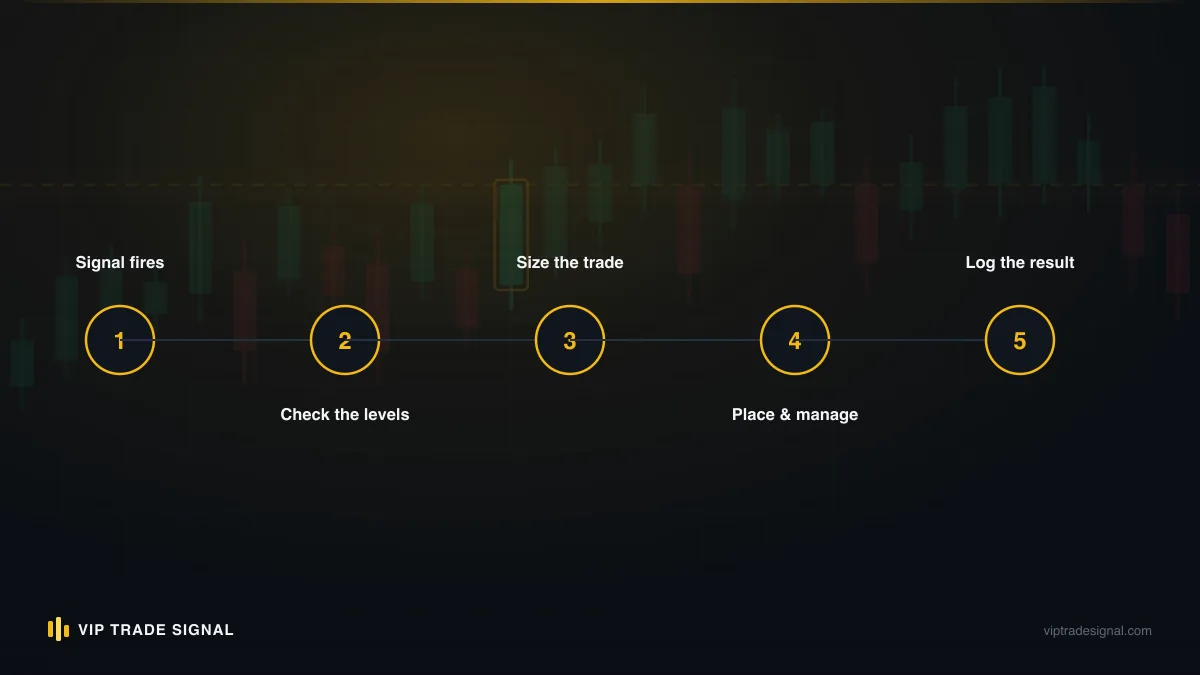
Stage one: the warm open. "Hello dear, I saw you joined our channel. How is your trading going?" Note "dear" — a verbal tic of these operations that has somehow survived a decade of ridicule. The opener's job is a reply, any reply. You're asked friendly questions: how long trading, which broker, what account size. That last one is not small talk. It's the qualification question, and your answer sets your price.
Stage two: the diagnosis. Whatever you say about your trading, the response is sympathetic agreement that you're doing worse than you should be, followed by the reveal: the free channel is only a taste. The real money is in VIP. "Our VIP members made 340% last month." The figure is always precise enough to sound accounted-for and always preposterous on a moment's arithmetic — compounding 340% monthly would turn $500 into roughly $2.4 million inside a year, at which point why is this person messaging strangers on Telegram.
Stage three: the anchor and the discount. VIP is normally $500. But — luck of luck — a promotion ends tonight: $150. The deadline is doing the work here. Every hour you wait to think, ask someone, or search the channel's name is an hour the script cannot afford.
Stage four: the payment funnel. USDT, TRC-20 usually, to a raw wallet address. Sometimes a gift card. Never a card payment, never PayPal goods-and-services, never anything reversible. If you hesitate, an "accounts manager" appears — a second puppet with a professional-sounding title — to reassure you and reissue the wallet address.
Stage five: the double-dip. This is the stage people don't see coming. Paying does not end the scam; it promotes you to a better mailing list, because you've proven you pay. Now come the upsells: the VIP-of-VIP tier, the "insurance fee" to release your profits, the account-doubling programme we'll cover in a moment. The requests keep escalating until you stop paying, and when you stop, you're blocked, and your money is a line item in the warehouse's spreadsheet.
Read the stages again and notice what's absent: trading. At no point does the script discuss a strategy, a risk model, or a losing week. It cannot, because there is no trading behind it. The product is the conversation itself.
There's an ugly extension worth flagging: the recovery scam. Weeks after being burned, victims get a DM from a "fund recovery agent" or "Telegram claims department" offering to retrieve the lost money — for an upfront fee. It's frequently the same operation, harvesting the same victim twice using the list they built the first time. Nobody legitimate proactively DMs you about recovering crypto. That money, hard as it is to hear, is gone, and anyone who claims otherwise for a fee upfront is round two.
Fake giveaways and account doubling offers
Alongside the signal-selling script runs a cruder, faster cousin: the giveaway and the doubling offer. Less patient, more brazen, and still astonishingly effective, because it targets the one lever the VIP script leaves alone — the fantasy of free money right now.
The account-doubling version goes like this. The admin announces a "management programme": send $300, receive $3,000 in seven days, admin trades it for you, profits split. Sometimes it's framed as flash-pumping, sometimes as "binary account management", sometimes the admin claims broker insider access. Occasionally — and this is the clever bit — small early payouts are real. You send $100 as a cautious test; $180 comes back three days later. Convinced, you send $2,000. That one doesn't come back. The $80 the scammer "lost" paying you out was customer acquisition cost, and it bought your life savings at a discount.
The giveaway version is even simpler: the channel announces free money or free VIP access to celebrate some milestone, winners are "selected" (everyone wins), and claiming your prize requires a small release fee, a verification deposit, or your broker login "to credit the account". Each of those three asks is a different theft. The fee is stolen directly. The deposit is stolen directly. And the broker login is the worst of the three — with your credentials, a scammer doesn't need to withdraw your funds (withdrawals usually route back to your own bank). Instead they burn the account deliberately, taking massive opposing positions against another account they control at the same broker, or trading max lot sizes until the balance is dust. Your money doesn't vanish from the system. It migrates to them through the market itself.
The underlying test for all of it is one sentence: real trading returns come from risk over time, and anyone quoting a fixed return by a fixed date is describing a payment schedule, not a market. Gold moves 1–2% on a lively day. A $2,000 account trading it sensibly, risking 1% a trade, is fighting for $20–60 wins. Anyone promising to 10x that account in a week is planning to keep it. We manage accounts for clients and we won't even estimate a monthly figure, because the honest answer is that some months lose — that's also why our management model only charges 50% of profit actually realised, with the client holding the master password. Any structure where you hand over money, or control, on the strength of a promised number is a structure designed by the person keeping the money.
Why scammer lists don't work — pattern recognition does
Search "telegram forex scammer list" and you'll find dozens: forum threads, channels dedicated to naming scammers, spreadsheets passed around trading groups. People ask us for one. And we understand the instinct — a list feels like a solved problem. Check the name, check the list, done.
Here's why we won't maintain one, and why you shouldn't lean on anyone else's.
A list matches names, and names are the one thing scammers change effortlessly. Remember the mechanics from earlier: renaming a channel takes seconds and costs nothing. The operation behind @GoldRushVIP doesn't die when @GoldRushVIP hits a scammer list — it sheds the name like a jacket. The list ends up as a museum of abandoned usernames while the operators run fresh branding against fresh victims. By the time any list is published, it's describing last month's costume.
It gets worse, because scammers weaponise the lists themselves. Some of the most active "scam exposure" channels on Telegram are run by scam operations. Think about what such a channel harvests: an audience of recently burned, angry, still-hopeful traders — the single most valuable victim demographic there is. The channel builds trust by (accurately!) exposing rival scammers, then monetises that trust with its own "verified" signal service or a recovery-agent referral. And lists double as protection rackets: several operations "list" legitimate providers, then offer delisting for a fee. We've seen honest services smeared and prolific scammers awarded glowing "verified safe" badges on the same list in the same week, priced accordingly.
A checklist of patterns, unlike a list of names, doesn't expire. Every scam in this article — the clone, the bought crowd, the puppet chorus, the DM script, the doubling offer — has to exhibit its patterns to function. A scammer can rename a channel in ten seconds; they cannot run the scam without unsolicited DMs, unverifiable results, irreversible payments, and manufactured urgency, because those four things are the scam. Pattern recognition means checking behaviour instead of identity:
- Did this account contact me first?
- Is the track record verifiable anywhere the provider doesn't control?
- Is the payment method irreversible, and is that being insisted upon?
- Is there time pressure that serves no purpose except preventing thought?
- Does anyone here ever, even once, mention a loss?
Five questions. A "wrong" answer on any two of them and you walk, regardless of what the channel is called this week, regardless of what any list says. That's the whole system, and unlike a scammer list, it works on scams that haven't been invented yet.
Verifying a channel is the real one — including ours
Suppose you've decided a provider is worth trying. Perhaps you've read our piece on what a decent Telegram signal service actually looks like and picked one. The last gap between you and the clone problem is verification: making sure the channel you're about to join, or pay, is actually operated by the provider you researched. Here is the procedure, and it takes three minutes.
Start from the website, never from Telegram. Type the provider's URL into your browser yourself. Search results and — especially — links inside Telegram messages can route you to clone infrastructure; a typed URL can't. On the site, find the official channel link. A provider serious about the clone problem publishes exactly which usernames it operates. We do: our channels are linked from the site, and our about page says who we are and what we run.
Match the @username character by character. Not the display name, not the photo, not the description — all three are copied perfectly by clones. The username. Watch specifically for the capital-I-for-lowercase-l swap, which is invisible in most fonts, and for suffixes like _official, _vip, _team. If the site says @ExampleSignals and the channel is @ExampleSignals_Official, that suffix is a scam telling you its name.
Cross-check the payment route. Pay only through the mechanism on the website. If the site says $99/month through a card processor and someone on Telegram is offering the "same" service for USDT at a discount, you are not talking to the provider. This single rule defeats nearly every clone, because redirecting payment is the entire point of cloning.
Test the no-first-DM rule. Any DM that arrives before you've initiated contact is a clone, full stop. When in doubt, contact the provider through their site and ask "is @suchandsuch actually you?" — we answer those within a day and would far rather field a hundred of them than have one reader pay an impostor.
Then verify the substance, not just the identity. The real channel being really theirs doesn't make the service good. Check whether the track record is public and includes losses — ours is at /signals/history, every closed signal, red weeks included, and we'd argue any provider unwilling to match that has answered your real question. Then run it on a demo account before risking money; we've written a full walkthrough of demo-testing a signal service and it's the cheapest due diligence in trading.
One caution on Telegram's own trust signals: the blue verification tick exists but is rare for trading channels, so its absence means nothing — and scammers exploit that by putting a tick emoji in the channel name, which fools more people than you'd hope. Member count, as established, is furniture. The only verification that counts is the loop back to a website you typed yourself.
Using Forex Peace Army and Trustpilot properly
Review sites should be where scams go to die, and searching "forex peace army trustpilot signal reviews" before paying anyone is genuinely worth doing. But both platforms are themselves gamed hard by the same industry we've been dissecting, so they're only useful if you know how to read them — the skill is separating the signal from the manufactured noise.
Trustpilot first, since it's the more heavily gamed of the two. Fake five-star reviews are bought in bulk, and they have a texture much like sock-puppet chatter: short, generic, superlative, clustered in time. Twenty five-star reviews in the same fortnight, from accounts that have each reviewed exactly one company, saying "great signals highly recommend" — that's a purchased batch, and it should count against the provider, not for it. So invert your reading order. Skip the five-star wall entirely and read the one- and two-star reviews first, because almost nobody fakes a negative review of themselves. Then read the replies to those negatives, which is where providers involuntarily tell the truth about their character. A reply that engages with the specifics — acknowledges the losing month, explains what happened — suggests an operation run by adults. A reply that calls the reviewer a liar or a competitor, on every single negative, suggests the register you've already learned to recognise.
Forex Peace Army has been reviewing this exact corner of the industry for a very long time, and its structural advantage is memory: threads on FPA go back years, and the discussion format is much harder to spam convincingly than a star rating. The habit that makes FPA useful is searching more than the current brand name. Scam operations rebrand; FPA threads about the previous brand often connect the dots — same payment wallets, same scripts, same "accounts manager" — that a Trustpilot search of the shiny new name will never surface. If a service is eight months old and its FPA presence is either empty or already smoking, both facts are informative.
Three reading rules that apply to both platforms. First, weight specific reviews over emphatic ones — "the stop on the 14th March gold short was moved after entry" is worth fifty "AMAZING SERVICE" posts, in either direction. Second, check reviewer history; single-review accounts are ammunition, not people. Third, treat the absence of any negative reviews as itself a red flag. We're reviewed on these platforms too, and not uniformly kindly — a signal service that never has a bad month will never have an honest bad review, and we'd rather you see a real complaint about a losing streak than a suspiciously perfect wall of stars. Perfection, in this industry, is the tell.
Protecting yourself: settings, habits, and skepticism
Most of this article has been about reading other people. This section is about configuring yourself — your app and your habits — so the machinery gets less surface to grip. Ten minutes of setup, then a handful of standing rules.
The settings first. Open Telegram's Privacy and Security menu and do the following, today:
- Phone number → Nobody. Your number is the thread that connects your Telegram identity to your SIM, your other accounts, and targeted follow-up scams. No stranger needs it.
- Calls → My Contacts. Scam operations escalate to voice for the same reason boiler rooms always have: a voice applies pressure text can't.
- Groups & Channels → My Contacts. This stops strangers adding you to groups without consent. Being silently added to fake trading groups is a primary acquisition channel — remove it entirely.
- Turn on two-step verification. Account takeovers feed the clone economy; a hijacked account with your face DMs your contacts with the script. A password on your account is the cheap fix.
- Review active sessions monthly and kill anything you don't recognise.
Then the habits, which matter more than the settings:
- Never act on an unsolicited DM. Ever. This one rule, followed literally, defeats the clone scam, the recovery scam, the giveaway, and most of the DM script, because they all require the first move. Delete and report; don't reply even to argue, since any reply marks your account as live and moves you up the target list.
- Impose a 48-hour rule on every payment. Every scam in this piece runs on urgency, because urgency is the solvent that dissolves the checks you'd otherwise do. No legitimate provider's offer evaporates in two days — our price is the same tomorrow, and next month. If waiting 48 hours kills the deal, the deal was the trap.
- Pay reversibly or not at all. Cards have chargebacks. USDT to a wallet address has a screenshot and a lesson. The payment method is the risk decision.
- Never share broker credentials, and guard the master password with your life. Read-only investor passwords exist for showing a track record. Even in legitimate account management the client keeps the master password — that's how we structure ours, and any arrangement demanding full control plus withdrawal rights is a heist with paperwork.
- Demo-test everything for a month minimum. Signals that can't survive a month on a demo account weren't going to survive on your money; the demo just charges less tuition.
- Assume the burden of proof sits with them. You are not obliged to prove a channel is fake. They are obliged to prove they're real, and honest providers accept that cheerfully. There's a longer treatment of the sensible questions to ask any provider in our FAQ.
And the skepticism itself, which is the part nobody can configure for you: the scams work because the fantasy works. The doubled account, the 340% month, the admin who has finally cracked it — some part of every trader wants those to be true, and the script is aimed at that part. The traders who don't get scammed aren't smarter. They've just accepted, fully, that trading profits are slow, lumpy, and interrupted by losses, which inoculates them against every pitch built on the opposite claim.
What to do mid-scam: cutting losses safely
Maybe you're reading this with a sinking feeling because you're in one right now. You've paid something, the promised profits are "processing", and there's a fee to release them. This section is for you, and the first thing to say is: it's not stupidity, it's a script that has been optimised against thousands of people, some of them professionally sceptical. What matters now is the next hour.
Stop paying. Immediately, and completely. The release fee will not release anything; it precedes another fee. This is the sunk-cost stage of the script, engineered around the feeling that you're one payment from making it all back. You aren't. Every scam's final fee is followed by another final fee until you stop, so stop now, mid-conversation, without announcing it.
Say nothing about your intentions. Don't threaten, don't demand refunds, don't tell them you've figured it out. The moment they know you're done, you're blocked and evidence starts disappearing. Silence buys you time for the next step.
Screenshot everything, tonight. The full DM thread, the channel, usernames, the wallet addresses you paid, transaction hashes, timestamps. Scammers delete and rename; your screenshots are the only durable record, and you'll need them for reports and for any chargeback attempt.
Chase the reversible payments. If any payment went by card, contact your bank about a chargeback now — timelines matter and evidence helps. Crypto is almost certainly unrecoverable, but reporting the wallet address to the exchange it belongs to (if the address is hosted) occasionally freezes funds, and costs you nothing to try.
Lock down whatever you exposed. Shared broker credentials? Change the password this minute and email your broker's support flagging unauthorised access — if trades were opened on your account, say so explicitly and ask what their process is. Shared ID documents? You've raised your identity-theft risk; monitor accounts opened in your name. Telegram two-step verification on, sessions reviewed.
And brace for round two. You're now on a list of people who pay, which is the most traded commodity in this economy. The recovery agents will come — "we can retrieve your funds, small fee upfront" — and they are the same industry, sometimes the same office. Anyone who contacts you about your loss is monetising it. The correct response to every such message, forever, is report and block.
The money that's gone irreversibly is gone, and the healthiest thing we can tell you is what a trader eventually tells themselves about any blown account: the loss is tuition, and tuition only becomes waste if you don't collect the lesson. Plenty of careful, profitable traders have a Telegram scam somewhere in their origin story. It's a lousy club with excellent membership.
Reporting on Telegram: what works and what doesn't
The honest version of this section is shorter than you'd like: reporting scammers on Telegram is worth doing, works slowly and unreliably, and should be one step in your response rather than the whole of it. Here's the realistic picture.
In-app reporting — long-press the message or open the profile, Report, choose Scam or Fraud — is the baseline. Do it, and get others to do it, because reports appear to work on volume: one report does nothing visible, while coordinated reports from many accounts sometimes get a channel restricted or the "SCAM" banner Telegram occasionally applies. Sometimes. The same channel can also sit untouched for a year with a five-figure victim count. Manage your expectations, and report anyway; it costs thirty seconds and it's cumulative.
A few things multiply your report's weight. Report the specific fraudulent messages, not just the channel, so a human reviewer sees the pitch rather than a chart. If the scam involves impersonation, the impersonated party's report carries more weight — which is why, when a clone of a real provider scams you, you should tell the real provider immediately. When someone reports a clone of us, we report it ourselves, get clients to report it, and pursue it through every channel we have; we can't always kill it quickly, but we can often kill it, and we cannot do anything about a clone nobody tells us about.
Then take the report beyond Telegram, because the platform is the least consequential place your evidence can go. Report the payment: the receiving crypto exchange for a hosted wallet, your bank for card payments. Report to your national fraud body — Action Fraud in the UK, IC3 in the US, or your local equivalent — not because they'll recover your money (they almost certainly won't) but because these operations get dismantled on aggregated reports, and your screenshots become part of a case file. And post your experience, with specifics and evidence, on Forex Peace Army and Trustpilot, where the next victim will actually search. Realistically, that review will protect more people than every in-app report combined. The platform forgets; the forums remember.
What doesn't work: public confrontation in the group (you'll be deleted and banned in seconds, and you've burned your access to evidence), vigilante "scam-baiting" (entertaining, occasionally doxxes you to an organised criminal operation), and paying anyone — anyone — who offers to get the channel taken down or your money returned.
Where this leaves you
Strip the detail away and the entire Telegram scam economy runs on four load-bearing behaviours: they contact you first, they show you results you can't verify, they take payments you can't reverse, and they never let you slow down. Every scam in this article is some costume draped over those four bones. The costumes change weekly — that's why the scammer lists fail — but the skeleton can't change, because the skeleton is the scam.
Which means your defence is four refusals. Don't transact with anyone who DMs first. Don't believe any result that isn't verifiable somewhere the seller doesn't control. Don't pay irreversibly to strangers. Don't act inside anyone else's deadline. Hold those four lines and the machinery — the warehouse phones, the bought crowds, the scripts — grinds against you and finds nothing to grip.
And ask the quiet question underneath all of it: why were you in that channel? Usually the honest answer is hope of returns that, deep down, you knew were implausible — and that hope, not any technical trick, is the vulnerability the whole industry farms. The unglamorous fix is expecting less: real signal services have losing weeks and publish them, real account management splits realised profit rather than promising it, and real trading compounds slowly when it compounds at all. Judge us by the same skeleton, by all means — our history is public at /signals/history, losses included, our channels are linked only from our site, and we will never, ever DM you first. If an account wearing our name does, you now know exactly what you're looking at. Screenshot it, report it, and tell us. You'll be doing the next reader a favour.