A trader we'll call Dan sent us a screenshot last spring. It showed a Telegram channel's "March results": 214 pips banked, 91% win rate, a tidy grid of green ticks. He wanted to know if the maths held up. It took eleven minutes to establish that four of the "winning" posts had been edited after the trades closed, that the channel's pinned Myfxbook link pointed to an account with the track record flag unverified, and that the account itself was a demo dressed up as live money. Dan had been two days from paying $250 a month for it.
That story is why this piece exists. Knowing how to verify a signal provider track record is the single most valuable skill a signal buyer can have, and almost nobody teaches it, because almost nobody selling signals benefits from you having it. The industry's marketing runs on claimed results. Verification is the acid that dissolves most of them.
So this is a forensic manual, not a think piece. We'll go through Myfxbook properly (including the flags nearly everyone skips), the tells that separate demo accounts from live ones, how to cross-examine a Telegram history, the timestamp tricks used to backdate wins, and what to do when a provider offers you an investor password. We'll also be straight about the limits of verification, including the limits of our own. By the end you'll have a workflow you can run in about an hour on any provider, before a single dollar moves.
Why claimed results are worthless without verification
Start from a blunt premise: an unverified performance claim from a signal seller carries the same evidential weight as a stranger in a casino telling you he's up for the year. It might be true. You have no way of knowing. And the incentives point hard in one direction, because the person making the claim earns money if you believe it and loses nothing if it's false.
This isn't cynicism for its own sake. It's arithmetic. Setting up a Telegram channel costs nothing. Posting "TP HIT +80 PIPS" costs nothing. Photoshopping an MT5 history screen takes a competent teenager about four minutes. Meanwhile a genuinely verified, multi-year, live-account track record takes years of disciplined trading to build and can be destroyed in one bad month. Which of these two things do you suppose is more common in your Telegram search results?
The base rates back this up. Most retail traders lose money over time, a commonplace that every regulated broker prints on its own homepage in the form of those "76% of retail CFD accounts lose money" risk warnings. Signal sellers are drawn from the same population. The proportion of channels claiming 85%+ win rates is wildly, laughably out of line with the proportion of traders who could actually produce them. Someone is making things up, and it's a lot of someones.
There's a second, subtler reason claims are worthless raw: even honest ones are usually incomplete. A provider can truthfully post every winning trade and simply go quiet on the losers. They can truthfully report a 70% win rate while omitting that the average loser is three times the average winner, which makes the strategy a slow bleed. They can truthfully show six great months that sit inside a two-year record containing a 60% drawdown. Selective truth is the industry's favourite instrument, and it doesn't even require lying.
Verification fixes this, or at least fixes as much of it as can be fixed, by moving the evidence from the seller's mouth to a system the seller doesn't fully control: a broker's servers, a third-party tracker reading those servers, a public history with timestamps that predate the outcomes. That's the whole game. Everything below is just technique.
The verification hierarchy: from screenshots to audited accounts
Not all evidence is equal, and it helps to hold a ranking in your head before you start poking at any specific provider. Here's ours, from worthless to gold-plated.
| Tier | Evidence | What it actually proves |
|---|---|---|
| 0 | Screenshots, "results" posts, testimonials | Nothing. Trivially fabricated. |
| 1 | Unverified tracker link (Myfxbook/FX Blue with grey flags) | The account exists. Data may be partial or demo. |
| 2 | Verified tracker, short history (under 6 months) | Real connected account, but sample too small to judge. |
| 3 | Verified live tracker, 12+ months, all trades visible | Strong. This is the practical benchmark for retail. |
| 4 | Read-only investor password access | You see the raw broker record yourself. Excellent. |
| 5 | Regulated fund with audited financials | Effectively never available at retail signal prices. |
Two things about this table. First, notice how much of the industry's marketing lives at tier 0. Every "results channel", every monthly pips recap, every photo of a phone showing MT4 profits next to a rented Lamborghini: tier 0, all of it, evidential value nil. If a provider's entire public case is tier 0 material, you already have your answer and can save the hour.
Second, notice the jump between tiers 2 and 3. Length of record matters as much as verification status, because short records are where survivorship tricks live. A seller can open ten accounts, run aggressive strategies on all of them, and publish the one that got lucky. Three months of verified brilliance is compatible with that stunt. Eighteen months, with a couple of visible losing months and a drawdown that got recovered honestly, is much harder to fake, not because it can't be manufactured, but because manufacturing it costs more time than most fraudsters will spend when easier victims are available.
Your job as a buyer is simply to refuse to transact below tier 3, or tier 4 if you can get it, and to treat everything below that line as advertising. Not evidence. Advertising.
Myfxbook done right: the flags that must be green
Myfxbook is the industry's default tracker, and used properly it's genuinely useful. The problem is that "used properly" involves checking things most buyers never click on, and sellers know it.
When you open a Myfxbook account page, look at the top of the stats block for two separate verification indicators. They are not the same thing and the difference is the whole ballgame.
Track record verified. This means Myfxbook has connected to the trading account (via investor password or the broker's API) and is reading the trade history directly from the broker's server, rather than accepting whatever the account owner uploads. If this flag is not green, the history you're looking at may be partial, curated or invented. An unverified track record on a page that's being used to sell signals is disqualifying on its own. Not a yellow flag. A red one.
Trading privileges verified. This confirms Myfxbook has been given proof that the account owner can actually trade the account, which mostly matters for distinguishing the strategy's author from someone republishing a stranger's results. Less critical than the first flag, but a serious seller has both green, and an unexplained grey here deserves a direct question.
Then look past the flags at the settings a manipulator would want you to miss:
- Open trades visibility. If open trades are hidden, the equity curve can look serene while the account floats a monstrous unrealised loss. Grid and martingale systems love this setting, because their "balance" curve climbs in a straight line right up until the day it doesn't. Hidden open trades plus a suspiciously smooth curve is the classic martingale signature.
- History visibility. Some accounts hide the trade history entirely and show only summary stats. Decline to engage. Summary stats without the underlying trades are tier 0 material wearing a tier 3 badge.
- Custom start date. Myfxbook lets an owner set the analysis start date, which quietly amputates any embarrassing early history. Check whether the displayed record starts at the account's actual creation. A 2019 account whose public stats begin in March 2024 had a reason for choosing March 2024.
- Real / demo label. Myfxbook labels account type. It's astonishing how many "verified" pages being circulated in Telegram are labelled Demo in plain sight, relying on nobody scrolling. Scroll.
- Deposits and withdrawals. Look at the account size and the deposit history. A $312 account being used to sell a $250/month service tells you the seller doesn't trade their own strategy at meaningful size. And repeated deposits after drawdowns can disguise a losing strategy as a flat one if you only glance at the balance line.
None of this takes long. Flags, open trades, history, start date, account type, deposits: two minutes per account once you've done it a few times. The point is to do it every time, because myfxbook verified signal providers are a real and useful category, but "has a Myfxbook link" and "is verified on Myfxbook" are separated by exactly the checks above.
Spotting fake and manipulated Myfxbook accounts
The checks so far catch the lazy fraud. The competent fraud takes more looking, and it's worth knowing the standard plays, because how to spot fake Myfxbook accounts is mostly a matter of recognising patterns that honest trading almost never produces.
The too-smooth curve. Real trading breathes. Even excellent records have flat spells, losing weeks, a drawdown you can see without squinting. An equity curve that ascends at 45 degrees for a year with no visible pullback is produced by one of three things: hidden open losses (see above), a martingale that hasn't detonated yet, or broker-side manipulation on an unregulated shop. Occasionally it's genuine arbitrage that will die the moment it scales. It is essentially never a durable strategy you can follow with signals.
The gain/drawdown mismatch. Check the stated maximum drawdown against the monthly returns. A page claiming 25% monthly gains with a 6% max drawdown is describing a risk-to-reward relationship that professional funds would sacrifice limbs for. When a number looks like the best in the world, the explanation is almost never that you've found the best in the world.
Profit concentrated in a handful of trades. Open the trade history and sort by profit. If three trades account for most of the gains, the "system" is one lucky punt wearing a lab coat. Related tell: enormous lot-size variance, where the wins conveniently carry ten times the size of the losses. Honest records have reasonably consistent risk per trade; curated ones have suspiciously well-timed size increases.
The account-farm survivor. Harder to spot from the account page itself, because the whole trick is that you're only shown the winner. Clues: a short verified history, an aggressive strategy, and a seller whose name is attached to other dead or deleted Myfxbook pages. Search the seller's username on Myfxbook itself and on Google with `site:myfxbook.com`. Multiple abandoned accounts with ugly endings tell you what the published account's siblings looked like.
Unregulated-broker records. A verified flag proves Myfxbook read the broker's server. It does not prove the broker's server tells the truth. On an offshore, unregulated broker, "live" account data can be whatever the broker wants it to be, and some signal operations are cosy with exactly such shops. Check which broker the account sits at. A record built at a recognised, regulated broker is worth strictly more than an identical record from a Vanuatu letterbox.
One more meta-tell: how the seller responds to being checked. Ask a direct question about the grey flag or the hidden history. An honest provider answers plainly, because they've been asked before. A fraudulent one gets aggressive, changes the subject to lifestyle, or blocks you. Getting blocked for asking about verification is, in its way, the fastest verification result you can obtain.
Demo accounts dressed as live: the detection tells
The demo-as-live trick deserves its own section because it's endemic and because the account type label, the obvious defence, isn't always available. Screenshots and screen recordings don't carry the label; forwarded "proof" rarely does.
On tracker pages, again: scroll to the account information block and read the type field. Done. But when you're looking at raw MT4/MT5 evidence, use these tells instead.
Execution quality is the big one. Demo accounts fill instantly at the quoted price, every time, in every market condition. Live accounts experience slippage, requotes on fast markets, and partial fills. A trade history where dozens of entries during high-volatility windows (NFP releases, CPI prints, the gold spikes that we live inside daily) all filled at exactly the signalled price is describing an execution environment that doesn't exist for real money. On gold especially, where the spread on a real account can jump from 15 cents to over a dollar around data releases, immaculate fills are a fingerprint. We've written elsewhere about what moves gold prices and why those event windows are so violent; the short version is that anyone showing you frictionless executions through them is showing you a simulator.
Other tells worth checking:
- Round-number account balances. Demo accounts start at $10,000 or $100,000 by default. A history that traces back to a suspiciously round genesis deposit, with no incoming transfer record, smells of practice mode.
- The server name. MT4/MT5 screenshots often show the server in the terminal title bar or the account line, and demo servers usually say so: "Demo", "Trial", "Contest" in the server string. Zoom in on any screenshot you're sent. Sellers forget this detail constantly.
- Weekend and rollover behaviour. Live accounts show swap charges, and gold swaps are chunky. A months-long history of held positions with no swap column activity is either a genuinely swap-free account type (possible, ask) or a simulation.
- Psychologically impossible trading. This one's soft but real. Demo trading has a signature: oversized positions, no hesitation after losses, doubling down with total calm. A "live" record where the trader risks 20% per position without a single visible flinch across fifty trades is either a person with no amygdala or a person with no money at stake.
None of these tells is individually conclusive. Stack three of them and you're no longer speculating.
Cross-checking Telegram history against claimed results
Now the part almost nobody does, which happens to be the part that catches the most liars: reading the channel itself like a court exhibit.
A signal channel's own message history is a timestamped public record, and the claims a provider makes about their results have to be consistent with it. Usually they aren't, and finding the inconsistency is mechanical work rather than genius.
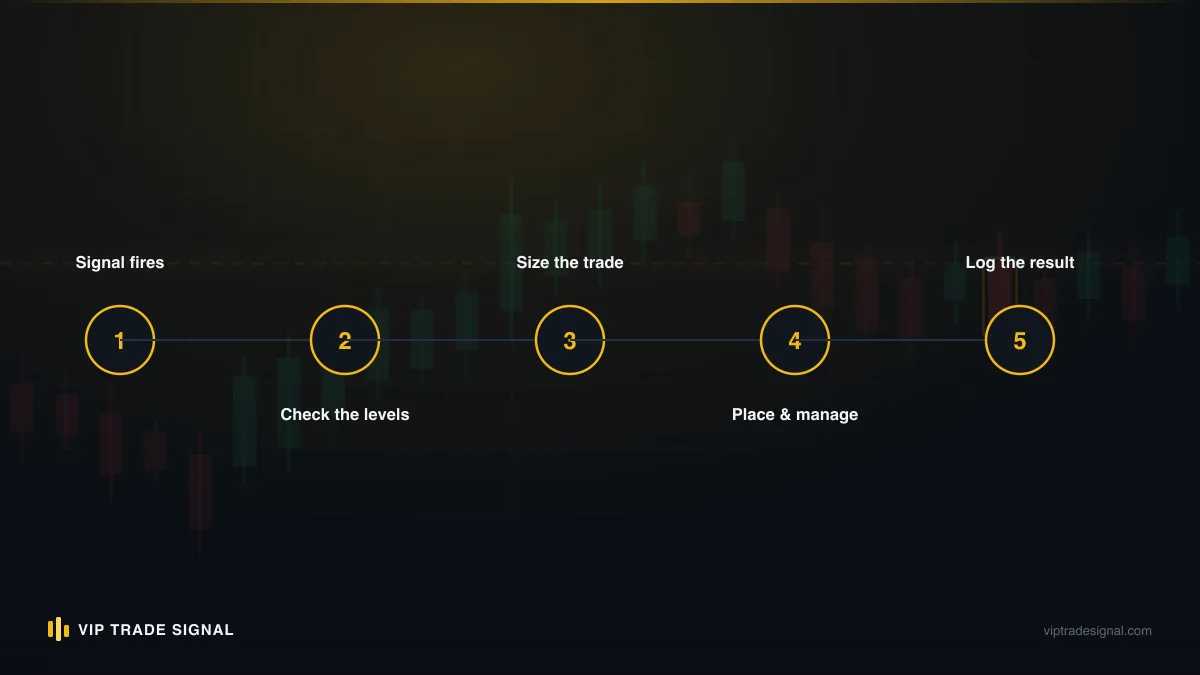
Here's the procedure. Pick a period the provider has summarised, say "September: 21 wins, 4 losses, +540 pips". Now scroll the channel back to 1 September and count for yourself. Every signal post, every outcome. Log them in a spreadsheet as you go: date, instrument, direction, entry, stop, targets, and what the channel later said happened. It's tedious for about twenty minutes. It's also the closest thing to an audit you can run without any cooperation from the seller.
What you're looking for:
- Count mismatches. The summary says 25 trades; the channel shows 31 signal posts. Where did six go? The usual answer is that they lost and were quietly excluded as "early entries" or "not official signals".
- Outcome inflation. A signal posted three take-profit levels; price tagged TP1 and then reversed through the stop. Honest accounting calls that roughly breakeven or a small win depending on the management rules. Channel accounting calls it "+30 pips TP1 HIT" and moves on. Multiply that across a month and a mediocre record becomes a stellar one without a single fabricated trade.
- Missing losers. Find signals with no follow-up whatsoever. Silence after a signal is a loss more often than not. Providers celebrate wins in real time and develop amnesia about the rest.
- Ambiguous entries claimed both ways. "Buy zone 3,310-3,325" gives the provider a 15-dollar window to retroactively define the entry wherever it flatters the outcome. Wide zones aren't automatically dishonest, but a channel that consistently scores zone trades at the most favourable edge of the zone is telling you how it will treat every future ambiguity.
- Deleted posts. Gaps in a channel's message numbering, or references to signals you can't find, mean the record has been pruned. Telegram doesn't flag deletions in channels, but abrupt jumps in context ("closing the second position", which second position?) give them away.
If you want the baseline for what a signal should even contain to be checkable in the first place, we've broken down the anatomy in what forex signals actually are. A signal without a stop loss, for instance, can never honestly be scored, which is precisely why some channels omit them.
This cross-check is also the reason we publish every closed signal, wins and losses together, at /signals/history. Not because we're saints. Because a public, dated, complete record is the only format that survives the audit you've just learned to run, and we'd rather be audited than take the word-of-mouth damage of being caught curating. Run the count on us in the same spreadsheet. That's what the page is for.
Timestamp forensics: edited and backdated posts
Telegram gives sellers two specific tools for rewriting history, and both leave fingerprints if you know where to press.
The edit trick. Telegram lets a channel owner edit a post long after publication, and an edited post shows only a small "edited" label, not the original text. The play: post a vague message before an event ("watching gold here"), wait for the move to resolve, then edit the post into a precise, correct call ("SELL 3,342, SL 3,351, TP 3,310"), timestamped before the move happened. To a scroller, the channel called it. In reality the channel called nothing.
Defence: tap or long-press the edited label where your client shows edit times (some do, some show only that an edit occurred). More reliably, treat any signal-bearing post marked "edited" as unscoreable. There are innocent edits, typo fixes and the like, but a channel whose winning calls are disproportionately edited posts has told you its method. Count the ratio: if 40% of the wins carry an edited label and 5% of the neutral chatter does, that's not typos.
The forward trick. Results are "proven" by forwarding old messages from a private channel you can't inspect. The forward carries the original timestamp, which looks like verification. But you have no way to see what else that private channel contains, whether it's one of six parallel private channels posting contradictory calls (post buy in one, sell in another, forward the winner), or whether its history has been pruned to a highlight reel. Forwarded proof from an uninspectable source is tier 0 evidence with a timestamp costume on.
The parallel-channel trick deserves its own paragraph because it's elegant and vile. Run several channels. Before a big event, post opposite calls across them. After the event, promote the channel that "won" and let the others rot. Every claimed call is genuinely timestamped and genuinely pre-event. The fraud lives entirely in the selection. Your defence is the completeness check from the previous section: never evaluate a forwarded highlight, only a full, continuous channel history, counted start to finish.
Screenshot timestamps barely need saying: the clock in a screenshot is pixels, editable in any image tool, and phone system clocks can simply be set backwards before capturing. A screenshot proves nothing about time. Ever.
The general principle underneath all of this: evidence is only as good as the seller's inability to select it. Timestamps you can verify inside a complete public record are strong. Timestamps attached to curated fragments are theatre.
FX Blue, investor passwords, and other verification routes
Myfxbook isn't the only road, and a couple of the alternatives are actually stronger.
FX Blue works on the same principle, publishing stats from a connected account, and the same checks apply: is the connection live and automatic, is the account real, is the full history visible, when does the record start. FX Blue's slippage and execution analytics are arguably better than Myfxbook's, which makes demo-spotting easier. Neither platform is inherently more trustworthy; both are exactly as good as the flags you bother to check.
The investor password is the closest thing retail has to tier 4 evidence. MT4 and MT5 accounts have two passwords: the master (full control) and the investor (read-only). A provider who gives you the investor password to their live account is letting you open the actual account, on the actual broker server, and read the actual history yourself, no tracker in the middle. Ask for it. A serious provider with a real record will often oblige, sometimes with a delay ("we rotate it monthly, next window is the 1st"). A refusal isn't automatically damning, and it's fair for a provider to decline handing server credentials to every anonymous prospect. But watch the shape of the refusal: "here's our verified tracker instead" is reasonable, while indignation is information.
While you're in there, check the trades against the broker's server clock, confirm the account type in the terminal, and look at the swap and commission columns for the live-account friction discussed earlier.
For what it's worth, the read-only principle is the same one we build our account management around, just pointing the other direction: clients keep the master password on their own MT4/MT5 account and we trade it, so the client can audit us continuously rather than trusting monthly PDFs. The mechanics are on our about page if the model interests you. The point here is narrower: any arrangement, in either direction, that survives on read-only transparency is structurally more honest than one that survives on screenshots.
Copy-trading platform stats (broker copy systems, signal marketplaces) sit around tier 2-3: the data comes from the platform rather than the seller, which is good, but watch for the same survivor problem, since anyone can spin up twenty strategies and market the lucky one. Platform-reported drawdown and follower profit figures, where available, cut through most of it. A strategy with 4,000% gain and a follower base that's collectively lost money is a common and clarifying sight.
Reading a performance report like an auditor
Suppose the record is verified, live, and complete. You're past the fraud checks. Now comes the second skill: reading a signal provider performance report the way an auditor reads accounts, which means hunting for the risk hiding inside true numbers.
Win rate is the least important headline number. A 90% win rate with 1:5 reward-to-risk (risking 50 to make 10) loses money at the ninth losing streak and blows up on the tenth. A 40% win rate at 3:1 compounds nicely. Always read win rate and average win/loss ratio together, never separately. The single most seductive false signal in this industry is a high win rate purchased with fat, rare losers.
Drawdown is the most important one. Maximum drawdown tells you the worst experience you'd have had following this record from the worst possible start date, and your psychological reality is that you might join at exactly that point. Ask: could I watch my account fall this far and keep taking signals? A verified 35% drawdown means months of following losers with no certainty of recovery. Most subscribers who churn out of even honest services quit inside a drawdown, right before the maths would have redeemed them.
Profit factor (gross wins divided by gross losses) compresses the last two into one figure. Below 1.0 loses money. From roughly 1.3 to 2.0 is credible, sustainable territory for a real service. Well above 3 over a long sample is either brilliance or, more often, a risk structure the summary stats are hiding, so go back to the trade list and find it.
Sample size and time. Thirty trades tell you almost nothing; variance alone produces gorgeous thirty-trade runs from coin flips. A couple of hundred trades across at least a year, spanning different market regimes, is where a record starts meaning something. For a gold-only record like ours, regime coverage matters double, because gold trends violently in some quarters and chops traders to ribbons in others, and a record built entirely inside one regime is a weather report from a single sunny week.
Return consistency beats return size. A record of +4%, +6%, -2%, +5% monthly is more valuable than +40%, -25%, +60%, -30%, even if the second compounds higher on paper, because you have to live through the path, and the path of the second one ends with most followers quitting at the bottom.
And one auditor's habit that catches everything else: pick five individual trades at random from the verified history and reconstruct them. Was the risk per trade consistent? Did the stop honour the stated rules? Did position size balloon after losses (the martingale reflex)? Five random trades tell you more about discipline than any summary page, because summaries are what sellers optimise and random samples are what they can't.
A track record isn't a promise about the future. It's evidence about a person: how they behave when they're losing, whether their rules survive contact with a bad week, and whether the story they tell matches the record they leave.
Hold that framing and the numbers organise themselves. You're not buying past returns, which are gone. You're buying the behaviour that produced them.
The limits of verification, including ours
Time for the section most verification guides skip, because it complicates the sales pitch. Here is what even perfect verification cannot do.
It cannot promise the future. A pristine, verified, three-year record is evidence of skill and discipline, and skilled, disciplined traders still have losing months, losing quarters, and occasionally losing years. Markets shift. Strategies decay. Gold's behaviour in a rate-cutting panic is not its behaviour in a quiet summer. Anyone who converts "verified past performance" into "reliable future income" in their marketing has left honest territory, however green their flags are.
It cannot verify your execution. The record shows the provider's fills, at their broker, with their latency and their position sizes. You will take the same signals with different slippage, a different spread, sometimes minutes later. Follower results scatter around provider results, and on a fast instrument like gold the scatter is wide. A signal that made the provider 40 pips can make a slow follower 25, or 5, or a loss.
It cannot see intentions. A provider can build an honest record and then change, scaling risk after success, revenge-trading after a public loss, or simply selling the channel to someone else who inherits the reputation without the discipline. Verification is a photograph, and people are films.
And ours, specifically. Our signals history is complete and dated, which protects it from the curation tricks above, but be clear-eyed about what it is: a record we publish on our own site. You cannot independently confirm through a third party that a given signal was delivered to subscribers at the moment we say it was; you'd have to join and watch the timestamps land in real time, which, for what it's worth, is exactly what we'd suggest a sceptical reader do for a few weeks before paying anyone anything, us included. We're not a licensed advisor, nothing we publish is personalised advice, and the honest summary of any signal record, ours in front, is: real, losses included, and no guarantee of the next month. Trading gold on leverage can lose you money faster than almost any instrument retail traders touch. A verified record changes the odds of you dealing with someone honest. It does not change what gold does on a Wednesday.
Sit with that limit rather than resenting it. Verification's job was never certainty. Its job is to shrink the pool from "everyone with a Telegram channel" to "the small set who survive an audit", and that shrinkage is worth more than any single month of anyone's results.
A 60-minute verification workflow, start to finish
Everything above, compressed into a runnable procedure. Put on the kettle; this genuinely fits in an hour.
Minutes 0-10: the public shell. Who operates this service? A named entity, a registration, a real about page with humans and history, or an anonymous channel with a Gmail address? Search the brand plus "scam", plus "review", plus the operator's name. Check how old the domain and the channel are (Telegram shows channel creation date in the profile). Anonymity plus youth plus big claims ends the workflow at minute ten, verdict rendered.
Minutes 10-25: tracker forensics. Open every Myfxbook or FX Blue link they publish. Run the flag sequence: track record verified, trading privileges, real not demo, open trades visible, full history visible, custom start date matching account creation, deposits sensible, broker regulated. Then the shape checks: curve too smooth, drawdown implausibly small against gains, profit concentrated in a few trades, lot sizes erratic. Fifteen minutes covers two or three accounts once you've practised.
Minutes 25-45: the channel audit. Pick the most recent full month the provider has summarised. Scroll the channel to the start of it and count every signal into a spreadsheet: instrument, direction, entry, stop, targets, claimed outcome, and whether the post carries an edited label. Reconcile your count against their summary. Note silent signals, edited winners, zone entries scored generously. Twenty minutes does a month for most channels. This step catches more liars than all the others combined.
Minutes 45-55: direct contact. Ask two questions. One about a specific losing trade you found ("the 14th's short from 3,355, how was it managed after TP1?"), because the response to a loss question is the single best character read available. One about access ("is an investor password or trial period available?"). You're grading the shape of the answers as much as the content: specific and calm, or evasive and grand.
Minutes 55-60: the decision. Tally it. Any single red flag from the hard list (unverified track record used in marketing, demo dressed as live, edited winners, count mismatch) is a no, not a "but the vibes are good". If everything held, your next step still isn't a payment; it's observation. Take the signals on paper or on a demo for two to four weeks and compare live delivery against the published record. Where the economics allow, start on a free route rather than a paid one, the same logic behind our own partner-broker option, where the service costs nothing beyond a maintained deposit at a broker you'd need anyway, keeping your downside during evaluation close to zero.
An hour of this per provider, against months of subscription fees and the account you'd wire behind a fraud, is the cheapest insurance in trading.
The verification checklist to save
Screenshot this section or copy it somewhere permanent. Twenty checks, in the order to run them. Scoring guidance is at the bottom.
Identity and surface
- Named operator or company, findable beyond their own site
- Channel/domain age over a year (younger isn't fatal, it's just untested)
- Search results for brand + "scam" read clean, or the complaints are substantively answered
- Risk of loss acknowledged in their own marketing, unprompted
Tracker checks
- Track record verified flag: green
- Trading privileges verified: green, or credibly explained
- Account type: real, confirmed on the tracker page itself
- Open trades: visible
- Full trade history: visible
- Record start date matches account creation
- Broker is regulated and nameable
- Verified history spans 12+ months and a few hundred trades
- Equity curve shows visible, recovered drawdowns (a real curve breathes)
- Profit not concentrated in a handful of outlier trades
Channel audit
- Your independent count of a month's signals matches their summary
- Losses posted and scored in real time, not silently dropped
- Winning posts not disproportionately marked edited
- Every signal carries entry, stop and targets, so it can be scored at all
Access and behaviour
- Investor password, trial, or free evaluation route exists
- Direct questions about losses get specific, calm answers
Scoring: items 5, 7, 15 and 17 are pass/fail; miss any one and you walk, whatever the rest says. Of the remainder, a serious provider clears at least thirteen. Ten to thirteen means extend your observation period before any money moves. Below ten, you already know.
Where this leaves you
Here's the uncomfortable arithmetic to end on. Run this workflow honestly on the next ten signal providers you encounter and, in our experience of doing exactly that for years out of professional curiosity, somewhere between seven and nine of them won't survive minute twenty-five. That's not a reason for despair. It's the entire point. The workflow's value isn't finding the good ones faster; it's that it makes you unfarmable by the bad ones, and the bad ones are the ones that cost people their accounts.
And when a provider does survive the full hour, something shifts in the relationship. You're no longer a hopeful subscriber taking claims on faith; you're an informed counterparty who has read their record, counted their losses, and knows what their drawdowns look like. That's the only footing worth trading from.
Our standing invitation is the same one we'd respect from anyone else: don't take our word for any of it. Open /signals/history, pick a month, and run the count from the channel-audit section on us, losers and all. Bring questions to the FAQ or ask us directly, including the awkward ones about the losing weeks, because there are losing weeks, and any gold signal service that claims otherwise has just failed your checklist at item four. If we pass your audit, the subscription is $99 a month or free through a partner broker deposit. If we don't, you'll have lost an hour and gained a skill.
Either way, never again pay for a green-ticks screenshot. You now know exactly what those are worth.