A man messaged me last spring after losing $4,300 to an account manager he'd found through an Instagram comment section. I asked him what checks he'd done before handing over access. His answer was honest and painful: "He seemed legit. His page had loads of followers and he answered my questions fast."
That's the whole problem with most advice about spotting forex account manager red flags. It tells you to trust your instincts, watch for anything that "feels off", do your due diligence. Useless. Your instincts are exactly what the scammer is trained to manage. The follower counts are bought. The fast, friendly replies are the product. By the time something feels off, your deposit has usually already made a one-way journey.
So this article does something different. Every red flag below comes with a verification procedure you can actually run — a specific thing to ask for, a specific place to look, a specific behaviour to test. None of them takes more than ten minutes. None of them requires you to be an experienced trader. Most require nothing more than a message and the patience to wait for the answer. If you're considering handing an account to anyone, including us, run the lot.
Why "trust your instincts" is useless advice here
Let's kill this idea properly before we start, because it underpins almost every forex account manager scam warning list on the internet, and it fails for a simple reason: the people running these schemes are better at social engineering than you are at detecting it. That's not an insult. It's their full-time job. They run the same script dozens of times a week and they've A/B tested every sentence against real victims.
A competent scammer will feel more trustworthy than a competent trader. Think about why. The scammer's entire operation is optimised for your comfort: quick replies, confident answers, screenshots of wins, testimonials from "clients" who are usually other accounts run by the same person. The genuine manager, meanwhile, is going to say awkward things. They'll talk about losing months. They'll refuse to predict returns. They'll make you sign something. They'll be slower to reply because they're actually watching charts. If you score both on vibes, the fraud wins nearly every time.
There's a second problem. Instinct-based vetting gives you no record of what you checked. Six months later, when you're trying to work out whether to add funds or pull out, you can't review your reasoning because there wasn't any. A checklist fixes that. You write down what you asked, what they answered, and what you verified. Boring? Completely. And that's rather the point — fraud lives in excitement, and verification lives in boredom.
One more thing before the list. These flags are cumulative but not equal. Some of them (the first three, in particular) are instant walk-aways on their own. Others are yellow rather than red in isolation, and only become damning in combination. I'll say which is which as we go, and the scoring section at the end puts numbers on it.
Red flag 1: any guaranteed return, any percentage
This is the big one, and it's beautifully binary. Any manager who guarantees a return — any return, any timeframe, any hedged wording — is either lying or doesn't understand the job. There is no third option. Markets do not offer guaranteed profit to anyone, and gold in particular will hand a 60-pip loss to the cleanest setup you've ever seen without a moment's apology.
The scam version is usually brazen: "10% weekly, guaranteed." Sometimes it's dressed in false modesty: "we only promise a conservative 5% per month." Run the compounding on that "conservative" figure and a $5,000 account becomes roughly $9,000 in a year and about $16,000 in two. Consistently, without losing months. Nobody managing retail accounts on Telegram has found a money machine that hedge funds with billion-dollar research budgets haven't. And if they had, they would not be renting it to strangers for a cut of your $3,000.
The verification procedure. Ask one question, in writing: "What's the most this account could realistically lose in a bad quarter?" Then read the answer with cold eyes. A genuine manager gives you a number — a drawdown percentage, a worst-case scenario, a reference to a stop-out policy. A fraud deflects ("we've never had a losing quarter"), reassures ("our system protects capital"), or turns it back on you ("why so negative?"). The guaranteed profit forex red flag isn't just the promise itself; it's the structural inability to talk about loss. Anyone who can't describe how you lose money with them has no plan for when you do.
This one is an instant disqualifier. No second question needed, no benefit of the doubt. Guaranteed returns in forex are a scam signature as reliable as a fake Rolex with a ticking second hand, and the phrase "guaranteed returns forex" should be doing the same work in your head that "free iPhone, just pay shipping" does.
Red flag 2: asks for your master password
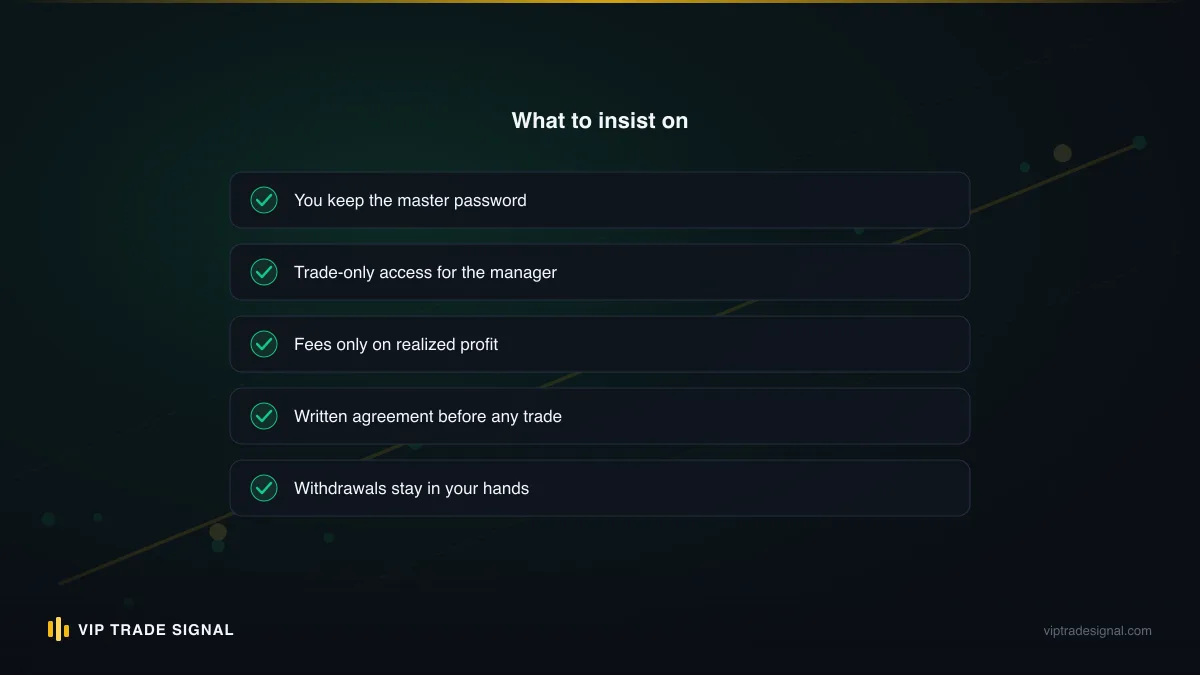
Every trading account has two credentials. The master password can trade, change settings, and — depending on the broker portal it's attached to — reach withdrawal functions, security settings, or the email on file. The investor password can look. A legitimate manager needs to trade, which on a properly configured setup means a dedicated trading login on an account where you hold the master credentials and the broker profile they sit inside.
Here's the thing people miss: managing your money never requires controlling your money. Those are different permissions, and the entire history of managed-account fraud lives in the gap between them. A manager with your master password and access to your broker profile can change your registered email, then your password, then request a withdrawal to a "verified" account that is no longer yours. You find out when the login stops working.
The verification procedure. Two steps, five minutes. First, ask the manager directly: "Do I keep the master password, and do withdrawals stay locked to my own bank account?" The only acceptable answer is an unqualified yes to both. Any hedging — "we need full access for our risk system", "it's just simpler this way", "everyone does it like this" — is your answer. Second, log into your broker portal and confirm what the master credential can actually reach, because setups differ and you want to know exactly what you'd be handing over. Takes three minutes and most people have never looked.
For what it's worth, this is how we structure it on our own account management service: the account is yours, at your broker, and you keep the master password and the withdrawal rights from day one. Not because we're saints. Because any arrangement where the manager can take the money eventually attracts managers who do, and we'd rather compete in a structure where theft is mechanically impossible than ask you to trust our character.
Instant disqualifier number two. There is no legitimate reason for a manager to hold your master password. None has ever been offered to me that survived thirty seconds of thought.
Red flag 3: wants deposits sent to them, not a broker
"Send the funds to our company wallet and we'll allocate them to the trading pool." Stop. Whatever comes after that sentence, the answer is no.
When your money sits in your own account at a regulated broker, the worst a bad manager can do is trade it badly — painful, but bounded, and you can pull the plug the moment you don't like what you see. When your money sits in someone else's wallet, they don't need to trade it at all. Most don't. The "account dashboard" you're shown is a web page with numbers typed into it, the profits are your own deposit being partially returned to build confidence for a bigger deposit, and the withdrawal that eventually fails was never going to succeed. That's not account management. That's a Ponzi with a candlestick chart as set dressing.
Crypto payment makes it worse, not better. A wire transfer to a fraudulent company at least creates a paper trail a bank can sometimes claw back. A USDT transfer to an anonymous wallet is gone the moment you press send, and every scammer knows it, which is why so many of them insist on it while calling it "faster" or "more private".
The verification procedure. Ask where the money physically sits and who the broker is. Then verify the broker independently — not through links the manager sends you, which can point at cloned sites, but by typing the broker's name into the regulator's own register (FCA in the UK, ASIC in Australia, CySEC for much of Europe) and finding the entity yourself. Then confirm you'll be opening the account directly with that broker, under your own name, with your own login issued to your own email. If any step of that chain runs through the manager — they open the account "for you", they receive the funds "to pass on", they handle the broker relationship "to keep it simple" — walk. The whole point of the structure is that it doesn't require trusting them, and every deviation from it exists to reintroduce the trust they intend to abuse.
Third and final instant disqualifier. The remaining nine flags are about judgement. These first three are about whether the person is running a business or a theft.
Red flag 4: the track record exists only as screenshots
Every fraudulent manager has screenshots. Gorgeous ones. Rows of green, a balance curve climbing like a staircase to heaven, the occasional artfully included small loss for credibility. And every single pixel of it can be produced in fifteen minutes with a demo account, or in five with an image editor, or in seconds with one of the MT4 "profit generator" tools that exist specifically to service this industry's marketing needs.
A screenshot is not evidence. It is a claim, wearing evidence's clothes.
Real verification means third-party, read-only access to a live account's history: a Myfxbook or FX Blue link with verified track record status, or investor-password access to a real account where you can scroll the closed trades yourself. These aren't exotic asks. Connecting an account to Myfxbook takes a manager about ten minutes, once, and costs nothing. Which tells you something important: any manager trading real money with real results has no reason on earth to refuse, because verified performance is the best marketing that exists. Refusal isn't a neutral choice. It's information.
The verification procedure. Ask for a verified tracking link or investor access to the track record account. If you get a link, check three things. That the "track record verified" badge is actually present, because unverified Myfxbook pages can be fed nonsense. That the history is long enough to mean something — a brilliant six weeks is noise; you want six months minimum and ideally a year that includes at least one rough patch. And that the account is real money rather than demo, which the platforms display if you look. If you get investor access instead, open the account history and read the losers. Their size, their frequency, whether stops were honoured or trades were held underwater for weeks hoping for a rescue.
The forex manager track record red flags cluster tightly here: screenshots only, "our old account was closed, we're rebuilding", "results are confidential for regulatory reasons" (they are not), or a verified link that turns out to show three weeks of demo trading. We publish every closed signal, wins and losses both, at /signals/history precisely because we spent years watching this industry hide its losers and decided the only credible position was to hide nothing. Hold anyone who wants your account to at least that standard.
Red flag 5: pressure and countdown tactics
"Only 2 slots left this month." "The current entry price closes Friday." "I can hold your place until tomorrow, then it goes to the next person on the list."
Scarcity is the oldest lever in sales, and in managed forex it's almost always fake, because the product doesn't have the property that makes scarcity real. A restaurant has finite tables. A manager running trades across client accounts adds your account with a few clicks; the marginal cost of client number 41 is close to zero. Genuine capacity limits do exist at the top end of the industry — strategies really do stop scaling at size — but the managers who hit them run institutional money and are not recruiting through WhatsApp.
The purpose of the countdown is precise: to compress your decision window below the time verification takes. Every check in this article needs a few minutes to a few days (waiting on answers, watching a track record breathe). Pressure exists to make sure you never get those days. Which hands you a lovely judo move.
The verification procedure. Use the deadline as the test. Say: "I need a week to verify the track record and read the agreement. Does your offer survive a week?" A legitimate manager says yes, without theatre, because a client who verifies carefully and then commits is the best kind of client there is. A fraud either lets the deadline mysteriously extend itself (revealing it was fake) or escalates the pressure (revealing everything else). Either way you've learned the truth for the price of one message.
And notice how this flag compounds with the others. Pressure plus screenshots-only plus a guaranteed return isn't three separate problems. It's one coherent machine, and every part of it is doing its job.
Red flags 6 to 9: the middle tier
The next four are individually survivable — you'll occasionally find an honest operator flying one of them out of carelessness rather than malice. Two or more together, though, and the odds turn against you sharply.
Red flag 6: you can't establish who they actually are
Anonymity is cheap to fix and frauds never fix it, because a name that can be searched is a name that accumulates history. Verification: ask for the legal name of the person or company you'd be dealing with, then spend ten minutes searching it alongside words like "scam", "review", and "withdrawal". Check whether the company exists in an official registry (Companies House and its equivalents are free and take two minutes). Check whether the person's photo reverse-searches to a stock library or somebody else's LinkedIn. A real operator has a findable footprint and will point you at it — ours is on the about page, deliberately. A ghost with a profile photo of a rented Lamborghini has made a choice, and you should read it as one.
Red flag 7: no written agreement
If there's nothing in writing covering the fee structure, the risk limits, how either side terminates, and what happens in a drawdown, then whatever you think the deal is exists only in a chat scrollback. Verification: ask for the agreement before any money moves, and actually read it — you're looking for the fee calculation spelled out with an example, a stated maximum drawdown or risk-per-trade figure, and a termination clause that lets you leave without penalty. "We keep things informal, it's all about trust" is not a business model. It's the absence of one.
Red flag 8: they never talk about losing
Scroll any manager's public channel and count the losses. Not the annotated wins, not the "recovery" posts — plain, unspun losing trades, reported the day they closed. A gold strategy that trades daily will lose often; something like a third to nearly half of decent setups fail, and that's fine, because sizing and risk-reward carry the maths. Verification: if the last thirty posts contain no losses, the channel is a highlight reel, and a manager who curates a highlight reel for marketing will curate your reporting too. Ask them directly about their worst month. The quality of that answer — specific, numeric, unembarrassed — tells you more than any win ever could.
Red flag 9: the equity curve is suspiciously smooth
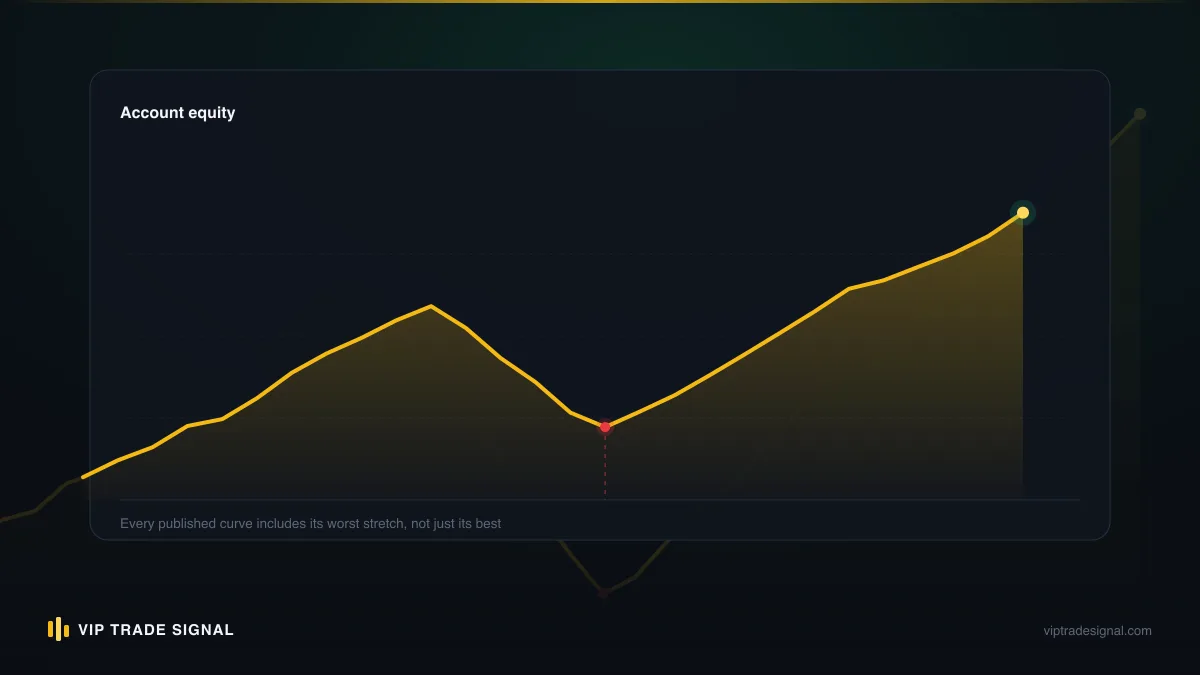
This one needs slightly more attention because it catches people who did check a verified track record and still got burned. A martingale or grid strategy — doubling exposure into losing positions, or averaging down without stops — produces the most seductive equity curve in trading: months of smooth, steady gains with barely a visible dip. The losses aren't absent. They're deferred, accumulating silently as open drawdown until one strong trend refuses to pull back and the account loses in a week what it made in a year. Gold, which trends hard and often, is the natural predator of these systems.
Verification: on a verified tracker, look past the balance curve to the open drawdown and the trade list. Warning signs: floating losses that dwarf realized profits, clusters of same-direction positions at stepped prices, average losing trades several times larger than average winners, and a history where no individual losing day exceeds a fraction of a percent while open risk quietly balloons. A real curve breathes. It has losing weeks you can see. The smooth staircase is not skill; it's a loss that hasn't been introduced to you yet.
Red flags 10 to 12: money mechanics
The last three live in the plumbing — how the money enters, gets charged, and leaves. Less dramatic than guaranteed-return promises, and responsible for just as much lost capital.
Red flag 10: they insist on one specific unregulated broker
Plenty of legitimate managers have broker preferences; execution quality genuinely differs, and partnership arrangements are common and can be honest (we run one ourselves — the signal service is $99 a month or free through a partner broker, and we say so out loud rather than hiding the affiliation). The red flag is insistence on a broker you can't find in any regulator's register, especially paired with resistance to any alternative. The ugliest version is a broker the manager effectively controls, where the platform itself is the fraud: your "account" is a database entry, spreads and stops behave however the house needs them to, and withdrawal requests age like milk. Verification: take the broker's exact legal name, find the regulator they claim, and search the regulator's own register directly. No entry, or a clone-warning notice, ends the conversation. Then ask the manager: "Would you trade my account at [major regulated broker] instead?" A no with an evasive reason is the tell.
Red flag 11: fee opacity
You should be able to state, in one sentence, exactly what the manager earns and when. "50% of realized profit above the starting balance, charged monthly, no other fees" is a sentence. "Performance-based compensation aligned with client success" is a fog bank. The dangerous structures hide in the fog: fees charged on unrealized gains that later evaporate, management fees charged win or lose, "spread sharing" arrangements that pay the manager per trade and quietly reward overtrading regardless of your outcome. That last one deserves special fear, because it means the manager profits from volume while you carry all the risk. Verification: ask for the fee terms in writing with a worked example — "if my $2,000 account ends the month at $2,400, what exactly do I owe?" — and then ask the sharper question: "Do you earn anything if I don't?" We've written up how honest profit-sharing structures work, and where ours sits against industry norms, in our profit split explainer; ours is a flat 50% of realized profit, which is the high end of the market, and the trade-off we offer for it is a $200 minimum and no lock-in. High but simple beats low but foggy every time.
Red flag 12: withdrawal friction stories
Before you deposit, everything moves fast. After, if you've picked wrong, withdrawal requests meet a fog of "processing", "compliance review", "please pay the tax clearance fee first" (a pure scam signature — legitimate brokers never collect tax through withdrawal fees), or the classic: "withdrawing now would disrupt the open positions, wait until the cycle completes." Verification: two checks. Before committing, search "[manager/broker name] withdrawal" and read what actual clients report — payout complaints leave scar tissue all over review sites and forums. After committing, test the pipe early: within the first weeks, withdraw a small amount, even $50, all the way back to your own bank. Not because you need the money. Because a withdrawal that works is the only proof the exit exists, and you want that proof while the amount at stake is still small. Any manager who resists a small test withdrawal has told you exactly what a large one will be like.
The ten-minute forex account manager red flags check
Here's the whole thing compressed into a routine you can run against any manager in about the time it takes to drink a coffee, with a few items that need a day or two of waiting on replies. Do it in order; the early steps disqualify fastest.
- Ask the loss question. "What's the most I could realistically lose in a bad quarter?" No number, no deal. (Tests flags 1 and 8.)
- Ask the access question. "Do I keep the master password and withdrawal control?" Anything but a clean yes, walk. (Flag 2.)
- Ask where the money sits. Your name, your account, a broker you verified in a regulator's register yourself. (Flags 3 and 10.)
- Ask for verified performance. Myfxbook/FX Blue with the verification badge, or investor access. Six months minimum, real account, visible losers, no ballooning open drawdown. (Flags 4 and 9.)
- Apply the one-week test. Tell them you need a week to verify. Watch what the deadline does. (Flag 5.)
- Search the human. Legal name plus "scam", company registry, reverse image search. Ten minutes. (Flag 6.)
- Read the agreement. Fees with a worked example, risk limits, exit clause. If it doesn't exist, neither does the deal. (Flags 7 and 11.)
- Search for withdrawal complaints, and plan a small test withdrawal for week two or three. (Flag 12.)
Notice what's absent from that list: any assessment of whether the trading strategy is good. That's deliberate. Strategy evaluation is genuinely hard and takes months of watching a track record breathe. Fraud detection is easy and takes an afternoon. Do the easy layer first, because a brilliant strategy run by someone who fails step 2 is worth exactly nothing to you, and an average strategy run by someone who passes all eight at least loses your money honestly and slowly enough to stop it.
A screenshot is not evidence. It is a claim, wearing evidence's clothes.
Worth saying plainly: passing every check does not mean you'll profit. It means the structure can't rob you, which is a different and smaller promise. Managed forex remains high-risk after all the verification in the world; honest managers have losing quarters, and some honest managers are simply not very good. The routine's job is to make sure that if you lose money, you lose it to the market — which is recoverable and survivable — rather than to a thief, which usually isn't.
Green flags: what the absence of red looks like
It's worth flipping the lens, because "not obviously fraudulent" is a low bar and you deserve a picture of what good actually looks like when you meet it.
A good manager volunteers the uncomfortable material before you ask. The losing months come up in the first proper conversation, with numbers attached. The agreement arrives before the deposit instructions do. The verified track record link is in their bio, not extracted under interrogation. When you ask a question they don't know the answer to, they say so instead of improvising confidence.
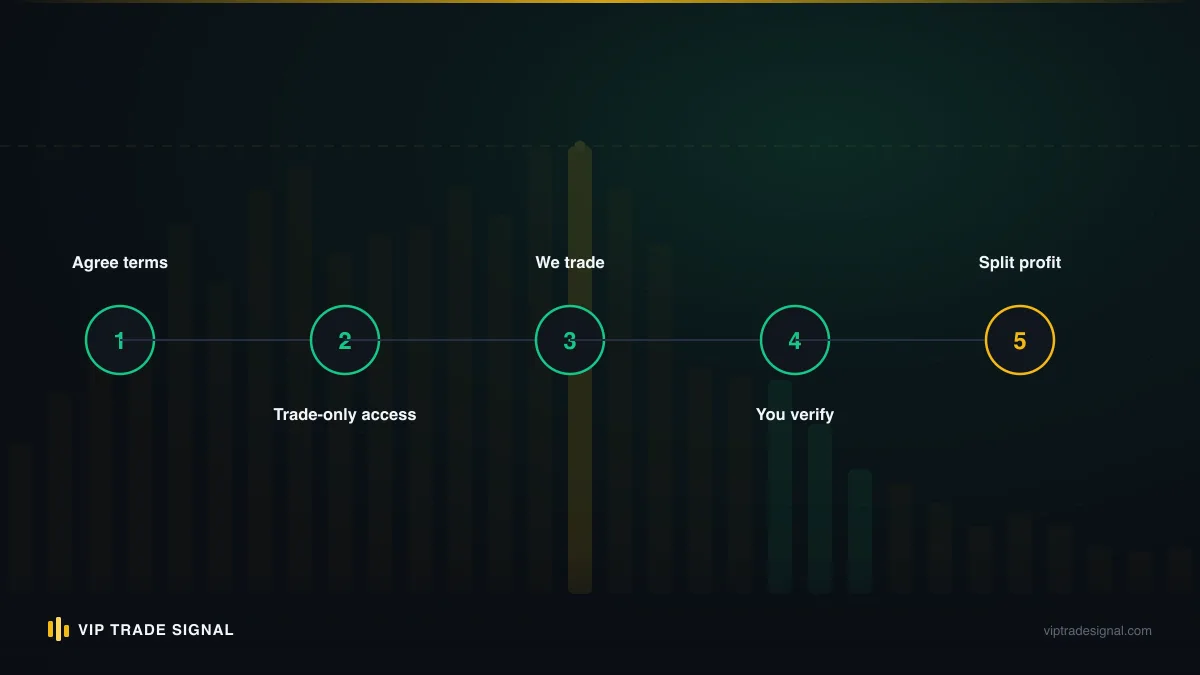
A good structure, meanwhile, has a shape you can draw: your money at your broker under your name, the manager holding trading access only, fees calculated on realized profit with a formula a twelve-year-old could apply, and an exit you can trigger any day by changing a password. Every piece of that is checkable, which is the entire point. Trust built on checkable structure survives a losing month. Trust built on charisma dies with the first drawdown, usually taking your judgement with it.
| What you're checking | Red version | Green version |
|---|---|---|
| Returns talk | Guaranteed X% | A drawdown number, unprompted |
| Account access | Wants master password | Trading access only, you keep the keys |
| Money location | Their wallet or "pool" | Your name, your account, regulated broker |
| Track record | Screenshots, highlight reels | Verified third-party link, losers visible |
| Timeline | Countdown pressure | "Take the week, verify everything" |
| Fees | Fog | One sentence with a worked example |
| Exit | Friction stories | Small test withdrawal clears in days |
One honest caveat about green flags: they can be worn as costume too. A sufficiently patient fraud can produce a contract, register a company, and act relaxed about deadlines. What they can't fake, in combination, is the structural stuff — the regulated third-party broker holding your money under your name, the verified multi-month track record with real losses, the working withdrawal. Costume is cheap. Structure is expensive. Weight your judgement toward the things that cost something to fake.
And before you run any of this, it's worth asking the prior question: do you want managed trading at all? For plenty of people, signals — where you see every trade and press the button yourself — are the better fit, and we've laid out that trade-off honestly in signals versus account management. Managed accounts suit people who genuinely can't be at the screen; they are not a shortcut past learning what risk feels like.
The scoring template: when you walk
Time to put numbers on it, because "use your judgement" is exactly the vagueness this article exists to replace.
Score each flag you detect. The first three — guaranteed returns, master password requests, deposits to the manager — are worth 10 points each. Flags 4 and 5 (screenshot-only records, pressure tactics) are worth 5. Flags 6 through 12 are worth 3 each.
The threshold is 10. One instant disqualifier, or two from the middle tier, or a scatter of four from the bottom tier, and you're done. Not "proceed with caution". Not "start small and see". Done. I'd honestly defend a threshold of 5 — in eight years around this industry I have never once seen a manager flying two of these flags turn out to be worth the risk — but 10 is the line past which continuing isn't optimism anymore, it's donation.
Why so hard a line? Because of what the flags actually are. These aren't quirks of presentation. Each one is a structural choice the manager made, and made for a reason. Nobody accidentally insists on your master password. Nobody's track record is screenshots-only by oversight when verification is free. When two of these choices point the same direction, you're not looking at sloppiness. You're looking at design.
The counterargument you'll hear from your own head, usually while staring at a beautiful equity curve, goes: "but what if this one's real, and I miss out?" So run the cost of each mistake. Walking away from a genuine manager costs you one opportunity in a market that produces new ones every week; there are thousands of managers, and the good ones will still be verifiable next month. Staying with a fraud costs you the entire balance, some weeks of humiliating hope while the withdrawal "processes", and — this is the part people underestimate — a hit to your confidence that makes you worse at the next decision. The asymmetry isn't close. False negatives are cheap. False positives are catastrophic. Set your threshold accordingly and let the marginal cases go.
If, after all that, a manager passes — the loss question answered with numbers, your keys in your pocket, the money at a broker you verified yourself, six months of warts-and-all verified history, a contract you've read and a test withdrawal that cleared — then you've done the vetting that ninety-something percent of managed-account victims never did, and whatever happens next, at least it will happen in an honest structure. That's the standard we've tried to build our own gold account management around: your account, your master password, a flat 50% of realized profit and not a penny on anything unrealized, and a public history of every closed signal, red ones included. Judge us by this checklist. Judge everyone by this checklist.
And if a manager ever objects to being run through it — if the questions themselves cause offence, if verification is treated as an insult to their integrity — score that reaction as the thirteenth flag, worth 10 on its own. Honest operators love informed clients. Only one kind of business fears an audit it knows is coming.