There is a particular phone call every gold desk eventually gets. A trader, usually competent, sometimes very competent, explains that he ran a forex book for years without drama and then put the same playbook on XAU/USD. Same risk percentage. Same lot-sizing habit. Same "hold through the news, it always comes back" instinct. Six weeks later a $10,000 account is down $4,200 and he wants to know what happened.
What happened is that gold is not a currency pair, and gold trading account management, done properly, is its own discipline with its own rules. XAU/USD trades on a forex platform, sits next to EURUSD in the market watch, and quotes in pips if you squint. But the contract underneath it is different, the volatility profile is different, and the calendar that moves it is different. Done as an afterthought by a generalist, it is one of the fastest ways to hurt an account that we know of.
This piece is the operational companion to our managed account service. Not a pitch. A desk manual. We run gold accounts all day, and this is how the job actually works: the contract maths, the calendar, the sessions, the risk rules, and the honest shape of a losing month. If you are considering handing a gold account to anyone, us included, you should know what competent management looks like before you sign anything.
Gold trading account management is not forex management with a new chart
Start with the thing most people get backwards. A managed forex account and a managed gold account look identical from the outside. Same MT4 or MT5 terminal, same trade tickets, same equity curve in the report. The difference is entirely in what the manager has to respect.
A forex book spreads risk across instruments. A manager running EURUSD, GBPJPY and AUDUSD has three partially independent streams of movement. When the euro goes quiet, the yen crosses might be moving. Correlation is a real problem on a pair book, but diversification, even imperfect diversification, is available. A gold book has one instrument. One. Every position, every day, is a view on the same chart. There is nowhere to hide a bad read and no second market to grind back a loss while the first one chops.
That single fact changes almost everything downstream. Position sizing has to be more conservative, because concentration risk is total. Trade selection has to be more patient, because there is no "well, nothing on gold today, let's poke at the kiwi" option. The desk either has a setup on XAU/USD or it sits on its hands. And the calendar matters more, not less, because there is no other instrument to rotate into while gold digests a Fed decision.
The temperament changes too. Currency pairs mostly mean-revert inside ranges and trend in long, grinding moves. Gold does both of those and then, a few times a year, does something else entirely: it gaps, spikes $40 in an hour on a headline out of nowhere, and repriced everyone's stop placement assumptions in the process. A pair manager can go years without seeing his instrument move 2% in a session. A gold manager plans for it every single week.
None of this makes gold unmanageable. It makes it specific. The desks that do well on XAU/USD are the ones that treat it as a specialism, the way a bond desk would never casually trade crude. The ones that do badly treat it as "just another symbol". You can usually tell which kind you are talking to within five minutes, and later in this piece we will give you the exact questions that expose the difference.
The contract maths: why lot-sizing errors are amplified
Here is the mechanical heart of the problem, and it is worth slowing down for because this is where most gold accounts actually die. Not on bad analysis. On arithmetic.
One standard lot of XAU/USD is 100 ounces of gold. A $1.00 move in the gold price is therefore worth $100 per lot. Brokers quote gold to the cent, and the habit is to call a 10-cent move "a pip", which makes one pip worth $10 per standard lot. So far that sounds like EURUSD, where a pip is also $10 a lot. The trap is in how far each instrument travels.
EURUSD on an ordinary day covers perhaps 60 to 80 pips. Gold on an ordinary day covers $15 to $30, which is 150 to 300 of its "pips". On a Fed day or a geopolitical headline, $50 to $80 ranges are not rare. The instrument simply moves three to five times as many dollar-increments as a major pair, session after session. Put the same lot size on both and gold is not a similar trade with more excitement. It is a position three to five times larger in real risk terms, wearing the same ticket size.
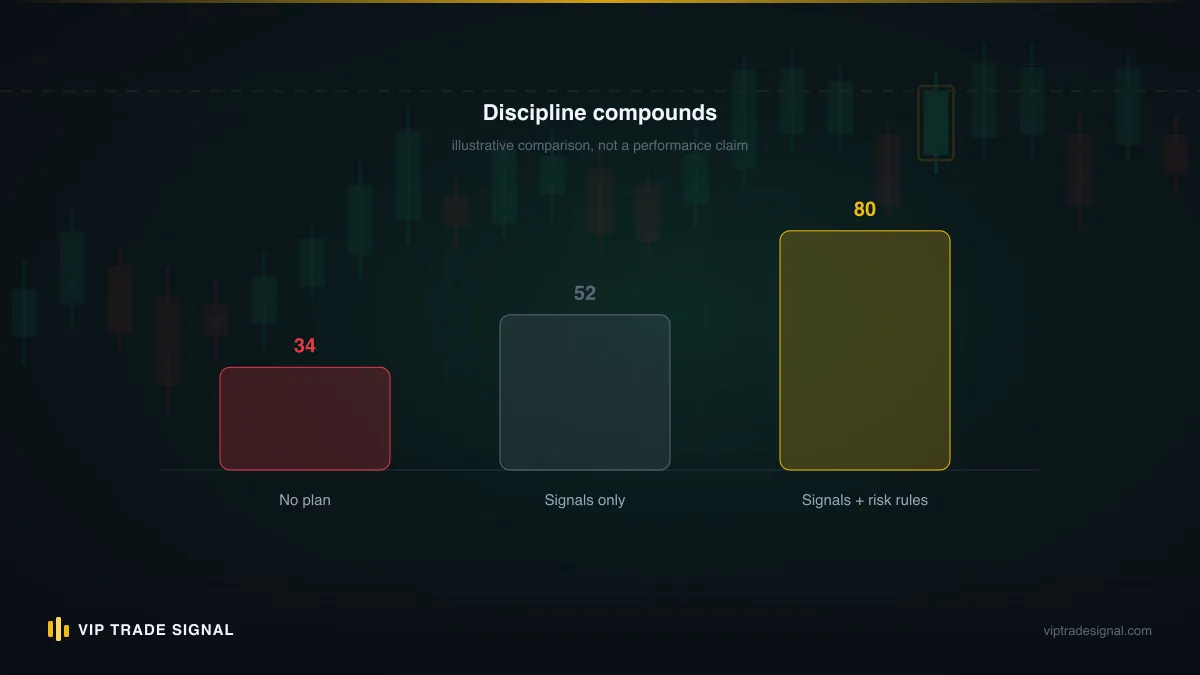
Run the numbers on a real account. Say you manage $5,000 and want to risk 1% per trade, so $50. On EURUSD with a 30-pip stop, that is roughly 0.16 lots. On gold, a technically sensible stop is rarely tighter than $5, often $8 to $12 once you place it beyond the noise. A $10 stop at $50 of risk means 0.05 lots. Not 0.16. A generalist who carries his forex sizing habit across, and puts 0.15 or 0.20 lots on a gold trade with a $10 stop, is risking $150 to $200 on a $5,000 account. That is 3% to 4% per trade before anything has gone unusually wrong. Three losers in a row, which every strategy on earth produces regularly, and the account is down double digits for reasons that have nothing to do with market analysis.
The sizing rule on our desk is boringly simple: risk is defined in dollars first, the stop is defined by the chart second, and the lot size is whatever falls out of dividing one by the other. Lots are the output of the calculation, never the input. If the maths says 0.03 lots, the trade is 0.03 lots, even if the ticket looks embarrassingly small next to the account balance. We wrote up the same arithmetic for self-directed traders in our piece on lot sizing gold on a small account, and honestly the managed version differs in only one respect: there is no moment of weakness at 2am where someone doubles the size because the last trade lost.
One more contract detail that catches people: margin. Gold's notional value per lot is large, so leverage that feels comfortable on pairs evaporates quickly on XAU/USD. A manager who runs a gold book near its margin limit has built a machine that gets stopped out by the broker, not by the market. Free margin on a gold account is not idle money. It is the crumple zone.
The gold desk calendar: Fed, CPI, NFP and the headlines nobody schedules
A pair trader watches the calendar for the currencies he holds. A gold desk watches one calendar with total obsession, because nearly everything that violently moves gold is a scheduled US event or an unscheduled global one.
The scheduled list is short and brutal. FOMC rate decisions and the press conference that follows. US CPI. Non-farm payrolls. The occasional Treasury auction that goes sideways, and testimony days when the Fed chair sits in front of Congress with a live microphone. Gold's largest single-session moves cluster around these dates with remarkable reliability, because gold is, at heart, a bet on real interest rates and the dollar, and these are the days that reprice both.
So the desk runs blackouts. Ours look like this: no new positions in the final hours before FOMC, CPI or NFP, and existing positions either closed or cut to a size that can absorb a $40 adverse spike without threatening the account. Not because the desk has no opinion about the number. Because having an opinion about a number is gambling, not management. The honest truth about high-impact releases is that the first move is frequently reversed within the hour, spreads widen from 20 cents to $1 or more at the print, and stops fill wherever liquidity happens to be rather than where you placed them. A stop-loss $3 away can fill $6 away. On a leveraged instrument that moves $100 per dollar per lot, that slippage is not a rounding error.
Then there is the calendar nobody publishes. Gold is the market's fear gauge, and fear does not file a schedule. A strike in the Middle East, a bank wobble, a surprise election result, and gold can move $30 before the desk has finished reading the headline. You cannot blackout the unscheduled. What you can do is size every position, always, as if a $40 gap against you might happen tonight, because a few times a year it genuinely will. This is the deepest difference between gold portfolio management and pair management: the tail event is not a black swan to be survived once a decade. It is a seasonal bird.
A quick sketch of how a normal month divides up on the desk:
| Week | Typical events | Desk posture |
|---|---|---|
| Week 1 | NFP Friday | Normal trading Mon-Thu, flat or minimal into Friday's print |
| Week 2 | US CPI | Blackout around the release, trade the post-print structure once spreads settle |
| Week 3 | FOMC (8 weeks in the year) | Reduced size all week, flat into the statement and presser |
| Week 4 | Usually quiet | Often the best clean trading of the month |
Eight to ten days a month, the professional posture on gold is doing less or doing nothing. Clients sometimes read those flat days as laziness. They are the opposite. They are the fee you pay to still have an account on the ninth day.
Session strategy: when a gold desk trades and when it sits
Gold trades nearly 24 hours, five days a week, but it does not offer the same market all day. It offers three different markets wearing the same symbol, and a desk that treats them identically is donating money to whoever understands the difference.
The Asian session, roughly midnight to 7am UK time, is gold at its thinnest. Ranges are often $5 to $10, spreads are wider at the open, and the price action is dominated by regional flows and stop-hunting wicks around obvious levels. Some desks scalp Asia. Ours mostly does not: the reward available rarely justifies the spread paid, and a thin market is precisely where a random headline does the most damage. Asia is for marking levels, not trading them.
London, from about 8am UK, is where gold wakes up. Liquidity deepens, the day's first real directional attempt usually happens within a couple of hours of the open, and false breaks of the Asian range are so routine that fading them is practically a desk tradition. This is a tradeable session, and a decent share of our entries happen here, particularly around the London morning when a level built overnight gets its first genuine test.
New York is the main event. The 1:30pm UK data window, the US equity open at 2:30pm, and the overlap with London until late afternoon produce the deepest liquidity and the largest sustained moves of the day. Most of gold's daily range is typically carved out between 1pm and 6pm UK time. It is also when the scheduled violence happens, which is why the blackout rules above exist. The desk's day, in practice, is shaped like a batting order: observe Asia, work London, respect and selectively trade New York, and go absolutely flat-footed into the last hour before a major US release.
The year has seasons too, and a gold desk plans around them the way a farmer plans around frost. August is notoriously thin: half the institutional world is on a beach, ranges compress, and breakouts fail at a rate that will demoralise anyone who does not expect it. Mid-December through the new year behaves similarly. Meanwhile the weeks around quarter-end, and the stretches when a fresh macro theme is being priced, produce the cleanest trends of the year. A desk that trades identical size and frequency in August and in a trending March is ignoring free information. Ours trades roughly half frequency through the dead patches, and clients see that in the statement as quiet weeks. Quiet weeks are not idle weeks. They are the desk declining bad odds.
And Fridays deserve their own sentence. Holding a full-size gold position over a weekend means holding through 65 hours in which anything can happen and nothing can be closed. Gold gaps on Sunday opens more meaningfully than majors do, because geopolitics does not take Saturdays off. Our default is to cut weekend exposure hard, and any manager who routinely carries big gold positions through weekends should be able to explain, in numbers, why the gap risk is paid for.
Risk rules tuned for gold's temperament
Every managed account lives or dies on its risk rules, so here are the ones a gold book actually needs, stated the way we run them rather than the way a brochure would put them.
Per-trade risk between 0.5% and 1% of equity, hard cap. On gold this matters more than on pairs, for the concentration reason above: every trade is the same instrument, so consecutive losers are not independent events. Five 1% losses on five different pairs is bad luck. Five 1% losses on gold is one wrong view, compounded, and the sizing has to assume that clustering will happen.
Stops beyond the noise, always in the market, never mental. Gold's intraday noise band is wide; a stop $2 from entry on a London-session trade is not a stop, it is a scheduled donation. Typical desk stops run $5 to $12 depending on structure, and the lot size shrinks to match. A mental stop on an instrument that can travel $15 in ten minutes is not a plan. It is a hope with a login.
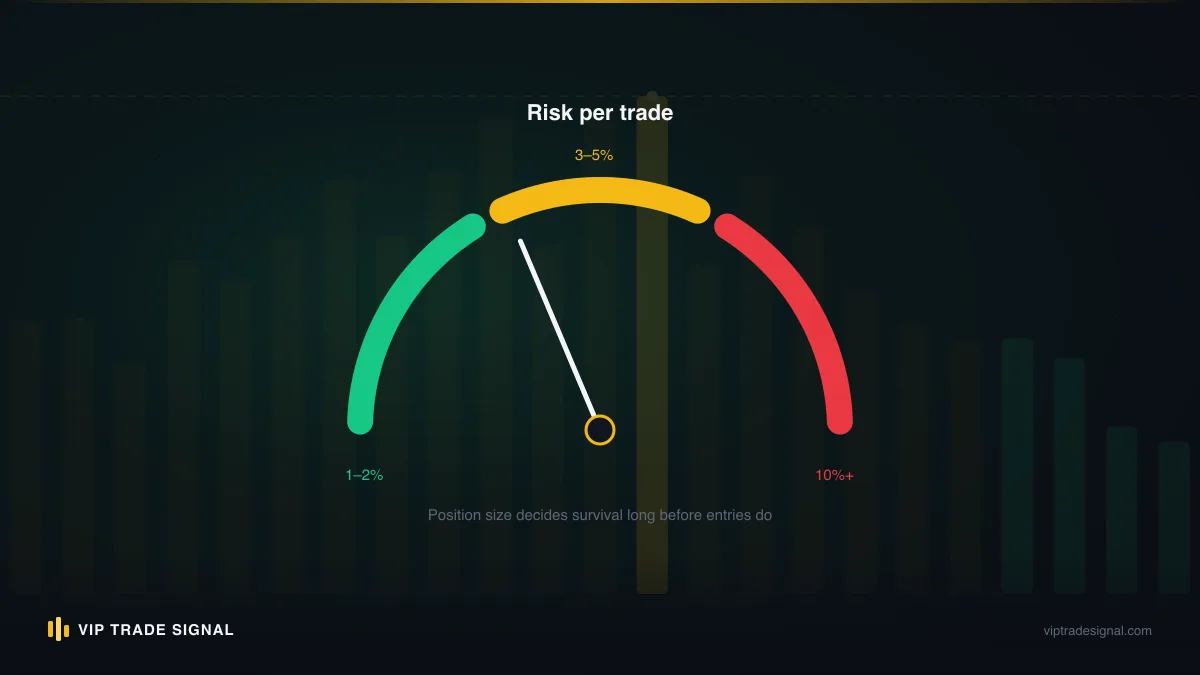
A daily loss limit, around 2% to 3%, after which the desk stops trading. Full stop, until tomorrow. The worst gold losses we have ever seen were not single bad trades but revenge sequences: a loser at the London open, doubled after lunch, tripled into New York. Gold invites this behaviour because it moves enough intraday to make "winning it back today" feel plausible. The daily limit exists to make it impossible instead.
A monthly drawdown ceiling, ours sits near 10%, at which the book goes flat and the strategy gets reviewed rather than pushed. Nobody enjoys invoking this rule. It has saved more accounts than any entry technique we own.
And a leverage posture that leaves room. Total open exposure across all gold positions capped so that a $50 adverse move, roughly a big Fed day, costs single-digit percent of equity, not the account. If you want the fuller framework, our guide to risk management around gold signals covers the same rules from the self-directed side.
The entries get the attention. The limits keep the account. In gold management, the second sentence is the entire job.
Notice what is missing from this list: any promise about returns. Risk rules control the losing side, which is the only side a manager truly controls. Anyone who quotes you a guaranteed monthly percentage on a live gold account is describing either a lie or a martingale, and we have written at length about what guaranteed-return promises actually mean.
Drawdown behaves differently in a gold book
Every trading account spends most of its life below its last equity high. That is just the geometry of the business. But the shape of drawdown on a gold book is distinctive, and if you are going to have your account managed on XAU/USD you should know what the curve will actually look like, because it will occasionally frighten you.
A diversified pair book tends to bleed. Losses arrive in dribbles across instruments, the curve sags gently, and drawdowns are shallow but long. A gold book does the opposite: it steps. Weeks of small wins and small losses that net slightly positive, then one volatile stretch, usually around a macro repricing, where the book takes its two or three losers close together and the curve drops visibly in days. Then, if the desk is any good, a slow climb resumes.
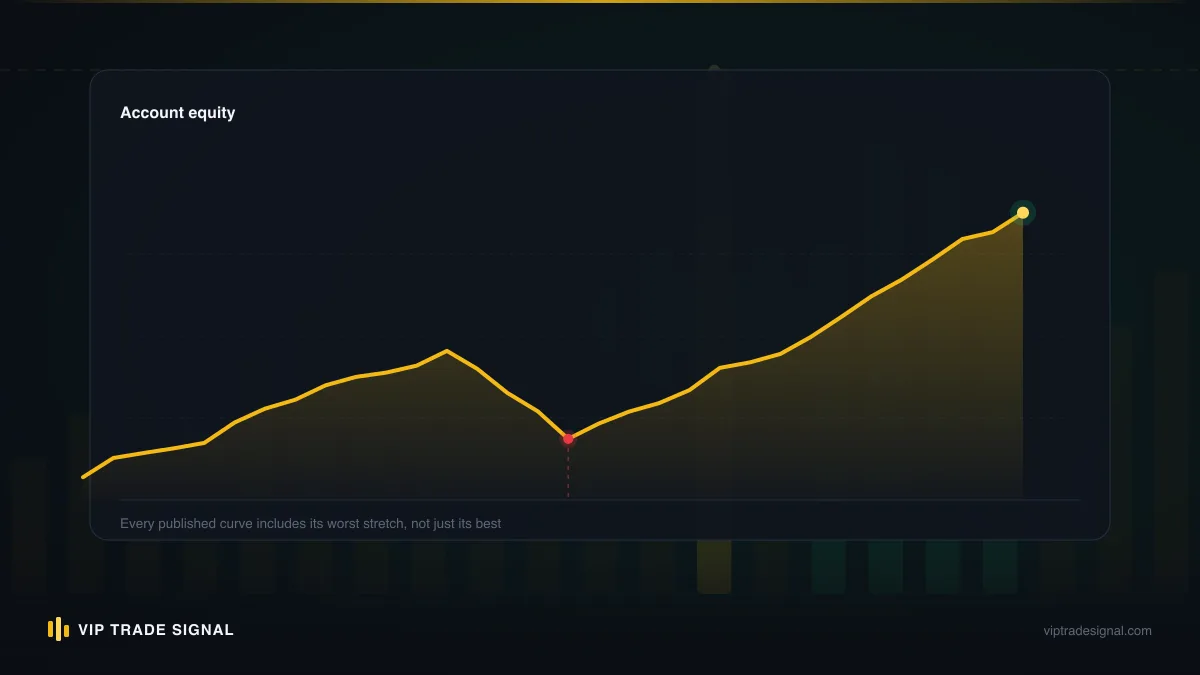
The step shape is not a flaw. It is what concentration plus volatility mathematically produces, even with clean execution. But it has a psychological consequence that every gold manager learns to handle: clients panic at the step. A 6% drop in four days feels like an emergency in a way that a 6% sag over two months never does, even though the second one is often the sicker account. The managers who fail here are not always the ones losing money. Sometimes they are the ones who never prepared the client for the shape of normal, so the client pulls the account at the bottom of a routine step and converts a temporary drawdown into a permanent loss.
So ask any prospective manager the drawdown questions before the deposit, not after. What is the worst peak-to-trough drop this exact approach has produced? How long did recovery take? What happens, procedurally, when the monthly ceiling is hit? A manager with real gold history answers in specific numbers and dates. A manager who says "we keep drawdown very low" without a figure attached has either not traded through a hostile stretch or is not telling you about it. Neither is comforting. On our own service every closed trade, the ugly steps included, sits publicly at /signals/history, because we would rather lose a prospect to honesty than gain one to a smoothed curve.
There is a separate, harder conversation for accounts already deep underwater from someone else's trading, and it deserves its own rules; we run that as a distinct drawdown-recovery service precisely because recovering a damaged account and growing a healthy one are different jobs with different risk postures.
A month inside a managed gold account
Abstractions only get you so far, so let's walk a plausible month. The numbers are illustrative, invented to show the shape of the work, not a performance claim; your month, and ours, will differ, and some months finish red.
Say the account is $5,000, risk is 0.75% per trade, so $37.50 of risk on each ticket.
Week one opens quietly. Monday and Tuesday, Asia ranges are dead and London produces one setup: a failed break below the prior week's low, long from the reclaim with a $7 stop, 0.05 lots. It runs $11 in favour over two sessions and closes for about $55. Wednesday offers nothing worth a ticket. Thursday the desk goes flat by the afternoon because Friday is NFP. The print comes hot, gold drops $28 in twenty minutes, and the account watches from cash. That flat Friday is invisible on the statement and might be the best decision of the month.
Week two is CPI week. One short on Monday against a New York rejection level loses its full $37.50. Tuesday's long recovers $50. Blackout Wednesday around the release; the post-CPI structure sets up Thursday and gives the month's best trade, roughly $95 on a trend continuation with a trailed stop. Week three is FOMC. Reduced size all week, two small trades netting about breakeven, flat into the statement. The presser whipsaws $45 top to bottom. Cash again.
Week four, the calendar is clear and the market trends. Three trades, two winners, one loser, net around $85. The month closes up roughly $210, call it 4%, from about nine actual trades and perhaps thirteen trading days of genuine activity. The other days were observation.
What does the client actually see while all this happens? Everything, in real time, which is one of the underrated virtues of the own-account model. The trades appear in your own terminal as they open and close, with your broker's timestamps, not a monthly PDF assembled after the fact. You can watch the flat NFP Friday happen. You can see the CPI blackout as an absence of tickets on the statement. Some clients check daily at first and then, after a month or two, weekly, which is roughly the healthy frequency; staring at an open gold position tick by tick is a form of self-harm we would talk anyone out of. The reporting layer on top, a short monthly note on what the desk did and why, exists for context, but the ground truth never leaves your login.
Now the honest inversion: run the same month with the losers clustered differently, and the account finishes down 2% instead. Same desk, same rules, same quality of decision. That is trading. What the client is paying for is not the green month. It is the fact that the red month was minus 2 and not minus 20, and that every ticket, both kinds, is visible in the account they own. Under our structure, the fee is 50% of realised profit only, so the red month costs the client management fees of exactly nothing. Which is precisely how the incentives should sit.
Choosing a gold-capable manager: the questions that differ
Generic due diligence questions, regulation, track record, fee structure, apply to any managed account and we have covered them elsewhere. But vetting specifically for gold competence needs a sharper set. These are the ones we would ask, in order, and what the answers reveal.
- "What is one pip of gold worth on one lot, and what stop distance do you typically run?" Anyone who hesitates on the first half has not sized enough gold tickets. Anyone who answers "$2 to $3 stops" for the second half is either scalping spreads or getting wicked out daily.
- "What is your position going into CPI and FOMC?" The only strong answer contains the words flat or reduced. "We trade the news" from a retail-account manager means your equity is the chip stack.
- "How did your gold book handle the last major geopolitical spike?" Specific dates and numbers, or waffle. You will learn more from thirty seconds of this answer than from any brochure.
- "What was your worst drawdown on gold specifically, and how long to recover?" Not blended across instruments. Gold. Blended numbers are where ugly gold months go to hide.
- "Do I keep the master password and withdrawal rights?" Non-negotiable, and any structure where money must move into the manager's own wallet is a different product wearing a management costume. On a properly structured gold account management service, the manager holds trading access only; deposits and withdrawals never touch their hands.
- "Where can I see every closed trade, including losers?" Screenshots are not an answer. A public, dated, complete record is.
There is a version of this checklist for religiously constrained accounts too; if swap-free execution matters to you, the considerations around halal managed account structures overlap heavily with gold, since XAU/USD swaps are among the heaviest on most brokers and holding style has to adapt.
One more filter that costs nothing: ask the manager to talk about a losing trade of theirs, unprompted, in detail. Competent desks do this easily, almost fondly. Marketing operations physically cannot.
How generalists blow up gold accounts: the recurring failure modes
We have watched a lot of gold account post-mortems, our own early ones included, and the failures are strikingly repetitive. Five patterns cover nearly all of them.
Forex sizing on a gold ticket. Covered above, and still the number one killer. The account dies of arithmetic in the first two months, usually with correct directional analysis attached, which makes it worse.
Averaging into gold trends. On a ranging pair, adding to a loser sometimes gets bailed out, which is exactly the problem: the habit gets learned where it is survivable and applied where it is not. Gold trends hard when it trends. A desk that adds every $10 against a gold trend is running a grid, and gold grids do not lose often. They lose once.
Tight stops in the noise band. The generalist places gold stops the way he placed EURUSD stops, 20 or 30 "pips" away, inside gold's ordinary hourly wiggle. He then experiences a strategy that is directionally right and constantly stopped, concludes gold is manipulated, and leaves. The instrument was fine. The stop was parked on the tram tracks.
Trading the print. Holding size through NFP or FOMC because "the setup was still valid". The setup does not attend the press conference. The slippage does.
Overtrading the 24-hour chart. Gold prints a fresh candle every minute of a very long day, and the generalist reads that as opportunity. Twelve tickets a day, spread paid twelve times, decisions made tired at 11pm because "the chart was still moving". A gold desk's edge lives in a handful of well-understood situations that occur a few times a week; everything else is spread and noise. The accounts that trade gold forty times a week do not lose to the market. They lose to the costs, slowly, and blame the market anyway.
No weekend policy. Full positions carried into Sunday gaps until the one Sunday that matters. This failure mode has a long fuse and a spectacular ending, and it is entirely optional.
What these share is a common root: every one is a habit that a forgiving instrument taught and an unforgiving one punished. Which is why "we manage all markets" is, for gold specifically, closer to a warning label than a credential. The desks we respect on XAU/USD are narrow. Ours is narrow on purpose: one instrument, studied to the point of tedium, beats eleven instruments understood at brochure depth.
Our gold desk, briefly and concretely
Since this whole piece is the manual, here is where our own service sits inside it, stated plainly and once.
We manage gold only, on your own MT4 or MT5 account at your broker. You keep the master password, you keep withdrawal rights, and we hold trading access only, so the custody question in the checklist above answers itself. The fee is a flat 50% of realised profit with a $200 minimum advance, and nothing else: no management fee in flat months, no charge on a losing month. That percentage is at the high end of the industry, and we say so openly; it is the price of low minimums and pay-as-you-go, and the comparison with pooled structures is laid out honestly in our piece on hedge funds versus managed accounts, with the full numbers on the pricing page. Every closed trade the desk takes is published, dated, wins and losses alike. No guarantees of profit are made, because none can honestly exist, and gold traded on leverage can lose money in any month including the first one.
That is the whole pitch, and it is deliberately short, because the rest of this article is the actual argument: the rules above are not what we say. They are what the published record shows us doing.
Where this leaves you
If you take one idea from this desk manual, take the structural one: gold trading account management is a specialism, and the evidence of specialism is checkable. The contract maths is checkable in five minutes with a position size calculator. The calendar discipline is checkable by looking at any manager's trade timestamps against FOMC and CPI dates. The drawdown honesty is checkable by demanding numbers instead of adjectives. Nothing in this piece requires you to trust anyone, us included.
So here is the homework, and it is genuinely worth an evening. Take any manager you are considering for a gold account, ours too, and run three checks. Pull their closed-trade record and find the losers; if you cannot find losers, you have found your answer already. Cross-reference their trade times against the last three CPI and FOMC releases and see whether they were flat, small, or fully loaded into the prints. Then ask the drawdown question and write down whether the answer contained a number.
A manager who passes all three might still have losing months, because every honest desk does. But he will lose the way the risk section above describes, in controlled steps with a ceiling, rather than the way the failure-mode section describes, all at once with an apology. On a one-instrument book, that difference is not a detail. It is the entire distance between a drawdown and an ending, and it is decided before the first trade is ever placed, in the rules the desk either has or does not.
Read the record, ask the questions, count the losers. The good desks will not mind. That fact alone tells you most of what you need to know.