A reader emailed us a while back with a question that deserved a better answer than the one most of the industry gives. He had money he wanted managed, he trades within Islamic principles, and every "halal managed forex account" he found online amounted to a broker logo, a green tick, and the word swap-free in a large font. Nobody would explain what actually made the arrangement compliant. Nobody could tell him how the manager's fee was structured, whether the underlying trades involved overnight interest, or what happened to the riba question once leverage entered the picture.
That's the gap this article tries to fill. Not because we're religious authorities — we are very much not, and you should take the specifics of your own situation to a scholar you trust — but because we run managed accounts for a living, a meaningful share of our clients care about this deeply, and the technical mechanics of forex and gold trading are something we can explain precisely. Where a trading practice conflicts with a widely held scholarly position, we'll say so plainly. Where scholars genuinely disagree, we'll say that too, rather than pretending the debate is settled because it's commercially convenient.
One warning before we start. The phrase "halal certified" gets stapled onto a lot of trading products by marketing departments, not scholars. Treat every such claim, including anything we say here, as a starting point for your own verification. That's not a legal disclaimer. It's how this subject actually works.
What makes a trading arrangement halal or haram: the core principles
Strip away the jargon and Islamic commercial law asks a few blunt questions of any financial arrangement. Is anyone earning interest? Is the transaction built on excessive uncertainty or something close to gambling? Is there real exchange of real value, or is money simply being rented out? Is the risk shared fairly between the parties, or has one side arranged to profit whether or not the venture succeeds?
Those questions map onto three concepts you'll see everywhere in this discussion:
- Riba — interest, or more precisely any guaranteed increment on a loan. This is the clearest prohibition of the three, stated directly in the Qur'an, and it's the one that standard forex accounts trip over first.
- Gharar — excessive uncertainty or ambiguity in a contract. Not all uncertainty; commerce always involves some. The prohibition targets contracts where what's being bought, when it's delivered, or what it costs is so unclear that the deal resembles a gamble.
- Maysir — gambling itself: staking money on chance for the possibility of gain, with no productive exchange underneath.
There's a fourth principle that matters enormously for managed accounts specifically, and it gets far less airtime: risk sharing. Classical Islamic finance is comfortable with profit, even large profit, provided the person earning it also carried genuine risk. What it dislikes is a party who gets paid regardless of outcome. A lender collecting interest whether the borrower's business thrives or fails is the archetype. But a fund manager collecting a fixed 2% of your assets every year, up or down, sits uncomfortably close to the same shape. Hold that thought, because it's the hinge on which the whole managed-account question turns.
And note what's not on the list. Currency exchange itself is not prohibited — it's explicitly permitted in the classical sources, with conditions. Speculation on price, in the sense of buying something you believe will rise, is not automatically gambling; merchants have done it forever. The problems are in the mechanics of how modern retail forex is delivered, not in the idea of trading currencies or gold. That distinction is why this subject has honest grey areas rather than a simple yes or no.
Riba: why swaps are the first problem
Open a standard account with almost any forex broker, buy EUR/USD, and hold the position past 5pm New York time. Your account will be debited or credited a small amount called a swap, or rollover. On a one-lot EUR/USD position that might be a few dollars a night; on exotic pairs it can be dramatically more. Hold for a month and the swaps can rival the spread you paid to enter.
What is that charge, mechanically? It's interest. Not interest-like, not interest-adjacent — actual interest, derived from the difference between the two currencies' interbank rates, applied because a leveraged spot position is, under the hood, a pair of overnight loans. You've borrowed one currency to hold another. The broker passes through (and marks up) the funding cost of that borrowing.
For halal forex trading this is the first and least ambiguous problem. Whatever a scholar's view on leverage or speculation, there is essentially no serious position that permits paying or receiving rollover interest on positions. A managed account whose strategy holds trades overnight on a standard account is accruing riba nightly, and it doesn't matter how the manager gets paid or how clean the rest of the structure is. The foundation is already broken.
This is also why the swap question comes before every other question. If someone pitches you a halal managed forex account, the very first thing to establish is what account type the trades actually run on — not what the marketing page says, but what appears in the account's trade history under the "swap" column. That column should read zero on every line. It takes thirty seconds to check in MT4 or MT5, and it's the fastest honesty test in this entire subject. A provider who hasn't thought about it will have swaps scattered through the history. A provider who waves the question away has told you everything you need to know.
Positive swaps deserve a mention too, because people sometimes assume the prohibition only covers paying interest. Some pairs, held in the right direction, credit your account nightly. That's still riba. Receiving interest is prohibited just as paying it is, which is why genuine Islamic accounts remove swaps in both directions rather than only the debits.
Swap-free accounts: the genuine article versus the marketing sticker
Because Muslim traders are a large market, nearly every retail broker now offers an "Islamic" or swap-free account. Exness, XM, IC Markets, Vantage — the brokers we work with on the signals side — all have one, and so do dozens of others. But the label covers at least three quite different products, and only one of them does what it says.
The genuine version simply removes swaps. No overnight credit or debit in either direction, on all instruments or a defined list of them, indefinitely. The broker absorbs the funding cost or manages it internally. Spreads and commissions are the same as the standard account, or very close. This exists, and it's more common than cynics assume, particularly on major pairs and gold where the broker's own funding exposure is manageable.
The repackaged version removes the swap line and reintroduces the cost elsewhere: a nightly "administration fee" per lot held, wider spreads on the Islamic account type, or a flat carrying charge that — when you do the arithmetic — tracks the swap it replaced suspiciously well. Whether a fixed administration fee constitutes riba is genuinely debated. A flat storage-style charge unconnected to interest rates has scholarly defenders; a "fee" that mysteriously equals the interbank rate differential is riba wearing a name badge. You have to look at how the number is calculated, not what it's called.
The time-limited version is swap-free for a grace period — often five to fourteen days per position — after which swaps or fees kick in. For a scalping strategy this may never bite. For anything that holds positions for weeks, it quietly converts the account back into a standard one.
The practical test isn't the account name. It's the trade history. Run the intended strategy, or ask to see it run, and read every closed trade: swap column zero, commission and spread in line with the standard account, no mystery debits on the statement. We've seen "Islamic" accounts that passed and standard accounts rebadged in a weekend that didn't. Ten minutes with a statement beats any amount of website copy.
One more wrinkle worth knowing: brokers police swap-free accounts for abuse, because traders without religious motivation sometimes open them purely to harvest positive-carry trades for free. If a broker suspects that, they can revoke the status or back-charge fees, and their terms usually let them. If you're opening the account for genuine compliance reasons, this rarely causes trouble — but read the swap-free terms so you know what the broker reserves the right to do.
Gharar and leverage: the honest grey areas
If swaps were the whole story, this article would be short. They aren't. Two harder questions sit underneath, and this is where honest writers admit the scholarship is split rather than declaring victory for whichever side suits them.
The first is spot settlement. Classical texts require currency exchange to be hand-to-hand — taqabud, immediate mutual possession. Modern retail forex is margin trading: no euros ever land in your bank account, positions settle as account balance changes, and delivery in any physical sense never occurs. Some scholars hold that constructive possession — the gain or loss is credited to you immediately, and you control the position outright — satisfies the requirement in a modern context. Others hold that contracts for difference, which is what most retail forex legally is, fail the possession test entirely regardless of swaps. Both camps include serious people. Anyone who tells you this question is settled is selling something.
The second is leverage, and it has two sub-problems. Where does the borrowed money come from, and does the resulting risk profile tip trading into maysir? On the first: broker leverage on a swap-free account carries no interest charge, and its defenders characterise it as the broker facilitating a larger trade for a client rather than lending at a price — the broker earns spread and commission, not interest on the margin loan. Critics respond that an interest-free loan extended in order to generate trading commissions is a loan that attracts a benefit to the lender, which classical law treats as a form of riba. On the second: at 1:500 leverage, a position can be stopped out by noise, and several scholars have argued that the resemblance to gambling at extreme leverage is not metaphorical. At 1:10 or 1:20, with stops and sizing rules, the same instrument looks a lot more like ordinary commerce with borrowed capacity.
Our practitioner's observation, for whatever it's worth alongside the scholarship: the traders who treat leverage as a sizing convenience rather than a lottery ticket are also the ones whose trading least resembles gambling in any ordinary sense of the word. A gold position sized so that a losing trade costs 1% of the account behaves like commerce. The same instrument sized to double-or-halve the account in a week behaves like a casino, whatever the account type says. Risk management and religious compliance point in the same direction more often than either camp seems to notice. We covered how sensible sizing should look when someone else trades your money in our piece on hiring a forex trader, and the logic transfers wholesale.
Where does that leave a careful person? Broadly: swap-free execution is necessary but not sufficient; moderate leverage strengthens the case; and the spot-settlement question is one to resolve with your own scholar, because reasonable authorities land on both sides.
Why profit-sharing maps to mudarabah better than fixed fees
Now to the part that most "halal managed account" pages skip entirely, which is odd, because it's the part where classical Islamic finance has the most direct precedent to offer: how the manager gets paid.
Islamic commercial law has a purpose-built structure for exactly this situation. It's called mudarabah. One party (the rabb al-mal) provides capital. The other (the mudarib) provides skill and effort. Profits are split by a pre-agreed ratio. Losses of capital fall on the capital provider alone — the manager loses their time and effort, but cannot be made to guarantee the money — and, critically, the manager earns nothing unless there is actual profit. Merchants ran caravans on this structure a millennium before anyone charged two-and-twenty.
Look at what that rules out. A fixed management fee — 2% of assets annually, collected in profit and in loss — pays the manager for outcomes he didn't produce. The capital provider bears the trading losses and pays the fee on top. Classical mudarabah forbids the mudarib from taking a guaranteed payment from the capital precisely because it converts a partnership into something closer to a disguised loan with the risk dumped on one side. AAOIFI's standards on mudarabah reflect the same principle: the manager's compensation is a share of profit, defined as a ratio, not a lump sum and not a percentage of capital.
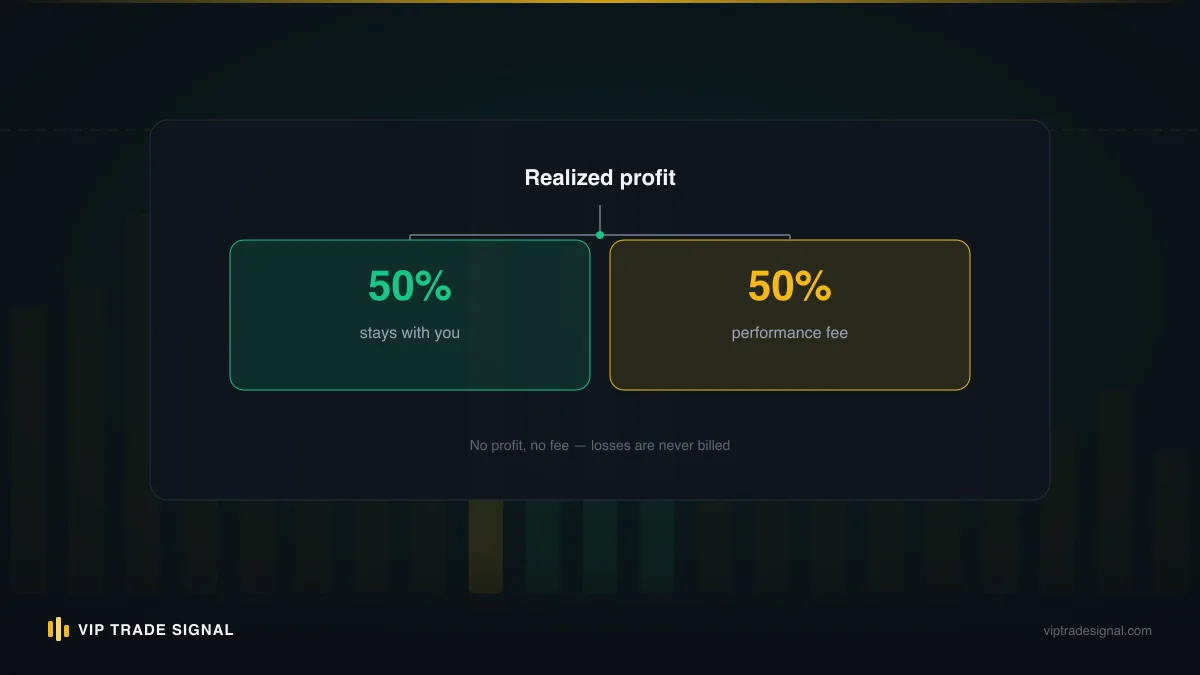
Now look at a straight profit-sharing agreement. The manager earns a defined percentage of realized profit. No profit, no fee. Losses fall where mudarabah says they fall — on the capital. The incentive structure and the classical structure are the same shape.
A manager who only eats when you eat is not just better aligned. He's structured the way Islamic finance has structured this relationship for a thousand years.
We should declare our interest here, because it's obvious: our own account management service charges a flat 50% of realized profit and nothing else — no management fee, no charge in losing months. We didn't design it to satisfy mudarabah; we designed it because we think managers should be paid for results. But the convergence is real, and several clients came to us specifically because the structure maps cleanly onto the profit-sharing model their scholar approved. Two honest caveats. First, 50% is at the high end of the industry range, and we say so openly — the trade-off is a $200 minimum advance against future profit share rather than a $10,000 account minimum, and no lock-in. Second, mudarabah compliance involves more than the fee line: the underlying trading must itself be permissible (swap-free, and to your scholar's satisfaction on the settlement and leverage questions above), the profit ratio must be agreed in advance, and the manager cannot guarantee the capital. That last one cuts against something customers often want to hear. Any manager who guarantees your deposit back has either broken the structure or is lying about the guarantee. Usually the second.
The comparison in table form:
| Feature | Fixed management fee | Performance/profit share |
|---|---|---|
| Manager paid in losing periods | Yes | No |
| Loss borne by | Client, plus fee | Client (capital), manager loses effort |
| Classical analogue | None clean; resembles guaranteed return to agent | Mudarabah profit ratio |
| Incentive | Grow assets under management | Grow your account |
| Common range | 1-2% of assets/year | 20-50% of profit |
A hybrid — small fixed fee plus performance share — inherits the fixed fee's problem in miniature. Some scholars accept a modest fixed wakalah (agency) fee for administrative service as a separate contract; others see it as the same guaranteed payment through a side door. If your provider charges one, ask them which scholarly basis they're relying on and watch whether they have an answer. For the mechanics of how performance fees get calculated fairly — high-water marks, what counts as realized profit, why that matters more than the headline percentage — see our piece on high-water marks and hurdle rates.
Gold's special status in Islamic finance — and its complications
Since everything we trade is gold, we'd be dodging if we didn't address XAU/USD specifically. Gold is not just another instrument in Islamic law. It's one of the six ribawi commodities named explicitly in the hadith of the Prophet ﷺ — gold, silver, wheat, barley, dates, salt — for which exchange rules are stricter than for ordinary goods. Gold for gold must be equal and immediate. Gold for silver, or gold for currency, may be at any negotiated rate but must be exchanged hand to hand, on the spot.
That immediacy requirement makes spot gold trading conceptually closer to the classical rules than many people expect — currencies-for-gold at a spot price is precisely the transaction the texts regulate — but it also raises the possession question in its sharpest form. When you buy a lot of XAU/USD on a margin account, no bar moves. No allocated storage entry changes. You hold a contract whose value tracks gold. Is that possession?
The most widely cited modern treatment is the AAOIFI Shariah Standard on Gold (Standard 57, developed with the World Gold Council in 2016), which permits gold investment where there is either physical or constructive possession — and constructive possession requires something specific to be possessed: allocated, identified gold, with the buyer bearing its risk, even if it sits in a vault elsewhere. Gold-backed instruments with allocated metal can qualify. A leveraged CFD on the gold price, where the broker holds no metal on your behalf, is much harder to fit through that door, and plenty of scholars say plainly that it doesn't fit.
So an honest summary looks like this. Trading gold is not the problem; gold is arguably the most halal-discussed asset in the classical literature, and the instinct that draws Muslim traders toward gold rather than exotic currency crosses is a sound one. The delivery mechanism is the problem, and it's the same spot-settlement question from earlier wearing a heavier coat, because gold's ribawi status makes the immediacy requirement explicit rather than inferred. Scholars who accept margin-account balance changes as constructive possession will generally extend that to XAU/USD on a swap-free account. Scholars who require allocated metal will not, and for them the compliant routes are physical gold, allocated vault accounts, or certain gold ETFs structured for Standard 57.
We won't pretend to referee that. What we can do is keep our side of it clean — every gold position on a client's Islamic account swap-free, every trade visible in their own MT4/MT5 — and encourage you to put the possession question, specifically and in these terms, to your scholar before any money moves. It is the single most consequential question in this article for a gold-focused account, and it deserves a considered answer rather than a broker's green tick.
Where the scholars agree, and where they don't
It helps to see the terrain in one place. On some points the positions are close to unanimous. On others, respected authorities disagree, and a provider who claims otherwise is being careless or worse.
Broad agreement:
- Paying or receiving rollover interest (swaps) is riba. Standard accounts held overnight are impermissible. This is the closest thing to a universal position in this entire subject.
- Currency exchange itself is permissible with immediate settlement — the prohibition is not on forex as an activity.
- Gambling-shaped trading — no analysis, extreme leverage, staking rent money on coin-flips — falls under maysir regardless of account type.
- A manager cannot guarantee capital or a fixed return to the client. Any "guaranteed 10% monthly, fully halal" pitch is doubly fraudulent: the guarantee breaks the structure, and nobody can deliver it anyway.
Genuine disagreement:
- Whether margin-account settlement constitutes valid possession (qabd) for currencies, and especially for gold under the ribawi rules.
- Whether broker leverage on a swap-free account is a benign facility or a benefit-bearing loan.
- Whether fixed "administration fees" on Islamic accounts are an honest service charge or repackaged riba — often it depends on the individual broker's formula.
- Whether short selling currency pairs is permissible (you're selling one currency of the pair either way, which softens the objection, but positions differ).
- How much leverage is too much before the gharar/maysir concern bites. Some draw no numeric line; some are comfortable only at low single digits.
Notice the pattern. The agreements cluster around things you can verify mechanically — the swap column, the absence of guarantees. The disagreements cluster around legal characterisation of modern market plumbing. Which is exactly why our advice throughout is split in two: demand the verifiable things from any provider as non-negotiables, and take the characterisation questions to a scholar whose methodology you trust. Fatwa-shopping until you find a permissive answer is its own kind of dishonesty, and most people who care enough to read this far already know that.
Vetting a "halal" managed account offer
The uncomfortable truth about this corner of the market: religious framing is a trust accelerant, and fraudsters know it. Affinity fraud — scams that spread through communities of faith precisely because the shared identity lowers everyone's guard — is a documented, recurring pattern, and "halal investment" schemes promising fixed monthly returns have burned communities from Malaysia to Birmingham. The word halal on a pitch deck deserves more scrutiny, not less, because the people most likely to misuse it are betting you'll extend trust on the label alone.
So vet a halal managed forex account the way you'd vet any managed account, plus the compliance layer on top.
The ordinary layer first, because a compliant structure on top of a scam is still a scam:
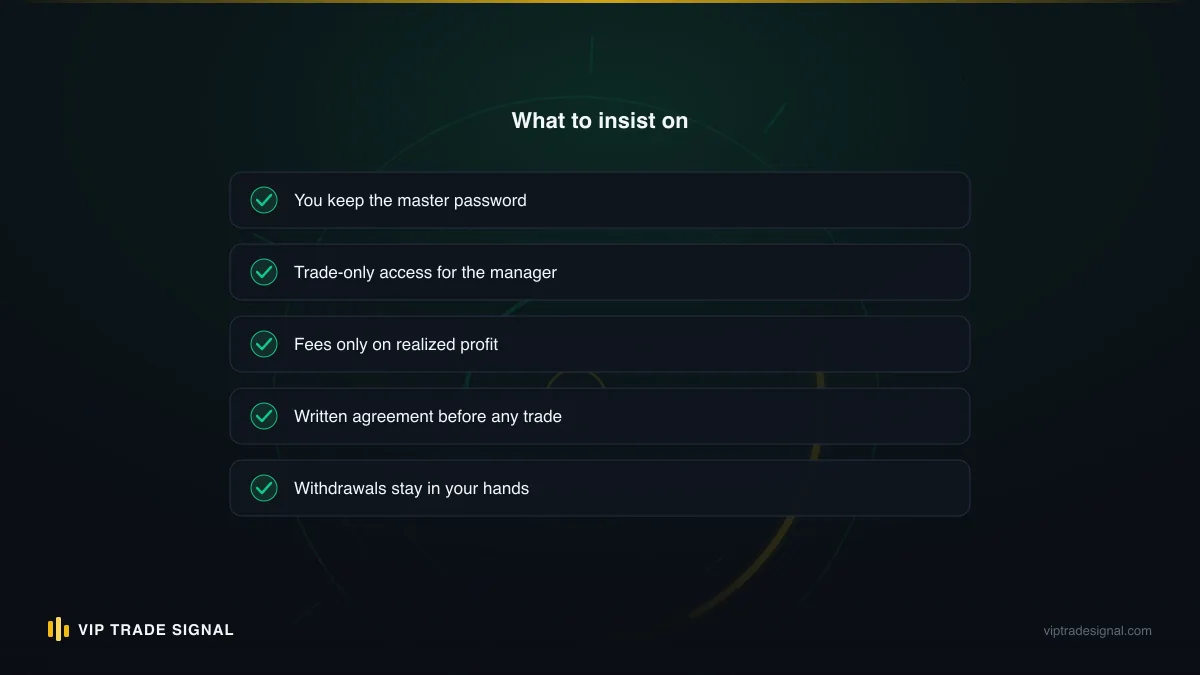
- Your money stays in your name. The account should be yours, at a regulated broker you chose, with the manager trading it under limited access. If they ask you to wire funds to their account or a pooled wallet, walk away. This single rule filters out the large majority of frauds.
- You keep the master password and withdrawal rights. The manager gets trade-only access (the investor password arrangement, or a dedicated trading login). At our desk this is how every account runs, and we'd be suspicious of any structure where it doesn't — there is no legitimate reason a manager needs the ability to withdraw your money.
- No guaranteed returns. Covered above, but it belongs on the checklist because it's the most common tell. Losses are normal in trading; months will be red; a pitch that says otherwise is either naive or predatory.
- A verifiable, warts-included record. Myfxbook or investor-password access to a live track record, losses visible. Screenshots prove nothing. We publish every closed signal, wins and losses, for exactly this reason.
Then the compliance layer:
- Swap-free execution, evidenced. Not claimed — shown, in trade history, on the account type your money will actually use.
- A profit-sharing agreement in writing. The ratio stated in advance as a percentage of realized profit, what "realized" means defined, no fixed management fee (or, if there's an administrative fee, a stated scholarly basis for it).
- No capital guarantee in the contract. Its presence is a compliance failure and a fraud flag simultaneously — a rare twofer.
- Straight answers about the grey areas. A provider doesn't need to resolve the possession debate for you. They do need to know it exists. Ask about leverage policy and settlement and watch whether you get an answer or a brochure.
- Comfort with your scholar's involvement. A legitimate provider will happily explain their structure to a third party. Evasiveness here is disqualifying.
If a provider passes all nine, you still haven't found a guarantee of profit — no such thing exists, and gold in particular can hand a well-managed account a losing quarter. What you've found is an arrangement where the losses, if they come, are the honest kind: market losses on a structure you understood, rather than structural extraction dressed in religious language.
How to set up swap-free management with your broker
Practically, here's the sequence for a managed forex account for beginners setting this up for the first time. It's less work than it sounds — perhaps an hour of admin spread over a few days.
Open the account yourself, in your name. Pick a regulated broker offering a genuine Islamic account on the instruments the manager trades. If the manager is gold-only, as we are, the swap-free terms on XAU/USD specifically are what matter; some brokers exclude metals from their Islamic offering or apply the time-limited version to them, so read the metals line, not just the headline. Complete your own KYC. Fund it from your own bank.
Request or select the swap-free status. Some brokers offer it at signup as an account type; others convert an existing account on request, occasionally asking for a declaration of eligibility. Once active, verify it: open a small gold position, hold it over two rollovers (ideally across a Wednesday, when triple swaps normally post), and check the swap column reads zero. Five dollars of spread cost buys certainty about the thing this entire arrangement rests on. Cheap.
Set up manager access properly. Either share the investor-style trading credentials for that account or, on some platforms, a dedicated trade-only login. You keep the master password. You keep withdrawal rights. The manager can open and close trades and nothing else. Change the password later and their access ends — that's your kill switch, and a legitimate manager will point it out to you rather than hoping you don't notice it exists.
Put the profit-sharing agreement in writing before the first trade. The split, the schedule for settling it, the definition of realized profit, what happens in losing months (nothing should happen — that's the point), and how either side terminates. Read it against the mudarabah criteria from earlier. If you have a scholar advising you, this document plus the broker's swap-free terms are what they'll want to see. Our own process, including how the profit share is calculated and invoiced, is laid out in the FAQ; the setup for other providers should be comparably transparent, and if it isn't, ask why.
Agree the risk parameters out loud. Maximum leverage, risk per trade, whether news events are traded, drawdown level at which trading pauses for a conversation. This is where the gharar concern becomes something you can actually manage: a 1% risk-per-trade cap at moderate leverage isn't just prudent trading, it's the version of this activity easiest to defend as commerce rather than chance. If you're comparing this route against pooled alternatives with formal compliance boards, our comparison of hedge funds versus managed forex accounts covers the trade-offs — pooled Islamic funds offer institutional oversight at high minimums; a managed personal account offers control and transparency with the vetting burden on you.
Questions to ask us, or any provider, about compliance
We'll finish the practical section by arming you against everyone, ourselves included. These are the questions we think a serious enquirer should put to any halal managed forex account provider. We're happy to take them through our contact page; any competitor worth your money should be equally happy.
- "Show me a closed-trade statement from an account on the exact account type mine will use. What's in the swap column?" The answer should be a statement, not a paragraph.
- "How are you paid, precisely? Is any part of your compensation payable in a period with no profit?" The compliant answer is a profit ratio and an unqualified no.
- "Do you guarantee my capital or any return?" The only acceptable answer is no, said without hedging. Watch for "well, effectively..." — effectively means no structure and yes marketing.
- "Whose name is the account in, and who holds withdrawal rights?" Yours and you, or the conversation is over.
- "What leverage and risk-per-trade do you actually use, and can I see it in the history?" Vague answers about "dynamic risk management" mean they don't want you to know.
- "If my scholar wants to review the structure, will you walk him through it?" The reaction tells you more than the answer.
- "What's your position on the possession question for margin-traded gold?" They don't need to resolve it. They need to have heard of it. A provider selling halal gold trading who's never engaged with AAOIFI's gold standard hasn't done the homework their label claims.
Notice that none of these require you to be a trader or a jurist. They require the provider to be transparent, and transparency is the one property that both good compliance and good management share unconditionally.
Where this leaves you
Here's our honest summary of the whole terrain, as practitioners rather than authorities.
The clear-cut part is bigger than the industry admits. Swaps are riba and must be gone — verifiably, in the statement, not the brochure. The fee model matters religiously, not just financially, and a pure profit share is the structure with a thousand years of precedent behind it while a fixed fee in losing months has essentially none. Guarantees of capital or return are both non-compliant and a fraud signal. Your money should sit in your own account with your own broker under your own master password. Every one of those is checkable in under a day, and most "halal" offers on the internet fail at least one before you reach any hard jurisprudence at all.
The genuinely hard part is narrower but real: whether margin settlement counts as possession, particularly for gold; how leverage should be characterised; where speculation shades into maysir. Serious scholars disagree on these, which means two things. It means you should distrust anyone — provider, broker, or blog — who tells you the debate doesn't exist. And it means the final call belongs with a scholar who knows your school, your circumstances, and your risk, not with a trading desk. We can make our side of the arrangement as clean as the mechanics allow: swap-free gold execution, a straight 50% share of realized profit and nothing in losing months, your account, your keys, every trade visible. Whether that cleaned-up version passes the possession test is a question we genuinely cannot answer for you, and we'd rather say so than sell you a green tick.
Trading remains risky either way — compliant structure doesn't soften a losing streak, and anyone managing money who won't say that out loud shouldn't be managing money. But if you're going to have an account managed at all, the version where the manager only earns when you do, on an account you control, with the interest stripped out and the record public, is the version worth taking to your scholar. Start there, ask the seven questions, and don't let anybody rush you. The market will still be open after you've done it properly.