Strip away the Mayfair address and the investor letters, and a currency hedge fund does exactly what the bloke on Instagram offering to trade your MT5 account says he does: someone else's decisions, your money, a cut of the profits. Same DNA. Wildly different worlds.
That's why the hedge fund vs managed forex account question is worth taking seriously instead of treating it as a class divide. The fund manager and the retail account manager are cousins. One works inside a fortress of lawyers, auditors, administrators and prime brokers that costs hundreds of thousands a year to maintain. The other works inside a Telegram chat and a limited power of attorney form. The service is the same. The guardrails are not even close.
We sit on the retail side of this line, so you'd expect us to sell you the managed account and rubbish the fund. We're not going to. The honest version is this: the hedge fund is the safer structure and most people reading this cannot get into one, and the managed forex account is the accessible descendant that hands you real advantages (custody, liquidity, transparency) while quietly removing almost every institutional safety net. If you understand exactly which guardrails you're giving up, you can rebuild some of them yourself. If you don't, you're the reason the retail managed account has the reputation it has.
Two products with the same DNA and different postcodes
Start with what they share, because it's more than people think.
In both cases you are buying discretionary management. You hand over the trading decisions, in writing, to someone who claims an edge. In both cases the fee model is built around performance: the manager eats when you eat, at least in theory. And in both cases the core risk is identical and boringly human. Not the market. The manager. Every disaster in this business, at every level of wealth, comes down to a person with access to other people's money behaving badly or trading badly, usually both, usually in that order.
Now the differences, in one pass, before we take them slowly.
A hedge fund is a pooled vehicle. You wire money into a company (typically a limited partnership in Delaware, or an offshore feeder in the Caymans), receive units or partnership interests, and your cash becomes part of one big pot the manager trades as a single book. You own a claim on the pot, not any specific trade. Around that pot sits an ecosystem: a fund administrator independently calculating the value of your units each month, an annual audit by an outside accounting firm, a prime broker holding the assets, legal documents thick enough to stop a door, and a regulator (the SEC, the FCA, CIMA) somewhere in the background with the power to make everyone's year miserable.
A managed forex account is your own retail brokerage account, in your own name, at a broker you chose, which a manager trades under a limited power of attorney or through the broker's PAMM/MAM software. There is no pot. There are no units. There is usually no administrator, no auditor, and no regulator paying the slightest attention to the manager as a manager. The entire oversight apparatus is you, logging in.
Everything else in this article is a consequence of that structural fork.
Access: who's allowed in, and at what price
Here is where the fund world slams the door on most readers, so let's be concrete about the numbers.
Hedge funds in the US mostly raise money under exemptions that restrict them to accredited investors. The standard test: $200,000 of annual income ($300,000 with a spouse) for the last two years, or $1 million of net worth excluding your home. Funds that charge performance fees generally need you to be a qualified client, which currently means around $2.2 million in net worth. Some structures want qualified purchasers, at $5 million of investments. The UK and EU have their own versions (professional client status, minimum subscription rules) that land in roughly the same place. The paperwork exists precisely to keep out the people who can least afford a blow-up, which is patronising and also, if we're honest, correct on average.
Then there's the forex hedge fund minimum investment itself, which is a separate hurdle from accreditation. Small currency funds might accept $100,000. Established ones commonly want $250,000 to $1 million as a first ticket. And below all of that sits a soft filter nobody writes down: a fund with $200 million under management does not want the administrative hassle of a $100k investor asking questions. You can be legally eligible and still not worth their time.
So the practical answer for someone with $5,000, $20,000, even $80,000 in trading capital is blunt. The fund world does not want you. Not as a snub; as arithmetic. The compliance cost of onboarding you exceeds what they'd ever earn from your money.
The retail managed account inverts every one of those numbers. No accreditation test, because you're not buying a security, you're granting trading authority over your own account. Minimums set by the manager, not by regulation: some PAMM managers accept $500, most serious retail managers want $2,000 to $25,000, and our own account management service starts at whatever your broker's minimum is because we trade your account rather than pooling anything. Accredited investor forex products do exist in the gap (feeder funds, tokenised fund units, "mini" funds), but for most people the choice is genuinely binary: fund money or retail money.
That accessibility is a real achievement. It is also the entire reason the retail side is crawling with frauds. When anyone can offer the product and anyone can buy it, the filter that used to be regulation becomes your own judgement. Keep that thought; it's the theme of everything below.
Custody: fund units versus your own broker login
Custody is the single biggest structural difference, and it cuts in the opposite direction to what most people assume.
When you invest in a hedge fund, your money leaves you. It sits in the fund's account at a prime broker, commingled with everyone else's, and what you hold is a paper claim: units whose value the administrator reports to you. You cannot log in and look at the positions. You cannot withdraw on a whim. If the manager turns out to be lying about the assets, your monthly statement is fiction and you won't know until the redemption cheque bounces. This is exactly how Madoff ran for decades: no independent custody, no real administrator, statements typed up in-house. The institutional world responded by making independent administration and custody near-universal, but the lesson stands. In a pooled vehicle, you are trusting the structure, and the structure is only as good as the independence of the people running it.
A managed forex account flips custody entirely in your favour, and this is the one place where retail genuinely beats institutional. The money never leaves your name. It sits in your account, at your broker, and the manager gets trading access only. Done properly, the manager holds an investor password or an LPOA that permits trading and nothing else, while you keep the master password, the withdrawal rights, and the ability to see every position in real time. Nobody can wire your balance to Belize. There is no cheque to bounce, because there is no cheque. If we manage your account, we cannot withdraw a pound of it, and any manager who asks for withdrawal rights or wants you to deposit into "their" platform is not offering account management. That's just handing a stranger your money with extra steps.
But (and this matters) custody protects you from theft, not from trading. A manager with trading-only access can still destroy the account the ordinary way, with size. Custody means the money can only leave via losses. That's a meaningfully better position than a fund investor holding fictional statements. It is not safety.
PAMM, MAM, LPOA: not the same custody
Worth a short detour, because retail "managed account" covers three plumbing variants and they are not equally safe. Under a straight LPOA or investor-password arrangement, the manager trades your individual account and nothing else touches it. Under MAM software, the manager places one master trade that the broker's system allocates across many client accounts proportionally; your account is still yours, but you've accepted that your fills are whatever the block trade got, and that you're one of fifty accounts being steered by a single keystroke. PAMM goes further: your money is measured into a percentage share of a pooled trading account on the broker's platform. Still segregated in your name legally, still withdrawable, but you can no longer see individual positions in your own terminal, only your share's performance. Notice what happened there. PAMM quietly reintroduces the fund's keyhole problem, at retail, without the fund's auditors. If transparency is the thing you're buying with a managed account, and it should be, straight individual-account management shows you the most and PAMM shows you the least. Ask which plumbing you're getting before you ask about returns.
One more honest wrinkle: your custody is only as good as your broker. A fund's prime broker is a Goldman or a Morgan Stanley. Your retail broker might be a well-regulated firm in London or Sydney, or it might be a brass plate in St Vincent. If the manager insists on one specific obscure broker, ask why, loudly. Manager-and-broker working as a pair is one of the oldest structures in retail forex fraud, and we've covered the pattern in how forex account management works.
Oversight: an audit ecosystem versus you, squinting at MyFXBook
Here's what your fund fees actually buy, because it's mostly not trading talent.
A functioning hedge fund carries an independent administrator (firms like Citco or SS&C) who values the book monthly and controls the official record of what your stake is worth. It carries an annual audit, often by a Big Four firm, that physically confirms assets exist where the manager says they do. It carries a prime broker with its own risk department watching leverage. It files with regulators. Its marketing documents are reviewed by lawyers who go pale at the word "guaranteed". None of this makes the fund profitable. All of it makes large-scale lying difficult, because at least three independent organisations would have to be in on it.
Now list the equivalent for a retail managed account. Go on. We'll wait.
There isn't one. No administrator, because there's no pooled vehicle to administer. No audit, because nobody requires it and no manager pays for it voluntarily. No regulator, in most jurisdictions, because a limited power of attorney over an individual account slips between the definitions that trigger licensing (and where it doesn't, enforcement against a manager in another country is theoretical). The oversight layer for a retail managed forex account is you: your own reading of a Myfxbook or FX Blue track record, your own broker statements, your own willingness to log in and check.
In a fund, three independent firms have to fail for you to be robbed. In a managed account, only you do.
That sounds bleak, but self-verification is more powerful than it looks, because the raw data you can access is better than what fund investors get. A fund investor sees a monthly NAV. You can see every fill, timestamped, at your own broker, and no one can fake that upstream of you. The verification work is genuinely doable: demand investor-access (read-only) to a live track record, not screenshots; check the record covers eighteen months and a losing streak, not a lucky quarter; confirm the strategy on the record is the strategy proposed for your account, at your risk setting. We've written a full walkthrough of vetting in hire a forex trader, and the short version is that most candidates fail at the first step, which saves everyone time.
The trade, stated plainly: the fund buys oversight with your fees and its minimums. The managed account gives you better raw transparency and zero enforcement. Whether that's a good swap depends entirely on whether you'll actually do the checking. Most people don't. Be the exception or buy the fund.
Fees: 2-and-20 versus the retail profit split
The classic hedge fund model is 2-and-20: a 2% annual management fee on assets, plus 20% of profits, usually above a high-water mark and sometimes above a hurdle rate. In practice the industry has drifted cheaper (1.5-and-15 is common now, and big allocators negotiate below that), but 2-and-20 remains the reference point.
Retail managed accounts mostly drop the management fee and raise the performance cut. Typical splits run from 20% to 50% of profits, charged monthly or per withdrawal, ideally above a high-water mark. Ours is a flat 50% of realized profit with a $200 minimum advance that nets against your first fees; the split is at the very top of the market and we say so plainly on the pricing page, because the trade we're offering is high fee percentage in exchange for no management fee, no lockup, tiny minimums, and pay-as-you-go exit. High-water marks matter enormously in both worlds, and if the mechanics are fuzzy to you, read our piece on high-water marks and hurdle rates before you sign anything, fund or retail.
Now the part almost nobody works through: on the account sizes each product actually serves, the fee structures suit their worlds, and swapping them would be mad. Run the numbers on a decent year, say 20% gross return.
| Hedge fund (2-and-20) | Managed account (50% split) | Managed account (30% split) | |
|---|---|---|---|
| Account size | $500,000 | $10,000 | $10,000 |
| Gross profit (20%) | $100,000 | $2,000 | $2,000 |
| Management fee | $10,000 | $0 | $0 |
| Performance fee | $18,000 | $1,000 | $600 |
| You keep | $72,000 | $1,000 | $1,400 |
| Effective cost of gains | 28% | 50% | 30% |
Two things jump out. First, 2-and-20 is not cheap; on a 20% year the fund takes 28% of your gains, and in a flat year the 2% management fee means the fund gets paid for losing you nothing. The retail split, for all its scary headline number, charges exactly zero in a flat or losing year. Second, the reason retail splits are high is brutally simple: a manager doing real work on a $10,000 account earns $1,000 in a good year at 50%. At 2-and-20 he'd earn $560. No competent person runs a business on that, which is why every retail manager advertising fund-style fees on four-figure accounts is either lying about the fee or planning to make money some other way, usually rebates from churning your account through a partnered broker.
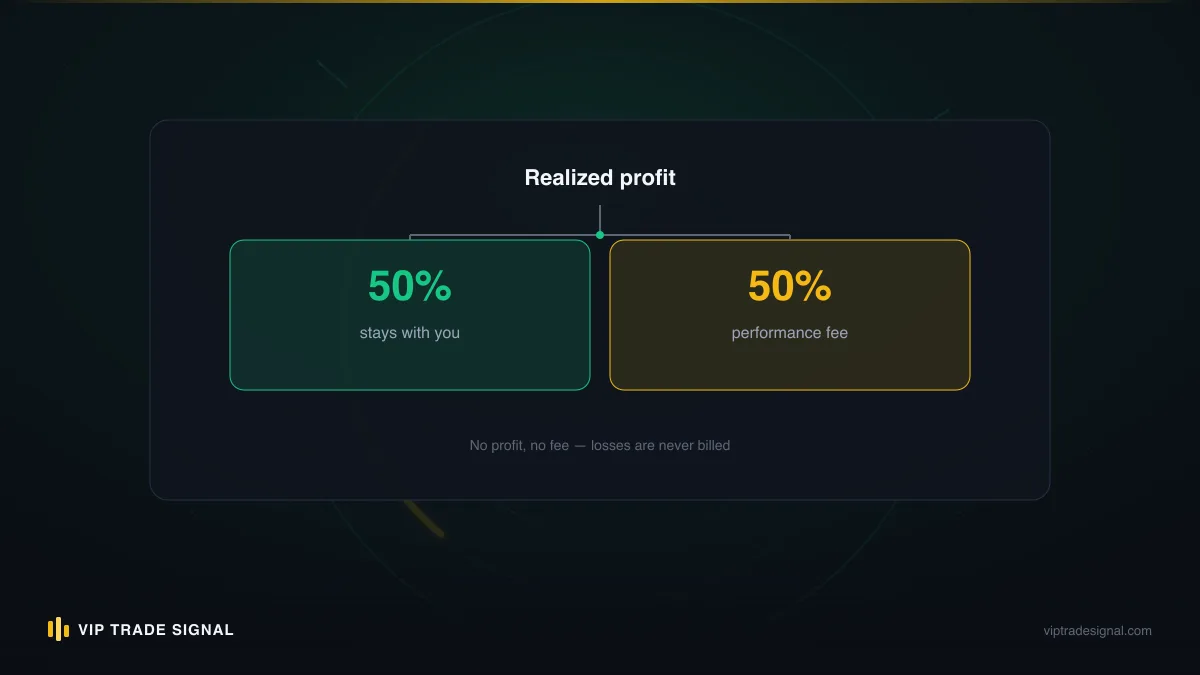
The fair conclusion on fees: neither structure is a rip-off and neither is a bargain; each prices the overheads and account sizes of its own world. What is a rip-off is any structure that charges you when you haven't made money above your previous peak. Performance fees without a high-water mark, in either world, are a machine for paying twice for the same gains.
Liquidity: lockups and gates versus pulling the plug tonight
Here's the difference people feel most viscerally once they're inside.
Hedge fund money is slow money by design. A typical fund takes subscriptions monthly, requires 30 to 90 days' notice for redemptions, and often imposes a hard lockup of a year on new money. On top of that sit gates: provisions letting the fund limit total redemptions to, say, 25% of assets per quarter when too many investors head for the exit at once. In 2008 plenty of investors discovered their "quarterly liquidity" was notional; funds gated, suspended redemptions, or shoved illiquid positions into side pockets that took years to pay out. The lockup isn't malice. A manager running size genuinely cannot unwind a book overnight without torching the remaining investors. But it means fund money is money you must be able to live without for a year or more, full stop.
Your managed forex account has none of this, and the speed is glorious. Spot gold and major forex pairs are among the most liquid instruments on earth; there is nothing to side-pocket. Revoking access is one email to the broker to cancel the LPOA, or one master-password change, and it takes effect in minutes. You can close every open position yourself tonight if you want to. Withdrawal is a normal broker withdrawal, in your name, typically one to three days to your bank. When people ask us what happens if they get cold feet mid-month, the answer sits in our FAQ and is one sentence long: change the password, we settle up on whatever profit is realized, done.
So retail wins liquidity outright? Almost. Two honest caveats.
First, instant liquidity has a floating-position asterisk. If you pull access while trades are open and underwater, you own those positions now, at their current loss. The right to leave instantly is not the right to leave at your high-water mark. Managers who run wide stops or (worse) no stops can leave you holding a floating drawdown that makes "instant" exit expensive on the day you most want it.
Second, your own liquidity can be your enemy. The fund lockup, for all its annoyance, forcibly stops the classic retail self-sabotage: pulling the plug at the bottom of a normal losing streak, right before the strategy's recovery, then chasing the next manager. We've watched people do this three times in a year and call the strategy the problem. Slow money is sometimes protected from its owner. Fast money never is.
Transparency: the quarterly letter versus the live login
A fund investor's information diet is thin and curated. A monthly NAV from the administrator. A quarterly letter where the manager explains, in prose he wrote himself, why the quarter went how it went. Perhaps a top-positions summary, delayed and aggregated so nobody can reverse-engineer the book. This opacity is deliberate and partly legitimate; a fund's positions are its trade secrets. But it means a fund investor evaluates the manager through a keyhole the manager built.
The managed account is the opposite extreme, and it's not close. You can open the MT4 or MT5 app right now and see every open position, its size, its entry, its stop, its floating profit or loss, updated tick by tick. Every closed trade sits in your account history with timestamps to the second, recorded by the broker, not the manager. No fund investor on the planet gets that. It is the strongest single argument for the managed account structure, because it makes slow-motion lying nearly impossible: the account is what it is, and you can look at any hour of any day.
The catch is what real-time transparency does to your head. Watching a position float $400 against you at 11pm is a skill nobody warns you about, and plenty of clients discover they'd rather not have the keyhole after all. Full visibility means full exposure to the mid-trade discomfort that fund investors are structurally spared. Our advice, for what it's worth: check weekly on a schedule, judge monthly against the agreed risk parameters, and don't watch individual trades breathe unless you're auditing something specific. The login is for verification. It makes a terrible television channel.
There's also a transparency trap on the retail side worth naming: transparency about the past. The fund's track record is administrator-calculated and audited. The retail manager's track record is whatever he chooses to show you, and the ecosystem of fake Myfxbook pages, demo accounts dressed as live ones, and cherry-picked windows is vast. Real-time transparency starts only after you sign. The history you evaluated before signing deserves triple the scepticism, precisely because no auditor ever touched it.
When it goes wrong: blow-ups in both worlds
Neither structure prevents disaster, and it's clarifying to look at how each one fails.
Funds fail in two flavours. There's honest failure: FX Concepts, once the largest currency hedge fund in the world with over $14 billion at peak, wound down in 2013 after years of poor returns and redemptions. Investors lost money the legitimate way, with audits and administrators watching all along. The guardrails don't stop losses; they were never meant to. Then there's fraudulent failure, Madoff being the canonical case, where every guardrail was missing or captured: no independent administrator, a two-man audit shop, custody in-house. The institutional lesson from both flavours is the same. Oversight protects you from lies, not from losses, and only when it's genuinely independent.
Retail managed account failures are faster, uglier, and mostly invisible because no journalist covers a $12,000 account. The common patterns, from years of watching post-mortems land in our inbox: the martingale manager who doubles into every loser and produces a beautiful 11-month equity curve before donating the account to the market in a week; the rebate churner who over-trades your account for broker kickbacks and doesn't much care whether you win; the outright thief who needed withdrawal access or "his" platform to operate, and got it. The custody rules kill the third pattern completely. Nothing structural kills the first two; only your risk limits, in writing, and your willingness to enforce them by revoking access at the first breach.
Put a scenario on the martingale case, because the shape of it is the same every time. A trader we'll call Dan hands $15,000 to a manager whose published curve shows 6% a month for nearly a year with barely a red week. Smooth curves at that return level are the tell, not the reassurance; real trading breathes, and anything that only goes up is usually averaging into losers and hiding the risk in floating drawdown. For ten months Dan withdraws a little profit and tells his mates. In month eleven gold runs 900 points against the grid, the doubled positions hit margin, and the broker's stop-out closes everything at once. Dan's statement shows one catastrophic day that returned every previous gain plus half his principal, all of it via authorised trades, every one within the LPOA. He has no complaint to file. The manager, who was running forty accounts the same way, deletes the channel and starts a new one under a fresh name by the weekend. Nothing in that story is exotic. It's the standard failure, and the only defences are the boring ones set before month one: a hard monthly drawdown cap in writing, position-size limits you actually monitor, and the resolve to pull access the first time either is breached rather than the fifth.
Notice the asymmetry in aftermath. When a regulated fund fails, there's a liquidator, a legal process, sometimes partial recovery over years. When a retail manager in another jurisdiction blows up your account within the terms of the LPOA you signed, there is no process. Losses through authorised trading are just losses. This is the risk sentence we're obliged to say and mean: any managed forex arrangement, ours included, can lose a lot of your money legitimately, and no split, structure, or track record changes that.
The separately managed account: the institutional middle ground
There's a third structure sitting between the two worlds, and it's worth knowing about even if you'll never use it, because it proves the point of this whole comparison.
A separately managed account (SMA) is what happens when a large investor wants a hedge fund's manager without a hedge fund's pooling. Instead of buying units, the investor opens an account in their own name at an institutional custodian, and the fund manager trades it under an investment management agreement, often running the same strategy as the flagship fund. Family offices and pension allocators love SMAs precisely for the reasons this article has been circling: custody stays with the investor, positions are visible in real time, liquidity is a termination notice rather than a redemption queue, and fees get negotiated below the pooled fund's rack rate.
Sound familiar? It should. A separately managed account is, structurally, a managed forex account with the serial numbers filed off and a few zeros added. The institutional world converged on your structure once the cheques got big enough to demand it. The custody and transparency advantages retail investors get by default are the very things $50 million allocators fight for in negotiations.
The differences are the surrounding fortifications. An SMA minimum typically starts around $1 million to $5 million, because running a parallel book is operational hassle the manager only tolerates for size. The manager is a regulated investment adviser with fiduciary duties. The agreement runs to dozens of pages of negotiated risk limits, and the custodian is a real bank. So the middle ground exists, but its drawbridge is up for anyone under seven figures.
Why bring it up at all, then? Because the SMA is the standard your retail arrangement should imitate on paper even when nobody forces it to. Written risk limits (maximum open risk, maximum monthly drawdown, instruments allowed, leverage cap). A defined baseline and high-water mark, recorded before trading starts. Termination mechanics agreed in advance. When we take on an account, that's the shape of the agreement we insist on, and any retail manager who reacts to a written risk limit like you've insulted his mother has told you everything you need to know.
Managed account vs fund: a net-worth-based way to choose
Time to make the decision framework explicit, because "it depends" is a cop-out and the managed account vs fund choice mostly resolves itself once you're honest about three numbers: your investable net worth, the size of this allocation, and whether losing it entirely would change your life.
Under roughly $100k investable: the fund question is closed for you. You can't meet accreditation, you can't meet minimums, and any "fund" that eagerly accepts your $5,000 anyway is answering the most important due-diligence question for you, unfavourably. Your real choice is between a managed account, trading your own money on signals, and not doing this at all. Not doing it is underrated. If you do proceed, the allocation should be money whose total loss you can absorb without drama; for most people that's 5-10% of investable assets, not the lot.
$100k to $1m: technically in reach of the bottom of the fund world, practically better served elsewhere. The funds that would take your $100k minimum are, by and large, the small and hungry ones without the institutional infrastructure that justifies fund fees in the first place, which buys you the worst of both worlds: fund lockups with startup oversight. At this level a managed account with SMA-grade paperwork, at a first-tier regulated broker, sized as a small slice of your assets, is usually the more honest structure. You keep custody and liquidity, and you have enough at stake to actually do the verification work.
Above $1m to $2m: you finally have real options, and the calculus flips. Accreditation opens, decent funds return your calls, and the value of audits, administrators and legal recourse compounds with cheque size. A $500k allocation deserves the fortress; the fees fund something you can no longer verify alone at that scale. Plenty of wealthy investors still run a managed account alongside, for liquidity and visibility, but as the satellite rather than the core.
Whatever bracket you're in, one rule survives every scenario: the structure you choose must match the checking you'll actually do. A fund investor can be lazy, mostly, because the fortress checks for them. A managed account holder who is lazy is unprotected in every direction that matters. There is no structure that combines retail access, retail minimums, and institutional oversight. Anyone selling you one is lying about at least one of the three.
Where this leaves you
Strip it back to the trade you're actually making. The hedge fund sells you guardrails and takes away access, custody, liquidity and visibility. The managed forex account sells you access, custody, liquidity and visibility, and takes away every guardrail except your own diligence. Neither is the grown-up option and neither is the mug's option. They're the same product wearing different armour, priced for different wallets.
If you're going the retail route, the working checklist is short and non-negotiable. Custody stays with you: your account, your broker, your master password, your withdrawals, no exceptions ever. Verification before signature: live investor-access track record, eighteen months minimum, losing streaks visible, matched to the strategy you're actually buying. Paper like an SMA: written risk limits, a recorded baseline, a high-water mark, termination mechanics. And sizing like an adult: an amount whose complete loss you could shrug off, because complete loss is a real outcome in leveraged trading no matter who holds the reins.
That's the standard we hold ourselves to on the account management side, and we'd rather you hold every manager to it, including us, than take anyone's word for anything. The retail managed account earned its dodgy reputation one lazy investor at a time. It doesn't have to include you.
The hard question to sit with tonight isn't which structure is better. It's this: if nobody is going to audit your manager, are you truly willing to be the auditor, every month, even when the equity curve looks lovely? If yes, the accessible version of this product can work for you. If no, keep your money in things that come with a fortress, and don't let anyone on the internet talk you out of that.