There's a specific moment that kills more small gold accounts than any market crash, and it happens before the trade is even placed. A trader with $300 sees a signal, opens the order ticket, and types 0.05 into the volume box because 0.01 "feels too small to bother with". Gold moves $18 against them overnight. That's $90 gone. Thirty percent of the account, on one trade, and the stop hadn't even been hit yet.
Getting the lot size for gold with a small account right isn't a nice-to-have. It is the whole game. Entries, exits, signal quality, market analysis: all of it is downstream of one boring calculation that takes fifteen seconds and that most people skip because the number it produces feels insultingly tiny.
So here are the exact numbers. Tables for $100, $250, $500 and $1,000 accounts across the stop distances gold actually produces. A hard rule for when the minimum lot size means the correct trade is no trade. And a proper explanation of leverage, because the 1:500 your broker handed you is not what you think it is.
The small-account gold problem in one example
Let's make it concrete straight away, because abstractions are where bad sizing hides.
Say you have a $250 account. A signal arrives: buy XAU/USD at 3,340, stop loss at 3,332, take profit at 3,356. An $8 stop. Perfectly normal for gold. Tight, even, by this market's standards.
The textbook says risk 1% per trade. One percent of $250 is $2.50. Now, on gold, a 0.01 lot position (the smallest most brokers allow) moves $1 in your equity for every $1 the gold price moves. So an $8 stop on 0.01 lots risks $8. You wanted to risk $2.50. The smallest position your broker will let you open risks more than three times that.
There is no lot size that makes this trade fit a 1% rule on $250. None. The maths doesn't bend because you'd like it to. You have exactly three options: risk 3.2% and accept it consciously, skip the trade, or move to an account type with smaller minimums. What you cannot do (what thousands of small traders do every week anyway) is open 0.02 or 0.03 "to make the win worth it" and pretend the risk rule still exists.
And this is the mild case. Gold signals with $15 or $20 stops are common when price is moving around a big level. On a $250 account, a 0.01 lot with a $20 stop is 8% risk. Three losers in a row, which any honest signal provider will tell you happens regularly, and you're down nearly a quarter of the account. That's not a losing strategy. That's a sizing problem wearing a strategy's clothes.
The small-account gold problem, stated plainly: gold's volatility produces stop distances that frequently make even the minimum lot size too big for textbook risk on accounts under $500. Everything else in this article is about handling that honestly.
Gold pip value and the 0.01 lot floor
Before the tables, we need the machinery, because half the confusion around XAU/USD sizing comes from the word "pip" meaning different things at different brokers.
Forget pips for gold. Think in dollars of price movement. It's cleaner and you can do it in your head.
The standard contract for XAU/USD at almost every retail broker is 100 troy ounces per 1.00 lot. So:
- 1.00 lot: a $1 move in the gold price changes your equity by $100
- 0.10 lot: a $1 move changes your equity by $10
- 0.01 lot: a $1 move changes your equity by $1
That last line is the one to memorise. At 0.01 lots, gold's price movement in dollars equals your profit or loss in dollars, one for one. If your stop is $12 away, a 0.01 lot position risks $12. Done. No calculator needed.
(When brokers quote gold "pips", some mean $0.10 moves, some mean $0.01, and their platforms count "points" differently again. This is why a xauusd lot size calculator gives different answers on different sites: they're using different pip definitions. Dollars of price movement sidesteps the entire mess. A signal that says "stop 80 pips" from a provider using $0.10 pips means an $8 stop. Always convert to dollars first.)
The general formula, once you're sizing above the minimum:
Lot size = (account balance × risk %) ÷ (stop distance in dollars × 100)
Example: $1,000 account, 1% risk ($10), stop $5 away. Lot size = 10 ÷ (5 × 100) = 0.02. A $2,000 account with the same stop gets 0.04. Simple.
Now the floor. Most standard and "cent-free" retail accounts have a minimum volume of 0.01 lots and step in 0.01 increments. You cannot open 0.005. You cannot open 0.014. The ladder starts at 0.01 and climbs in whole hundredths, and for small gold accounts that first rung is the entire problem. On EUR/USD a 0.01 lot is pocket change per pip; on gold, 0.01 lots with a normal $10-$15 stop is real money against a three-figure balance.
Every table below is built on that floor. When the formula spits out a number under 0.01, the position you want does not exist, and we'll deal with what that means in a moment.
Lot size for gold with a small account: the exact tables
Here is the lookup most articles dance around. Four account sizes, five stop distances, at 1% and 2% risk. Numbers are rounded down to the nearest 0.01. You always round down, never up, because rounding up quietly increases risk and rounding down quietly reduces it. Where the correct size is below the 0.01 floor, the cell says skip and means it.
At 1% risk per trade:
| Stop distance | $100 acct | $250 acct | $500 acct | $1,000 acct |
|---|---|---|---|---|
| $3 stop | skip | skip | 0.01 | 0.03 |
| $5 stop | skip | skip | 0.01 | 0.02 |
| $8 stop | skip | skip | skip | 0.01 |
| $12 stop | skip | skip | skip | skip* |
| $20 stop | skip | skip | skip | skip |
*A $12 stop on $1,000 at 1% wants 0.0083 lots, under the floor. At 1.2% risk it just fits 0.01. Your call whether that rounding is acceptable; ours is that up to about 1.5% on a clean setup is fine, and we say so out loud rather than pretending.
At 2% risk per trade:
| Stop distance | $100 acct | $250 acct | $500 acct | $1,000 acct |
|---|---|---|---|---|
| $3 stop | skip | 0.01 | 0.03 | 0.06 |
| $5 stop | skip | 0.01 | 0.02 | 0.04 |
| $8 stop | skip | skip | 0.01 | 0.02 |
| $12 stop | skip | skip | skip | 0.01 |
| $20 stop | skip | skip | skip | 0.01 † |
† 2% of $1,000 is $20, exactly matching a $20 stop at 0.01 lots. It fits, but with zero headroom.
Read those tables slowly, because they say something uncomfortable. A $100 account on a standard gold contract has no valid trades at all at sensible risk. Not some. None. Even a tight $3 stop at 0.01 lots risks 3% of the account, and gold rarely gives you $3 stops that survive contact with its ordinary noise. If you have $100 and want to trade gold responsibly, you need a cent account (more on those below) or you need to save up. That's not gatekeeping, it's arithmetic.
The $250 account gets a sliver of room at 2% risk, and only on tight stops. The $500 account starts to breathe. At $1,000, most normal signals become tradeable at defensible risk, which is why we tell people that four figures is where gold stops fighting you on size.
One more honest note on these numbers: they assume $1 of price movement equals exactly $1 per 0.01 lot, which holds for USD-denominated accounts at 100 oz contract brokers. If your account is in euros or your broker uses a different contract size (a few use 10 oz), rerun the formula. A gold position size calculator is worth using once to verify your broker's contract spec, then the mental math above takes over.
The skip rule: when the minimum lot means no trade
Every cell that says "skip" deserves its own section, because skipping is the single hardest discipline for a small account and the one that actually determines survival.
Here's the rule we give people, stated as a rule because fuzzy guidance gets ignored:
If 0.01 lots at the signal's stop distance risks more than 2% of your account, the trade does not exist for you. Not smaller. Not "just this once". It does not exist.
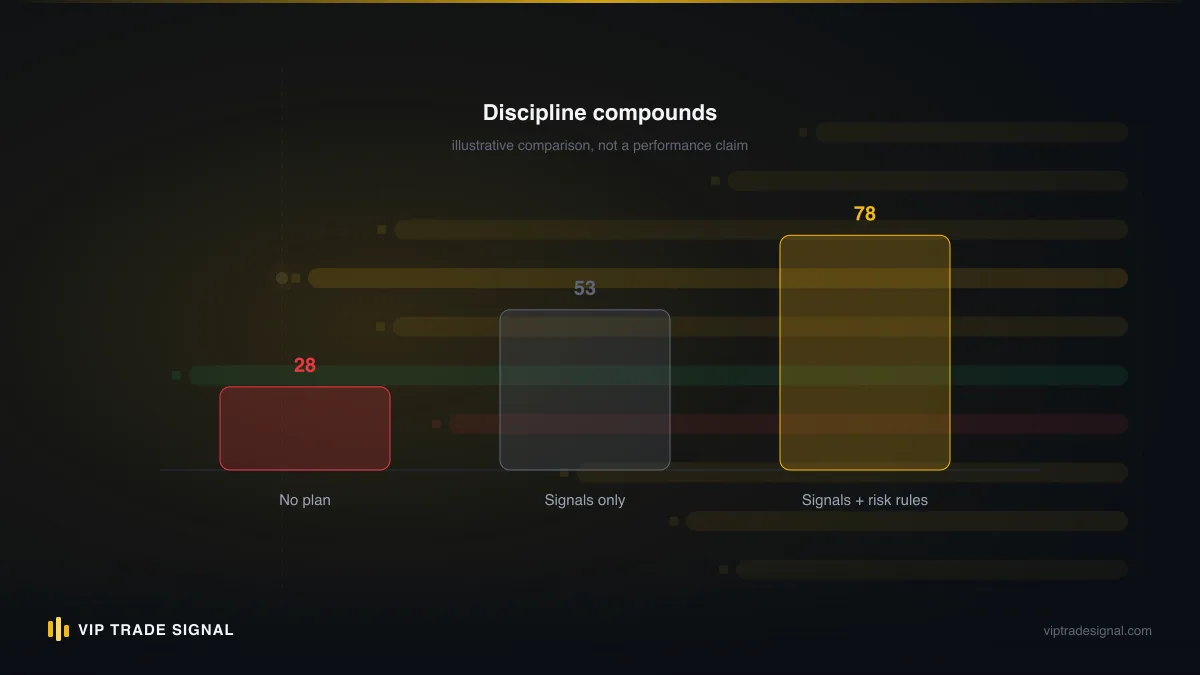
Why 2% and not 1%? Because we're being practical. A small account following gold signals at a strict 1% cap would sit out most of the market, and a rule that forbids nearly everything gets abandoned within a fortnight. We've watched it happen over and over. Two percent is the compromise between textbook and reality: high enough that some trades qualify, low enough that a bad week is a bruise rather than a burial. Ten consecutive losses at 2% leaves you with about 82% of your starting balance. Painful, recoverable. Ten at 8% leaves 43%. That's a different kind of problem.
The psychological trap is that skipping feels like losing. The signal wins, you weren't in it, and your brain files that as money taken from you. It wasn't. The counterfactual isn't "I'd have won that trade". It's "I'd have taken every wide-stop trade this month at oversized risk", and across a real distribution of wins and losses that version of you is poorer, sometimes dramatically so. You don't get to cherry-pick which oversized trades you'd have taken. Discipline is a package deal.
What does skipping look like in practice with a signal service? Our signals publish entry, stop and target on every trade, and the full record, losers included, sits at /signals/history. When a signal lands, you check the stop distance in dollars, run it against your balance, and if the maths says skip, you close Telegram and do something else. A $250 account might qualify for roughly a third of a typical month's gold signals. That's fine. Nobody is grading you on participation.
And if you find yourself unable to skip, if every signal feels mandatory, that's worth sitting with, because it usually means the account is being treated as a lottery ticket rather than a trading balance. Lottery tickets have a known expected value. It's negative.
Leverage is a margin tool, not permission to size up
Now the great misunderstanding. Somewhere along the way, retail marketing convinced an entire generation of traders that leverage is a multiplier on their potential, that 1:500 means "trade 500 times bigger". So let's take it apart properly, because leverage risks trading XAUUSD are almost entirely self-inflicted and almost entirely avoidable.
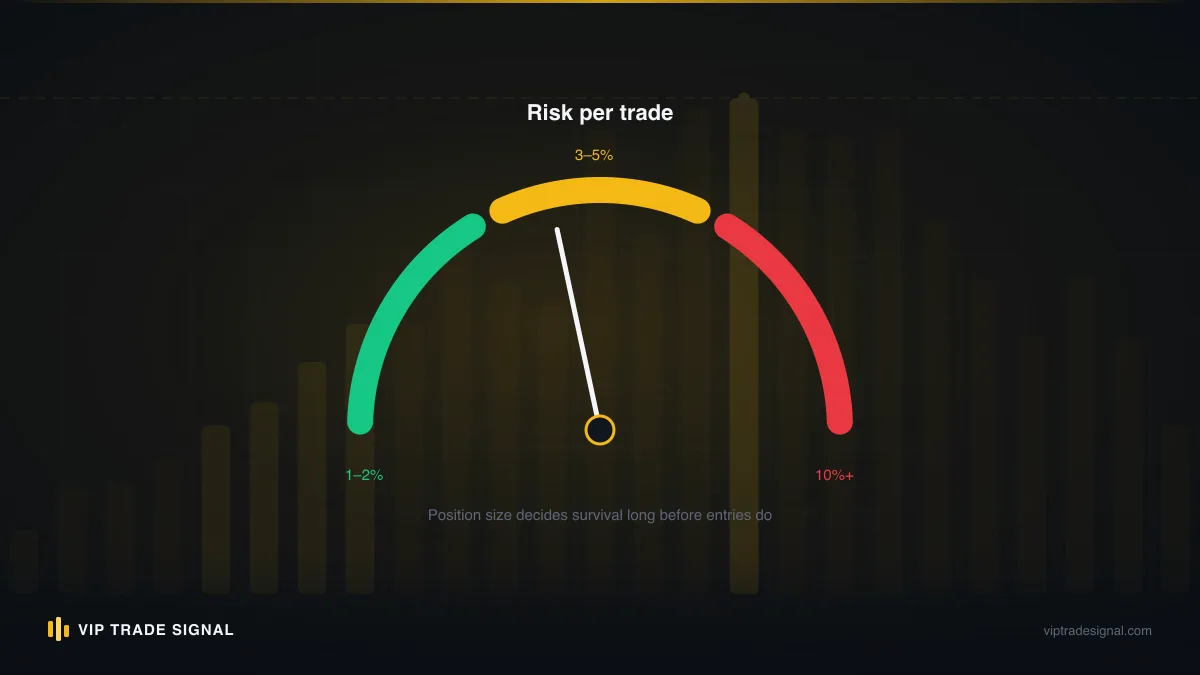
Leverage determines one thing: how much margin your broker sets aside as collateral when you open a position. That's it. It does not change what a position is worth, how much it moves, or how much you lose when the stop hits.
Walk through it with real numbers. Gold at $3,340. You open 0.01 lots: one ounce of exposure, $3,340 of notional value.
- At 1:100 leverage, the broker locks $33.40 of your balance as margin.
- At 1:500 leverage, the broker locks $6.68.
- At 1:2000, about $1.67.
In every single case, a $10 adverse move costs you exactly $10. The leverage changed the deposit, not the risk. Your loss is set by lot size and stop distance, full stop. A 0.01 lot position with a $10 stop risks $10 whether your account leverage is 1:30 or 1:2000.
So what is high leverage actually for on a small account? Breathing room. On a $250 account at 1:100, that $33 of locked margin is 13% of your balance sitting unavailable; open two positions and margin starts crowding your free equity, which matters because your floating losses draw down free margin and a margin call arrives when free margin runs dry. At 1:500, the same position locks under $7, leaving the rest of the balance free to absorb normal drawdown without the broker force-closing you at the worst possible moment. Used this way (same lot sizes you'd have chosen anyway, just less capital held hostage) higher leverage genuinely helps small accounts.
Used the other way, it's a loaded gun. Because the same 1:500 that locks only $7 for a sensible 0.01 lot position will also cheerfully let your $250 account open 0.37 lots of gold. Thirty-seven ounces. A $6.75 move against you, which gold does between breakfast and lunch, and the account is gone. The broker didn't make you do that. The leverage just stopped saying no.
The sentence to internalise: position sizing decides your risk; leverage decides your margin. They are different dials. Turn the leverage dial as high as your broker offers if you like, and never touch the sizing dial because of it.
Why 1:500 leverage still destroys small gold accounts
If leverage doesn't change risk per lot, why do high-leverage gold accounts blow up so reliably? Because leverage removes the guardrail that used to fail the reckless trade before it opened.
At 1:30 — the cap European regulators enforce for a reason — a $250 account physically cannot open 0.10 lots of gold; the margin requirement (over $1,100) exceeds the balance and the platform rejects the order. The constraint does the discipline for you. At 1:500, the margin for 0.10 lots is about $67, the order goes through, and now a $250 account holds a position where every $1 of gold movement is $10 of equity. A perfectly ordinary $22 intraday swing is nearly the whole account.
Watch how this plays out in the wild, because the pattern is depressingly consistent. A trader we'll call Sam funds $300 at 1:500. First week, Sam trades 0.01 and 0.02, wins a little, gets bored. The wins feel too small to matter — $8 here, $14 there. So Sam "scales up" to 0.10, reasoning that the broker allows it, so it must be within some sanctioned boundary. Two winners at 0.10 double the boredom into conviction. Then a signal loses $16 of gold movement, which at 0.10 lots is $160. Sam revenge-trades 0.20 to win it back, gold gaps $9 on a data release, and the account that survived three weeks dies in four minutes.
Every step in that chain felt locally reasonable. The only structural defence was the one Sam abandoned in week one: size from the risk formula, ignore what the margin allows.
There's a second, sneakier mechanism worth naming: stop-out cascades. Overleveraged accounts run with thin free margin, so a normal adverse move triggers the broker's stop-out and closes positions at market — often at the spike's worst tick, in spread conditions far uglier than your intended stop loss. Traders then blame the broker for "hunting stops" when the honest post-mortem is that the position was ten times too big for the balance. Gold, with its habit of $5 spreads during news and its violent reactions around key levels (we've written about how it behaves at support and resistance), punishes thin margins harder than any major forex pair.
High leverage on a small gold account is fine the way a sharp knife is fine. The tool isn't the danger. The tool in the wrong grip is.
Wide-stop signals and small accounts: the honest conflict
Here's a tension most signal services won't say out loud, so we will: good gold signals often carry stops that small accounts cannot afford, and no amount of cleverness fully resolves that.
A stop loss belongs where the trade idea is wrong — beyond the swing low, past the level, outside the noise. On gold, "outside the noise" is frequently $10-$25 away. That's not the signal provider being sloppy; a tighter stop would just donate money to ordinary volatility. We've covered why gold stops need room in our piece on stop loss strategies for gold, and the short version is that a stop placed where the maths is comfortable rather than where the chart is wrong isn't a stop, it's a random exit.
So the conflict is genuine. The signal needs a $18 stop to be a good signal. Your $250 account needs a $5 stop for 0.01 lots to be 2% risk. Both facts are true and they don't negotiate with each other.
What people try, and why most of it fails:
- Tightening the stop yourself. Taking a signal's $18 stop and moving it to $6 turns someone else's tested trade into your untested one. You'll get stopped by noise on trades that then hit the original target, which is more corrosive to discipline than clean losses. Don't.
- Trading without a stop "mentally". On gold. Overnight. We shouldn't have to finish this paragraph.
- Entering on a pullback for a tighter stop. Occasionally legitimate if you actually know what you're doing, but it converts a follow-the-signal service into a discretionary trading job, which defeats the purpose and usually degrades results.
- Skipping the trade. Boring. Correct.
The honest resolution is the skip rule from earlier plus patience: a small account follows the subset of signals whose stops fit, and treats the rest as spectator sport. If a service's signals are worth following, the tight-stop subset alone should still show a sensible pattern over months — which is checkable, in our case, because every closed signal we've issued sits publicly at /signals/history with its stop distance visible. If a provider won't show you that history, the lot size question is premature; you've got a trust question first. (We've written before about how to vet gold signal channels on Telegram, and stop-distance honesty is half the test.)
Cent accounts and micro alternatives
There is a proper technical fix for the 0.01 floor, and it's older and less glamorous than most workarounds: the cent account.
A cent account denominates your balance in cents. Deposit $100 and the platform shows 10,000¢. The minimum 0.01 lot still exists, but it now represents one-hundredth of the exposure — your 0.01 "cent lot" on gold moves 1¢ per $1 of price movement instead of $1. Suddenly the whole lot table shifts two decimal places in your favour. A $100 balance (10,000¢) risking 2% (200¢, i.e. $2) on a $10 stop needs 0.02 cent lots. Tradeable. Every signal fits.
Several of the brokers we partner with offer cent or micro account types, and for balances under about $400 we think they're the correct default, not the embarrassing option. The candid trade-offs:
- Spreads are often slightly worse on cent accounts, and gold's spread matters more on short-hold trades. Check the live spread, not the advertised one.
- The profits are also in cents. A good month on a $100 cent account might be $9. If that number makes the exercise feel pointless, notice the feeling — it's the same one that pushes people to 0.10 lots on standard accounts. The point at this stage is building a verified process, not income.
- Some cent accounts cap maximum volume or restrict instruments. Confirm gold is available and check the maximum lot before funding.
- Platform arithmetic can confuse. Your MT5 shows 10,000 balance; your brain must remember those are cents. People have sized off the wrong denomination. Once is enough to learn.
The alternative path is simply trading a demo account until the balance you can fund is $500+. Unfashionable advice, and demo psychology differs from live psychology, granted. But the difference between demo and a $100 standard account isn't as large as marketing suggests, because the $100 standard account can't take proper trades anyway. A cent account splits the difference: real money, real spreads, real emotions, survivable maths.
When your lot size gets to rise
Sizing isn't static. The account grows (or shrinks) and the lot table moves with it. The mistake is treating size increases as rewards for feeling confident rather than outputs of the same formula that set the initial size.
The mechanical version: recalculate from current balance, every trade, using the formula. A $250 account that grinds to $340 now risks $6.80 at 2%, which means $6 stops fit at 0.01 and the qualifying subset of signals widens slightly. That's it. No ceremony. Compounding on the way up, automatic de-risking on the way down, because 2% of a shrunken balance is a smaller dollar figure. This anti-martingale property — size falls as you lose — is quietly the most protective feature of percent-based sizing and the exact opposite of what instinct suggests after losses.
Two refinements we'd actually defend:
Step, don't slide. Recalculating to the cent every trade produces noise. Set thresholds instead: trade the $250 column until the balance crosses $400, then the $500 column's tighter cousin, and so on. It reduces fiddling and makes the milestones feel like something.
Never step up inside a losing streak, even if the maths allows it. Suppose you're at $520 after a drawdown from $610. The formula says the $500 column applies. Fine — but if the last four trades were losers, hold the smaller size until you've banked a couple of wins. This isn't superstition; it's an acknowledgment that losing streaks correlate with market regimes that don't suit the strategy, and pressing size into an unsuitable regime is how mediocre months become terrible ones.
The realistic timeline nobody wants to hear: at 2% risk with a decent signal service and honest skipping, doubling a small account is a many-months project, not a many-weeks one. Anyone promising otherwise is describing risk levels that also double the account's odds of dying. Both doors are opened by the same key. Trading gold is high-risk at any size, and the small account's edge is that it can afford to be patient in a way an overleveraged one never gets the chance to be.
Broker minimums compared for small gold traders
The broker you sit at changes the small-account maths more than people expect, because minimum lot, contract size, spread and stop-out level all interact with a three-figure balance. The specifics move around too often to promise you a permanently accurate table, so verify against the broker's live specification page — but here is the shape of what to check, with typical figures for the brokers we work with:
| What to check | Typical range | Why a small account cares |
|---|---|---|
| Minimum gold lot | 0.01 standard; 0.01 cent-lot on cent accounts | Sets the floor for the entire skip rule |
| Contract size | 100 oz standard (a few offer 10 oz micro contracts) | 10 oz contracts shrink every number in our tables tenfold |
| Gold spread | ~$0.15-$0.40 typical, wider at news | A $0.30 spread is 6% of a $5 stop — tight stops pay it twice over |
| Max leverage | 1:200 up to 1:2000 by jurisdiction | Margin headroom; never a sizing licence |
| Stop-out level | 0%-50% of margin | Higher stop-out = force-closed earlier in drawdown |
| Cent/micro account | Offered by some, not all | The only clean fix under ~$400 |
Exness, XM, IC Markets and Vantage — the partner brokers through which our signal service is free with a $250+ balance instead of $99/month — all handle 0.01 gold lots, and cent-type accounts are available at some of them. We'd tell you to weigh the gold spread most heavily of everything in that table: a small account trades small targets, and spread is a tax charged in full regardless of size. A broker saving you $0.15 per round trip on gold is worth more to a $250 account than any deposit bonus, all of which come with conditions worth reading twice anyway.
One warning shot: any broker whose small-account pitch is built on 1:1000+ leverage and deposit bonuses, rather than mentioning them in passing, is telling you who their profitable customer is. It isn't the customer.
A worked month: $250 following our signals
Theory settles nothing, so let's run a fully invented but honestly-shaped month. A trader — call her Dana — funds $250 on a standard account, 0.01 minimum, and follows a gold signal service (ours, for the sake of the arithmetic) with one rule: 2% max risk, skip anything that doesn't fit. These are illustrative numbers, not a performance claim; a real month can and regularly does end red, and we'd rather you hear that from us than learn it live.
The month issues 22 signals. Dana's 2% is $5.00, so at 0.01 lots her cutoff is a $5 stop. Eight signals qualify. Fourteen get skipped — including, painfully, two wide-stop winners she watches hit target from the sidelines. It stings. She skips them anyway.
Her eight trades, in sequence:
- $4 stop, wins $7 → +$7 (balance $257)
- $5 stop, loses → −$5 ($252)
- $4.50 stop, loses → −$4.50 ($247.50)
- $5 stop, wins $9 → +$9 ($256.50)
- $3.50 stop, loses → −$3.50 ($253)
- $5 stop, wins $8 → +$8 ($261)
- $4 stop, loses → −$4 ($257)
- $5 stop, wins $10 → +$10 ($267)
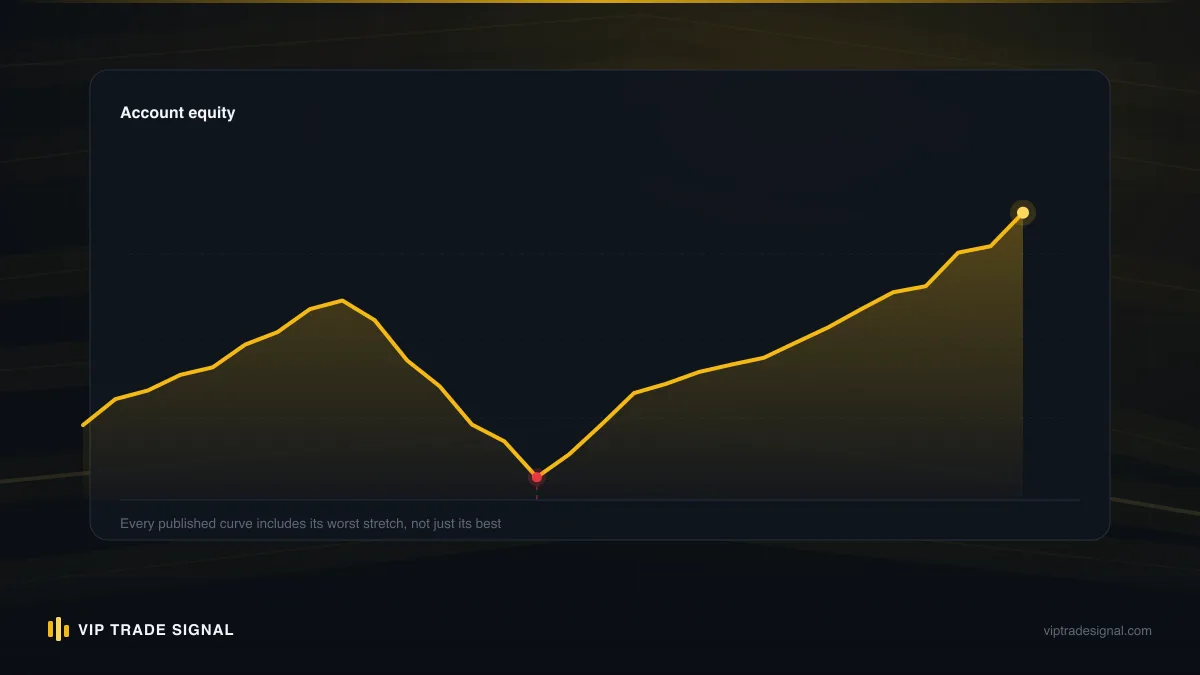
Final balance: $267. Up 6.8% on the month, with a 50% win rate, and — this is the part that matters — the worst moment of the month was a $2.50 drawdown from the starting balance after trade three. At no point was Dana's month riding on any single trade. Boring. Beautiful.
Now run the counterfactual that plays out on a thousand real accounts: same signals, but Dana takes all 22 at 0.02 lots because skipping felt like waste. The fourteen wide-stop signals average $14 stops; at 0.02 lots that's $28 of risk each — 11% of the account per trade. It only takes the ordinary three-loss patch that every strategy on earth produces, and somewhere mid-month the balance is under $150, at which point the maths of recovery (needing +67% just to get home) meets the psychology of desperation, and we both know how that meeting goes.
Same signals. Same market. Same trader, even. The only variable was sizing, and it was worth more than every winning trade combined.
The small-account survival checklist
Print this, or don't, but at minimum run it in your head before every gold trade until it's reflexive:
- Convert the stop to dollars of gold movement. Not pips, not points. Dollars. An "80 pip" gold stop from a $0.10-pip provider is $8.
- Multiply by 100 per 0.01 lot you intend to trade. At 0.01 lots, stop-in-dollars equals risk-in-dollars. This is the whole calculation.
- Check it against 2% of your current balance. Current. Not the balance you funded, not the one you're hoping for by Friday.
- If 0.01 lots exceeds 2% — skip. No exceptions clause. The exceptions clause is how the rule dies.
- Round lot sizes down, always. 0.017 becomes 0.01, not 0.02.
- Set leverage for margin comfort, then forget it exists. It has no vote in sizing. If you're under $400, get a cent account and reclaim the full signal list.
- Recheck sizing after every five trades or any 10% balance change. Sizes fall in drawdown automatically. Let them.
- Log every skip. A month of skip records will show you, in your own handwriting, the blown account you didn't have.
That's the whole edge a small account has, and it's a real one: the ability to still be here in six months. Most small gold accounts don't die because the analysis was wrong. They die because 0.05 felt like ambition and 0.01 felt like an insult, on an instrument that moves $20 before lunch.
If you want signals to size against, ours are unlimited, gold-only, and every closed one — winners and losers, stop distances on display — is public at /signals/history. It's $99 a month, or free through a partner broker with $250 maintained, and the honest print above tells you what we think a $250 account should do with them: take the ones that fit, skip the ones that don't, and let arithmetic do the compounding. Questions on how the broker route works are covered in the FAQ.
The tables are up there. The formula fits on a beer mat. What's left is the part no article can do for you, which is typing 0.01 when everything in you wants to type 0.05 — and doing it again next week.