A man messages you on Telegram. Well-dressed profile photo, screenshots of a Bentley, a pinned post full of grateful voice notes. His offer is clean and simple: send him $1,000, he trades it, you get 10% back every week. Guaranteed. If a trade loses, he covers it. "Your capital is insured."
Most people reading this can feel something is off. Fewer can explain exactly what is off, and that gap — between the gut feeling and the argument — is where the guaranteed returns forex scam lives. Because when the gut feeling meets a persuasive stranger, screenshots, and a run of small early payouts that actually arrive, the gut usually loses. The argument doesn't.
So this article is the argument. Not a list of vague warnings, but the actual financial logic showing why a genuine guaranteed return would never, under any circumstances, be sold to you on Telegram, plus the psychology of why the promise keeps working anyway, and the mechanics of what's really happening to the money. It's the one red flag that outranks every other red flag, and once you understand it to the bottom, you become close to unscammable in this particular corner of the internet. That's worth an evening of your time.
The iron law: market returns cannot be guaranteed
Start with the simplest version, because everything else builds on it.
A forex trade is a bet on the future price of one currency against another. Gold against the dollar, if you trade what we trade. The future is unknown. Not "hard to predict" — unknown. Central banks surprise markets. Wars start on a Tuesday. A single US inflation print can move gold $40 in twenty minutes, and nobody, anywhere, knows the number before it drops.
Any position exposed to that uncertainty can lose. That's not pessimism, it's a definition. Risk is exposure to outcomes you don't control. So a "risk free forex investment" is a contradiction in terms, the same way a dry swim is. Either the money is in the market — in which case it can lose — or it isn't in the market, in which case it isn't earning market returns and something else is generating the payouts. We'll get to what that something else usually is.
The only genuinely guaranteed returns in finance come from lending money to entities that essentially cannot default in their own currency: government bonds, insured bank deposits. And the market prices those with brutal honesty. A US Treasury bill pays a few percent per year. Not per week. Not per month. Per year, and that number is roughly the world's consensus price of certainty.
Hold that yardstick up against a typical pitch. "10% weekly" compounds to something north of 14,000% a year. "5% monthly, fixed" is about 80% annually. The best hedge funds in history — Renaissance, the ones with PhD armies and private data feeds — averaged somewhere in the tens of percent per year, with losing months, without guarantees, and they mostly stopped accepting outside money decades ago. When a stranger offers you a certain return that beats the greatest trading operation ever assembled, the pitch isn't ambitious. It's fictional.
And notice something about the direction of the claim. Real trading results are a distribution — some wins, some losses, an average that hopefully lands positive. A guarantee flattens the distribution into a single number. The moment someone quotes you one fixed figure with no downside, they've told you they're not describing trading at all. They're describing a payment schedule. Payment schedules need a payer, and it's going to be you.
The arbitrage proof: why real fixed returns would never reach you
Here's the part almost nobody walks through, and it's the part that ends the argument permanently. Suppose, for the sake of it, the guy is telling the truth. Suppose he really has a method that produces 10% a week, every week, no losing weeks. What happens next?
Not what he says happens next. What actually happens, given how money works.
A genuine risk-free return above the government bond rate is the single most valuable object in finance. It's called an arbitrage, and the entire global financial system is a machine for hunting them down and consuming them. Anyone holding one has better options than you, in strict order:
- Compound their own money. $10,000 at a genuine 10% weekly becomes roughly $1.4 million in a year and about $19 billion in two. He doesn't need your $1,000. He doesn't need anyone's $1,000. He needs about eighteen months of patience to be the richest person alive.
- Borrow at scale. Banks lend against certainty. A provable no-loss strategy is perfect collateral; he could borrow millions at single-digit annual rates and keep the entire spread. Institutions do exactly this with real (tiny, fleeting) arbitrages every day.
- Sell it once, to professionals, for a fortune. A hedge fund would pay nine figures for a verified strategy like this and staff it with lawyers. What no rational holder would ever do is retail it in $500 slices to strangers, complete with the overhead of marketing, payment processing and customer service, for a fraction of what the strategy supposedly earns on its own.
Look at what the offer implies economically. He claims to own a money-printing machine, and his chosen business model is charging you a small fee to stand near it. The machine, if real, makes the fee irrelevant — a rounding error he pays in time, hassle and legal risk to collect. The only world in which selling the guarantee to you makes financial sense is the world where the machine doesn't exist and the fees, or your deposit itself, are the entire revenue.
This is why the promise is the scam, not merely a sign of one. It's not that guaranteed-return offers are often fraudulent, or usually fraudulent. The structure of the offer — certainty above the risk-free rate, sold downmarket for small money — is only coherent as fraud. There is no honest version of it. A too good to be true forex offer isn't hiding a catch somewhere in the terms. The headline is the catch.
Sit with that for a second, because it inverts how most people screen opportunities. You've been taught to look for red flags buried in the details: dodgy licences, anonymous founders, pressure tactics. All real, all secondary. Here the red flag is the product itself. You don't need to investigate anything else. The pitch has already confessed.
The menu of phrasings: fixed, assured, insured, risk-free
Scammers know the word "guaranteed" has scorch marks on it, so the promise arrives in costume. The costume changes yearly. The underlying claim never does. Here's the current wardrobe.
"Fixed monthly return." The most common dialect right now. A fixed monthly return forex account paying "5-8% monthly" sounds humbler than 10% weekly, and the range ("5-8%") fakes the texture of variability. But a floor is a guarantee. If the worst month is +5%, someone is promising that markets will never hand them a losing month, which is the same impossible claim in a cardigan.
"Assured profit" / "confirmed profit." Popular in signal-adjacent scams: "assured 100 pips weekly." Same logic. Pips don't arrive on schedule any more than dollars do.
"Risk-free" and "capital protected." Sometimes dressed up with a story: "we hedge every position, so losses are impossible." Understand what hedging actually does — a genuinely fully hedged position has no market exposure and therefore no market return. You cannot hedge away all risk and keep the profit; the profit is payment for the risk. Anyone claiming both is claiming a perpetual motion machine.
"Insured account" / "loss covered by the company." This one deserves a special mention because it borrows real vocabulary. Regulated brokers in some jurisdictions do participate in compensation schemes — but those cover broker insolvency, not trading losses. No insurer on earth writes policies against your trades losing, for the same arbitrage reason as above: they'd be handing out free money. When a manager says "losses are on us," ask who "us" is and where their reserves sit. The answer is always fog.
"Profit split, but we cover the downside." The hybrid that catches smarter people. It mimics legitimate performance-fee structures (real, and we run one ourselves) but bolts on the impossible half. A real manager shares your upside because they cannot promise it. The moment downside coverage appears, you're back in fairyland.
"Guaranteed recovery." Aimed at people already down money, which makes it the cruellest variant. Someone $8,000 underwater gets promised their drawdown back "within 30 days, guaranteed." Recovery trading is real work — we do it, slowly, with position sizing you can defend — but a guaranteed recovery is just a guaranteed return pitched to a desperate audience. Desperation is the target market, not an unfortunate coincidence.
The test that cuts through every costume: does the offer specify a return, or a floor under returns, in advance? If yes, it's the same claim. The word "guaranteed" is optional. The impossibility isn't.
Why the promise works: certainty is a drug
If the logic is this airtight, why do intelligent people keep wiring money? Because the pitch was never aimed at the part of you that does logic.
Behavioural economists have a name for the core mechanism: certainty effect. Humans don't value a sure thing a little more than a probable thing — we value it wildly more, far beyond what the probabilities justify. Offered a certain $500 or an 80% shot at $700, most people grab the $500, even though the gamble is worth more on average. Scammers didn't read the papers, but they discovered the finding in the field: a fake certainty outsells an honest probability nearly every time. Our own honest pitch — real signals, published losses, no promises — loses head-to-head against "10% weekly guaranteed" with a depressing share of the audience. We've watched it happen.
Then layer on the state of mind of the actual target. Nobody researching forex returns at 1am is idly curious. There's usually money anxiety underneath — a salary that doesn't stretch, a debt, a retirement number that recedes, or a trading account already bleeding. Anxiety narrows thinking. A person under money stress isn't weighing probability distributions; they're looking for the feeling of the problem being solved. "Guaranteed" is that feeling, bottled. The scammer isn't selling returns. He's selling relief, and relief doesn't fact-check.
The guarantee isn't a description of the returns. It's an anaesthetic for the questions you'd otherwise ask.
Three more accelerants, briefly. Social proof: the testimonials, the payout screenshots, the group chat of winners — trivially fabricated, and some are real, because early victims genuinely get paid (hold that thought for the next section). Authority theatre: rented Lamborghinis, "ex-Goldman" bios, fake regulatory badges. Small yes first: the $100 trial that pays out on time, on purpose, so that the $5,000 "VIP tier" feels like upgrading a working product rather than making a decision.
None of this means victims are stupid. That framing actively helps scammers, because everyone believes they're too smart to fall for it, so nobody applies the checks. Doctors fall for these. Engineers. Traders, honestly — people who know better in daylight and wire money at midnight. The defence isn't intelligence. It's a rule, applied mechanically, before the emotion arrives: fixed return promised, conversation over. Rules don't get tired at 1am.
The business model underneath: ponzi mechanics
So if there's no trading edge behind the guarantee, where do the early payouts come from? From the only place they can: other deposits.
The machine is old — Charles Ponzi ran it on postal coupons in 1920 — and forex is merely its current favourite costume, because forex is plausible. Everyone's heard that currency traders make fortunes; almost nobody can audit a broker statement. Here's the machine in motion.
Deposits flow in. A slice flows back out as "returns" — your 10% weekly is simply a tenth of your own money, or a tenth of the person's who joined after you. The books, such as they exist, show a growing hole: the scheme owes everyone their capital plus the promised gains, while the actual pot only shrinks (payouts, plus the operator's lifestyle, which is rarely modest). Sometimes a bit of real trading happens on the side. It doesn't matter. The trading was never the engine; it's set dressing for the screenshots.
Which produces the scam's most disorienting feature: early victims are genuinely paid, in full, on time. They aren't lying when they vouch for the scheme in the group chat. Their testimony is true and worthless simultaneously, because a ponzi must pay early to recruit late. The payouts aren't evidence against fraud. They're the marketing budget of the fraud. Whenever someone says "but my cousin actually withdrew his profits," the honest answer is: yes, that's the scheme working as designed, and your cousin was the advert.
The arithmetic sets a hard expiry date. Owing 10% weekly means liabilities double in under two months while assets don't. Survival requires deposits to grow faster than an exponential curve, forever, which is why every scheme mutates the same way in its final act: withdrawal "delays," new fees to unlock your balance, a "system upgrade," a pivot to a fresh token or platform. Those aren't operational hiccups. They're the sound of the exponential catching up.
One more wrinkle worth knowing: some "guarantee" operations skip the ponzi patience entirely. The fake-broker variant shows you a beautiful dashboard where your balance grows on schedule — pixels, nothing more — and the money left the building the day you deposited. The withdrawal stage then produces an endless corridor of "taxes" and "release fees," each one a test of how much more you'll send. Different plumbing, same principle: the guarantee exists to stop you asking where the money actually is.
Anatomy of a scheme: launch to exit
Abstract mechanics are easy to nod along to. So let's run one from the inside. Call the operator Dan. Dan is a composite — the pattern is drawn from a decade of collapsed schemes, and it barely varies.
Months 1-2, the seeding. Dan builds the surface: sleek site, Telegram channel, an "official-looking" certificate from a regulator nobody checks (or a real registration in a jurisdiction that regulates nothing relevant). He seeds the channel with fifty fake members and starts posting daily "results." Sometimes he posts real demo trades, cherry-picked. The offer: 8% weekly, capital insured, minimum $300. The minimum is low on purpose — small money asks small questions.
Months 2-4, the proof phase. The first dozen depositors get paid like clockwork. Dan is attentive, replies within minutes, remembers your kids' names. He encourages small withdrawals — each one converts a customer into a missionary. The group chat fills with payment screenshots. Referral bonuses (5% of anyone you bring) turn the victims into the salesforce, which is why these schemes chew through families and church groups and university friends: the recruiter is someone you trust, and they genuinely believe.
Months 4-8, the harvest. Now the upsells: VIP tiers at $5,000 with a "higher fixed rate," a "compounding plan" where profits auto-reinvest (translation: you stop withdrawing, which extends the scheme's life at zero cost). Deposits peak. Dan's lifestyle content peaks with them — the watch, the airport lounge, the "office." Anyone asking sharp questions in the group is removed within minutes, and the silence teaches everyone else what curiosity costs.
The wobble. Deposit growth flattens — every network exhausts itself — and the exponential bites. First withdrawal delays appear, always with a confident explanation: bank compliance, a liquidity provider issue, a platform migration. A masterstroke you'll see again and again: Dan announces a deposit bonus during the delays. Panicked members, anchored on recovering what's stuck, send more to "unlock faster processing." The scheme's last and largest inflows often arrive after it has already stopped paying.
The exit. The channel goes quiet, or deletes, or — increasingly common — announces that Dan was "hacked" or arrested-but-innocent, and a "recovery agent" appears offering to retrieve everyone's funds for an upfront fee. That agent is Dan, or Dan's colleague, running the second lap on the same victim list. Total lifespan: usually eight to eighteen months. The money is long gone through crypto rails, and cross-border recovery, in practice, approaches nil.
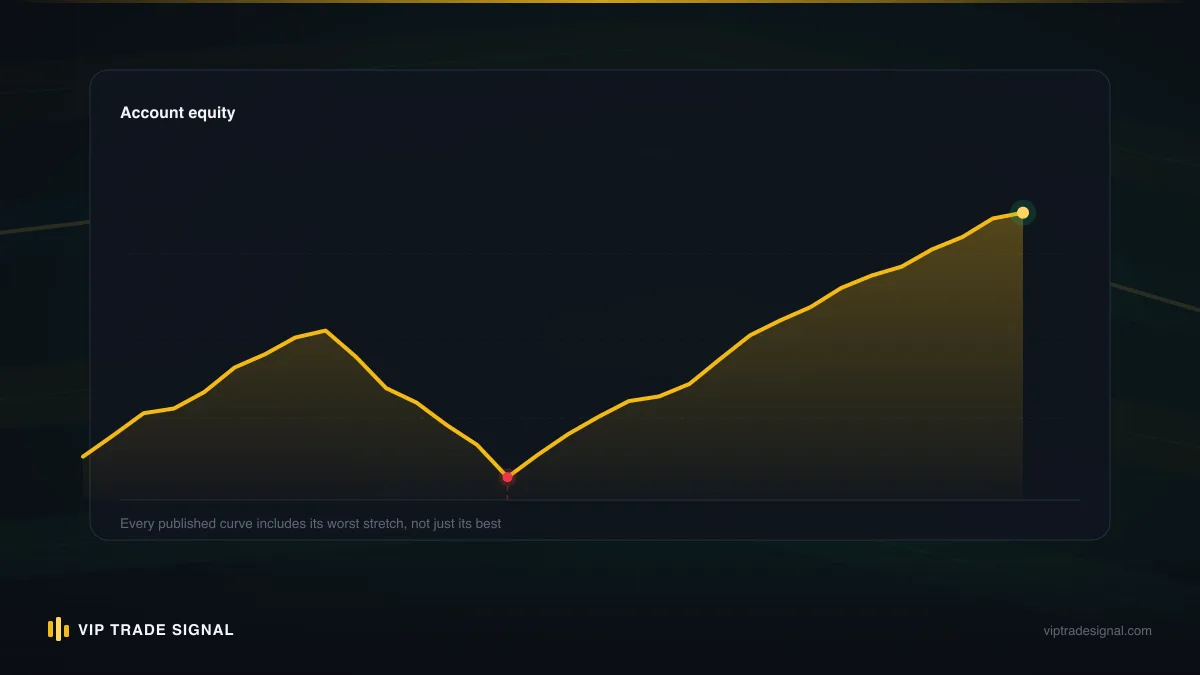
Read that timeline again and notice the uncomfortable bit: for over half the scheme's life, the experience of being inside it is excellent. Better than any honest service, in fact — smoother returns, faster replies, warmer community. Honesty can't compete on experience, because honesty includes losing months and unanswerable questions. If you select for what feels best, you will select the fraud. Every time.
The legitimate things that sound like guarantees but aren't
Fairness demands this section, because a few real, honest structures use vocabulary that rhymes with guarantee-speak, and lumping them in helps nobody.
Guaranteed stop-losses. Some regulated brokers offer, for a premium, stops that fill at your exact level even through a gap. That's a real product — a guarantee about execution of a loss, not about profit. It caps how badly one trade can hurt. It says nothing about whether you'll make money, and no honest broker claims otherwise.
Negative balance protection. In the UK and EU, regulators require that retail clients can't lose more than their deposit. Again: a floor on catastrophe, not a promise of gain. You can still lose every penny you put in, with full regulatory blessing.
Demo accounts and paper trading. "Risk-free" is technically accurate here because there's no money. Also no returns. Fine.
Deposit compensation schemes. The FSCS in the UK protects cash held at failed institutions up to a limit. It protects you from the broker collapsing, not from your positions collapsing. Scammers love blurring this line; regulators write in the sharp one.
Performance-fee structures. This is the one closest to home, so let's be precise. A manager who charges only a share of realized profit — as we do on managed accounts, at a flat 50% — has aligned incentives, but has guaranteed you nothing. In a losing month you pay no fee and you still hold the loss. The structure changes who profits when things go well; it cannot change whether things go well. If you're weighing structures like these, the mechanics of high-water marks and hurdle rates are worth understanding properly, because those are the honest industry's tools for keeping performance fees fair — and notice that the entire apparatus exists precisely because returns can't be promised. Nobody builds a high-water mark for a guaranteed product. There'd be nothing to mark.
The clean dividing line through all of it: honest structures limit or price your losses, or share your realized gains. Only fraud specifies your gains in advance. Any product, service or manager can be sorted with that single sentence.
How real managers actually talk about returns
Having spent this long on what fraud sounds like, it's worth calibrating your ear to the other thing, because honest return-talk has a distinct sound and most people have heard so little of it that it registers as weakness.
Real managers talk in ranges and conditions, not points. "In a good year, something like this might do 15-30%; in a bad one it can be down 10-15%, and there will be bad ones" is what competence sounds like. It's less quotable than "8% monthly, fixed" and infinitely more honest, because it describes a distribution — which is the only thing trading actually produces.
Real managers lead with risk, unprompted. Ask about returns and the good ones answer with drawdown first: how much can this be underwater, for how long, and what happens then. The hedge fund world settled its norms around exactly this grammar — track records with losing periods shown, risk-adjusted metrics, fees tied to results — and any retail manager who won't speak it is telling you which world they belong to.
Real track records include losses, visibly. Ours does: every closed signal we've ever issued sits at /signals/history, reds next to greens, because a record with no losses is either very short or very fake. When we took the desk gold-only, we didn't get to delete the losing trades from the archive, and that's the point of an archive. A manager's willingness to show you their worst month tells you more than their best month ever could. And for readers screening managers against additional criteria — a reader asking whether a managed forex account can be run halal, say — the same rule holds: the compliance questions come after the honesty questions, because a fraudulent account fails every framework at once.
Real managers also say "I don't know" without flinching. Where will gold be in December? Nobody knows. What we know is our process: what triggers an entry, where the stop lives, how much of the account rides on any one idea. Process is knowable; outcomes aren't. A pitch built entirely on outcomes, with the process hidden behind "proprietary algorithm" fog, has it exactly backwards.
Trading gold is high-risk, full stop — leveraged metals can hand you a brutal week regardless of who's managing what — and an honest shop says so in the sales copy, not just the small print. If reading honest return-talk feels underwhelming after the guarantee pitches, good. That's your ear recalibrating. Underwhelming is what true sounds like in this industry.
The one-question test that ends every pitch
You don't need to memorise red-flag lists. You need one question, asked sincerely, and the discipline to act on the answer.
"If your returns are guaranteed, why do you need my money?"
Ask it and watch. There is no good answer, because the arbitrage logic from earlier closed every exit. Compounding his own capital beats your fees. A bank loan beats your deposits. Selling to a fund beats retail slog. The question forces the pitch to explain its own economic absurdity, and the responses fall into a few recognisable buckets:
- The generosity story. "I've made mine; now I'm giving back." People who give back give money away. They don't run subscription tiers with a referrals programme.
- The scale story. "More capital means bigger positions." His guaranteed compounding is unlimited capital on a short delay. Eighteen months of patience makes your $2,000 laughable.
- The liquidity story. "The strategy needs pooled volume to work." A strategy that works would attract institutional pools in a phone call. Retail deposits are the most expensive, most complaint-prone capital on earth; nobody with options chooses them.
- Aggression or deflection. "Do you want to be rich or ask questions?" The most honest answer you'll get, in its way. The pressure is the tell — real opportunities survive scrutiny; manufactured ones can't afford it.
A couple of follow-ups if you want to watch the wheels come off entirely: "Which regulated entity holds the funds, and can I verify the licence number on the regulator's own website?" (not a certificate image he sends you — the regulator's site, searched by you) and "Can I see the full account history, losses included, on the platform itself rather than screenshots?" Fraud lives on images and vanishes under verification. But honestly, you rarely need the follow-ups. The first question, asked plainly, ends most pitches on its own — usually via you being blocked, which is the cheapest exit you'll ever make from a bad investment.
Turn the test on us, while you're here, since the style guide we write under says we mention ourselves briefly and honestly. Why does VIP Trade Signal need your money? Because our returns are not guaranteed. We sell a service — gold signals at $99 a month or free through a partner broker, and managed trading where we only earn a cut of profit that actually lands — and the service revenue is the business, transparently, because there's no money machine in the back room. Nobody has one. The /about page says what we are; the fee exists because the guarantee doesn't. That's what the honest version of this industry looks like: unimpressive on purpose.
What to do when someone guarantees you returns
Theory's done. Here's the practical playbook, in order, for the moment the pitch actually lands in your inbox — and it will.
1. End the conversation. Actually end it. Not "I'll think about it," which invites a follow-up sequence these operations have refined over thousands of victims. Block, or say no once and stop replying. You owe a stranger promising impossible things precisely nothing, including politeness. The longer the conversation runs, the more data he gathers about your pressure points — and these are pipelines, not individuals; your "maybe" gets you moved to the persistent-contact list.
2. Don't send a test amount. The most common half-measure and the most dangerous, because the test is designed to succeed. Your $200 trial paying out $220 isn't evidence; it's bait, priced into his acquisition cost. The trial working is how the real loss gets authorised.
3. Warn the person who referred you — gently. Odds are the pitch reached you through someone you trust who's already invested and already evangelising. They are a victim mid-scheme, not an accomplice, and they will resist hard, because admitting the doubt means admitting their money is gone. Send them this article, or just the one-question test, and don't fight beyond that. People exit these when the maths reaches them, not when they're shamed.
4. Report it, even though it feels pointless. Action Fraud in the UK, the FTC or CFTC in the US, your local equivalent elsewhere, plus the platform itself (Telegram, Instagram, WhatsApp all take reports). One report rarely kills a scheme. Aggregated reports get payment rails cut and pages pulled, which shortens the harvest window for everyone downstream of you.
5. If you've already sent money, move fast and grieve later. Contact your bank or card provider immediately — chargeback and recall windows are short but real, and card payments recover far more often than crypto. File the police report even if recovery looks hopeless; some compensation routes require it. And treat any "recovery agent" who contacts you afterwards as chapter two of the same scam, because that's exactly what it is. Paying a fee to recover funds is the fraud's encore.
6. Redirect the impulse. This one matters more than it sounds. The pull toward guaranteed returns is really a pull toward certainty about money, and that need doesn't vanish when you block a scammer — it goes looking for the next pitch. Give it something real to hold: an emergency fund in an actual insured account, honest yields honestly labelled, and — if you still want market exposure — services that publish their losses and answer questions before taking payment. Our /faq exists for exactly that pre-payment interrogation, and any provider worth a deposit has an equivalent and answers it straight.
Where this leaves you
One sentence, if you keep nothing else: the guarantee is not a feature of the offer; the guarantee is the fraud, whole and entire.
Everything in this piece hangs off that. The iron law says market returns can't be promised. The arbitrage proof says a real guarantee would never be retailed to you — its owner has strictly better options at every turn. The psychology explains why the impossible promise outsells honest probability anyway. The ponzi mechanics explain where the "returns" come from and why the early payouts are marketing, not evidence. And the one-question test — if it's guaranteed, why do you need my money? — compresses all of it into something you can deploy at 1am, tired and tempted, when the argument matters most.
You'll notice we never asked you to trust your instincts. Instincts lose to good salesmen. We asked you to adopt a rule, and rules don't negotiate: any offer that specifies your return in advance, above the boring government-bond rate, gets a no before the second message. No exceptions for friends who vouch, screenshots that dazzle, or trials that pay. Especially not those, because those are the mechanism.
The honest alternative is less comfortable and it's the only thing actually for sale: real markets, real risk, losses said out loud, fees that only bite when profit is real. That's the deal we offer on our own desk and it's the deal every legitimate operator offers in some dialect. If it ever starts sounding better than certainty — not as exciting, just better — then this article did its job, and you've become a very hard person to steal from.