Two traders join the same signal service on the same day. Same alerts, same entries, same stops, same targets, delivered to both phones within the same second. Six months later one of them has grown a $2,000 account to roughly $2,700 and feels vaguely disappointed. The other one is gone. Account at $180, subscription cancelled, an angry one-star review left somewhere claiming the signals were a scam.
The signals were identical. Risk management with forex signals is the half of the job that stays entirely on your side of the screen, and it is the half that actually decides your outcome. What differed was everything the provider never sees: lot sizes, moved stops, revenge entries, the Tuesday where one of them decided a losing trade "had to come back" and doubled into it. We have watched this play out for years, on our own desk and in every community we have ever been part of, and the pattern never changes. Followers obsess over the provider's win rate. They should be obsessing over their own risk plan.
So that is what this piece is. Not theory, not a lecture on trading psychology, but ten concrete rules for people who trade someone else's signals, each one paired with the specific way accounts die when it gets ignored. Print them, argue with them, adapt the numbers. But have a version of every single one before your next alert arrives.
Why risk management with forex signals beats any win rate
Here is the maths nobody wants to sit with. Say a signal provider runs a genuinely decent service: 55% of trades win, average winner is 1.5 times the average loser. Over 200 trades that edge compounds nicely, provided the person following it risks a fixed, small fraction on every trade and takes every signal.
Now hand those same 200 trades to someone who risks 2% normally but 8% "when the setup looks strong", skips signals after two losses in a row, and widens the stop on one trade in twenty. The edge is still there in the signals. It is no longer there in the account. The skipped trades were disproportionately winners (losing streaks cluster, and so does the fear that follows them), the oversized trades were a coin flip like all the others, and the one widened stop turned a routine 1R loss into a 6R crater.
We wrote a whole separate piece on why two followers of the same service post completely different results, but the short version is brutal: the signal is maybe 40% of the outcome. Execution and risk are the rest. A mediocre signal service followed with iron discipline will usually beat an excellent one followed emotionally. That is not a motivational poster. It is arithmetic.
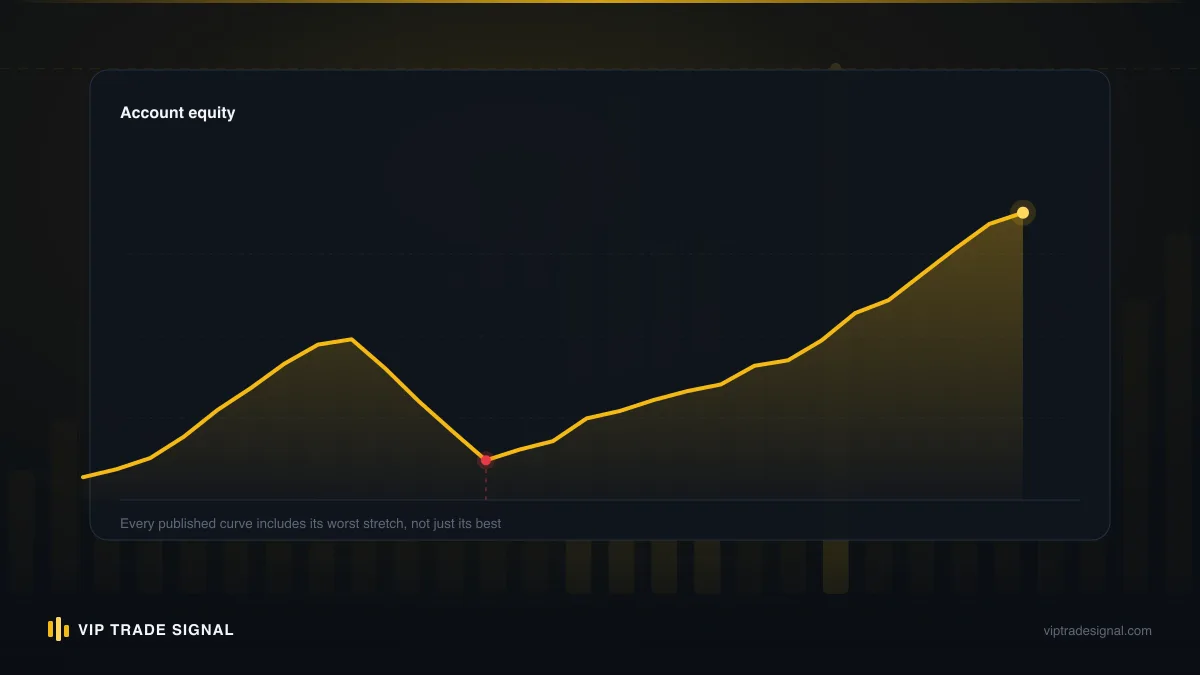
And gold makes this sharper than most markets. XAU/USD, which is all we trade at VIP Trade Signal, moves in dollars what many currency pairs move in a week. A 300-pip adverse move on gold is a normal afternoon around a US data release. If your risk rules have slack in them, gold will find it. Quickly.
One more thing before the rules. Every one of these assumes something that should not need saying but does: trading gold and forex on leverage is genuinely high risk, losing runs are a certainty rather than a possibility, and no rule below turns that off. The rules exist so the losing runs are survivable. That is their entire job.
Rule 1: fixed fractional risk on every trade
The foundation everything else stands on: pick a fixed percentage of your account, and risk exactly that on every single signal. Not "about that". Exactly that.
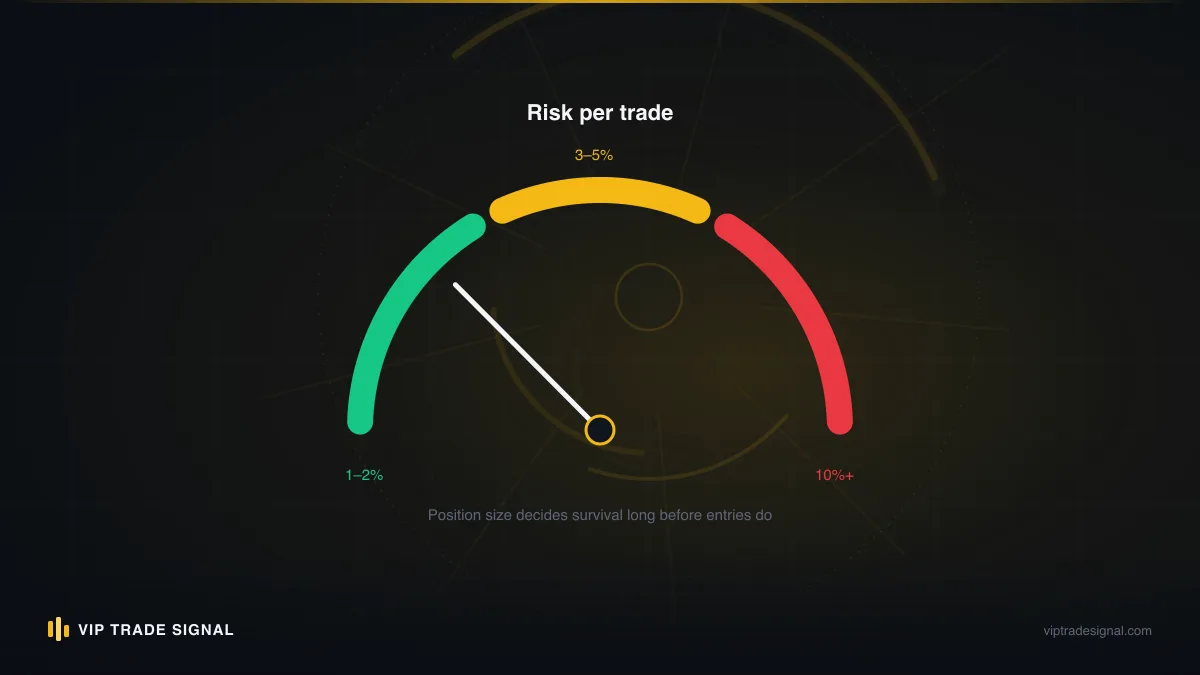
For most signal followers the right number sits between 0.5% and 2%. A $2,000 account risking 1% has $20 of room per trade. That sounds insultingly small until you run the downside. At 1% risk, a ten-trade losing streak (which any honest provider will tell you happens) leaves you down roughly 9.6%, an annoyance. At 5% risk, the same streak takes 40% of your account, and now you need a 67% gain just to get back to where you started. At 10%, you are down 65% and, in practice, finished, because nobody trades their way calmly out of that hole.
The counterexample this rule prevents is the most common account death we see, and it is rarely dramatic. It is a follower risking 2% who has a good fortnight, quietly drifts to 4% because "the signals are working", then meets the losing streak at double size. The streak was always coming. The maths of when it arrives is random; the maths of what it costs is entirely your choice.
Two refinements worth stealing:
- Recalculate the dollar amount weekly, not per trade. Risking 1% of a live balance that updates every trade makes size lurch around and invites tinkering. Fix it Monday morning, trade the week on it.
- Risk the same on every signal, including the ones you dislike. The moment you start sizing by conviction, you are no longer following a system, you are trading your feelings with extra steps. If you genuinely distrust a class of signals, drop them entirely and consistently. Half-sizing your doubts gives you the worst of both.
If you want the full treatment of picking your number, including why we think 1% is right for most people and 2% is already aggressive, we went deep on how much to risk per trade separately. For now: pick one number. Write it down. That number is now the law.
Rule 2: the stop loss is sacred, and you never widen it
Every signal worth following arrives with a stop loss. That stop is where the provider's idea is wrong. Not "temporarily inconvenienced". Wrong.
The rule: you may tighten a stop. You may close early. You may never, under any circumstances, for any reason, move a stop loss wider. Not by 50 pips because gold is "about to bounce". Not because the provider posted "holding, still valid" in the channel. Not because closing here would make this your fourth loss of the week. Never move your stop loss wider is the closest thing this business has to a commandment, and it earns that status through body count.
Here is the counterexample, and if you have traded signals for more than a few months you have either done this or watched someone do it. A follower is short gold from 3,340 with a stop at 3,352, risking their standard 1%, $25 on a $2,500 account. Price grinds up to 3,350. Two dollars from the stop. And the follower, who cannot bear a fourth consecutive loss, drags the stop to 3,365. "Just giving it room." Price takes the room, so the stop goes to 3,380. By the time they finally close, manually, in a panic during the New York session, the $25 planned loss has become $190. One trade. Seven and a half trades' worth of risk budget, gone, and the provider's records still show a clean, small, ordinary loss on that signal.
A moved stop is not a bigger stop. It is the decision that this trade is no longer allowed to lose, and the market will invoice you for that decision at the worst possible price.
The psychology is well understood: taking the loss makes it real, moving the stop keeps hope alive. Knowing that changes nothing in the moment, which is why the rule has to be absolute rather than sensible. "Never" is enforceable. "Only when justified" is a door, and doors get used.
Practical enforcement: place the stop in the platform the moment you enter, and treat modifying it in the losing direction the way you would treat drink-driving. Some followers go further and use a broker account with no mobile app installed, so the 2 a.m. stop-widening impulse has friction in its way. Whatever works. The stop the signal shipped with is the stop.
Rule 3: size from the stop distance, not from lot habits
Most losing signal followers trade the same lot size on everything. 0.10 lots, every signal, because that is what they have always done and the sums are easy. This feels consistent. It is the opposite of consistent.
On gold, a 0.10 lot position moves about $10 per dollar of price movement. So a signal with a $6 stop distance risks around $60, while a signal with a $30 stop, the kind you get around a Fed decision, risks about $300 at the identical lot size. Same "consistent" sizing, five times the risk. The follower thinks they are risking the same on every trade. Their account knows better.
The correct order of operations is always the same, and it takes thirty seconds:
- Fixed risk in dollars (Rule 1). Say $40.
- Stop distance from the signal. Entry 3,326, stop 3,318, so $8 of distance.
- Divide: $40 ÷ $8 = $5 of risk per dollar of movement, which on gold is 0.05 lots.
That is position sizing for signal trades in its entirety. Wide stop, small position. Tight stop, larger position. The dollar risk never changes; only the lot size does. A signal with a $25 stop under the same $40 budget gets 0.016 lots, call it 0.02, and if your broker's minimum lot makes the risk too big for your account on wide-stop signals, the answer is to skip those signals, not to take them oversized. There is no rule that says you must take a trade your account cannot afford.
The counterexample here is quieter than the stop-widening disaster but kills just as surely: the fixed-lot follower does fine for months while stops happen to be similar, then a volatile fortnight arrives, stop distances triple, and their real risk per trade triples with it without a single conscious decision being made. They never chose to risk 6%. They just never chose anything at all.
Build the calculation into your routine, or use any of the free position size calculators and keep the habit. Every signal, every time, before the entry. No exceptions for "obvious" trades. The obvious ones lose at the same rate as the rest.
A word on risk-reward, since sizing decides it
While we are on stops and sizing: the risk reward ratio on forex signals is set by the provider (entry, stop and target define it), but whether you actually collect it is set by you. A signal offering a $10 stop and a $20 target is a 1:2 trade on paper. It stops being one the moment you take partial profit at $6 because you were nervous, or hold past the target because it "looks strong", or size the trade so large that you close it early to stop your hands shaking.
Run the numbers on why this matters so much. At 1:2 reward-to-risk, a strategy only needs to win about 34% of the time to break even before costs. At 1:1 it needs 50%. If your habit of banking winners early quietly turns the provider's 1:2 trades into 1:0.8 trades, you have raised the win rate the whole operation needs from roughly a third to well over half, without changing a single signal. Followers do this constantly, then blame the service. The provider's published record assumes their targets; your account only ever sees yours.
Two habits keep the ratio honest. First, when a signal ships with multiple take-profit levels, decide your standing policy once (all out at TP1, half at TP1 and the rest at TP2, whatever suits your nerves) and apply it to every signal identically, so your results are at least measuring something consistent. Second, if you find yourself routinely cutting winners at less than half the intended target, treat it as a sizing symptom rather than a strategy: you are trading too big to tolerate the ride. Halve the size, collect the full target, and you will usually come out ahead of the larger, panic-managed version. Smaller and complete beats bigger and butchered.
Rule 4: cap your concurrent exposure
Risking 1% per trade means little if you are holding seven trades at once. That is potentially 7% of your account in the wind simultaneously, and if those positions are correlated it is closer to one 7% trade wearing seven hats.
For followers of a gold-only service the correlation question answers itself: every signal is XAU/USD, so every open position is the same market. Three open gold longs are not diversification. They are one large long with three tickets. When the US dollar rips higher on a hot inflation print, all three lose together, at full speed, at the same moment.
So set two caps and honour both:
| Cap | Conservative | Standard | Aggressive |
|---|---|---|---|
| Max open trades at once | 2 | 3 | 4 |
| Max total open risk | 2% | 3% | 5% |
| Max risk in one direction | 2% | 3% | 4% |
When you are at the cap and a new signal arrives, you skip it. Yes, even if it looks better than the ones you are holding. Skipping a winner costs you a missed gain; breaching your exposure cap into a bad afternoon costs you the month. Those are not comparable prices.
The counterexample: a follower with a $5,000 account is holding three gold longs, roughly 3% total risk, all opened across a quiet Asian session. US CPI lands hot at 8:30 New York time, gold drops $35 in twenty minutes, and all three stops fill with slippage. The follower planned to lose $150 at worst. They lost $150 in one gulp, plus slippage, and the experience felt so violent that they spent the next two weeks skipping perfectly good signals. The cap exists to keep the worst single moment small enough that you keep functioning afterwards.
If you follow multiple services across different pairs, the same logic applies with more homework: EUR/USD and GBP/USD longs are mostly the same dollar-short bet, and gold often piles onto it. Count exposure by theme, not by ticket.
Rule 5: define your maximum drawdown before you start
Drawdown, for signal followers who have not had it explained plainly: the distance from your account's highest point to its lowest point after that high. Peak $3,000, trough $2,400, that is a 20% drawdown, and it remains a 20% drawdown even if you later recover, because drawdown measures the journey, not the destination.
Every strategy, every provider, every follower has a maximum drawdown in their future. The only questions are how deep, and whether you decided in advance what depth means "stop".
Decide now, in a calm moment, two numbers:
- Expected drawdown. Roughly double your worst reasonable losing streak times your per-trade risk. At 1% risk, a realistic bad patch for a decent signal service might be 10-15%, so seeing your account down 12% should register as "normal weather", not emergency.
- Maximum tolerated drawdown. The line where you stop trading and reassess everything: the provider, your execution, your sizing. For most followers 20-25% is sensible. Write the number down where you will see it.
The counterexample this prevents is subtle, because it has two opposite failure modes. Followers without a defined drawdown limit either quit at down 8%, right in the middle of ordinary variance, abandoning an edge just before it pays (usually to go find a new provider and repeat the cycle), or they ride a broken situation to down 60% because no alarm was ever set. The pre-committed number protects you from both your panic and your hope.
There is an ugly asymmetry worth staring at: a 20% drawdown needs a 25% gain to recover, 33% needs 50%, and 50% needs a clean double. The maths of holes gets worse faster than the maths of digging. It is exactly why our drawdown management service exists for accounts already floating $5k-$10k underwater, and why the honest version of that service charges only on recovered profit and promises nothing, because nobody can promise recoveries. The far better trade is never needing one. That is what the first four rules are for.
Rule 6: have news-event rules, especially for gold
Gold does not care about your pending orders during a red-folder news release. Non-farm payrolls, CPI, FOMC: in the minute after these land, XAU/USD can travel $20-$40, spreads on many brokers stretch from 20 cents to $2 or more, and stops fill wherever liquidity happens to exist rather than where you placed them. Slippage of several dollars on a gold stop during NFP is not a broker scandal. It is Friday.
So you need standing rules for the calendar, written before the week starts:
- Ten minutes before a red-folder US release: no new entries, regardless of what signals arrive. A signal sent 3 minutes before CPI is a signal you skip.
- Positions already open into news: either accept the stop as placed and the slippage risk that comes with it, or reduce size beforehand. Decide which policy is yours in advance; deciding at 8:28 is not deciding, it is flinching.
- Never "trade the number". Entering seconds after a release to chase the spike is where spreads, slippage and requotes go to feed.
The counterexample: a follower is long gold with a stop $8 below, risking their standard $40. FOMC minutes land more hawkish than expected, price gaps through the stop, and the fill comes $5 beyond it. The $40 planned loss became $65. Annoying, survivable, and completely priced in for someone at 1% risk. Now rerun it for the follower risking 5% with three correlated longs (Rule 4, waving from the back). Their planned $750 loss became $1,100 in ninety seconds, on a $15,000 account. Same event, same signals. One follower shrugged; the other one is writing furious messages to the provider.
A decent provider structures around the calendar anyway, and it is worth asking any service how they handle news before you pay them (we keep a longer list of questions worth asking a signal service before subscribing). But their policy does not replace yours. You are the one wearing the slippage.
Rule 7: never add to losers, even when the provider does
Some services will send "second entry" or "averaging" signals: the first long from 3,330 is underwater at 3,312, and here comes an instruction to buy again "at a better price". Sometimes this is a pre-planned, pre-sized scaling strategy with the total risk defined across both entries from the start. Fine, if, and only if, the combined position still fits inside your fixed risk per idea.
Mostly, though, averaging down is how a provider avoids printing a loss on the record, and how a follower converts a small planned loss into an account event. Adding to a loser doubles your exposure precisely where the market has just told you the idea is not working. Your average entry improves; your risk balloons. And because the second entry "needs" a wider stop to make sense, Rule 2 usually gets broken in the same motion. The two rules die together, almost every time.
The counterexample is the classic martingale death spiral, and gold's volatility makes it fast. Long 0.05 lots from 3,330. Add 0.10 at 3,315. Add 0.20 at 3,300, because the bounce is surely close now. The follower now loses $35 per dollar of further downside on a position that started at $5 per dollar, and gold falls $18 more before lunch. A trade that was budgeted at $40 of risk finishes down over $900. The provider's channel, meanwhile, either goes quiet or posts the eventual bounce as a win from the lowest entry.
Your rule as a follower is clean: one signal, one position, one stop, one budget. If a second-entry alert arrives and taking it would push the total risk on the idea beyond your fixed fraction, you do not take it. If your provider's records only look good because of averaging, you have learned something important about the records. Every closed signal we publish at /signals/history includes the losers for exactly this reason; a track record without visible losses is not a track record, it is a brochure.
Rule 8: run a weekly risk review, not just a P&L review
Every follower checks their P&L. Almost none of them review their risk, which is a shame, because the P&L tells you what happened and the risk review tells you what is about to.
Fifteen minutes, every weekend, same questions:
- Did every trade risk the planned percentage? Pull the actual dollar loss on each loser and divide by your balance. Anything above plan gets circled and explained.
- Was any stop moved wider? Yes or no. This is a binary integrity check, not a discussion.
- Did open exposure ever breach the cap? Count the worst simultaneous moment of the week, not the average.
- Which signals did I skip, and why? Skipped-from-rules (exposure cap, news window) is fine. Skipped-from-fear is data about you.
- Where is the drawdown? Current distance from equity peak, plotted against your two numbers from Rule 5.
Notice that not one of those questions is "did I make money". A profitable week full of breached rules is a worse week than a losing one that followed the plan, because the breaches are the future and the P&L is the past. The follower who widened a stop and got away with it this week has just been paid to do it again. That is the most expensive salary in trading.
The counterexample is not a single disaster but an erosion. No review means small drifts go unmeasured: risk creeps from 1% to 1.4%, one stop gets nudged in March and two in April, the exposure cap becomes more of a suggestion. None of it feels like a decision. Then a normal losing streak arrives and does 30% damage where the plan said 12%, and the follower genuinely cannot explain why, because nobody was keeping the books. Ten minutes on a Sunday keeps the books.
Keep it in a spreadsheet or a notebook, whichever you will actually maintain. The format matters far less than the streak of weeks where every answer was clean.
Rule 9: earn your size increases, and script them in advance
At some point the account grows and the question arrives: when may I risk more? The dangerous answers are all feelings. "The signals are hot right now." "I'm up 30%, I can afford it." "This setup is different." Every one of those is how winners hand it back.
The boring, correct answer is that size increases should be mechanical, small, and specified before you begin. Something like:
- Percentage risk stays fixed; dollar risk grows with the account. This is the default and, honestly, enough for most people. 1% of a growing balance is a raise you did nothing to deserve except follow the rules. Compounding does the ambitious part for you.
- Raising the percentage itself (say 1% to 1.25%) requires all of: three consecutive months of full rule compliance from your weekly reviews, current drawdown under half your expected figure, and a written note of the change with the date. One step at a time, never mid-losing-streak, and never mid-winning-streak either, because euphoria sizes worse than fear does.
- After a maximum-drawdown breach, size resets to half of standard until a month of clean reviews rebuilds it.
The counterexample: a follower turns $2,000 into $3,100 over four disciplined months at 1% risk, then decides the training wheels can come off and moves to 4% "temporarily, to accelerate". The next six weeks are an ordinary rough patch, seven losers in ten, the sort of stretch that costs a 1% follower about 5% and teaches them nothing new. At 4% it costs 25%, and worse, it costs the discipline itself, because now they are down and the temptation is to size up further to get it back. The four good months did not fail. The undocumented, feelings-based size change failed.
Write your scaling ladder down next to your risk number. If a size change is not on the ladder, it does not happen. Dull as ditchwater, and it is the difference between compounding and round-tripping.
Rule 10: know your stop-trading triggers before you need them
The final rule assumes every other rule will, at some point, come under more pressure than you can hold. So you pre-install circuit breakers: specific, numeric conditions under which you stop trading entirely, no judgement required in the moment because all the judgement was done in advance.
Ours would look something like this for a signal follower:
- Daily: three losses in a day, or a daily loss of 3%, and you are done until tomorrow. Close the platform. Signals that arrive after the trigger are not your business.
- Weekly: down 6% on the week and the week is over, review on the weekend, fresh start Monday.
- Drawdown: hitting your Rule 5 maximum stops everything for a minimum of two weeks while you audit provider, execution and sizing separately. Half size on return.
- Integrity: any widened stop or averaged loser triggers an immediate 48-hour stop, regardless of how the trade ended. Especially if it ended well.
The reason these must be numeric and pre-committed is that the moments they fire are precisely the moments your judgement is worst. Nobody assesses risk clearly while down 3% on the day and staring at a fresh signal that could "make it back". Tilt does not announce itself. A trigger does not need to assess anything; it just fires.
The counterexample is the one every experienced trader has lived at least once. A bad morning: two stops hit before lunch, down 2.5%. No circuit breaker, so the afternoon is available for revenge. The next signal gets taken at double size, because getting back to flat has quietly replaced trading well as the goal. It loses. The one after that gets triple size and a mental stop instead of a real one. By the close, a 2.5% morning has become an 11% day, and the follower's own trade log, read a week later, will look like it was written by a stranger. Every trader who has been at this a while has met that stranger. The circuit breaker exists so the stranger never gets the keys.
Building your one-page risk plan
Everything above compresses onto a single page, and it should, because a risk plan you cannot see at a glance is a risk plan you will not follow at 8:31 on a CPI morning. Here is the skeleton; fill in your own numbers tonight, not "soon":
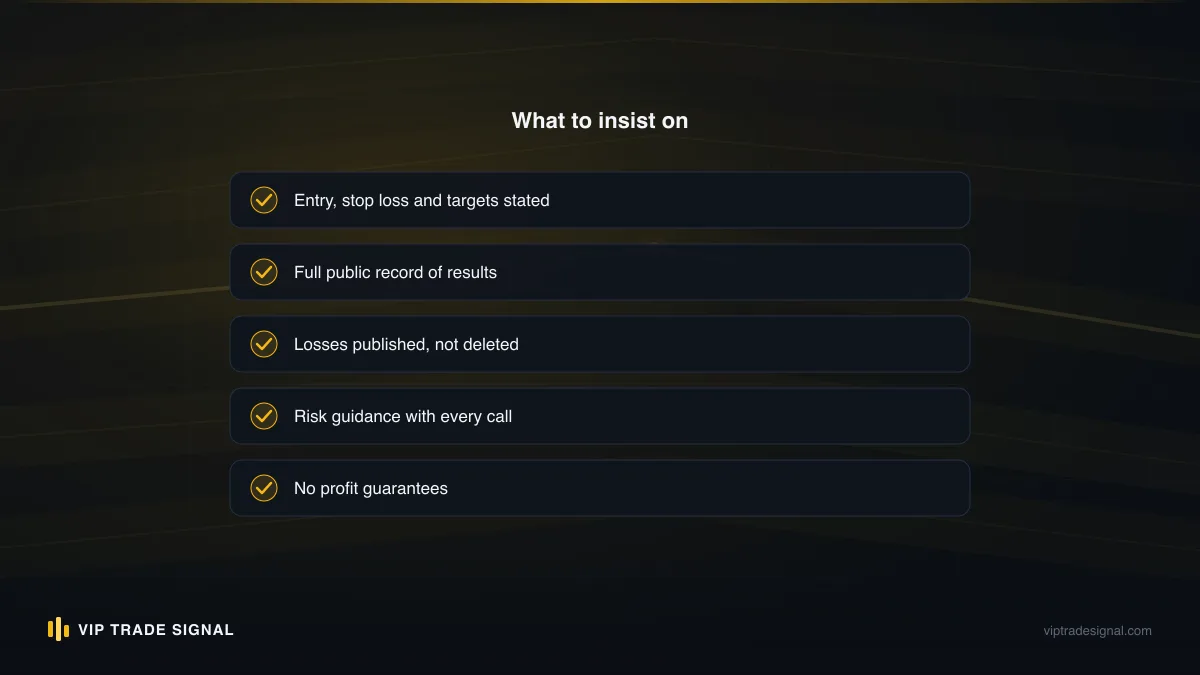
- Risk per trade: ____% (dollar figure recalculated each Monday: $____)
- Stop policy: stops as delivered by the signal, tighten-only, no exceptions signed: ________
- Sizing method: dollar risk ÷ stop distance, calculated before every entry
- Exposure caps: max ____ open trades, max ____% total open risk, max ____% one direction
- Drawdown lines: expected ____%, hard stop ____%
- News windows: no entries within ____ minutes of red-folder releases; open-position policy: ________
- Averaging: one entry per signal idea, full stop
- Review: every ________ (day/time), five questions, answers logged
- Scaling ladder: current size earned on ________, next review date ________
- Circuit breakers: ____ losses or ____% down daily, ____% weekly, integrity breach = 48 hours off
Ten lines. A $2,000 account and a $200,000 account fill in different numbers and identical structure. And notice what the page does not contain: nothing about the provider, their win rate, their pips, their marketing. The plan is entirely about you, because that is where the outcome lives.
Where this leaves you
A last opinion, since you have read this far. The signal industry sells the wrong thing. It sells entries, and entries are the commodity: any provider, ourselves at VIP Trade Signal included, can put you into gold at a sensible price with a stop and a target. What nobody can sell you, at $99 a month or any other price, is the discipline layer between the alert and your account, and that layer is worth more than every signal you will ever receive. The same alert compounds one account and bankrupts another, and the alert is innocent both times.
So before you evaluate one more provider, evaluate yourself against these ten rules. Which ones do you already keep? Which ones have you broken in the last month? (Be honest; your trade history knows.) If the phrase "I sometimes give trades a bit more room" appeared anywhere in your answer, you do not need better signals. You need Rule 2 and a locked platform.
Do the one-pager tonight. Trade nothing until it exists. Then follow whichever service you trust, ours or anyone's, with the page beside the screen, and judge yourself weekly on rule compliance first and profit second. Our own answers to the common follow-up questions live in the FAQ, and every closed signal we have issued, the losers in full view, is public precisely so you can check whether the risk numbers you just wrote down fit the reality of what following actually looks like.
The rules are not exciting. That is rather the point. Excitement is what the accounts in the counterexamples were having, right up until they stopped.