Your phone buzzes. A message appears in a Telegram group you joined last week: "XAUUSD SELL 3,342. SL 3,351. TP 3,326." That's it. No explanation, no chart, no context. Just a string of numbers that, apparently, thousands of people are about to bet real money on.
If you've ever stared at a message like that and felt slightly stupid for not knowing what it meant, this article is for you. Nobody is born knowing what SL stands for. Everyone who trades now was once the person squinting at that message wondering whether 3,342 was a price, a code, or a phone extension.
So let's answer the question properly. What are forex signals, who sends them, what do all those abbreviations mean, and what can they realistically do for someone starting from zero? We'll define every term the first time we use it, and about halfway through we'll walk through a complete losing trade, start to finish, because if the first signal example you ever study is a winner, you'll build expectations that the market will spend the next year dismantling.
What are forex signals, actually?
A forex signal is a trade suggestion sent to you by someone else, with specific numbers attached. It tells you four things: what to trade, which direction to trade it, where to get in, and where to get out (in both the good scenario and the bad one). That's the whole idea. Someone who watches the market full time does the analysis, packages their conclusion into a short message, and sends it to subscribers who can then copy the trade into their own accounts.
The word "forex" is short for foreign exchange, the market where currencies are bought and sold against each other. When people say forex signals, they usually mean signals for currency pairs like EUR/USD (euros against US dollars), but the term stretches to cover gold, which trades under the ticker XAU/USD, priced in dollars per ounce. Gold behaves like a currency pair in every practical sense: same platforms, same order types, same signal format. We'll use gold examples throughout because that's what our desk trades, but everything here applies to any pair.
Notice what a signal is not. It is not a prediction that comes true. It is not advice tailored to you, your account size, or your nerves. And it is not a shortcut past learning how trading works, though plenty of sellers will imply otherwise. A signal is one experienced trader's opinion, expressed precisely enough that you can act on it. Some of those opinions will be wrong. On our own desk, a meaningful fraction of signals lose, and that's true of every honest service on earth.
Think of it like a navigator calling directions to a rally driver. The navigator says "left 4, tightens." Useful, maybe essential. But the navigator isn't holding the wheel. You are.
The five parts of every signal
Nearly every signal you'll ever see, from any provider, on any platform, contains the same five components. Learn these once and you can read any signal in the world.
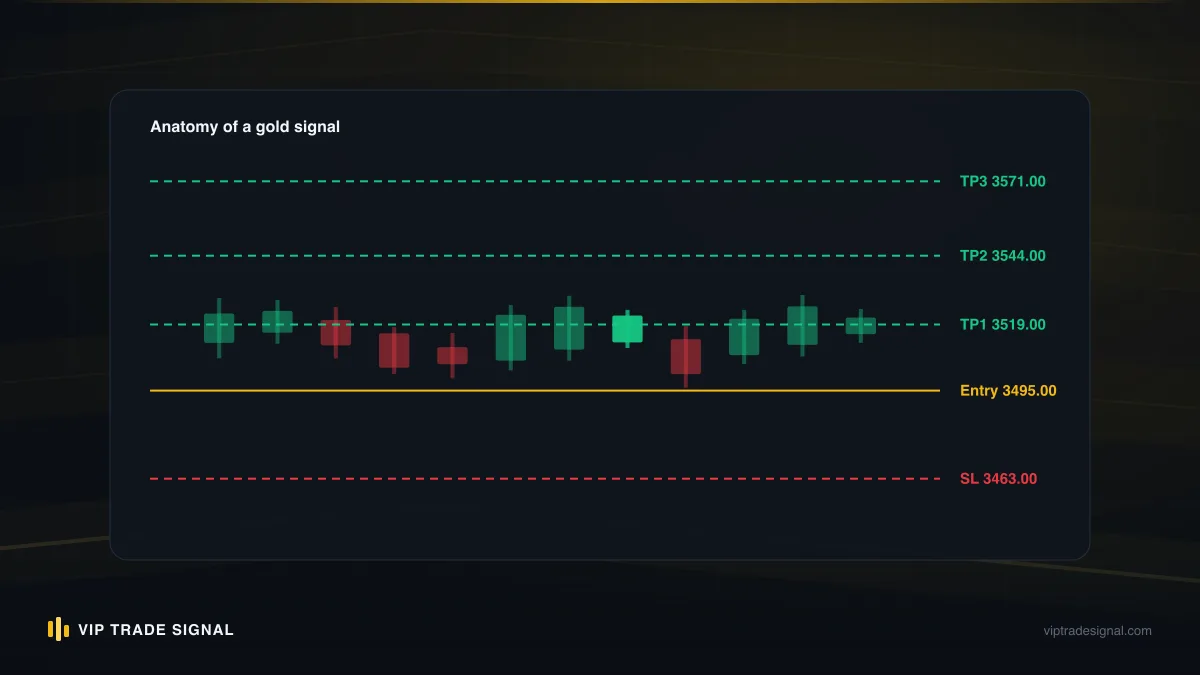
The pair. What's being traded. XAU/USD means gold against the US dollar. EUR/USD means euro against dollar. The first item is what you're buying or selling; the second is what you're paying with. When gold "goes up," it means one ounce costs more dollars than it did before.
The direction. Buy or sell. Buy (also called "long") means you profit if the price rises. Sell ("short") means you profit if it falls. Beginners are sometimes startled that you can sell something you don't own, but in forex and CFD trading that's routine; you're trading the price movement, not taking delivery of gold bars.
The entry price. Where the provider wants you to open the trade. Sometimes it's "at market," meaning immediately at whatever the current price is. Sometimes it's a pending order, an instruction to your platform to open the trade automatically if price reaches a specific level later. Say the signal reads "buy limit 3,318" while gold trades at 3,325: nothing happens unless price dips to 3,318, at which point your platform opens the buy on its own.
The stop loss (SL). The price at which the trade closes automatically at a loss. This is the single most important number in the entire message. The stop loss caps how much you can lose if the idea is wrong, and it does so without needing you awake, online, or emotionally capable of pressing the button. A signal without a stop loss isn't a signal; it's a dare. Close the channel.
The take profit (TP). The price at which the trade closes automatically in profit. Some signals give two or three take-profit levels (TP1, TP2, TP3), the idea being that you close part of the position at each one. That's a refinement you can ignore for now; one TP is enough to learn on.
There's a sixth element that never appears in the message but matters more than any of it: your position size, meaning how much money you actually put behind the trade. The signal can't include it because the provider doesn't know your account balance. A trade risking $20 for one subscriber can risk $2,000 for another on the identical signal. We'll come back to this, because it's where beginners get hurt.
Reading a real message without panicking
Formats vary between providers, and the abbreviations can make a first signal look like an intercepted military transmission. Some write "XAUUSD" with no slash. Some write "GOLD". Some put the stop loss before the take profit, some after, some scatter emojis through the whole thing like confetti. None of it changes the content. Your job on receiving any signal is a ten-second translation exercise: find the pair, find the direction, find the three prices, and check they make sense together. On a sell, the stop must sit above the entry and the target below it; on a buy, the reverse. If the numbers don't line up that way, the provider has made a typo, and you should skip the trade rather than guess what they meant. It happens more often than you'd hope.
Who sends signals, and why would they bother?
Fair question. If someone can predict where gold is going, why are they messaging strangers instead of quietly getting rich?
The honest answer is that nobody predicts markets; good traders play probabilities with controlled risk, which is profitable but slower and lumpier than the fantasy. And signal providers have a range of motives, some fine, some not:
- Subscription businesses. You pay monthly; they send signals. Their incentive is keeping subscribers, which means their results need to be at least defensible over time. This is our model: gold-only signals at $99/month, or free if you trade through a partner broker. Not cheap, and we'd rather say so plainly than pretend otherwise.
- Broker-affiliated channels. The signals are free because the provider earns a commission from a broker every time you open an account and trade. The incentive problem is obvious: they get paid when you trade a lot, not when you trade well. Some are still decent. Many push high-frequency signals precisely because churn pays them.
- Marketing funnels. Free channel, cherry-picked screenshots, and a constant drumbeat toward a "VIP" upgrade or, worse, an account-management pitch. Most free Telegram signal channels are marketing funnels with a chart on top.
- Genuine communities. Traders sharing ideas with no money changing hands. Rare, lovely when found, and usually inconsistent because nobody's livelihood depends on the quality.
The single best question to ask any provider is not "what's your win rate?" but "where is your full history, including losses?" Anyone can screenshot winners. A complete public record, like the one we keep at /signals/history, is much harder to fake and much rarer to find. If a provider can't show you every closed trade, assume the hidden ones lost.
How signals reach you
The delivery channel matters less than beginners think, but here's the map.
Telegram dominates. It's free, instant, supports thousands of members per channel, and every signal service on earth has one. The speed matters: a scalp signal that takes four minutes to reach you may already be dead. Telegram's weakness is that it's also where every scammer on earth operates, because creating an official-looking channel costs nothing.
Dedicated apps and member areas are what the more established services use, sometimes alongside Telegram. Push notifications, trade history built in, no impersonation risk.
Email still exists for slower styles. If a provider sends swing signals meant to run for days, email's five-minute lag is irrelevant. For anything faster it's hopeless.
Copy trading is the sibling of signals worth knowing about: instead of receiving a message and placing the trade yourself, software mirrors a provider's trades into your account automatically. Convenient, but you surrender the decision-making entirely, and you inherit their position sizing philosophy whether it suits your account or not. For a beginner, manually placing trades from signals is better, and not because it's purer. Because you learn something each time.
Whichever channel, one warning: scammers clone popular providers constantly. Same name, same photo, one character different in the handle, and a DM saying you've "won" free VIP access. Real providers announce their official handles and never DM you first. Ours are listed on the /faq page precisely because impersonation attempts are that routine.
The four types of signals, by holding time
Signals differ mostly by how long the trade is meant to last. This shapes everything: how fast you must react, how large the stop loss is, how many signals you get, and how much of your life the style consumes.
| Type | Typical duration | Reaction time you need | Typical XAU/USD stop distance | Suits |
|---|---|---|---|---|
| Scalp | Minutes | Under a minute | $2–5 | People glued to screens |
| Intraday | Hours, closed same day | A few minutes | $5–15 | Most people with jobs |
| Swing | Days to weeks | Hours | $15–40 | Patient people, small time budgets |
| Position | Weeks to months | A day | $40+ | Almost no signal services |
Scalping chases tiny moves with rapid entries and exits. It photographs well in marketing (twenty wins in a day!) and works terribly for beginners, because execution speed and spread costs eat the small profits, and you need to be present the instant the message lands.
Intraday signals open and close within a session. This is where most reputable services live, ours included. You get a workable window to enter, the trade resolves within hours, and you're not carrying risk overnight while you sleep.
Swing signals ride multi-day moves. Fewer signals, bigger stops, and a psychological tax nobody warns you about: watching a trade float against you for two days without touching it takes discipline that beginners haven't built yet.
Position signals run for months and barely exist commercially, because nobody pays a subscription to receive three messages a quarter.
A beginner's default should be intraday or swing. If a channel fires eight scalps before lunch, that's not generosity. That's either a broker-commission model feeding on your trade volume, or a provider spraying entries so the winners make good screenshots.
The frequency question deserves one more beat, because beginners consistently get the intuition backwards. More signals feels like more value: you're paying the same money, so surely twenty trades a week beats five? In practice the opposite holds. Every extra trade costs spread, demands attention, and adds a fresh opportunity to make an execution mistake, and a provider who genuinely waits for good setups will have quiet days, sometimes quiet weeks. Our own desk sends nothing at all when gold is chopping sideways in a $5 range, and we count that restraint as part of the service, not a gap in it. A channel that never has a quiet day isn't finding more opportunities than everyone else. It's inventing them.
One real losing signal, walked through end to end
Time to make this concrete, and deliberately with a loss. Winners teach you nothing about whether you can survive this; losers teach you everything. What follows mirrors the shape of losing trades you can find in our public history, with rounded numbers so the arithmetic stays clean.
Tuesday, mid-morning UK time. Gold has been climbing for three sessions and is stalling under a level our desk has marked at 3,350, an area where sellers have shown up twice before. The signal goes out:
XAU/USD SELL at 3,342. Stop loss 3,351. Take profit 3,326. Risk no more than 1% of your account.
Read it with your new vocabulary. Pair: gold against the dollar. Direction: sell, so we profit if gold falls. Entry: 3,342, at market. The stop loss sits at 3,351, nine dollars above entry, just beyond that resistance area, so we're only proven wrong if buyers push through the level convincingly. The take profit sits at 3,326, sixteen dollars below entry. Risking $9 of price movement to try to win $16 gives a reward-to-risk ratio of roughly 1.8 to 1, a number that matters far more than any win rate, for reasons the win rate versus risk-reward article unpacks properly.
Now, your side of the trade. Say you're following this on a $2,000 account and risking 1%, so $20 is on the line. The $9 stop distance is 900 points in MT5's pricing, which works out to about 0.02 lots. (Don't worry if that unit means nothing yet; the lot size guide for XAU/USD exists exactly for this calculation, and doing it wrong is the number one way beginners turn a small loss into a disaster.) You place the sell, set the stop and target, and put the phone down.
For an hour, it works. Gold drifts down to 3,335. Your position shows about $14 of open profit and your brain, helpfully, starts spending it.
Then a US economic release lands stronger than expected, the dollar wobbles, and gold does what gold does several times a week: it moves $12 in twenty minutes. Price rips back through 3,342, through 3,348, and at 3,351 your stop loss executes. The platform closes the trade automatically. You've lost $21 with the spread, about 1% of the account, exactly as planned.
Here's what the stop loss actually bought you. Gold kept climbing that afternoon and printed 3,364. Without the stop, your $20 planned loss would have been floating near $45 and rising, and you'd be facing it live, at your desk, negotiating with a chart. "It'll come back" is the most expensive sentence in retail trading. The trade failing was normal. It cost one controlled, survivable, pre-agreed unit of risk, and the account lived to take the next signal, and the fifty after that.
That's the entire game. Not avoiding losses. Making every loss this boring.
Two footnotes to the story, because they're where the learning hides. First, the desk wasn't wrong to send the signal. Selling into a level that had rejected price twice, risking $9 to make $16, is a good trade whether or not this particular instance of it worked; run that setup a hundred times with the same discipline and the arithmetic favours you even at a modest win rate. Beginners judge trades by their outcomes. Traders judge them by their process, because outcome is the one part nobody controls.
Second, notice what you were never asked to do during those two hours. You weren't asked to interpret the economic release, redraw the levels, or decide in real time whether to hold or fold. Everything got decided before the trade opened, when nobody had money on the line and everyone was calm. That's the real product a signal delivers, and it's the habit worth stealing even if you never pay for a signal in your life: make every decision before the market can argue with you.
What signals can and cannot do for you
Time for straight talk, because the marketing around this industry is grim.
What a decent signal service genuinely provides: the analysis layer done by someone with screen-time you don't have; precise, complete trade parameters instead of vague "gold looks bullish" commentary; built-in risk discipline, since a professional stop loss arrives with every idea; and a stream of live worked examples that teach faster than any course, if you study them rather than just clicking.
What no signal service can provide, ever: guaranteed profits, because losing trades and losing weeks are structural features of trading, not defects. Immunity from your own psychology, because the signal can't stop you doubling your size after a loss. Protection from your own execution, since entering late or skipping the stop turns a good signal into a bad trade. And no signal makes sense of itself; a sell at resistance means something to someone who knows what moves gold prices, and is just numbers to someone who doesn't.
Anyone promising "90% accuracy" or "guaranteed daily profit" has told you everything you need to know, and none of it is about their trading. It's high-risk speculation with real money. Most retail traders lose overall, a fact regulators force honest brokers to print on their own websites. A signal service shifts the odds by lending you experience; it does not repeal them.
What you still have to learn, even with signals
Signals compress the analysis. They do not compress the rest, and the rest is where accounts die. Three things stay permanently on your side of the fence.
Position sizing. The provider picks the levels; you pick the money. The formula is short: risk amount divided by stop distance gives lot size. Two subscribers can take identical signals for a year and one ends up fine while the other blows up, purely on sizing. If you learn one technical skill before touching real money, this is it.
Execution judgement. Signals age. If the entry was 3,342 and price is 3,335 by the time you see it, the maths of the trade has changed: worse entry, wider effective risk, smaller reward. Beginners chase these entries because missing out feels worse than losing. Learning to skip a stale signal without regret is a genuine skill, and it takes months.
Emotional endurance. Sooner or later you'll hit four losses in a row from a provider you trust. Statistically inevitable, emotionally radioactive. The beginners who survive are the ones who decided in advance that a losing streak within normal bounds changes nothing. The ones who don't survive start skipping signals after losses and doubling after wins, which reliably underperforms just taking every trade at fixed risk.
You'll notice none of these is chart analysis. You can outsource the charts for a long time. You cannot outsource the discipline for a single day.
A worked example of how this bites. Say a trader we'll call Sam subscribes to a solid service, takes the first six signals at a sensible 1% risk, and drops four of them. Nothing unusual there; a service winning 55% of the time will hand you a four-loss run several times a year. But Sam is now down 4% and irritated, so he sits out the next two signals. Both win. Furious at missing out, he takes the eighth signal at triple size to catch up. It loses. Sam is now down 7% while the service itself is roughly flat over the same eight trades. The signals did their job. The subscriber traded a different, worse system: his own moods.
How much money do you actually need?
The industry's least-discussed question, so here are real numbers.
The practical floor for trading gold signals with proper risk management is about $500, and $1,000 is comfortable. Here's the arithmetic behind that, not a sales figure. Risking 1% of $500 gives you $5 per trade. A typical intraday gold signal carries a $6–10 stop distance, and the smallest position most brokers allow on gold, 0.01 lots, loses about $1 per $1 of price movement. So a $7 stop on the minimum position risks $7, which is 1.4% of a $500 account: workable, slightly over the ideal. On a $200 account that same minimum trade risks 3.5% per signal, and one ordinary five-loss streak wipes 16% off your account while you're doing everything right. The account isn't too small to trade; it's too small to survive normal variance.
And your first account should hold no real money at all. Every broker offers demo accounts with live prices and pretend balances. Two to four weeks of demo trading, following signals with correct sizing, costs nothing and answers the only question that matters early on: can you follow the plan when a trade goes against you? Plenty of people discover on demo that they can't yet. Far better to learn it there.
One caution flowing the other way: don't treat the demo stage as permanent either. Demo trading with fake money teaches mechanics but not nerve, because nothing is at stake. The bridge is starting live with the smallest viable size, where a loss stings enough to be real and small enough to be irrelevant.
While we're on money, budget for the costs that don't look like losses. The spread on gold takes a small bite from every trade, typically a fraction of a dollar per ounce with a decent broker, and it compounds quietly if you trade often. A paid subscription is a fixed monthly cost that your trading has to earn back before you're up a penny. And funding an account with money you'll need within six months is a cost too, just a deferred one: rent money trades scared, and scared money skips the good signals and chases the bad ones. The right starting bankroll isn't a universal number. It's whatever amount you could lose entirely, feel annoyed about for a weekend, and carry on with your life. For some people that's $500. For others, honestly, it isn't anything yet, and a longer stretch on demo is the right call, not a failure.
Free, paid, or broker-provided: a beginner's map
You have three broad routes to actually getting signals, and the right answer depends on where you are, not on which is "best."
Free public channels are where everyone starts, and that's fine, as long as you understand the business model. Free channels exist to convert you into something: a paid tier, a broker referral, or a managed-account pitch. Use them as reading practice. Follow two or three for a month on demo, track every signal yourself in a spreadsheet including the ones that lose, and watch how the provider behaves after a losing day. Silence after losses is the tell. You'll learn more about the industry in that month than from any review site.
Paid subscriptions make sense once you've proven on demo that you can execute, and once the monthly fee is proportionate to your account. This deserves honesty: $99/month against a $500 account is 20% of your capital per month, and no signal quality justifies that ratio. Against $2,000 it's 5%, which a decent service can plausibly outrun; against $10,000 it's noise. Our own pricing sits at the high end of the market, and the honest framing is that you're paying for unlimited signals with a fully public record, no long contract, and the option to route around the fee entirely.
Broker-partnered access is that route: several services, ours among them, waive the subscription if you open an account with a partner broker (Exness, XM, IC Markets and Vantage, in our case) and keep at least $250 in it. The provider earns from the broker instead of from you. It's a legitimate model with an incentive you should keep one eye on: it only rewards the provider when you're actively trading. The details of how ours works are on the /signals page; the principle of always knowing who pays your provider applies to everyone, us included.
The map, then: free channels on demo to learn the format, smallest-viable live account to learn your nerves, and paid or broker-partnered access only once the fee-to-capital ratio makes sense. Skipping steps costs more than it saves.
Your first week: from reading this to placing a demo trade
Knowledge without a next step evaporates. Here is a first week that costs nothing and builds the actual skills.
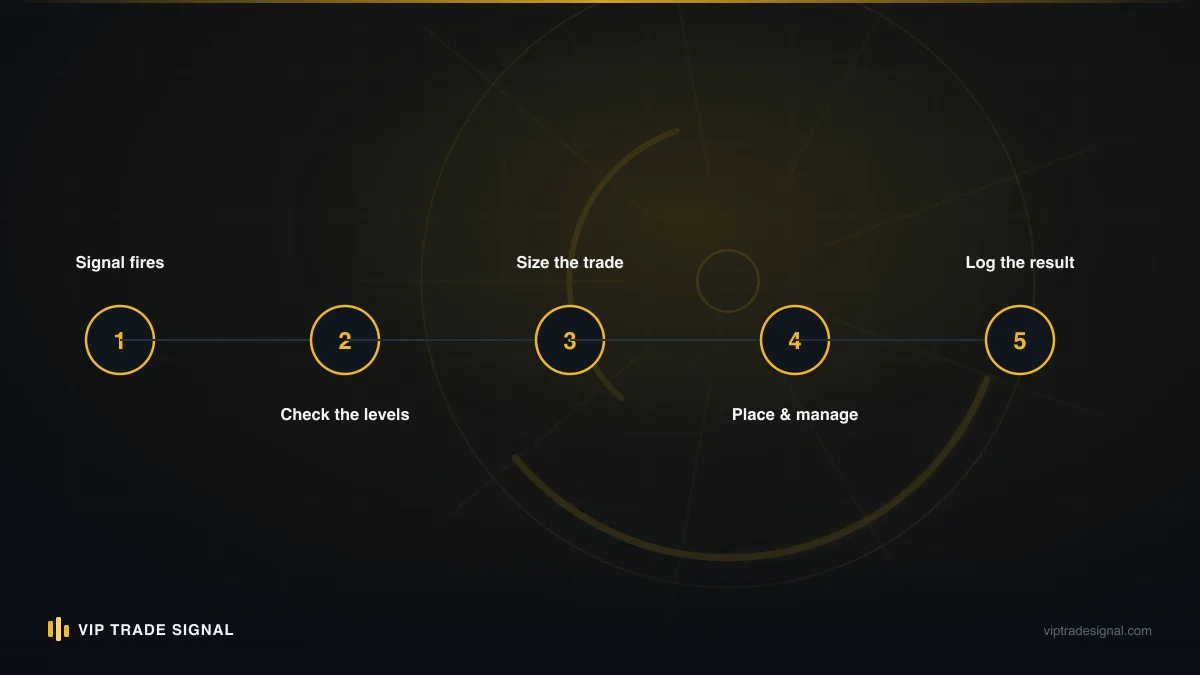
- Day 1: open a demo account. Any major regulated broker. Download MT4 or MT5, the two platforms nearly all signals assume. Set the demo balance to something honest, like $1,000, not the default $100,000, because practising with money you'll never have teaches habits you can't keep.
- Day 2: learn the order tickets. Place a market buy on gold. Attach a stop loss and take profit. Place a pending order and watch it trigger or expire. Close a trade manually. Total time: an hour. Value: everything, because fumbling the platform during a live signal is how "9 dollars of risk" becomes 90.
- Day 3: join two or three signal channels. One paid provider's free tier, a couple of free channels. Don't trade anything yet. Just read the signals as they arrive and translate each one out loud: pair, direction, entry, stop, target, reward-to-risk.
- Day 4: learn the sizing formula. Risk amount divided by stop distance. Work through five examples on paper with your demo balance until it's mechanical.
- Day 5: take one signal on demo. One. Correctly sized at 1% risk, stop and target set at entry, and then, hardest of all, leave it alone until it closes itself.
- Days 6–7: start the journal. A spreadsheet with one row per signal: date, pair, direction, entry, stop, target, result, and one sentence on what you did well or badly. Every serious trader keeps one. Every account-blower didn't.
By next week you'll have done, in miniature, everything this article describes. Repeat it for a month before a single real dollar goes in.
Glossary: every term from this article in one place
Bookmark this bit; you'll forget half of these by Thursday, and that's normal.
- Forex (FX): the global market for exchanging currencies.
- Pair: the two instruments in a trade, like XAU/USD. You trade the first, priced in the second.
- XAU/USD: gold priced in US dollars per ounce. Trades like a currency pair.
- Signal: a specific trade suggestion: pair, direction, entry, stop loss, take profit.
- Long / buy: a position that profits if price rises.
- Short / sell: a position that profits if price falls. Yes, you can sell first and buy back later.
- Entry: the price at which a trade is opened.
- Market order: an order that executes immediately at the current price.
- Pending order (limit/stop order): an instruction to open a trade automatically if price reaches a chosen level.
- Stop loss (SL): the pre-set price at which a losing trade closes automatically. Your seatbelt.
- Take profit (TP): the pre-set price at which a winning trade closes automatically.
- Reward-to-risk ratio: target distance divided by stop distance. 1.8:1 means risking $1 of movement to try to win $1.80.
- Lot: the standard unit of trade size. On gold, 0.01 lots moves your balance about $1 for every $1 gold moves.
- Position sizing: choosing your lot size so a stopped-out trade loses only your planned amount.
- Spread: the small gap between buying and selling price; the built-in cost of every trade.
- CFD: contract for difference, the instrument most retail brokers use to let you trade price moves without owning the asset.
- Demo account: a practice account with live prices and imaginary money.
- MT4 / MT5: MetaTrader 4 and 5, the platforms most retail brokers and signal formats assume.
- Drawdown: the drop in your account from its peak. Every trader has one; the question is size.
- Copy trading: software that mirrors a provider's trades into your account automatically.
- Scalp / intraday / swing / position: trading styles ordered from minutes-long holds to months-long ones.
Where this leaves you
Strip away the industry noise and the answer to "what are forex signals" is almost disappointingly simple: they're precise trade suggestions from someone with more screen-time than you, delivered fast enough to act on. The five parts never change. The maths of sizing never changes. And the uncomfortable truth never changes either: the signal is maybe a third of the outcome, and the other two thirds, sizing, execution, and temperament, stay yours forever.
So here's the test we'd set you before you spend a pound on any provider, ours included. Open the demo account. Follow signals for a month. Track every one, wins and losses, in your own spreadsheet, and compare your tracked results against what the provider claims. If a service won't survive that comparison, you've saved yourself the subscription. If it will, and it publishes its full record where you can check it, then you're no longer a beginner asking what signals are. You're a trader deciding whether one particular set of them deserves a place in your plan.
That's a much better question. And now you have the vocabulary to ask it.