The most expensive mistake in gold trading isn't picking the wrong direction. It's picking the wrong size. A trader can be right about the market four times out of six and still torch the account, because the two losers were taken at 0.50 lots on a $1,500 balance and the four winners at 0.05. We've watched it happen more times than we can count, and it's almost never a knowledge problem. It's an arithmetic problem that nobody sat down and solved before clicking buy.
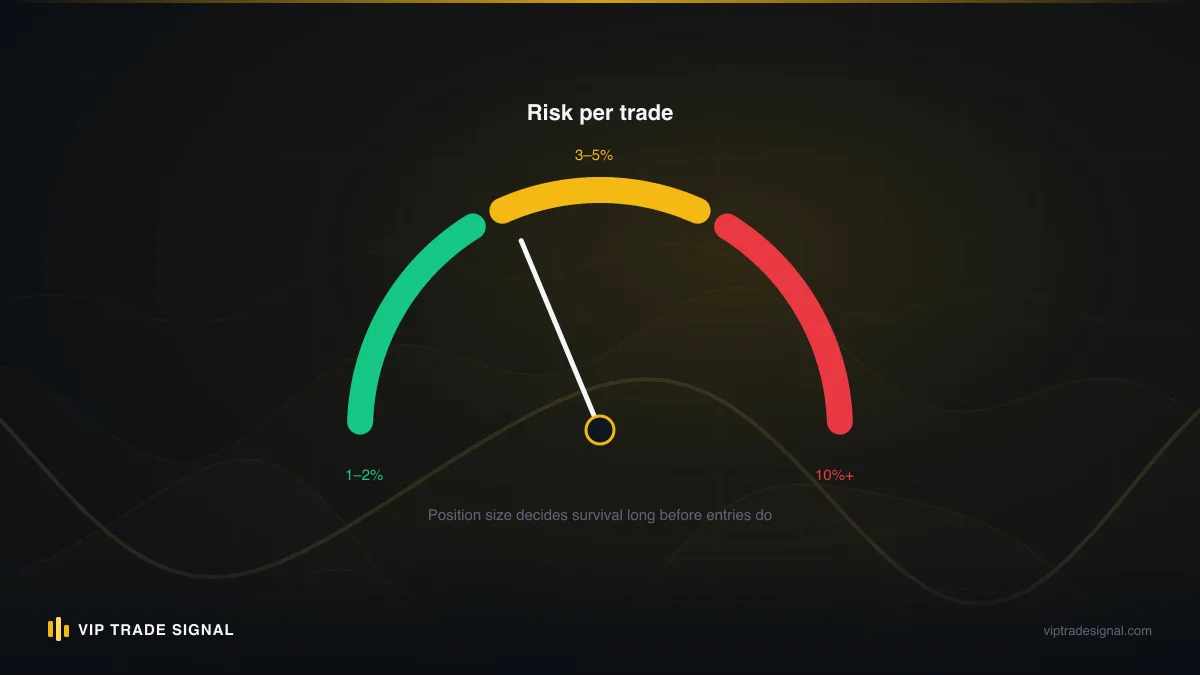
That's what an XAUUSD lot size calculator is for. Not to make you a better analyst. To make sure that when your stop gets hit, and it will get hit, regularly, forever, the damage is a number you chose in advance rather than a number the market chose for you.
This page gives you the calculator logic up top, then the full math underneath: what a gold pip actually is, what one lot actually pays or costs per dollar of movement, and how to go from "I'm willing to lose 1%" to "therefore 0.07 lots" in about fifteen seconds. By the end you shouldn't need any calculator at all, ours or anyone's. The formula fits on the back of a receipt.
The calculator: three inputs, one output
Every position size calculator on earth, however shiny the interface, is doing the same three-step sum. You give it:
- Account balance — your actual equity, in dollars. Not the balance you're hoping to have. What's in the account right now.
- Risk per trade — the percentage of that balance you're prepared to lose if the stop is hit. For most people this should be 0.5% to 2%, and if you're following signals, closer to the bottom of that range.
- Stop distance — how far your stop loss sits from your entry, in dollars of gold price. Entry 3,340, stop 3,332, distance is $8.
And it hands back one number: the lot size that makes those three facts consistent with each other.
Here's the entire engine, no mystery to it:
Lot size = (account balance × risk %) ÷ (stop distance in dollars × 100)
The 100 in the denominator is the ounces in one standard XAUUSD lot, and it's the single number that makes gold different from every forex pair you've traded. We'll unpack it properly in a minute.
Run it once with real numbers. $2,000 account, 1% risk, $8 stop distance:
- Risk in dollars: 2,000 × 0.01 = $20
- Dollars at risk per lot: 8 × 100 = $800
- Lot size: 20 ÷ 800 = 0.025, which you round down to 0.02 lots
That's it. That's the whole calculator. The rest of this article exists because the 100-ounce contract, the pip conventions, and broker minimums each have a way of quietly wrecking that sum for people coming over from EURUSD, and because knowing why the formula works is what stops you abandoning it during a losing week.
Why gold lot sizing confuses forex traders
If you learned position sizing on major currency pairs, you arrive at gold with a mental model that is subtly and dangerously wrong.
On EURUSD, one standard lot is 100,000 units of currency and a pip is 0.0001, which works out to a tidy $10 per pip per standard lot. Micro lot, 10 cents a pip. Every forex trader has that burned in. So they open a gold chart, see the price move from 3,340 to 3,348, think "eight pips, no big deal," size the trade like it's eight pips of EURUSD, and get absolutely flattened.
Because that wasn't eight pips. That was an $8 move, and on gold's most common quoting convention that's eighty pips. On one standard lot it's $800 of profit or loss. The trader thought they were risking pocket change and they were actually risking most of a small account.
The confusion has three roots:
The contract is in ounces, not currency units. One standard XAUUSD lot is 100 troy ounces of gold. Not 100,000 of anything. The P&L maths runs off ounces times price change, full stop.
"Pip" means different things on different platforms. Some brokers and most signal providers treat a gold pip as a $0.10 move (so 3,340.00 to 3,340.10 is one pip). Others casually call a full $1.00 move a pip. Same word, ten-times difference in meaning. When someone tells you "gold moved 50 pips," you genuinely cannot know whether they mean $5 or $50 without asking. We've seen traders size a position off a Telegram message using the wrong assumption and end up ten times over-exposed. Not slightly wrong. Ten times.
Gold's daily range is enormous relative to forex. EURUSD might travel 60-80 pips on an ordinary day. Gold routinely travels $20-$40, and on a hot CPI print it can do $50 in an hour. Stops that would be generous on a currency pair are laughably tight on gold, so gold stops are wider in dollar terms, so lot sizes need to be smaller than instinct suggests. Almost everyone's first gold position is too big. Ours were too, years ago, and the tuition was not cheap.
The fix for all three is the same: stop thinking in pips at all. Think in dollars of price movement. Gold went from 3,340 to 3,332, that's an $8 move. Dollars are unambiguous. Every formula in this article uses them.
XAUUSD pip value per lot: the actual numbers
Since "pip" won't die as a word, let's at least nail down the values so you can translate anything a broker or signal service throws at you.
The bedrock fact, the one worth memorising above all others:
One standard lot of XAUUSD makes or loses $100 for every $1.00 the gold price moves.
100 ounces, $1 per ounce, $100. Everything else scales linearly from there.
| Lot size | Ounces | Per $1.00 move | Per $0.10 "pip" | Per $10 move |
|---|---|---|---|---|
| 0.01 (micro) | 1 | $1 | $0.10 | $10 |
| 0.05 | 5 | $5 | $0.50 | $50 |
| 0.10 (mini) | 10 | $10 | $1 | $100 |
| 0.50 | 50 | $50 | $5 | $500 |
| 1.00 (standard) | 100 | $100 | $10 | $1,000 |
A few things fall out of that table that are worth saying in plain words.
A 0.01 lot, one single ounce of gold, is the friendliest unit in retail trading. One dollar of price movement equals one dollar of P&L. You can read your exposure straight off the chart. If your stop is $12 away and you're holding 0.01 lots, you're risking $12. No conversion, no mental gymnastics. For anyone learning gold, we'd argue there's no better teacher than a few weeks of 0.01-lot trades where the chart and the account statement speak the same language.
And at the other end: one standard lot with a typical $8-$10 gold stop is $800-$1,000 of risk. On the $500 and $1,000 accounts a lot of people start with, a single standard-lot trade isn't aggressive. It's a coin-flip on the whole account. When you hear about someone blowing up on gold in a day, this is almost always the shape of it.
If your broker quotes gold to two decimals (3,340.55) and calls the second decimal a "point," then one of their points is $0.01 of price, worth $1 per standard lot. It changes nothing about the sizing math, which is one more reason to work in dollars of price and ignore the vocabulary entirely.
How to calculate gold pips by hand
You'll still need to talk to people who speak pip, so here's the translation, usable in your head.
Price move in dollars = exit price − entry price. Long from 3,328, price now 3,343, move is $15. Nobody needs a calculator for this part, and honestly it's the only part that matters.
Move in "pips" (the $0.10 convention) = dollar move × 10. That $15 move is 150 pips. A signal that says "SL 80 pips" under this convention means an $8 stop.
Move in "pips" (the $1.00 convention) = the dollar move itself. That $15 move is 15 pips. A "$1 = 1 pip" service saying "SL 8 pips" also means an $8 stop.
So when a signal arrives with pip-denominated targets, do one check before anything else: divide the stated pip distance by the actual price gap on the chart. If a signal says entry 3,340, SL 3,332, and calls it "80 pips," they're on the $0.10 convention. If they call it "8 pips," it's the $1.00 one. Thirty seconds, once per provider, and you never mis-size off their messages again. This is the same reason our own signals always give explicit price levels for entry, stop and targets rather than pip counts; anyone who's watched a subscriber size a trade off an ambiguous pip figure stops using pip figures.
To go from pips back to money: dollar move × 100 × lot size. An $8 stop at 0.03 lots is 8 × 100 × 0.03 = $24. Practise that one until it's automatic, because it's the exact damage you're signing up for every time you set a stop.
The formula: from risk percentage to lot size, step by step
Time to assemble the whole thing properly. Four steps, and after a dozen repetitions you'll do it faster than you can open a gold position size calculator in a browser tab.
Step 1 — fix your risk in dollars. Balance × risk %. A $3,000 account at 1% is $30. Write the number down, at least mentally. This figure is the whole point of the exercise; everything downstream just serves it.
Step 2 — measure your stop distance in dollars of price. Entry minus stop for a long, stop minus entry for a short. Entry 3,352, stop 3,344: distance $8. Use the actual levels you'll actually place, not the tidy round number you wish the setup gave you. Widening a stop after sizing, without resizing, is one of the classic silent account-killers.
Step 3 — compute the risk per standard lot. Stop distance × 100. An $8 stop means $800 per lot. A $15 stop, $1,500 per lot. This is the step forex muscle memory gets wrong, so slow down here the first few times.
Step 4 — divide, then round down. Risk dollars ÷ risk per lot. 30 ÷ 800 = 0.0375, so you trade 0.03 lots. Never round up. Rounding 0.0375 up to 0.04 takes your real risk from $30 to $32, and while $2 sounds petty, the habit of rounding toward more risk is the thing you're actually training. Round down every time and the habit trains the other way.
One compact line, if you prefer it:
Lots = (Balance × Risk%) ÷ (Stop$ × 100)
Notice what's not in the formula. Leverage isn't in it. The current gold price isn't in it (only the stop distance matters, not whether gold is at 2,400 or 3,400). Your confidence in the trade isn't in it. Your last three results aren't in it. Every one of those absences is deliberate, and two of them get their own sections below because people keep trying to sneak them back in.
Risking a fixed percentage rather than a fixed lot size also does something quietly powerful: it makes your sizing breathe with your equity. Lose a few trades and your dollar risk shrinks automatically, slowing the bleed. Win a few and it grows, compounding without you touching anything. The trader on a permanent 0.10 lots gets neither protection nor compounding. We've argued the percentage question at length elsewhere on this blog if you want to push back on our numbers, but for the mechanics here, anything from 0.5% to 2% plugs into the same formula.
Worked example: sizing a real gold signal
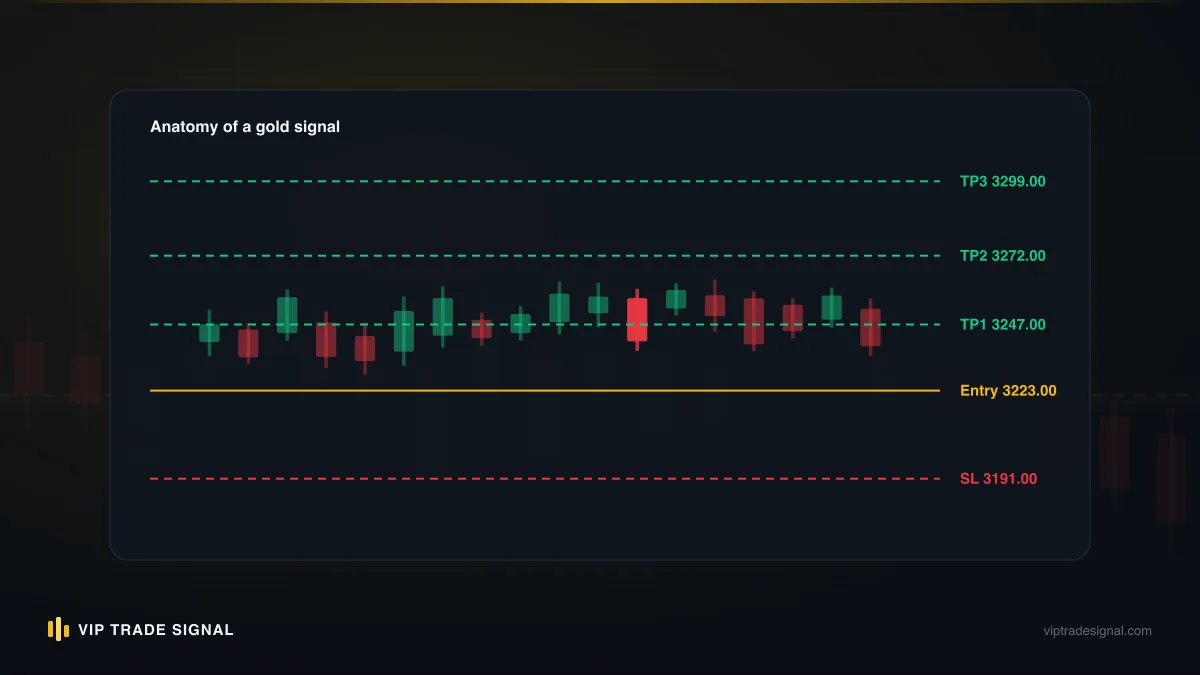
Let's run a complete, realistic signal through the machine, the same shape as the ones we publish, with every closed result sitting in our public signal history for anyone to audit, losers included.
Say the signal reads:
- SELL XAUUSD at 3,358
- SL: 3,367
- TP1: 3,349 · TP2: 3,340 · TP3: 3,326
You're trading a $1,200 account and you've settled on 1% risk. Here's the sequence, exactly as you'd do it at the screen:
Risk in dollars: 1,200 × 0.01 = $12.
Stop distance: 3,367 − 3,358 = $9. (A short, so stop minus entry.)
Risk per standard lot: 9 × 100 = $900.
Lot size: 12 ÷ 900 = 0.0133 → 0.01 lots, rounded down.
Now sanity-check it backwards, which is a habit worth keeping forever: 0.01 lots × $9 stop × 100 = $9 of risk. That's 0.75% of the account. Under your 1% ceiling, sized correctly, done. Total elapsed time, maybe twenty seconds.
And look at the anatomy of what just happened, because it's instructive. Your "risk budget" said 0.0133 lots, but the broker's 0.01 step size forced you down to 0.01, which means your actual risk came in under target. That's normal on small accounts and it's fine. What would not be fine is the trader who looks at 0.0133, feels the pull of "well, 0.02 is basically the same," and doubles their intended risk to 1.5% with one lazy round-up. On a single trade, invisible. Across two hundred trades a year, it's the difference between a survivable losing streak and a margin call.
Notice also what the calculation ignored: all three take-profits. TPs play no role in sizing. Size is set by the stop alone, because the stop is the only level that defines what you lose when you're wrong, and being wrong is the scenario position sizing exists for. Trades that never reach any TP are a normal part of any honest record, ours very much included.
Small accounts: minimum lots and when you can't take the trade
Here's the uncomfortable arithmetic nobody selling you a $50 account bonus wants to walk through.
The minimum position at almost every retail broker is 0.01 lots: one ounce. One ounce risks $1 per $1 of stop distance. So the smallest possible gold trade with a $9 stop risks $9. That's a hard floor. No calculator, no setting, no clever broker choice gets you under it (a rare few offer 0.001-lot gold, but don't plan around unicorns).
Flip that floor around and it tells you the minimum account for any given risk rule:
| Stop distance | Min risk at 0.01 lots | Balance needed at 2% | Balance needed at 1% |
|---|---|---|---|
| $5 | $5 | $250 | $500 |
| $8 | $8 | $400 | $800 |
| $12 | $12 | $600 | $1,200 |
| $20 | $20 | $1,000 | $2,000 |
Read the third row honestly. If you're running a $400 account and a signal arrives with a $12 stop, the minimum lot risks 3% of your account. Your 1% rule doesn't say "size it smaller." There is no smaller. Your rule says skip the trade. That is a real, legitimate output of a lot size calculator, and it's the output small-account traders hate most and need most.
Skipping feels terrible. You watch the signal hit TP3 without you and every instinct screams that the rule cost you money. But the rule isn't there for that trade. It's there for the losing streak you haven't met yet, and on gold, with its habit of stopping out three or four setups in a row before trending beautifully, you will meet it. A $400 account taking every wide-stop signal at forced 3% risk is one ordinary bad fortnight from being a $280 account.
There's a version of this that stings less: stretch your risk ceiling slightly, to 1.5% or 2%, only on a small account and only to make minimum-lot trades legal, then ratchet back down as the balance grows. Defensible. What isn't defensible is pretending the floor doesn't exist. We field this question constantly from people joining on smaller balances, it's half the reason our FAQ covers account minimums at all, and the honest answer never changes: on gold, some trades are simply not available to some account sizes, and admitting that is cheaper than testing it. However small the balance, the floor is the floor.
Leverage's role (and why it doesn't change your risk math)
The question arrives weekly in some form: "I have 1:500 leverage, so what lot size should I use?" And the answer, which surprises almost everyone the first time, is that leverage doesn't appear anywhere in the sizing formula. Scroll back up. It's not there.
Leverage determines one thing: how much margin the broker locks up to let you hold a position. One lot of gold at 3,340 controls $334,000 of metal. At 1:100 leverage the broker reserves $3,340 of your equity as margin; at 1:500, $668. That's it. That's the entire effect. Your P&L per dollar of gold movement is set by ounces held, and ounces are set by lot size, and lot size, if you're doing this right, is set by the formula above.
What high leverage actually changes is what you can do, not what you should do. At 1:500, a $1,000 account can technically open a full standard lot of gold. The formula, at 1% risk and an $8 stop, says that account should be trading 0.01 lots. The gap between those two numbers, a factor of a hundred, is the space in which accounts die. Leverage didn't kill them. It just unlocked the door and stood back.
So treat leverage as plumbing. Enough of it means margin never interferes with a correctly sized trade, and on gold, where wide stops are normal, 1:100 or better makes life easier for small accounts. More than enough changes nothing, because your lot size was already decided by balance, risk and stop. If a broker's marketing leads with a giant leverage number as the reason to fund an account, they are betting, with good historical odds, that you'll use it as a sizing input. Don't be the trader they're pricing in.
One honest caveat: leverage does interact with catastrophe. In a violent gap through your stop, a weekend open after news, say, an over-leveraged position can lose more than the stop implied before the platform closes it. Rare on gold, not impossible. One more argument for sizes that make even a bad fill survivable.
Common sizing errors and their cost in dollars
After enough years watching gold traders operate, the same handful of sizing mistakes account for most of the wreckage. Priced in real money, on a $2,000 account with a typical $8 signal stop, correct answer 0.02 lots and $16 of risk:
The EURUSD reflex. Sizing gold like a forex pair, usually 0.10 lots or more because "that's what I always trade." At 0.10 lots the $8 stop costs $80, which is 4% of the account gone per loser. Three consecutive stops, entirely ordinary on gold, and you're down 12% in a week wondering why the "same risk as always" hurts so much.
The flat lot size. Trading 0.05 on everything, every stop, every setup. An $8-stop trade risks $40, a $20-stop trade risks $100, and the trader believes both trades are "the same size." Their risk per trade is quietly swinging between 2% and 5%, decided at random by stop geometry rather than by them. The whole point of a gold position size calculator is that lot size should be the output of the risk decision, never the input.
Pip-convention roulette. Reading "SL 80 pips" as $80 of price distance, or as 8 pips of it, and sizing off the misread. Off by a factor of ten in either direction: either risking $1.60 when you meant $16, irritating but survivable, or $160 when you meant $16, which is 8% of the account on one trade. We keep hammering this because it's the one error that can be fatal on the very first attempt.
Rounding up, forever. Every 0.027 becomes 0.03, every 0.033 becomes 0.04. Each instance adds a whisper of extra risk, maybe 10-20%. Compounded over a year of trades, your "1% rule" has silently become a 1.2% rule, and worse, you've trained the reflex of resolving every ambiguity toward more exposure.
Revenge sizing. Two losses at 0.02, then the third trade goes on at 0.06 to "make it back." The formula's output hasn't changed. The trader has overridden it with feelings, and the market bills for that override more reliably than it bills for anything else. If your lot size ever goes up immediately after a loss, no market analysis produced that number. This one's psychology, not arithmetic, and no calculator on earth fixes it.
The pattern across all five: every error pushes risk up, never down, and none of them announce themselves on the day. They collect quietly, then present the bill during the losing streak.
Sizing for multi-TP signals with partial closes
Gold signals, ours included, usually carry two or three take-profits, with the expectation that you close part of the position at each. This changes how the trade ends. It should not change how it's sized.
The rule stays brutally simple: size the full position off the full stop distance. If the formula says 0.03 lots for a $9 stop, you open 0.03 lots. What happens at TP1 and TP2 is a management question, not a sizing one, because your maximum loss, the thing sizing controls, occurs in exactly one scenario: price never reaches TP1 and hits the stop with everything still on. Sizing for any friendlier scenario is sizing for a world where you don't need a stop at all.
Practicalities, though, because small accounts hit a wall here. To close in three parts, your total size must divide into three legal pieces. At 0.03 lots that's 0.01 per TP, fine. But if the formula gave you 0.02 lots, you cannot take three partials; the honest options are two partials of 0.01, or picking the two TPs you trust most. And at a formula output of 0.01 lots, partials are off the menu entirely: one ounce, one exit. Pick TP1 or TP2 as your single target, or hold for the stop-to-breakeven move after TP1 if the signal manages it that way. What you must not do is open 0.03 lots, triple your intended risk, because you wanted three partials. The tail doesn't get to wag the dog.
One more wrinkle worth naming: once TP1 is hit and, say, a third of the position is banked, many services (we're one of them) move the stop to breakeven. From that moment the trade's remaining risk is roughly zero and the maths changes character entirely. But that's a gift the market may or may not deliver. The sizing decision happened earlier, in the only moment you fully controlled, before entry.
Broker differences: contract sizes and minimums
The 100-ounce standard lot is near-universal at retail CFD brokers, but "near" is doing some work in that sentence, and the exceptions cost real money when they surprise people.
Things that genuinely vary between brokers:
- Contract size. A small minority quote gold in 10-ounce or even 1-ounce contracts, so "1 lot" means a tenth or a hundredth of the usual exposure. Rare, but if you ever move brokers and your gold P&L suddenly looks off by a factor of ten, this is the first thing to check.
- Minimum lot and step. Most allow 0.01 minimum in 0.01 steps. A few start at 0.10, which on gold's typical stops makes small-account risk rules impossible to follow; that alone is a legitimate reason to reject a broker.
- Maximum lots per ticket and total. Matters to bigger accounts splitting size across partials.
- Stop-out and margin rules. Different stop-out levels change when a badly sized position gets force-closed, though if that rule is ever relevant to you, the sizing went wrong long before.
The sixty-second check that settles all of it: open your platform's specification sheet for XAUUSD (right-click the symbol, "Specification" on MT4/MT5) and read three fields: contract size, minimum volume, volume step. If contract size says 100, every number in this article applies to you unchanged. If it says anything else, scale the formula's ×100 accordingly and carry on.
Worth saying plainly, since we work with partner brokers: the brokers we support for the free-access route, Exness, XM, IC Markets and Vantage, all run the standard 100-ounce contract with 0.01 minimums, so the arithmetic here transfers directly. The details of how VIP access through a partner broker works live on that page; for this article's purposes the only relevant fact is that none of them will surprise you with exotic contract specs.
Spreads and commissions differ too, of course, and on gold the spread is not decorative: a $0.30 spread on a 0.10-lot trade is $3 paid at entry. It doesn't belong in the lot size formula, but it does argue against strategies with very tight targets, and it's one more reason gold rewards the wider-stop, wider-target style over scalping the noise. Where the stop should actually go, as opposed to how to size around it, is its own craft and its own argument for another day.
Quick-reference sizing table to save
Everything above compresses into one grid. This is 1% risk; halve the lot sizes for 0.5%, double them for 2%. All entries assume the standard 100-ounce contract, rounded down to the nearest 0.01, with a dash where the minimum lot would breach 1% risk and the honest answer is "skip or accept higher risk knowingly."
| Balance ↓ / Stop → | $5 stop | $8 stop | $10 stop | $15 stop | $20 stop |
|---|---|---|---|---|---|
| $500 | 0.01 | — | — | — | — |
| $1,000 | 0.02 | 0.01 | 0.01 | — | — |
| $2,000 | 0.04 | 0.02 | 0.02 | 0.01 | 0.01 |
| $5,000 | 0.10 | 0.06 | 0.05 | 0.03 | 0.02 |
| $10,000 | 0.20 | 0.12 | 0.10 | 0.06 | 0.05 |
| $25,000 | 0.50 | 0.31 | 0.25 | 0.16 | 0.12 |
Two honest observations about that grid before you screenshot it.
First, look how small the numbers are. A $5,000 account, a healthy account by retail standards, trades 0.05 lots on an ordinary $10 gold stop. Five ounces. Anyone whose social feed is full of traders "going in with 2 lots" on similar balances is looking at either much larger accounts, much shorter life expectancies, or demo screenshots. Usually the last two.
Second, look at the dashes in the top rows. They're not gaps in the table; they're the table's most important cells. They mark the trades that a given balance cannot take at 1% risk because the 0.01-lot floor is already too big. The grid isn't only telling you how to size trades. It's telling you which trades aren't yours yet.
The table covers the common cases, but the formula covers everything, so once more for the road: lots = (balance × risk%) ÷ (stop distance × 100), round down. Odd balance, odd stop, changed risk rule, different contract size: the formula doesn't care. The grid is the crib sheet; the formula is the skill.
The size is the strategy
Here's the opinion we've been circling the whole way through, stated straight: for a retail gold trader, position sizing is the strategy. Entries, indicators, session timing, the eternal argument about which XAUUSD trading strategy wins, all of it decides how often you're right. Sizing decides whether being wrong is an event or an ending. Only one of those is fully in your control, and it's the one this article just handed you in a single line of arithmetic.
The strongest evidence we can offer is negative space. Nobody has ever blown a gold account following the formula above at 1% risk. Losing streaks at 1% are miserable, seven straight stops costs you about 6.8% of the account, but miserable is recoverable. Every gold blow-up we've ever been shown the statement for, and running a signal desk means we're shown plenty, involved sizes the formula would have refused to produce. Every single one.
So, next moves, concretely. Open your platform and check the XAUUSD contract spec: confirm the 100-ounce lot and the 0.01 minimum. Decide your risk percentage tonight, in cold blood, not mid-trade; write it where you'll see it. Run your next five trades through the formula by hand before touching any calculator, until the ×100 is reflexive. And re-size before every single entry, because your balance moved since last time even if your rule didn't.
If you're sizing signals rather than your own setups, one last filter: a signal without an explicit stop level cannot be sized, and a signal that cannot be sized cannot be risk-managed, and money given to something that can't be risk-managed isn't trading. It's donation. Any provider worth following, us or anyone else, hands you entry and stop as exact prices and shows you their full closed history, losses on the page next to the wins. Ours is public precisely so the maths in this article has something real to be applied to. The same scrutiny applies double when someone else wants to trade your account for you; the account management scams piece covers what that vetting looks like.
The market decides whether your next gold trade wins. You decide, before entry, exactly what it costs if it doesn't. Fifteen seconds of division is a cheap price for being the one who chose.