A trader we'll call Sam joined four free Telegram signal channels in the same week. Two called the same gold trade in opposite directions on the same afternoon. One posted a 900-pip win screenshot with no entry time, no lot size, and another channel's watermark. The fourth sent him a DM about a "special managed account opportunity". Sam did what most people do next: he assumed free was the problem, and went shopping for a $150-a-month paid service on the theory that money buys quality.
That theory fails often, and it's the one almost every free vs paid forex signals comparison quietly assumes, which is why most of those comparisons are useless. They line up features in two columns, count the ticks, and declare paid the winner. Meanwhile some paid services are worse than the better free channels, some free channels are genuinely decent for reasons that have nothing to do with generosity, and a third route exists that is technically free and structurally paid at the same time.
We run a paid signal service, so you'd expect us to tell you paid wins. We're not going to, because it isn't that simple, and pretending otherwise is exactly the kind of marketing this industry drowns in. What actually predicts signal quality is one question: how does the provider make money, and does that mechanism get stronger or weaker when you lose? Get the answer to that and the free-or-paid question mostly answers itself.
Price is the wrong question. Incentives are the right one
Here's the uncomfortable core of it. A signal is a claim about the future, and you cannot verify a claim about the future at the moment you receive it. You find out later whether it was any good. That delay is where every bad actor in this business lives.
Because you can't judge the product upfront, you're forced to judge the producer. And the only reliable way to judge a producer you've never met is to ask what they're optimising for. Not what they say they're optimising for. What their revenue actually depends on.
A restaurant lives or dies on whether you come back, so the food has to be at least decent. A timeshare seller gets paid at the signature, so the pitch matters and the product doesn't. Signal providers sit somewhere on that line, and where they sit is determined almost entirely by their business model, not their price.
Ask these three questions of any provider, free or paid:
- Where does the money come from, precisely? Subscriptions, broker rebates, upsells, affiliate commissions, "management" fees?
- What happens to that revenue when subscribers lose money for a month?
- Can you see every historical call, including the losers, without asking?
A provider who scores honestly on all three might be worth your time at any price, including zero. A provider who dodges any of them isn't worth your time if they paid you. The rest of this piece is really just those three questions applied to the three routes you can take.
What free channels actually optimise for
Nobody runs a Telegram channel with 80,000 members out of kindness. Running one takes hours a day. The people doing it are getting paid; the only question is by whom, and the answer is usually one of four models.
The affiliate funnel. The channel exists to push you toward a specific broker through the admin's referral link. The admin earns a cut of your spread or a flat commission per lot you trade, sometimes both. Read that again, because it's the single most important sentence about free forex signals: the admin earns per lot you trade. Not per winning trade. Per trade. Their income goes up when you trade more, bigger, and more often. A channel with this model has a direct financial incentive to fire signals at you constantly, encourage oversized lots, and keep you excited enough to keep clicking. Whether the trades win is close to irrelevant to their bank balance, and churn doesn't hurt much because the funnel keeps refilling.
The upsell funnel. The free channel is a shop window. You get two or three delayed or cherry-picked signals a week, plus a drumbeat of screenshots from the "VIP channel" where the real trades supposedly live. The free tier's job is not to make you money. Its job is to make the paid tier look irresistible, which is why the screenshots are all green. We've written before about how this plays out specifically in gold signal channels on Telegram, where the pattern is so standardised you could set your watch by it.
The managed-account harvest. The signals are bait. The product is a DM offering to trade your account for you, usually with profit splits that sound reasonable until you notice there's no downside participation, no track record, and sometimes a request for your master password. This is the model most likely to end with an emptied account rather than just a drained one.
The genuine loss-leader. Rare, but real. A competent trader posts free calls to build an audience for something legitimate later: a paid tier, a prop firm referral, a course that actually exists. These channels can be worth following for a while. The trouble is that from the outside, in week one, a genuine loss-leader and an upsell funnel look identical. Only time and a full ledger of results separates them.
Notice what's missing from all four models: any mechanism that pays the admin more when you end the month up. That's the structural problem with free. It's not that free channels are run by bad traders, although plenty are. It's that even a good trader running a free channel is being paid to do something other than make you money.
What paid services optimise for, and where that breaks
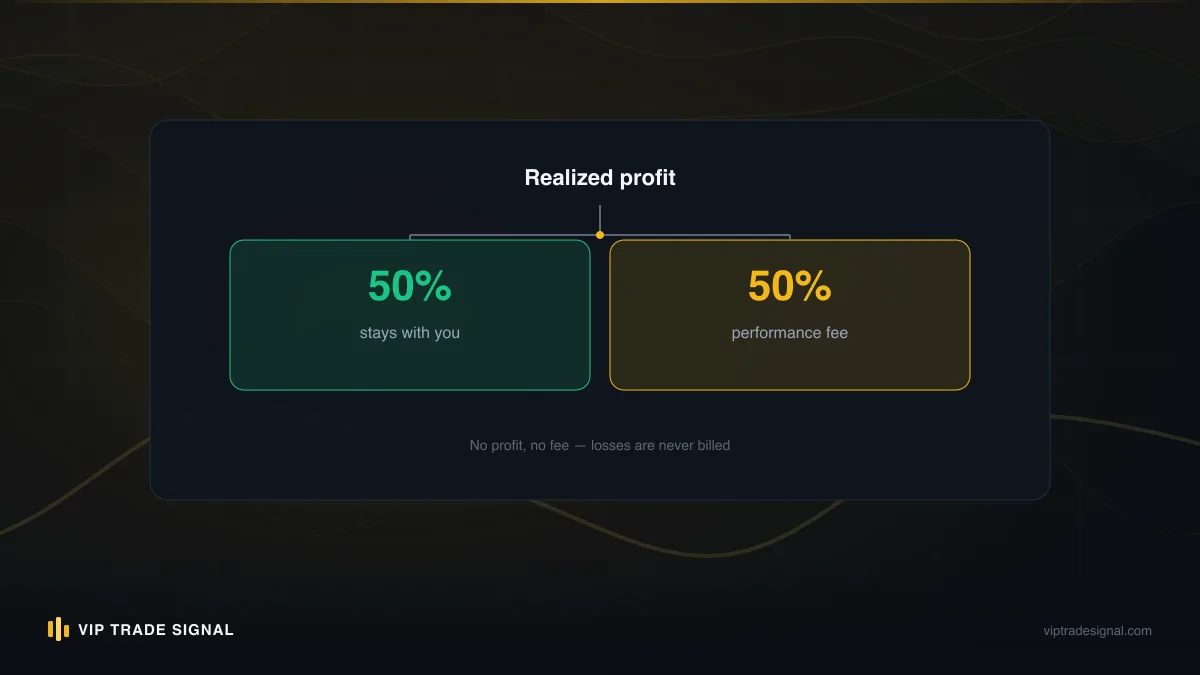
A subscription changes the maths in one important way: the provider now gets paid by you, monthly, and only for as long as you choose to stay. Churn becomes the enemy. And since the main reason people cancel a signal subscription is losing money, the provider has, for the first time, a financial reason to care whether you win.
That's real, and it's why the better paid forex signals services are noticeably more careful than free channels. You tend to get defined stop losses on every call instead of "close when I say", position sizing guidance instead of "load up", and fewer trades, because a paid provider eats the reputational cost of every loser while a free channel just deletes the message.
But let's not get romantic about it, because the subscription model breaks in three well-known places.
First, the acquisition treadmill. If a service's marketing is loud enough, new subscribers can replace quitting ones faster than bad results drive them out. A service pulling in 500 new $99 subscriptions a month can tolerate horrific churn indefinitely. For these operations the product isn't signals, it's advertising, and the signals only need to be plausible for about sixty days, which is roughly how long a losing subscriber takes to leave.
Second, survivorship theatre. Paid services fail and relaunch under new names constantly. The one you're evaluating today may be on its third identity, with a track record that conveniently starts eight months ago. A clean recent history means much less than it appears to.
Third, the free-trial trap, which deserves its own paragraph because so many people treat a forex signals free trial as due diligence. A seven-day trial samples maybe three to eight trades. Any strategy on earth, including a coin flip, can look brilliant or terrible over eight trades. Worse, some outfits run multiple trial cohorts with different calls and simply let the winning cohort convert. A trial tells you what the delivery format feels like. It tells you almost nothing about expectancy, and treating it as evidence is how people end up paying twelve months for a service they evaluated over five days.
One more tell worth knowing: watch how a paid service prices itself. Retention-driven providers tend to have one or two flat, boring tiers, because their whole model is "stay because it works". Acquisition-driven ones sprawl into Bronze, Silver, Gold, Diamond and Lifetime packages with countdown timers and "80% off, today only" banners, because their model is closing you on the day you land, and the theatrical discount exists to manufacture urgency where the product can't. Nobody discounts a genuinely scarce, genuinely profitable thing by 80% on a Tuesday. If the checkout page is working harder than the track record, believe the checkout page.
So paid is not a quality guarantee. It's a different incentive structure, one that can align with you but only does so when the provider depends on retention rather than acquisition. Which you can't see from the pricing page. You can only see it in the one place incentives leave fingerprints: the published record.
Free vs paid forex signals, feature by feature
Features matter less than incentives, but they're not nothing, and this is where the typical comparison table actually earns its keep, as long as it's honest about the spread of quality within each column.
| What you get | Typical free channel | Typical paid service | Honest caveat |
|---|---|---|---|
| Entry price | Yes, sometimes after the move | Yes, actionable | Late entries quietly wreck free-signal results |
| Stop loss | Sometimes, often absent | Almost always | A signal without a stop is not a signal, it's a tip |
| Take-profit levels | One, often fantasy-distance | Usually two or three, structured | TP screenshots prove nothing without the losers |
| Reasoning / analysis | Rare | Sometimes a sentence or two | Most traders skim it anyway; presence signals effort |
| Signal frequency | High, sometimes 10+ a day | Lower, filtered | High frequency usually means volume-based revenue |
| Support / questions | No | Usually yes | Test it before you pay, not after |
| Full public history | Almost never | Sometimes | This one column outweighs the rest combined |
Two things stand out from that table if you sit with it. The first is that the stop loss row is the fastest quality filter that exists. Any channel, at any price, that regularly sends entries without stops should be muted the same day; how a provider handles protective stops tells you nearly everything, and we've covered what good stop placement on gold actually looks like in detail elsewhere.
The second is that last row. Every feature above it can be faked in a screenshot. A complete public history, timestamped, with the losing trades left in, cannot be faked cheaply. Which brings us to evidence.
Judging a track record without being played
Whether a service costs $0 or $200 a month, the evaluation method is identical, and it's worth doing properly because this is the step where most people get fooled.
Demand completeness before performance. Don't ask "what's your win rate". Ask "where can I see every trade you've called since a fixed date". A provider showing you a 71% win rate over a hand-picked window is showing you marketing. A provider showing you a full ledger, including a nine-trade losing stretch in some ugly month, is showing you data. We publish every closed call, red ones included, at our signal history page, and we'd suggest holding anyone who wants your money, or your clicks, to the same standard. Most won't meet it. That refusal is itself the answer.
Check timestamps against the chart. Pull up the instrument on TradingView and spot-check five historical signals. Was the stated entry price actually available at the stated time, or is it suspiciously close to the extreme of the move? Entries pinned to the exact low of the day, repeatedly, mean the record was written after the fact.
Count the pips both ways. A 65% win rate is meaningless without the ratio of average win to average loss. A channel winning 65% of the time but losing 60 pips on losers and taking 25 on winners is a slow bleed dressed as success. Sum the actual outcomes over at least 50 trades. Fewer than that and you're reading noise.
Ask about the worst stretch, in dollars, not pips. A record that only reports pips is hiding the thing that actually breaks accounts: sequencing. Two hundred pips of monthly profit means nothing if the road there included a run of consecutive losers that would have taken a 1%-risk account down 12% and shaken you out of following the calls at all. So ask the provider directly what their deepest drawdown was and when. A straight answer with a date attached is a good sign. A pivot to "our win rate is..." is a bad one, and "we don't really have drawdowns" is your cue to leave, because everyone has drawdowns. We do. Anyone trading gold does.
Watch a losing week in real time. Before committing money, follow along on paper for three or four weeks. What you're waiting for isn't the wins. It's the first losing streak, because that's when providers reveal themselves. Do the losers get posted and owned, or does the channel go quiet for two days and resurface with an unrelated win screenshot? Does lot-size guidance stay constant, or does "recovery trade, double size" appear? One doubled-up martingale suggestion is a complete evaluation. Leave.
A provider's losing week tells you more than their best month ever will.
None of this takes special skill. It takes about a month of patience, which is precisely why so few people do it, and why providers who count on impatience keep eating.
The third route: free VIP access funded by your broker
Now the option that two-column comparisons skip entirely, partly because it's newer and partly because it doesn't fit the columns: free vip signals with broker deposit arrangements, where you get a service's full paid tier without paying the subscription, because you open and fund an account with one of the provider's partner brokers instead.
Mechanically it works like this. The provider has an introducing-broker relationship with certain brokers. When you trade through an account tagged to the provider, the broker shares a slice of its own revenue with them. That rebate replaces your subscription fee. We run exactly this: our VIP tier is $99 a month paid directly, or free through a partner broker (Exness, XM, IC Markets or Vantage) with a $250+ balance maintained, and the mechanics are laid out on the broker route page if you want the specifics.
Told you we'd mention ourselves. Now let's do the part a marketing page wouldn't, because this model has a genuine structural tension in it and you should walk in with eyes open.
The rebate is volume-linked. The provider earns when you trade. That is, on paper, the same incentive problem as the free affiliate funnel, and if a broker-funded provider starts firing fifteen signals a day at you, you should treat it exactly as sceptically as you'd treat a free channel doing the same. What keeps the model honest, when it is honest, is that the subscriber can leave for the paid door at any time, and the whole arrangement collapses if the signals themselves aren't worth $99. The paid tier acts as a price anchor and a quality floor. A pure affiliate channel has no such floor; there's no paid version of it that anyone would buy.
So the checklist for this route is short but strict: the paid option must genuinely exist at a published price, the signal frequency and content must be identical on both doors, and the full history must be public. If the "VIP" tier is only available via broker deposit, with no cash price anywhere, you're not looking at a funded subscription. You're looking at an affiliate funnel wearing a dinner jacket.
The other honest caveat is the deposit itself. That $250 isn't a fee, it stays your money in your account, but it is real capital exposed to real market risk the moment you trade it. Gold moves hard, and a small account trading it carelessly can lose that $250 through nothing but poor sizing. If you go this route, sort your position sizing before your first trade; our piece on lot sizing gold on a small account exists for exactly this situation.
What each route actually costs: three account sizes
Time to put numbers on it, because "free" and "$99 a month" are meaningless until they're set against your account size. Assume a subscription at $99 monthly, a broker-funded route needing $250 maintained, and a free channel costing nothing in cash. Yearly cash cost as a percentage of capital:
| Account size | Free channel | Paid at $99/mo | Broker-funded |
|---|---|---|---|
| $500 | $0 (0%) | $1,188 (238%) | $0 cash, $250 committed |
| $2,000 | $0 (0%) | $1,188 (59%) | $0 cash, $250 committed |
| $10,000 | $0 (0%) | $1,188 (12%) | $0 cash, $250 committed |
The middle column is the one people flinch at, and they should. A $500 account paying $99 a month needs to more than triple every year just to cover the subscription before making a single dollar of actual profit. That's absurd, and any small-account trader buying signals at that price has lost before the first trade. We say this as a service that charges exactly that: at $500, do not pay cash for signals. Ours or anyone's.
But the free column is lying to you too, because cash cost isn't cost. A free channel with late entries costs you slippage on every fill. Say its calls reach you after the move has run 40 cents on gold; on a 0.05-lot position that's $2 of dead expectancy per trade, twenty times a month, forever. A free channel with no stops costs you the occasional account-denting loss that a $30 defined risk would have capped at $30. And a free channel run as a volume funnel costs you overtrading, which is the most expensive habit in retail trading and doesn't appear on any invoice. Plenty of "free" followers pay more per year than any subscriber ever has. They just pay it to the market instead of a provider, in instalments small enough not to notice.
The broker-funded column is the interesting one at small size. Cash cost zero, quality floor set by the paid tier's existence, and the main risks are the volume-incentive tension above plus whatever spread difference exists at the partner broker versus your current one. Check that last part yourself: compare the partner broker's typical gold spread against your own during London and New York hours. If it's materially wider, that difference is your real subscription fee, priced per lot. On the brokers we partner with it's a wash for most retail traders, but verify rather than trust, including with us. Full cash pricing for both doors sits on our pricing page if you want to run your own version of this table.
Why free feels safer than it is
Worth pausing on the psychology, because the pull of free isn't really about money. Behavioural researchers have a name for it, the zero-price effect: cutting a price from $1 to zero changes demand far more than cutting it from $2 to $1, even though the saving is identical. Free doesn't register as a cheaper price. It registers as the absence of a decision, and the absence of risk.
Which is exactly backwards in this business. Paying $99 forces a decision, and decisions come with scrutiny; you check the ledger, you shadow the calls, you set a date to review whether it earned its keep. Joining a free channel requires nothing, so it gets nothing. No evaluation, no review date, no exit criteria. People who would interrogate a $20 subscription will follow a free channel's calls with real money for a year and never once tally the results, because there was no invoice to make them look.
Free also spreads on autopilot. A channel that costs nothing gets forwarded, and forwarded again, which is why the biggest signal channels are almost never the best ones. Size measures shareability, not expectancy. A 90,000-member channel is proof that free things travel. Nothing more.
The practical fix is blunt: bill yourself. Whatever route you take, free included, put a monthly review in the calendar as if a $99 invoice had landed, open the spreadsheet, and ask whether the last month of calls earned the imaginary fee. A free channel that can't survive an imaginary invoice is telling you what a real one would.
Moving from free to paid without torching a month
Suppose you've decided the free channel you follow is a funnel and you're moving to a paid or broker-funded service. There's a right order to do this in, and most people do it backwards by paying first and evaluating after. Sequence it like this instead.
Weeks one to four: shadow, don't trade. Track the new provider's calls on paper while still watching the old channel. Log every signal in a spreadsheet: timestamp received, entry, stop, targets, and what price was actually available when your phone buzzed. That last column is the killer. A signal that's profitable at the provider's price and flat at yours is not a profitable signal for you.
Weeks five to eight: smallest real size. Paper results survive contact with fills, spreads and your own hesitation about 80% of the time; the other 20% is worth finding out at 0.01 lots. Trade the minimum, follow the calls exactly, no editing entries or moving stops. You're testing the service and your ability to execute it, and the second one fails more often than people admit.
Week nine onwards: scale to your actual risk plan. Sized so a full stop-out costs 1-2% of the account, not sized to make the subscription "worth it" quickly. Trying to make $99 back in the first week is how a $99 cost becomes a $600 loss.
Two pieces of admin before any money moves, both tedious, both skipped by nearly everyone. Read the cancellation terms and find the actual cancel button before you subscribe; a surprising number of services make joining a one-click affair and leaving a support-ticket ordeal, and some "lifetime" deals are lifetime in the sense that you'll spend yours trying to get out of the rebill. And pay by card, not crypto, whatever discount the crypto price dangles. A card gives you a chargeback path if the service vanishes. A wallet address gives you a lesson.
And don't unsubscribe from the free channel out of spite. Mute it and keep it. It's data now, and comparison data is the hardest thing to get in this business.
The hybrid play: free channels as a filter, not a source
There's a legitimate use for free channels even after you've stopped trading them, and the sharper traders we know all do some version of this.
Free channels are a decent sentiment gauge precisely because they're funnels. When four unrelated free gold channels are all screaming buy within the same hour, that tells you retail is loaded long, which is occasionally actionable information, usually in the opposite direction. When your paid provider calls a short and the free channels are calling longs, nobody's "right" yet, but you've learned where the crowded side is.
They're also a cheap education in what bad looks like. Six months of watching a funnel channel operate teaches you to recognise martingale language, screenshot theatre and post-hoc entries faster than any article can, including this one. Consider it an inoculation.
What the hybrid approach is not is trading two sources at once. Mixing signals from providers with different methods means their stops and targets disagree, your risk per trade stops being measurable, and when the account bleeds you can't tell which source did it. One executed source. Everything else is weather.
Case study: the same trade through two doors
Here's a generic but realistic illustration of the mechanism people underestimate most: delivery timing. Say a provider's desk calls a gold long at 3,308 with a stop at 3,299 and targets at 3,317 and 3,330. Risk: 9 dollars of price. First target: 9 out. A clean 1:1 to TP1 with a runner. Now follow it through two doors.
The VIP door. The signal lands at 14:02, price is at 3,308.40 when the subscriber sees it. Fill at 3,308.50. Effective risk 9.50, reward to TP1 8.50. Slightly worse than advertised, which is normal and fine. Trade runs, TP1 hits, half closed, stop to entry. Boring. Boring is the point.
The free door. The same provider, or a channel recycling its calls, posts the trade to the free tier at 14:31 as proof of quality, by which time gold has already run to 3,313. The late follower buys 3,313, five dollars into a nine-dollar move. Same stop at 3,299 makes the risk 14 to earn 4 to TP1. The exact same signal, and the arithmetic has flipped from roughly 1:1 into risking 3.5 to make 1. Price tags TP1 at 3,317, retraces, and stops the free follower at breakeven-minus while the VIP subscriber banked half.
Same analysis. Same levels. One profitable outcome, one loss, and the difference was 29 minutes. This is why "the free channel posts the same signals" is usually technically true and practically false. In signal trading, a call's value decays by the minute, and free tiers are structurally the last to know. That's not an accident, either. The delay is what makes the paid tier sellable.
Which route fits which trader
No universal answer, but there are honest ones by situation.
Under $500, learning: Don't pay cash for signals, full stop, the percentages are ruinous. Either trade your own tiny setups while you learn, or take a broker-funded route where the $250 stays yours, and treat the whole thing as tuition with strict 1% risk per trade. Expect losses. They're part of the bill.
$1,000 to $5,000, part-time, employed: This is where signal services genuinely earn their keep, because your scarce resource is screen time, not capital. Broker-funded first if a credible provider offers it, cash subscription if the maths clears: as a rough rule, don't pay a monthly fee above 2% of your account. At $2,000, that's $40 a month before our own $99 tier makes cash sense, which is exactly why the broker door exists.
$10,000 plus, experienced: The subscription is noise at 1% of capital a year. Your real questions are provider risk and correlation with what you already trade. Evaluate the ledger over 100+ trades, check the strategy isn't just a levered version of your existing exposure, and size at your rules rather than theirs.
Anyone who checks their phone forty times a day hoping for a signal: The route question isn't your problem. Overtrading is, and every provider model except a strictly filtered one will feed it. Fix that first; it's worth more than any signal.
The decision, reduced to seven questions
After all of that, the free vs paid forex signals decision compresses to a short interrogation. Put any provider, any price, through it.
- Can you state, in one sentence, exactly how this provider earns money? If not, assume the worst available answer.
- Does their revenue rise when you trade more, or when you stay longer? Volume-linked pays them to churn you; retention-linked pays them to keep you profitable enough to remain.
- Is the complete history public, losses included, without asking? No ledger, no money, no exceptions.
- Does every signal carry a stop loss at issue? One naked entry is a warning. Three is a verdict.
- If it's "free VIP via broker", does a real cash price for the identical tier exist in public? No cash door means it's an affiliate funnel, whatever it calls itself.
- Have you shadowed it on paper through at least one losing streak? If you haven't seen them lose, you haven't evaluated them.
- Is the total cost, cash plus spread difference plus your realistic slippage, under about 2% of your account per month? Above that, the arithmetic beats the analysis.
A free channel can pass all seven. A few do. A paid service can fail five of them and thousands of people will subscribe anyway this month. That's the whole argument of this piece: the price tag was never the variable that mattered. The business model is, and unlike future performance, the business model is something you can actually inspect today, for free, in about an hour.
Trading gold on leverage is high-risk whichever door you walk through, losses are a certainty along the way, and no provider, us included, can promise you otherwise. What a provider can do is show you everything and let you decide. Ours is all on the table: the ledger at /signals/history, both doors priced in plain numbers. Run us through the seven questions the same as anyone else. If we fail one for you, walk. That's the standard, and you should hold it whether the price tag reads $99 or nothing at all.