Somebody sent you a screenshot. That's usually how it starts. A friend, a cousin, someone from work — a phone screen showing a gold trade up a few hundred dollars, and a caption that says something like "easy money bro". And now you're here, typing questions into a search bar at eleven at night, trying to work out how to trade gold XAUUSD without doing anything stupid.
Good instinct. Because the screenshot never shows the other trades. It never shows the Tuesday that account gave half of it back, or the margin call three weeks later. Gold is a genuinely tradeable market — deep, liquid, active nearly round the clock — and it is also the market where new traders lose money fastest, because it moves further in an afternoon than most currency pairs move in a week.
This is the field manual I wish someone had handed me before my first gold trade. Not a strategy article. A ground-floor manual: what the instrument actually is, what a position really costs, how to set up an account without getting fleeced, what your first ten trades should look like, and what a sane first ninety days involves. We run a gold signal service, so we'll mention that where it's honest to, but most of this piece has nothing to sell you. It's the stuff you need whether you ever follow a signal or not.
What XAUUSD actually is: spot gold as a CFD
Start with the symbol, because it confuses everyone. XAU is the ISO code for one troy ounce of gold — X for "not a national currency", AU from aurum, the Latin for gold. USD is the dollar. So XAUUSD is a currency-pair-style quote that answers one question: how many US dollars does one troy ounce of gold cost right now? When you see 3,318.40 on a chart, that's the price of an ounce in dollars. Nothing more mysterious than that.
Here's the part beginners skip and regret skipping. When you trade XAUUSD on a retail platform like MT4 or MT5, you are not buying gold. No vault, no bars, no delivery van. You're trading a CFD — a contract for difference — with your broker. You open a position at one price, close it at another, and the broker settles the difference in cash. If you buy at 3,318 and sell at 3,325, you get paid the $7 move multiplied by your position size. If price goes the other way, you pay it.
That structure has three consequences worth holding in your head from day one.
First, you can go short as easily as long. Selling gold you don't own sounds exotic; on a CFD it's one click, and roughly half your eventual trades should probably be shorts, because gold falls just as enthusiastically as it rises.
Second, your counterparty is your broker, not "the market". That makes broker choice a real decision, not an afterthought — more on that below.
Third, leverage is baked in. You control an ounce of gold worth $3,300-odd while posting a small fraction of that as margin. Leverage is the reason a $500 account can trade gold at all, and it's also the reason most $500 accounts don't survive their first month. We'll deal with it properly in the beginner-killers section, but the honest framing belongs right here at the top: trading gold CFDs is high risk, most retail accounts lose money, and nothing in this article changes that. What a manual like this can change is how you lose while you're learning — small and educational, rather than large and terminal.
One more clarification, because you'll see the alternatives mentioned. You can also get gold exposure through futures (too big for beginners — one COMEX contract is 100 ounces), ETFs like GLD (fine for investing, useless for active trading), and physical coins (a hobby, not a trading vehicle). For an active retail trader with a small account, spot gold CFDs — gold cfd trading, in search-engine speak — are the practical instrument, which is why this whole manual assumes them.
How gold is priced: ounces, dollars, and the pip problem
A troy ounce is 31.1 grams, the price is quoted in dollars and cents, and the chart reads like any other chart. Easy. The confusion arrives with the word "pip", and it's worth clearing up now because it causes real, costed mistakes.
In forex, a pip has a settled meaning: the fourth decimal place on most pairs. In gold, there is no settled meaning. Some brokers and most signal providers treat a 10-cent move — 3,318.40 to 3,318.50 — as one pip. Others call the smallest increment, one cent, a pip. So when someone tells you "gold moved 50 pips", they might mean 50 cents or they might mean five dollars, and the difference is a factor of ten. We've watched a new trader set a stop 30 "pips" away thinking he had a $30 buffer, when his platform's convention gave him $3. Price sneezed. He was out in four minutes.
The fix is to stop thinking in pips entirely and think in dollars of price movement. "I'm risking a $6 move." "Gold has a $45 range today." Dollars are unambiguous. Every decent gold trader we know talks this way, and when you read a signal from anyone — us included — translate it into dollar distances before you touch the order ticket.
While we're on price behaviour: gold's daily range is the thing that makes it both attractive and dangerous. A typical day in recent conditions covers somewhere between $30 and $60 top to bottom; a news day can triple that. Compare that with a major currency pair, where the whole day might be a 0.5% range, and you see why people fall in love with gold — and why the market charges tuition. The moves that make the screenshots are the same moves that delete unprotected accounts.
Gold also has a rhythm across the day. It trades nearly 24 hours from Monday to Friday, but the real business happens when London and New York are both open — roughly 1pm to 5pm UK time. Asian hours are usually quieter and rangier. As a beginner you don't need to trade the busy window, and there's a decent argument you shouldn't at first, but you absolutely need to know when it is, because a position opened into it behaves like a different animal.
Contract sizes and what 0.01 lots really costs
This is the section to read twice, because position sizing is the entire game for your first year.
The standard lot in gold CFDs is 100 troy ounces. At $3,300 gold, that's $330,000 of exposure — plainly absurd for a beginner. Fortunately almost every broker lets you trade 0.01 lots, which is a single ounce. One ounce is the beginner's unit, and here's what it actually does:
| Position size | Ounces | $1 price move | $10 price move | Typical margin at 1:100 |
|---|---|---|---|---|
| 0.01 lots | 1 | $1 | $10 | ~$33 |
| 0.05 lots | 5 | $5 | $50 | ~$165 |
| 0.10 lots | 10 | $10 | $100 | ~$330 |
| 0.50 lots | 50 | $50 | $500 | ~$1,650 |
| 1.00 lot | 100 | $100 | $1,000 | ~$3,300 |
The arithmetic is mercifully clean: at 0.01 lots, every dollar gold moves is a dollar in your P/L. Gold rallies $8 while you're long one ounce, you're up $8. It drops $20 against you, you're down $20. Scale linearly from there.
Now run the numbers on a real beginner account, because this is where dreams meet division. Say you fund $500 and follow the standard risk rule — no more than 1% of the account on any single trade. That's $5 of risk. A sensible gold stop-loss, one that isn't inside the market's random noise, usually needs $5 to $10 of room, sometimes more. At 0.01 lots, a $5–$10 stop costs you $5–$10 when it's hit. Which means a $500 account trading 0.01 lots is already at or slightly above the textbook risk limit on every trade. There is no room to size up. None.
And the costs eat proportionally harder at this size. The spread on gold at a decent broker runs somewhere between 15 and 35 cents in normal hours. On one ounce that's $0.15–$0.35 per round trip — trivial in absolute terms, but if your average winner is only $5, the spread is quietly taking 3–7% of it every single time. Hold overnight and swap charges (the daily financing cost on a leveraged position) nibble further, particularly on long positions. None of this makes small-account trading pointless. It makes it a training environment, which is exactly what you need it to be.
The honest conclusion, and we'd rather say it plainly than let you find out expensively: with $200–$1,000, you are not trading gold for income. You're paying a modest, controlled fee to learn a difficult skill with real feedback. Traders who accept that tend to still have accounts in month six. Traders who fund $500 and try to make $500 a month from it are usually gone by week three, and it wasn't bad luck.
Choosing and setting up a broker account
Your broker is your counterparty, your price feed, and the custodian of your money. Beginners agonise over strategy and pick a broker in ninety seconds off a YouTube ad. Reverse that energy.
What actually matters, in order:
- Regulation. A real licence from a serious regulator — FCA, ASIC, CySEC, or the reputable offshore arms of established firms. An unregulated broker with tight spreads is a casino that also holds your coat.
- Gold spreads and execution. Compare the live XAUUSD spread across two or three brokers on a demo during the London/New York overlap, not at midnight. Anything consistently over 40–50 cents on a standard account is giving your edge away.
- Micro-lot support and reasonable margin rules. You want 0.01 lots available and a clear, published stop-out level.
- MT4 or MT5. Not because they're beautiful — they're not — but because they're the standard, every tutorial assumes them, and if you ever use signals or account management, that's where it happens.
- Clean deposits and, more importantly, clean withdrawals. Search "[broker name] withdrawal problem" before funding. Five minutes of reading has saved people five figures.
The big established names — Exness, XM, IC Markets, Vantage — all clear this bar, which is one reason they're the partner brokers through which our own signal membership comes free with a $250+ balance instead of the $99 monthly fee. But to be clear: any properly regulated broker with tight gold spreads and micro lots will serve you fine for learning. Pick on the criteria, not the affiliate link.
Setup itself is a half-hour job: verify your identity (photo ID plus proof of address — every legitimate broker requires this, and one that doesn't is telling you something), open a demo account first, install MT4 or MT5, and find XAUUSD in the symbol list. It's sometimes listed as GOLD, XAUUSDm, or XAUUSD.a depending on account type; check the contract specification inside the platform to confirm the lot size is 100 ounces so your maths holds.
Then — and this is the step everyone skips — spend one full session doing nothing but mechanics on demo. Place a buy. Place a sell. Attach a stop-loss and a take-profit. Modify them. Set a pending order and delete it. Close half a position. Fumbling the order ticket is harmless on demo and genuinely expensive live; we've seen a trader buy 1.0 lots instead of 0.01 because the field remembered his last entry, and that story only ended tolerably because his stop was tight.
Reading a gold chart: your first hour
Open the XAUUSD chart on the 1-hour timeframe, set it to candlesticks, and resist the urge to install indicators. Your first hour with a gold chart should be about four things, and none of them need a single line of code.
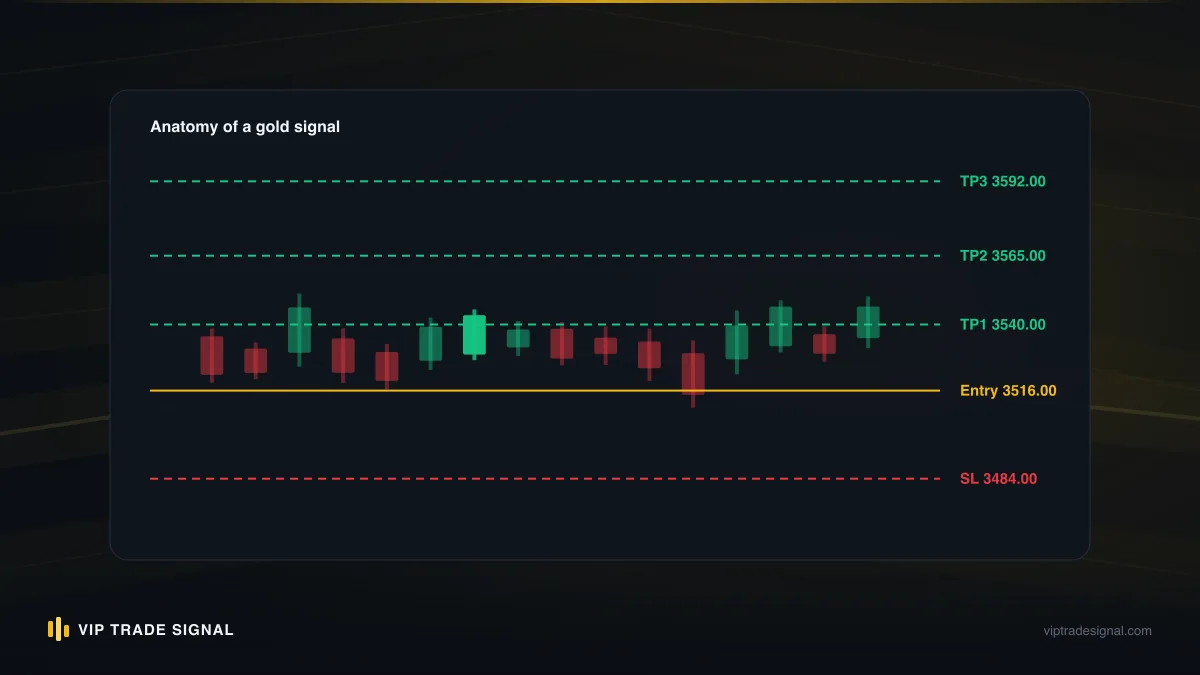
One: the recent highs and lows. Scroll back a couple of weeks. Where has price repeatedly stalled and turned? Those horizontal areas — call them support below and resistance above — are where other traders' orders cluster, which is why price so often reacts there. Mark the two or three obvious ones. Obvious is the point; a level only works because many people can see it.
Two: round numbers. Gold respects them to an almost comical degree. 3,300. 3,350. 3,250. Watch how often price hesitates, bounces, or fakes through a round 50-dollar figure. Nobody fully agrees why — clustered orders, option strikes, plain psychology — but you'll see it within a week of watching.
Three: today's range versus a normal day. If gold usually travels $40 in a day and it's already moved $55 by early afternoon, chasing the move is statistically buying the top of a stretched elastic band. Not always. Often enough to matter.
Four: where price sits relative to all of the above. Mid-range, miles from any level, in a quiet session? That's a "do nothing" chart, and recognising a do-nothing chart is the single most profitable skill a beginner can build. Most hours of most days are do-nothing hours. The market pays patience and charges boredom-relief by the trade.
Later — genuinely later, month two or three — you can add one moving average for trend context and start studying entries properly. For now, an annotated naked chart teaches you more than fifteen indicators, because indicators answer questions you don't know how to ask yet.
The three beginner-killers: leverage, news, and revenge
Ask anyone who's watched a lot of new gold traders and the failure stories collapse into three patterns. Not thirty. Three.
Leverage. The broker offers 1:500 and the beginner reads that as a suggestion. It isn't; it's a credit limit, and like all credit limits it's set for the lender's benefit. At 1:500 a $500 account can technically open 0.75 lots of gold — 75 ounces — at which point a routine $7 wobble is a $525 move against a $500 account. Game over inside an hour, and the trader walks away believing gold is rigged when the honest post-mortem is that they bet their whole stake on a coin flip with a fee attached. The defence is boring and absolute: size positions by the 1% risk rule, and treat the leverage number in your account settings as irrelevant trivia. Risk per trade is the dial that matters. Leverage just determines how catastrophically you can ignore it.
News. A handful of scheduled announcements move gold violently: US CPI, non-farm payrolls, and Federal Reserve rate decisions above all. In the seconds around a big release, gold can travel $20–$40, spreads can blow out from 25 cents to several dollars, and stop-losses fill wherever there's liquidity rather than where you placed them. Trading into that as a beginner isn't trading, it's queueing to be slipped. The fix costs nothing: check an economic calendar each morning — thirty seconds — and be flat, or at least stopped tight and at peace with the outcome, ten minutes before red-flag US news. You'll feel like you're missing fireworks. You're missing shrapnel.
Revenge. The quiet one, and the one that ends more accounts than the other two combined. You take a $10 loss. Fine on paper. But it annoys you, so you re-enter without a setup to win it back, lose $14 more, double size because now it's personal, and forty minutes later a controlled $10 loss has become an $80 crater and a ruined evening. Every trader recognises this; the good ones just built a circuit breaker before they needed it. Yours, from day one: two losses in a session means the platform gets closed. Not reviewed, not watched. Closed. The market reopens tomorrow with fresh setups and no memory. Your account, on the other hand, remembers everything you did tonight.
The market charges every beginner tuition. Your only real decision is whether you pay it in small instalments or one lump sum.
Your first ten trades: a structured curriculum
Most beginners treat their first trades as attempts to make money. Wrong frame, and expensively wrong. Your first ten live trades are laboratory exercises whose purpose is to install correct habits while the stakes are tiny. The profit or loss across all ten should be small enough to be boring — think plus or minus $50 on a small account. Here's the curriculum we'd set.
Trades 1–2: pure execution. 0.01 lots. Take an unremarkable setup at a level you marked in advance. The entire grade is mechanical: stop-loss attached before entry, take-profit set, position survives untouched until one of them is hit. Outcome irrelevant. A losing trade executed perfectly scores higher than a lucky winner you managed by vibes.
Trades 3–4: planned entries. No market orders. Write the trade down first — direction, entry level, stop, target, one sentence of reasoning — then set a pending order at your level and let the market come to you or not. Half the time it won't, and the order expires untouched. That's a pass, not a fail: you've just learned that missing a trade costs nothing, which is a lesson some traders never receive. (The trade-offs between pending and market entries run deeper than beginners expect; we've written a full piece on pending versus market execution for when you're ready.)
Trades 5–6: holding through noise. Gold will float $3–$4 against a good entry as a matter of routine. These two trades exist to teach your nervous system that adverse movement inside the stop is weather, not information. Set the stop where the idea is wrong — beyond the level, not inside the wobble zone — and keep your hands off. If you close early out of fear, log it honestly and repeat the exercise. Most people need the repeat.
Trades 7–8: the two-loss rule under fire. Sooner or later a session hands you two stops in a row. These trades are about proving you'll actually close the platform when it does — the rule is easy to write and hard to obey with adrenaline in your blood. If you get through trades seven and eight without a two-loss session, fine; the rule stays armed and the exercise carries forward.
Trades 9–10: full cycle, no supervision. Plan, size, enter, manage, exit, journal — the complete loop with every habit from trades one through eight running at once. Then grade yourself on process only: ten out of ten trades journalled? Every stop attached before entry? Two-loss rule never broken? That's a pass, regardless of P/L.
Run the ten trades over two to four weeks, not two days. Spacing is part of the design — it keeps each trade a considered event rather than a slot-machine pull, and it gives the journal (coming below) time to start showing you patterns.
Demo to live: the graduation criteria
"How long should I demo?" is the wrong question — time served proves nothing. Demo until you meet criteria, then go live small. Ours:
- Thirty demo trades minimum, every one journalled. Not thirty clicks; thirty planned trades with written reasoning.
- Zero mechanical errors in the last fifteen. No missing stops, no wrong sizes, no fat-fingered lots.
- The two-loss rule held every single time it triggered. One violation resets the counter. Harsh, and meant to be — discipline that fails on demo, where nothing is at stake, has no chance live.
- A flat-or-better equity curve over the last twenty trades. Not profits — you don't need demo profits to graduate, because demo profits are only weak evidence anyway. You need evidence you're not systematically bleeding.
- You can state your risk per trade in dollars without checking. If you have to open a calculator to know what you're risking, you don't yet know what you're risking.
Meet all five and fund a live account with money whose total loss would irritate but not injure you. Rent money, borrowed money, credit-card money — never. That's not a platitude, it's mechanics: a trader who needs the money trades scared, and scared traders cut winners early, widen stops on losers, and break every rule in this article inside a fortnight.
Expect live trading to feel completely different from demo even at 0.01 lots. It does for everyone. The $4 floating loss that meant nothing on demo suddenly itches. This is normal, it's precisely why you go live at minimum size rather than jumping to "real" size, and it fades over about twenty trades as your brain recalibrates. Plan for your first live month to be demo-with-feelings, and grade it the same way: process, not profit.
Using signals while learning: crutch or curriculum
Now the awkward section, given who's writing. Should a beginner learning gold use trading signals?
The honest answer is that signals are either the best learning accelerant available to a retail beginner or a way to learn absolutely nothing, and the difference is entirely in how you use them. Here's the split we see over and over.
Signals as a crutch: the trader copies every alert at the biggest size they can, checks the P/L, and skips the thinking. When the provider has a losing week — every honest provider has losing weeks — the trader has no framework for judging whether it's variance or decay, panics, and quits at the exact bottom of the drawdown. Twelve months later they've paid for signals and learned nothing except that they blame signal sellers now. This describes a large share of the market, and it's why most signal Telegram channels are marketing funnels with a chart on top: the business model doesn't need you to learn, it needs you to hope.
Signals as a curriculum: the trader takes each alert as a worked example from someone further along. Before entering — at 0.01 lots, always — they annotate it: why this level, why this stop distance, why this target, what would I have done unaided? After the close, win or lose, they compare the outcome to their annotation. Each signal becomes a small apprenticeship in trade construction, and after fifty of them the trader has a library of dissected examples plus live experience executing them cleanly. That trader is learning faster than either the pure self-teacher or the pure copier.
If you go this route, apply one filter ruthlessly: only follow a provider who publishes every closed trade, losses included. A track record you can't audit is an advert. It's the reason our own signal history is public down to every losing trade — and the reason we'd tell you to walk away from anyone's service, ours included, whose history you can't inspect before paying. The membership itself runs $99 a month or free via a partner broker with $250 maintained; the FAQ covers the mechanics. But the deeper how-to — sizing signal trades, handling provider drawdowns, when to override an alert — deserves its own article, and we've written it: how to use forex signals properly. Read it before you follow anyone. And if you're comparing paid providers generally, the economics of paid signal services are worth understanding first, because the pricing tells you a lot about the incentives.
One line we won't blur: signals while learning should be small, or learning-focused, and preferably both. A beginner running someone else's trades at aggressive size is combining maximum risk with minimum understanding, and no provider's win rate makes that combination safe.
Realistic monthly expectations by account size
This section will read as pessimistic. It's actually just arithmetic, and the traders who accept the arithmetic early are massively overrepresented among the ones still trading in year two.
Professional money managers celebrate 20–30% in a year. A retail trader compounding 3–5% a month is doing genuinely excellent work — and that's an aspiration for after you're consistent, not a plan for month one. Put real numbers on it:
| Account | A poor month (−5%) | A good month (+4%) | An excellent month (+8%) |
|---|---|---|---|
| $500 | −$25 | +$20 | +$40 |
| $2,000 | −$100 | +$80 | +$160 |
| $10,000 | −$500 | +$400 | +$800 |
Sit with the middle column. A good month on a $500 account is twenty dollars — a takeaway meal. The gap between that number and the numbers in the screenshots that brought you here is filled by one of three things: much larger accounts, much larger risk, or fiction. Usually fiction, occasionally survivorship — the person showing you the winning month simply doesn't post the others.
This is why the account-size conversation matters more than the strategy conversation for beginners. If you need trading income now, a $500 gold account cannot supply it, and forcing it to try — oversizing, overtrading, revenge sequences — is the mathematically certain way to lose the $500 too. The sustainable sequence is slower and less romantic: learn on small money, prove consistency over months, and let the account grow through deposits from your actual income plus modest compounding. Traders we've seen make it almost all followed some version of that path. The shortcuts all lead through the same door, and it's marked "re-deposit".
And the loss column is not decoration. You will have losing months. We have losing stretches, publicly logged. Anyone in this business who claims otherwise has a track record you're not being shown, and the risk warning belongs in the arithmetic rather than the small print: money in a gold account can be lost, in whole, and sometimes is.
Records: journaling from trade one
Every seasoned trader says journal. Nearly every beginner nods and doesn't. So instead of moralising, here's the practical case: your journal is the only place your actual patterns are visible, because memory is a marketing department. Memory keeps the great winner from a fortnight ago on a loop and quietly buries the four revenge trades that paid for it. The journal keeps the books.
Keep it stupid-simple or you'll abandon it by Thursday. A spreadsheet, seven columns, under two minutes per trade:
- Date and session (Asia, London, New York)
- Direction and size
- Entry, stop, target — the planned trade
- What actually happened, including any rule you bent
- Risk in dollars, result in dollars
- One-sentence reason you took it
- Emotional state, one word, honest ("calm", "bored", "tilted", "fomo")
Columns four and seven earn their keep within a month. Review the journal weekly — ten quiet minutes, Sunday works — and ask two questions: which trades would I delete if I could, and what did those trades share? The answers are unglamorous and repetitive. "Everything tagged 'bored' lost." "I break rules after 10pm." "My third trade of any day is my worst." Boring, personal, and worth more than any indicator you will ever install, because each one converts into a rule: no bored trades, no trades after ten, two trades a day maximum. Your edge in year one isn't prediction. It's subtraction.
If you're following signals during this period, journal those identically, plus one extra note: what you'd have done differently unaided. That single column is what turns copying into the apprenticeship we described earlier, rather than outsourced hoping.
The 90-day beginner roadmap
Pull it all together into a schedule. Ninety days is enough to go from "what does XAU mean" to "competent, tiny, and disciplined" — which is further than most people who fund an account ever get.
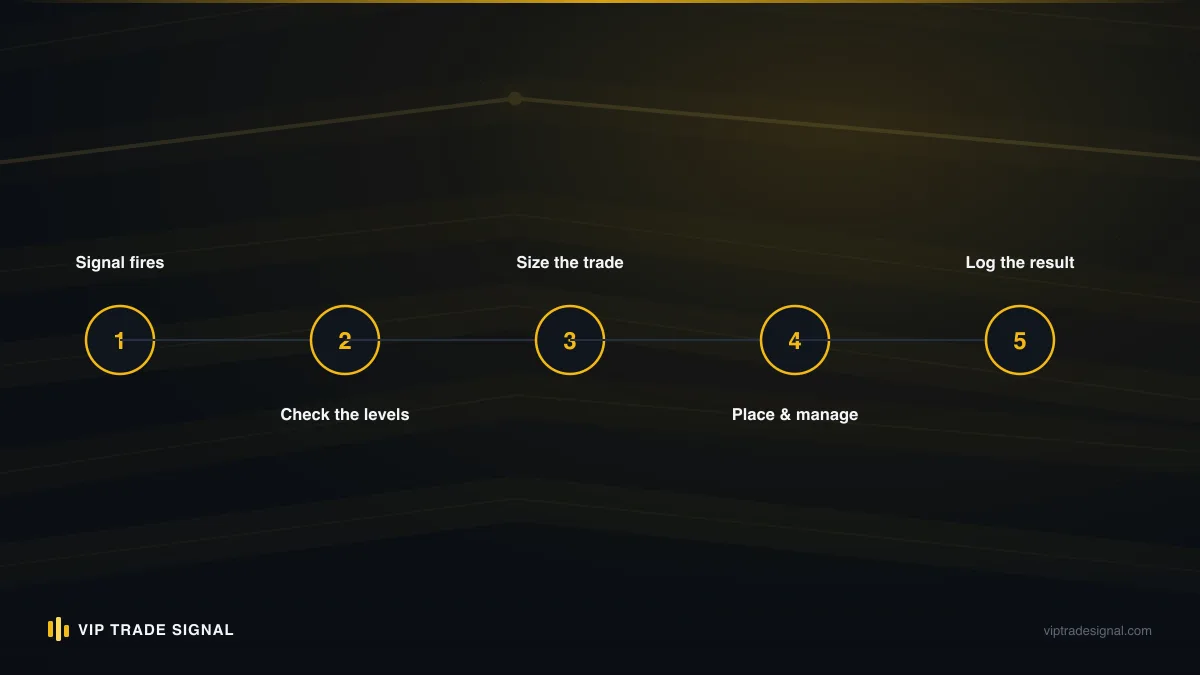
Days 1–30: foundations on demo. Week one: broker chosen on the criteria above, demo open, platform mechanics drilled until the order ticket is muscle memory, chart marked with levels and round numbers. Weeks two to four: demo trades on the first-ten-trades curriculum, every one journalled, economic calendar checked every morning until it's as automatic as looking at the weather. Watch how gold behaves around one CPI print and one Fed decision from flat. Just watch. That education is free exactly once — before you have money on.
Days 31–60: live at minimum size. If — only if — the graduation criteria are met, fund the small live account and repeat the curriculum at 0.01 lots with real money and real feelings. Expect performance to dip versus demo; everyone's does. Your only targets this month are zero mechanical errors, zero rule violations, and thirty journalled trades. P/L is data, not a verdict. If discipline cracks — a missed stop, a broken two-loss rule — the honest response is a week back on demo, not a bigger position to win the mistake back.
Days 61–90: consistency and review. Keep size unchanged. (The urge to increase it will be strong by now. The urge is not evidence.) Add the weekly journal review if you haven't, and start converting its findings into personal rules. By day 90 you should be able to answer, with numbers rather than feelings: what's my risk per trade, what's my error rate, which setups and sessions actually work for me, and did my discipline hold under a losing streak? A trader who can answer those has earned the right to think about sizing up — slowly, something like 0.01 to 0.02, not 0.01 to 0.10 — or to think seriously about how xauusd trading for beginners becomes just xauusd trading.
What the roadmap deliberately excludes: strategy-hopping (one simple approach, ninety days, no exceptions), any position size that makes your pulse noticeable, and every form of "make it back" trade. The traders who fail rarely fail for lack of information. They fail because they abandoned a perfectly good plan in week five, usually right after their first losing streak, which is precisely when the plan was doing its job.
Where this leaves you
Strip the manual to its load-bearing walls and gold trading for beginners comes down to a short list. XAUUSD is a leveraged CFD on the dollar price of an ounce, so think in dollar moves and ignore pip talk. One ounce — 0.01 lots — is your unit until you've earned bigger, and "earned" is measured in journalled, disciplined trades, not in wins. Three things kill new accounts: oversized leverage, red-flag news, and revenge, and all three have cheap, boring defences you can install today. Small accounts are classrooms, not income streams, and the arithmetic on that isn't negotiable. And whether you learn alone or alongside signals, the non-negotiable filter is a fully public track record, losses on display — audit ours with exactly that scepticism.
So here's the hard question to close on, and we'd ask it of any beginner across a table: are you trying to learn to trade gold, or are you trying to feel what a win feels like this week? They sound similar. They produce opposite behaviour — one leads to 0.01 lots, a journal, and a dull, survivable first quarter; the other leads to the screenshot lifecycle, and you already know how that ends, because the second half of the screenshot never gets sent.
Ninety days. One ounce at a time. A written record of everything. It's slower than what the marketing promised you, and it's the only version of this that we've ever seen actually work.