A losing signal costs you one trade. A bad month of signals costs you a drawdown. But hand your login or your deposit to the wrong person and you can lose the whole account in an afternoon, plus whatever they talk you into "topping up" afterwards. Account management and deposit scams in forex sit in a different weight class from every other con in this industry, because they don't need to fool you trade by trade. They only need to fool you once.
We should know. We run a legitimate account management service, which means we spend a strange amount of time explaining to prospective clients why the offer they got last week on Instagram — the one promising to double their $500 in ten days — is going to end with an empty account and a blocked contact. Selling the real thing obligates you to map the fake versions precisely, because the fakes borrow our vocabulary. "Managed account." "Profit split." "PAMM." Same words, completely different machinery underneath.
So that's this article. Every major variant of the managed-account and deposit scam, how each one actually extracts the money, the specific contract terms that separate legitimate management from theft with paperwork, and — because people usually find this article too late — what's realistically recoverable once you've been had. It's longer than the listicle versions of this topic because the details are where the protection lives.
Why this is the most expensive scam category in retail forex
Think about what a signal scam can take from you. A fake signal channel charges maybe $100 a month for garbage calls, and you can stop paying the moment you smell it. Annoying, cheap-ish lesson. We've written about how the free channel funnels work, and the honest summary is: they nibble.
Management and deposit scams don't nibble. They take custody — of your login, your money, or both — and custody is the whole game. Once someone else controls the account, your losses are no longer capped by your own discipline. They're capped by your balance. And in the worst variants, not even by that, because the follow-up phase ("your account is in profit, pay the tax/fee/margin call to withdraw") extracts money you never intended to trade with at all.
There's a second reason this category outranks the others: the ticket size. Nobody sends a stranger $30. The pitch is built around lump sums — $500, $2,000, sometimes a redundancy payout or a chunk of savings — because the story only works at lump-sum scale. "Double your money" sounds silly at $50 and life-changing at $5,000. The scammers know exactly which one to ask for.
And a third: shame does half their security work for them. Someone who bought a bad signal subscription will complain about it publicly. Someone who gave their MT5 password to a man called "Fx_Wealth_Manager_Kevin" mostly won't, because saying it out loud makes the mistake feel obvious. Under-reporting keeps the model profitable and the next victim uninformed.
Most retail traders lose money even doing everything themselves, honestly, with a regulated broker. That's the baseline risk of leveraged trading and it never goes away. The scams stack a second, avoidable layer on top. You can't remove market risk. You can absolutely remove the risk of Kevin.
The account-doubling DM: how it always ends
Let's start with the entry-level version, because it's the one flooding every trading hashtag on Instagram, TikTok and Telegram. You post something vaguely trading-related, or you join a forex group, and within a day or two the DM arrives. The wording barely varies: they manage accounts, they flip or double deposits, minimum $300 (or $500, or $1,000), profits in 7–14 days, screenshots attached. The screenshots show a broker app with a five-figure balance and a string of green trades. Sometimes there's a fake payout proof — a bank notification, a crypto transfer.
Here's how it always ends, and we mean always, in one of two ways.
Ending one: you send the deposit to them directly — a crypto wallet, a payment app, a "company account" — and that's it. There is no trading account. There never was. The screenshots came from a demo account or a photo editor. You'll get a few days of fabricated progress updates ("we're at +40%, boss"), then the withdrawal-fee phase begins. To release your doubled money you must pay a "commission" upfront. Then a "tax". Then a "transfer charge". Each payment is the last one, until you stop paying, at which point you're blocked. The doubling was never the scam. The doubling was the bait for the fee chain.
Ending two: you open a real broker account yourself, deposit into it, and give them the trading password. Marginally less bad, in the sense that a real broker is holding real money for a while. Then they trade it the only way this model can be traded — maximum lot size, no stop, both directions if needed — because their incentive is not to grow your account. It's to either blow it fast (if they're paid by an offshore broker for churned volume) or to produce a quick lucky win they can screenshot for the next victim. Your $500 becomes $1,100 or it becomes $0, and either way you were the dice, not the player.
Run the arithmetic on the promise itself and the whole thing collapses without needing any other red flag. Doubling money in ten trading days is roughly 7% compounded per day. A fund manager who could do that reliably would run the largest pool of capital on earth within a couple of years. He would not be DMing you. The pitch isn't just dishonest; it's arithmetically self-refuting. Anyone offering guaranteed doubling either can't do it (fraud) or doesn't need you (contradiction). There is no third option.
But people still bite, and not because they're stupid — because the ask is framed as small relative to the payoff, and because fifty fake testimonial accounts cost nothing to run. When one real victim's lucky-win screenshot enters the rotation, it does months of work.
Password-sharing "managers": theft with extra steps
The step up from the doubling DM is the password-share arrangement, and it deserves its own section because it snares more experienced people — traders who would never send crypto to a stranger but will hand over MT4 credentials to someone with a professional-looking track record.
The setup: a "manager" or "fund" offers to trade your account. Not to hold your money — you keep it at your own broker, which sounds safe. All they need is the account number and password. Sometimes they'll even suggest a reputable broker, which reads as legitimacy. Then one of several things happens, in ascending order of sophistication.
The crude version is the casino play we described above: oversized positions, fast outcome, they keep a cut of wins via your "profit share" payments and walk away from losses. Notice the asymmetry — heads they take 30–50% of your gain, tails you eat 100% of the loss. Anyone trading other people's money under that payoff structure is mathematically incentivised to gamble. Not tempted. Incentivised. The structure does the corrupting even if the individual started out semi-honest.
The sneakier version is churning. If they've routed you to a specific broker (usually offshore, usually one you'd never heard of before they mentioned it), there's a fair chance they earn a rebate per lot traded. Your account then gets traded a lot. Constantly. Tight scalps, huge frequency, spreads and commissions bleeding out the balance while the equity curve wobbles sideways-down. The account dies slowly enough that you keep believing, and every trade paid them regardless of outcome.
The nastiest version uses the master password specifically. On MT4/MT5 there are two credentials: the master (full control) and the investor password (read-only). A manager who insists on the master password when an investor password plus limited trading access would do — or who asks for your broker portal login, where withdrawals live — isn't planning to just trade. Broker portal access means they can change the withdrawal destination. Some victims discover the "management" phase was cover while a withdrawal to a new beneficiary cleared.
Handing a stranger your master password isn't hiring a manager. It's making an unsecured loan to someone whose best-case plan is gambling with the proceeds.
One line to hold onto: legitimate managers trade through structures that separate trading authority from custody. Anyone whose model requires the two to be merged has told you the plan.
Fake PAMM and copy-structures that hide control
PAMM — percentage allocation management module — is a real thing, and that's exactly why it appears in scams. A genuine PAMM at a regulated broker pools investor money under a master trader, allocates profits and losses proportionally, and crucially, the broker enforces the structure: the manager can trade the pool but cannot withdraw investor funds. The broker's own system is the custody wall. MAM and copy-trading setups work on similar lines — trading authority delegated, money movement not.
The scam version borrows the acronym and deletes the wall. You'll be shown a "PAMM" that exists on a slick website rather than inside a broker's audited system. You deposit — often in crypto, often to an address rather than a brokerage — and a dashboard shows your allocation growing. The dashboard is a database entry. There is no pool, no trades, no broker. It's a Ponzi interface: early withdrawals get paid from later deposits precisely so the payment proofs exist, right up until the withdrawal button starts returning errors and the Telegram admin goes quiet.
How do you tell a real PAMM from a painted one? Three checks, in order of power:
- Where does the money physically sit? In a genuine structure, your deposit goes to a regulated broker in an account tied to your identity, and you can verify it by logging into that broker directly — not through the manager's site. If the money's destination is anything else (a wallet, a "fund account", the manager's company), stop.
- Who can move money out? Only you should be able to withdraw to your own bank/card. If withdrawals route through the manager, or need the manager's "approval", the wall doesn't exist.
- Can you see the raw trades? Real structures give you broker-level statements — every ticket, every swap, every commission. A performance chart on the manager's own dashboard proves nothing; a broker statement is checkable against the market.
Copy-trading scams run a related con with a twist: the "master account" whose glorious history you're copying was demo, or was one survivor of fifty accounts opened simultaneously (open 50, trade them wildly, 2–3 will look brilliant by chance, market those). We covered survivorship tricks when reviewing signal apps and copy platforms, and the same rule carries over — a track record you can't verify at broker level, third-party level, is a marketing image, not evidence.
The general principle underneath all of this: legitimacy lives in the structure, not the story. Scammers can fake any story — audits, awards, office photos, registration numbers of unrelated real companies. What they can't fake is a structure where a regulated third party holds the money and you hold the withdrawal keys. So interrogate the structure and ignore the story entirely.
Profit-split traps: fees on gains that aren't real
Now we get to the subtler stuff — arrangements that involve actual trading on your actual account, but where the fee mechanics are built to rob you politely. These snare people who did some homework, because from a distance the terms look like ours or any other legitimate manager's. The theft is in the definitions.
Trap one: fees on unrealized profit. The manager opens positions, the account floats up $800, and an invoice arrives for their split of the "profit". You pay. The positions later reverse and close red. The profit you paid a fee on never existed — it was open equity, a number that hadn't happened yet. Any agreement that charges on floating or unrealized gains lets the manager manufacture fee events at will: open a big position, wait for any favourable wiggle, invoice, repeat. Legitimate splits are calculated on realized profit only — closed trades, banked money — and usually over a defined period, not per green flicker.
Trap two: no high-water mark, or a resetting one. Say your $5,000 account grows to $6,000. You pay a split on the $1,000. The account then falls back to $5,200 and climbs to $5,800. A fair agreement charges nothing on that climb, because you're still below the $6,000 mark you already paid fees at. A predatory one charges you again on the $600 "gain" — meaning you can pay performance fees repeatedly while your account goes nowhere, or even net-down. The high-water mark is one sentence in a contract, and its absence is worth thousands. Read for it specifically.
Trap three: fees on fake gains entirely. The dashboard version — you're invoiced against performance numbers you can't verify at broker level. This overlaps with the fake-PAMM structure: if the profit exists only on their reporting layer, the fee is just a withdrawal request with costume on.
Trap four: the upfront "management fee" that is the entire business. Some operations charge $200–$500 upfront to "onboard" your account, trade it listlessly or not at all, and make their real living from onboarding volume. Upfront fees aren't automatically a scam — small ones can be a legitimate filter against time-wasters, and we charge a $200 advance ourselves, credited against the profit split. The tell is proportion and follow-through: an advance that's credited back against future performance fees aligns interests; a chunky non-refundable fee with vague trading obligations afterwards is the product.
The common thread: in every trap, the fee event has been decoupled from real, banked, verifiable client profit. Recouple those two things contractually and most of the poison drains out of any profit-split deal.
Deposit-routing scams: money that never reaches a broker
Everything so far assumed your money at least touched a trading account. This category is simpler and uglier: the deposit itself is diverted, and no market ever sees it.
The mechanics vary in dressing, not in substance:
- The fake broker. A polished site, a real-feeling registration flow, a deposit page, even a functioning web terminal showing live-ish prices. Your card payment or crypto goes to the operators. The platform balance is a number they type. You can even "trade" — some fake platforms let you win for a while, because winners deposit more. Withdrawal requests trigger the fee chain or silence.
- The deposit middleman. A real broker is named, but you're told to send funds via an "agent", "IB", or "regional payment partner" who will credit your account at better rates. The agent is the scam; the broker never hears of you. Real brokers take deposits through their own client portal, full stop, and no legitimate service — ours included — will ever ask you to route a deposit through a personal wallet.
- The clone firm. The most professional version: scammers impersonate a genuinely licensed company. Same name, same logo, a domain one letter off, sometimes the real firm's actual license number quoted at you as proof. Regulators (the FCA prominently) publish clone-firm warnings by the hundreds. The defence is direction of contact: find the regulator's register yourself, get the firm's contact details from the register, and initiate contact through those. Any details supplied by the person who approached you verify nothing, because the clone controls every channel it handed you.
- The recovery-agent sequel. After any of the above, victims get approached — often within weeks, because victim lists are sold — by "fund recovery specialists" who can retrieve the lost deposit for an upfront fee. This is the same scam wearing a rescue uniform. Legitimate recovery paths (your card issuer, your bank, law enforcement, and in some cases actual law firms working on documented mandates) do not cold-call, and mostly do not charge large upfront retainers to begin.
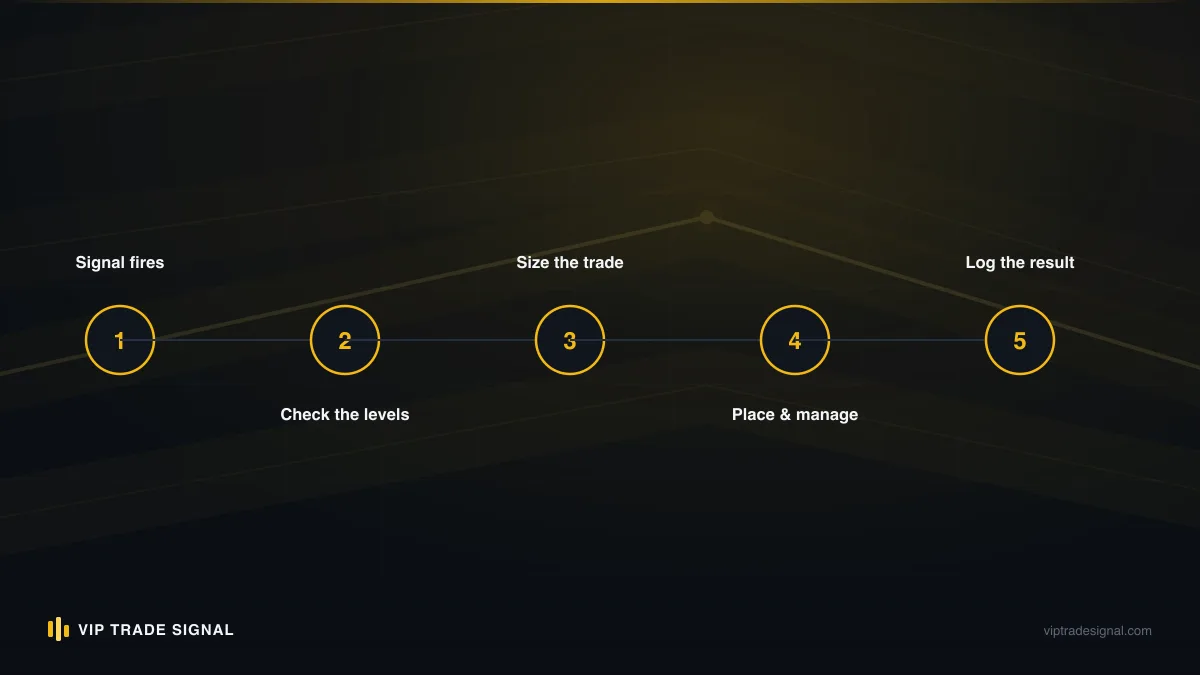
One habit defeats the entire category: verify the destination before money moves, using a channel the counterparty didn't give you. Look up the broker independently. Log into the broker portal directly and check the balance there, not on anyone's dashboard. If a deposit can't be made through a regulated broker's own portal into an account in your name, the trade you're actually making is a donation.
What legitimate account management looks like, term by term
Time to build the positive picture, because "avoid scams" is useless advice without a model of what the real thing looks like. Legitimate forex account management, whatever the firm, converges on a recognisable shape — not because managers are saints, but because the structure removes the opportunities that corrupt.
Here's the anatomy, term by term:
| Term | Legitimate version | Scam version |
|---|---|---|
| Custody of funds | Your account, at your chosen regulated broker, in your name | Their wallet, their "fund", their platform, their chosen unknown broker |
| Access granted | Trading-only access; you keep master password and broker portal | Master password, portal login, or full deposit handover |
| Fee basis | Realized (closed) profit only | Floating profit, dashboard numbers, or flat upfront sums |
| Fee timing | Periodic, after results, ideally above a high-water mark | Whenever the equity ticks up; repeatedly on the same ground |
| Withdrawals | You, alone, anytime, to your own bank | Via the manager, with "approval", after "fees" |
| Track record | Broker-level statements, wins and losses visible | Screenshots, testimonials, dashboard charts |
| Promises | Targets and risk limits; losses stated as possible | Guarantees, "risk-free", fixed weekly percentages |
| Exit | Revoke access instantly; no lock-in on your own money | Lock-in periods, exit penalties, held balances |
Read down the left column and notice the theme: at no point does the legitimate manager hold anything of yours except permission — revocable, limited permission to place trades. Your money never crosses into their possession. Their pay arrives only after your banked results, calculated from statements you can independently pull from your broker.
Notice also what the legitimate column does not contain: guaranteed returns. A real manager talks about risk limits, maximum drawdown tolerance, what happens in a losing month — because losing months happen to everyone who trades, us very much included. Every leveraged product carries genuine risk of loss, managed or not. The presence of a guarantee anywhere in the conversation is not a yellow flag to weigh against green ones. It's disqualifying on its own, because it's either a lie about markets or a lie about intentions.
Two softer markers worth checking. First, does the manager define what they trade and how? "We trade everything, all strategies" is a story; "we trade XAU/USD around London and New York sessions with fixed fractional risk" is a checkable claim. Second, will they put every term in writing before any access changes hands? Reluctance to document is itself documentation.
Our terms as a specimen you can dissect
Since we've been grading everyone else's homework, fair's fair — here's ours, laid out for dissection. Not as an advert (the account management service page exists for people who actually want the pitch), but because a concrete, real set of terms makes the abstract checklist above much easier to apply to whatever offer lands in your inbox next.
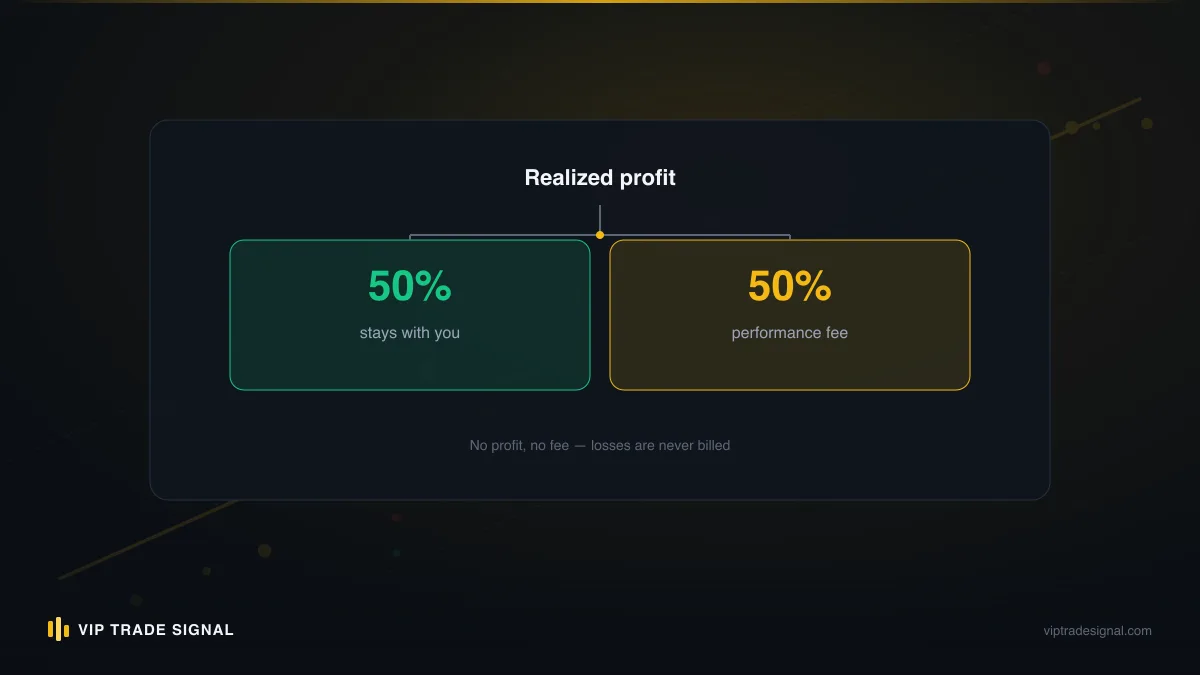
The deal: we trade your own MT4 or MT5 account — gold only, XAU/USD, because that's the one market we do — and our fee is a flat 50% of realized profit. There's a $200 minimum advance that counts toward that split. You keep the master password and the broker portal login; we get trading access only. Withdrawals are yours alone, at whatever moment you like, and revoking our access takes you about a minute inside your broker's settings.
Now dissect it, adversarially. Where could we hurt you under those terms, and where can't we?
We can't take your deposit — it never passes through us; it sits at your broker under your name. We can't block a withdrawal, because we don't have portal access. We can't invoice you against floating equity, because the split is defined on realized profit — closed, banked trades — checkable against your own broker statement. We can't lock you in; the moment you're unhappy, you change the trading password and the arrangement is over, with your balance exactly where it always was.
What we can do is lose your money in the market. That's the honest residual risk, and no contract structure removes it. We can have a losing month; gold can gap through a stop; a strategy that's worked can stop working. If someone tells you their structure eliminates that risk too, you're back in the guarantee section above. The structural terms protect you from us. Nothing protects anyone from the market, and 50% of profit only ever gets charged if there's realized profit to halve — a losing period costs you the losses and pays us nothing, which is precisely the alignment you want.
Is 50% a high split? Yes, and we say so plainly — industry performance fees on larger managed accounts often run 20–35%. Ours is high because the minimum is low, there are no monthly management fees, and everything is pay-as-it-performs. Whether that trade-off suits a given account size is a judgement call, and it's exactly the kind of question worth asking us directly (contact page) or checking against the FAQ before anything is signed. What's not a judgement call is the structure — and the structure, not the percentage, is what separates management from a scam.
The custody rule: your broker login stays yours
If this article compressed to a single sentence, it's this one: whoever can withdraw controls the outcome, so withdrawal power never leaves you. Everything else — fee traps, fake dashboards, doubling promises — is elaboration.
It's worth being precise about the mechanics, because "keep your login" hides some detail. A typical broker relationship has three layers of access, and they are not equally dangerous:
- The broker portal (your email login to the broker's website): controls deposits, withdrawals, bank details, and password resets for everything below it. This is the crown. It never gets shared with anyone, for any stated reason, ever. A "manager" asking for it is asking for the money.
- The master trading password (MT4/MT5): full control of the trading account — placing trades, but also changing settings and, combined with social engineering at the broker, a path toward the portal. Legitimate management can work without it; you can create separate trading access or, in properly structured setups, delegate through the broker's own PAMM/MAM/copy systems where no password moves at all.
- The investor password: read-only. Share it freely — it's how you give auditors and reviewers visibility, and how an honest manager proves a track record.
The custody rule also implies some hygiene that costs nothing. Unique password on the broker portal, two-factor authentication on, an occasional check of the withdrawal bank details on file. And when a management arrangement ends — ours or anyone's — change the trading password that day, not eventually. Old access has a way of outliving old agreements.
One more implication people miss: the custody rule cuts both ways on trust. When someone can't take your money even in the worst case, you don't have to assess their character — only their trading, which the statements show. Any manager who resists the rule is asking you to substitute character judgement for structure. Don't. Character judgement is exactly the faculty these scams are engineered to beat.
Vetting any manager: licenses, structures, and limits
Suppose an offer passes the smell test — no guarantees, plausible returns, custody stays with you. There's still a vetting layer before money or access moves, and it takes an evening, not a month.
Licenses, with caveats. Check whether the person or firm holds relevant authorisation with the regulator where you are, and check it on the regulator's own register — FCA in the UK, ASIC in Australia, CySEC in Cyprus, and so on — not on a certificate JPEG they sent you. Two honesty notes here. First, plenty of scammers quote real license numbers belonging to other firms, which is why you cross-check names, domains and contact details on the register itself, then contact the firm through the register's details. Second, plenty of legitimate services operate in the large unregulated space of this industry (signal providers and small management outfits often do — we're not a licensed advisor ourselves, and say so). A license is meaningful protection where it exists; its absence raises the weight on every structural check rather than settling the question either way.
Track record, at broker level. Ask for verifiable performance: investor-password access to a live account, third-party verification, or raw broker statements covering losing periods as well as winning ones. A record with no losing stretches is a fabrication — the same standard we apply to signal sellers applies double here, since a manager's drawdowns land on your balance.
Limits, in writing. A serious manager will agree, before starting, to concrete risk parameters: maximum risk per trade, maximum open exposure, a drawdown level at which trading halts pending your say-so. Vague answers ("we manage risk dynamically") mean no limits exist. And check the trading style fits the market — someone claiming to manage gold accounts should talk fluently about the sessions and volatility windows that actually drive the metal, which is a fast way to expose tourists.
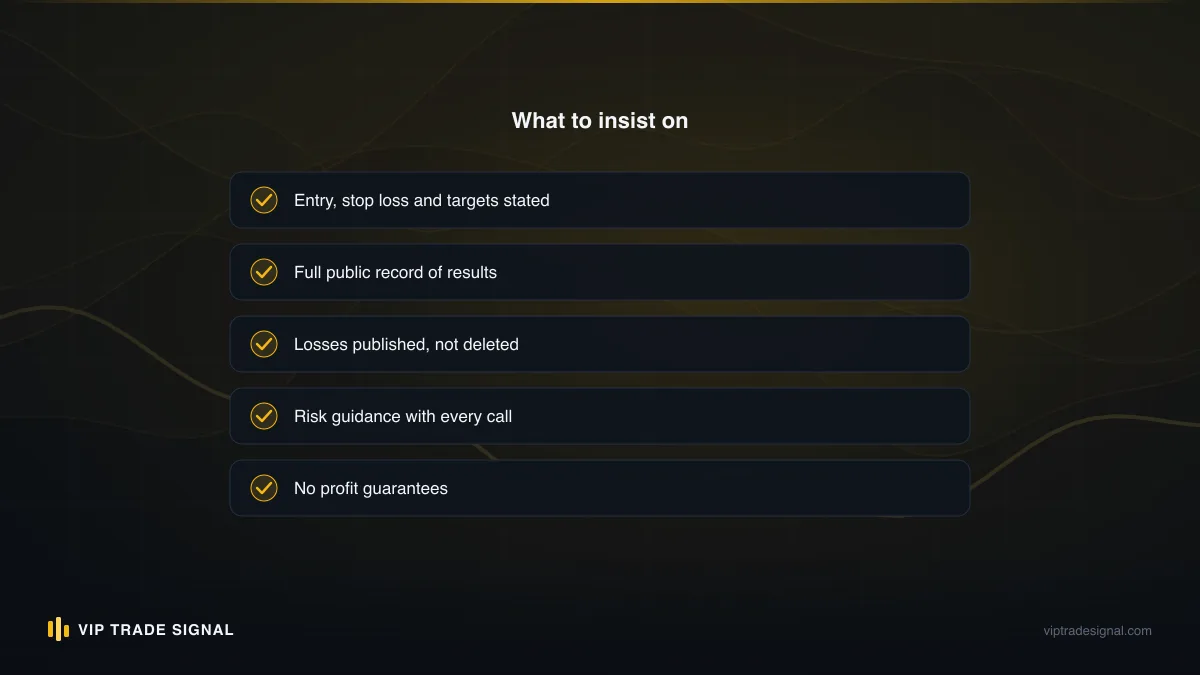
Then the small stuff that's really the big stuff. How did they reach you? Cold inbound contact delivers nearly every scam in this article; real managers with real records rarely trawl DMs. How fast do they push? Legitimate opportunities in a market open five days a week do not expire on Friday. And how do they respond to this exact checklist? An honest operator enjoys these questions. Evasion, flattery, or "don't you trust me" is the test failing in real time.
Escaping a management scam in progress
Maybe you're reading this with a sinking feeling because some version of the above is already running on your account. What now, today, in order:
- Cut access first, ask questions second. Change the master trading password, change the broker portal password, enable 2FA, and check the email address and phone number on the broker account haven't been altered. If they had portal access, also check pending withdrawals and stored bank/wallet details. Minutes matter less than sequence: access dies before any confrontation, because confrontation warns them to move.
- Flatten what you can live with. If they've left open positions, you now own them. Close anything oversized immediately; a scammer's abandoned 5-lot gold position is not a trade, it's a fuse. If the account is in drawdown from their trading, resist the urge to "trade it back" tonight — that instinct funds a second disaster.
- Withdraw to safety. If the money sits at a real broker, pull most of it to your bank now and let the transfer confirm the broker is real. If withdrawal suddenly requires fees, approvals, or "unlocking", you weren't at a real broker, and you've learned it at the cheapest possible moment.
- Document everything before it disappears. Screenshot the chats, the payment records, the dashboard, their profiles, wallet addresses, the lot. Scammers delete channels fast once a victim goes quiet. Your evidence file is the difference between a chargeback that succeeds and a story nobody can act on.
- Say nothing about your next move. Don't announce the report you're about to file or negotiate for a partial return. Every extra conversation is another chance for them to extract a "release fee" or talk you into one more deposit to "recover the position". The moment you know, the relationship is over; behave accordingly.
And expect the aftermath to include a second wave of contact — sympathetic strangers, recovery agents, even "regulators" emailing from Gmail. Your details are now on a list of people who sent money once. The list is the product. Treat every unsolicited rescue as the sequel it is.
Recovery reality: what's gettable and what's gone
Now the part most articles fudge, because it's grim: honest odds on getting money back, channel by channel. Forex deposit scam recovery is a real process with real occasional wins, and also a phrase scammers themselves have colonised, so precision matters.
Card payments: your best odds. If you deposited to a fake broker or "manager" by debit or credit card, contact your card issuer immediately and ask about a chargeback for services not rendered or fraud. There are time limits — often in the region of 120 days from payment or from when you reasonably discovered the fraud, scheme rules vary — so speed genuinely changes outcomes. Bring the evidence file. Success is far from guaranteed, but this is the channel where ordinary people most often see real money return.
Bank transfers: worth trying, fast. UK banks in particular have reimbursement mechanisms for authorised push payment fraud, and banks elsewhere can sometimes recall transfers if the receiving account hasn't been drained. The window is short — days, sometimes hours. Report to your bank the same day you cut access, not after a week of deliberating.
Crypto: mostly gone, occasionally traceable. Be braced: money sent as crypto to a scammer's wallet is usually unrecoverable in practice. Transactions don't reverse, and mixing services exist precisely for this. Tracing firms can sometimes follow funds to an exchange where law enforcement can act, and large cases do occasionally claw something back, but for a typical retail-sized loss the realistic expectation is zero. Anyone promising otherwise for an upfront fee is the recovery-scam sequel, without exception. No legitimate outfit guarantees crypto recovery.
Reports that matter even when they don't pay you. File with your national fraud channel (Action Fraud in the UK, the FBI's IC3 in the US, your local equivalent elsewhere), the regulator whose firm was cloned if one was, and the platforms hosting the scammer's accounts. Individually these rarely retrieve your money. Collectively they're how clone warnings get published, wallets get flagged and the occasional network actually gets rolled up. Reporting is also, bluntly, how you convert a bad experience into a smaller future problem for someone else.
The hard sentence: partial or zero recovery is the normal outcome, which is why every earlier section of this article exists. Prevention is cheap and mostly procedural. Recovery is expensive, slow, and usually incomplete. That asymmetry, more than any single red flag, is the thing to internalise.
Where this leaves you
Strip away the branding and every scam in this article is one machine with different fairings: get custody, then invent reasons the money can't come back. The doubling DM gets custody by direct transfer. The password "manager" gets it through your login. The fake PAMM gets it through a painted dashboard. The fee trap gets it invoice by invoice. The deposit router gets it before a market is ever involved. One machine. So one defence: custody never moves. Your broker, your name, your portal login, your withdrawal button — and any manager, us included, operates inside that wall or not at all.
If you're evaluating an offer right now, here's the two-minute version of everything above. Where does the money sit, and can you verify it by logging into a regulated broker directly? Who can withdraw, and to whose bank? Are fees on realized profit only, above a high-water mark? Is there a broker-level track record that includes losing months? Are the risk limits written down? Did they find you, or did you find them? Six questions. A legitimate manager clears all six without flinching, because the questions describe how they already operate. A scam fails at least two, usually four, and responds to the asking with pressure or charm.
And if what you actually want is to stay in full control and just trade better yourself, management isn't the only door — plenty of people are better served following signals on their own account, on their own click, at their own size. Timing and session behaviour matter enormously there too; our piece on the best times to trade gold is a decent place to start if the metal is your market, as it is ours.
Either way, the standard doesn't change. Anyone touching your account earns their access through structure, verification and written terms — never through screenshots and confidence. Hold that line and the most expensive scam category in retail forex becomes, for you personally, unprofitable. Which is the only language it understands.