A trader we'll call Danny messaged us last spring with a question that sounded simple. He'd been following a signal channel for four months and losing money, so he was thinking of switching to copy trading instead. "Same trades, less work, right?" he asked. "The copier just does what I was supposed to do anyway."
Wrong on both counts, as it turned out. And the reason he was wrong is the reason this article exists.
The whole forex signals vs copy trading debate gets framed as a product comparison, like choosing between two phone plans. It isn't one. Signals, copy trading, PAMM accounts, and full account management are not four versions of the same service at different price points. They are four different answers to one uncomfortable question: how much control over your own money are you willing to hand to a stranger, and what do you get back for surrendering it? Danny's problem was never the signals. His problem was that he skipped half of them, doubled the lot size on the ones that "felt right", and moved his stop on a losing gold trade because he was sure it would come back. It didn't. No copier would have fixed that, because a copier would have faithfully replicated a strategy Danny was never actually running.
So before you compare features and fees, you need to place yourself on an axis. Everything else follows from where you sit on it.
The real axis: how much control you hand over
Picture a line. On the far left, you trade entirely alone: your analysis, your entries, your exits, your sleepless nights. On the far right, someone else has trading authority over your capital and you check a statement once a month. Every "trade like someone else" product lives somewhere on that line, and its position tells you almost everything about it.
Signals sit just right of fully solo. Someone hands you the analysis (an entry price, a stop, targets) and you do literally everything else. You decide whether to take the trade, how big to go, whether to honour the stop. You have surrendered the thinking and kept the doing.
Copy trading sits further along. Software mirrors another trader's positions into your account automatically. You've surrendered the thinking and the doing, but you still hold the account, you can close trades manually, and you can pull the plug at any moment. Social trading platforms dress this up with leaderboards and follower counts, but mechanically that's the whole product: automated replication with an off switch.
PAMM and MAM structures sit further along again. Your money joins a pool (or your account joins a master's allocation block) and a manager trades it as one unit. You can usually withdraw at set intervals, but you can't touch individual trades. The off switch got slower and blunter.
Full account management sits at the far right. A manager has trading access to your account and runs it, trade by trade, with you watching from outside the glass. Done properly, you keep the master password and control of withdrawals while they hold trade-only access. Done badly, you've simply handed your money to somebody on the internet.
Here's the part almost nobody says out loud. Moving right along that axis doesn't reduce your risk. It relocates it. On the left, your biggest risk is your own discipline. On the right, your biggest risk is the counterparty: the manager, the platform, the structure holding your money. You never get to have zero risk. You only get to choose which flavour keeps you up at night, and trading leveraged products means real losses are on the menu at every point on the line.
Forex signals vs copy trading: the short version
Since it's the comparison most people arrive with, let's deal with it head-on before widening out.
A signal service sells you information. A copy trading platform sells you execution. That single distinction drives every practical difference between them.
With signals, the service says: gold, buy at 3,308, stop 3,296, targets 3,320 and 3,338. What happens next is entirely yours. If you're asleep, you miss it. If your broker's spread is wide at that moment, you eat it knowingly. If you decide 0.10 lots is right for your $2,000 account, that decision, good or bad, was made by you with your own numbers in front of you. The service's track record and your account's track record can diverge wildly, and the gap between them is a precise measurement of your own execution and discipline. That gap is diagnostic gold, if you're honest enough to look at it.
With copy trading, the platform says: whatever the master does, your account does, scaled to your settings. You get every trade, at whatever price the copier achieves, at whatever hour it fires. You can't skip the setups you'd have skipped, which cuts both ways, because followers are famously terrible at choosing which trades to skip. But you also inherit every one of the master's bad days at full fidelity, including the revenge trades, and you often inherit them at slightly worse prices than the master got.
Which is better? Wrong question, honestly. The right question is which failure mode is more dangerous for you personally. If you follow rules well but can't analyse, signals fit like a glove. If you have decent judgement but sabotage your own execution at 2am, automation might genuinely protect you from yourself. Danny assumed he was the first type. He was the second. Most people guess wrong about this, and we'll come back to why.
Signals: you keep the execution, the risk, and the blame
Let's be blunt about what signal following demands, because the marketing never is.
A signal is a decision someone else made, delivered to a person who must now make four more decisions in about ninety seconds: take it or leave it, what size, exactly where to enter if price has already moved, and whether to trust the stop. Each of those is a place where your results detach from the provider's. A provider running 1% risk per trade with instant execution lives in a different universe from a follower risking 5% and entering four minutes late.
The maths of that gap is unforgiving. Say a service's gold signals average 12 pips of edge per trade before costs. A follower who consistently enters 3 pips late and exits 2 pips early has burned 5 of those 12 pips, over 40% of the entire edge, through latency alone. Add a moment of hesitation on the losers (people are quick to bank winners and slow to take stops, always in that order) and a perfectly decent service produces a losing follower. We've watched it happen. The provider's history shows green, the follower's statement shows red, and both are telling the truth.
There's also the vetting problem, which is bigger in signals than anywhere else on the axis because the barrier to entry is a Telegram account and a logo. The channels run by anonymous admins posting screenshot profits deserve every bit of your suspicion, and we've written a whole piece on how those Telegram operations actually work if you want the anatomy of it. The short version: demand a full public record of closed trades, losses included, before a single dollar moves. Ours lives at /signals/history precisely because a track record you can't audit is a story, not a record.
What signals genuinely give you, though, is education by immersion. Every trade arrives with its logic visible: here's the level, here's the invalidation, here's the target. Follow attentively for a year and you absorb a framework. Copy trading teaches you nothing, ever, because you never see a decision, only its aftermath in your statement. If part of your goal is to eventually stand on your own, signal following is the only option on this axis that moves you toward it.
Copy trading: the mechanics nobody reads
Copy trading's pitch is beautiful: find a profitable trader, click copy, receive their results. The mechanics underneath are messier, and the mess lives in three places.
First, replication is not teleportation. When the master opens a trade, the platform detects it, transmits it, and executes it in your account, and each step takes time. On a major platform in calm conditions that might be under a second. During a news spike, when spreads on gold can jump from 20 cents to $1.50 in a heartbeat, your fill can land meaningfully worse than the master's. The master's statement will never show this. Yours will. Multiply a small per-trade haircut across three hundred trades a year and slippage quietly becomes one of your largest costs, invisible on any fee schedule.
Second, scaling is treacherous. Copiers offer proportional modes, fixed-lot modes, equity-ratio modes, and most followers pick one without understanding it. A master with $80,000 running 2 lots is risking a certain fraction of their capital. Copy them proportionally with $800 and rounding effects at minimum lot sizes can leave you risking a much larger fraction of yours. The platforms do warn you, technically, in the sense that a paragraph exists somewhere.
Third, the leaderboard problem. Platforms rank masters by recent return, and recent return is the single most seductive and least predictive number in trading. The top of any leaderboard is disproportionately populated by traders running strategies that look brilliant right up until they don't: martingale grids, no-stop averaging, massive leverage on a hot streak. A master showing 40% in three months with tiny drawdown has, more often than you'd hope, simply not met their losing conditions yet. When they do, you're strapped in. You gave the copier authority to replicate everything, and everything is what you'll get.
Copy trading doesn't remove the discipline problem. It moves the discipline problem to a single decision — who you follow and when you unplug — and makes that one decision carry the weight of hundreds.
None of this makes copy trading useless. For someone who genuinely cannot be near a screen and who researches masters the way they'd research a used car (service history, not paint job), it can work. But go in knowing that "passive" is doing heavy lifting in the brochure. The follower who never reviews their copier's performance is not passive. They're absent, which is different.
PAMM and MAM: pooled money, pooled fate
Move right along the axis and you reach the structures with the intimidating acronyms. PAMM (percentage allocation management module) pools investor money into one master account; the manager trades the pool and results are split by each investor's share. MAM (multi-account manager) keeps your money in your own account but lets a manager trade a block of accounts as one, allocating lots across them. When people search for pamm mam managed accounts vs signals comparisons, they're usually trying to work out whether the extra surrender buys extra safety. Mostly, it buys different exposure.
What you gain is genuine hands-off operation with broker-level plumbing. The structure lives inside a regulated broker (choose the broker carefully, that word "regulated" varies enormously by jurisdiction), fee calculations happen automatically, and the manager physically cannot pay old investors with new deposits the way a raw "send me money" scheme can. High-water marks are usually built in, meaning the manager only earns performance fees on new profit, not on recovering losses they caused.
What you lose is granularity, in both information and action. In a PAMM you typically can't see individual open trades in real time, only periodic performance. You can't close a position you hate. Withdrawals happen at rollover intervals (weekly, monthly), so when a manager starts misbehaving on a Tuesday, your money may be strapped in until month-end. During that window you are a passenger in the fullest sense.
And the selection problem from copy trading returns wearing a suit. PAMM leaderboards on broker websites rank managers by return, the same seductive, unpredictive number. The manager risking 15% per trade looks magnificent for six months and then hands the pool a 60% drawdown in a week. The fee structure can even encourage this: a manager on 30% of profits with no capital of their own in the pool is holding a free option. Heads they take a third of your win, tails they lose nothing but time. Before joining any pool, the questions that matter are: how much of the manager's own money is in it, what's the maximum historical drawdown (not return, drawdown), and what exactly can you do, and how fast, when you want out.
Full account management: last resort or the right call
At the far right of the axis sits full management: a professional trades your account, in your name, trade by trade. No pool, no copier, no signal to execute. For some people this is where they end up after everything else failed. For others it's simply the honest answer to an honest self-assessment, and we'd argue the second group makes better clients.
The structural questions here matter more than anywhere else on the axis, because you are granting a human being trading authority over your money. The non-negotiables, in our view:
- You keep the master password. The manager gets trade-only (investor-plus-trading) access. They can open and close positions; they cannot withdraw a cent.
- Withdrawals stay in your hands only. Any arrangement where the manager can move money out is not account management, it's custody transfer with extra steps.
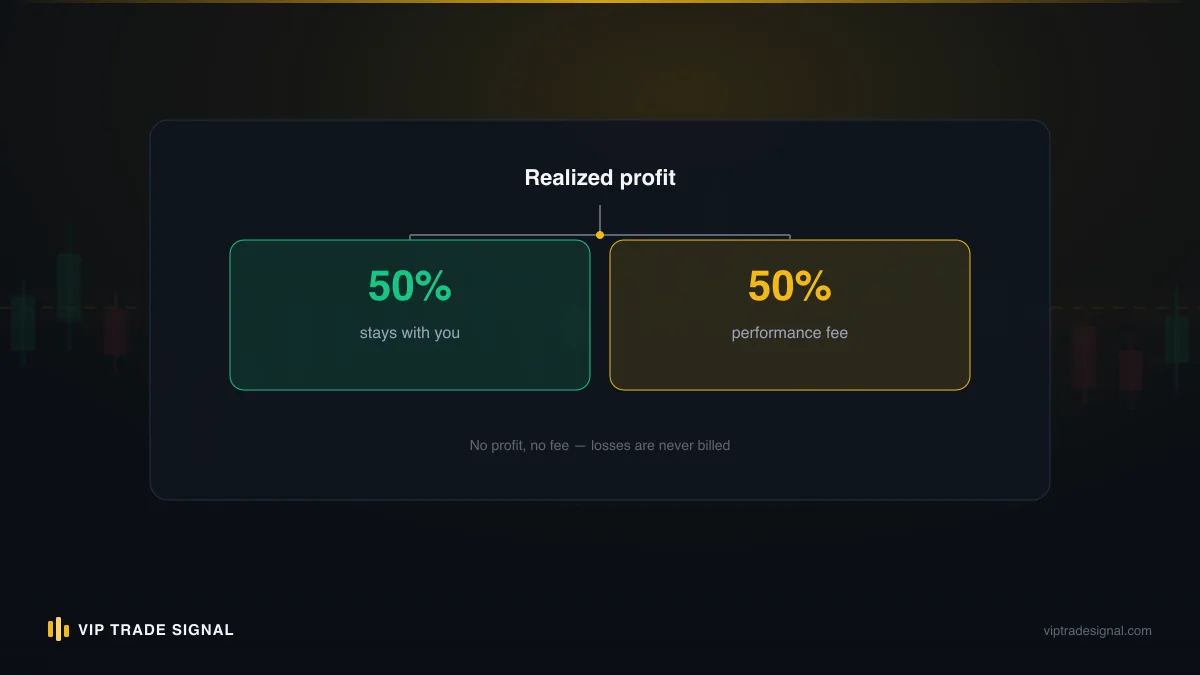
- Fees on realized profit only. Performance fees on closed, banked profit, calculated against a recorded baseline. Fees on floating profit are an invitation to open positions, charge you, and let them rot.
- A written stop condition. The maximum drawdown at which trading halts and you talk. Agreed before the first trade, not negotiated during the bleeding.
This is how we structure our own account management: you keep the master password and withdrawal control, we take trade-only access to your MT4 or MT5 account, and the fee is a flat 50% of realized profit with a $200 minimum advance. Fifty percent is high, and we say so plainly. It's the price of a low minimum and a pay-as-you-go arrangement with no lock-in, no management fee on losing months, and no charge on your capital just for existing. A fund charging 2-and-20 looks cheaper per unit of profit; it also wants a six-figure minimum and a lock-up, and it charges the 2 whether you make money or not. Different products for different sized problems. Neither structure makes losing months impossible, and any manager who implies otherwise has told you everything you need to know about them.
When is full management the right call rather than the last resort? When your constraint is genuinely time or temperament rather than knowledge. The surgeon who understands risk perfectly well but works fourteen-hour days. The trader who has proven, over years and multiple blown accounts, that their hands cannot be trusted near a terminal. There's no shame in the second one. Knowing it about yourself is worth more than most trading courses.
What each option actually costs
Fee schedules across this axis are built to be hard to compare, so let's force them into one table and then talk about what the table hides.
| Typical pricing | You also pay | Cheap when | Expensive when | |
|---|---|---|---|---|
| Signals | Flat subscription ($30–$300/mo) or free via partner broker | Your own spread, your own mistakes | You execute well and size sensibly | You skip winners and oversize losers |
| Copy trading | 20–30% of profits, or spread markup, or both | Slippage on every replicated fill | Master is steady, latency is low | High-frequency master, news-heavy strategy |
| PAMM/MAM | 20–35% performance fee, sometimes + management fee | Reduced liquidity, interval lock-ins | Manager is conservative and invested | Fee on floating equity or no high-water mark |
| Full management | 30–50% of realized profit | Counterparty trust, your attention to statements | Losing months cost you nothing extra | You never audit the statement |
Three things the table can't show.
Flat subscriptions and performance fees punish different failures. A $99 monthly subscription on a $1,000 account is an enormous 9.9% monthly hurdle; the same subscription on a $20,000 account is 0.5% and nearly irrelevant. Performance fees scale perfectly with account size but bite hardest exactly when things go well, which is psychologically fine and mathematically significant. Our own pricing went flat-subscription for signals ($99/month, or free if you trade through a partner broker like Exness, XM, IC Markets or Vantage with $250 or more maintained) partly because a signal provider paid per profit has an incentive to inflate reported profit, and we'd rather not hold that incentive.
Hidden costs dwarf visible ones at the automated tiers. The copy platform advertising "no fees" and earning from spread markup is charging you on every single trade, winners and losers alike, at a rate you can't see on any invoice. A 0.3-pip markup across 400 copied trades a year on one lot is real money that never appears as a fee line.
And your own execution is a cost. The signal follower who leaks 40% of the edge through latency and nerves is paying a performance fee to nobody. It just evaporates. When people say signals are the cheapest option on this axis, they're describing the invoice, not the outcome.
Who's responsible when you lose
Here's a test worth running on any arrangement before you enter it: when the account is down 15%, whose fault is it, and does everyone involved agree on the answer in advance?
With signals, attribution is messy and that mess protects the provider. Your results blend their analysis with your execution, and when things go wrong each side has a plausible story. The provider points to their published record; you point to your statement; both are real. This is exactly why a public, complete history of closed trades matters so much, because it lets you separate "the signals lost" from "I lost while holding the signals". Those are different diagnoses with different cures. A losing provider gets fired. A losing execution gets fixed, and firing the provider won't fix it, which is how people end up cycling through six services in a year, each time carrying the same untouched problem to a new address.
With copy trading and PAMM, attribution is cleaner: the master traded, you lost, the causal chain is short. But cleaner attribution buys you surprisingly little, because you have no lever to pull except leaving. You can't coach a PAMM manager. You can't ask the copier to skip news days. Responsibility without a remedy is mostly just somewhere to point.
With full management, attribution is cleanest of all and the stakes are highest. The manager made every decision; the results are theirs to own. Which is why the fee structure is the real accountability document. A manager paid only on realized profit shares your downside months in the most concrete way possible: they work them for free. A manager collecting a fixed management fee during a drawdown is being paid to lose your money slowly. Read the fee schedule as an incentive map and most of the industry's behaviour stops being mysterious.
One more honest note that applies at every point on the axis. Losing periods are not evidence of failure; they are a scheduled feature of trading leveraged products. Gold can trend beautifully for a quarter and then chop every strategy to pieces for six weeks. The question is never whether losses happen. It's whether the person responsible for them told you they would, before they did.
The discipline question: which option protects you from yourself
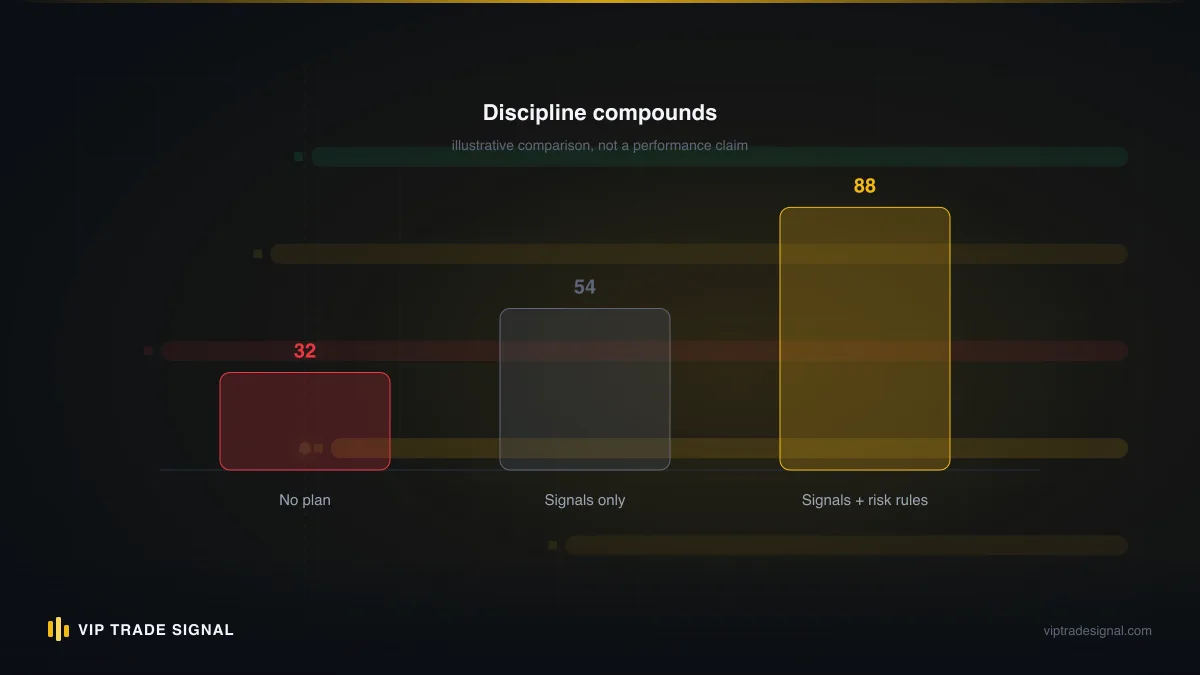
Most retail accounts lose money. Brokers publish this on their own risk warnings, in percentages that should be sobering. And the uncomfortable, well-worn truth behind that number is that strategy failure explains less of it than behaviour failure: oversizing, revenge trading, cutting winners, nursing losers, abandoning plans mid-trade. Which means the most important feature of any product on this axis is not its returns. It's how much of your own behaviour it removes from the loop.
Signals remove none of it. Every behavioural failure available to a solo trader is available to a signal follower, plus a new one: selective execution, the art of skipping precisely the winners. If your discipline is genuinely solid (be brutally honest, and check your trade history rather than your self-image, because the history doesn't flatter), signals give you maximum value per dollar. If it isn't, signals hand you a well-lit road and let you drive off it.
Copy trading removes per-trade behaviour and leaves meta-behaviour. You can't oversize trade #47, but you can absolutely unplug the copier after four straight losers, right before the recovery, then plug into last month's leaderboard winner just in time for their drawdown. Follower returns lagging master returns is a commonplace on social trading platforms for exactly this reason: the trades are automated, the panic isn't.
PAMM and full management remove almost everything, and this, quietly, is their best feature, more valuable than any manager's alleged genius. The friction of withdrawing from a pool or ending a management agreement is high enough that you can't sabotage the strategy at 2am from your phone. For a certain kind of trader, and Danny turned out to be one, paying 50% of profits for the removal of their own thumbs is the single best trade available to them.
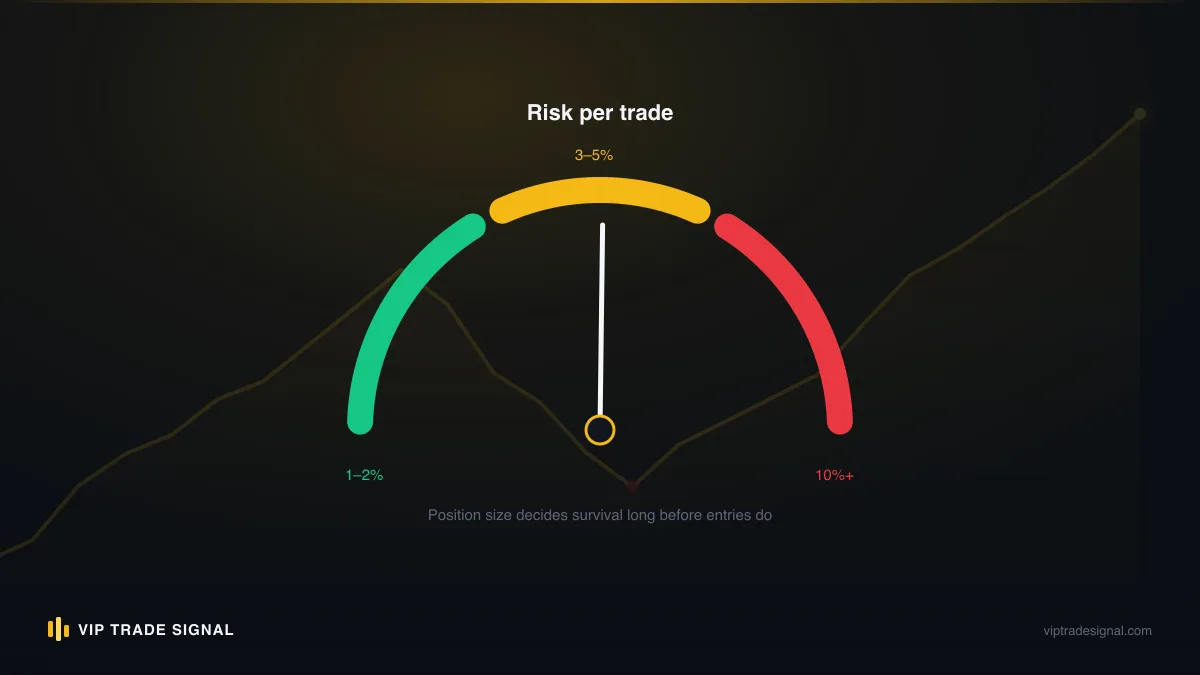
So run the diagnostic honestly. Pull your last fifty trades. If the losers are systematically bigger than your plan allowed, if you can find trades with no stop, if your real risk per trade wandered between 0.5% and 6% depending on mood, your problem is discipline, and buying more analysis will not touch it. If instead your execution was clean and consistent and the ideas were simply bad, your problem is analysis, and that one, at least, can be outsourced cheaply.
Risk controls: what you can actually adjust at each level
Control isn't just philosophical. It's a concrete list of levers, and the list shrinks as you move right.
A signal follower holds every lever that exists. Position size per trade. Which trades to take. Where the stop goes (honour the provider's, we'd say, but the physical control is yours). A daily loss limit: two losers and done. A weekly circuit breaker. Whether to trade during news. On a $2,000 account risking 1%, you have $20 of room per trade, and nobody but you decides whether that number is respected. The lever count is maximal, and so is the number of hands required on them.
A copy trader holds meta-levers only, but they're real: allocation caps (never copy with more than a set slice of capital), equity-stop settings that disconnect the copier at a defined drawdown, maximum lot overrides, and on some platforms per-symbol filters. Set an equity stop at 20% and the platform enforces the discipline you might not have at 3am. Most followers configure none of this at setup, which is roughly like buying a car and declining the brakes to save time at the dealership.
A PAMM investor holds two levers: how much goes in, and the withdrawal request. That's the list. Sizing your allocation is therefore the entire risk management job, done once, in advance. The old rule applies: never place money in a pool you couldn't watch halve without it changing your life.
A management client's levers are contractual: the agreed drawdown ceiling, the risk-per-trade cap written into the arrangement, the reporting cadence, and the kill switch of ending the agreement. Because you keep the master password in a properly structured arrangement, you also hold the nuclear lever of changing it, instantly revoking access. You should never need it. You should never sign with anyone while lacking it.
The pattern is worth staring at. Moving right along the axis, the levers get fewer, bigger, and slower. Whether that's the danger or the entire point depends, again, on whose hands you trust less: theirs or yours.
Custody and regulation: who is actually holding your money
Boring section, this one. Read it anyway, because more retail money dies here than in any drawdown.
At the signals end, custody is a non-issue. Your money sits in your brokerage account; the provider never touches it and couldn't. The worst a signal seller can do is charge a subscription and be wrong, which caps the damage at fees plus whatever losses you execute yourself. This is the quiet, underrated virtue of the left end of the axis, and it's why even a mediocre signal service is structurally safer than a brilliant stranger with your account credentials.
Copy trading splits custody by construction. On broker-integrated platforms your funds stay in your own account at your broker, which is fine if the broker is fine. Standalone copiers that require depositing money with the platform itself are a different animal wearing the same fur. Know which one you're using before funding anything, and if you're piping trades between accounts yourself, the copier-software route has its own set of traps worth reading about first.
PAMM structures put your money inside the broker's legal perimeter, so the broker's regulator becomes your real counterparty question. An FCA or ASIC-regulated broker with segregated client funds and a compensation scheme is one universe; an offshore entity registered in a jurisdiction whose regulator is a PO box is another. Same acronym on the website, wildly different recoveries when something breaks.
Full management is where custody discipline matters most because the failure mode is total. The industry's graveyard is full of "managers" who collected login credentials with withdrawal rights, or worse, had clients wire funds to the manager directly. Every rule we listed earlier (master password stays with you, trade-only access, withdrawals only ever by you) exists because each one is a tombstone. A manager who resists any of those terms has answered your due diligence for you, and you didn't even have to pay for the lesson.
None of this is personalized advice, and we're not a licensed advisor. It's plumbing. But plumbing is what floods the house.
Hybrids: signals plus management, and how we ended up structuring it
The four options get presented as a menu where you pick one, but real trading lives are messier, and some of the most sensible arrangements are hybrids.
The commonest DIY hybrid is signals plus automation: a subscriber runs copier software that executes a provider's signals into their own account mechanically. You've bought analysis from one party and delegated execution to a machine, keeping custody entirely. It fixes latency and selective execution in one move, though it inherits copy trading's configuration traps, and it deserves the same suspicion of any tool granted access to your terminal.
Another hybrid is the split account. Say you've got $6,000. You put $4,000 under professional management and trade $2,000 yourself on the same signals the desk publishes. The managed side compounds without your interference; the self-traded side keeps your skills alive and gives you a live benchmark of your own execution against a professional's, on identical information. After six months, the gap between those two statements tells you exactly what your hands cost. Some clients close the gap and take the whole account back. Some look at it and gratefully never touch a terminal again. Both outcomes are wins, honestly.
We'll also mention the recovery case, briefly, because it's a hybrid of circumstances rather than products. Accounts floating $5,000 to $10,000 underwater, usually from held losers, sit in a nasty in-between: too damaged for signals to fix quickly, too alive to write off. We take some of these under drawdown management at a flat 50% of recovered profit above a jointly recorded baseline, and we tell every one of those clients the same thing on day one: no recovery is guaranteed, ever, and anyone who guarantees one is lying for money. Some baselines don't get beaten. Saying so up front is the only honest way to sell the service at all.
The thread through every hybrid worth having: custody never moves, and each party is paid for the thing they actually control. Analysis fees for analysts, performance fees for people with trading authority. When a structure pays someone for something they don't control, walk away from it on principle.
Choosing by weakness: a decision that takes ten honest minutes
Forget which product has the best marketing. The choice comes down to which of three things you're actually short of: analysis, discipline, or time. Everyone is short of at least one. Most people misdiagnose which.
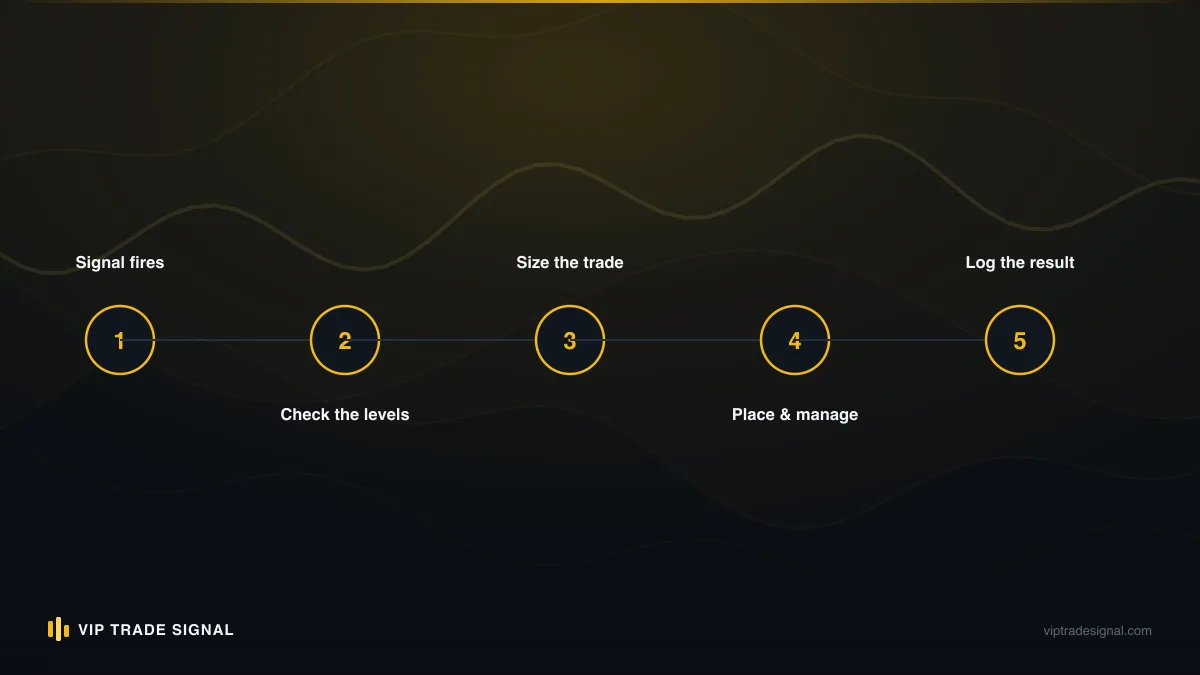
Work through it in order.
- Short on analysis, solid on discipline. You follow rules, size consistently, honour stops, but your own trade ideas lose. Buy analysis and keep everything else. Signals, at the left of the axis, are your fit, and they're the cheapest fix on the entire menu. Vet the provider through a complete public record (every closed trade at /signals/history, in our case, losses in full view) and hold up your end with boring, mechanical execution. Our guide to judging signal channels properly covers what a real record looks like against a marketing reel.
- Short on discipline, whatever your analysis. Your trade history shows wandering risk, missing stops, doubled-up losers. Do not buy signals; you'll execute them the way you execute everything, and pay a subscription for the privilege. You need structure that removes your hands: tightly configured copy trading with a hard equity stop if you want to stay close to the wheel, or managed arrangements if you're ready to admit the wheel is the problem.
- Short on time, solid on everything else. No screen hours, no desire for them, but sound judgement about people and risk. The right side of the axis was built for you. Spend your limited attention where it actually pays: vetting the manager, nailing down custody terms, and reading every statement. Ten minutes a month of real auditing beats ten hours of watching charts you weren't going to act on anyway.
- Short on all three. It happens, usually early on. Then the honest answer is the one nobody sells: trade tiny or trade demo while you fix at least one of the three. No product on this axis rescues someone with no analysis, no discipline, and no time. That person is not a trader yet; they're a donor.
And whichever branch you land on, hold every provider, us included, to the same three-part standard: a complete public record, custody that never leaves your name, and fees that only exist when you actually made money. The forex signals vs copy trading question stops being confusing the moment you stop asking which product is best and start asking which weakness is yours. Danny, for what it's worth, moved to a managed arrangement, kept his master password, and stopped getting 2am ideas. His statement is not spectacular. It is, for the first time in three years, boring. In this business, boring is the win.