There's a moment every retail trader goes through. You're three months into forex, you've had a couple of decent weeks and one horrible one, and somebody in a Facebook group or a YouTube comment mentions a Telegram channel that "never misses". You join. Within an hour you're watching green checkmark emojis roll in under messages like GOLD BUY 3,315 and thinking, well, maybe.
We run a signal service ourselves, so this is not a hit piece on the format. Telegram forex signals are genuinely the most efficient way to move a trade idea from one screen to thousands of others in under a second, and a small number of channels use that machinery honestly. But the format was also colonised, years ago, by people who understood something important: it is far easier to look profitable on Telegram than to be profitable in a market. The app hands them the tools. Edits, deletions, member-count inflation, forwarded "results" images that can't be verified. Most of the channels you'll find by searching are marketing funnels with a chart on top.
This article is the inside view. How the channels are built, why the free ones exist, what the VIP tier actually sells, which tricks to check for in the message history, and a concrete workflow for trading from a channel without handing your account to a stranger's ego. By the end you should be able to audit any channel in about twenty minutes and know, with reasonable confidence, whether it deserves a demo trial or the block button.
Why Telegram became the home of trading signals
It wasn't an accident, and it wasn't because traders love the app's sticker packs. Telegram won the signal market for boring structural reasons.
First, broadcast channels. A Telegram channel is one-way: the admin posts, subscribers read, nobody can clutter the feed with "what's your SL bro". That matters more than it sounds. A signal is a time-sensitive instruction, and in a WhatsApp group of 200 people it drowns in chatter within minutes. On a channel it sits there, clean, timestamped, top of the feed.
Second, no member cap that matters. WhatsApp historically limited groups to sizes that a signal seller would outgrow in a fortnight. Telegram channels scale to hundreds of thousands of subscribers with identical delivery speed for each of them. One post, everyone gets it, push notification and all.
Third, and this is the one the industry doesn't say out loud: anonymity and disposability. A channel needs no verified identity, no company registration, no website. If a channel torches its reputation with a blown month, the admin deletes it and opens a fresh one the same afternoon, usually with "VIP" or "Official" bolted onto the name. The cost of failure is a new username. Compare that with a regulated advisory firm, where a bad year follows you through filings and reviews for a decade, and you can see why the low-accountability crowd pooled here.
Fourth, bots. Telegram's bot API is open and genuinely good, which means payment bots for subscriptions, forwarding bots that copy posts between channels, and copier bridges that read a signal message and fire it into MT4 or MT5. An entire micro-economy of tooling grew around the signal format, and tooling attracts sellers the way a reef attracts fish.
None of these features is sinister on its own. We use the same broadcast mechanics for our own channel, because when gold moves fifteen dollars in four minutes you want delivery measured in seconds, not email-server minutes. The point is that the platform is neutral and the incentives are not. Telegram makes honest delivery fast and dishonest theatre cheap, and every channel you evaluate sits somewhere on that line.
The standard funnel: free channel in front, VIP channel behind
Almost every signal operation you'll encounter runs the same two-room structure, and once you see the shape you can't unsee it.
The free channel is the shop window. It posts a handful of signals a week, market commentary, motivational content, and screenshots of wins from "inside". The free forex signals Telegram search results are dominated by exactly these rooms, and it's worth being clear-eyed about their economics: the free channel is not a charity, it is an advertising cost. Nobody spends hours a day publishing free trade calls out of generosity at scale. The free room exists to convert you.
The VIP room is the product. Access is sold monthly, usually somewhere between $30 and $250, and the pitch writes itself: the free channel gives you two signals a week, VIP gives you two a day; free signals come late, VIP signals come instantly; free gets one take-profit, VIP gets the full ladder. Some of that differentiation is real. Plenty of it is manufactured scarcity, where the "free" signals are deliberately delayed or cherry-picked losers so the paid room looks sharper by contrast.
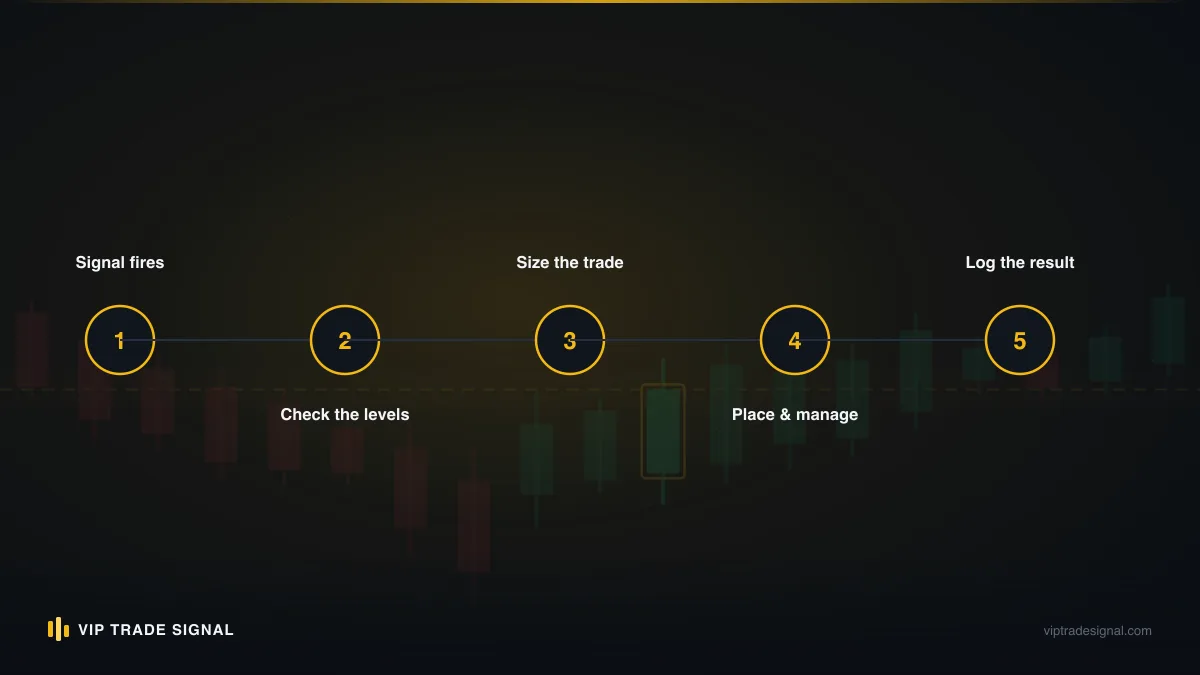
Here's the mechanism in sequence, because the sequencing is the tell:
- You join the free room from an ad, a YouTube short, or a search for telegram gold signal groups.
- For a week or two you see wins. Screenshots of $1,400 profits, green pips counts, celebration posts.
- A "limited" VIP offer appears. Fifty percent off, twenty slots, closes tonight. It never actually closes.
- You pay via a bot, crypto, or worse, a DM. You're now in a second channel that looks much like the first.
- The renewal pitch begins around day 25.
And this is where we should be straight about our own position, because we run a version of this funnel too. There's a public feed, and there's a paid tier. The difference we'd point to isn't the structure, it's the accounting: every signal we close, winner or loser, lands on a public signals history page that doesn't get pruned. The funnel shape is neutral. What matters is whether the shop window is showing you the whole ledger or just the trophies.
The rough rule: judge a channel by its worst visible week, not its best. If you can't find a bad week anywhere in the history, you're not looking at a trading record. You're looking at a highlight reel.
What a Telegram signal actually looks like
Format varies, but a competent signal on Telegram carries the same skeleton wherever you find it: instrument, direction, entry, stop loss, and one or more take-profit levels. For gold it might read:
XAUUSD SELL 3,342 SL 3,351 TP1 3,334 / TP2 3,325 / TP3 3,310
That's the whole contract in four lines. Everything you need to size the trade is there: a 9-dollar stop means a $2,000 account risking 1% ($20 of room) takes roughly 0.02 lots, and if that maths is unfamiliar, stop reading signal channels and learn it first, because no channel can save a trader who sizes by vibes.
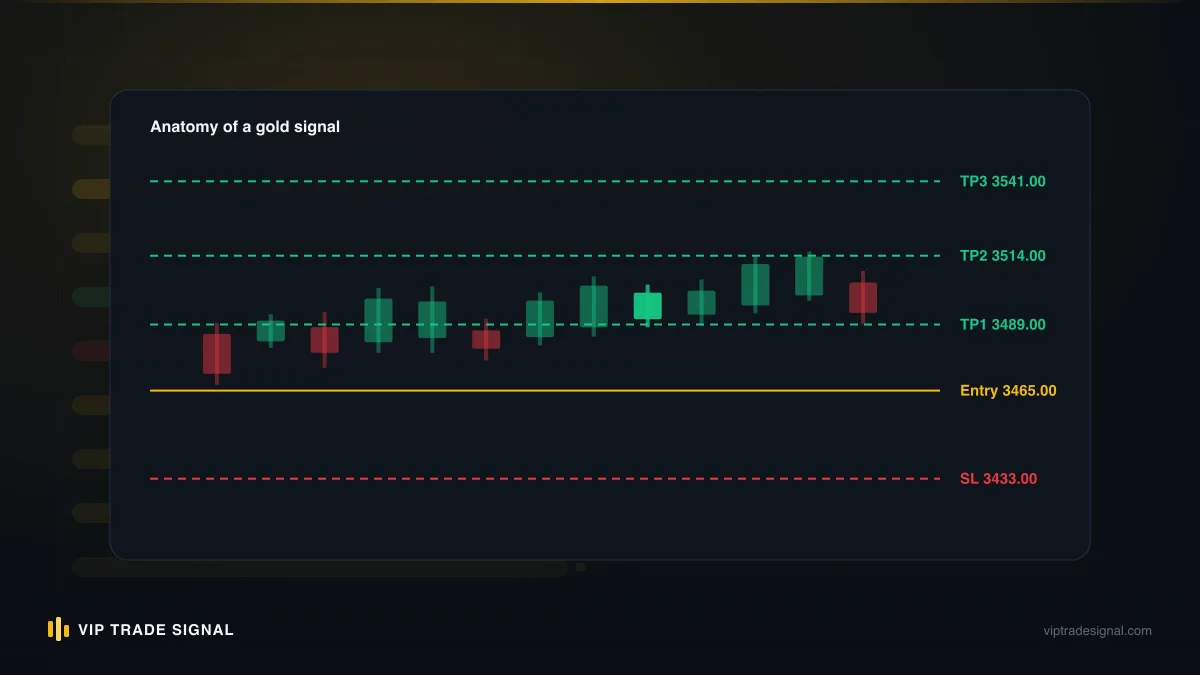
The multiple take-profits are the standard risk-management ladder, and how a channel uses them tells you a lot. Honest channels specify what to do at each level: close a third at TP1, move stop to breakeven, trail the rest. Theatrical channels use the ladder as a marketing device, counting one trade as three separate "wins" when TP1, TP2 and TP3 print, while the losing trades are quietly counted once. We've written a full breakdown of how the TP1/TP2/TP3 structure works and how it gets gamed, and it's worth reading before you evaluate anyone's win rate, ours included.
Watch for what's missing more than what's present. The red flags in formatting:
- No stop loss. A signal without an SL is not a signal, it's a lottery ticket with your money. Immediate disqualification, no appeal.
- "Buy now" with no price. If there's no stated entry, you can never audit whether the trade was a win. That's usually the point.
- Entry zones a mile wide. "Buy gold 3,300-3,340" isn't analysis, it's a 40-dollar net for catching credit later.
- Signals posted after the move. Check the timestamp against the chart. A "BUY 3,315" posted when price was already 3,329 is a screenshot factory, not a desk.
Delivery cadence matters too. Real analysis produces trades irregularly, because markets offer setups irregularly. A channel that posts at 9:00, 13:00 and 17:00 sharp every day is running a content calendar, not a strategy. Gold in particular clusters its best setups around London and New York sessions and around data releases; a gold channel firing signals at a metronome pace through the dead Asian hours should make you squint.
The edit and delete tricks
This is the section that will save you money, so slow down here.
Telegram lets a channel admin edit any message, at any time, and delete any message without a trace visible to ordinary subscribers. A tiny "edited" label appears on edited posts, but no diff, no history, and deletions leave nothing at all. For a dishonest signal seller this is the entire business model, and the classic plays are worth knowing by name.
The retro-edit. Post "GOLD BUY 3,315, SL 3,308, TP 3,330". If the trade wins, leave it. If it loses, edit the entry to 3,309 or flip the direction, then post the "result" screenshot against the edited message. Subscribers scrolling back see a channel that called it perfectly. The only clue is that grey "edited" tag, which nobody reads. Whenever you audit a channel, read every edited signal with the assumption the edit was cosmetic surgery.
The disappearing loser. Simpler still: delete losing signals within a day or two. The surviving history is wins, "almost" trades, and commentary. If a channel claims 4-6 signals a day but its visible history shows 15 signals for the month, roughly 100 messages have gone somewhere, and they didn't go to heaven.
The both-ways call. Post "gold will either break 3,350 for a run to 3,370 or reject to 3,320" and then screenshot whichever half happened as a successful call. This one's popular with the "analysis" channels that never state entries at all.
The stacked-TP miracle. Covered above, but in edit form: a channel sets TP3 at some absurd distance, and when price falls short, edits TP3 down to wherever price actually reached. Now every trade "hit all targets".
The result screenshot from nowhere. MT4/MT5 profit screenshots are trivially faked, and even genuine ones prove nothing about the channel's subscribers. A $9,000 profit screenshot might be from a demo account, someone else's account, or a real account fifty times larger than yours running lot sizes that would vaporise your balance. Screenshots are decoration. Only a timestamped, unedited, complete message history is evidence, and even that has holes, which is why we keep our full closed-signal ledger on the website rather than asking anyone to trust a scrollback.
One honest caveat: edits aren't automatically sinister. We occasionally edit a live signal to update a trailing stop, and any real desk will do the same. The difference is direction and timing. Editing management instructions on an open trade, fine. Edited entries and stops appearing after the trade resolved, run.
Auditing a channel in twenty minutes
You don't need special tools for a first-pass audit. You need the channel's own history, a charting platform for cross-reference, and a bit of stubbornness.
Start with the info page. Tap the channel name. Note the subscriber count, then look at views per post. A channel with 80,000 subscribers whose posts get 900 views has bought its members from a bulk-subscriber service; bots don't read. Views between roughly 10% and 40% of the member count suggest a live audience. Under 3%, the count is furniture.
Scroll to the beginning. Every channel has a creation date at the top of its history. A channel claiming "5 years of experience" that was created seven months ago has answered your first question for you. Also look at what the early posts were. A surprising number of signal channels began life as crypto pump rooms, sneaker-resale channels or something in another language entirely, then rebranded when forex looked more lucrative. Telegram preserves the whole archaeology if the admin never bothered to prune it.
Count edits. Pick a month at random. Read every signal message and tally the ones with the "edited" label. Some edits are legitimate trade management, so pair each one with a chart: was the edit consistent with managing a live position, or does the message now describe a perfect entry the market barely offered? Ten minutes of this against real price data usually settles the question.
Reconcile claimed frequency against visible history. Marketing says "3-5 daily signals"; count what's actually there for the last 30 days. A big gap means deletions.
Check the forwarding chain. Forwarded messages carry a "Forwarded from" header. Plenty of "providers" simply forward, or copy via bot, the output of other channels, sometimes several links down a chain, adding delay at every hop. If half the signals originate elsewhere, you're paying a middleman for latency.
Then run the numbers yourself. Take the last 20 visible signals, mark each against the chart at its timestamp, and build a small spreadsheet: entry, SL, TPs, outcome in R (risk multiples), not pips or dollars. A channel can be 70% accurate and still lose money if the average loser is 2R and the average winner 0.5R. This half-hour of work filters out more bad channels than any review site, partly because review sites for signal channels are themselves mostly pay-to-play. If a channel survives the spreadsheet, it graduates to a demo trial, and we'd argue strongly for testing any signal service on a demo account first for at least three or four weeks before a single real dollar follows a signal.
Telegram-specific scams: clones, fake admins and the DM that costs you
Beyond dressed-up statistics, Telegram has a scam layer all of its own, and it catches experienced traders as often as beginners because it exploits the app rather than the market.
Channel clones. Anyone can create a channel with an almost-identical name and the same profile image. If @GoldSignalsVIP has traction, @GoldSignaIsVIP (capital i for l) will exist within weeks, seeded with forwarded posts from the real channel to look legitimate, and its only original content will be a payment address. Before paying anyone, verify the exact username character by character from the provider's website, not from Telegram search. This is precisely why our own site lists the official channel link and why we tell people to treat any other route, including "helpful" links in comment sections, as hostile until proven otherwise. If in doubt, ask us directly rather than trusting a search result.
The admin-DM scam. This is the big one. A scammer joins the discussion group attached to a popular channel, copies the admin's display name and photo, and messages members privately: your VIP payment failed, there's a special offer, you've won a free month, just pay here. Real channel operators, us included, essentially never DM first, and any legitimate service will happily confirm through official support whether a message was real. Treat every unsolicited DM about payments, "account managers" or investment opportunities as a scam. Not probably a scam. A scam.
The recovery follow-up. Lose money with a fraudulent channel and, months later, someone contacts you claiming to be a fund-recovery agent who can get it back for an upfront fee. Same crew, second harvest. Nobody legitimate cold-DMs recovery services.
Payment-method tells. Honest services take payment methods with a paper trail and a dispute mechanism. A provider that accepts only USDT to a bare wallet address, or gift cards (yes, really), has chosen irreversibility on purpose. Crypto payment alone isn't proof of fraud, but crypto-only, DM-negotiated payment for a channel with an edited history completes an ugly picture.
"Account management" upsells inside signal rooms. Sooner or later a VIP room will offer to trade your account for you, typically demanding your full credentials or asking you to deposit with "their" broker. Handing over a master password to a stranger from Telegram is how accounts get churned to zero for rebates. There are legitimate ways to structure managed trading, with investor passwords, profit splits and you keeping withdrawal control, but they're formalised, documented and never initiated through a DM.
Latency: the gap between their post and your fill
Suppose the channel is honest. There's still a mechanical problem nobody advertises: the time between the provider's decision and your execution, and on a fast instrument that gap is money.
Walk through the chain. The provider's analyst decides to short gold at 3,342. They type or paste the message: call it 15-60 seconds if manual. Telegram delivers in about a second. Your phone buzzes; you notice it after anywhere from five seconds to five minutes depending on whether you're at a desk or in a supermarket. You open MT5, check the chart against the signal, calculate lots, and place the order: a practised trader takes 30-60 seconds, a nervous one takes three minutes. Total, realistically, one to six minutes from decision to fill.
Now put that against gold, which moves $1-2 in a quiet minute and $10-15 in a busy one. A signal with a 9-dollar stop can have a third of its edge eaten by two minutes of drift. In a news spike, all of it and more.
| Step | Fast case | Slow case |
|---|---|---|
| Provider writes and posts | 15s | 60s |
| Telegram delivery | 1s | 2s |
| You notice the notification | 5s | 4 min |
| Check, size and place order | 30s | 3 min |
| Total decision-to-fill | ~50s | ~8 min |
Three practical conclusions fall out of this. First, entry zones and pending orders beat market orders for signal followers: if the signal says sell 3,342 and price sits at 3,338, a limit at the level protects you from chasing. Second, respect the provider's price, not the current one. A rule we push hard: if price has moved more than about a third of the stop distance past the stated entry, skip the trade entirely. Missing a winner costs nothing; chasing a worse entry with the original stop turns a good signal into a bad trade. Third, latency is the strongest honest argument for automation, which brings us to copiers.
Copiers and bots that trade the messages for you
A Telegram copier is software that reads new messages in channels you belong to, parses the instrument, direction, entry, SL and TPs, and places the order in your MT4/MT5 within a few seconds. The good ones handle edits (mapping a changed SL to a modification on the open position), the bad ones mangle number formats and buy when they should sell.
Used well, a copier solves the latency problem and, just as usefully, removes the human moment of doubt where you skip the signals that would have won and take the ones that lose. Used badly, it's an unattended machine with your account credentials and someone else's judgement. Three things decide which experience you get: whether lot sizing is fixed by you as a percentage risk rather than copied blindly, whether the copier respects a maximum-slippage rule so it won't chase runaway entries, and whether you've tested the whole pipeline on demo through at least one messy week, including a news spike and an edited signal. We've written a separate, detailed piece on choosing and configuring a Telegram signal copier, including the parsing failures we've seen firsthand, so I'll leave the mechanics there.
One warning that belongs here rather than there: a copier amplifies the channel, faithfully. Wire an honest channel through a copier and you've automated a real edge, if the edge exists. Wire a doctored channel through one and you've automated the losses while the channel's history continues to show wins. The copier question is always second. Audit first.
What a trustworthy channel looks like day to day
Enough about the crooks. It's worth describing the boring texture of a channel run properly, because once you've seen it, the theatrical ones feel off within a day.
A real desk posts irregularly. Some days two signals, some days none, with a line explaining why: spread's blown out ahead of the Fed, structure is mid-range, we're standing down. Standing down is the single most reliable sign of a genuine operation, because it's the one behaviour a content-calendar channel cannot fake for long. Their business model needs constant product; a trading desk's model needs good trades.
Losses get posted with the same formatting and the same speed as wins. Not buried at 2am, not wrapped in three paragraphs of excuse about manipulation and stop-hunts. "SL hit, -1R, next" is the register. Over months you'll notice the tone barely changes with the equity curve, which is exactly what you want from people making risk decisions.
Every signal is complete at the moment of posting. Entry, stop, targets, and lot-sizing guidance stated as risk percentage rather than fixed lots, because the channel doesn't know your balance. Management updates arrive as new messages, not silent edits: "move SL to entry", "close half here". The original message stays untouched as a record.
And the results live somewhere the admin can't quietly revise. That's the real dividing line. Telegram history, even unedited, is a poor ledger because you can't prove deletions didn't happen. A trustworthy provider maintains an external, append-only record of every closed signal, and invites you to reconcile it against the channel. Ours is public precisely because we spent years watching competitors hide theirs, and the FAQ explains how the counting works, including the part most services fudge: one signal is one result, however many TPs it had.
A signal channel's honesty is measured by how it behaves in a losing week, and only ever then.
Fees, while we're being blunt. Trustworthy doesn't mean cheap. Our subscription runs $99 a month (or free through partner brokers with a maintained balance), which sits at the high end of the market, and plenty of honest channels charge less. Price tells you almost nothing either way; a $30 channel and a $250 channel can both be funnels. The ledger tells you everything.
Running the numbers on a channel's real performance
Before any real money follows any channel, ours included, sit down with a spreadsheet for an hour. This is the part almost nobody does, which is why the doctored channels keep eating.
Take at least 20 consecutive signals. Consecutive matters: sampling "recent highlights" replicates the channel's own selection bias. For each, record the stated entry, stop, targets and timestamp, then check the chart for what price actually did afterwards. Score outcomes in R. A full stop-out is -1R. A trade closed at TP1 with the rest at breakeven might net +0.4R. Resist pips entirely; pips ignore the stop distance and flatter channels that win small and lose big.
Then compute three numbers. Win rate, obviously. Average R per trade, which is the one that pays or doesn't. And maximum consecutive losses, which tells you whether you'd psychologically survive the strategy: a profitable channel that loses six in a row twice a year will shake out every follower who didn't know that number in advance. A worked example: 20 signals, 11 winners averaging +0.9R, 9 losers averaging -1R, comes to (11×0.9) − (9×1) = +0.9R total. Barely positive, and that's before your spread, your latency drift, and the trades you'll inevitably miss overnight. A channel needs a visibly healthy margin over breakeven in your audit to be worth following, because everything about live execution erodes it.
Two adjustments make the audit honest. Apply your own realistic entry, not theirs: if you'd typically fill 30 seconds late, mark entries a dollar or two worse on gold and rerun the numbers. And exclude nothing. The "that one doesn't count, it was news" instinct is exactly how followers talk themselves into funnels. If the channel posted it, it counts.
Twenty signals won't give you statistical certainty; nothing short of hundreds will. What it gives you is protection from the worst outcomes, because doctored channels rarely survive even this shallow reconciliation. The edits, the impossible fills, the deleted gaps all surface once you put timestamps against a chart.
How we run our own Telegram channel
Fair question at this point: what does our setup look like, given everything above? Briefly, because this is an education piece and not an advert.
We're a gold-only service. Every signal is XAU/USD, which is a deliberate narrowing: one instrument, studied to death, rather than fourteen pairs covered thinly. Signals are unlimited rather than rationed into tiers, and each one carries entry, stop and a TP ladder at the moment it's posted. Management arrives as follow-up messages. We don't edit entries or stops after the fact, and the claim is checkable, because every closed signal, red or green, is published on the public signals history within hours of closing and never removed. Some weeks that page is unflattering. It stays up anyway, because a results page you'd only show when it's pretty isn't a results page.
Posting rules we hold ourselves to, which double as a checklist for judging anyone else: no signal without a stop; no counting one trade as multiple wins; no performance screenshots as marketing; no DMs initiating payment, ever; and standing down, stated out loud, when conditions are poor. Gold is a violent instrument and there are weeks where the honest signal count is two. We'd rather bore you than churn you.
And the standing disclaimer, in the flow where it belongs: gold and forex trading is high-risk, losing trades are a permanent feature of every real strategy including ours, and nothing in a Telegram channel, ours included, is personalised investment advice. We're not licensed advisors. A signal is an idea with defined risk; whether it fits your account and your temperament is a decision only you can make.
A safe workflow for trading from any Telegram signal
Pull it all together and the safe path from "found a channel" to "trading it live" looks like this. It takes about six weeks, which feels slow next to a channel promising you'll double by Friday, and that's rather the point.
- Verify the channel's identity from the provider's website or official support, character by character. Never from Telegram search.
- Run the twenty-minute audit: creation date, views-to-members ratio, edit count on a random month, claimed versus visible signal frequency.
- Build the spreadsheet on 20+ consecutive signals, scored in R against real charts at real timestamps, with your realistic entry slippage applied.
- Trial on demo for 3-4 weeks, executing every signal exactly as posted, including the inconvenient ones at 2am you'd miss. That miss rate is data too.
- Go live small. Half your normal risk per trade for the first month, so 0.5% instead of 1% on the standard model. Latency and psychology only reveal themselves with money attached.
- Keep your own ledger forever. Your fills, not their claims. Reconcile monthly. The day your numbers and the channel's numbers drift apart is the day you have your answer.
Hard rules that never bend inside that workflow: no trade without a stop, no chasing entries beyond a third of the stop distance, no responding to DMs about money, no credentials shared with anyone whose company name you couldn't put on an invoice, and no increasing risk during a winning streak because the channel is "hot". Streaks end. The sizing that survives the ending is the sizing you chose before it began.
Where this leaves you
The uncomfortable summary is that Telegram forex signals are a market where the product is easy to fake, the platform helps the fakers, and the burden of proof sits entirely on you. That's not a reason to write off the format. It's a reason to import the burden-of-proof habit that every other financial decision already gets. You wouldn't buy a fund off a screenshot. Don't buy a channel off one.
The good news is that the audit is genuinely doable. Creation dates, edit labels, view counts and a spreadsheet will disqualify nine channels out of ten in an evening, and the survivors can prove themselves on demo without costing you anything but patience. The channels that resent being audited have told you what you needed to know. The ones that make auditing easy, with complete signals, untouched histories and results published somewhere they can't quietly rewrite, are the short list worth your time.
So here's the closing question, and it applies to us as much as anyone: for the channel you're currently watching, could you reconstruct its last thirty days of results from public, unedited evidence alone? If yes, run the numbers and let them decide. If no, you already have your answer, however green the checkmarks look. And if you want to see what a fully public ledger looks like in practice, our closed-signal history is on the site, losses included; judge it by its worst week, the same way you should judge everybody else's.