It's 3:12 in the morning and gold has just broken through a level your signal provider has been watching all week. The message lands in the Telegram channel: sell 3,348, stop 3,356, three take-profits underneath. You are asleep. By the time you surface, drink something with caffeine in it and open MT5, price has already tagged TP1 and pulled back. The trade happened without you.
This is the exact frustration a telegram signal copier is built to solve. It's a piece of software that reads the messages in a signal channel and turns them into live orders on your MT4 or MT5 account, automatically, in under a second, whether you're awake or not. No more missed entries. No more fat-fingering a lot size at 3am. That's the pitch, and honestly, the pitch is mostly true.
But we've also watched copiers do genuinely stupid things to real accounts. We've seen one open a 1-lot gold trade on a $700 account because a parser misread "TP 3352" as a lot size. We've seen a copier faithfully execute a signal that the provider had deleted ninety seconds after posting it, because deleting a Telegram message doesn't un-send it to software that already read it. A copier is a power tool. Used properly it removes the two biggest execution problems retail traders have, which are speed and discipline. Used carelessly it removes the last human checkpoint between a stranger's message and your money. This piece is the sober version of the manual nobody ships with these things.
What a Telegram signal copier actually does
Strip away the marketing and a telegram signal copier is three components bolted together.
First, a listener. The software connects to Telegram, either through the official Telegram API using your own account credentials, or by running a bot that sits inside the channel. It watches specific chats you point it at and receives every new message the moment it's posted.
Second, a parser. This is the clever bit and the fragile bit. The parser reads the raw text of each message and tries to extract a trade from it: the symbol, the direction, the entry price or entry type, the stop loss, and one or more take-profit levels. "XAUUSD SELL 3348, SL 3356, TP1 3344, TP2 3339, TP3 3331" needs to become a structured order, not a sentence.
Third, an executor. Once the parser has a valid trade, the executor talks to your MT4 or MT5 terminal, usually through an Expert Advisor (EA) attached to a chart, and places the order with whatever lot size and risk rules you've configured. Good copiers also keep listening after entry, so a later message saying "move SL to breakeven" or "close half" gets applied to the open position.
That's the whole machine. Message in, order out, typically inside 200 milliseconds to a couple of seconds depending on the software and your connection. The commercial products (Telegram Signals Copier, TSC, Combo Copier, Telegram-to-MT4 bridges of various names, plus a long tail of $30 EAs on forums) all follow this same architecture. The differences that matter are in how well the parser copes with messy human writing, and how many safety rails the executor gives you.
One thing a copier is not: a strategy. It has no opinion about the market. It will copy a brilliant signal and a terrible one with identical enthusiasm, at identical speed. Every conversation about copier software should start from that fact, because the software's quality matters far less than the quality of what it's copying. If you haven't done the work of checking a provider's full closed history, the kind of open record we publish for every one of our own signals, the copier just helps you lose money more efficiently. We wrote a whole piece on how to verify a signal track record before trusting anyone with automation, and it applies double here.
How message parsing works, and where it breaks
Parsing is pattern matching. The copier ships with (or lets you build) a set of rules: the symbol is a word matching a known instrument list, the direction is BUY/SELL/LONG/SHORT in any casing, numbers following "SL" or "stop" are the stop loss, numbers following "TP" are targets. Modern copiers layer on some fuzziness, so "Gold" maps to XAUUSD, "sl @ 3356" still parses, and a stray emoji doesn't kill the match. A few newer products run the message through a language model instead of regex rules, which handles conversational phrasing better but introduces its own occasional creativity, which is not a word you want anywhere near order execution.
Here's where parsing breaks in the wild. We've seen every one of these happen to a real account.
- Image signals. Some providers post a chart screenshot with the levels drawn on it and no text. A regex parser gets nothing. OCR-based copiers exist, and they misread 8s as 3s often enough that we'd never let one near live money.
- Multi-message signals. Entry in one message, "SL 3356" thirty seconds later in a second message. Cheaper copiers treat these as unrelated and open the trade with no stop, or reject both.
- Commentary that looks like a signal. "If we break 3,350 I'd look to sell towards 3,331" is analysis, not an instruction. A greedy parser opens a trade. Now you're short gold because someone was thinking out loud.
- Reversed or unlabelled TP ladders. "TP 3344 / 3339 / 3331" with no TP1/TP2/TP3 labels. Most copiers assume the first number is TP1. If the provider lists them furthest-first, your partial-close logic runs backwards.
- Format drift. The provider changes their template one day. Adds a flag emoji, restructures the layout, starts writing "Take Profit" in full. Your parser rules, tuned to the old format, silently start missing trades. You find out a week later.
- Symbol ambiguity. Your broker calls it XAUUSDm, or GOLD, or XAUUSD.pro. If the copier's symbol mapping isn't set, orders get rejected, or worse, land on the wrong instrument.
The honest summary: parsing works about as well as the signal format is disciplined. A provider who posts every signal in an identical, machine-friendly text template will copy near-flawlessly. A provider who posts screenshots, voice notes and vibes will fight your copier forever. When you're evaluating a channel for copying, scroll back a hundred messages and ask one question. Could a slightly dim intern turn every one of these into a trade ticket without asking a follow-up? If not, neither can the software.
This is, incidentally, why we keep our own gold signal format rigid and boring. Same fields, same order, same labels, every single time. Boring formats are what machines and half-asleep humans both parse correctly.
Choosing copier software: the feature checklist
There are a dozen credible copiers and a hundred sketchy ones. The price band runs from free EAs on forums to about $250 for a lifetime licence on the polished commercial tools. Price correlates loosely with quality here; some of the $30 tools are fine and at least one famous $200 one has shipped bugs that doubled lot sizes. Judge on features, not price tag.
Non-negotiable features, in rough order of importance:
- Per-trade risk sizing. The copier must be able to size each position from a fixed percentage of your balance and the signal's actual stop distance. Fixed lot sizes are acceptable only as a fallback. If it can only do "0.10 lots every trade regardless", walk away.
- A maximum lot cap. A hard ceiling the software will never exceed no matter what it parses. This is your defence against the misread number that tries to open 25 lots.
- Edit and delete handling. The copier should detect when a signal message is edited (and update SL/TP accordingly) and let you choose what happens when one is deleted. More on why in a minute, because this failure mode is the quiet account killer.
- Multi-TP support with configurable splits. Native handling of TP1/TP2/TP3 ladders, either by opening split positions or partial-closing one position, your choice.
- Symbol mapping and suffix handling. So XAUUSD in the channel becomes XAUUSD.r at your broker without drama.
- Entry-price tolerance. A setting like "only enter if current price is within X of the signalled entry". Without it, a copier that comes online after downtime will happily enter a six-hour-old signal 40 dollars away from where it made sense.
- Trading-hours and news filters. The ability to block execution during rollover spread widening or around red-folder news if that's your policy.
- A daily loss cut-off. Stop copying after the account is down a set amount or percentage on the day.
- A proper log. Every message received, every parse result, every order sent, timestamped. When something goes wrong, and eventually something will, the log is how you find out whether the provider, the parser or the broker was at fault.
Nice-to-haves: breakeven automation, trailing stops, mapping different channels to different risk levels, and a "shadow mode" that logs what it would have done without placing orders. That last one is criminally underrated for testing.
One structural choice to be aware of: user-account copiers (which log in as you via the Telegram API) can read any channel you're a member of, while bot-based copiers only work in channels where the admin has installed the bot. User-account copiers are the norm for copying a provider's channel. They need your Telegram API credentials, which you generate yourself at my.telegram.org, and those credentials effectively are your Telegram account, so they live on your machine or VPS and nowhere else. Any copier that asks you to hand your API keys to the vendor's cloud is asking for more trust than the product category has earned.
Setup walkthrough: Telegram API to MT4/MT5
The details vary by product, but every setup follows the same skeleton. Budget a quiet evening for it, not fifteen minutes.
Step one: Telegram API credentials. Log in at my.telegram.org with your own Telegram account, create an application under API development tools, and note the api_id and api_hash. This takes two minutes and costs nothing. These credentials let software act as your Telegram account, treat them like a password.
Step two: install the copier application. Most run as a Windows desktop app that pairs with MetaTrader. Enter your API credentials, complete the one-time login code Telegram sends you, and the copier can now see your chats.
Step three: attach the EA. In MT4/MT5, the copier's Expert Advisor gets dropped onto any chart (the chart symbol usually doesn't matter). Enable algorithmic trading in the terminal options, allow DLL imports if the product requires it, and confirm the little icon shows the EA is live. The desktop app and the EA talk to each other locally; the EA is the only thing that actually touches orders.
Step four: select channels and map symbols. Point the copier at the specific signal channel. Then map every symbol the provider posts to your broker's exact instrument name. For a gold-only feed this is one mapping, XAUUSD to whatever your broker calls it, which is one of the underrated conveniences of following a single-instrument service.
Step five: configure the parser. Paste in several real historical messages from the channel and check the parse preview. Entry, direction, SL, every TP, all extracted correctly? Test the awkward ones too: the signal where the provider added commentary, the one they edited, the follow-up "close half" instruction.
Step six: set the risk rules. This is the step people rush and the step that decides everything. It gets its own section, next.
Step seven: demo first. Attach the whole stack to a demo account with the same balance as your intended live account and let it run for real weeks. Not a weekend. We've written before about why demo-testing signals properly takes 20+ trades, and with a copier you're testing two things at once: the signals and the plumbing.
Risk settings that are non-negotiable
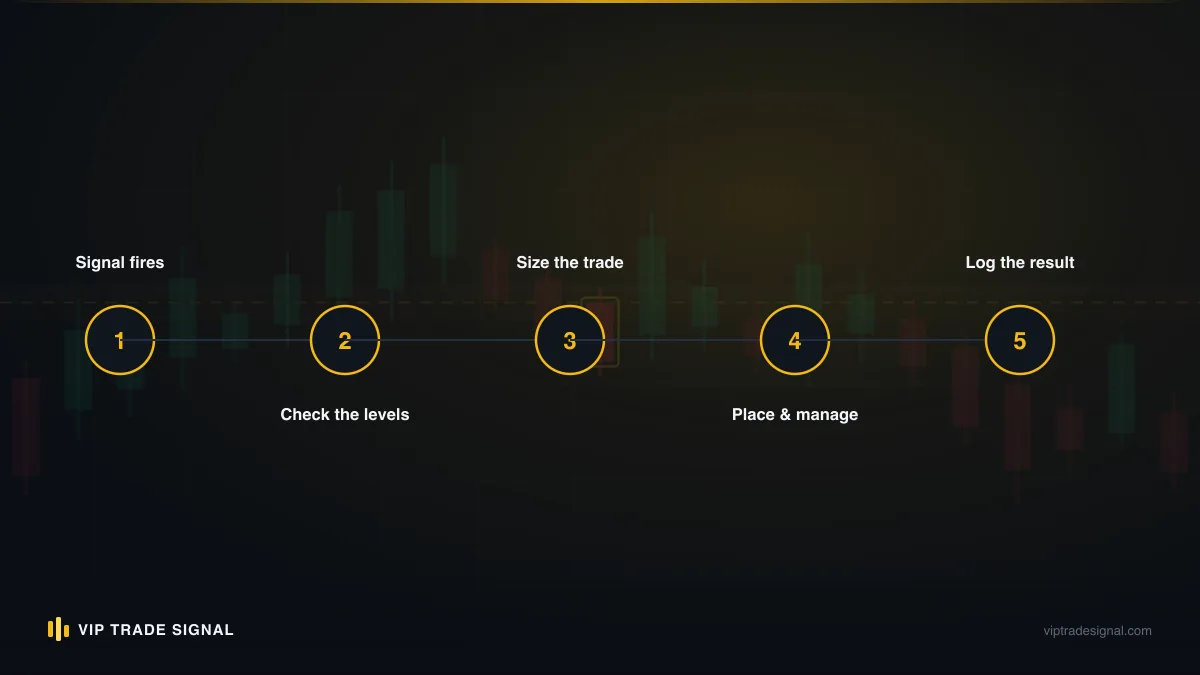
Every copier disaster we've been asked to look at, and people do email us their wreckage, traces back to this screen. The parser failures are dramatic, but it's the risk configuration that decides whether a failure costs you an annoyance or an account.
Work through these in order and do not let the software trade live until every one has a deliberate value in it.
Risk per trade, as a percentage. Set the copier to risk a fixed percentage of balance per signal, calculated from the signal's stop distance. On a $2,000 account risking 1%, that's $20 on the line per trade. Gold moves in dollars, so an 8-dollar stop on XAUUSD is 800 points on most brokers' pricing; $20 of risk across 800 points means roughly 0.02 lots. The copier should do this arithmetic on every signal. If you take one number from this article, take 1%, maybe 2% if you've verified the provider across months. Anyone auto-copying at 5% per trade is volunteering for a margin call, they just haven't scheduled it yet.
Maximum lot size. Independent of the percentage calculation, set an absolute cap. Work it out from your worst case: if a parse error produced a trade with a 1-dollar stop, percentage sizing would produce a huge position. The cap catches it. For a $2,000 account trading gold, something like 0.10 lots is a sane ceiling.
Maximum simultaneous trades and total open risk. Signals cluster. A provider might have three gold positions running at once, and three concurrent 1% risks that share one instrument are really a single 3% bet on the same price moving the same way. Cap concurrent trades at whatever total open risk you can stomach, for most people 3% to 4% of the account.
Entry tolerance. "Do not enter if price has moved more than X from the signalled entry." For gold we'd suggest somewhere in the 1.50 to 3.00 dollar range depending on the provider's style. This single setting prevents the worst copier behaviour: executing stale signals into a market that has already moved.
Signal age limit. Related but distinct: ignore any message older than a few minutes. If your VPS rebooted and the copier reconnects to a backlog of six hours of messages, you want it to shrug at all of them, not trade them.
Mandatory stop loss. Configure the copier to refuse any signal it cannot parse a stop loss from. No SL, no trade, no exceptions. A copied position without a stop on an unattended account is the closest thing retail trading has to a lit fuse.
Daily cut-off. Down 4% on the day, copier switches off until tomorrow. Losing streaks are normal, we say that about our own signals too, and every closed one sits in our public history including the losers. The cut-off doesn't stop the streak; it stops the streak from compounding with your absence.
Handling multi-TP signals and breakeven moves automatically
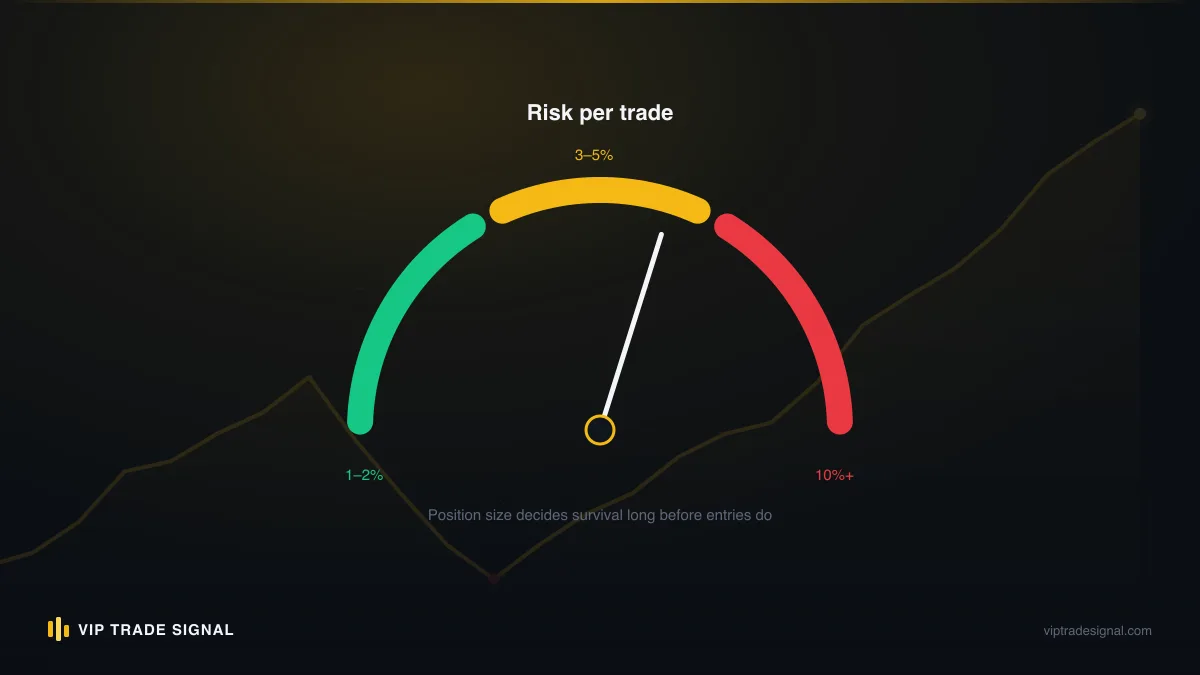
Most serious signal providers, ourselves included, post laddered targets: TP1 close, TP2 further, TP3 ambitious. (If the whole TP1/TP2/TP3 convention is new to you, we've unpacked exactly what the ladder means and why it exists.) Executing a ladder manually is easy. Executing it automatically forces a decision, because MT4/MT5 positions carry one TP each.
Copiers solve it two ways.
Split positions. The copier divides your calculated size into two or three separate orders, each with its own TP from the ladder. Signal says three TPs, your 0.06-lot total becomes three 0.02-lot positions. Clean, visible, and each leg behaves independently. The downside is triple commission tickets and slightly clumsier sizing on small accounts, where the maths can round a leg down to below minimum lot size and quietly drop it.
Single position with partial closes. One order for full size, and the copier closes fractions as price reaches each level. Fewer tickets, but now you're trusting the copier's live monitoring, and if the software or VPS is down at the moment TP1 trades, the partial close doesn't happen.
We lean towards split positions for gold specifically, because gold's habit of tagging TP1 then reversing hard makes the independence of the legs worth the extra tickets. Whichever you choose, set the split ratios deliberately. A common and sensible default is 50/30/20, half off at TP1, and don't accept whatever the software defaults to without looking.
Then there's breakeven. Many providers post "move SL to entry" once TP1 is hit, and good copiers can either obey that message or do it automatically on TP1 regardless of whether the provider says so. Automatic-on-TP1 is the setting we'd choose. It converts every one-target winner into a scratch-or-better outcome without depending on the provider remembering to post, or the parser catching a conversationally-worded instruction like "let's protect this one". Just be aware of stop-level restrictions: some brokers reject a stop placed too close to current price, so a breakeven instruction arriving while price hovers at entry can fail. Decent copiers retry; check yours does, in the log, on demo.
The general point underneath all this: a multi-TP signal is a small strategy, not a single instruction, and the copier is now responsible for executing the whole strategy over hours. That's a bigger delegation than "open this trade". Configure it like one.
Edited and deleted messages: the silent account killer
Here's the failure mode almost nobody thinks about until it costs them.
Telegram lets a sender edit or delete a message after posting. Signal providers use this constantly, and not always for shady reasons. A provider fat-fingers the stop, posts, spots it, edits within twenty seconds. Fine, human, normal. But your copier read the message the moment it arrived. Whatever happens next depends entirely on whether your software watches for edits, and what it's configured to do about them.
The scenarios, from benign to brutal:
- Edited SL/TP, copier tracks edits. Position updates within a second or two. This is the behaviour you want, and it's a headline feature, so verify it on demo rather than trusting the sales page.
- Edited SL/TP, copier ignores edits. You're now in a trade whose stop differs from the provider's. Their update messages ("SL to breakeven") reference a position that doesn't match yours. Small divergences compound over weeks into a copy of the service that performs measurably differently from the service.
- Deleted signal, copier does nothing. The provider posted, thought better of it, deleted. Their followers never traded it. Your copier did, and now holds an orphan position the provider will never manage, never update, never close, because as far as their channel is concerned it doesn't exist. If you're not watching, that position just sits there with your money in it.
That third case deserves the label we gave this section. And it points at something worth saying plainly about the industry: a minority of providers use edit-and-delete as a marketing weapon, deleting losers and editing entries after the fact so the channel history reads clean. A copier is accidentally a truth machine here. Its log records what was actually posted, when, and what changed. More than one trader has discovered their "94% win rate" provider's real behaviour by reading a week of copier logs. If a provider's messages are being edited after price has moved, you've learned everything you need to know, and the correct response involves the leave-channel button rather than a settings tweak. It's one reason we publish every closed signal, wins and losses, where nobody can edit them after the fact.
Configuration advice: set edits to be tracked and applied; set deletions to trigger an alert to your phone at minimum, and think hard about "close position on signal deletion" if your provider is disciplined (a good provider deleting a signal usually means "this is void"). And whatever you set, test both behaviours on demo by having a friend post, edit and delete signals in a private test channel. Ten minutes of testing, and you'll actually know.
VPS or always-on: infrastructure basics
A copier only copies while it's running. That sentence sounds too obvious to write down, and yet the most common copier complaint on any forum is some flavour of "it missed the trade because my laptop slept".
Your options, honestly ranked:
A Windows VPS. The standard answer and the right one for most people. You rent a small virtual Windows machine in a data centre, ideally in the same region as your broker's servers (London and New York cover most brokers), install Telegram, the copier and MT4/MT5 on it, and it runs around the clock. Cost runs $5 to $25 a month depending on spec; the copier stack is light, so 2 GB of RAM and two cores is usually plenty, though check your specific copier's requirements because a few are hungrier. Latency from a decent VPS to a broker is single-digit milliseconds, not that signal copying is a latency game. The real win is uptime and the fact that a Windows Update at 2am no longer costs you a trade.
A spare PC at home, always on. Workable if your power and internet are reliable and you disable every sleep and update-restart behaviour Windows has. That's a longer list than you'd think. Count on the occasional missed session and treat it as the discount option it is.
Your everyday laptop. No. This is how positions get orphaned. The copier is off whenever the lid is closed, which is most of the time, which means it catches entries randomly and misses the management messages that follow, which is worse than either copying everything or copying nothing.
Whichever you run, two habits matter more than the hardware. First, monitoring: set the copier (or a cheap uptime tool) to alert your phone if the terminal disconnects or the Telegram session drops, because Telegram sessions do occasionally need re-authentication and the copier sits there silently logged out until you notice. Second, a weekly glance at the machine itself: disk not full, terminal actually connected, EA smiley face still showing, log free of repeated errors. Five minutes on a Sunday. Automation reduces your workload; it doesn't reduce it to zero, and the traders who treat a copier as fire-and-forget are the ones who eventually forget something that's on fire.
Testing a copier on demo before going live
Run the full stack, real channel, real VPS, real settings, on a demo account sized like your live account, for at least three to four weeks or 20 signals, whichever takes longer.
That duration isn't ceremony. Here's what you're actually testing, and none of it shows up in a weekend:
- Parse rate. What fraction of the provider's signals did the copier catch and execute correctly? Below roughly 95%, you don't have automation, you have a lottery ticket that sometimes trades. Find the failed messages in the log and fix the rules, or accept that this provider's format and this copier don't mix.
- Execution fidelity. For each copied trade, compare your fill against the signalled entry. On gold, slippage of 20 to 40 cents on a fast break is normal; consistent 2-dollar divergence means your entry tolerance, your broker's execution or the copier's speed needs investigating.
- Management fidelity. Did breakeven moves apply? Did partial closes happen at the right ladder levels? Did an edited SL propagate? These are exactly the behaviours a weekend can't exercise, because they need real multi-day positions and a provider going through their real routine.
- The boring failures. A VPS reboot, a Telegram re-auth, a broker maintenance window. Three weeks is usually long enough for at least one of these to happen while you're not looking, which is precisely the test you want.
Keep a simple sheet: signal posted, copied yes/no, entry difference, management events, notes. Fifteen entries in, patterns are obvious. And to be clear, this demo period tests the plumbing, not the provider's edge; a month of results proves nothing much about profitability either way, in ours or anyone's favour. The provider verification is a separate, longer job that should mostly lean on their full public history rather than your demo window.
One more blunt thing. If a provider or copier vendor discourages demo testing, "you're missing real profits", "demo fills aren't realistic anyway", that's not advice, that's a sales tactic aimed at your impatience. Real fills differ from demo fills, sure. The direction of that difference is that live is slightly worse. Nothing about it argues for skipping the test.
Copier vs manual execution: honest tradeoffs
The manual vs automated forex signals question gets argued as if one side is simply correct. It isn't. They're different bargains, and which one suits you depends on your schedule, your temperament and your account size more than on any property of the software.
| Copier (automated) | Manual execution | |
|---|---|---|
| Speed to entry | Under a second, every time | 30 seconds to never, depending on where you are |
| Overnight/at-work signals | Caught | Mostly missed |
| Sizing discipline | Enforced by configuration | Enforced by willpower, i.e. variable |
| Judgement filter | None, copies everything | You can skip signals that look wrong for you |
| New failure modes | Parser errors, orphan trades, infra downtime | Fat fingers, hesitation, revenge-sizing |
| Learning value | Low, you watch trades happen | High, you handle every decision |
| Ongoing effort | Weekly checks, occasional maintenance | Attention at every signal |
The case for the copier is stronger than purists admit. Execution discipline is a real edge, and most humans don't have it at 3am. A copier never doubles size after two losses, never hesitates on a valid entry because the last one lost, never widens a stop "just this once". For a provider whose signals arrive around the clock, gold is active through Asian, London and New York sessions, a working adult without automation will simply miss a large share of the trades, and missing trades non-randomly (you catch the ones posted while you're bored at your desk, miss the ones at night) can turn a profitable feed into a losing personal record.
The case against is just as real. A copier executes your worst-configured day forever. It strips out the judgement layer where an experienced trader skips a signal into a news spike or passes on entry number four of a correlated cluster. And it teaches you nothing. If part of your goal is becoming a trader rather than remaining a subscriber, the copier removes exactly the repetitions you'd learn from.
Our actual position, for what it's worth: manual execution for your first months with any signal service, copier afterwards if your fill quality or coverage is demonstrably suffering. Learn the provider's rhythm by hand first. Then automate the part you've proven you understand.
When we tell clients not to use a copier
We're a signal service. A working copier means subscribers catch more of our entries, which flatters our results in their accounts. And still, there are situations where our honest answer to "should I set up a copier?" is no. These come up in real conversations, so here they are.
Accounts under about $1,000. Sizing maths breaks down at the bottom. Risking 1% of $600 with a typical 6-to-8-dollar gold stop wants roughly 0.01 lots, which is already the minimum, so the copier can't size down, can't split across a TP ladder, and every rounding decision rounds your real risk up. Trade signals manually on a micro account, or wait until the account is big enough for the maths to have room.
Anyone who hasn't traded the signals manually first. Covered above, but it's the single most common situation where we say wait. You cannot supervise automation of a process you've never done yourself. You won't recognise wrong.
Unverified or fresh providers. Automating a channel you found last Tuesday is handing a stranger your card because their sign was nice. The order is always: verify the full track record, then follow manually, then automate. Skipping to step three doesn't compress the timeline, it just moves the tuition fees earlier.
People who can't stop watching, or can't start. Two temperaments fail with copiers. The interferer checks the account hourly and manually closes copied trades early, ending up with the copier's losses and a fraction of its winners, the worst of both regimes. The abandoner sets it up and genuinely never looks again, missing the logged-out session, the format drift, the orphan trade. If you know you're one of these, and most people know, choose manual or choose a different hobby respectively.
Prop firm and funded accounts. Many prop firms prohibit or restrict copy trading and third-party EAs outright, and their daily-loss rules interact badly with an unattended copier during a losing cluster. Read your agreement before the software does something your firm's risk desk notices before you do.
Anyone hoping the copier fixes a losing service. It won't. Automation is a multiplier with no sign attached. This comes up more than you'd think, usually phrased as "maybe I'm just executing badly". Sometimes true. Usually the signals were the problem.
None of this is us being coy about automation. It's us preferring subscribers who are still around in a year. There's a fuller set of questions like this answered on our FAQ, including the ones about how our own signals are formatted and delivered.
A configuration template for gold signals
Enough principles. Here's the concrete starting configuration we'd hand a friend setting up a copier on a gold-only channel with a $2,000 account. Adjust the numbers to your balance, keep the structure.
Sizing and caps
- Risk per trade: 1% of balance, calculated from the signal's SL distance. Not fixed lots.
- Absolute maximum lot size: 0.10.
- Maximum simultaneous open trades: 3. Maximum total open risk: 3%.
- Daily loss cut-off: 4% of balance, copier disables until next day.
Entry rules
- Entry tolerance: skip if price is more than $2.00 from the signalled entry.
- Signal age limit: ignore messages older than 5 minutes.
- Mandatory SL: reject any signal without a parseable stop loss.
- Pending orders: if the provider posts limit entries, copy them as limits with the provider's price, expiry 24 hours unless the signal states otherwise.
Trade management
- Multi-TP handling: split positions, 50/30/20 across TP1/TP2/TP3.
- Breakeven: automatic move of remaining position's SL to entry when TP1 fills, plus obey any explicit breakeven message from the channel.
- Edited messages: track and apply changes to SL/TP.
- Deleted messages: alert to phone immediately; close the position if your provider treats deletion as cancellation (ask them; ours does).
Instrument and session
- Symbol mapping: XAUUSD mapped to your broker's exact gold symbol, everything else unmapped so nothing but gold can ever trade.
- Rollover filter: no new entries in the 15 minutes around 5pm New York, when gold spreads routinely triple.
- News filter: your call. We don't blanket-block news on our own signals, but if you do, block entries only, never management actions on open trades.
Infrastructure and review
- Windows VPS near your broker's server, auto-start for terminal and copier on reboot.
- Disconnect alerts to your phone for both the Telegram session and the MT4/MT5 connection.
- Weekly ritual, five minutes: log review for parse failures, VPS health, and a spot-check of three copied trades against the channel's messages.
Run exactly this on demo for three weeks first. Then go live at half the risk numbers for the first month, 0.5% per trade, and step up only once the live log looks like the demo log did.
That's the whole honest picture. A telegram signal copier is worth having when the provider is verified, the format is disciplined, the risk screen is filled in with intent, and you've watched the machine work on demo until it's boring. Miss any one of those and you've built a very fast way to make someone else's mistakes with your money. Get all four right and you've solved the 3am problem for good, which, if the signals are worth following in the first place, is the only problem execution was ever causing you.