Here is a conversation we have had, in one form or another, more times than we can count. A subscriber joins, follows every gold signal for three weeks, does fine. Then he skips one because it "looked overextended". That one wins. The next day he takes two, doubles the lot size on the second because he's owed something, and both lose. Within a month he is running a private strategy loosely inspired by our signals, and it is bleeding.
Nobody warned him that trading psychology when following signals is its own discipline. He assumed the hard part was analysis, and since he'd outsourced the analysis, the hard part was done. That assumption quietly wrecks more signal followers than bad providers do. And there are plenty of bad providers.
This piece maps the actual battle. Not the generic "control your emotions" sermon you've read forty times, but the specific failure patterns that show up when the trades aren't yours: outsourced confidence, cherry-picking, chasing missed entries, revenge trading on someone else's loss, and the slow collapse of compliance across a losing streak. We see these patterns weekly in real subscriber behaviour. You will recognise yourself in at least two of them. Most people do.
Trading psychology when following signals: why it's harder than it looks
The pitch for signals (anyone's, including ours) carries a hidden promise: hand over the decisions, and you hand over the stress. It sounds reasonable. It's wrong.
What you actually hand over is the analysis. The decisions stay with you, every single time. Do I take this one? At this price, or has it moved too far? Full size or half? Do I close early because it's up 40 pips, or trust the target? Do I honour the stop or widen it "just this once"? A signal removes exactly one question, where price might go, and leaves you the other five, which happen to be the five that emotion attacks.
Worse, following someone else strips out the thing that normally steadies a trader through a rough patch: conviction. When you trade your own analysis, a loss hurts but you understand it. You saw the setup, you know what invalidated it, you can rebuild. When a signal loses, you have no scaffolding. You didn't see the setup. You can't evaluate whether the loss was a good trade with a bad outcome or a genuinely bad call. All you have is a red number and a stranger's track record.
So the follower's psychology runs on borrowed conviction, and borrowed conviction has a short shelf life. It survives about as long as the last three results. That's not a character flaw. It's the structural position you're in: full financial exposure, zero analytical ownership. Sit with that combination for a few weeks of normal gold volatility (and XAU/USD will happily hand you an 80-pip adverse move before lunch) and it produces very specific, very predictable behaviour.
The rest of this article is a tour of that behaviour. If it reads like we're describing you personally, good. That's the point of writing it down.
Outsourced confidence: the trust rollercoaster
Every signal follower rides the same curve, and almost nobody notices they're on it.
Week one is the honeymoon. You follow everything, exactly as posted, because you've just paid (or just committed your broker deposit) and the sunk cost is doing your discipline for you. Ironically, this is often the follower's best-performing period, not because the signals are better but because compliance is perfect.
Then comes the first loss cluster. Two, maybe three stops hit in a row, which is unremarkable (any honest strategy eats sequences like that monthly), but it doesn't feel unremarkable, because your trust in this provider has no roots. It was built on a marketing page and a few green screenshots. So trust drops fast, much faster than it would in your own tested system.
Borrowed conviction has a shelf life of about three trades.
Now the dangerous phase: conditional following. You still take signals, but each one gets a private audition. Does the chart "look right" to you? Did the last one win? Are you up or down on the week? The provider is now producing maybe 60% of your trades, and here's the trap: you're selecting which 60% based on feelings you'd never accept as a trading strategy if you wrote them down.
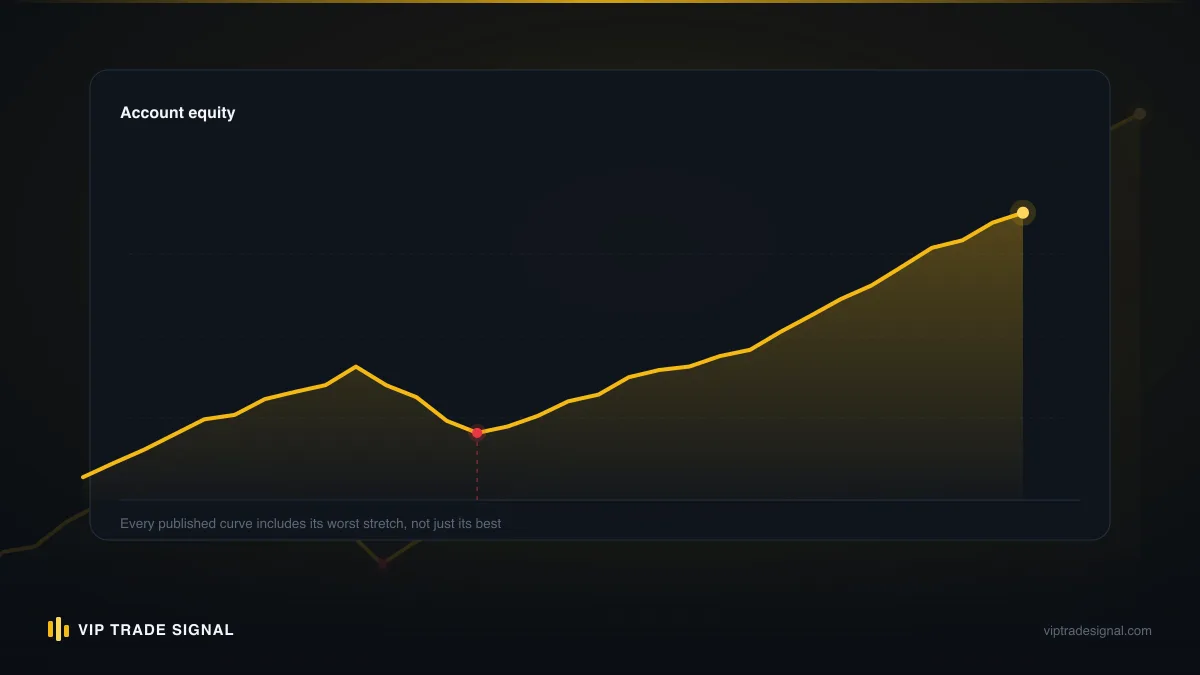
If results improve, trust rebuilds and the cycle resets. If they don't, you either quit (honestly, the least damaging exit) or drift into freelancing: using the signals as loose inspiration for trades that are really your own, at sizes that are really your mood's. The account that dies in month three usually dies here, and its owner will tell everyone the signals were bad. Sometimes they were. Often the signals were fine and the following wasn't. That is precisely why we publish every closed result, wins and losses, on our signals history page: so trust has something sturdier than screenshots to stand on when the inevitable red patch arrives.
Know the curve exists. You cannot skip it, but you can refuse to make decisions while you're on the steep part of it.
Cherry-picking signals: the silent performance killer
Of all the common mistakes traders make with signals, cherry-picking is the most expensive per unit of how innocent it feels.
The logic seems sound. You have judgment. Why not apply a filter and take only the "best" signals? Surely some human oversight beats blind following.
The problem is arithmetic before it is psychological. Any signal service's published performance is the performance of the full set. A strategy that nets out ahead over 100 trades can easily be underwater on any hand-picked 40 of them. And your 40 won't be random. They'll be selected by a nervous human, which means selected badly in consistent, repeatable ways.
Here's what the filter actually selects for. You skip signals that come after losses (feels risky) and take signals that come after wins (feels safe), which is momentum-chasing your provider's equity curve, and equity curves mean-revert just like price does. You skip counter-trend entries because the chart "looks wrong", and counter-trend entries at exhaustion are frequently where the fat reward-to-risk lives. You skip the 2 a.m. signal and take the 2 p.m. one, as if gold consults your timezone. You take smaller size when you're down and full size when you're up, so your worst-followed week gets your biggest bets.
Run the numbers on a plausible scenario. Say a provider closes 20 gold signals in a month: 11 winners, 9 losers, decent net. A cherry-picker who caught 12 of those 20 (skipping mostly the after-loss entries) could easily hold 5 winners and 7 losers from the same feed. Same provider. Same month. Opposite outcome. When he cancels his subscription, both parties will be telling the truth: the signals made money, and he lost money.
There is exactly one honest version of filtering: a written rule, decided in advance, applied without exception. "I only take London-session signals" is a defensible policy you can evaluate after 50 trades. "I skip the ones that feel off" is not a policy. It's mood, wearing a policy's clothes.
FOMO and chasing: the missed-entry spiral
You were in a meeting. The signal said buy gold at 3,308, stop 3,296, target 3,338. By the time you open the app it's trading 3,321. Thirteen dollars gone. What now?
What the maths says: your reward-to-risk just collapsed. At the original entry you were risking 12 to make 30, comfortably better than 2:1. Enter at 3,321 with the same stop and you're risking 25 to make 17: the trade is now worse than backwards, and taking it is strictly irrational. The correct move is boring: let it go. There is always another signal. On an unlimited-signals service there is literally always another signal.
What the feeling says is louder. The signal is winning without you. That sensation, watching a trade you were handed run to target while you stand on the platform, is one of the sharpest pains in this business, and fomo and chasing missed signals is the industry's most reliable account-drainer because of it. The pain of missing a win is, for most people, noticeably worse than the pain of taking a loss. A loss at least feels like participation.
So the follower chases. And chasing has a spiteful failure mode: the late entry gets stopped on a retrace that the original entry would have survived, meaning you managed to take a loss on a winning signal. Do that twice in a fortnight and something curdles. Now you're not just chasing. You're pre-empting, entering before signals fire because you "know one's coming", which is no longer following a service at all. It's trading your own untested system with extra steps and a monthly fee.
Two rules kill the spiral dead:
- Set a chase limit in price, not vibes. Decide once, in writing: "If gold has moved more than one third of the stop distance past entry, I don't take it." On a 12-dollar stop, that's 4 dollars of grace. Beyond it, the trade no longer exists for you.
- Log every skipped signal's outcome — including the wins. Over a month you'll notice most missed winners were followed within days by perfectly takeable setups. The scarcity is imaginary. Your logbook proves it to the part of your brain that doesn't believe sentences.
Missed money is not lost money. Repeat it until it stops feeling like a lie.
Revenge trading after a provider's loss
Revenge trading is well documented in solo traders: take a loss, feel wronged, immediately place a bigger trade to win it back, donate the rest of the account. Signal followers run a stranger variant, and it's worth naming precisely because almost nobody talks about it.
When your own trade loses, the revenge impulse at least points at the market. When a signal loses, the impulse splits. Half of it wants revenge on the market. The other half wants revenge on the provider: a need to prove that you would have done better, that your instinct in the moment ("I knew that stop was too tight") was superior to the analysis you're paying for.
This produces the signature move of the wounded follower: the counter-signal. The provider's long just got stopped, so you short, at market, at double your normal size, with no stop because "it already fell, how much lower can it go". On gold, the answer to that question is regularly "another $25 in an hour". One counter-signal at 2x size can erase a month of disciplined following, and the follower who does it once has crossed a line that's hard to uncross. He now believes, somewhere below argument, that his reactive judgment beats the system he subscribed to. Every future signal is auditioned before that belief.
The other flavour is overtrading the gap. A losing signal leaves a silence, and the silence itches. Overtrading and revenge trading signals feed on that itch: if the provider won't fire the recovery trade right now, you'll find one yourself. Three self-generated "bridge trades" later, the day's damage is 4% and the provider's contribution to it was one clean 1% loss.
The countermeasure is almost embarrassingly simple, which is why nobody does it: a cooling-off rule attached to the provider's losses, not just your own. After any stopped signal, no self-initiated trades for 24 hours. Write it where you can see it. The rule works because it doesn't ask you to feel calm (feelings don't take instructions); it just removes the button while you aren't.
The blame problem: whose loss is it anyway
Ask a signal follower about last month's wins: "the service is decent, I've got a good process." Ask about the losses: "the provider had a rough patch." Attribution flows one way, credit inward, blame outward, and it isn't dishonesty; it's the default setting of every human who has ever explained their own results.
For a signal follower, though, blame displacement isn't just vanity. It's operationally corrosive, because it destroys the feedback loop you need to improve. If every loss is the provider's fault, then your cherry-picking, your chased entries, your doubled lots and your widened stops never appear in the post-mortem. You will review a losing month, conclude "the signals were off", and change providers, carrying every one of your actual problems to the new subscription, where they will produce the same month with different branding. We've watched people do this lap four times. The Telegram world is full of channels happy to catch them on each orbit, and the worst of those channels are outright engineered to exploit exactly this migration.
The fix is an accounting change. Split every result into two ledgers:
| Ledger | Question it answers | Who owns it |
|---|---|---|
| Signal P/L | What did the signal earn as posted — exact entry, stop, target, standard 1% risk? | The provider |
| Execution P/L | What did my account earn on that signal, after my sizing, timing, skips and overrides? | You |
Track both for 30 signals and the gap between the columns is your behaviour, in dollars, with nowhere to hide. Some followers discover the gap is small: genuinely disciplined. If their signal ledger is also red, they have a real provider problem and should leave. Fine. That's the system working. But most discover the provider's column is modestly green and theirs is red, and that discovery, uncomfortable as it is, is worth more than any signal we will ever send. You can fire a provider in one click. Firing your own habits takes longer, and it starts with seeing them itemised.
Losing streaks: what five losses in a row does to compliance
Let's do the arithmetic first, because the arithmetic is comforting and the feelings are not. A strategy that wins 55% of the time (respectable for a stop-and-target gold approach) will still throw five consecutive losses somewhere in most hundred-trade stretches. On an active service, that's not a tail risk. That's a scheduled event, like weather. At 1% risk per trade, five straight losses costs about 4.9% of the account. Uncomfortable, survivable, and fully priced into any honest long-run expectancy.
Now the feelings. Here is the compliance decay we actually observe across a five-loss streak, more or less on schedule:
- Loss 1: Nothing. Losses happen. Full size on the next one.
- Loss 2: A flicker. You check the provider's recent history. Still following.
- Loss 3: Doubt arrives with a narrative: "something's changed. The market, the analyst, something." Next signal gets taken at half size. (Note what this does mathematically: your losses ran at full size, and the recovery, when it comes, will run at half. You've just engineered a worse outcome than the streak itself.)
- Loss 4: You skip one. It wins, obviously (the universe has a sense of humour about these things), and the win you didn't take hurts more than the four losses you did.
- Loss 5: You're now "waiting for the service to stabilise", which means you'll re-enter after a visible run of winners. Full size again, right after the wins, just in time for mean reversion.
Follow that pattern and you take every loss at 100% size and the bounce-back at 50% or 0%. A streak the strategy was built to absorb becomes a hole the follower dug. This is what surviving losing streaks with signals actually requires: not stoicism, not affirmations, but pre-commitment. Sizing decided before the streak, in a written rule that doesn't consult your mood. "1% risk per signal, every signal, reviewed only at month end" is a complete anti-streak policy in eleven words.
One more honest note. Streaks are also when you find out whether your provider deserved the trust. A service that goes quiet, deletes losers, or suddenly rebrands during a red patch has told you everything. We keep every closed signal public precisely so that during our losing runs (and we have them; every strategy does) you're looking at the same ledger we are.
The interference cycle: overriding signals at the worst times
Put the previous sections together and a shape emerges. It's a loop, and once you see it you'll spot it in your own history immediately.
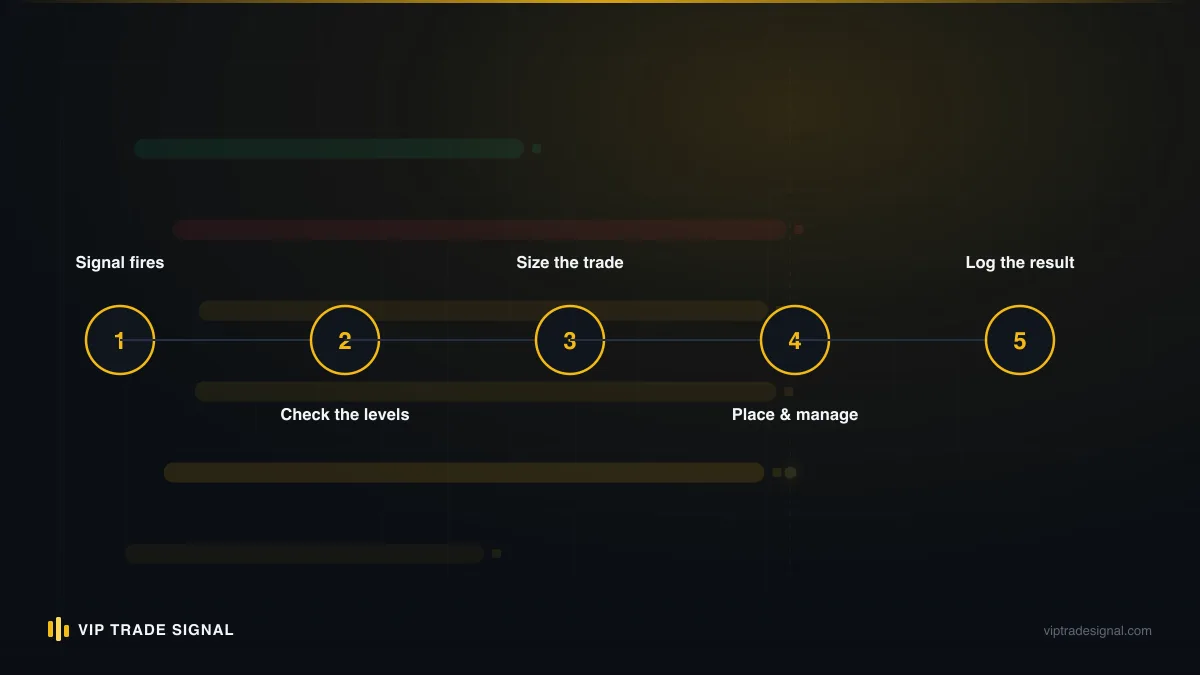
Trust → dip → override → regret → resolution → trust again. You follow cleanly while results are good. A normal dip arrives. Doubt converts into interference: a skipped signal, a trimmed size, an early close, a widened stop, a revenge counter-trade. The interference backfires (it usually does, because it was timed by anxiety, and anxiety is a contrarian indicator of the worst kind). Regret follows, then a firm resolution to "just follow the signals properly from now on". Which you do. Until the next dip.
The bitter part is the timing. Interference doesn't strike randomly; it clusters exactly where it does maximum damage. You override after losses, which is statistically where honest systems rebound. You close winners early when the account is down, capping the very trades that repair drawdowns. You size up after win streaks, which is where give-back lives. A coin-flipping monkey would interfere at random and merely add noise. A stressed human interferes with immaculate negative timing, and turns a mediocre month into a terrible one.
Three overrides deserve special mention because followers rationalise them as conservative:
- The early close. Taking 15 pips of a 40-pip target "to be safe" feels prudent. Do it habitually and you've slashed the average winner while leaving the average loser untouched: the expectancy quietly flips negative with a 60% win rate. Safety that bankrupts you slowly is not safety.
- The widened stop. Moving a stop from 3,296 to 3,288 "to give it room" converts a defined 1% risk into an undefined one, and teaches you that stops are suggestions. On gold, that lesson eventually costs 8% in one afternoon.
- The hedge. Opening an opposite position instead of taking the stop. Now you're paying spread twice to be guaranteed wrong once, while telling yourself you haven't lost yet.
Every one of these is a decision the signal already made for you, remade worse under stress. The whole value of a signal is that its decisions were made calmly, in advance. Interference re-injects the panic that the format exists to remove.
Building mechanical compliance: rules that remove decisions
If discipline were a personality trait, this article would end here with "be more disciplined", and it would be useless. Discipline, for a signal follower, is not a trait. It's a checklist: a set of decisions made once, in writing, on a calm Sunday, so they never have to be made live at 2:15 p.m. with gold dropping and your pulse up.
Here's the follower's rulebook we'd actually recommend. Steal it, adjust the numbers, but write yours down. Unwritten rules are moods.
- Fixed risk per signal. Pick a number (1% is the grown-up default, 0.5% while trust is young) and apply it to every signal without exception. Not "1% usually". Every signal, same formula: risk amount divided by stop distance gives lot size. A $5,000 account risking 1% on a 12-dollar gold stop trades roughly 0.04 lots. The calculation takes twenty seconds and deletes the single most damaging variable in follower behaviour, which is emotional sizing.
- A chase limit in writing. One third of the stop distance past entry, or the trade doesn't exist. Covered above; non-negotiable.
- All-or-nothing following, or a written filter. Either you take every signal, or you take a pre-defined subset ("London session only") chosen before the month starts. There is no third mode. "Discretionary filtering" is cherry-picking with a nicer name.
- Stops and targets as posted. You may not widen a stop, ever. You may pre-commit to closing half at a fixed fraction of the target if that's written in your rules: a partial-profit policy decided in advance is legitimate; the same action improvised mid-trade is interference.
- The 24-hour rule. No self-initiated trades within 24 hours of any stopped signal. Yours or the provider's.
- A monthly review date, and no other review dates. Compliance and performance get judged once a month, on the ledgers, not nightly on the mood. Between reviews, the rulebook runs the show.
Notice what this list has in common: none of it requires you to feel anything in particular. That's the design. Systems that need you calm will fail exactly when calm leaves. Systems that only need you to follow a written instruction survive the days that matter. If you can't yet trust yourself to run rule 1 through rule 6 (and plenty of honest people can't, especially mid-drawdown), that's the point where handing execution over entirely, or getting structured help out of a deep hole, stops being weakness and starts being self-knowledge. We'd rather say that plainly than watch another rulebook die on contact with loss number three.
Journaling the emotional data, not just the trades
Most trade journals are autopsies of price: entry, exit, pips, a screenshot. For a signal follower that journal is nearly worthless, because the price data isn't yours; the provider already has it, better organised. The only proprietary dataset you own is you, and almost nobody records it.
So journal the follower's variables, the ones that actually predict your blow-ups:
- Compliance, per signal. Taken as posted? Skipped? Modified, and how? One letter each: F (followed), S (skipped), M (modified). A month of letters tells you more than a year of screenshots.
- State before acting. One line, honest: "calm", "still annoyed about yesterday", "up 3% and feeling clever", "didn't sleep". You are not writing literature. You're tagging data.
- The urge log. Every time you wanted to interfere but didn't: wanted to close early, wanted to chase, wanted to double. One line each. This is the gold in the whole exercise, because urges precede actions by weeks. A journal that shows "urge to close early" appearing five times in a fortnight is telling you which rule is about to break, before it breaks and before the account feels it.
- Skipped-signal outcomes. What did the ones you didn't take actually do? This column is where the cherry-picking fantasy goes to die, in your own handwriting.
Then review monthly and ask exactly two questions. Where did the execution ledger diverge from the signal ledger, and which recorded state preceded each divergence? Ten minutes with an honest journal will hand you a sentence like "I modify signals when I'm up on the week and skip them when I'm down", a sentence worth real money, because behaviour you can name is behaviour you can write a rule against.
One practical note: keep the journal outside the trading platform. A note on paper, a plain spreadsheet, anything that doesn't show you a live P/L while you write. The whole point is a record made by the person you are at 9 p.m., about the person you were at 2:15.
When to pause: recognising tilt before the account shows it
Poker players have a word for the state where emotion has taken the controls and skill is a passenger: tilt. Traders are on tilt just as often; they just lack the vocabulary, so they call it "having a bad week" and keep clicking.
For a signal follower, tilt has tells that show up in behaviour well before they show up in the balance. Learn your own list; here's the common core:
- You're checking price between signals. Constantly. There's nothing to decide (a follower with no open urge doesn't need the chart), so the checking is the symptom.
- You've started composing complaints to the provider in your head mid-trade.
- The word "owed" has entered your inner monologue. The market owes you, the service owes you, this week owes you.
- You feel relief when a signal loses. Read that twice. When part of you is rooting against your own positions because being right about the provider's decline matters more than the money — that's tilt with its mask fully off.
- You're recalculating what the account "would be" without one specific loss, repeatedly, like tonguing a broken tooth.
The response to any two of these is a pause, and a pause needs teeth, so define it like a rule, not a vibe: flat for five trading days, journal stays open, platform stays closed, signals get logged but not taken. Five days costs you, at most, a handful of trades from an unlimited feed. The follower's one structural luxury is that missing a week costs almost nothing; a solo trader hunting rare setups doesn't have that. Compare it to what a tilted week costs. We've seen tilted weeks cost 20%.
And maybe the pause reveals something bigger: you've been on tilt for a month, the account is already down $6,000, every session is now about getting it back. Stop trying to trade your way out this week. Deep drawdown is its own psychological regime, nastier than anything in this article, and the honest options (including our answers to the awkward questions, which we keep public in the FAQ) deserve a clear head. Recovery plans made on tilt are how a $6k hole becomes a $10k one.
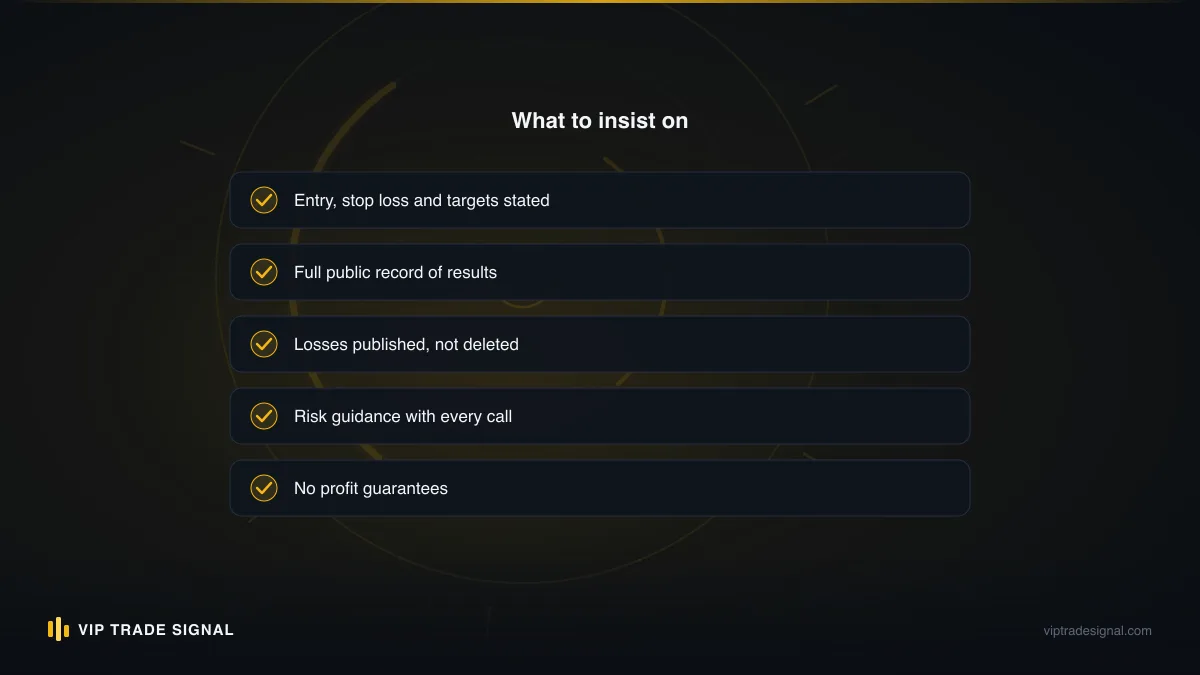
The follower's mental checklist, per trade and per week
Everything above compresses into two small routines. They fit on a card. They should live where you trade.
Before taking any signal — thirty seconds:
- Is price within my chase limit of the posted entry? (No → the trade doesn't exist.)
- Is my size the formula's size (risk amount ÷ stop distance) and not a feeling's size?
- Am I inside a 24-hour cooling-off window? (Yes → close the platform.)
- One-word state check, written down: calm, eager, wounded, bored? Anything but calm gets noted; "wounded" or "eager" gets a size sanity-check.
- Am I taking this signal because it's the next signal, or because of what the last one did? Only the first answer is allowed.
After the signal closes — ten seconds:
- Log the letter: F, S, or M.
- Log any urge you resisted.
- Do not open a chart for an hour. There's nothing there for you.
Weekly, ten minutes, ideally Sunday:
- Compliance rate: what fraction of signals were an F? Below 90%, the problem you work on this week is you, not the provider.
- The two ledgers: what did the signals earn as posted, and what did your account earn? Name the gap. Say the reason out loud.
- Skipped-signal audit: what did the ones you filtered out actually do?
- Any tilt tells from the list? Two or more → schedule the pause now, before Monday makes its argument.
- One sentence, written: "Next week I will follow the rulebook, and the rulebook says ___." Fill the blank with whatever nearly broke this week.
That's it. No affirmations in the mirror, no trading-in-the-zone meditation retreat. Thirty seconds, ten seconds, ten minutes. The whole psychological practice of a signal follower is smaller than people expect; it just has to actually run, every time, especially the times it feels unnecessary. It always feels unnecessary right before it isn't.
Where this leaves you
Strip it to the studs and the argument is this: signals move the analysis off your desk and leave the psychology sitting exactly where it was, wearing new clothes. The follower's demons aren't the solo trader's demons. You won't be tempted to over-analyse, because you're not analysing. You'll be tempted to audition: to grade each signal by mood, chase the ones that left without you, counter-trade the ones that stung, shrink into a losing streak and swagger out of a winning one. Different battle. Same casualty rate, for the people who don't know they're in it.
The encouraging part, and we mean this without a whiff of motivational-poster gloss: the follower's battle is more winnable than the solo trader's. You don't need to master market analysis, which takes years and breaks most people. You need to execute someone else's decisions at fixed size without meddling, a narrow, teachable, checklist-sized skill. Plenty of people who could never build a profitable strategy can absolutely run one, once they stop mistaking interference for judgment.
So here's the hard question to sit with, and be honest, because the two ledgers will out you eventually anyway. Over your last twenty signal trades, from us or from anyone: was the gap between what the signals earned and what your account earned a provider problem, or a you problem? If you've never split those ledgers, you don't know. Thirty days of the journal and the checklist will tell you, in your own handwriting, for free.
And if the answer turns out to be "provider problem"? Good. Leave. Pick a service that shows its full history, losers included, and run the same rulebook there; it travels. Ours is public at /signals, red trades and all, and whether you weigh us against the copy-trading alternative or against the Telegram channel your cousin swears by, weigh the follower in the mirror too. He's the variable nobody audits. Audit him first.