A trader we'll call Dan messaged us last year, annoyed. Not with us. With himself. He'd spent $840 across seven months on three different signal services, and when he finally sat down and totalled everything, the signals had lost him money on top of the subscriptions. What stung most, he said, was that every red flag had been visible before he paid. He just never asked.
That's the thing about signal sellers. The bad ones are rarely clever. They rely on nobody asking questions, because the typical buyer arrives excited, sees a screenshot of a 90-pip win, and reaches for a card. The whole business model of the worst corners of this industry is built on the assumption that you will not interrogate anyone.
So here is the interrogation. Twelve questions to ask before joining a signal service, in the order you should ask them, with the good answer, the bad answer, and the answer that should end the conversation on the spot. This is a literal script: you can copy these into a message and send them to any provider, including us. At the bottom of this piece we answer all twelve ourselves, in public, because we think every provider should have to, and most would rather you didn't ask.
Why you interrogate before you pay
There's an asymmetry at the heart of the signal business that you need to hold in your head the whole time you're evaluating anyone.
When you follow a signal, you carry the loss. All of it. The provider carries, at worst, a cancelled subscription. That means the provider's incentive is to look good, and yours is to find out whether they are good, and those are very different projects. A provider can look brilliant for months on cherry-picked screenshots while quietly losing money in aggregate. You can't afford to trade on how things look.
Due diligence on a signal provider isn't paranoia, it's just pricing. You're about to hand someone influence over your trades. If a $2,000 account risks 1% per trade, each signal you follow is a $20 decision, and over a year of two signals a day that's roughly a thousand decisions, call it $20,000 of cumulative risk deployed on someone else's say-so. You'd interview a builder harder than most people interview a signal seller, and the builder can only wreck your kitchen.
And the questions themselves do double duty. The answers matter, obviously. But how a provider answers matters nearly as much. A serious operation has been asked all of this before and answers quickly, specifically, in writing. An unserious one gets vague, or flattering, or pushy. You learn from the texture of the reply, not just its content. We'll come back to that.
One more framing note before the questions. For each one, we give three tiers:
- Good — the answer a legitimate, self-aware provider gives.
- Bad — not fatal on its own, but a mark against. Two or three bad answers and you walk.
- Disqualifying — end the conversation. No second chances, no "but their wins look great". One of these is enough.
Questions 1 and 2: the track record
Q1. "Can I see your complete signal history — every closed trade, wins and losses, for at least the last six months?"
This is the first question because it filters out most of the industry in one line. Not the good half. Most of it.
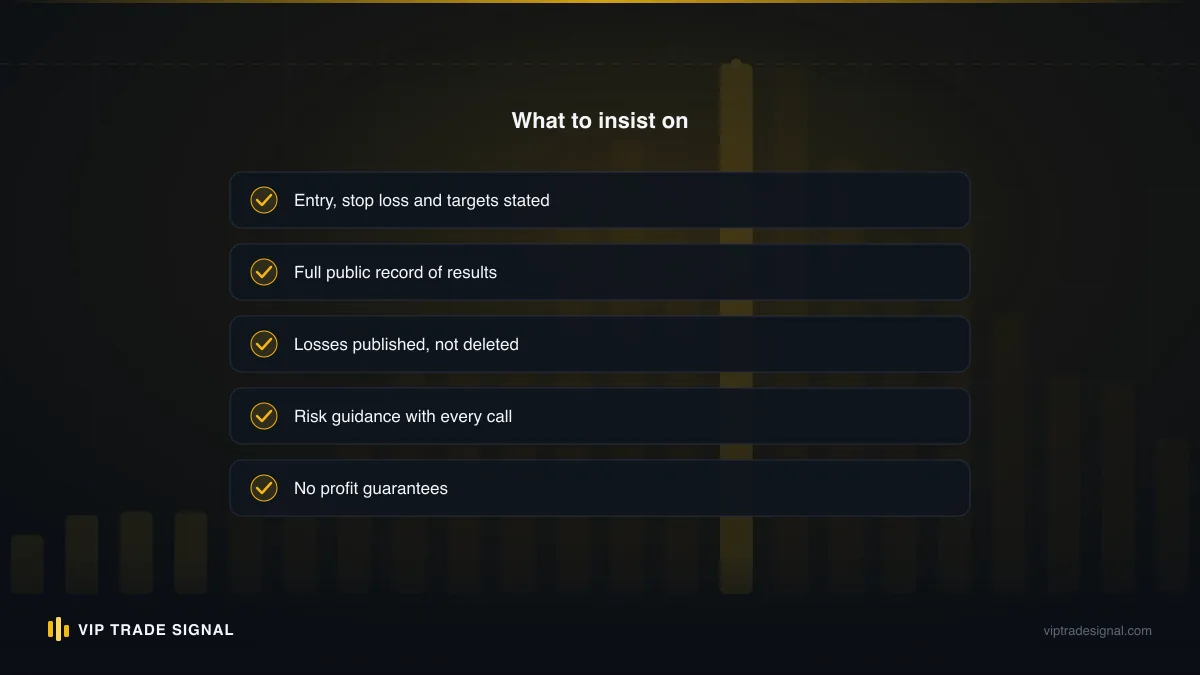
Good: a link to a full, public, dated record of every closed signal. Entry, stop, target, outcome, timestamped. Losses sitting right there next to the wins, unannotated and unexcused. Six months minimum; more is better because any strategy can look clever for a quarter.
Bad: "We post results in the group." Results posted inside a Telegram channel the provider controls are not a record, they're a highlight reel, because deleted messages leave no hole. Also bad: a PDF of results, screenshots of MT4 closed-trade lists, or a "verified" page that only starts three weeks ago.
Disqualifying: any version of no. "Past results don't matter, focus on the future." "History is for paying members only." "Trust the process." A provider who won't show you their losses has losses worth hiding, and a provider with no losses at all is showing you fiction. Every real trading record has red in it. Ours does, publicly, at /signals/history, and we'd be suspicious of anyone whose doesn't.
Q2. "Is that history verified by anything outside your own control?"
A self-published spreadsheet is better than nothing, but it's still self-published. So push one step further.
Good: something a third party timestamps or that can't be quietly edited. A Myfxbook or FXBlue account with trade history visible. Signals posted to a public channel before the trade plays out, so anyone can scroll back and check the call against the chart. Independent forex signal provider reviews help a little here too, though read them cynically; review sites take advertising money and affiliate commissions, and glowing reviews are cheap to manufacture.
Bad: "Our members verify it." Members who joined last month verify nothing. Also bad: verification links that show the equity curve but hide the open-trade history, which is the classic way to bury a martingale strategy that looks smooth until the month it detonates.
Disqualifying: getting defensive. "Why would we fake it?" is not an answer, it's a deflection, and the honest reply to your question costs a legitimate provider ten seconds.
Questions 3 and 4: the risk
Q3. "What's the worst losing streak and the deepest drawdown this service has actually had?"
Notice the phrasing. Not "what's your risk management like", which invites a paragraph of comfortable noise. You're asking for two numbers from the past, and the past has already happened, so there's no excuse for vagueness.
Good: specific and a bit uncomfortable. "Seven losses in a row in March, worst peak-to-trough drawdown about 9% at 1% risk per signal." A provider who volunteers their ugliest stretch without flinching has almost certainly lived through it and thought about it. Streaks of five to eight consecutive losses are normal for any real strategy over a year or two. That's not a flaw; it's arithmetic. A system that wins 55% of the time will still throw a six-loss streak surprisingly often across a few hundred trades.
Bad: "Drawdowns are minimal." Minimal is not a number. Also bad: quoting drawdown without saying what risk per trade it assumes, which makes the figure meaningless.
Disqualifying: "We don't really have losing streaks." Run. Not briskly. Run. Whoever says this is either lying about the record or hasn't traded long enough to have one, and both end the same way for your account.
Q4. "What risk per signal do you assume, and does every signal come with a stop loss?"
The follow-up that turns Q3's numbers into something you can act on.
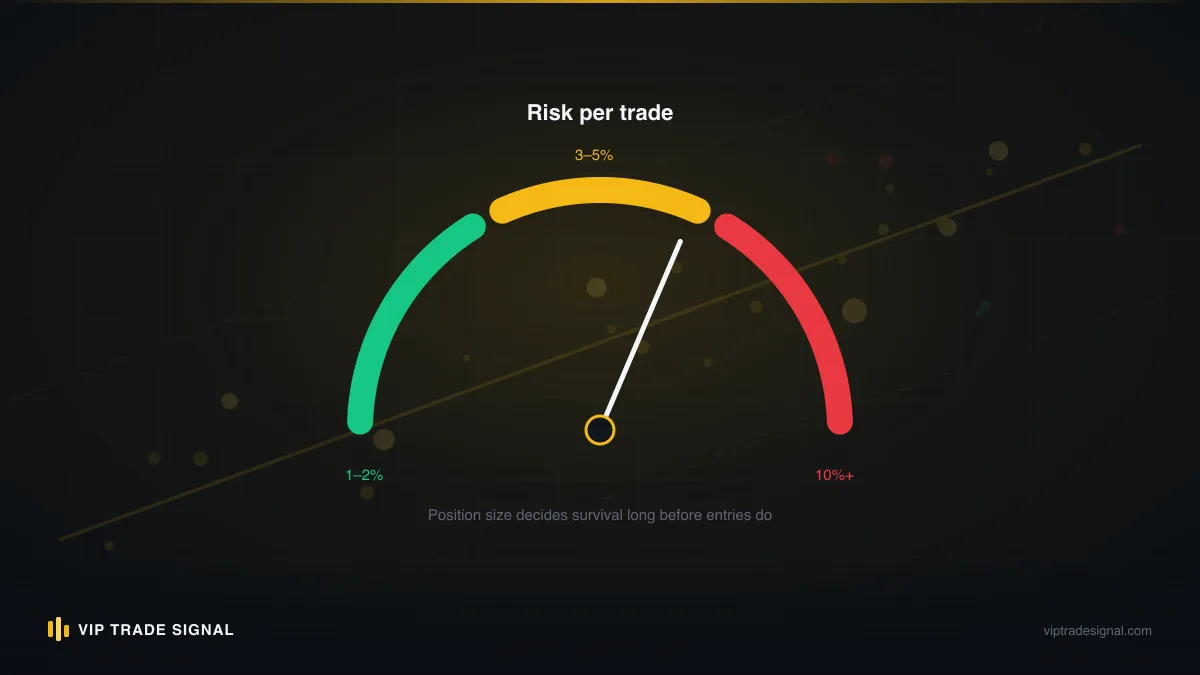
Good: a defined convention. "We size our published results at 1% risk per signal; scale to your own tolerance. Every signal carries a hard stop, no exceptions." The exact percentage matters less than the existence of a convention, because a stated convention means the provider's results and your results can actually correspond.
Bad: "Risk what you're comfortable with" and nothing else. That's not flexibility, it's abdication, and it usually means their published pip counts have no consistent sizing behind them. A 400-pip winning month means nothing if the losses were taken on double-size positions.
Disqualifying: any signal without a stop. Also disqualifying, and this one catches people: "we manage trades live, so stops are flexible." Flexible stops are how a 30-pip loss becomes a 300-pip loss while the provider narrates about patience. If they average into losers, add "recovery zones", or run grid or martingale sizing, you are not looking at a signal service. You're looking at a slow-motion margin call with a subscription fee.
Questions 5 and 6: the method
Q5. "How are the signals actually generated, and by whom?"
You're not asking them to hand over the strategy. You're checking whether there is one.
Good: a real answer at a sensible altitude. "Two traders on the desk, price-action and level-based setups on gold, discretionary entries around defined zones, signals sent when a setup completes." You don't need the entry criteria. You need to know whether it's humans or a bot, discretionary or mechanical, one person or a team, and roughly what school of analysis it comes from. A provider who can describe their own method plainly usually has one.
Bad: buzzword fog. "Proprietary AI algorithm combined with institutional order flow and quantum market structure." The fancier the description, the smaller the strategy underneath, in our experience. Real methods are usually boring to describe.
Disqualifying: "That's confidential." The edge can be confidential. The category of method cannot, because if they won't tell you whether a human or a script is producing the trades, you can't evaluate anything else they've told you. Secret methodology plus unverifiable results equals nothing at all.
Q6. "What instruments do you cover, and why those?"
Good: a narrow answer with a reason attached. "Gold only, because it's what we know" is a good answer. "EUR/USD and GBP/USD, London session, because that's where our setups occur" is a good answer. Specialisation isn't proof of skill, but it's evidence of focus, and focus is where skill lives.
Bad: "We cover all major pairs, gold, indices, oil and crypto." Twenty-eight instruments from one Telegram channel means nobody is actually watching any of them properly. Breadth in a signal service is a marketing feature, not a trading one. Nobody has an edge in everything.
Disqualifying: the instrument list changing with fashion. If they were an "SP500 specialist" last year, a crypto channel in the spring, and a gold desk now, the only consistent strategy is following whatever's trending on YouTube. Scroll their old posts; this one's easy to catch.
We're openly biased here, since we run a gold-only desk. But we'd give you the same advice if we traded cable: pick a provider who does one thing on purpose.
Questions 7 and 8: the logistics
Q7. "How many signals per week, delivered how, and how fast do I need to act?"
Unsexy question. Skipping it is why half of new subscribers get worse results than the provider's record even when the record is honest.
Good: concrete numbers and honest mechanics. "Five to fifteen signals a week depending on conditions, sent by Telegram and app notification, entries usually valid for a window of an hour or more because we use zone entries rather than single prices." The entry-window point is the crucial one. If a signal must be taken within ninety seconds of posting, and you're at work, you will systematically get worse prices than the record shows. Slippage between the provider's entry and yours is the silent killer of copied performance.
Bad: "Signals daily, guaranteed." Guaranteed frequency is a red flag dressed as a feature, because markets don't produce good setups on schedule. A provider who has promised thirty signals a month will find thirty signals a month, and numbers twenty through thirty will be filler that loses you money to keep a marketing promise.
Disqualifying: nothing here disqualifies outright, but pair a bad answer with your own life honestly. The best signal service on earth is worthless to you if it fires during hours you cannot act.
Q8. "What timezone and sessions do the signals favour?"
Good: a straight answer you can map onto your day. "Mostly London and early New York, roughly 8am to 6pm UK time." Then you do the maths for your own timezone. A trader in Dhaka following a New York-session scalping service is signing up to trade from 7pm to 2am, and most people's discipline at 1am, after work, is not the discipline their plan assumed. We wrote more about what following signals does to your head in our piece on signal trading psychology, and tiredness is a bigger factor in it than most people admit.
Bad: "Signals around the clock." That's the multi-instrument problem wearing a different hat; around-the-clock output means either a bot or a team churning volume, and volume is the enemy of selectivity.
Disqualifying: none. This is a fit question, not an integrity question. But answer it honestly for yourself, because the provider won't do it for you.
Questions 9 and 10: the money
Q9. "What is the total cost — subscription, tiers, upsells, and anything paid via broker arrangements?"
The word doing the work is total.
Good: one plain number and full disclosure of any broker relationship. "It's $X per month, that's everything, and yes, if you join through our partner broker we earn a rebate on your trading volume." The rebate disclosure matters enormously and we'll come back to it in Q11, because how a provider earns shapes what they send you.
Bad: tier ladders. A $30 "basic" tier drip-feeding you worse signals to sell you the $250 "VIP inner circle" is a funnel, not a service, and the basic tier exists to be disappointing. Also bad: prices only revealed after a "free trial" inside a group where the sales pressure lives.
Disqualifying: costs that only surface after payment. If you discover the real product is the mentorship upsell, the account-management pitch, or the "prop firm pass guarantee", the signals were bait. Leave.
And do the arithmetic against your account before you decide anything is cheap or dear. A $99 subscription on a $10,000 account is about 1% a year in cost, easily earned back by one decent trade. The same $99 on a $500 account is nearly 20% a year, which means the signals have to clear a 20% hurdle before you've made your first dollar, and very few strategies on earth clear that reliably. Subscription cost isn't high or low in the abstract; it's high or low relative to the capital it has to be recovered from. Plenty of people fail at signals not because the signals were bad but because the fee was structurally too big for their account to carry.
For scale: signal subscriptions across the industry run from about $30 to $300 a month, with most credible services between $50 and $150. Ours is $99, or free through a partner broker, and we're upfront that the free route pays us in rebates. Under $30 usually means the signals aren't the business, you are; your attention gets sold to brokers or upsells. Over $300 needs an extraordinary public record to justify, and extraordinary public records are thin on the ground.
Q10. "What are the refund and cancellation terms, in writing?"
Good: monthly billing, cancel anytime, cancellation takes effect at period end, terms stated on a page you can link to rather than in a chat message that can be deleted. Refund policies vary legitimately; a no-refund policy on a cheap monthly plan is defensible. What must exist is clarity, in writing, before payment.
Bad: "Just message us and we'll sort it." That's not a policy, it's a mood, and moods change after your money clears. Also bad: heavy discounts for annual prepayment from a service younger than a year. They're selling you twelve months of a track record they don't have.
Disqualifying: lifetime deals. A $500 "lifetime membership" is a going-out-of-business sale conducted in advance. The provider has just told you they value the entire future of their service at $500, and you should believe them.
A provider's answers tell you about their strategy. Their refusal to answer tells you about their character. Only one of those is guaranteed to show up in your account.
Questions 11 and 12: the alignment
Q11. "How exactly do you make money, and what happens to your income when I lose?"
This is the deepest question of the twelve, and the one providers least expect.
Good: a complete, slightly awkward answer. Every revenue stream named: subscriptions, broker rebates, whatever else. And an honest reckoning with the uncomfortable part, which is that in a rebate model the provider earns from your trading volume, not your trading profit. That conflict is real and it's fine, but only when it's disclosed and when the incentive is checked by something: a public loss record, a volume-independent option, a stated signal-quality bar. We earn rebates on the free route ourselves, which is exactly why every closed signal we've ever sent sits in public. The record is the check on the incentive.
Bad: "We make money trading; the service is just to give back." No it isn't. Nobody runs support, marketing and a signal desk as charity. This answer means the real revenue stream is one they'd rather not name, and unnamed revenue streams are the ones that bite.
Disqualifying: the provider is also the broker, or pushes one unregulated broker exclusively and gets aggressive when you mention using your own. A signal seller who profits directly when you lose, as the counterparty to your trades, is not a signal seller. It's the house dealing you cards face up.
Q12. "When a signal loses, whose loss is it — and what do you do about it?"
Good: unflinching. "Yours. We say so before you join, we publish every losing signal, and we don't send 'recovery' trades to win it back, because revenge trading is how bad weeks become dead accounts." A provider who owns the arithmetic of loss upfront is one whose relationship with you can survive an ordinary drawdown. And an ordinary drawdown will arrive; that's not pessimism, that's what trading is. You'll lose money some months following anyone honest. The question is whether the provider planned for that conversation or plans to dodge it.
Bad: loss talk that only exists in fine print. If the marketing screams 90% win rate and the losses live in a disclaimer, the provider's plan for your first losing week is that you blame yourself and stay subscribed.
Disqualifying: "We guarantee recovery." Recovery guarantees are the single most reliable scam marker in this industry, and they specifically target people already down and desperate. We run a drawdown-management service ourselves and we put "no recovery guarantees, ever" in the description, because guaranteeing recovery in a market is lying, full stop.
Reading between the lines: evasive answer patterns
Send all twelve questions and you'll get one of a few response shapes. The shape is data.
The flatterer. "Great questions bro! You're clearly serious, which is exactly the kind of member we want." Followed by answers to roughly three of the twelve. Flattery is a substitution move; it swaps the interrogation you started for a relationship you didn't. Count the answered questions and ignore the compliments.
The redirector. Every hard question is answered with a screenshot. Ask about drawdown, receive a 120-pip win from Tuesday. Screenshots are the currency of people who can't pay in records.
The urgency merchant. "Price goes up Sunday." "Only 3 VIP slots left." Scarcity on a digital product delivered through a chat app is fake by construction; a Telegram channel does not run out of room. Manufactured urgency exists to stop exactly the process you're in the middle of. We covered the full playbook of these operations in our anatomy of Telegram forex scams, and urgency is the load-bearing trick in nearly all of them.
The wounded party. "It's honestly a bit insulting to be interrogated like this." Good providers get these questions weekly and answer them on autopilot. Taking offence at due diligence is a confession with extra steps.
The half-answerer. The most dangerous type, because they sound reasonable. Ten decent answers, and questions 1 and 11 quietly skipped. Track your questions against their replies line by line. The skipped ones are the map to the problem.
The delegator. You ask the channel; an "admin" replies; the admin can't answer anything technical and promises "the analyst" will get back to you. The analyst never does, but the payment link arrives twice. A service where nobody who talks to customers understands the trading is a service where the trading may not exist at all. In some of the worst operations we've seen dismantled, the entire staff was sales, and the signals were copied late from someone else's paid channel with the losses trimmed off.
One more general rule for this whole section: put your questions in writing and keep the thread. Voice notes and calls are the evasive provider's favourite medium, because charm works there and records don't. "Can we jump on a quick call?" in response to twelve written questions is, at minimum, a bad answer to all twelve.
The pressure test: what happens when you push back
Answers can be rehearsed. Reactions mostly can't. So after the twelve, apply gentle pressure and watch.
Pick their weakest answer and push once, politely. "You said drawdowns are minimal. What was the actual worst month, in numbers?" A legitimate provider clarifies with specifics. A performer escalates: more screenshots, more flattery, more urgency, or the sudden discovery that you're "not a good fit for the community". Being disqualified by a signal seller for asking about drawdown is a compliment. Frame it.
Then run the two-week test, which costs you nothing but patience. Don't subscribe. Watch whatever free channel they run, and write down every signal as posted, then check each against the chart two days later. You're testing three things: do posted signals quietly disappear, do "results" posts match what was actually sent, and does the frequency match what they claimed in Q7. Two weeks of quiet observation beats fifty reviews, because you're generating the review yourself from primary evidence.
And notice what the pressure does to you. If you catch yourself defending the provider in your own head before you've paid them, the marketing is already working, and you should slow down, not speed up. Choosing a provider is also a self-discipline exercise; if you can't hold a two-week evaluation, holding a stop loss is going to be a struggle too.
Our answers to all twelve, on the record
We said any provider should have to answer this script. Here's ours. Where an answer is uncomfortable, it's printed anyway.
- Full history? Yes. Every closed signal, wins and losses, timestamped, public at /signals/history. It stays public whether the month was good or ugly.
- Outside verification? Signals go to members before outcomes exist, and the history page shows every close in sequence; nothing is pruned. We'd rather point you at the raw sequence than at a badge.
- Worst streak and drawdown? We've had losing streaks, including multi-loss runs in single weeks, and they're visible in the history. We won't quote a flattering summary number here precisely because the whole record is the answer. Go count the reds yourself; that's what it's there for.
- Risk and stops? Every signal carries entry, stop loss and take-profit levels. We assume you size your own risk, and we'd argue for 1% or less per signal on any account you'd mind losing. No stop, no signal, ever.
- Method? Human traders, one desk, level-and-structure-based setups on gold, discretionary execution. No AI mystique, no "quantum" anything.
- Instruments? XAU/USD only. Everything on the desk points at one chart, on purpose. If gold isn't the instrument you want, we're genuinely the wrong service, and we'd rather say that than widen the menu.
- Frequency and delivery? Unlimited signals as setups occur, no quota to fill, delivered by Telegram and the app. Quiet weeks happen and we don't pad them.
- Sessions? Gold's liveliest hours, mostly London through New York. If those hours don't fit your life, take that seriously.
- Total cost? $99/month flat, or free if you trade through a partner broker (Exness, XM, IC Markets or Vantage) with $250+ maintained, in which case we earn broker rebates on your volume and are telling you so in the same sentence. Our pricing sits at the high end of mid-market and we don't pretend otherwise; the fuller fee breakdown lives in our FAQ.
- Refunds and cancellation? Monthly billing, cancel any time, effective at period end, terms in writing on the site. No lifetime deals, on principle.
- How we earn, and losses? Subscriptions, broker rebates on the free route, and separately 50% of realized profit on account management with a $200 minimum advance. The rebate conflict is real and the public loss record is the check we offer against it. When you lose on a signal, our subscription revenue doesn't feel it, which is exactly why the record has to stay public.
- Whose loss is it? Yours, and we say so before you pay, not after. Gold is a fast, high-risk market; following our signals can and sometimes will lose you money, and no signal service changes that. We publish the losses, we don't send revenge trades, and we're not a licensed advisor: nothing we send is personalised investment advice.
If a competitor answers the same twelve in public, link theirs next to ours and compare. We mean that. The industry gets better the more providers are made to do this.
Turning twelve answers into a decision
You've got twelve answers, a reaction to pressure, and maybe two weeks of observed signals. Here's how we'd turn that into a yes or no.
First, the hard gate: any single disqualifying answer ends it. No stop losses, no visible history, recovery guarantees, provider-as-broker, lifetime deals. It doesn't matter how good the other eleven answers were. One structural rot is enough, because you'll be exposed to it on every trade.
Second, tally the bad answers. One or two bad answers with honest acknowledgment ("fair, we should publish that") can be fine; nobody's operation is perfect and a provider who takes the point is showing you something good. Three or more bad answers is a pattern, and patterns don't improve after your card is charged.
Third, weigh fit separately from quality. Questions 7 and 8 can produce a "great service, wrong life" verdict, and that's a real verdict. An honest provider whose signals fire while you sleep will lose you money honestly. If the fit fails, also consider whether signals are the right vehicle for you at all; we've written a straight comparison of signals versus copy trading, and for people who can't be at a screen during the right sessions, that trade-off reads differently.
Fourth, size the experiment. Even a provider who passes everything gets a probation, because passing an interview isn't the same as compounding your money. Two or three months, smallest sensible risk, results journalled against the provider's published record. If your fills track theirs within reason and the drawdowns arrive where the record said they would, scale slowly. If your results diverge badly from the record, that gap is the finding; investigate it before adding a pound of risk.
A last opinion, since you've read this far. The single most predictive item on the whole list, in our experience, is Question 1. Providers who publish complete histories are rare, and imperfect, and roughly honest, because the habit of publication disciplines everything upstream of it. Providers who don't are hiding something in at least eight cases out of ten. If you only ask one question, ask that one, and treat anything short of a link as a no.
The copy-paste template
Here's the script in sendable form. Paste it to any provider you're considering. Word for word is fine.
- Can I see your complete signal history, every closed trade including losses, for at least the last six months?
- Is that history verified anywhere outside your own control?
- What's the worst losing streak and deepest drawdown the service has actually had, in numbers?
- What risk per signal do your published results assume, and does every signal include a hard stop loss?
- How are signals generated, and by whom — human or automated, discretionary or mechanical?
- Which instruments do you cover, and why those specifically?
- How many signals per week, through what channel, and how quickly must I act on each?
- Which sessions and timezone do the signals favour?
- What's the total cost, including any tiers, upsells, or broker arrangements you earn from?
- What are your refund and cancellation terms, in writing?
- How exactly does your business make money, and what happens to that income when I lose?
- When a signal loses, whose loss is it, and what's your policy on recovery trades?
Send it whole. Serious providers will answer everything within a day or two, because they've answered it all before. Everyone else will flatter, redirect, or vanish, and each of those is an answer too, just not in words.
You're welcome to fire the whole list at us through the contact page; the twelve answers above are standing, but we'll expand on any of them for your specific situation, and "gold-only doesn't suit me" is an answer we'll happily help you reach. The point of this piece was never to funnel you here. It was to make the next Dan send twelve messages before spending $840 finding out the hard way. Ask first. The good ones won't mind, and the rest were counting on your silence.