A trader we'll call Sam has $600 in a live account and a $99 invoice sitting in his inbox. The invoice is from a signal service. A decent one, actually — real track record, sensible stop losses, none of the Lamborghini nonsense. Sam is trying to work out whether paying it makes him smart or broke.
Here's the thing nobody selling paid forex signals will tell you: the answer has almost nothing to do with how good the signals are. It's arithmetic. A fixed monthly fee against a variable-sized account produces wildly different outcomes depending on which side of a threshold you sit, and most people buying subscriptions have never once done the sum. The sellers certainly aren't going to do it for them, because the sum frequently says don't buy.
We run a paid signal service. We charge $99 a month, which puts us at the expensive end of the market, and later in this piece we'll show you exactly who should not pay us. That's not false modesty. It's the same maths we'd want someone to show our own family before they typed in a card number. So let's do it properly: what you're actually buying, what it has to earn back before you see a cent, and the point at which a forex signals subscription stops being a tool and becomes a slow leak.
What you're actually buying with a paid subscription
Strip away the branding and a paid signal service sells you three things.
First, decisions. Entry, stop, target, and (if the service is any good) the reasoning. You're outsourcing the hardest part of trading — the moment where you have to commit to a level — to someone who supposedly does it better than you.
Second, time. A serious analyst spends hours a day on the charts. If you have a job, a family, and a mild interest in sleeping, you don't have those hours. The subscription is partly a fee for someone else's screen time.
Third — and this is the one people forget — structure. A defined stop on every trade. A defined size implied by that stop. A published rhythm of entries instead of the 2am revenge trade. For a lot of subscribers the real product is discipline they couldn't impose on themselves, and honestly, that's a legitimate thing to pay for.
What you are not buying, under any circumstances, is a guaranteed return. No provider on earth can sell you that, and any who claims to is lying in a way that should end the conversation. Losing trades are part of every real track record, including ours — every closed signal we've ever issued sits publicly at /signals/history, reds and all, precisely because a record with no losses is a record that's been edited.
There's a fourth thing some subscriptions quietly sell: belonging. The Telegram group, the shared wins, the sense of being on a team. It feels nice. It is also worth exactly $0 of expectancy, and services that lean hard on community vibes are usually compensating for something.
The break-even math nobody puts on the sales page
Time for the sum. It takes ninety seconds and it will save some of you hundreds of dollars, so get a calculator out.
A subscription is a fixed cost. Your account is a fixed size. Divide one by the other and you get the monthly return you must generate just to break even on the fee — before you've made a single dollar for yourself.
| Account size | $99/mo fee as % of capital | Return needed just to cover the fee |
|---|---|---|
| $250 | 39.6% | 39.6% per month |
| $500 | 19.8% | 19.8% per month |
| $1,000 | 9.9% | 9.9% per month |
| $2,500 | 4.0% | 4.0% per month |
| $5,000 | 2.0% | 2.0% per month |
| $10,000 | 1.0% | 1.0% per month |
Now hold those numbers against reality. A genuinely strong signal service, followed with proper sizing, might produce somewhere in the region of 3–8% in a good month — and negative months happen, because drawdown is not a malfunction, it's a feature of every strategy that has ever existed. Nobody honest promises more. So look at the table again.
At $10,000, the fee costs you 1% a month. Entirely reasonable. A service only has to be mildly good for you to come out ahead.
At $2,500, the fee is 4%. Now the service has to be good — near the top of its realistic range — before you keep anything.
At $500, the fee is nearly 20% of your capital per month. There is no honest signal service on the planet that returns 20% monthly with any consistency. Which means at $500, a subscriber to any paid service, including the best one imaginable, is mathematically likely to lose money on the arrangement even while the signals themselves win. Read that sentence twice. The signals can be profitable and the subscription still isn't.
And that's before spreads, swaps, and the occasional fill you miss because you were in a meeting. The fee is the visible cost. It's rarely the only one.
Why paid signals rarely make sense under $1,000
The table above draws the line for you, but let's make it blunt: below roughly $1,000, a flat-fee forex signals subscription is a bad deal almost regardless of quality. We'd put the comfortable threshold nearer $2,500, where a fee like ours drops to 4% of capital and a decent service can plausibly outrun it.
But there's a second, sneakier problem with small accounts, and it's about risk per trade rather than fees.
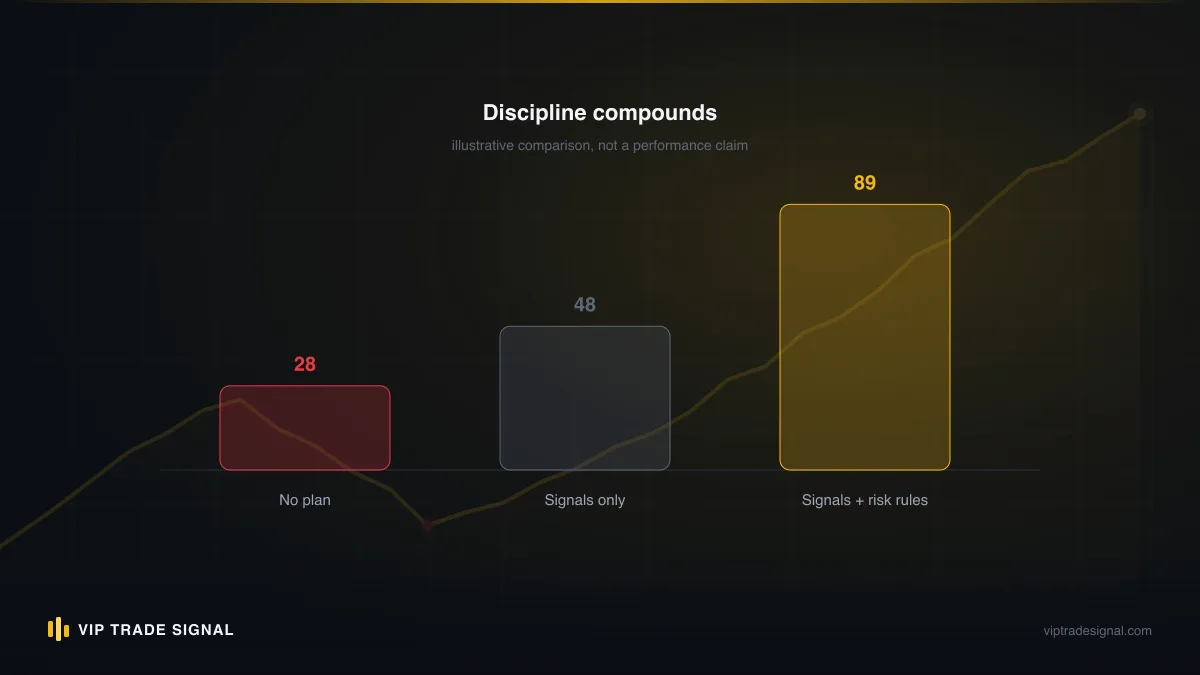
Say you're running a $600 account and risking a sensible 1% per trade — $6 of room. On gold, with a signal carrying a 300-cent stop, $6 of risk means a position so small that many brokers' minimum lot size won't even let you take it accurately. So what do small-account subscribers actually do? They oversize. They risk 5%, 8%, 10% per trade because "otherwise what's the point". And then a perfectly normal four-trade losing streak — which every strategy produces on schedule — takes a third of the account, and the subscription gets cancelled with an angry message, and the provider gets blamed for maths the subscriber broke. We've written before about why risk per trade is the dial that decides survival; on a small account, the signal fee forces that dial into the red zone before the first trade is even placed.
The uncomfortable conclusion: if you have $400 and a burning desire to trade signals, the rational move is not to find a cheaper provider. A $30/month service is still 7.5% of your capital, and cheap providers have their own problems we'll get to. The rational moves are to grow the account first, to learn while you do it, or — if a route exists — to get the signals without the flat fee at all. More on that route later, because it's the one we actually recommend to small-account traders who ask us.
And a word on the cheap-provider trap, because it's the obvious counter-move. "Fine, $99 is too much on my account — I'll find one for $25." The trouble is that $25 a month doesn't fund a desk. It funds a script, or a teenager forwarding another channel's calls with the watermark cropped, or a loss-leader whose real product is the $1,500 mentorship pitch you'll receive in week three. There are exceptions; there always are. But price-shopping signals the way you'd price-shop phone chargers selects, fairly reliably, for exactly the operators this article spends its middle third warning you about. Cheap is not the fix for small. Waiting is.
Painful advice from a company that sells subscriptions? Sure. But subscribers who are mathematically set up to fail become ex-subscribers who tell everyone signals are a scam. We'd rather have you back at $2,500 than resentful at $600.
What "VIP" really means (and what it should mean)
Somewhere along the way, "VIP" became the most devalued word in retail forex. Every Telegram channel has a free tier that posts vague charts and a "VIP" tier that posts the actual entries, and calling it VIP forex signals mostly means "the part you pay for". That's it. That's the whole trick. The free channel exists to show you screenshots of the paid one.
So let's define what the label should buy, because the gap between should and does is where your money disappears.
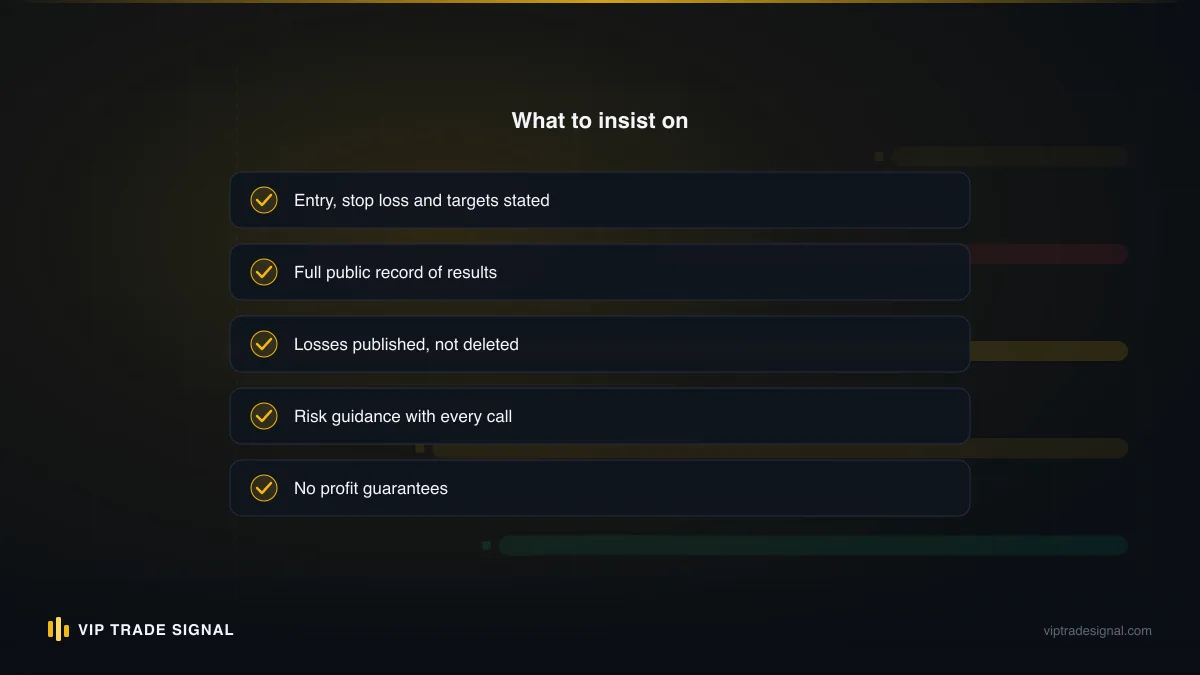
VIP should mean completeness. Every signal carries an entry, a stop loss, and at least one target, every time. A "buy gold now!!" message with no stop is not a signal; it's a liability transfer.
VIP should mean reasoning. Not an essay per trade, but enough context — the level, the timeframe, the invalidation — that you could learn something from a year of following along. If after twelve months of a paid channel you understand no more than you did on day one, you rented fish and were taught nothing about fishing.
VIP should mean accountability. A full, public, unedited record of closed trades. Wins and losses, timestamped, before the outcome was known. This is rarer than it should be, which tells you plenty.
And VIP should mean the numbers are survivable. Signals designed so that a subscriber risking 0.5–1% per trade can follow every one without praying. If the "VIP" strategy only works at 10% risk per trade, it doesn't work.
Notice what's missing from that list: win rate promises, daily pip guarantees, lifestyle photos, countdown timers on the checkout page. The louder the VIP branding, the quieter the track record, almost without exception. It's one of the most reliable inverse indicators in this industry.
What a fair price actually buys
Here's a fair question to fire back at us: if the maths is so brutal, what justifies charging anything at all — let alone $99?
A fair paid forex signal service is charging you for infrastructure, not magic. Analysts who are on the desk when London opens and still there through the New York session. Signals delivered fast enough that the entry is still valid when your phone buzzes — latency is a silent killer, and it's half the reason we're forever telling people to understand pending versus market execution before they follow anyone. Support from a human when a trade update is confusing. And the unglamorous discipline of publishing every result even in the months you'd rather not.
What separates a fair service from a hype service, line by line:
- Fair: entry, SL, TP on every trade. Hype: entries, and a stop "if needed".
- Fair: public record of all closed trades. Hype: cherry-picked screenshots of winners, posted after the fact.
- Fair: realistic tone about losses. Hype: "99% accuracy", which is not a number that exists in trading.
- Fair: a price on the website. Hype: "DM for pricing", which means the price is whatever they think you'll pay.
- Fair: one instrument or a tight set, done deeply. Hype: thirty pairs, crypto, indices, and oil, because more signals feel like more value.
That last one is a hill we'll die on. We trade XAU/USD only. Not because we couldn't post EUR/USD calls — because depth beats breadth, and a desk that lives inside one instrument's behaviour will beat a desk spraying signals across thirty. When a provider covers everything, ask yourself who on their team is actually watching each chart. The honest answer is usually an indicator script.
On our own pricing: yes, $99/month is the high end, and we say so on the pricing page rather than pretending otherwise. The trade-off we've chosen is low minimums and pay-as-you-go everywhere — no lock-ins, no annual contracts, cancel from the dashboard in two clicks. Some competitors are cheaper per month and clawier per year. Read the whole deal, not the headline number.
Payment red flags: crypto-only, lifetime deals, and the DM economy
Before quality, before track record, before anything — look at how a service asks to be paid. Payment mechanics are a confession. Providers reveal exactly what they think of their customers in the checkout flow.
Crypto-only payment. One legitimate reason exists (a provider in a jurisdiction cut off from card processing), and about nine illegitimate ones. Card processors offer chargebacks; chargebacks are a threat only to businesses that expect angry customers. A service that exclusively accepts USDT has structurally opted out of accountability. Treat it as the statement it is.
Lifetime deals. "$500 once, signals forever." Think about the incentive structure for four seconds. Once your lifetime payment clears, you are pure cost to that business for the rest of its existence — every message they send you loses them money. Lifetime deals are how a provider harvests maximum cash before quality collapses or the channel quietly dies. We have never seen one age well. Not once.
DM-for-pricing. If the price isn't printed on a public page, it's negotiable, which means it's whatever the salesperson reads in you. First message friendly, second message urgent, third message "the discount expires tonight". You are not in a sales funnel at that point; you are in a pressure funnel.
Countdown timers and fake scarcity. "Only 3 VIP slots left" on a Telegram channel with 40,000 members. Signals are digital. There is no warehouse. Scarcity theatre on an infinitely copyable product tells you the marketing budget outweighs the research budget.
Requests to fund an account they control. This one's beyond a red flag — it's the anatomy of most outright signal scams. A signal service needs your ears, never your money on deposit. Anyone blending "subscription" with "send funds to our recommended platform" (especially an unlicensed one you've never heard of) is not selling signals. They're staging a theft with extra steps.
The upsell ladder. Subtler than the others, and worth naming: you buy the $49 tier, and within a fortnight you're being told the real signals live in the $199 "inner circle", and above that sits a $999 "personal desk". Each rung is pitched exactly when you're frustrated with the one below. A provider confident in their standard product doesn't need to keep a better secret one behind it; the ladder exists because the bottom rung was never meant to satisfy anyone. Ask before subscribing: is there a tier above this one, and what's in it? A straight answer is fine. A coy one is your answer too.
None of these flags means the signals are bad, strictly speaking. It means the business is built to survive the signals being bad. Different problem. Worse problem.
Refund policies, and what they're really telling you
Refund terms are the one place a signal provider writes down, in legal-adjacent language, how confident they are in their own product. So read them the way you'd read a poker player's hands rather than his face.
A short money-back window — seven days, fourteen days — is a healthy sign. It says the provider expects a reasonable person, having seen the actual service, to stay. It also says their cash flow can survive refunds, which means they aren't spending every incoming dollar on Instagram ads.
"All sales final" on a digital subscription is legal in most places and telling in all of them. Combine it with crypto-only payment and you have a provider who has arranged, twice over, never to give money back under any circumstances. What do they know about their retention that you don't?
Then there's the strange inverse case: the too-generous guarantee. "Profitable month or full refund." Sounds consumer-friendly. It's actually a promise no honest trader can make, because no honest trader controls whether a given month is profitable — the market does. A provider offering profit-conditional refunds is either planning to argue about the definition of profitable when you claim (spoiler: they will), or churning through refund-claimers as an acceptable marketing cost while the non-claimers subsidise the operation. Either way, the guarantee is a lure, not a warranty.
One more wrinkle worth knowing: a refund policy tells you nothing if support never answers. Before subscribing anywhere, send the support inbox a boring question — a real one, about execution or timezone or lot sizing. Time the response. A service that takes five days to answer a pre-sales question, when you are at your most valuable to them, will take five weeks to process a cancellation. The pre-purchase support test costs you nothing and filters out an astonishing share of the industry.
Your first 60 days: measure like an auditor, not a fan
You've paid. The signals are arriving. Now comes the part almost nobody does: measuring the service as if you'll have to justify the renewal to a sceptical accountant. Because you should.
Rule one: track your own fills, not the provider's summary. Their record says +180 cents on the gold long; you got in 40 cents late because you were driving, and you got out early because the floating profit made you nervous. Your spreadsheet is the only one that pays your bills. Log every signal with the provider's stated entry/exit and yours, side by side. The gap between those columns is its own diagnosis — if it's big, the problem may be your execution habits rather than their analysis, which is fixable and worth knowing.
Rule two: sixty days minimum, every signal, fixed risk. Not "the ones that looked good". Cherry-picking your own follow-through destroys the sample exactly the way providers cherry-picking screenshots does. Pick a risk per trade — 0.5% is plenty while auditing — and hold it flat so results are comparable. (If you're unsure why flat risk matters so much, the piece on risk management for signal followers walks through what variable sizing does to a perfectly good signal stream. Short version: it mangles it.)
Rule three: judge process before outcome. Sixty days is honestly a small sample — around 40–60 signals for an active gold service — and a good strategy can lose over a stretch that short while a coin-flip strategy gets lucky. So alongside P&L, score the things a small sample can reveal: Did every signal carry a stop? Were updates issued when trades were adjusted, before rather than after the move? Did the published record match what you saw arrive in real time? Were losing weeks acknowledged plainly? A service can pass every process check and still have a losing month; that's a service worth another sixty days. A service that fails the process checks during a winning month is showing you its ceiling. Leave.
Rule four: audit the timestamps. Once a week, compare the provider's published record against your own log of when messages actually landed. The gap you're hunting for is signals that appear in the history after the move — entries "called" at 3,318 in a recap posted when price was already at 3,340. Real-time channels can't fake this; recap-only channels fake it constantly. If a provider publishes results but never timestamps entries before the outcome, their record is a diary, not evidence.
Write your numbers down weekly. Memory is the most generous accountant you'll ever meet, and it always rounds in the direction of hope.
One last thing about the audit period: don't tell yourself stories about scaling up "once it's proven". Decide now what a pass looks like — say, sixty days of clean process plus results inside the provider's stated drawdown range — and decide now what you'll raise risk to if it passes. Half the damage in this game comes from subscribers who audit carefully at 0.5% for two months, watch a hot streak, and jump straight to 5% the week before the cold one. The streak doesn't know you just arrived.
Exit criteria: decide when you'll quit before you start
Here's a habit borrowed from trading itself: you set the stop loss before the entry, when you're calm, because setting it during the trade means negotiating with your own hope. Do exactly the same with a subscription. Day one, before the first signal, write down the conditions under which you will cancel — and treat them as orders, not suggestions.
A reasonable exit list looks like this:
- Any signal arrives without a stop loss. One. Not a pattern — one. A provider who sends even a single naked entry has told you how they think about your downside. Cancel same day.
- The public record diverges from reality. A losing trade you personally watched close red appears in the monthly recap as a win, or vanishes. This is fraud in miniature and it never happens only once.
- Sixty days at fixed fractional risk leaves you down more than 2× the total fees paid. Signals lose sometimes; that's trading. But you set a budget for discovering whether this provider is good, and the budget has a floor.
- Risk profile drifts. Stops that were 250–350 cents in the sales material are suddenly 700. Position "adds" appear on losers. Martingale wears many disguises, and every one of them ends the same way.
- Your own behaviour is degrading. You're checking the channel at 3am, doubling size to win back a red week, feeling dread when the phone buzzes. A subscription that's costing you sleep is overpriced at any fee.
Notice what's not on the list: a normal losing streak. If you cancel every provider after four red trades you'll cycle through the entire industry, paying everyone's first month and collecting nobody's edge — the subscriber equivalent of a trader who moves his stop to breakeven the moment a trade breathes. Losing streaks within stated risk parameters are the cost of any strategy. Broken promises are not. The whole discipline is knowing which one you're looking at, and the day-one list is what stops you deciding under emotional load.
Put the list somewhere you'll see it. A note on your phone works. The act of writing it is half the protection.
The alternatives: broker-route access and just learning the thing
The honest cost-benefit article has to include the options the sales page leaves out, so here they are.
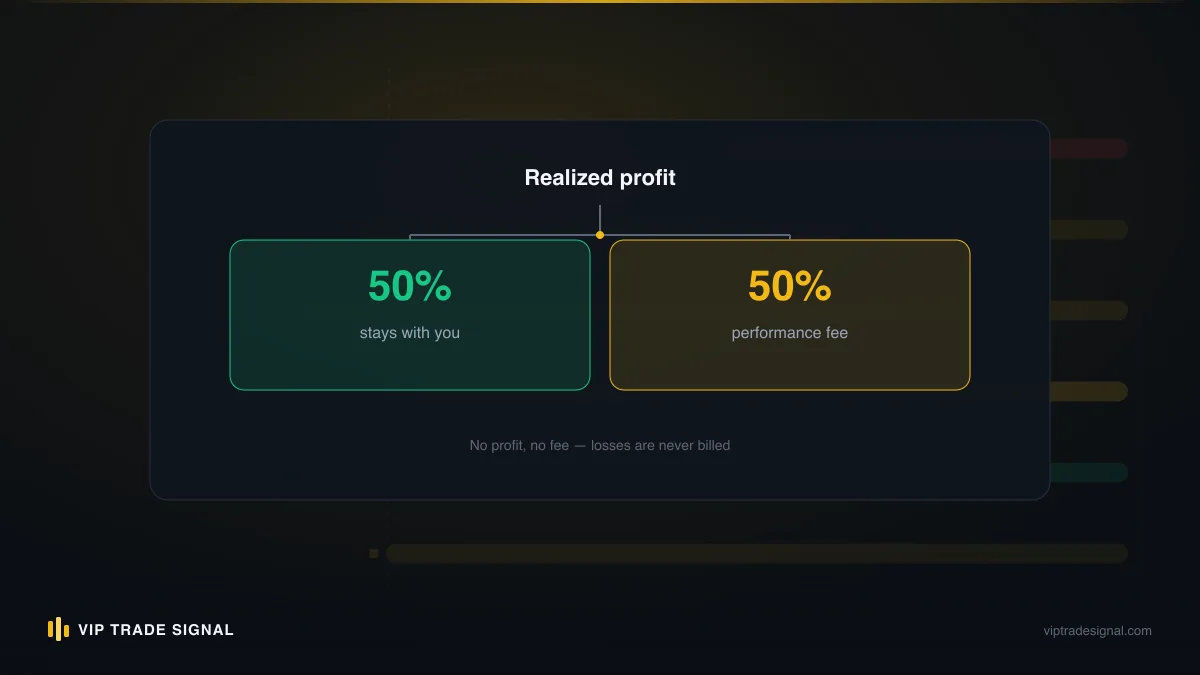
Option one: the broker route. Some services — ours included — waive the subscription entirely if you trade with a partner broker. The mechanics on our side: open an account with one of our partnered brokers (Exness, XM, IC Markets, Vantage) through the VIP-via-broker route, keep $250+ in it, and the $99 fee disappears for as long as the balance stays there. The provider gets paid a share of the spread by the broker instead of a fee by you.
Is that a free lunch? Not quite, and we'll spell out the catch ourselves: the provider now earns from your trading volume, which in the wrong hands is an incentive to over-signal. Judge any broker-route service — again, ours included — by whether signal frequency looks like analysis or looks like invoicing. But run the maths from earlier and the appeal for small accounts is obvious: at $600, the flat fee eats 16.5% of your capital monthly, while the broker route eats a slice of spread you'd mostly be paying anyway. For accounts under our recommended threshold, this isn't the consolation option. It's the correct one, and it's what we tell people directly.
Option two: pay for education instead. Six months of a $99 subscription is roughly $600. That same $600 covers a great deal of structured learning and a year of journaling software, and skills compound in a way rented signals never do. The catch is the timescale — learning to trade takes years, not a course-length weekend — and the honest admission that plenty of people don't actually want to become traders. They want exposure with a professional making the calls. That's a legitimate preference; just name it, because it changes which product fits.
Option three: neither. Genuinely. If the account is small, the income is tight, or the motive is "everything else feels slow" — paper trade the free ideas, build the account, come back when the arithmetic works. The market's deepest kindness is that it will still be here.
How our $99 compares — and exactly who it's wrong for
Time to mark our own homework, using the same rules we've applied to everyone else.
The market for gold and forex signal subscriptions runs from about $30 a month to $250+, and at $99 we sit above the middle. We think the fee is justified by things this article says matter — one instrument covered deeply, complete signals with stop and targets every time, a public record at /signals/history that includes every loss we've ever taken, humans answering support, and no contract tying you to any of it. You may weigh those differently. The pricing page lays it out and we'd genuinely rather you compare us against three competitors than subscribe on impulse; impulse subscribers churn, and churn helps nobody.
But the maths in this article doesn't bend for us, so here's the list our sales page won't fight you on. Our subscription is the wrong product if:
- Your account is under about $2,500 and you're paying the flat fee. The break-even table doesn't care whose logo is on the invoice. Under that line, take the broker route or don't come.
- You can't follow gold signals when they're issued. We trade XAU/USD through the London and New York sessions. If your timezone or job means every entry reaches you cold, you'll be trading our leftovers, and your results will not match the record.
- You need this money. Rent money, borrowed money, money whose loss changes your month — no. Trading gold on leverage is high-risk, losing months are part of any honest record including ours, and no signal quality overrides that.
- You want someone to blame. A signal service supplies decisions; you still execute, size, and hold through the drawdowns. Subscribers who arrive looking for a guaranteed outcome leave angry, every time, everywhere.
If none of those describes you — the account clears the threshold, the sessions fit your life, the risk capital is genuinely spare — then we think we're worth comparing. That's the strongest claim you'll get from us, because it's the strongest honest claim a signal service can make.
The signals can be excellent and the subscription still wrong. Quality answers whether a service is good. Only arithmetic answers whether it's good for you.
The worksheet: is a paid service rational for you?
Enough theory. Here's the whole article compressed into ten minutes with a pen. Answer in writing — vague answers are how bad subscriptions happen.
1. Fee ÷ account = ? Divide the monthly fee by your account balance. Over 4%: stop here; the answer is no, or the broker route. Under 2%: continue. In between: continue, cautiously.
2. Can you risk 0.5–1% per trade in real lot sizes? Check your broker's minimum position size against your per-trade risk budget on a typical 300-cent gold stop. If the minimum lot forces you above 2% risk, the account is too small for the signals regardless of the fee.
3. Have you seen the full record? Not screenshots — a complete, timestamped history of closed trades, losses included, published somewhere the provider can't quietly edit. No record, no subscription. This one has no exceptions.
4. Do the payment mechanics pass? Public pricing, card payment available, a written refund window, no countdown theatrics. Fail any one and you've learned something more important than any track record.
5. Did support answer your boring question? Send it before you pay. Under 24 hours with a real answer is a pass.
6. Have you written your exit criteria? The day-one list from earlier, on paper, before the first signal. If writing "I will cancel if a signal arrives without a stop" feels overly dramatic, you haven't been in this industry long. Welcome; it isn't.
7. Can you lose the fee and the risk budget without harm? Sixty days of fees plus your maximum planned drawdown, gone, and your life unchanged. If that number makes you swallow, the money isn't spare, and this whole product category isn't for you yet.
Seven honest answers. If they all pass, a paid subscription is a rational tool and you should go shopping — us, or someone better. If one fails, you've just saved the exact amount of money this article cost you: nothing.
And Sam, from the top of the page, with his $600 and his $99 invoice? Question one killed it in ten seconds. Sixteen and a half percent a month, just to break even on the fee. He took the broker route instead, kept his $600 intact, and got the same signals for the price of the spreads he was already paying. The maths was never complicated. It was just never on the sales page.