The notification lands at 14:32. Buy XAU/USD at 3,318, stop 3,309, targets 3,327 and 3,341. You open MT4 and gold is already trading at 3,323.20. Five dollars above the entry. And now you have maybe forty seconds to make a decision that will quietly decide whether this trade was worth taking at all.
This is the question of pending order vs market execution for signals, and it is the single most common thing followers get wrong. Not risk sizing. Not stop placement. Execution. Every signal you will ever receive arrives with a built-in delay: the time it took the provider to type it, the time it took to reach your phone, the time it took you to notice. Price does not wait for any of that. So on almost every signal, you face the same fork: hit buy at market and accept a worse price, or set a pending order at the quoted entry and accept the risk that price never comes back.
Most people resolve this with vibes. They chase when they're excited and set pendings when they're cautious, which is exactly backwards from how it should work, because the decision has nothing to do with your mood and everything to do with distance, structure and signal type. There is a concrete rule. It fits on a sticky note. By the end of this piece you'll have it, with actual gold numbers rather than the vague "use your judgement" that passes for guidance in most Telegram channels.
A thirty-second refresher on order types
Skip this if you've been trading a while, but get the vocabulary straight, because half the confusion around signal execution is people using "pending order" to mean three different things.
A market order is the simple one. You click buy or sell and the broker fills you at the best available price right now. Not the price on your screen when you clicked. The price available when your order reaches the server, which on a fast gold move can be meaningfully different. Market execution guarantees you're in the trade. It guarantees nothing about the price.
A limit order is a pending order that waits for price to come to you at a better level. Buy limit sits below current price; sell limit sits above it. If the signal says buy at 3,318 and price is at 3,323, a buy limit at 3,318 is you telling the broker: I'll only take this trade if gold dips back to the quoted entry. You get the price or you get nothing.
A stop order is the mirror image, waiting at a worse level. Buy stop sits above current price, sell stop below. These are for breakout entries: buy gold if it clears 3,330, because clearing 3,330 is the event that makes the trade valid. Signals that say "buy on break of" want a stop order, not a limit.
On MT4 the whole menu lives in the New Order window. Switch the type dropdown from Market Execution to Pending Order, choose buy limit, sell limit, buy stop or sell stop, set your price, set your stop loss and take profit in the same window, and optionally set an expiry. That last field matters far more than most people think, and we'll spend a whole section on it later. MT5 adds stop-limit variants, which are genuinely useful for breakout signals on gold but not essential; everything in this article works with the basic four.
That's the toolbox. The question is which tool, and when.
Pending order vs market execution for signals: the actual trade-off
Strip the jargon away and the choice is a bet on one variable: will price revisit the quoted entry before the move happens?
Take the market order and you are paying a known, immediate cost for certainty. In our opening example, buying at 3,323.20 against a quoted entry of 3,318 costs you $5.20 per ounce before the trade has done anything. That's not an abstract cost. On a signal with a 9-dollar stop and a 9-dollar first target, entering $5.20 late turns a 1:1 trade into roughly a 0.27:1 trade if you keep the original levels. You'd need to win 79% of the time just to break even on those numbers. Nobody wins 79% of the time. Not us, not anyone, whatever their pinned message claims.
Take the pending order and you are paying an uncertain, invisible cost for price. If gold retraces to 3,318, you get filled at the exact level the signal's risk-reward was built on. If it doesn't, you watch the move run to both targets without you, and the cost of the pending order was the entire profit of the trade. Missed trades don't show up on your statement. That is precisely why people underweight them: a bad fill stings visibly, a missed winner just evaporates. But over a hundred signals, systematically missing the best movers because you demanded a perfect price is every bit as expensive as systematically chasing.
Chasing costs you a little on every trade. Missing costs you everything on a few. The whole game is knowing which price you can afford to pay today.
So neither method is "right". The market-order-always crowd bleeds edge in slippage and bad entries. The limit-order-always crowd skips the strongest signals, because the strongest moves are exactly the ones that don't come back. The answer has to be conditional, and the condition is measurable.
When market execution is the correct call
Market execution is right when the cost of the worse price is small relative to the trade's risk, and the probability of a retrace is low. In practice that means three situations.
First, when you're quick. If you catch the signal within a minute or two and price sits within a dollar or so of the quoted entry, just take it. Fiddling with a pending order to save 60 cents on a trade risking $9 is precision theatre. The spread on gold at a decent broker runs $0.15 to $0.35 in normal London or New York hours anyway; sweating a sub-dollar difference while the market moves is how people miss fills by ten cents and then chase five dollars higher in frustration. We've all done it. Once is educational.
Second, on momentum signals. When a signal is built on a breakout or a news-driven push, the premise of the trade is that price is leaving. A breakout signal that retraces deeply enough to gift you the original entry has often already failed; the pullback that fills your limit order is frequently the same pullback that signals the breakout was false. On these, a slightly worse market fill is the honest price of admission. You can and should still recompute your risk, which we'll get to.
Third, when the remaining reward still clears your bar after adjustment. Say the signal targets 3,341 from 3,318 with a stop at 3,309. Price is at 3,321. Entering at market leaves you $20 of room to the final target against a $12 risk, about 1.7:1. Still a perfectly respectable trade. The quoted entry is not sacred; the ratio is. If the numbers still work from here, here is fine.
The discipline that makes market execution safe is this: when you enter late, you either keep the original stop and reduce your lot size so the dollar risk stays constant, or you keep your lot size and accept that your stop distance grew. Never neither. A trader who planned to risk 1% of a $5,000 account, $50, at 0.05 lots on a $10 stop, and then fills $4 late without adjusting, is now risking $70 on the same trade. Do that across a losing streak and your "1% risk" months quietly become 1.4% months. We wrote about this trap at length in our piece on risk per trade, and it matters twice as much for late entries.
When a pending limit order wins
Flip everything above and you get the limit order's territory: the cost of chasing is large relative to the trade, and the probability of a retrace is decent.
The classic case is a pullback signal. Gold trends in impulses and retraces; a huge fraction of good entries are "buy the dip to structure" trades, where the entry level was chosen because it's a prior breakout point, a session low, a moving average confluence, whatever the provider's method leans on. These levels attract price. That's the entire reason they were picked. When a signal quotes an entry at meaningful structure and price is hovering a few dollars above it, a buy limit at the level is not you being stubborn about price. It's you executing the actual idea of the trade, which was always "buy the retest", not "buy wherever you happen to be standing".
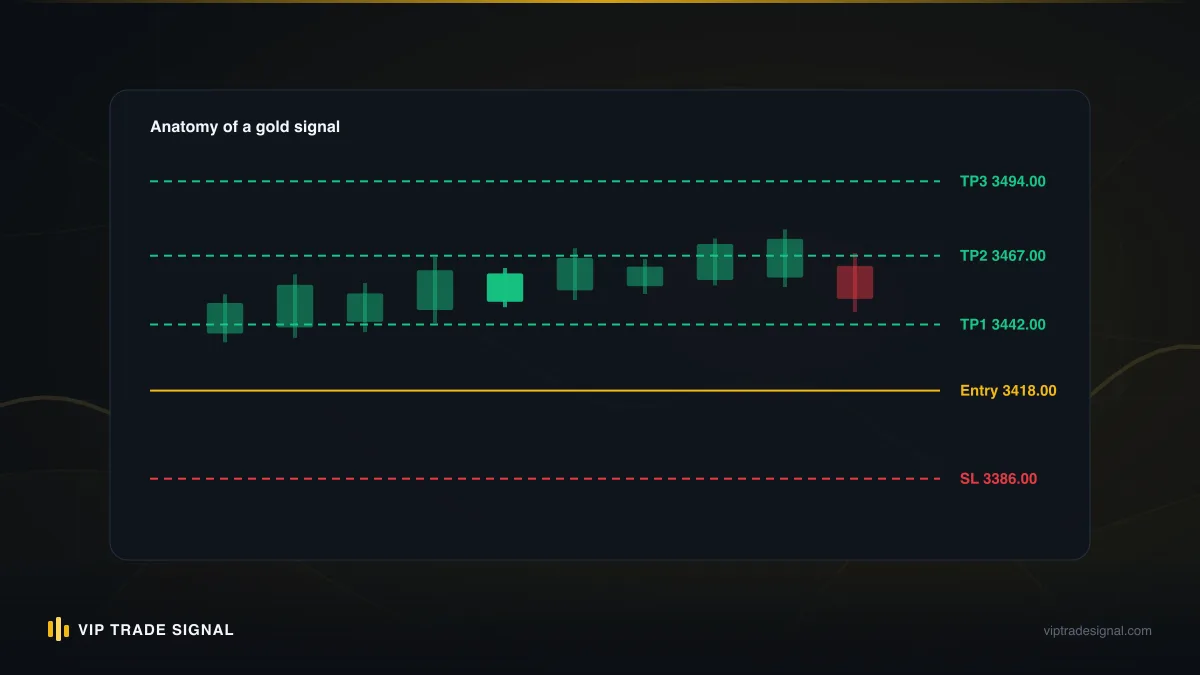
Limit orders also win on anything slow. Swing signals with 30-to-50-dollar stops and multi-day holds simply do not care about a $3 difference in entry the way a scalp does, but they give price hours or days to wander back through your level, so the fill probability on a reasonable limit is high. You get the signal at lunch, place the limit, and get filled at 2 a.m. during the Asian drift while you sleep. This is the single most underrated feature of pending orders for people copying signals around a day job: they decouple your execution from your availability. You cannot watch gold for the 14 hours a day it's worth watching. Your buy limit can.
And there's a quieter benefit. A limit order is placed calmly, once, with the stop and target typed in before there's any position on the line. Market execution on a moving chart is where fat fingers live: wrong lot size, forgotten stop loss, buy instead of sell. If you've ever typed 0.5 when you meant 0.05 with your heart rate at 110, you already know that half the value of pending orders has nothing to do with price at all.
The cost, again, is missed trades. Roughly speaking, the better the signal, the more likely price runs without retracing. You will miss winners. Placing limits only makes sense when the maths of the fills you do get outweighs the winners you skip, and that's exactly what a distance threshold sorts out.
The decision rule: distance to entry, measured against risk
Here is the rule. It needs one number you can compute in five seconds: how far price has moved past the quoted entry, expressed as a fraction of the signal's stop distance.
Call the stop distance R. A signal with entry 3,318 and stop 3,309 has R = $9. Now check where price is relative to the entry, in the adverse direction (i.e., it moved the way the trade wants to go, so you'd be entering late):
| Distance past entry | As fraction of R | What to do |
|---|---|---|
| Under $1 (or under ~10% of R) | Noise | Take it at market, keep original levels |
| ~10% to 30% of R | Grey zone | Market entry, but resize the lot so dollar risk is unchanged |
| ~30% to 60% of R | Expensive | Pending limit at the quoted entry, with expiry |
| Over 60% of R | Gone | Skip, or wait for the provider's update |
Why fractions of R rather than fixed dollar amounts? Because a $4 chase means completely different things on different trades. On a scalp with a $5 stop, $4 late is 80% of R and the trade is dead. On a swing with a $40 stop, $4 late is 10% of R and barely worth noticing. Distance only means anything relative to the risk the trade was designed around. This is the same reason proper signal risk management is always framed in R and percentages rather than raw dollars.
The 30% breakpoint isn't mystical, but it isn't arbitrary either. Enter 30% of R late with the original stop and your risk grows by 30% while your reward to each target shrinks by the same absolute amount; a trade drawn at 2:1 falls to roughly 1.3:1. Somewhere around there, most decent signals stop clearing the bar that made them worth sending. Past 60% of R, you're taking more than half again the designed risk for barely half the designed reward, and the honest description of that activity is donating.
One refinement worth adopting: in the grey zone, prefer market if the signal is momentum-flavoured, prefer a limit if the entry sits at obvious structure. The fraction of R tells you the price of each choice; the signal's logic tells you which side of the coin is weighted.
Gold-specific thresholds: dollars, not pips
Gold punishes people who think in generic forex terms, so let's put real numbers on this. Forget pips; on XAU/USD, think in dollars per ounce, because that's what your platform shows and what your P&L moves in.
Typical stop distances on gold signals cluster into three bands. Scalps run $3 to $8. Intraday trades run $8 to $18. Swings run $25 to $60, sometimes more when gold's daily range is stretched. Gold's average daily range through 2024 and 2025 has frequently sat north of $30, and on data days $50-plus ranges are routine, so these stops aren't conservative or aggressive, they're just matched to the timeframe.
Apply the fractions and you get thresholds you can actually memorise:
- Scalp signal, $5 stop. Market entry only if you're within about $0.50 of the entry. Between $0.50 and $1.50, resize and take it. Past $1.50 or so, limit or skip, and on a scalp, mostly skip: scalps are about immediacy, and a limit that fills twenty minutes later is filling into a different market than the one the signal read.
- Intraday signal, $12 stop. Within about $1.20, take it clean. Up to $3.50 or so, market with a resized lot. From roughly $3.50 to $7, place a buy or sell limit at the quoted entry. Beyond $7, let it go.
- Swing signal, $40 stop. Anything within $4 is effectively on time. Up to $12 late, resize and enter. From $12 to $24, a limit order is comfortable, and with a multi-day hold the odds of a fill are genuinely good. Past $24, skip or ask.
Notice what this framework kills: the universal habit of judging lateness by how the chart looks. A $6 move on gold looks dramatic on the M5 and invisible on the H4. The chart's zoom level is not information. R is.
One more gold-specific wrinkle: session matters. A limit order placed during the London/New York overlap is fishing in fast water; retraces happen, but so do clean runaway moves. The same limit resting through the Asian session has hours of slow, mean-reverting drift working for it. If a swing signal arrives late in New York and you're 40% of R away from entry, the pending order is even more attractive than the table suggests, because the Asian session ahead of you is the retrace-friendliest stretch of the day.
Entry zones: laddering pendings across the zone
Better signal providers, ours included, often quote an entry zone rather than a single price: "buy 3,314–3,320" instead of "buy 3,318". This isn't indecision. It's an honest admission that a level is a region, not a line, and it changes your execution options in a useful way.
The naive reading of a zone is "enter anywhere in here". That's fine. The stronger reading is that a zone invites you to ladder: split your intended position into two or three pending limit orders across the zone, so that you average into the level rather than betting your whole fill on one price.
Say the signal is buy 3,314–3,320, stop 3,306, and your planned risk is $60 on a $6,000 account. Instead of one order at 3,317 for the full size, you might place:
- One third at 3,319, near the top of the zone, likely to fill on a shallow dip.
- One third at 3,316, mid-zone.
- One third at 3,314, at the bottom, filling only on the deepest probe.
Size each rung so the total risk if all three fill and stop out equals your planned $60. The arithmetic takes an extra minute because each rung has a different stop distance, but the behaviour you buy is lovely: a shallow retrace gets you a partial position rather than nothing, a deep retrace gets you a better average price than any single sensible order would have, and the all-too-common scenario where price pokes the top of the zone and leaves no longer means you watched the whole move flat.
The cost is that your best-case fills are partial. When gold barely touches 3,319.80 and rockets $25, you'll have a third of a position and a full-sized sense of grievance. Accept it in advance. Laddering trades away the top of your best outcomes to cut off the worst of your missed ones, and across a long run of signals that is almost always a trade worth making, particularly on swings.
Two practical notes for MT4. Each rung is just a separate pending order, so your platform will show three tickets; that's normal, manage them as one trade in your head and your journal. And if the provider updates the signal ("entry zone invalid, cancel"), you have three orders to delete, not one. Delete all of them. A forgotten orphan limit order is a random trade waiting to happen at the worst possible moment, usually during news, three days later, while you're at dinner.
Expiry times: when an unfilled pending should die
A pending order without an expiry is a trade idea with no sell-by date, and trade ideas rot fast. The level that made 3,318 a good buy on Tuesday afternoon is not still a good buy on Thursday after two CPI-adjacent sessions have rewritten the structure around it. Yet MT4's default expiry is none, and most followers never touch the field.
Set one. Every time. The right expiry follows the signal's timeframe, and a sane starting policy looks like this:
- Scalps: 30 to 90 minutes. A scalp is a read on the market's next hour. If the retrace hasn't come within that window, the read is stale, whatever eventually happens at the level.
- Intraday signals: end of the current session, or 4 to 8 hours. An intraday idea generally shouldn't survive into a session with entirely different participants. A New York afternoon entry has no business filling in the following Asian morning without a fresh look.
- Swings: 24 to 48 hours, and then reassess rather than blindly extend. Swing structure can absolutely stay valid for days, but "still valid" is a decision to re-make deliberately, not a default to drift into.
The failure mode expiries prevent is nastier than it sounds. Price runs without you, hits both targets, and the trade is over, celebrated, closed in everyone else's account. Then two days later price collapses back through your still-live limit order, filling you into a "buy the dip" whose dip is actually the start of a $60 slide, with a stop loss placed for a market that no longer exists. You've managed to take the signal's entry after its entire thesis has played out and died. The order filled; the trade it belonged to was long gone. Every experienced signal follower has one of these scars. The expiry field is the vaccine, and it costs two clicks.
If your provider sends explicit invalidation updates ("cancel pendings on the 3,318 buy"), honour them within the hour, and keep the expiry anyway as a backstop for the updates you'll inevitably miss. Belt and braces. On our desk the rule is blunt: no pending order goes in without an expiry, ever, and any follower of our gold signals who adopts that single habit will dodge at least one ugly, avoidable loss a quarter.
Measuring the real cost: slippage and spread on each method
Let's put numbers on the frictions, because "slippage and spread when copying signals" is where the theoretical edge of a good provider quietly leaks out of a follower's account, and the leak is different for each execution method.
Spread hits both methods, but not equally. On a market order you pay the spread at whatever moment you click, and moments of excitement are moments of wide spreads. Gold at a reasonable broker runs $0.15–$0.35 in liquid hours, but stretches to $0.60, $1.00, sometimes several dollars in the seconds around tier-one news, at the daily rollover around 5 p.m. New York, and through thin Asian patches. A limit order, by contrast, fills when price comes to your level, which is more often a calm moment than a frantic one, and a buy limit fills when the ask touches your price, so you have at least chosen the level you pay it at.
Slippage is where market execution really pays its toll. Click buy while gold is travelling and the fill comes back 20, 50, sometimes 150 cents worse than the quote you clicked on; during genuine news spikes, multi-dollar slippage on gold market orders is not rare, it's Tuesday. Pending limit orders, on most brokers, fill at your price or better, never worse. Pending stop orders slip just like market orders do, since they become market orders when triggered, which is worth remembering on breakout signals.
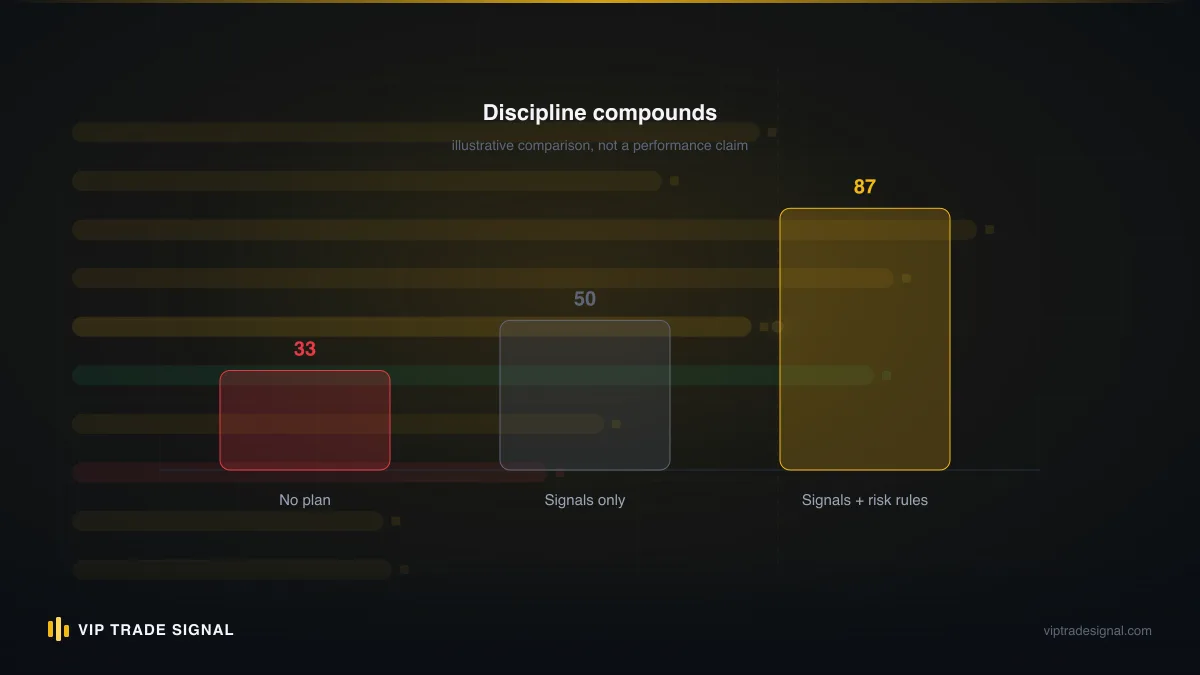
Add it up on a concrete trade. Intraday signal, $12 stop, price $3 past entry when you see it. Route one: market order, you pay $3.00 of adverse entry, ~$0.30 of spread, maybe $0.30 of slippage, total $3.60 against a $12 risk. That's 30% of R burned on execution. Route two: buy limit at entry, cost if filled is ~$0.30 of spread and nothing else, but suppose the limit only fills on 60% of such signals. Your visible cost is near zero; your invisible cost is 40% of the winners this setup produces.
Which route wins depends entirely on how often the retrace comes, and that's exactly what the distance rule is estimating: near the entry, retrace odds are high and chasing costs little, so either works; far from it, chasing costs a fortune and the limit's miss rate is the lesser evil. The frictions don't change the decision rule. They're the reason it exists.
While we're here: this arithmetic is also most of the answer to why your results never quite match any provider's published numbers, ours included. Two followers of the same signal, one chasing and one laddering limits, can finish the same month several percent apart with identical signals. We unpacked that whole gap in why your results differ from the signal provider's, and execution method is the biggest lever in it that's actually under your control.
Scalp vs swing: signal style changes the answer
Everything so far treats the signal as a generic object with an entry, stop and target. Real signals have personalities, and the pending-versus-market answer bends with them.
Scalps are market-order creatures. A gold scalp with a $4 stop is a claim about the next twenty minutes. Its edge decays by the minute, and its tolerances are tiny: at a $4 stop, the 10%-of-R "noise" band is 40 cents wide. If you're inside that, click. If you're outside it, the honest options are a very short-lived limit or a pass, and a pass is usually right, because a scalp that needs to retrace before going is a scalp whose window is closing. Chasing a scalp $2 late, half its stop distance, is the single most reliable way to turn a profitable scalping stream into a losing one while feeling like you took every trade.
Swings are limit-order creatures. A $40-stop swing built on daily structure has hours of tolerance and days of runway. Its entry level usually is structure, so retraces to it are common; its R is large, so moderate lateness barely dents the maths; and its hold time means an overnight fill is a feature rather than a compromise. Default to pending limits on swings, ladder them when a zone is given, and let the Asian session do your entries for you.
Intraday signals sit in between, which is why they're where the distance rule earns its keep. Within a dollar or so, market. A few dollars out, resize or place a limit depending on whether the setup is a pullback or a break. Most of your genuinely close calls will live here, and the fraction-of-R table settles them without drama.
Breakout signals are their own animal regardless of timeframe. "Buy above 3,330" wants a buy stop at 3,331-ish, placed in advance, not a market order after you notice it's broken and certainly not a buy limit hoping for a retest the signal never asked for. If the provider explicitly says "buy the retest of 3,330", that's a limit trade. The words in the signal describe a mechanism; your order type should be that mechanism translated into MT4. When the two disagree, you're not following the signal any more, you're improvising near it.
What we do with our own signals
A short, concrete section, because it would be odd to write two thousand words of theory and hide our own practice. VIP Trade Signal sends gold only, which makes execution guidance easier: one instrument, one spread profile, one set of dollar thresholds, no mental conversion between a 1.2-pip EUR/USD chase and a $6 gold one.
Our signals state a single entry or an entry zone, a hard stop, and two targets, and each one is labelled by type: scalp, intraday or swing. The execution guidance we attach comes straight from the logic above. Scalps: market within $0.50, otherwise stand down; we would genuinely rather you miss one than chase one. Intraday: market within roughly 10% of the stated stop distance, pending limit beyond that, expiry at session end. Swings: pending limits by default, laddered across the zone when one is given, 48-hour expiry, reassess on our updates. When an entry invalidates, we say so in the channel, and the trade's final outcome lands in the public history either way, wins and losses both, because a results page that only exists when it flatters is marketing, not a record.
Do our followers all end up with identical fills? No, and anyone who promises that is lying to you. A signal is a plan; execution is yours; slippage, spread and timing guarantee dispersion around whatever the ideal outcome was, and in a bad week that dispersion is the difference between a small win and a small loss. Gold is a fast, occasionally violent market and money you cannot afford to lose has no business in it. What good execution rules do is shrink the dispersion and stop it being systematically tilted against you. That's the honest ceiling of what any of this can promise, and it's plenty. The rest of the practical platform questions, minimum deposits, which brokers, how the free-access route works, live on the FAQ.
Choosing in five seconds: the flowchart
Under pressure, nobody consults a table. So compress the whole article into the sequence you actually run when the notification lands and gold is already moving.
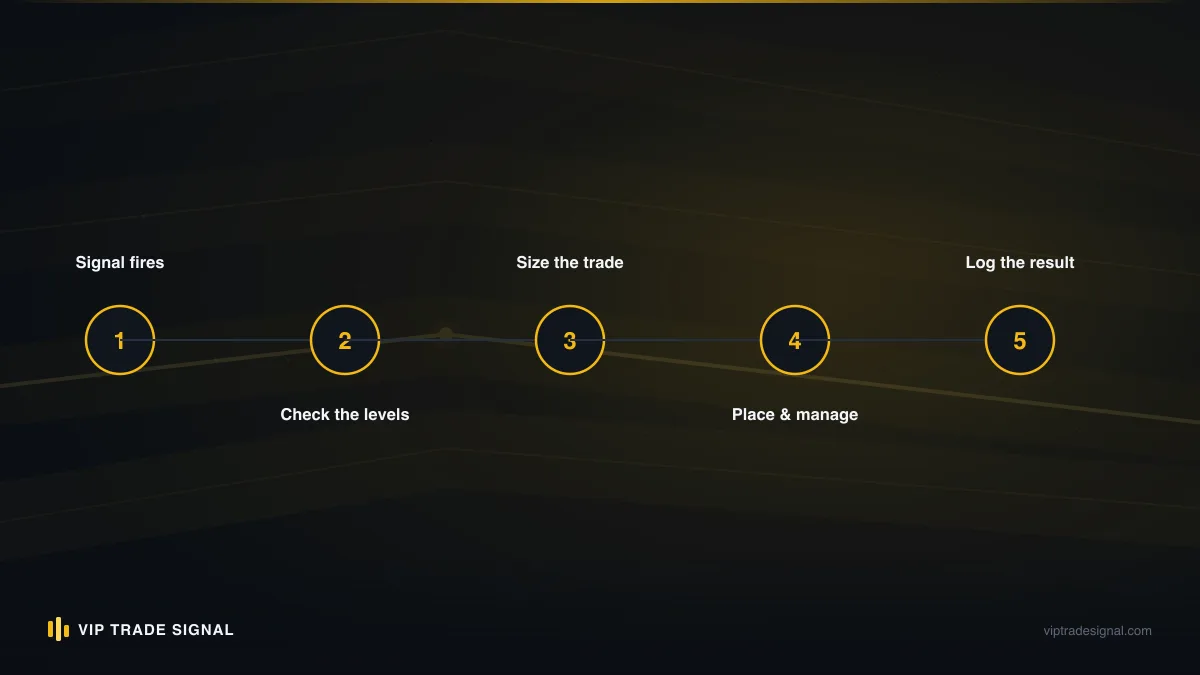
- What type is the signal? Breakout wording means a stop order at the trigger, done, stop reading here. Otherwise continue.
- What's R? Entry minus stop, in dollars. A $9 stop means R = 9. This takes three seconds and anchors everything.
- How far past entry is price, as a fraction of R? Under ~10%: market order, original levels, go. 10–30%: market order, but resize the lot so the dollar risk matches your plan. 30–60%: pending limit at the quoted entry. Past 60%: no trade, wait for an update.
- If it's a limit, set the expiry before anything else. Scalp: an hour. Intraday: session end. Swing: 48 hours. No exceptions, including the times you feel sure.
- If a zone was given and it's a swing, ladder it. Two or three rungs, total risk equal to your planned risk, top rung near the zone's top.
Run that sequence twenty times and it stops being a checklist and becomes reflex, which is the point. The traders who bleed on execution aren't the ones who lack a rule. They're the ones who have a mood instead.
Where this leaves you
The uncomfortable truth underneath all of this: execution is the part of signal following that belongs entirely to you. You can outsource the analysis, the levels, the timing of the idea. You cannot outsource the forty seconds between notification and order, and those forty seconds, compounded over a year of signals, are worth more than most people's entire strategy tweaking.
So here's the short version to tape next to your screen. Distance past entry, divided by stop distance. Under a tenth, take it. Under a third, take it smaller. Under two thirds, set a limit with an expiry. Past that, it was never your trade. Breakouts get stop orders, zones get ladders, and no pending order lives without a sell-by date.
And one final opinion, since you've read this far. The next time you miss a winner because your limit sat 30 cents shy of the low, you will be furious, and you will be tempted to conclude that pendings don't work and chasing is fine. Log the trade, note the miss, and change nothing. One vivid miss is an anecdote. The rule is built for the hundred signals after it, and over a hundred signals the boring, resized, expiry-stamped version of you beats the version with the fast trigger finger by a margin that would embarrass him. Every closed trade in our history page was executed by someone facing exactly the fork this article is about. Get the fork right, and you've fixed the biggest leak in the whole pipeline before you've changed a single thing about what you trade.