The phone buzzes at 14:32. Gold sell, entry 3,341, stop 3,349, two targets below. You're in a supermarket queue, or a meeting, or half-asleep, and you have maybe ninety seconds before the price moves on without you. What you do in those ninety seconds, and more importantly what you decided before those ninety seconds, is the whole difference between people who make money following signals and people who churn through providers blaming each one in turn.
Most articles about how to use forex signals stop at "copy the entry, stop and take-profit into your platform". That's not a workflow. That's a transcription job, and transcription jobs get automated or done badly. The traders we've watched succeed with signals over the years treat every alert the same way a desk trader treats a broker's idea: interesting, thanks, now let me check it against my own risk rules before a single dollar moves.
So this is the operational piece. Not why signals work or don't, not which provider to pick, but the actual sequence of things you do, in order, every single time, from the notification landing to the journal entry that closes the loop. Eight steps. Boring by design. Boring is what compounds.
The mindset shift: you are the risk manager
Here's the frame that changes everything: the signal provider proposes, you dispose.
A provider (any provider, including us) can tell you where they think price is going, where the trade is wrong, and where to take profit. What they cannot know is your account size, your open exposure, your broker's spread at that moment, whether you already took two losses this morning, or whether you're about to board a flight. Those five things decide whether this particular trade belongs in your account, and only one person has that information.
This is not a small philosophical point. It's the reason two subscribers to the identical service can finish the same quarter with completely different results. Sam takes every signal at a fixed 1% risk, skips the ones that arrive while he's asleep, and logs everything. His mate takes the same signals at whatever lot size feels right that day, chases the ones he misses, and doubles up after losses to "get back to flat". Same signals. One account grows in a jagged line; the other one dies in about seven weeks. We've seen that exact film often enough to recite the dialogue.
The provider's job is signal quality: a sensible entry, a stop that's placed for a reason, targets that respect structure. Your job is everything else. Sizing, timing, execution quality, and the discipline to skip. If you take nothing else from this article, take the job description. You are not a passenger who occasionally taps the screen. You're the risk manager of a very small fund, and the signal feed is your analyst.
And like any risk manager, your best tool is a process you run identically whether you're confident, scared, bored or on a losing streak. That's what the eight steps are for.
First, actually getting the signals to you
Quick practical detour, because "how to get forex signals" reliably matters more than people think: a great signal you see forty minutes late is a bad signal.
Delivery usually happens over Telegram, a private app, email, or some combination. Whatever the channel, do three things on day one:
- Turn on priority notifications for that channel and nothing else in it. If your signal channel also posts memes and market chatter, mute the chatter or move signals to a dedicated channel. Alert fatigue is real; the fifth buzz of the hour gets ignored, and it'll be the one that mattered.
- Test the latency. Send yourself a message and see how long until your phone shows it. Wi-Fi calling, battery savers and "focus" modes routinely delay Telegram pushes by minutes. On some Android setups you have to exempt the app from battery optimisation or you'll get alerts in batches, twenty minutes stale.
- Know the provider's cadence and hours. A gold-only desk mostly fires during London and New York. If you're in a timezone where those sessions overlap with your sleep, decide now what happens to signals you'll miss, because you will miss them, and the worst time to make that policy is at 3 a.m. squinting at a chart. (We come back to missed entries properly later on.)
If you're still choosing a provider, the short version of our advice is: demand a public, complete history with losses included (ours lives at /signals, and the closed record shows every red trade next to every green one), and treat anything screenshot-based as marketing. The longer version is its own article on what you're actually buying with paid signals.
Right. Delivery sorted. Here's the machine.
The eight-step workflow at a glance
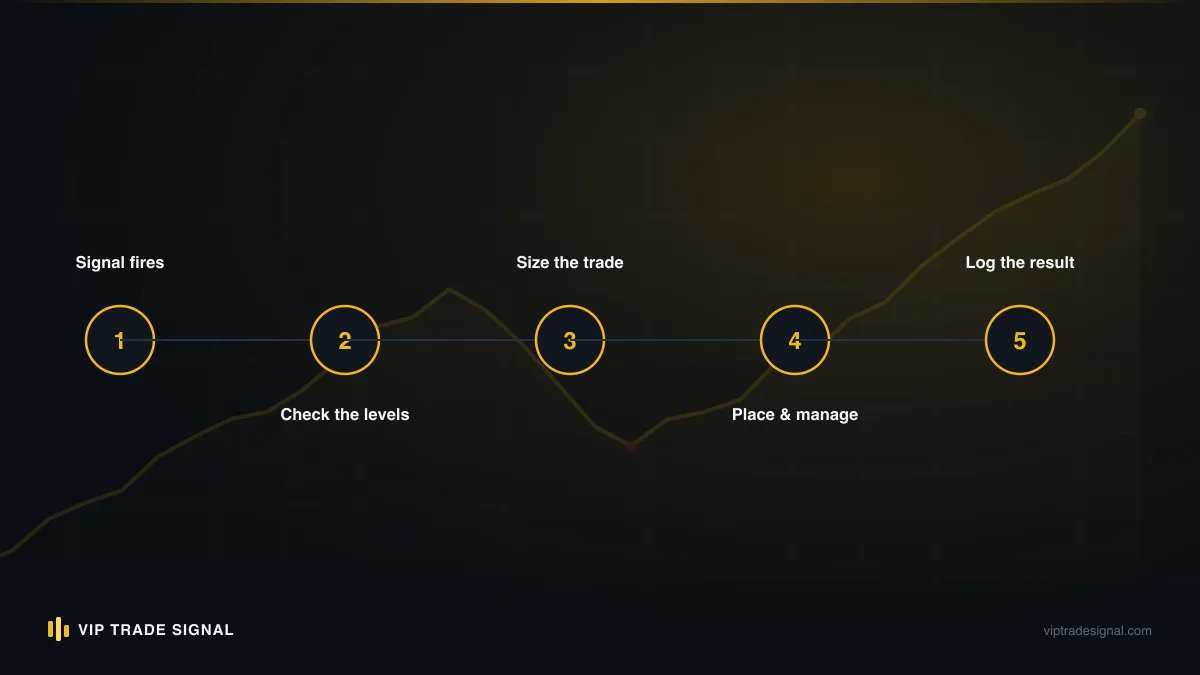
| Step | What happens | Time it takes |
|---|---|---|
| 1. Receive | Notification lands; you see it fast | Seconds |
| 2. Validate | Is it complete, current, and within your rules? | 30 seconds |
| 3. Size | Calculate lot size from your risk, not a default | 30–60 seconds |
| 4. Check conditions | Spread, session, red-flag news in the next hour | 30 seconds |
| 5. Place | Enter the order with stop and targets attached | 60 seconds |
| 6. Manage | Follow provider updates; partials, breakeven | Ongoing, minutes total |
| 7. Close & record | Trade ends; journal entry within the hour | 3 minutes |
| 8. Review | Weekly: your results vs the provider's | 30 minutes, once |
Total active effort per trade: under five minutes. The whole point is that none of those five minutes involves a decision you haven't already made in advance. Steps 1 through 5 happen before entry and are where nearly all subscriber damage occurs, so that's where we'll spend most of our words.
Steps 1 and 2: receive and validate the signal
Receiving we've covered: fast, reliable, one channel. Validation is the step almost everyone skips, and it's a thirty-second habit that filters out the majority of avoidable losers.
A complete signal has, at minimum: instrument, direction, entry (a price or a zone), a stop loss, and at least one take-profit. For gold that might read: XAUUSD sell 3,341, SL 3,349, TP1 3,332, TP2 3,320. If any of those is missing, especially the stop, the signal is not tradeable. Full stop. A "buy gold now, targets coming" message is not a signal; it's a liability with a timestamp. Providers who habitually send stops "later" are telling you how they think about risk, and you should believe them.
Then three quick checks:
- Is it still current? Look at the timestamp and the live price. If the entry was 3,341 and gold now trades 3,336, five dollars of the move has happened without you. The risk-to-reward the provider designed no longer exists at your fill. We'll give you a precise rule for this in the missed-entries section, but the validation habit is simply: check. Never assume the price on the alert is the price on your screen.
- Is it within your own rules? If your personal cap is two concurrent positions and you already hold two, this signal is a skip regardless of how good it looks. If it's the same instrument and direction as something you already hold (very possible with a single-instrument service), recognise that taking it doubles your exposure to one idea, and either halve the size or pass.
- Does anything about it look wrong? A stop 80 dollars from entry on gold, when the provider's normal stop is 8, is probably a typo. Message them, don't guess. Fat-fingered signals happen; the subscribers who get hurt are the ones who execute them faithfully.
Thirty seconds. That's the whole tax. And notice that steps 1–2 can end in "no trade", which is a completely successful outcome of the workflow. The follower who takes 80% of signals with discipline generally beats the follower who takes 100% of them raggedly, because the skipped 20% cluster around exactly the situations (stale entries, over-exposure, broken signals) that produce the ugliest fills.
Step 3: how to use forex signals without blowing up — size first
Position sizing for signal trades is the step that decides whether you're running a strategy or spinning a wheel, so we're going to be painfully concrete about it.
The rule: risk a fixed, small percentage of your account per trade, and derive the lot size from the stop distance. Not the other way round. Never a fixed lot size regardless of stop, and never a number chosen by feel.
The arithmetic, using gold because that's what our desk trades:
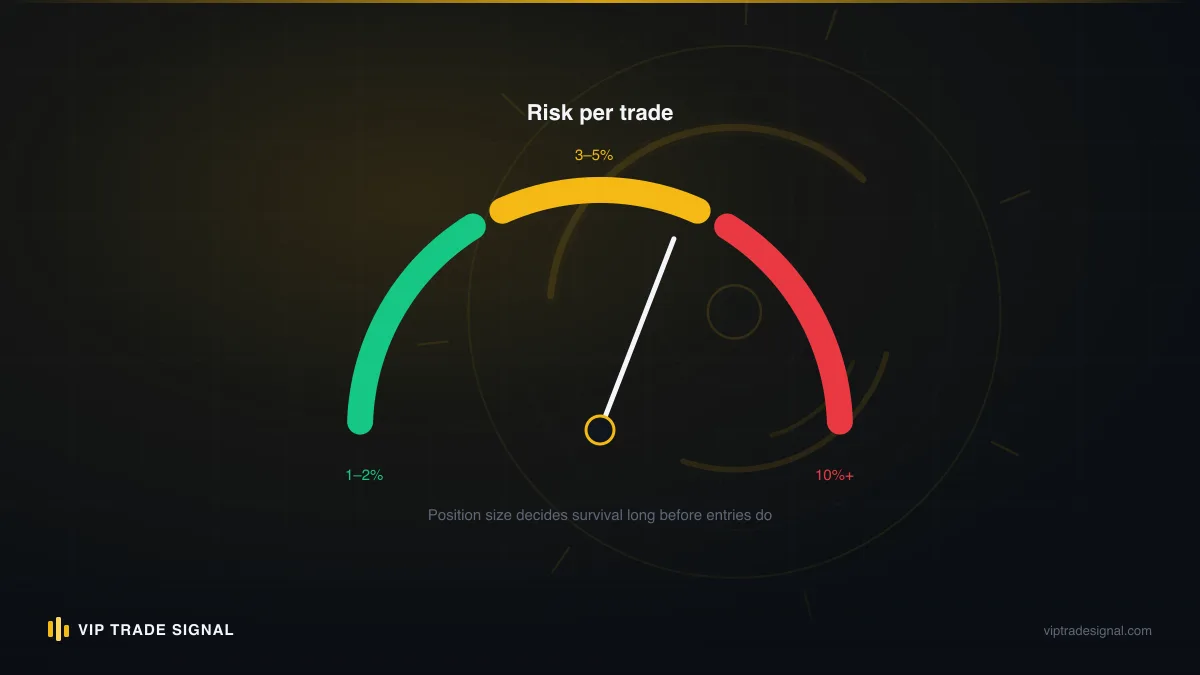
- Say your account is $2,000 and you risk 1% per trade. That's $20 of room. Not $20 of margin; $20 of loss if the stop is hit.
- The signal is sell 3,341, stop 3,349. Stop distance: $8, which is 80 pips the way most gold feeds quote it (one pip = $0.10 of price).
- On XAUUSD, a standard 1.00 lot produces about $100 of P&L per $1 of price movement. So an $8 stop on 1.00 lots would lose $800. Far too big.
- Your size = $20 risk ÷ $800 per-lot risk = 0.02 lots. Maybe 0.03 if your broker rounds and you accept $24 at risk.
That's it. Two lines of arithmetic that most losing subscribers have never once performed. Run the same calculation when the stop is $15 away and your size drops to 0.01; when it's $4 away, 0.05. The dollar risk stays constant while the lot size breathes with the stop. That constancy is what lets a normal losing streak (and five or six losers in a row is normal, not a scandal) cost you 5–6% instead of half the account.
A few second-order rules worth adopting:
- 1% is the sensible default; 2% is the ceiling for small accounts; 0.5% while you're evaluating a new provider. Your first month with any service is an audit, not a campaign.
- If the calculated size rounds below your broker's minimum lot (usually 0.01), the honest answer is that your account is too small for that particular stop distance, and the trade is a skip. Taking 0.01 anyway when the maths says 0.004 means you're risking 2.5x your plan and pretending otherwise.
- Multiple take-profits don't change the risk maths. If you split a 0.02 position across TP1 and TP2, size the total at your 1%, not each leg.
- Pre-build a lookup table. Ten minutes in a spreadsheet: stop distances from $2 to $20 down the side, your account's lot size for each. Now step 3 takes five seconds under pressure instead of sixty seconds of shaky mental arithmetic. Update it monthly as the balance changes.
We've written a full piece on risk management for signal followers that goes deeper into streak maths, drawdown caps, and when to cut a provider. But if you only ever adopt one step, adopt this one. Sizing errors aren't a category of mistake. They're the mistake; everything else is rounding.
Step 4: check spread, session and news
The order's sized. Before it goes in, thirty seconds of conditions-checking, because the same signal can be fine at 14:32 London time and horrible at 23:32.
Spread. Gold's spread on a decent account runs somewhere around 15–35 cents in liquid hours, ballooning to a dollar or more in the dead zone after New York closes and around big releases. Spread is a direct tax on the signal's geometry: if the take-profit is $6 away and the spread is $1, you've silently handed back a sixth of the reward before the trade starts, and your stop is effectively closer than the provider's. House rule worth stealing: if the current spread is more than about 10% of the stop distance, don't take the trade at market. Either use a limit order or let it go.
Session. Know what time it is in the market's terms, not yours. The Asian session's thin liquidity means worse fills and more spiky, meaningless movement; the London/New York overlap is where gold does its real business. A signal fired into the overlap and executed by you three hours later isn't the same trade. This overlaps with staleness from step 2, but it's a distinct check. Even a fresh signal deserves a second look if it arrives in a graveyard hour, and a provider who routinely fires into thin markets deserves questions.
News. Pull up any economic calendar and look one hour ahead. If CPI, non-farm payrolls or an FOMC decision lands in that window, understand what you're signing up for: gold can travel several dollars in a second on those prints, spreads gap, and stops fill wherever liquidity happens to be, sometimes well past the level you set. Some providers trade news deliberately and say so. If yours doesn't say so, a signal sitting right in front of NFP is a coin toss wearing a strategy's clothes. Skipping it costs you nothing but the fear of missing out, and that particular fear is the most expensive emotion in retail trading.
None of this requires expertise. It's a glance at the spread, a glance at the clock, a glance at the calendar. Three glances, and you've dodged the three most common execution ambushes.
Step 5: place the order correctly on MT4
Now, and only now, the platform. Here's how to execute a signal on MT4 (MT5 is near-identical) without the classic self-inflicted wounds.
If price is at or very near the signal entry, use a market order:
- Open the order window (F9, or right-click the chart, then Trading, then New Order).
- Symbol: XAUUSD. Volume: the lot size from step 3. Type it; don't trust whatever default is sitting there. The platform remembers your last volume, and "accidentally re-used yesterday's 0.50" is a genuinely common way people lose a month's gains in an afternoon.
- Fill in Stop Loss and Take Profit in the same window, before clicking Sell or Buy. Not after. Not "once I'm in". A disconnect, a phone call, or a fast market between entering naked and adding the stop is a small gap through which very large losses climb. There is no version of this trade that exists legitimately without its stop attached.
- Click the correct direction. Slowly. Sell means sell.
If price has moved away, or the signal gives a zone ("sell 3,341–3,344"), use a pending order: a sell limit at the zone in that example, with the stop and target set in the same ticket. The order then waits at the provider's price instead of you chasing a worse one. The market-versus-pending decision has enough nuance that we've given it its own article; the one-line summary is that pending orders buy you precision at the cost of sometimes missing the trade, and for signals with tight, deliberate entries that trade-off is usually worth taking. Set an expiry on pendings, though. A forgotten sell limit from Tuesday triggering into Friday's news is nobody's strategy.
For split take-profits, the clean method on MT4 is two orders: if your size is 0.02 with two targets, place two 0.01 positions, identical entry and stop, one at each TP. Everything then runs unattended, which matters more than it sounds. The version of you that manually closes half "around TP1" is the version that's asleep, in a meeting, or feeling greedy when the level trades.
Then screenshot the ticket or jot the order number. Ten seconds now saves an argument with your own memory during step 7.
Step 6: manage the trade like a professional passenger
Order's in, stop's attached. The live-trade phase is where good execution goes quiet, and where anxious execution starts to freelance.
Your default posture: do nothing that isn't a provider update or a pre-agreed rule. The trade was designed as a package of entry, stop and targets. Every improvised intervention breaks the package, and the interventions people actually make are almost uniformly value-destroying: widening the stop to "give it room" (translation: converting a planned $20 loss into an unplanned $60 one), closing early at +$3 on a trade targeting +$12 because green felt nice, adding to a loser because the entry is "even better now".
What legitimate management looks like:
- Act on provider updates promptly. A decent desk will send "move stop to breakeven" or "close half here" messages. Execute them within a couple of minutes when you can. If you routinely can't, because of your job or timezone, then favour the mechanical split-TP setup from step 5, which self-manages, over trying to hand-fly updates you'll always see late.
- Breakeven, handled honestly. When the provider says breakeven, set the stop at entry plus the spread (for a sell, entry minus a few cents; for a buy, plus a few), so a touch of the level doesn't stop you into a tiny loss and a large annoyance. And if no update comes, resist inventing your own breakeven the moment the trade goes green. Trades need room to breathe on the way to working; the stop was placed where the idea is wrong, not where your comfort ends.
- Partial profits, if they're your policy, are a policy. "Close 50% at 1R" is a fine standing rule. Deciding it live, per trade, based on mood: that's not a rule, that's a leak.
- One genuine emergency override exists. If something has structurally changed (a surprise central-bank headline, your broker showing prices a dollar off everyone else's), you're allowed to flatten and ask questions afterwards. That card gets played a few times a year, not a few times a week. If you find yourself reaching for it every second trade, the problem isn't the market.
Mostly, step 6 is a discipline of absence. The trade either hits the stop you sized for in step 3, a normal and budgeted event, or it works. Both outcomes were purchased in advance. Your job is not to renegotiate the price mid-delivery.
Step 7: close and record the outcome
The trade ends. Stop, target, or provider close: however it ends, within the hour it goes in the journal, because a signal service you don't measure is a subscription you're taking on faith, and faith is not a risk-management tool.
The entry takes three minutes. Fields worth having, whether in a spreadsheet or a notebook:
- Date/time of the signal, and time of your entry (the gap between them is data)
- Instrument, direction, provider's stated entry/SL/TP
- Your actual fill, actual stop, actual size, and the risk in dollars and %
- Outcome in R, meaning profit or loss divided by the amount you risked, so a $40 win on $20 risked is +2R
- The provider's stated result for the same signal
- One honest line of notes: "entered 90 seconds late, fill $0.60 worse", "skipped, spread", "moved stop early like an idiot, again"
The R column is the one that matters. Dollar results mix up your sizing with the provider's quality; R separates them. A month of signals at +6R with your 1% sizing is +6% and tells you the process works at any account size. And the gap between your R and the provider's R on the same trades is the purest measure of your execution that exists. It feels like homework. It is homework. It's also the only reason step 8 is possible, and step 8 is where the actual money decisions get made.
One habit to bolt on: log the skips too, with the reason. "Skipped, asleep" ten times a month is a delivery problem with a fix. "Skipped, felt nervous" ten times a month is a you problem with a different fix. You can't tell those apart without the record.
Step 8: the weekly review — your results vs the provider's
Once a week, thirty minutes, same day each week so it actually happens. Pour the coffee, open the journal, and answer three questions.
Question one: how did the provider actually do? Sum their results in R across the week's signals. All of them, including the ones you skipped. Compare against their published record; with us that means the closed-trade history at /signals/history, which exists precisely so subscribers can run this audit without trusting our word for anything. Weekly results will swing. Losing weeks are part of any honest service, and one bad week means nothing. What you're watching for over months is whether the published record and your received record match, and whether the long-run expectancy is positive after your costs.
Question two: how did you do relative to them? This is the comparison nobody runs and everybody should. If the provider logged +5R this week and your journal shows +2R on the same signals, you have a 3R execution leak, and the journal notes will tell you where it's dripping: late entries costing half a dollar of slippage each, one improvised early close, one signal taken at double size that happened to lose. Execution leaks are wonderful news, in a way. They're the only part of the whole system entirely inside your control, and plugging one is worth more than finding a slightly better provider.
Question three: what's the one adjustment for next week? One. Not five. "Place pendings instead of chasing entries more than $1.50 gone." "Build the lot-size lookup table." "Mute the channel's chat thread." A single concrete change, written down, checked the following week. Fifty-two small adjustments a year compound into a genuinely different trader; an annual resolution to "be more disciplined" compounds into nothing.
Signals are a subscription to someone's opinions. The workflow is what turns opinions into a business.
While you're in review mode, glance quarterly at the money side too: a $99/month service needs roughly +5R a year on a $2,000-at-1% account just to cover its own cost, which is exactly why our pricing includes a route to free access through partner brokers. Small accounts shouldn't be paying a double toll of trading fees plus subscription. Run your own numbers on whatever you pay. If the arithmetic doesn't work at your size, that's not a moral failing of yours or the provider's; it's just arithmetic, and it's telling you to grow the account or lower the cost before continuing.
Missed entries: the skip-or-adjust decision rule
The most common question we get from subscribers, by a distance: the signal said enter at 3,341, price is now 3,335, what do I do? So let's give what to do when you miss a signal entry the precise treatment it deserves, because "use your judgement" is useless advice at 14:34 with the chart moving.
The damage from a late entry isn't the missed profit. It's the wrecked geometry. That sell from 3,341 with a stop at 3,349 and target at 3,320 risked $8 to make $21, better than 2.5-to-1. Enter late at 3,335 with the same stop and target and you're risking $14 to make $15. Barely 1-to-1, on a trade designed to be 2.5-to-1, taken by the exact process that's supposed to protect you from trades like that. Chasing doesn't get you the provider's trade minus a bit. It gets you a different, worse trade wearing the same name.
The rule, then. Decide once, apply forever:
- Measure how far price has gone from entry toward the first target, as a fraction of the stop distance. Stop distance $8, price moved $2.40 in the trade's favour: that's 0.3R gone.
- Under about one-third of the stop distance: enter at market. The geometry is bruised, not broken. Size off your actual entry to the original stop. Note that this means a slightly smaller position, since your stop is now further away in R terms; the lookup table from step 3 handles it in seconds.
- Past one-third: no market entry. Place a limit order back at the original price, expiry a few hours out or per the provider's guidance. Price often retraces to sensible entries; if it does, you get the designed trade, on time in every way that matters. If it doesn't, you were never in, which is a perfectly fine outcome.
- Signal already at or past TP1: it's over. Delete the idea from your day. Log it as "missed, moved", and let it go genuinely, because the shadow version (watching a missed winner run while composing your feelings about it) is exactly the emotional state that produces the next unforced error. The feed will fire again this week. Scarcity thinking around any single trade is how disciplined people become chasers.
And a boundary worth stating plainly: never "invert" a missed signal, reasoning that since the sell already played out, you'll buy the bounce. That's not using a signal; that's improvising a strategy in the provider's name and billing them for it in your head. If a third of your signals are arriving too late to act on under this rule, the fix lives back in the delivery section, or in choosing a provider whose active hours fit your life. It does not live in looser rules.
Automating parts of the workflow, safely
Once the manual loop is second nature, some of it can and should be automated. The ordering matters: automate what you already do correctly, never what you're avoiding learning. Automation is a photocopier. It will happily reproduce a flawed process at scale and speed.
Worth automating, roughly in order of value per unit of risk:
- The sizing arithmetic. Position-size calculators exist as free web tools, phone apps, and MT4 indicator scripts that read your stop line off the chart and print the lot size. This is pure upside: it removes arithmetic errors under pressure and changes nothing about your decisions. If you automate only one thing, this is it.
- The journal's plumbing. MT4/MT5 account history exports to CSV in two clicks, and third-party journal tools can sync trades automatically. Let software fill the numbers; keep writing the one-line notes yourself, because the notes are where the actual learning lives.
- Alerting. Price alerts at signal entry zones and calendar alerts before red news are free, dumb, and reliable.
- Copy-execution tools, the Telegram-to-MT4 copiers and the like, are the deep end. They parse signal messages and place orders in your account within seconds, which genuinely solves latency and the asleep-during-London problem. They also inherit every risk of their configuration: a mis-parsed message, a fixed-lot default you forgot to change, an update the parser didn't understand. If you go this route, run it on a demo account for two full weeks first, cap the per-trade risk in the tool's settings and verify the cap fires, and reconcile its trades against the signal feed weekly as part of step 8. A copier is an employee. You still audit employees.
What should stay manual for good: the validation judgement in step 2, the skip decision, and the weekly review. Those are the steps where you're being a risk manager rather than a keyboard, and outsourcing them means nobody is doing the job. On that note, anyone offering to run the whole loop in your account has left signal territory for account management, which is a different service with different economics. Ours charges a flat 50% of realised profit and you keep the master password; the details and the honest caveats are in the FAQ. Know which product you're actually using.
The workflow on one page
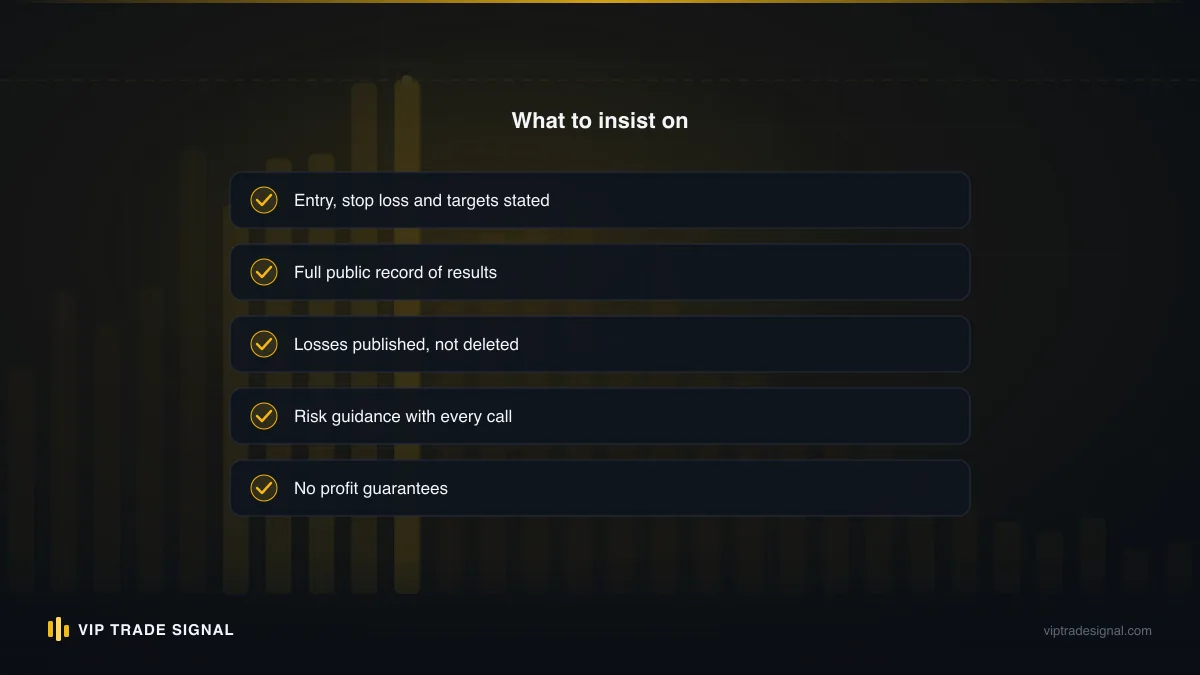
Print this, or copy it somewhere you'll actually see it. The test of the workflow isn't whether you agree with it. It's whether you still run it on the day you're tired, down 3R on the week, and the notification looks like a sure thing.
Before entry:
- Signal complete? Instrument, direction, entry, stop, target all present, or no trade.
- Still current? Price within one-third of the stop distance from entry, or limit order at the original price, or pass.
- Within my rules? Exposure caps, correlation with open trades, my trading hours.
- Sized from my risk: fixed %, lot size derived from the stop distance, off the lookup table.
- Conditions clear? Spread under ~10% of stop distance, sane session, no red news inside the hour.
- Order placed with SL and TP attached in the same ticket, volume typed fresh, direction double-checked, expiry set on pendings.
After entry:
- Provider updates executed promptly; no improvised stops, targets, or additions; breakeven set past spread.
- Journal entry within the hour of close: fills, R result, provider's result, one honest note. Skips logged too.
- Weekly, same day: provider's R, my R, the gap, one adjustment for next week.
Nine lines. Nothing on that list requires talent, prediction, or a view on the Fed. Which is precisely the point. The follower's edge is not analytical, it's operational, and operational edges are the only kind that survive contact with a losing streak. Trading gold on leverage remains a fast way to lose money, with or without good signals, and the workflow doesn't repeal that. What it does is guarantee that when losses come, they arrive in the size you chose, for reasons you can read in your own handwriting.
Run the loop for ninety days before you judge it, or the provider, or yourself. Most people quit signals after a bad fortnight of undisciplined execution and call it the provider's fault; a smaller group runs a boring process through the same fortnight and has the journal to show exactly what happened and why. Be the second group. The buzz at 14:32 is just the start of the machine.