There is a particular kind of silence that settles over a trader who has just been stopped out by a wick. The trade idea was right. The direction was right. Price is now moving exactly where they said it would, sometimes within minutes of taking their money. The only thing wrong was a stop loss parked eight dollars too close, in a market that routinely wiggles twelve dollars for no reason at all.
If you trade gold, you have lived this. Probably more than once this month. Most of the stop loss strategies for gold trading you find online were written by people who learned to trade on EURUSD and simply scaled the numbers up. That does not work. Gold is not a big forex pair. It is its own animal, with its own noise floor, its own session rhythms, and a well-earned reputation for spiking straight through obvious levels before doing what everyone expected.
This piece is the stop-placement playbook we actually use on the desk. It covers the maths (ATR, session ranges, spread), the market structure logic (swing points, liquidity, why your stop is somebody else's entry), and the discipline layer, including the one rule we treat as unbreakable. You may tighten a stop. You may never, ever widen it. Everything else in this article is negotiable craft. That rule is not.
Why gold eats forex-sized stops for breakfast
Start with the raw numbers, because they explain almost everything.
On a normal day, EURUSD moves somewhere around 60 to 80 pips top to bottom. Gold, at prices above 3,000, routinely covers $35 to $55 in a day, and on a data day or a headline day it can do $80 to $120 without anyone considering it remarkable. Convert that into the "pip" language most retail platforms use for XAUUSD, where a pip is ten cents, and gold's ordinary day is 350 to 550 pips. Its lively day is over 1,000.
Now think about what a trader carries over from forex. On EURUSD they learned that a 20-pip stop is reasonable for an intraday trade. So on gold they place a $2 stop, because it feels like the same kind of number. But $2 on gold is not a stop. It is a donation. Gold can travel $2 in the time it takes you to screenshot your entry. We have watched a single one-minute candle on a Fed afternoon cover $9 from wick to wick, and that was not even the interesting candle of the day.
There is a second problem stacked on top of the first: spread and slippage. Gold's spread at a decent broker runs maybe 15 to 30 cents in calm London hours, but it can stretch to a dollar or more in the dead zone after New York closes, and around news it goes wherever it wants. A stop that sits $2.50 from entry is, in practice, a stop that sits $2.20 from entry once spread has taken its bite. On a fast move, your fill can land 30 to 80 cents beyond your stop level. None of this is scandalous. It is just gold. But it means every tight stop is tighter than it looks on the chart.
And here is the part that stings. A stop that is too tight does not reduce your risk. It converts one large, planned loss into four small, unplanned ones, usually on trades where the idea was perfectly fine. Death by paper cuts is still death, and it comes with a side order of tilt.
A quick illustration, generic but true to life. A trader we'll call Sam moves over from EURUSD with a tidy system: 20-pip stops, 40-pip targets, 55% win rate, slow steady grind. He applies the same geometry to gold, $2 stops and $4 targets, and his win rate collapses to something like one in four inside a fortnight. Nothing about his analysis got worse. His entries are, if anything, better, because gold trends more cleanly than the euro. What changed is that his stop now lives inside the market's random static, so it gets tagged by noise before the trend has a chance to pay him. Sam's fix was not a new strategy. It was multiplying his stop by five and dividing his size by five. Same risk per trade, completely different survival rate.
Gold's noise floor: what the wicks actually measure
Every market has a noise floor: the amount of movement that means nothing. Below that threshold, price action is just order flow sloshing around, and any stop placed inside it will be hit by randomness rather than by your idea being wrong.
On gold the noise floor changes by session, and the difference is big enough that ignoring it is malpractice.
The Asian session is the quiet one. From roughly midnight to 7am UK time, gold often drifts in a $8 to $15 range, with candle wicks on the 15-minute chart running perhaps 50 cents to a dollar beyond the bodies. Then London opens and the character changes completely. The 8am to 11am window regularly prints the day's first real push, wicks stretch to $2 or $3 on the 15-minute, and the "range" concept stops being useful because gold has started trending. New York, especially the 1:30pm to 4pm UK stretch when US data lands and COMEX is fully awake, is the loudest of all. This is where the famous gold spikes live: the $10 straight-line move, the V-shaped reversal, the wick that hunts a level and snaps back inside fifteen minutes.
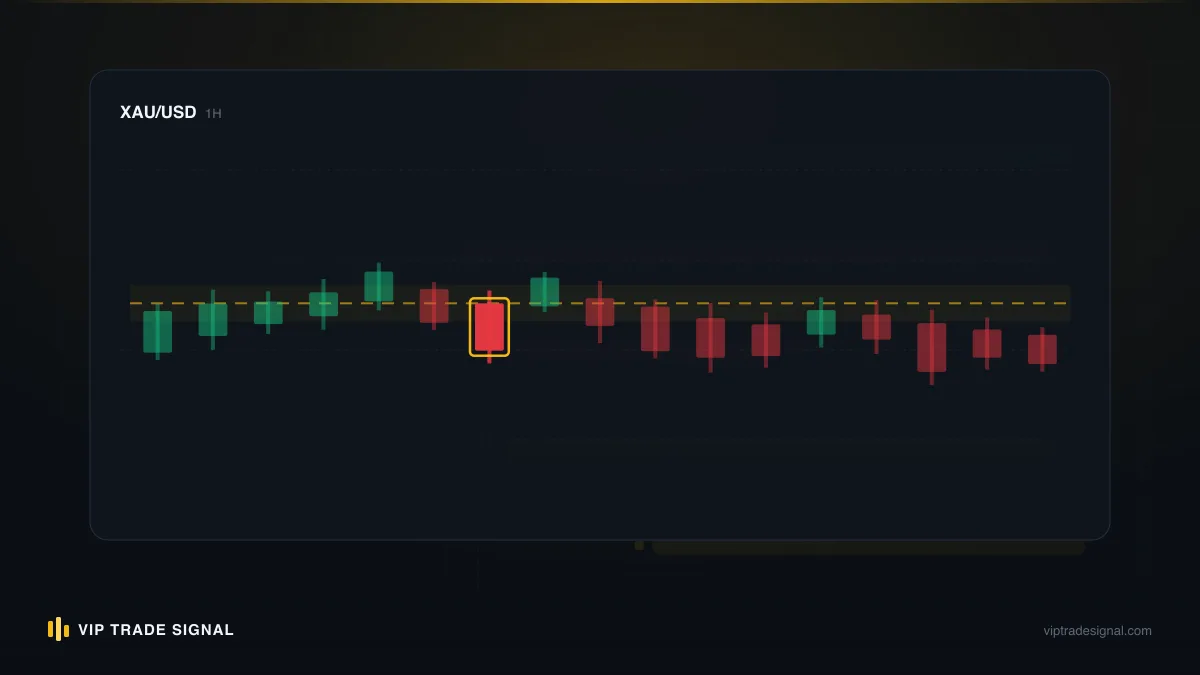
Why does this matter for stops? Because a stop is only valid if it sits outside the noise floor of the session you are trading in. A $4 stop placed at 2am might be generous. The identical $4 stop placed at 1:25pm, five minutes before US CPI, is a coin toss with extra steps. Same distance, completely different survival odds.
Our rough working numbers, and treat these as ballpark craft rather than gospel, since they drift with the volatility regime: intraday stops in Asia can live $4 to $6 from entry. In London, $6 to $10. In New York on a data day, we either want $10 to $15 of room or we want to not be in the trade until the data has printed. Traders hate hearing that last option. It remains the correct one surprisingly often.
ATR-based stop placement, with real numbers
If you take one mechanical tool from this article, take the Average True Range. ATR-based placement is the closest thing to an honest, self-updating answer among stop loss strategies for gold trading, because it measures what gold is actually doing right now rather than what you wish it were doing.
The recipe is short. Put a 14-period ATR on your chart. Read the number. Multiply it. Place the stop that far beyond your entry, or better, that far beyond the structure your trade is based on.
The multiplier is where judgement lives, and here is how we use it:
| Trade type | Timeframe for ATR | Multiplier | Typical stop (gold at ~3,300, daily ATR ~$45) |
|---|---|---|---|
| Scalp | 15-minute ATR (~$3–4) | 1.5× | $4.50–$6 |
| Intraday swing | 1-hour ATR (~$6–8) | 1.5–2× | $9–$16 |
| Multi-day swing | Daily ATR (~$40–50) | 0.5–0.75× | $20–$35 |
| Position trade | Daily ATR | 1.5–2× | $65–$100 |
Read those numbers again if you came from forex, because the multi-day row is the one that breaks brains. A proper swing trade on gold needs $20 to $35 of stop room. Not because we like big losses, but because a market that ranges $45 in an ordinary day will touch anything closer than that almost by accident.
The obvious complaint arrives on schedule: "I can't afford a $30 stop." Yes you can. You are confusing stop distance with risk. Risk is stop distance multiplied by position size, and position size is the lever you control. A $2,000 account risking 1% has $20 of risk per trade. With a $30 stop, that is 0.006 lots on most brokers' gold contracts, roughly $0.60 of movement per dollar gold moves. Small? Certainly. But it is a position that can breathe, survive the noise, and actually collect when the idea plays out. The alternative, a full 0.10 lots with a $2 stop, is the same $20 of risk wearing a blindfold in traffic. We wrote more about sizing around signal parameters in how to read forex signals properly, and the sizing logic there applies double to gold.
One refinement worth stealing: read the ATR at your trade's timeframe, but sanity-check it against the daily. If your 1-hour ATR maths says $8 but the daily ATR is $60 because we are in a headline week, the market's bigger rhythm will roll over your intraday stop without noticing it. When the timeframes disagree, the higher one wins the argument.
Structure-based stops: hiding behind something real
ATR tells you how far. Structure tells you where. The best stops use both: an ATR-sized distance, anchored beyond a level that actually means something.
The logic is simple enough to say in one sentence. Your stop should sit at the price where your trade idea is objectively wrong, plus a buffer for noise. If you buy gold because it bounced off support at 3,285, the idea is wrong when 3,285 properly breaks. So the stop belongs below 3,285, not at some tidy round distance from your entry at 3,296 that happens to sit at 3,286, a dollar above the level, in the exact pocket where every dip gets bought and every stop gets clipped first.
Swing lows and swing highs are the workhorse anchors. For a long, find the most recent meaningful swing low on your trading timeframe, then place the stop below its wick, not its body, with a buffer. On gold we like a buffer of $1.50 to $3 for intraday structure and $4 to $6 for daily structure. Below the wick matters. Gold's reversals routinely probe beyond the previous extreme by a dollar or two before turning; a stop level that merely matches the old low is a stop that gets collected on the retest.
Which levels count as meaningful is its own craft, and we have a full piece on how support and resistance actually behave on gold, but the short version: prior day high and low, the week's high and low, round numbers ending in 00 and 50, and the origin points of strong impulsive moves. Levels that thousands of traders can all see. Which brings us to the uncomfortable part.
The stop-hunt reality around obvious levels
Let us be adults about this. Your stop loss is not just your exit. It is somebody else's liquidity.
A resting sell stop below a swing low is, mechanically, a market sell order waiting to trigger. Cluster a few thousand of them under an obvious level and you have created a pool of guaranteed selling that larger players can push price into, absorb, and use to fill their own buys at better prices. This is not conspiracy talk. It is the routine plumbing of every liquid market, and gold, with its enormous retail following and its love of clean technical levels, does it more visibly than almost anything else you can trade.
The signature is unmistakable once you know it: price grinds toward an obvious level, accelerates suddenly into it, spikes through by $2 to $5 on a single ugly candle, then snaps back inside the range and reverses hard. The wick that is left behind is a receipt. It records exactly where the stops were.
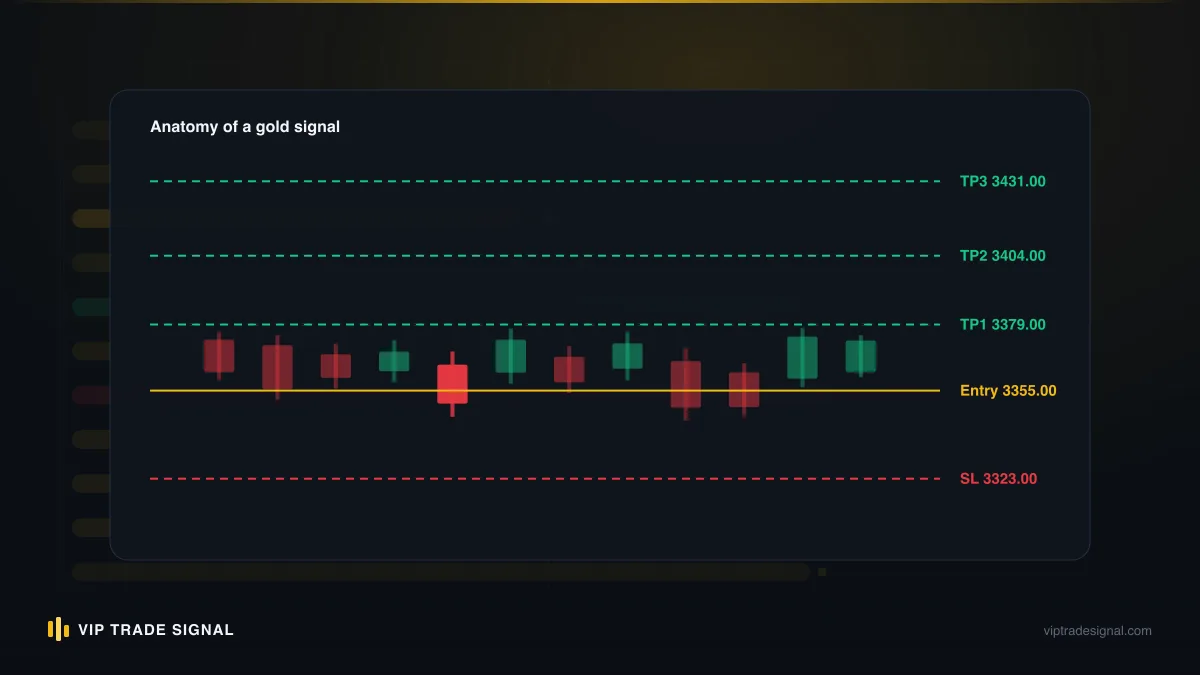
You cannot prevent this. You can stop volunteering for it. Three adjustments do most of the work:
- Never place a stop at the obvious level itself. If everyone can see the low at 3,285.40, the pocket from 3,285 down to about 3,283 is the kill zone. Your stop goes below the zone, not inside it. On intraday gold that usually means $2 to $3 beyond the level; on daily structure, more.
- Respect round numbers. Gold gravitates to 00 and 50 levels like a moth to a porch light. A stop at 3,299.80, just under 3,300, is a stop placed inside the single most crowded pocket on the chart. Either get beyond the round number with room to spare or anchor to different structure entirely.
- Give wicks time to finish. If you watch gold spike toward your level on a fast candle, the worst possible reaction is panic-widening the stop (more on that sin shortly). The best is having placed it far enough out in the first place that the wick exhausts before it reaches you. A stop-hunt wick on gold usually completes and reverses within one to three candles on the 15-minute. Stops that survive that window tend to survive the trade.
There is a mirror-image opportunity here, too. Once a hunt wick has printed and snapped back, the level is often cleaner than it was before, because the stops are gone. Some of the best gold entries of the past year have been buying the reclaim after a sweep of an obvious low. But that is an entries article. Today we are just trying to stop being the fuel.
Fixed-dollar stops: when simple beats clever
Everything above assumes you are willing to do a little measuring before each trade. Not everyone is, and not every situation rewards it. So let us give fixed-dollar stops a fair hearing, because the internet's technical crowd sneers at them more than they deserve.
A fixed-dollar stop is exactly what it sounds like: every gold trade gets, say, a $10 stop, full stop. No ATR, no structure hunt, no session table. Its weaknesses are obvious. It ignores context, so it will be too tight on wild days and needlessly wide on dead ones, and it is not anchored to the price where your idea fails.
Its strengths are quieter but real. It is impossible to fudge. It makes position sizing instant, since your per-trade risk divided by a constant is always the same lot size. And it removes the nightly negotiation between you and your worst instincts about what the chart "really" says. For a newer trader who has been widening and shuffling stops for months, a blunt constant is often the intervention that works, precisely because it leaves nothing to argue with.
Our honest take: a fixed $8 to $12 intraday stop on gold, sized properly, beats a clever stop applied inconsistently. Every time. The best stop-placement method is worth maybe a 10 or 15 per cent improvement over a decent one. Consistency versus inconsistency is worth several times that. Start blunt, get consistent, then earn your way into the craftier methods one at a time.
The one law: tighten allowed, widen never
Here is the section this article exists for. Everything else is technique. This is law.
Once a trade is live, you may move your stop in only one direction: toward price. You may tighten it, trail it, or take the exit early. You may never move your stop loss wider. Not by a dollar, not "just past this wick", not because the fundamentals still look good, not because it is about to bounce. Never.
The moment you widen a stop, you are no longer trading your plan. You are negotiating with a loss, and the loss always negotiates better than you do.
Why be absolutist about this when we have been happy to say "it depends" about everything else? Because widening is the specific mechanism by which small accounts die. Not tight stops, not bad entries, not even overtrading. Those wound. Widening kills. The maths is brutal: a trader risking 1% per trade with disciplined stops needs roughly a hundred consecutive losers to destroy the account, which essentially never happens. The same trader who widens one stop, then widens it again, then removes it because they are "in too deep to stop out now", can convert a planned $20 loss into a $700 hole in a single afternoon. We have seen accounts survive forty bad trades and then not survive one widened stop. On gold, with its speed, the arithmetic runs faster than anywhere else.
The psychology behind widening deserves a moment, because you cannot beat an urge you have not named. In the moment, widening never feels like breaking a rule. It feels like patience. The trade "just needs room". You are being flexible, sophisticated, unlike those rigid amateurs. But notice what actually happened: when you placed the stop, before the trade, you were a neutral analyst choosing the point where the idea fails. Now, with the loss in front of you, you are a defendant pleading a case. Same brain, entirely different machinery. The pre-trade version of you is the only one qualified to set stop distances, which is exactly why the in-trade version gets zero votes.
Two edge cases people raise, so let us close the loopholes now. Weekend gaps: yes, gold can open Monday beyond your stop, and your fill will be at the open, not your level. That is a reason to reduce or flatten swing risk before uncertain weekends, not a reason to widen mid-trade. And "the news changed": if genuinely new information makes your original stop wrong, the honest response is to close the trade entirely and re-plan with a clear head, then re-enter if the fresh analysis says so. Closing and re-planning feels almost identical to widening. It is not. One resets the decision to a neutral brain; the other lets a losing position write its own rules.
And note what the law does not say. It does not say your stops must be tight. Set them as wide as your sizing allows, cathedral-wide if the trade calls for it. It says the width is decided once, before entry, with a calm head. If gold reaches the stop, the idea was wrong, the loss is the planned cost of finding out, and the next trade is unaffected. That is the entire deal. Losses are normal here. On our own public signal history you will find every closed trade, losers included, because a stop that gets hit is not a scandal. A stop that gets moved is.
If reading this section stung a little, good. It means you have widened before. So have we. The difference between traders who make it and traders who refill deposits is not that the first group never felt the urge. It is that they built a wall in front of it.
Trailing stops on gold: settings that don't choke winners
Trailing stops are where good intentions go to strangle good trades. The idea is sound: as the trade moves your way, drag the stop along behind it, converting open profit into protected profit. The execution, on gold specifically, is where nearly everyone gets it wrong, and they get it wrong in the same direction. Too tight.
Gold does not trend in straight lines. It trends in lunges: a $15 push, a $6 pullback, a stall, another push. A trailing stop set $5 behind price on a trending gold day is not protecting your winner. It is guaranteeing you exit on the first routine pullback of a move that had $40 left in it. You keep a $7 profit from a trade your analysis earned $30 on, then watch the rest happen without you. Do that for a year and your win rate looks lovely while your equity curve goes nowhere.
Numbers that actually survive gold's pullback rhythm:
- ATR trail: trail by 2 to 2.5 times the 1-hour ATR for intraday trades. With the 1-hour ATR around $7, that is a $14 to $17 trail. Feels enormous. Works.
- Structure trail: move the stop beneath each new confirmed higher low (for longs) as the trend builds, with the usual $1.50 to $3 buffer. This is our preferred method, because it trails the trend's actual skeleton instead of an arbitrary distance. The stop only moves when the market builds a new floor, which might mean it does not move for hours. Fine. Patience is the point.
- The platform default: most MT4/MT5 trailing settings people use (30 to 50 points, meaning $3 to $5) are calibrated for forex and are, on gold, a machine for donating winners back. If your trail is tighter than the session's ordinary pullback, you do not have a trailing stop. You have a scheduled exit at the first wobble.
One more habit worth building: once a trailing stop has locked in meaningful profit, stop watching the trade so closely. The whole purpose of the trail is to make the remaining decisions automatic. Hovering over a protected winner is how you invent reasons to interfere with it.
Breakeven moves: earned, not automatic
Somewhere along the way, "move to breakeven" got promoted from a tool to a religion. Trade goes $3 onside, stop slams to entry, trader feels safe. And then gold does what gold does: pulls back through entry by 40 cents, tags the stop, and resumes the move without them. The trader books a heroic $0, the analysis was worth $25, and the ritual repeats tomorrow.
The problem is not breakeven itself. It is automatic breakeven, triggered by profit-on-the-ticket rather than by anything the market did. Your entry price is meaningful to exactly one person on earth. The market will happily revisit it, because to everyone else it is just a price.
So make breakeven something the trade earns structurally. Our rule of thumb on gold: the stop moves to entry only when both of these are true. First, price has travelled at least 1.5 times your original stop distance in your favour, so a $10 stop needs $15 of progress. Second, the market has printed new structure between your entry and current price, a higher low for longs, that would have to break for price to return to you. At that point breakeven is no longer a comfort blanket. It is a structure-based stop that happens to sit at your entry.
There is a decent alternative for people who cannot resist doing something early: take a third of the position off at 1× your risk and leave the stop where it was. You have banked something real, reduced the open risk, and left the stop at the level your pre-trade self chose for reasons. That beats moving the whole stop to a price the market does not care about.
How we place stops on our signals, and why we show you
Since we run a gold signal service, it is fair to ask how much of this we practise. Every signal we send carries an entry, a stop, and targets before the trade is live, and the stop is built exactly the way this article describes: anchored beyond the structure that invalidates the idea, sized against the current ATR, padded past the obvious liquidity pocket rather than parked inside it. The full recipe, from level selection to the final buffer, is written up in how our signals are generated if you want the machinery with the covers off.
Two things about that are worth saying plainly. First, our stops on XAUUSD are wider than new subscribers expect, commonly $8 to $18 depending on setup and session, and occasionally wider on swing ideas. People raised on forex signals sometimes ask if that is a typo. It is not. It is gold. A signal service advertising $3 stops on gold is advertising its own churn rate.
Second, those stops get hit. Regularly. Plenty of signals in any given month close at the stop, and every one of them is sitting in our public history, timestamped, next to the winners; count them yourself rather than taking a tidy percentage from us on faith. We publish the losers because a stop loss is a cost of doing business, not an embarrassment, and any service that shows you only its wins is showing you marketing rather than trading. High-risk market, real losses, out loud. If you want to check how the numbers land before trusting anyone's word, ours included, the FAQ covers how the history page works and what the $99/month (or free via partner broker) arrangement involves.
What we will not do, ever, is send "hold, it will come back" after a stop is breached. The stop is the signal's contract. When it is hit, the idea was wrong, we say so, and the next setup gets a clean sheet. The same one-way law applies to us that applies to you.
Stop placement for scalps versus swings on gold
The same market needs completely different stop craft at different holding periods, and mixing the two is a quiet account-killer: swing-sized conviction defended with scalp-sized stops, or worse, a scalp that goes wrong and gets promoted to a "swing" so the loss can keep breathing.
For scalps, meaning trades measured in minutes to a couple of hours, the stop is tight by gold standards but still gold-sized: $4 to $6 in ordinary conditions, anchored beyond the most recent 5- or 15-minute swing point. Scalping demands you obey the session table religiously. Scalping gold through a red-folder news release with a $4 stop is not a strategy. It is a raffle ticket. The scalper's real edge is not the stop at all; it is refusing trades in conditions where no reasonable tight stop can survive. Some hours the correct position size is zero.
For swings, trades measured in days, everything inverts. The stop lives beyond daily structure, sized off the daily ATR, commonly $25 to $40 from entry, and it must be placed with the full knowledge that gold will spend hours of every day moving against you inside a position that is, on the timeframe that matters, working perfectly. This is why swing traders who watch the 5-minute chart destroy themselves: they experience twenty intraday emergencies per day inside one healthy daily trend. Size the position so the $30 stop equals your normal per-trade risk, place it, set an alert near it, and go do something else.
The promotion trap deserves its own sentence. A scalp that hits its stop was a scalp that lost, and that is the end of it. Re-labelling a losing scalp as a swing trade so you can justify a wider stop is just stop-widening wearing a costume, and it breaks the law from earlier in this piece.
Stop loss strategies for gold trading, condensed into one tree
Cheat-sheet time. Before each gold trade, run this from the top. It takes under a minute once it is habit.
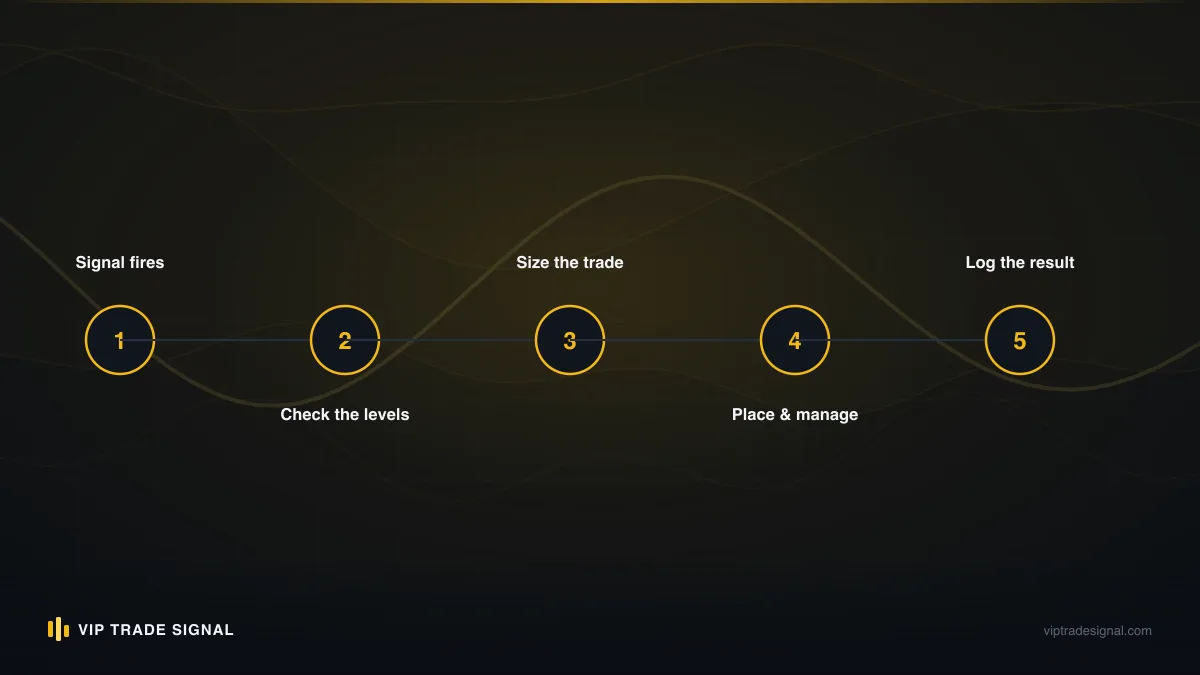
- What kind of trade is this? Scalp, intraday, or swing. Decide now, in writing if you must, because it cannot be renegotiated after entry.
- What invalidates the idea? Find the structural point, the swing low, the broken level, the origin of the move, where you would objectively be wrong. No structure to anchor to? That is information. Skip the trade or use a fixed-dollar stop and half size.
- Check the session. Asia, London, or New York, and is there red-folder news inside your holding window? If yes and you are scalping, stand down until it prints.
- Read the ATR on your trade's timeframe, sanity-checked against the daily. Your minimum stop distance is the multiplier from the table earlier. If structure sits closer than the ATR minimum, the ATR wins and the stop goes further out.
- Clear the liquidity pocket. Is the resulting level sitting just beyond an obvious low, high, or round number? Push it $2 to $3 further so the routine hunt wick dies before it reaches you.
- Size the position from the stop, never the reverse. Account risk (1% or less while you are learning) divided by stop distance gives the lot size. If the lots look tiny, they are correct.
- Place the actual order. A stop in your head is not a stop; gold moves too fast for intentions. Hard stop, in the platform, at placement.
- Pre-commit the management: the earned-breakeven condition, the trailing method if any, and the reminder that from this second the stop moves only one way.
Eight steps, one direction, no exceptions.
Where this leaves you
Strip the article down and four sentences remain. Gold needs wider stops than your forex instincts want, and the ATR will tell you how much wider if you let it. The obvious level is where the stops die, so hide yours beyond the pocket, not inside it. Size from the stop, never the other way round. And once the trade is live, the stop tightens or it holds, but it never, under any provocation, moves away from price.
None of this makes losing trades stop happening. Nothing does, and anyone who implies otherwise is selling something you should not buy. What proper stop craft changes is the shape of your losing: planned, sized, survivable, and boring. Boring losses are the tuition of this business. Catastrophic ones are the dropout letter.
If your account is already carrying the scars of the other kind, a few widened stops that became a deep floating hole, that is a different problem from stop placement and it needs a different conversation; our drawdown management service exists for exactly that situation, no recovery promises attached, because promising recoveries is its own kind of lie. And if you simply want to watch disciplined stops operate in the wild before rebuilding your own rules, every gold signal we have ever closed, stop-outs included, is public. Look at the losers first. They are the part that tells you whether anyone is serious.
Then go open your platform, find your last ten stopped trades, and answer one question honestly: were you stopped out because the ideas were wrong, or because the stops never had a chance? For most gold traders it is the second. Which, for once, is good news. Placement is fixable this week. Being wrong takes longer.