A signal lands on your phone. BUY XAU/USD at 3,342, stop 3,334, targets 3,352 and 3,365. Twelve seconds later a second channel you follow posts almost the same thing, and a third posts it eight minutes after that with the entry already five dollars stale. Same trade, three sources, three different prices. Somebody generated that idea, and two other somebodies either generated it independently or lifted it.
Most subscribers never ask how signal providers generate signals in the first place. They ask about win rate, they ask about price, they occasionally ask about refunds, and then they wire money to a stranger whose entire production process is a black box. Which is strange, because the generation method is the product. The Telegram message is just packaging.
So this piece is about how signal providers generate signals, technical vs fundamental and everything in between: the four legitimate methods, the fifth one nobody admits to, how to work out which one a given provider actually uses, and why the method has to fit the instrument. We run a gold-only desk, so we'll use our own XAU/USD process as the worked example rather than hiding behind generalities. Where our approach has weaknesses, we'll say so, because every method has them and anyone who claims otherwise is selling you the packaging.
The question almost nobody asks before paying
Think about how you'd buy anything else at $99 a month. A gym, you'd visit. Software, you'd trial. A used car, you'd at least open the bonnet. Signals? People routinely subscribe off a screenshot of somebody else's profit and a bio that says "10 years experience".
The question that actually predicts whether a service can survive contact with a live market is boring: what is your process, and can you show me it running? Not "what's your win rate", which is trivially fake-able and meaningless without risk-reward attached. Not "how many pips last month", which is worse. Process. Because a process can be evaluated, stress-tested, and checked for consistency over months, while a win rate is just a number someone typed.
Here's the uncomfortable arithmetic behind why this matters. A provider sending five signals a day across fourteen pairs cannot be doing deep discretionary analysis on all of them; there aren't enough hours. A provider posting entries at 3:07am their local time either has a night desk, an algorithm, or a copying script pointed at someone else's channel. A provider whose signals always arrive four to nine minutes after a well-known free channel posts nearly identical levels is not running a research operation. Each of these tells is visible from the outside if you know what generation actually involves.
And that's the gap this article fills. Once you understand the mechanics of each method (what it needs as input, how long it takes, what its output looks like, where it breaks) you can reverse-engineer a provider's real process from nothing but their public feed. We publish every closed signal, wins and losses, at /signals/history partly for accountability and partly because a full public record is the raw material for exactly this kind of audit. Any provider who won't give you that material has answered your question already.
How signal providers generate signals: technical vs fundamental in practice
Strip away the marketing and there are four honest ways to produce a trade idea, plus one dishonest way to acquire one.
- Discretionary technical analysis. A human reads charts and decides. Judgement is the engine.
- Rules-based technical systems. A human follows a written checklist of conditions. The rules are the engine; the human is the operator.
- Fundamental and news-driven analysis. Trades built from macro data, central bank policy, and event flow rather than chart patterns.
- Fully algorithmic generation. Code scans, decides, and publishes with no human in the loop per trade.
- Copying. Subscribing to other channels and republishing their calls, sometimes laundered through delay and reworded targets.
The technical vs fundamental split is the oldest fault line in trading, and it maps onto signals directly. Technical methods ask "what is price doing?" and treat the chart as the complete record of everyone's opinions. Fundamental methods ask "what should this be worth, and what's about to change?" and treat the chart as an afterthought. Neither side is right in general. They're right for different instruments, different timeframes, and different temperaments, which is a point we'll come back to when we get to gold, because gold punishes anyone who picks a side too cleanly.
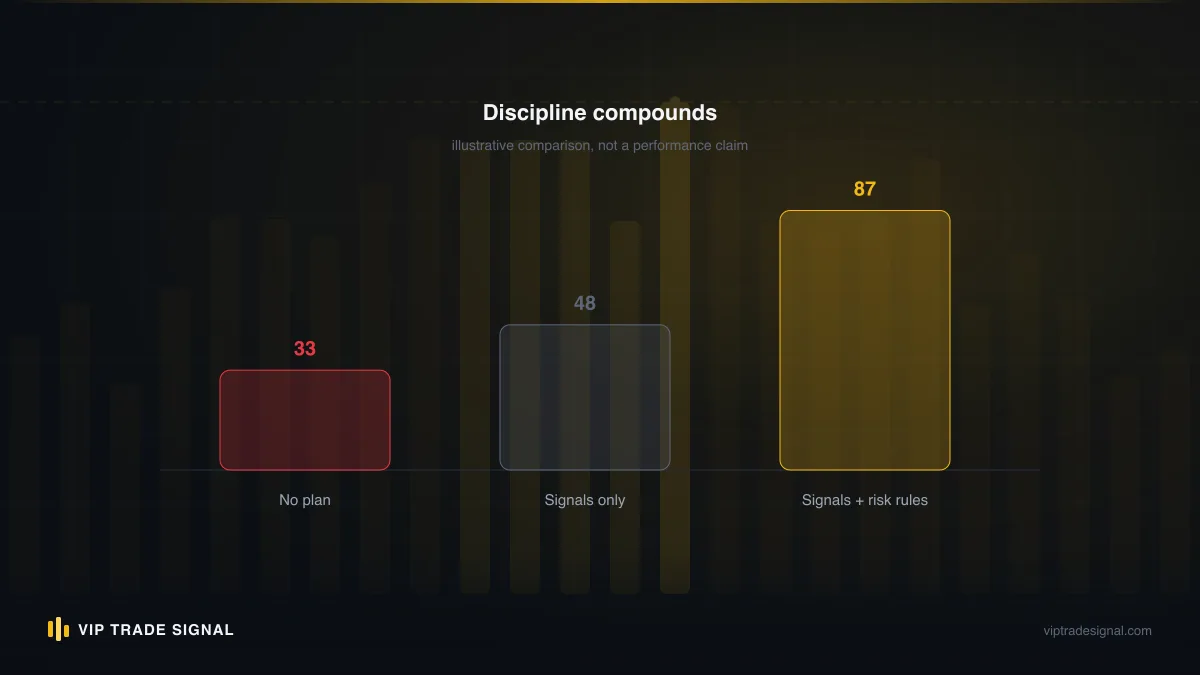
Real desks blend, of course. Ours is technical at the trigger and fundamental at the filter, and we'd guess most serious operations sit somewhere on that same spectrum rather than at a pole. But the blend still has a dominant ingredient, and identifying it tells you what conditions will hurt that provider most. A chart-driven service suffers in news-whipped chop. A macro service suffers in quiet technical grinds. An algorithm suffers whenever the market stops resembling its training years. Knowing which pain applies is half of knowing what you're buying.
Method one: discretionary technical analysis
This is the classic image: a trader, two or three monitors, marked-up charts, coffee going cold. They scan their instruments each session, draw levels, watch how price behaves when it gets there, and pull the trigger when the picture matches something they've seen work a few hundred times before. The signal you receive is that person's judgement, compressed into five lines of text.
Done well, discretionary technical work is genuinely powerful, and it's powerful for a reason automation still struggles with: context. A trained human sees that support at 3,318 held twice yesterday but the bounces are getting weaker each time, that the second test came on rising volume, that Asia is quiet ahead of tonight's Fed minutes so the level probably survives until New York. No indicator encodes all that. Experienced discretion is pattern recognition running on a decade of examples, and at its best it adapts to regime changes in real time, which is exactly where mechanical systems die.
The failure modes are equally human. Discretion means mood. A trader who took three stops before lunch reads the afternoon chart differently than the same trader on a winning week, and the subscribers can't see which version showed up today. Discretionary services also drift: the "strategy" in month one and the strategy in month nine can be quietly different animals, with no changelog. And there's a scale ceiling. One person can genuinely cover perhaps two to four instruments with proper attention. When you see a "manual analysis" service posting across twenty pairs, do the arithmetic on hours in a day and draw your own conclusion.
There's also a survivorship problem specific to this method. Because output quality tracks one individual, you're not really subscribing to a service, you're subscribing to a person, and people have bad quarters, health problems, and burnout. A discretionary channel that was excellent for two years can degrade in a month if the person behind it does. That's not a reason to avoid the method; some of the best signal records anywhere are discretionary. It's a reason to weight recent months over lifetime stats when you're evaluating one, and to notice if the posting voice or cadence suddenly changes.
Method two: rules-based technical systems
Now take the same charts and remove the mood. A rules-based desk trades a written system: if the 4-hour trend filter is up, and price pulls back to a prior demand zone, and the 1-hour closes back above it with a defined rejection candle, then long, stop below the zone's low, first target at the last swing high. Every condition is specified in advance. The human's job isn't to have opinions; it's to check boxes honestly and refuse trades that miss even one.
This is the method most professional retail-facing desks actually run, ours included, because it keeps the two things you want and discards the two you don't. You keep human execution (someone sane watching for the news spike that should veto an otherwise valid setup) and you keep consistency, since the system that fires today is the system that fired in March. You discard mood, mostly, and you discard drift, mostly. The "mostly" matters. Humans running rules still bend them on tilt; the discipline is in how rarely.
The great advantage of written rules is that they're testable. You can run the conditions across five years of history and get an honest picture of frequency, average win, average loss, and the worst losing streak, before risking a pound. That last number deserves more respect than it gets. A system that wins 55% of the time with 1.8-to-1 reward-to-risk is a good system, and it will still, with near mathematical certainty, hand you seven or eight consecutive losses at some point in a few hundred trades. A rules-based desk knows this in advance and sizes for it. A subscriber who doesn't know it quits at loss number five, right on schedule, usually just before the streak breaks. If you want the practical side of surviving that, we've written separately about how to use forex signals without sabotaging them.
The failure mode is rigidity. Rules encode a market regime, and regimes end. A pullback-continuation system built during a trending year bleeds during a ranging one, not because anyone did anything wrong but because the market changed shape underneath it. Good rules-based desks handle this with explicit regime filters and scheduled reviews. Bad ones handle it by quietly rewriting the rules after every losing fortnight, which turns method two back into method one with extra paperwork.
Method three: fundamental and news-driven signals
Fundamental generation starts from a different question entirely: not where price has been, but what's about to hit it. The inputs aren't candles. They're the economic calendar, central bank statements, inflation prints, employment data, positioning reports, and the geopolitical tape. A fundamental desk shorted the euro in 2022 because of the energy shock and rate differentials, not because of a trendline.
For a signal service, pure fundamental generation is honestly rare, and there's a structural reason. Fundamentals are brilliant at direction and hopeless at timing. "Gold should rise over the next quarter because real yields are falling and central banks are hoovering up reserves" can be completely correct and still lose money for six straight weeks if your entry, stop, and leverage are wrong. A signal, by definition, needs an entry, a stop, and a target. So fundamentals alone under-specify the product. What you actually see in the wild is fundamentals used in three narrower ways:
- Event trading. Signals built around scheduled releases: CPI, non-farm payrolls, FOMC. The desk has a view on the number or on the reaction, and trades the minutes around it. High octane, wide spreads, brutal slippage; when a hot CPI print moves gold $30 in ninety seconds, your fill and the signalled entry can be different postcodes.
- Directional bias. The macro picture sets which side of the market the desk will trade this week, and something else (usually technicals) picks the moments. This is the common hybrid, and in our view the correct one for gold.
- Thesis trades. Occasional longer-horizon calls with wide stops, held for days or weeks. Fine for position traders, miserable for anyone on a small account who can't stomach 400 pips of adverse float.
The strength of fundamental work is that it's anchored to something real; when it's right, it's right for reasons that keep paying for weeks. The weakness, beyond timing, is that everyone has the same calendar. The consensus is priced in before the release, so the fundamental trader's edge isn't knowing that CPI is Thursday; it's having a better-than-consensus read on the reaction, which is a genuinely hard skill that maybe one channel in fifty claiming it actually has. Be especially suspicious of services promising precise entries "based on news" seconds after a red-folder release. That's not analysis. That's a coin flip with commentary.
Method four: fully algorithmic generation
Method four removes the human per-trade entirely. Code monitors the market, evaluates conditions, and fires the signal into your channel untouched by hands. At the simple end this is an indicator mashup: EMA cross plus RSI threshold plus a session filter, wired to a Telegram bot, buildable in a weekend. At the serious end it's a statistically validated model with regime detection, dynamic sizing, and real infrastructure behind it. The marketing for both looks identical, which is the first problem.
Algorithms have real, undeniable advantages. They don't sleep, so the 3am setup gets taken with the same precision as the 3pm one. They don't tilt, revenge-trade, or widen a stop out of hope. They're perfectly consistent: the rules of January are the rules of June, byte for byte. And they scale across instruments in a way no human can, which is why the high-frequency end of institutional trading went fully automated years ago and never looked back.
But retail "algo signals" live or die on one question the sales page never answers: how was it validated? A weekend indicator bot will backtest beautifully, because its creator, consciously or not, tuned the parameters until the historical curve looked good. That's overfitting, and it's the default outcome of amateur system building, not the exception. The tell is a backtest that looks like a staircase to heaven followed by live results that look like a ski slope. Real quantitative work fights this with out-of-sample testing, walk-forward analysis, and honest accounting of transaction costs; a serious desk will happily bore you about all three, while a curve-fitted bot's owner will send you another screenshot of the staircase.
The other structural weakness is brittleness at regime change. An algorithm is a frozen photograph of the market it was trained on. When conditions shift hard (a war premium entering gold, a central bank pivot, a liquidity event) the photograph stops matching reality, and code doesn't feel the ground moving; it just keeps firing signals into a market that no longer exists, sometimes losing in a week what it made in a quarter. This is the strongest argument for the manual vs automated forex signals debate ending in a hybrid: machine consistency for the routine, human veto for the abnormal. Fully automated with no human circuit-breaker is a service that will work right up until the day it very much doesn't.
The fifth method nobody admits to: copying other channels
Here's the industry's grubby open secret: a meaningful slice of paid signal channels generate nothing. They subscribe to other providers, wait, and republish. Sometimes it's crude, a copy-paste with the branding swapped. Sometimes it's laundered: the entry shifted a couple of dollars, the second target tweaked, the message delayed nine minutes and rephrased so a side-by-side comparison isn't instant. Either way, the "analysis team" in the channel's bio is one person with four subscriptions and a forwarding script.
Why does this economy exist? Because it's nearly free money. Signals aren't copyrightable in any way that gets enforced across anonymous Telegram accounts, the marginal cost of forwarding a message is zero, and a copied channel's early results are exactly as good as its source's. Charge $60 against the source's $99, undercut on price, and you've built a business on someone else's desk. For a while.
The rot is structural, though, and it always surfaces. First, latency: by the time a copied entry reaches you, price has moved, and on a fast instrument like gold a nine-minute-stale entry isn't the same trade; it can be a worse price and a worse reward-to-risk on every single signal, a tax that compounds invisibly. Second, the copier can't manage what they didn't create. When the source updates a trade (moves the stop to breakeven, closes half at the first target, scraps the setup before entry) the copier lags again or misses the update entirely, and subscribers are left holding positions the actual analyst already exited. Third, there's no one to ask. Put a question about the reasoning behind a trade to a copier and you'll get silence, boilerplate, or bluster, because the reasoning lives in someone else's head.
A copied signal isn't a cheaper version of the same product. It's a worse trade, managed by nobody, sold by someone who can't explain it.
The detection is fortunately straightforward, and it's the core of the next section: copiers have a timing signature and a knowledge signature, and neither can be hidden for long from anyone who bothers to look.
How to work out which method a provider actually uses
You don't need inside access to identify a provider's generation method. Their public feed leaks it. Here's the audit we'd run on any channel, ours included, before paying a penny.
Watch the timestamps for a fortnight. Method four (algorithmic) posts at odd, precise, sleepless hours: 02:41, 04:17, Sunday-open gaps. Methods one and two cluster in the provider's waking sessions with human irregularity. Method five posts in a consistent lag behind some other channel; if you follow a few free channels, actively check for signals that land minutes after theirs with near-identical levels. Two coincidences is a market; ten is a script.
Ask one specific question about one specific trade. Not "what's your strategy", which everyone can waffle through, but "on Tuesday's short from 3,351, what invalidated the setup when you closed it early?" A discretionary trader answers with texture. A rules-based desk answers with a rule. An algo operator says the model exited, which is honest. A copier goes quiet or vague, because they genuinely don't know.
Read fifty signals as a body of work. Consistency of format, stop placement logic, and reward-to-risk reveals method two or four. Setups that vary in structure but share a recognisable style suggest method one. Entries around red-folder news suggest method three is at least in the mix. Wild inconsistency (scalps on Monday, 300-pip swing calls on Wednesday, a martingale "recovery" on Friday) suggests nobody is running any method at all. If reading a raw signal message is itself unfamiliar ground, start with our piece on how to read forex signals and come back; the audit assumes you can parse the anatomy.
Check the record's honesty before its quality. Full history including losses, published as trades close rather than in curated monthly screenshots, is table stakes. Ours is at /signals/history, every result, because a record you can't audit is an anecdote.
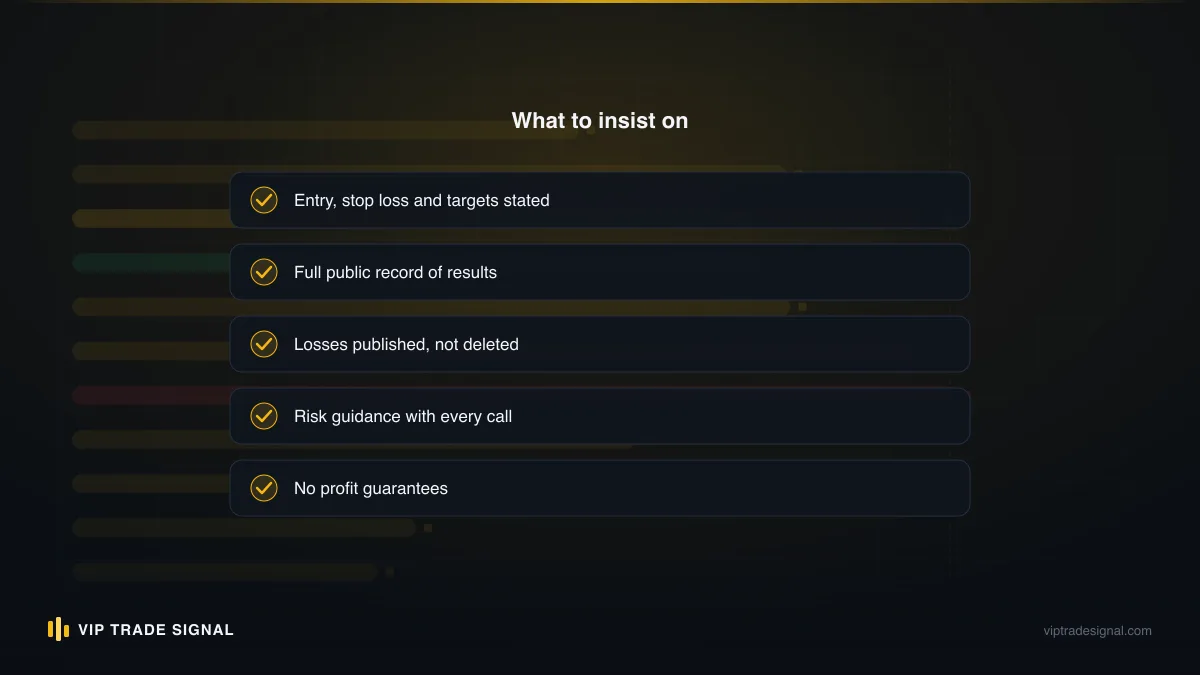
Then test on demo for a month. Whatever the method turns out to be, a month of forward results in your own account, at your own execution speed, tells you more than any claim. Total cost: some patience. Compare that to the cost of skipping it.
Where each method breaks
Every generation method has a market that flatters it and a market that ruins it. The table below is the honest version of the comparison the sales pages won't print.
| Method | Best conditions | Worst conditions | Typical tell in the feed | Biggest hidden risk |
|---|---|---|---|---|
| Discretionary technical | Regime shifts, messy news-driven charts | Provider's bad month | Irregular timing, varied setups, real answers | You're subscribed to a person, not a process |
| Rules-based technical | The regime the rules were built for | Regime change, prolonged chop | Uniform format, repeatable logic | Rules quietly rewritten after losses |
| Fundamental / news | Strong macro trends, policy shifts | Quiet ranges, priced-in events | Calendar-clustered entries, wider stops | Right thesis, wrong timing, dead account |
| Fully algorithmic | Conditions matching training data | Anything the model never saw | Odd-hours precision, machine cadence | Overfitted backtest sold as live edge |
| Copied | Whenever the source is winning | The source's first losing streak | Fixed lag, no reasoning, missed updates | Stale entries and unmanaged positions |
Two things jump out of that grid if you stare at it. First, the failure conditions barely overlap, which is why blended methods exist: a technical trigger with a fundamental veto covers more of the grid than either alone. Second, the copier's row is the only one where the subscriber inherits every downside of another row plus latency plus abandonment. There is no market condition in which copied signals are the best available version of anything.
What the table can't show is frequency of failure. Regime changes that break rules-based systems arrive maybe once or twice a year. A discretionary trader's bad month arrives, well, some months. An overfitted algorithm's day of reckoning arrives exactly once, terminally. Weight accordingly: a method with rare, survivable failures beats a method with rare, fatal ones, even if the fatal one's good months look shinier.
Why the method has to match the instrument: gold's case
A generation method isn't good or bad in the abstract; it's good or bad for an instrument. And gold is the clearest example we know, because XAU/USD sits with one foot in each world and steps on anyone who ignores either.
Gold is a technician's instrument for perhaps 70% of its life. It respects horizontal levels with a cleanliness that majors rarely match; round numbers and prior swing points get defended, retested, and defended again, and a patient level-trader can make a living off nothing else for months. Session structure is reliable too: Asia typically compresses, London probes and often sets the day's trap, New York resolves. Any half-decent technical method, one or two, reads this fine.
Then the other 30% arrives and the chart stops being in charge. A hot US inflation print reprices real yields and gold moves $25 in two minutes, straight through three "strong" levels like they were chalk lines. A geopolitical shock adds a fear premium overnight that no indicator anticipated. Central banks, who have been net buyers on a historic scale in recent years, lean on the market in ways that show up in the trend months before they show up in any pattern. In those windows a purely technical desk gets systematically hurt, buying supports that were only ever going to matter in a calm tape.
Flip it round and the pure fundamental desk suffers the other 70%: right about direction, weeks early, stopped out of a correct idea three times before it pays. Gold's daily range (routinely $20-$40, several times a major pair's) makes bad timing far more expensive than it is on EUR/USD, because the float against you is bigger and arrives faster. If you're newer to the metal's personality, our guide on how to trade gold covers this temperament in full.
So gold demands a hybrid, and the shape of the hybrid matters: technical for the where and when, fundamental for the whether. Levels and structure pick entries, stops, and targets. The macro tape and the calendar decide if today is a day those levels can be trusted at all. That conclusion isn't a preference of ours; it's a scar. It's also why we ended up gold-only rather than gold-plus-twelve-pairs, a decision we've written up on our about page: a hybrid this specific doesn't transfer to instruments with a different split of technical and fundamental character, and pretending it would is how providers end up mediocre at everything.
Our gold process, step by step
Enough theory. Here's the actual pipeline behind every XAU/USD signal we publish, documented the way we'd want any provider to document theirs. Method-wise it's rules-based technical generation with a fundamental veto layer and human execution: method two wearing method three as armour.
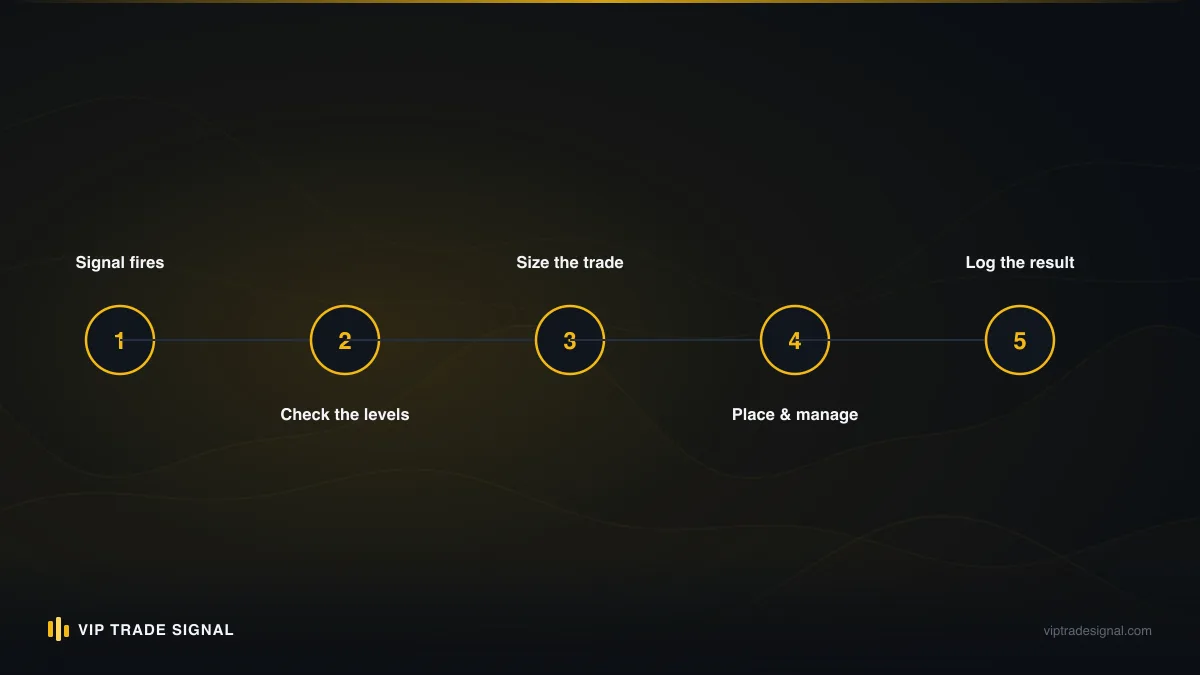
Stage one: the macro frame, before Monday. Each weekend we set the week's bias from the boring inputs: the real yield trend, the dollar's posture, the calendar's red folders, ETF and central bank flow, any live geopolitical premium. The output is deliberately crude, one of three states: favour longs, favour shorts, or two-sided. This frame doesn't generate a single trade. It exists to veto them.
Stage two: the map, daily. Before London each day we mark the levels that matter on the 4-hour and 1-hour: prior day's high and low, the week's untested swing points, the zones where price reversed hard on volume. Usually that's four to six prices, written down before the session so they can't be redrawn to flatter whatever happens next. Levels invented after the move are astrology.
Stage three: the trigger, rules only. A setup exists when price reaches a mapped level and prints a defined rejection or reclaim pattern on the 1-hour or 15-minute, in the direction of the weekly frame, outside a one-hour buffer around red-folder releases. Every clause is written. Most days two or three candidates appear and zero to two survive; the buffer clause alone kills plenty, and killing them is the system working, not the system failing.
Stage four: construction. Stops go beyond the structural invalidation point, not at a tidy dollar figure, and never tighter than the setup's logic demands just to advertise a sexy ratio. Minimum reward-to-risk of 1.5-to-1 to first target or the trade doesn't publish. Second target at the next mapped level. What you receive is entry, stop, two targets, and the one-line reason, the same anatomy every time.
Stage five: management, out loud. Updates go to the channel as the trade evolves: stop to breakeven after target one, early exits when the premise dies, the loss posted with the same promptness as the win. Then the closed result lands on the public record, and the live signals feed carries the next one. That's the whole machine. No genius, no black box, and a losing week every so often, which the record shows because pretending otherwise would insult you. Trading leveraged gold is high-risk; a process controls the risk, it doesn't abolish it.
"AI-generated signals" and what that phrase actually hides
Somewhere around 2023 every third signal channel discovered its bio needed the letters A and I. "AI-powered analysis." "Machine learning entries." Occasionally, gloriously, "quantum AI". So let's separate what machine learning can genuinely do in this domain from what the phrase is being used to sell.
The real capabilities are real. Models can classify chart patterns at scale and with more consistency than a tired human. They can process news sentiment across thousands of sources in seconds. Large funds have used statistical learning in execution and screening for a decade, unglamorously and profitably at the margins. A signal desk that uses machine classification to shortlist candidate setups for human review is doing something entirely sensible, and some do.
But notice what that sensible version is: method four or a method two-and-four hybrid with newer maths. It inherits every validation question we raised about algorithms, and adds harder ones. Financial time series are close to the worst-case input for machine learning: brutally noisy, non-stationary (the rules of the game change mid-game), and thin on truly independent samples. Overfitting isn't a risk here, it's the default, and modern models are so flexible they can memorise noise more convincingly than any 1990s indicator ever could. The gap between "our model backtests at 71%" and "our model makes money live, after costs, this year" is where nearly all retail AI claims go to die.
So treat "AI" in a signals context as a claim requiring more evidence, not less. The questions that cut through are the unglamorous ones: what does the model actually decide versus what do humans decide? What data was it trained on, and has it been tested on data it never saw? What happened to its live performance during the last violent regime shift? A provider using machine learning seriously will have crisp, slightly boring answers. A provider using it as a costume will pivot to the staircase screenshot within two messages. For what it's worth, our own use of automation is deliberately narrow: scanning and alerting on our mapped levels, so a human never misses a level being hit. The decisions, every one, are made by the rules and the people accountable for them. Less impressive in a bio. Easier to stand behind.
Questions to ask before you join anything
Where does all this leave you, practically? With a short interrogation that any provider worth $99 a month can pass in ten minutes, and most can't pass at all. Run it before your card comes out, on us as much as anyone.
- "Which method generates your signals?" You now know the five. A provider who can't place themselves on that map in one sentence hasn't got a method, they've got a vibe.
- "Show me the full closed history, losses included." Not screenshots. A running public record, ideally timestamped as trades closed. Refusal ends the conversation; a record that shows a plausible losing rate continues it. Anyone above roughly 85-90% wins over a long sample is either scalping ten-pip targets against fifty-pip stops or lying, and both cost you the same in the end.
- "Walk me through one specific losing trade." The single highest-signal question in the industry. Real desks talk about their losses fluently because they've reviewed them. Copiers and vibes-merchants have nothing, because you can't review a decision you never made.
- "What market conditions hurt your approach?" Every method has a worst regime; you've just read a table of them. "None, our system adapts to everything" is a confession.
- Then demo it for four weeks anyway. Take every signal on paper or a demo account, at your real reaction speed. The month costs you nothing and converts claims into your own data.
Notice that none of these questions is "what's your win rate", and none of the good answers involves a Lamborghini. The whole game is checking that a real generation process exists, matches the instrument, and survives being looked at. That's it. Providers who welcome the audit are, in our experience, the only ones worth auditing.
We'll take our own medicine here rather than end on a flourish: we're a rules-based technical desk with a fundamental veto, gold only, and our entire record, red weeks included, sits at /signals/history for exactly this interrogation. Run the four-week demo on us before paying anything; the signals exist either way, and gold isn't going anywhere. And if a shinier channel won't survive the same five questions, you already know which method they're running. It's the fifth one.