A message lands in your Telegram at 14:32. "GOLD BUY NOW 3342 SL 3334 TP 3350 3358 3370." Fourteen words, no punctuation, and somewhere between this message and your broker's order ticket you have to make about six decisions. Market order or pending? Full size on one position or split across the three targets? What happens if price is already at 3,346 by the time you've read it? The signal doesn't say. Most never do.
Learning how to read forex signals properly is not glamorous. It is closer to learning to read a train timetable than learning to trade. But I have watched more accounts get hurt by misread signals than by bad ones. A perfectly decent call, entered late, sized wrong, with the stop placed on the wrong side of a zone, loses money for the follower while the provider posts a green screenshot. Both are telling the truth. That gap is the whole subject of this article.
So we're going to do the unglamorous thing and go line by line. Pair, direction, entry, stop, targets, the messages that come after, and the lines that are missing on purpose. By the end you should be able to look at any signal from any provider and know, within ten seconds, exactly what it's asking you to do, or know that it's deliberately not telling you.
The standard format, and why almost nobody sticks to it
There is a canonical shape to a trading signal, and it looks like this:
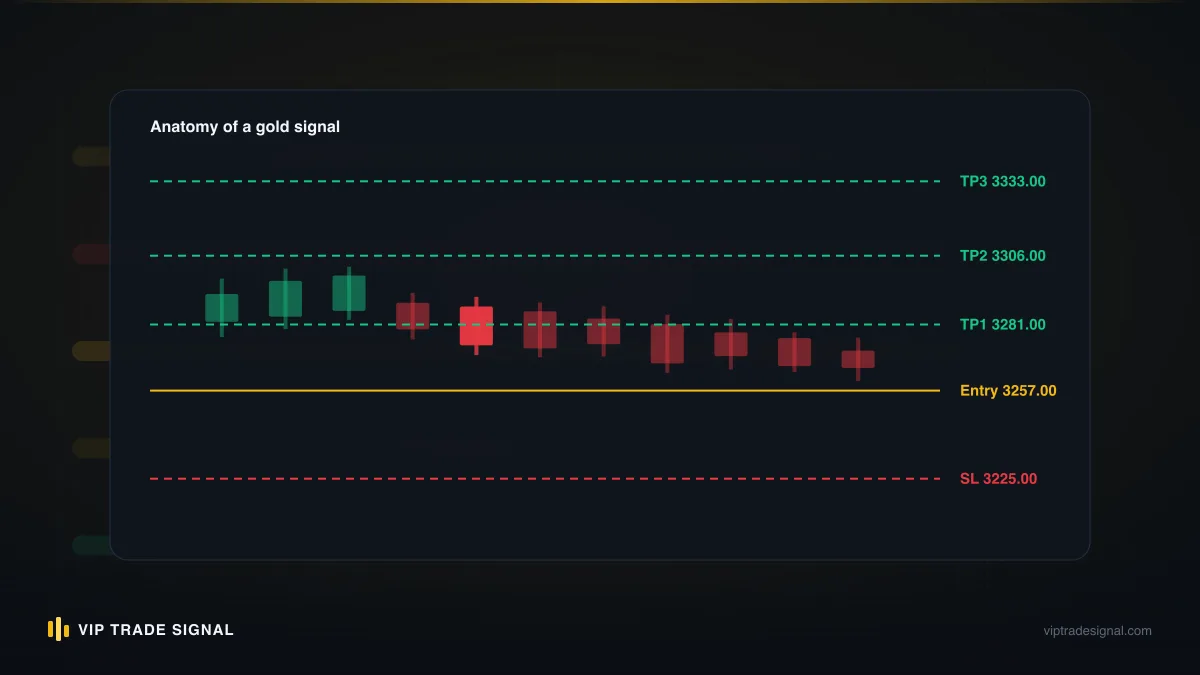
``` XAU/USD — SELL Entry: 3,348 Stop loss: 3,356 Take profit 1: 3,340 Take profit 2: 3,330 Take profit 3: 3,318 ```
Five pieces of information. Instrument, direction, where to get in, where you're wrong, where to get out. That's the anatomy of a forex signal: entry, stop loss, take profit, wrapped around a pair and a side. Everything else a provider adds is either genuinely useful context (timeframe, reasoning, risk suggestion) or decoration.
In practice you will almost never receive a signal that clean. You'll get "GOLD SELL 3348/3352" with the stop implied. You'll get "BUY NOW" with no entry price at all. You'll get TP levels labelled in pips instead of prices, or prices instead of pips, sometimes both in the same channel within the same week. Some of that is sloppiness. Providers are often trading while they post, typing with one thumb, and formatting discipline is the first thing to go.
But some of it is not sloppiness, and this matters. A vague signal is a flexible signal, and a flexible signal can be graded generously after the fact. Keep that thought; we'll come back to it with examples, because spotting deliberate ambiguity is arguably the most valuable decoding skill you can build.
One more framing point before the line-by-line. A signal is an instruction set, not a prediction. The provider is not telling you gold will go up. They're telling you: here is a trade where the entry, the invalidation point and the targets create a payoff we think is worth taking. Wins and losses are both normal outputs of that process. On our own desk, every closed call sits on the public signal history with the red ones left in, because a signal reader who has never seen the provider's losses hasn't actually seen the provider.
Pair and direction: what BUY and SELL actually commit you to
The first line looks like the easy one. It usually is. But there are three traps hiding in it, and beginners fall into all three.
First, the instrument itself. XAU/USD, GOLD, XAUUSD and "Gold spot" are all the same thing: gold priced in US dollars. But GBP/JPY and GBPJPY are the same while XAU/EUR and XAU/USD are emphatically not, and I have seen a signal for gold-in-euros followed on a dollar chart by someone who couldn't work out why the numbers were 400 apart. Check the quote currency. It takes two seconds.
Second, direction. BUY means long: you profit if price rises. SELL means short: you profit if price falls. Simple. Except providers muddy it with jargon, so here's the translation table you'll actually need. "Long" is buy. "Short" is sell. "Bearish on gold" means they want to sell it. "Looking for downside" is a sell. "Fade this move" means trade against the current direction, so if gold just spiked up, a fade is a sell. If a signal says SELL and every line under it only makes sense for a buy (stop below entry, targets above), the provider has fat-fingered the direction, and it happens more often than anyone admits. The internal logic is the truth: the stop should always sit on the losing side, targets on the winning side. When direction and structure disagree, trust the structure or skip the trade entirely.
Third, the quiet commitment you're making. A SELL on gold at 3,348 with a stop at 3,356 isn't just "I think gold falls". It's "I think gold falls before it rises eight dollars". Direction plus stop is a statement about path, not destination. Gold can end the week at 3,300, exactly as the provider predicted, having first tagged 3,357 and stopped you out on Tuesday. Both things happened. Your account only experienced one of them. Understanding that a signal is a path bet, not a forecast, is the difference between reading signals and merely receiving them.
And a small practical note: check the line for a suffix like "scalp", "intraday" or "swing". That single word changes how long you should expect to hold and how much heat is normal, and it's routinely ignored.
The entry: single price, zone, or "now" — and what each one implies
The entry line comes in three species, and each implies a different order type at your broker.
A single price. "Entry: 3,342." If price hasn't reached it yet, this is a pending order: a buy limit if the entry is below current price, a sell limit if it's above, a stop order if the provider wants to enter on a breakout through the level. Most signal entries are limit orders, meaning the provider wants a pullback into the level before committing. The honest implication of a single-price entry is that if price never comes back to 3,342, there is no trade. That discipline costs the provider some wins, which is exactly why the sloppier ones avoid it.
A zone. "Entry: 3,340–3,346." Zones are legitimate. Gold is a fast market that regularly moves $3 to $5 in a minute around news, and pretending a level is a single tick wide is false precision. A zone tells you to build the position inside the range, or to place one order in the middle of it. The reasonable reading of a buy zone of 3,340–3,346: set a limit around 3,343, or split into two orders at 3,345 and 3,341. What a zone must never be is wider than the distance to the stop. A buy zone spanning $6 with a stop $7 below the zone's bottom means your actual risk depends entirely on where inside the zone you filled, and it can range from $7 to $13. Same signal, near-double the risk. When we cover unfalsifiable signals below, oversized zones are exhibit A.
"Now." The provider entered at market and wants you to do the same. The problem is that "now" is a moving target. The message was typed at one price, delivered at another, read by you at a third. If gold was at 3,342 when they hit send and it's at 3,347 when you read it, entering "now" gives you a trade with $5 less profit potential and $5 more risk than the one being advertised. My rule, and I'd suggest you steal it: a "now" signal is valid only within a defined slippage budget from the quoted price. On gold I use about $2. Beyond that, either wait for a pullback to the original level or let the trade go. There will be another one. There is always another one.
The entry line also silently answers a question beginners rarely ask: how urgent is this? A limit order into a zone can sit for hours. "NOW" means minutes. If a provider never distinguishes between the two, they're not thinking about your execution at all.
The stop loss: the only line that defines your risk
If you take one thing from this piece, take this. The stop loss is not a suggestion, not decoration, and not the provider's problem. It is the line that converts a signal into a defined-risk trade, and it's the only line on the page that tells you how much you can lose.
Here is how the arithmetic actually works, because "manage your risk" is useless without numbers. Say the signal is a gold buy at 3,342 with a stop at 3,334. That's $8 of risk per ounce, and on the standard retail gold contract 0.01 lots is one ounce, so every 0.01 lots you hold turns that stop into an $8 loss. Concretely: a 0.10 lot position loses $80 if that stop is hit. If you're running a $2,000 account and risking 1% per trade, you have $20 of room, so your size is 0.02 lots, maybe 0.03 if you round bravely. Not 0.10 because the number felt normal, and not 0.50 because the last three signals won.
Notice what just happened there. The signal gave you the stop distance; your account gave you the risk budget; the position size fell out of the division. The provider cannot do that last step for you because they don't know your balance. Any signal that includes a fixed lot size ("BUY 0.5 LOTS") is either assuming an account size you probably don't have or not thinking about the question at all. Treat fixed-lot instructions as noise and size from the stop distance every time. We keep a longer walkthrough of this in the FAQ, because it's the single most common question new subscribers ask, and honestly it should be.
Now the red flags. A signal with no stop loss at all is not a signal; it's a tip, and tips are how accounts die, because a position with no invalidation point has unlimited downside and a holder with no plan. A stop described as "mental" or "manage manually" is a stop that will not be honoured at 2am when gold gaps through a level. And a stop that migrates in later messages ("move SL to 3,328, giving it room") is the provider widening the definition of being right while your loss grows in real money. Widening a stop after entry is the one behaviour I'd call disqualifying. A provider who does it once will do it again, and one of those times the market will not come back.
The stop loss is the only line in a signal that costs the provider something to write honestly. Read it first, size from it, and judge the provider by how they treat it.
Take profits: one target, or the TP1/TP2/TP3 ladder
Most signals ship with a ladder: TP1, TP2, TP3, occasionally a heroic TP4 that lives mostly in the provider's imagination. A ladder is not inherently a gimmick. It reflects how a lot of real traders actually manage positions: bank some at the first level, some at the second, let a final piece run. But a ladder only means something if you know how to execute it, and the signal almost never tells you.
The standard reading, absent instructions: split your position into equal parts across the targets. Three TPs, three thirds. A gold buy from 3,342 with TPs at 3,350, 3,358 and 3,370, done in thirds with an $8 stop, gives you a blended reward of roughly $12 per ounce against $8 of risk, a shade better than 1.4-to-1. Run the same numbers taking the whole position off at TP1 and you get 1-to-1, a coin flip's payoff that requires much better than a coin flip's win rate to survive spread and the occasional slip. This is worth doing once with a calculator for any provider you follow: work out the blended risk-reward of their typical ladder, because the headline TP3 number is marketing and the blend is your real expectancy.
There's also a scoring problem, and here providers are graded on a curve of their own drawing. When price tags TP1 and reverses to the stop, was that a win or a loss? If you banked a third at TP1 and the rest stopped out, you roughly broke even or lost a little, depending on whether the stop moved. The provider, meanwhile, posts "TP1 HIT" and colours the day green. Neither is lying, exactly. But over a month, a channel can print twenty green checkmarks while a follower executing the same calls in thirds finishes flat or down. When you scan a provider's results page, count how they score partial fills before you count anything else. It's why we publish every closed signal, wins and losses, at full resolution rather than as a checkmark tally, and why any provider who won't do the same deserves your suspicion.
One honest note on single-TP signals: they're cleaner to grade and cleaner to execute, and I have a soft spot for them. One entry, one stop, one target, no ambiguity about what winning meant. If you're new to following signals, a single-TP provider will teach you faster than a ladder ever will. There's more on the mechanics of actually executing all this in how to use forex signals, which is the practical sibling of this decoding piece.
How to read forex signals on gold: dollars, pips and points
Gold deserves its own section because it is the instrument where signal arithmetic goes to die. Currency pairs have a settled convention: on EUR/USD, a pip is 0.0001 and everyone agrees. Gold has no settled convention, and providers exploit or trip over that daily.
Here's the mess. Gold trades at a price like 3,348.25. Some providers call a $1 move "a pip" (so 3,348 to 3,358 is "10 pips"). Others call $0.10 a pip, making the same move "100 pips". Others say "points" and mean either. So when a channel advertises "+300 PIPS ON GOLD TODAY", that's either a $30 move, which is a strong day, or a $3 move, which is Tuesday lunchtime. The screenshot looks identical. The marketing certainly reads identically.
The way out is to stop reading units and start reading prices. A gold signal with TP and SL given as actual price levels cannot lie about magnitude: entry 3,342, stop 3,334, TP 3,358 is $8 of risk for $16 of reward whatever anyone calls the increments. When a gold signal quotes only pips ("SL 80 pips"), you must convert before sizing, and the conversion you choose changes your position size by a factor of ten. Get it wrong in the generous direction and a trade you sized for a $20 loss can hand you a $200 one. That's not a hypothetical; that's the classic first-month blow-up of gold signal followers, and it's why we write every level as a price, always.
The practical decode: assume $1 = 1 pip on gold unless the provider's own numbers prove otherwise, then verify against a live chart. If their "50 pip" stop maps to a $5 distance between their quoted entry and SL prices, they're using the $0.10 convention. Check once per provider, write it down, and re-check whenever a claimed result smells too large. Gold moves $20 to $40 on an ordinary day and more when the Fed clears its throat, which is exactly why it attracts both the best and the worst of the signal industry. If you want the fuller picture of the metal's behaviour, session rhythms and why it trends the way it does, that's covered in how to trade gold.
Ten real formats, decoded side by side
Below are ten signal formats, lightly anonymised, all shapes I've genuinely seen across the industry. Read the decode column, but more importantly read the "what's off" column, because half of decoding is noticing what a format quietly permits.
| # | The signal, as sent | Decoded | What's off |
|---|---|---|---|
| 1 | XAU/USD SELL 3,348 / SL 3,356 / TP 3,340, 3,330 | Sell limit at 3,348, $8 risk, two targets | Nothing. This is the standard. |
| 2 | GOLD BUY NOW!! TP 3,360 TP 3,375 SL BELOW SUPPORT | Market buy, targets given | "Below support" is not a price. Risk is undefined. Skip. |
| 3 | BUY GOLD ZONE 3,335–3,345, SL 3,329, TP OPEN | Buy anywhere in a $10 zone | Zone wider than the stop distance from its bottom; "TP open" means any exit can be claimed as the plan. |
| 4 | XAUUSD SHORT @3,352, SL 3,357, TP1 3,344 TP2 3,338, risk 1% | Sell limit 3,352, $5 stop, ladder, sizing guidance | Nothing. The risk note is a good sign. |
| 5 | Gold looking bearish, watch 3,350 | Not a signal. A mood. | No entry, no stop, no target. Gradeable as a win whatever happens. |
| 6 | BUY 3,342 SL 30 PIPS TP 90 PIPS | Buy limit with pip-denominated levels | Which pip? $3/$9 or $30/$90? Tenfold sizing ambiguity. |
| 7 | SELL GOLD 3,348, NO SL NEEDED, STRONG RESISTANCE | Sell with no stop | Disqualifying. "No SL needed" has ended more accounts than any news event. |
| 8 | VIP ONLY: BUY 3,340, SL 3,332, TPs in premium chat | Half a signal as advertising | The free feed will only ever show you the entries that worked. |
| 9 | XAU BUY 3,341.50, SL 3,336.20, TP 3,352.80, close 50% at TP, trail rest | Precise levels plus a management plan | Nothing. Rare, and worth noticing when you see it. |
| 10 | GOLD BUY LAYER 3,340 / 3,332 / 3,324, SL 3,310, TP 3,365 | Three averaged entries, one deep stop | Layering triples exposure as price falls; the $30 blended stop means the real risk is far larger than it looks. |
Formats 1, 4 and 9 are followable as written. Formats 2, 3, 5 and 7 should be discarded on sight. Format 6 is followable only after you've pinned down the provider's pip convention. Format 8 isn't a signal, it's a funnel. And format 10 is followable only if you understand that a three-layer entry with a wide stop is one large trade wearing a trench coat: size the total position off the worst-case fill and the full stop distance, or don't take it.
Vague on purpose: the unfalsifiable signal
Now the uncomfortable section. Some ambiguity is laziness. Some is engineered, and the engineering has a clear purpose: to make the signal impossible to score as a loss.
Think about what each kind of vagueness buys the provider. A missing stop means no trade can officially be stopped out, so losers become "still running" until everyone's forgotten them. A "TP open" or "targets: let it run" line means any favourable wiggle, even $1.50, can be screenshotted as the intended win. An entry zone spanning $10 means that whichever end of the zone would have produced the better result is, retroactively, where "we" entered. "Watch 3,350" with no direction is the purest form: gold will do something at 3,350, and whatever it does can be framed as the call.
The test I use is falsifiability, borrowed shamelessly from the philosophy of science. Before taking any signal, ask: is there a specific price at which this signal is definitively, publicly wrong? For format 1 above, yes: 3,356 trades, the signal lost, everyone can see it. For "gold looking bearish, watch 3,350", no such price exists. A signal that cannot lose is not a strong signal. It's not a signal at all, because it carries no information you can act on and no accountability you can check.
This is also why unfalsifiable formats cluster in free channels. The free feed's job in that business model is not to make you money; it's to accumulate a highlight reel that sells the paid tier. Ten vague calls generate ten claimable wins, the losing interpretations quietly evaporate, and the pinned message reads "94% accuracy". We went deep on what paid tiers actually deliver, and what they cost against the alternatives, in paid forex signals, but the short version is that the formatting of the free feed tells you nearly everything about the honesty of the paid one. A provider who is vague when it's free will find new ways to be vague when it's $150 a month.
None of this means a precise signal is a good signal. Precision measures honesty, not skill; a provider can be exact and still be wrong half the time, which, said plainly, all of us are more often than the marketing implies. Losing trades are a running cost of this business. Precision just guarantees the losses are visible, and visible losses are the only foundation a real track record can stand on.
The messages after the signal: updates, closes and breakeven calls
A signal is rarely one message. It's a thread, and the follow-ups need decoding just as much as the original. Here are the ones you'll actually see, translated.
"Move SL to breakeven" means shift your stop to your entry price, so the worst remaining outcome is roughly zero (minus spread and any slippage, which on gold around news can be a real number, not a rounding error). It's a risk-off instruction. Its cost is real too: gold loves to revisit entries before continuing, and a breakeven stop converts many would-be winners into scratches. When a provider calls breakeven, the trade's risk profile just changed, and if you skip the instruction you are now in a different trade from the one being tracked.
"Close 50%" or "partials off at TP1" means take half (or the stated fraction) of the position off at market. If you followed the ladder logic from earlier, this may already be your plan; if the provider calls it early, they're reading danger the chart hasn't confirmed. Fine either way, but note it, because how the trade is scored later depends on it.
"Close now" mid-trade is the provider overriding their own levels. Occasionally that's discipline: news is coming, the setup's invalidated, get flat. Done occasionally, it's a mark of a live human managing risk. Done constantly, it means the posted SL and TP were never the real plan, and the track record built on them is fiction, because no follower could have matched the improvised exits.
Silence is the follow-up nobody talks about. A trade hits the stop and the channel simply moves on, no confirmation, no accounting. Track a channel for two weeks and count: signals posted versus outcomes explicitly closed out. In an honest operation the numbers match. In most, they don't, and the gap is precisely the losses.
Two practical habits make follow-ups manageable. Turn notifications on for the signal channel while you have an open position, because a breakeven call you read three hours late is worthless. And keep your own log: entry, stop, size, and each instruction with a timestamp. Thirty seconds per trade, and at month's end you have something no screenshot can fake, which is your own executed record of what following this provider actually returned.
What's missing from most signals (and what the absence tells you)
You now know how to read the lines that are present. The sharper skill is noticing the ones that aren't, because omissions are choices, and they compound in the provider's favour.
No timeframe or holding window. Is this a forty-minute scalp or a two-week swing? Without it you can't judge whether being $4 underwater an hour in is normal heat or a failing trade. Providers omit it because an unlabelled trade can be reclassified after the fact: the losing scalp becomes "a swing that needs patience".
No reasoning. A line of logic ("selling the retest of yesterday's broken support at 3,350") doesn't need to be an essay, but its presence proves a human made a decision, and it lets you learn something even when the trade loses. Its absence across an entire channel suggests the signals are recycled, generated, or copied from someone else's feed, all three of which are rampant.
No risk guidance. The best formats say "risk 0.5–1%". Its absence isn't disqualifying, since sizing is ultimately your job, but combined with fixed-lot instructions it tells you the provider isn't picturing a real account on the other end.
No spread or timing awareness. Gold spreads at a typical retail broker widen from around $0.30–$0.50 in calm hours to several dollars in the seconds around a red-news release. A provider who posts tight-stop scalps into those windows either doesn't know or doesn't care that followers' fills will be worse than theirs. Signals timed thoughtfully around sessions and news are a quiet mark of someone who has actually executed at retail.
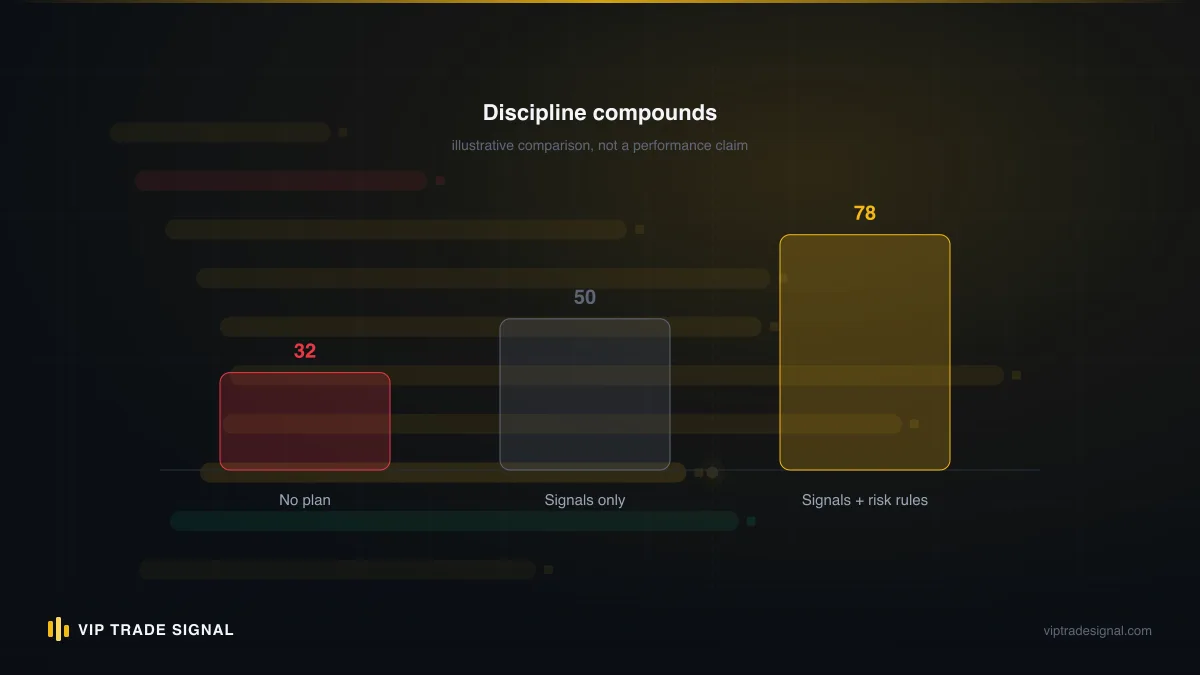
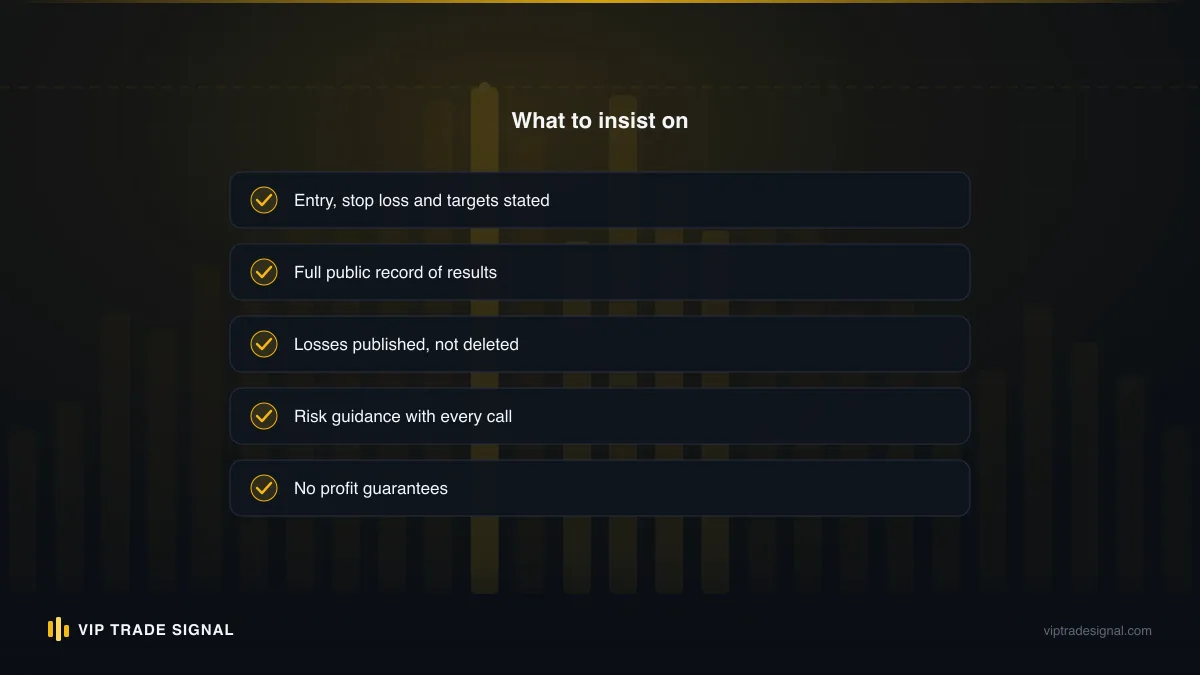
No history. The big one. Every claim a provider makes is downstream of whether you can see their full closed record, priced and dated, losses included. A channel that shows you only pinned screenshots is asking you to audit a business from its adverts. Any provider worth paying can show the whole ledger; ours is public at /signals precisely because we'd rather lose a subscriber to an honest red month than keep one with a cropped screenshot. High-risk products deserve that much, and forex and gold CFDs are exactly that: most retail accounts lose money, and a signal service changes who makes the decisions, not the risk of the instrument.
Practice set: decode these five yourself
Reading about decoding is like reading about swimming. Here are five signals. For each, decide: what's the order type, where's the risk, is it followable, and would you take it? My answers follow, but genuinely try them first.
- `XAU/USD BUY 3,338, SL 3,331, TP 3,352`
- `GOLD SELL NOW FROM 3,355, TP1 3,347, TP2 3,336, SL 3,363`
- `BUY GOLD, ENTRY 3,330–3,344, SL 3,326, TP 3,360+`
- `XAUUSD SELL 3,351, SL 60 PIPS, TP 180 PIPS`
- `GOLD: big move loading. Key level 3,340. Be ready.`
One. A buy limit at 3,338 (assuming price is above it), $7 of risk, $14 of reward, exactly 2-to-1. Followable as written. On a $2,000 account at 1% risk, that $7 stop prices you at 0.02–0.03 lots. Take it or not on the merits, but the signal itself is honest.
Two. A market sell, but "from 3,355" gives you the reference price, which is the considerate way to write a NOW signal. Check the live price: within a couple of dollars of 3,355, it's followable with an $8 stop and a blended two-target reward around $13.50. If gold's already dropped to 3,349 by the time you read it, most of TP1 is gone and the entry is stale. Let it go.
Three. A $14-wide entry zone with a stop $4 under the zone's bottom. Fill at the top and your risk is $18; fill at the bottom, $4. That's not a risk plan, it's a lottery ticket about your fill, and "TP 3,360+" is unfalsifiable garnish. Discard.
Four. The pip trap from earlier. If this provider means $1 pips, it's a $60 stop, which on gold is a multi-day swing trade; if $0.10 pips, a $6 stop and an intraday setup. You cannot size this without knowing the convention, so until you've verified it against their past signals, this is unreadable. Not wrong. Unreadable, which for your purposes is the same thing.
Five. Not a signal. No direction, no entry, no stop, no target. Whatever gold does at 3,340, the channel will claim it called. This is content, and its job is engagement, not your P&L.
Score yourself honestly. Four or five right and the rest of this industry's formatting games will mostly bounce off you. Two or fewer, reread the entry and stop sections before you follow anything with real money, and consider paper-following a provider for a couple of weeks first, checking your decode of each signal against what their own recap says it meant.
The decoding card: where this leaves you
Here's the whole article compressed into the checklist I'd want taped next to a new trader's screen. Run every incoming signal through it, in order, before your hand goes anywhere near an order ticket.
- Instrument and direction confirmed? Right pair, right quote currency, and the stop sits on the losing side of entry. If direction and structure disagree, skip.
- Entry type identified? Single price means a pending order. Zone means orders inside it, and the zone must be narrower than the stop distance. "Now" is valid only within your slippage budget, about $2 on gold.
- Stop loss is a price? Not "below support", not "mental", not absent. No price, no trade. Ever.
- Size from the stop. Stop distance times your per-trade risk budget gives the lot size. A $2,000 account risking 1% has $20 of room, full stop. Ignore any lot size printed in the signal.
- Targets and the plan for them. Ladder means thirds unless told otherwise; work out the blended risk-reward, and be suspicious of anything under about 1.5-to-1 as a habit.
- Gold units verified. Prices beat pips. If pips, confirm the provider's convention once and write it down.
- Falsifiable? Name the exact price at which this signal is publicly wrong. Can't name one? It isn't a signal.
- Follow-ups on. Notifications live while a position is open; every breakeven and close instruction logged with a timestamp.
- The ledger exists. Somewhere, this provider shows every closed trade, red included. If they don't, everything above is decoration on an advert.
That's it. Nine checks, ten seconds each once they're habit, and they filter out the majority of what circulates on Telegram before it can touch your account.
I'll end with the opinion the whole piece has been building toward. The signal industry's dirty secret is not that providers lose trades. Everyone loses trades; we lose trades, in public, monthly, and anyone who claims otherwise is selling something other than trading. The secret is that most providers write their signals so that losing is structurally impossible to pin on them, and most followers never learn to read closely enough to notice. You now read closely enough to notice. Whether you follow our gold signals, someone else's, or nobody's at all, hold every message you receive to the standard of format 1 in that table: five lines, all prices, one point of public failure. The providers who can live with that standard are the only ones worth a minute of your screen time, and the ones who can't have just saved you a subscription fee.