Search Telegram for "gold signals" and you'll get hundreds of channels in half a second. Golden Eagle VIP. XAUUSD Sniper Pro. Free Gold King. Most have a lion or an eagle in the logo, a pinned message full of green ticks, and a subscriber count that would make a mid-sized newspaper jealous. And almost all of them will lose you money.
That's not cynicism for its own sake. It's arithmetic. Running a genuinely good gold signal desk is hard, slow, expensive work. Running a gold signals Telegram channel that merely looks good takes about an afternoon and a screenshot editor. When the fake version costs 1% of the effort and captures 90% of the audience, the market fills up with fakes. Gresham's law, but for trading channels.
We run one of these channels ourselves, so read everything here knowing that. But we've also spent years watching the other side of this industry operate, and the vetting process below doesn't favour us or anyone else. It favours channels that publish everything and hide nothing, and it will disqualify most of what you're currently subscribed to. Give it a week and a notebook. That's all it needs.
Why gold owns Telegram signal marketing
Walk through the numbers and it makes uncomfortable sense. Gold moves. On an ordinary day XAU/USD covers 200 to 400 pips of range; on a hot CPI day it can do 600 or more. Compare that with EUR/USD grinding out 60 pips and you see the marketing appeal immediately. Big ranges mean big pip counts, and big pip counts make spectacular results posts. "+380 PIPS TODAY" simply isn't available to a channel calling EUR/USD trades, however good they are.
Gold is also the instrument retail traders arrive wanting to trade. It has a story. Everyone's grandmother understands gold in a way she does not understand the Swiss franc. New traders in Nigeria, Bangladesh, Vietnam, the Gulf and everywhere else open their first MT5 account and go looking for XAUUSD before they've learned what a pip is worth on it. The channels know this. They fish where the fish are.
And there's a third, less obvious reason: volatility hides incompetence. A gold channel that fires signals at random will still land a decent run of winners purely because the instrument travels far enough to hit almost any take-profit eventually, provided the stop is wide or absent. A trending week can make a coin-flip caller look like a prophet. The same random caller on a quiet cross pair would be exposed in a fortnight. On gold, the reckoning arrives later, usually in one violent session that hands back a month of gains, and by then the channel has already banked its referral commissions and moved its audience to a fresh channel name.
So the density of rubbish in xauusd signals telegram search results is not an accident. It's the predictable output of an instrument that flatters bad callers and photographs well. Which means your filter has to be better than the average subscriber's, because the channels are optimised precisely for the average subscriber.
What separates a real gold channel from a generic forex one
Plenty of channels tack "GOLD" onto the name and call the same trades they'd call on any pair. It shows. Gold has habits that a specialist respects and a generalist tramples.
Session behaviour, first. Gold does most of its honest travelling in the London and New York sessions, with the overlap around 13:00 to 16:00 UK time being where the real range gets built. The Asian session is usually a drift. A channel firing five Asian-session gold scalps a night either knows something unusual or, far more likely, is generating activity for its own sake. Activity keeps subscribers engaged. Engagement, not profit, is what the channel is optimised for.
Second, stop distance. A 20-pip stop on EUR/USD is a position; a 20-pip stop on gold is a donation to your broker. Ordinary intraday noise on XAU/USD runs 30 to 80 pips, so honest gold stops tend to live in the 80 to 250 pip range depending on the setup, and honest position sizes shrink to match. We've written a full piece on how stop placement on gold actually works if you want the mechanics. The short version for vetting purposes: a channel posting tight 25-pip gold stops with big lot suggestions is either inexperienced or knows the stops will be hit and doesn't care, because the results posts only ever show the winners.
Third, news respect. Gold is the most macro-sensitive instrument retail traders commonly touch. NFP, CPI, FOMC, and lately every stray comment about rate cuts, can move it 300 pips in minutes and blow through stops with 100 pips of slippage. A specialist channel flags these dates, flattens or warns ahead of them, and says so. A generic channel sails into NFP with a pending order and then quietly deletes the loser.
Fourth, levels that mean something. Gold respects round numbers and prior structure to an almost superstitious degree, and a channel whose entries cluster at sensible zones (we cover this in our piece on gold support and resistance) is showing its working. Entries scattered at arbitrary prices with no reference to structure suggest the "analysis" is a random number wearing a chart.
None of these four things guarantee profitability. But their absence is close to disqualifying, and you can check all four from the public feed without spending a penny.
How to score gold signals Telegram channels: the 10-point rubric
Here's the core of this article, and the thing to actually use. Ten checks, one point each, scored over one week of watching a channel without trading it. Anything scoring 7 or better earns a paper-trading trial. Anything at 4 or below gets muted and forgotten, whatever its subscriber count says.
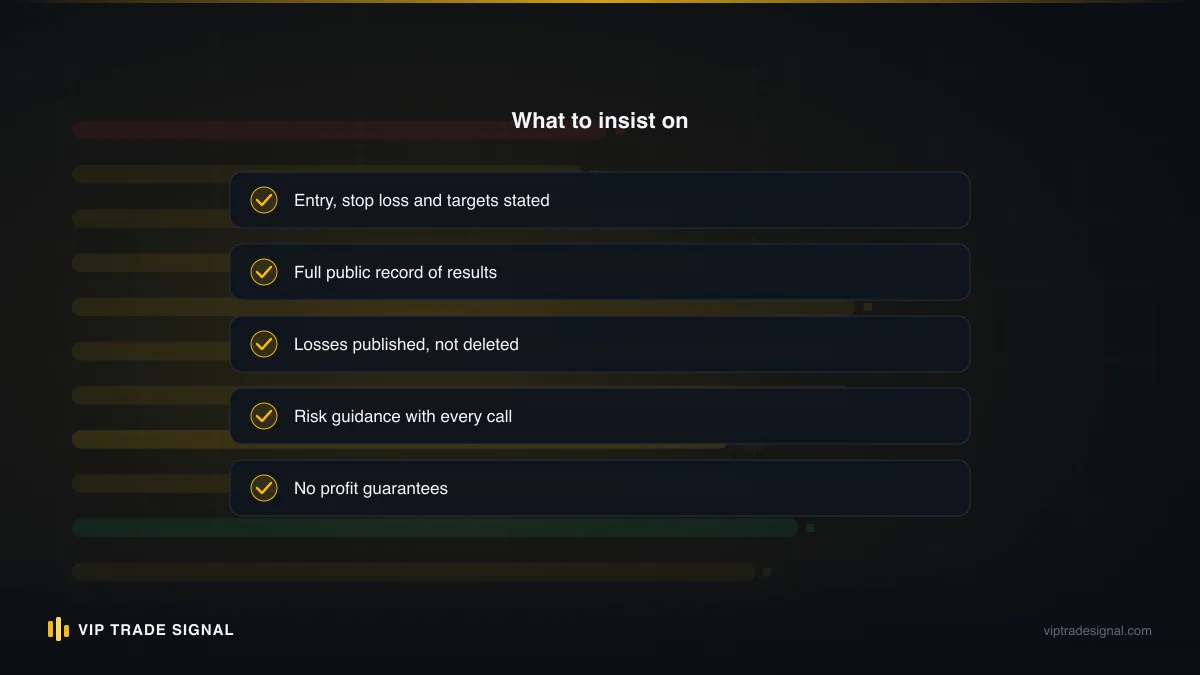
- Every signal has an entry, a stop, and at least one take-profit, posted before the move. Not "buy gold now", not a screenshot of a trade already in profit. A complete, timestamped instruction you could have acted on. One point.
- Losses are posted with the same formatting and prominence as wins. Scroll the history. If wins get poster-sized graphics and losses get a one-line mention or nothing, zero.
- Signal frequency is sane. One to four gold setups a day is a working desk. Ten or fifteen is a content mill. Fewer signals, taken seriously, is a good sign, and yes, that surprises people.
- Stops are gold-sized. Mostly 80 pips or wider on intraday setups, per the section above. Point for sanity, zero for 20-pip fantasy stops.
- Risk is stated per trade, in percent, not lots. "Risk 1%" travels across account sizes. "5 lots" on an unknown account size is meaningless, and usually reckless.
- The channel survives news weeks. Watch how it behaves around one red-folder release. Warning ahead, standing aside, or explicitly managing exposure scores the point.
- Message history is intact. Telegram shows edits and lets admins delete. Spot-check: screenshot three open signals when posted, compare against the channel's history two days later. Any vanished loser is an automatic zero on this check and honestly should end the whole trial.
- No guaranteed anything. "90% accuracy", "guaranteed 500 pips weekly", "no-loss strategy" are not marketing enthusiasm, they're tells. Losing months are normal in this business; a channel that has never had one is lying about something.
- The business model is visible and honest. Paid subscription, clearly priced? Fine. Broker partnership, openly disclosed? Fine. "Free VIP access, just register with this broker link and deposit $500"? That's an affiliate funnel, and you're the product. More on that below.
- The admin answers hard questions. DM them the questions in the section near the end of this piece. Evasion, flattery or pressure to deposit scores zero.
Score honestly, especially on checks 2 and 7, because those are where the industry's whole illusion lives. A channel that publishes full history and states risk properly is already in the top few percent of what's out there, which says less about that channel than it does about everything else.
Reading a channel's history for cherry-picking
Cherry-picking is the industry's core technology, so learn to spot the harvest.
The crude version is deletion. Signal posted, signal loses, signal disappears. Your defence is the screenshot habit from check 7: capture signals at post time, audit later. It costs you thirty seconds a day and it is the single most effective vetting technique that exists, because no manipulation survives it.
The subtler version is selective celebration. Nothing gets deleted, but wins get graphics, tallies and pinned recaps while losses sit unremarked in the scroll. Over a month, subscribers remember a winning channel even when the arithmetic says otherwise. Count for yourself. Take a fixed 30-day window, tally every completed signal at its stated stop and first take-profit, and compute the pip total nobody posted. Do it once and you'll never trust a channel's own recap again.
Then there's the multi-TP shuffle, which deserves its own paragraph because gold channels lean on it hard. A signal goes out with TP1 at +40 pips, TP2 at +100, TP3 at +250, and a stop at -120. If price grazes TP1 then reverses to the stop, the recap says "TP1 HIT, +40 PIPS" and counts a win. If it runs to TP3, the recap counts +250. The losers, meanwhile, count once at -120, except the channel often "moved stop to breakeven after TP1", which converts many losers to zeros in the record. Run the honest version: assume one position, closed half at TP1 and half at stop-or-TP2, and recompute the month. Channels that look like +2,000 pips routinely come out flat or negative under that single, fair assumption.
A signal history you can't audit isn't a history. It's an advert with timestamps.
A worked example makes the shuffle concrete. Say a channel posts 40 signals in your window. Twenty-two touch TP1 for +40 pips each, and of those, nine run on to TP2. Eighteen hit the -120 stop, but eleven of them "went to breakeven" first in the channel's telling. The recap reads: 31 wins, 7 losses, roughly +1,400 pips, an 82% win rate. Your honest single-position ledger of the same 40 signals reads closer to minus 300 pips. Same trades. Same prices. Two entirely different months, and only one of them happened to anyone's actual account.
One more trick: the resurrection channel. A network runs five channels under different names, calls opposite directions across them, then heavily promotes whichever ones had a hot month while quietly abandoning the rest. Survivorship bias, industrialised. You can't detect this from inside one channel, which is exactly why long, continuous, unbroken public history matters more than any hot streak. Six weeks of brilliance means nothing. Eighteen months of intact, boring, audited history means quite a lot.
Free gold channels: the three types you'll meet
Type "best free gold signals telegram channels" into any search engine and you'll find listicles recycling the same names. What you won't find is anyone explaining who pays for all this free analysis. Someone always does. Free gold signals telegram channels come in three species, and identifying which one you're in tells you most of what you need to know.
Type one: the deposit farm. By far the most common. The channel is free because the operator is an introducing broker earning commission on every lot you trade, and often a cut of your losses at the sketchier offshore shops. The tell is the funnel: "free VIP" gated behind registering under their broker link with a minimum deposit, usually $300 to $1,000. Signal quality is irrelevant to this business; churn is the product. High-frequency signals, oversized lots and tight stops all generate commission whether you win or lose, and mostly you lose. The angrier variant then offers a "recovery service" to win back what their own signals cost you. Leave these channels. Not warily, immediately.
Type two: the teaser tier. The free channel exists to sell a paid one. You get two or three delayed signals a week, the recaps of the VIP channel's wins, and a steady drip of "VIP members caught the full move" messages. This model is at least honest about being a business, and some teaser channels front real desks. Judge the free output by the full rubric anyway, because a seller who cherry-picks the free feed is showing you their character, and character doesn't improve behind a paywall.
Type three: the genuine free feed. Rare, but real. Some funded traders and small desks publish free signals to build a track record or an audience, and some paid services (ours included) offer their full feed free when you trade through a partner broker relationship that's openly disclosed, which is how our broker-funded access works with a $250 maintained balance instead of the $99 subscription. The distinction from type one is disclosure and structure: a named broker from the regulated mainstream, the arrangement explained in plain language, no pressure, and the paid route always available if you'd rather not link a broker at all. If a channel hides how it gets paid, assume the answer is "by you, in ways you won't enjoy".
The blunt summary: free is a pricing model, not a warning sign, but undisclosed free is always a warning sign. The best xauusd signals telegram channel for you might genuinely be free. It will never be mysterious about why.
Pip-counting tricks unique to gold results posts
Gold's pricing quirks give dishonest channels room that forex pairs don't, and it's worth knowing the specific moves.
Start with the pip definition itself, because gold doesn't really have one. Some count a pip as $0.10 of price movement, some as $1.00. That's a factor of ten hiding in plain sight. A move from 3,300 to 3,310 is 100 pips under the first convention and 10 under the second, and channels switch conventions depending on which makes the post look better. Wins get counted in the small unit for a big number; the odd admitted loss shows up in the large unit looking tiny. Always translate results into dollars-per-lot or percent-at-stated-risk before comparing anything. Pips on gold are a unit of marketing, not measurement.
Then the greatest hits of the results-post genre:
- The floating-profit screenshot. An open trade showing +$1,400, posted mid-move. Open profit is not a result. You'll notice the closing screenshot never arrives.
- The demo account flex. MT5 kindly prints "demo" on the terminal, but a crop hides it. Big round balances ($100,000 exactly) and flawless streaks are the giveaway.
- The lot-size lever. "+$4,000 on one signal" is 40 pips on 1 lot or 4 pips on 10 lots. Dollar results without lot size and account size attached are noise.
- The retro-entry. A results graphic drawn after the move, with an entry arrow at the perfect low. Cross-check against what the channel actually posted, at the time, with timestamps. This is where your screenshots pay off again.
- The pip total with no denominator. "+3,200 pips this month" from a channel firing 15 signals a day at 100-pip targets is a participation trophy. Divide by signals given, then subtract the losers they didn't total.
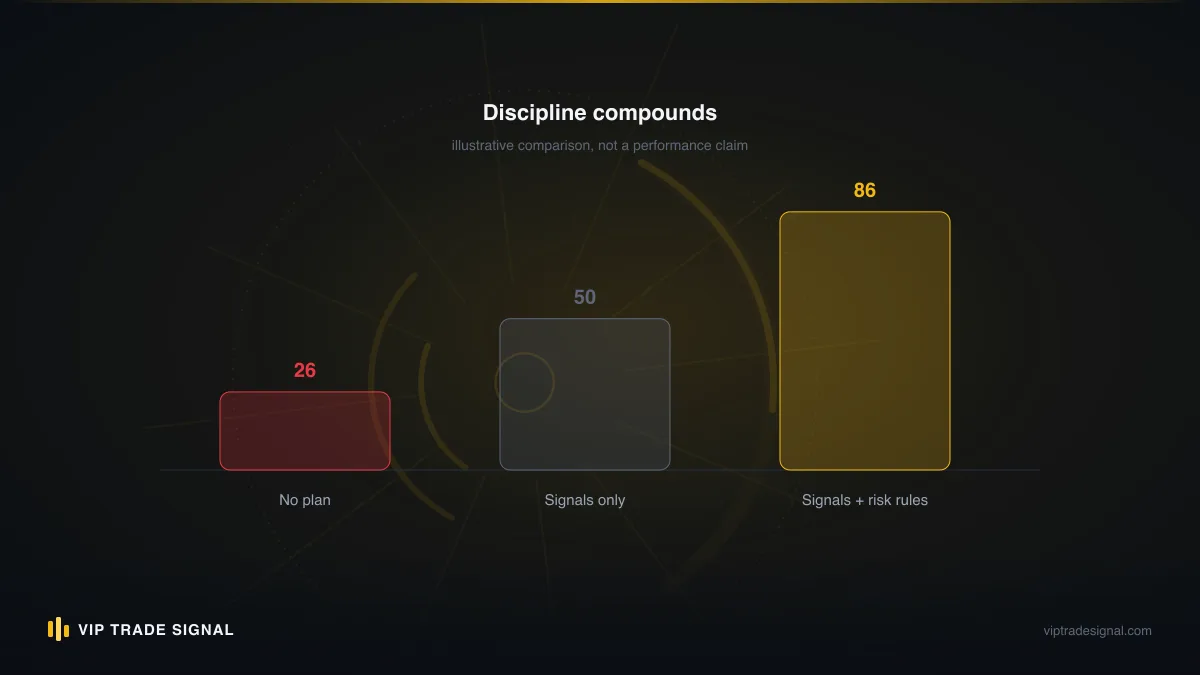
There's a pattern under all of these: results presented in whichever unit cannot be checked. Honest reporting picks one convention, states risk per trade, includes every signal, and reads like accounting rather than fireworks. Boring is the tell. When we say every one of our closed signals sits publicly at /signals/history, wins and losses in one list, that's not modesty theatre, it's the only reporting format that can't be gamed, which is precisely why almost nobody uses it.
Realistic expectations: frequency, win rate, drawdown
Vetting is only half detection. The other half is calibration, because if your expectations are fantasy, an honest channel will look disappointing next to a dishonest one, and you'll pick the liar.
So, some ranges a working gold desk actually lives in. Not promises. Ranges.
| What | Marketing fantasy | Working reality |
|---|---|---|
| Signals per day | 10-20, round the clock | 1-4, mostly London/NY |
| Win rate | "90%+ accuracy" | Roughly 45-65%, varying by month |
| Monthly return at 1% risk | "Double your account" | Low single digits to ~15% in good months; negative months happen |
| Losing streaks | Never mentioned | 4-6 in a row, a few times a year |
| Drawdown | Never mentioned | 5-15% peak-to-trough is unremarkable |
The win-rate line deserves a beat. A 55% win rate with winners averaging 1.5 times the losers is a genuinely strong signal service, the kind that compounds meaningfully over a year. It is also a service that loses nearly half its trades and will, several times a year, lose four or five in a row. At 1% risk per trade that streak feels like a bruise. At the 5% risk the deposit-farm channels push, the same ordinary streak is a quarter of your account gone, and most subscribers quit at exactly the wrong moment. The maths of the service and the psychology of the subscriber part company right there, and every honest provider knows it.
Frequency deserves one too. Gold does not offer fifteen high-quality setups a day. It offers a handful a week that are excellent and a few more that are decent, and a channel showing restraint on quiet days is displaying the discipline you're paying for. If you're curious what disciplined setup selection involves on the desk side, we've written up how our signals actually get generated, and the striking thing is how much of the process is deciding not to send things.
Calibrate on these numbers and the loud channels start looking absurd rather than tempting, which is the correct way for them to look. Anyone promising to double your money monthly on gold is describing either a fantasy or a risk profile that will eventually destroy the account. Usually both.
How to paper-trade a channel before funding anything
A channel that survives the rubric has earned a trial, not your money. The trial is four weeks of paper-trading, done with enough rigour that the result means something. Sloppy paper-trading is worse than none, because it manufactures false confidence.
The procedure, concretely:
- Set up a spreadsheet, not a demo account. Demos tempt you into "just adjusting" entries. A spreadsheet records what the channel said, verbatim: timestamp, direction, entry, stop, TPs, and the message screenshot.
- Log every signal, including ones you'd have missed. Sent at 3 a.m. your time? Log it, and flag it. If 40% of signals arrive while you sleep, the channel's results aren't available to you regardless of quality. This kills more subscriptions than accuracy does, and nobody checks it in advance.
- Apply one honest fill model. Entry counts only if price traded through it after the message timestamp. Stop is filled at stop price plus 3-5 pips of slippage (more across major news). TPs count at their price, no favourable rounding.
- Pick one management rule and freeze it. Say: half off at TP1, stop to entry, remainder to TP2 or stop. Doesn't matter exactly what, matters that you fix it in week one, because switching rules mid-trial to flatter the results is the retail version of cherry-picking, done to yourself.
- Score in R, not pips. Each trade risks 1R. A win to TP1 at half distance-to-stop is +0.5R on that half. Month-end, sum the R. Positive after honest slippage is promising. Also count the experience: the worst streak, the biggest single loser, how it felt to log five reds in a row. You're auditing your own tolerance as much as their signals.
- Compare their recap against your ledger. Publish nothing, accuse nobody, just look. A modest gap is convention differences. A chasm is your answer.
Four weeks feels long when a channel is posting daily wins and you're sitting on your hands. Do it anyway. Every deposit-farm operator relies on the subscriber who joins on a Tuesday and funds on a Thursday, and four weeks of distance is precisely the defence they have no counter for. A genuinely good service will still be good next month. A fake one usually won't survive your spreadsheet past week two.
Red flags that should make you leave immediately
Some findings don't lower a channel's score. They end the evaluation, that day. No trial, no benefit of the doubt.
- A deleted or edited losing signal. Once. This is fraud in miniature, and people who defraud you in miniature are rehearsing.
- Any recovery-service pitch. "Lost money? Our recovery experts can win it back." This preys on desperation and frequently escalates into demanding "release fees". It is a scam category of its own, and its presence tells you what business you're actually inside.
- Pressure and countdowns. "VIP closing tonight, 3 slots left" from a channel with 80,000 subscribers. Scarcity theatre exists to prevent exactly the four-week trial you're planning.
- Requests for your account password. No signal channel needs your MT4/MT5 master password, ever. Even legitimate account management (ours included) is structured so you keep the master password and control withdrawals; anyone asking for full credentials to "trade for you" from inside a Telegram DM is not managing your account, they're emptying it.
- Unregulated or unheard-of broker requirements. If free access requires a specific broker you can't find a regulator record for, the broker is the scheme.
- Guaranteed-profit language. Covered above, repeated here because it's the one people most want to excuse. "Guaranteed" in this industry is a confession.
- Admins impersonating other services. Common enough to say plainly: scammers clone real channels' names and logos, then DM users first. A legitimate admin almost never opens the DM. If "we" message you first offering a special deal, it isn't us.
Notice none of these are about win rate. Bad trading gets a channel scored down; dishonesty gets it deleted. The distinction matters because a mediocre-but-honest channel wastes some of your time, while a dishonest one is running a process on you whose final step is your deposit. Different threat categories, different responses.
Questions to DM the admin, and answers to expect
The DM test is quick and brutally revealing. Send these five questions, verbatim if you like, and grade the replies.
"What was your worst month in the last year, in R or percent?" A real desk answers with a number and no flinch: "March, about -4R" or "we gave back 6% in a choppy stretch". Evasion ("we focus on the positive"), deflection to a wins montage, or the claim of no losing months are all failures. Everyone has losing months. Everyone.
"What risk per trade do your numbers assume?" The only good answer is a percentage, stated plainly, usually 0.5% to 2%. "Depends on your account" without a baseline, or lot-size talk with no denominator, fails.
"Where can I see your complete signal history, including losses?" A link, or an honest "our full history is the channel scroll, unedited, check it" both pass. "Trust me bro" energy, in any phrasing, fails. For contrast, this question is why we keep every closed signal public at /signals/history; a provider who invites the audit has pre-answered it.
"How do you get paid?" Subscription price, disclosed broker partnership, or both. Anything that takes two paragraphs and still doesn't say fails. You're listening for whether their incentive is your trading volume or your continued subscription, because those pull in opposite directions.
"What happens to open signals across major news?" Any coherent policy passes: flatten before, widen stops with reduced size, no new entries within an hour of red folders, whatever. "We trade the news for big pips" from a retail signal channel is a slippage machine and fails.
Two failing answers out of five and you're done, regardless of how the feed looks. And note what you're really testing: not knowledge, comfort with accountability. Skilled traders talk about losses the way mechanics talk about rust, matter-of-factly, because it's the material they work with daily. Marketers talk about losses the way politicians talk about scandals. The difference comes through even in broken English over Telegram DMs, and it's very hard to fake for five questions in a row.
How our gold channel operates and reports
Since we've spent four thousand words handing you a weapon, it's fair to state plainly how we look when it's pointed at us.
VIP Trade Signal calls one instrument: gold. XAU/USD only, no 28-pair scattergun, because we'd rather be genuinely good at one market than presentable at many. Signals are unlimited, mostly London and New York sessions, every one carrying entry, stop and take-profits at post time. Access is $99 a month on the direct plan, or free with a partner broker (Exness, XM, IC Markets or Vantage) holding a maintained $250 balance, and that broker arrangement is disclosed exactly as bluntly here as we told you to demand from everyone else. The paid route exists precisely so nobody is forced through a broker link.
Reporting: every closed signal, winner or loser, is published in one public list. No deletions, no selective recaps, no multi-TP accounting games; the pricing convention is stated and it doesn't change when a month goes badly. Months do go badly. We've had losing streaks that tested our own rules and we'll have more, because that's what trading a volatile metal honestly looks like, and gold remains a leveraged, high-risk market where losing real money is a normal outcome you should size for.
Run us through the rubric. Genuinely. Screenshot our signals at post time, audit the history against them, do the four-week spreadsheet, send the awkward DMs. If we score badly on your ledger, leave, and you'll have lost nothing but a month of watching. That offer is the whole point of publishing a vetting guide: a provider confident in their process wants sceptical subscribers, because sceptics who stay, stay for years. The channels this article threatens are the ones that need you to decide within 48 hours.
Building your own top-5 test
Here's the closing move, and it's practical. Don't pick a channel. Pick five, and run a tournament.
Spend one evening shortlisting: search xauusd signals telegram, skim thirty channels, and keep any that clear the instant disqualifiers (visible losses in the scroll, complete signals with stops, a disclosed business model, no guarantee language). You'll be surprised how few survive even that sieve. If you can't find five, three will do; the scarcity is itself an education.
Then run all of them through the same four weeks simultaneously. Same spreadsheet, one tab per channel, same fill model, same management rule, same R-based scoring. Log the DM test in week one, the news-week behaviour whenever the calendar provides one, and the history audit in week four against your screenshots. Total cost: maybe twenty minutes a day. Total risked: nothing.
What tends to happen is clarifying. One or two channels disqualify themselves mid-trial by deleting a loser or launching a deposit push. One turns out to signal mostly while you're asleep. One is honest but roughly breakeven after slippage. And occasionally, one comes out of the month with a positive R total, an intact history, straight answers, and a losing streak it handled like an adult. That channel, and only that channel, earns a small live allocation at 0.5% to 1% risk per trade, scaled up slowly over months as the live results keep matching the trial. If none qualify, you fund nobody, and the tournament just saved you a deposit. That's a win. It doesn't feel like one, but check back in six months.
The uncomfortable truth threaded through all of this is that the best xauusd signals telegram channel isn't found by searching harder. It's found by testing colder. The channels are optimised to win the first 48 hours of your attention; the rubric, the spreadsheet and the DM test are how you refuse to decide inside that window. Every fraud in this industry, without exception, depends on speed. Take it away from them and most of the danger goes with it.
So: five channels, four weeks, one spreadsheet. Start the clock this week. And if you'd like a channel to include in the tournament, ours is on the list at /signals, history and all, standing for the same audit as everyone else. We'd honestly prefer you arrive that way.