A trader we'll call Danny joined a free gold signals channel in March. Forty thousand members, a pinned message full of screenshots, three signals a day, and not a single request for payment. Six weeks later he'd opened an account at a broker he'd never heard of, deposited $500, blown $370 of it following signals with no stop losses, and received a private message offering "VIP recovery signals" for $149 a month. At no point did anyone lie to him, exactly. But at no point did anyone tell him the truth either.
So let's ask the question Danny should have asked on day one: how do free signal providers make money? Because they do. All of them. Running a signal service costs real money: analysts, tools, staff answering messages at 2am, servers, ad spend to fill the channel in the first place. Some of the bigger free channels spend five figures a month on Facebook and TikTok ads alone. Nobody spends that to give you charity.
This piece is a follow-the-money exercise written from inside the industry. We run a signal desk ourselves, so we know where every dollar in this business comes from, including our own. By the end you'll be able to look at any free forex signals channel and work out, usually within ten minutes, exactly who's paying for it. Spoiler: it's you. The only question is the currency.
So how do free signal providers make money at all?
Start with the arithmetic, because it kills the fantasy quickly.
A serious signal operation needs at least one full-time analyst who actually knows what they're doing. Cheap end, that's $3,000 a month. Add charting and data subscriptions, a VPS or two, someone handling the channel and support messages, and ad spend to keep new members flowing in, because free channels churn members constantly and the top of the funnel never stops needing fuel. A modest operation burns $8,000 to $15,000 a month. The big ones burn far more.
That money has to come back from somewhere, with margin on top, or the channel dies. There is no version of this where a stranger on Telegram spends his working life analysing XAU/USD for forty thousand people out of kindness. And when a member asks "why is it free?", watch how vague the answer gets. "We just want to help the community grow." Right.
Here's the frame that makes everything below make sense: in any free service, you are either the customer or the inventory. A free signal channel has customers. They're just not you. The customers are brokers paying for your deposits, advertisers paying for your attention, and the upsell funnel paying for your desperation after a losing week. The signals are the bait that keeps the inventory (that's you, and your trading volume, and your deposit) in the shop.
In a free signal channel, you're not the customer. You're the inventory.
None of this means every free provider is a crook. Some of the revenue models below are perfectly legitimate — we use one of them ourselves, openly. But you can't judge a provider until you know which model they're running, because the model shapes every signal they send. So let's itemise the lot.
Revenue stream one: IB commissions from partner brokers
This is the engine room of the free signal economy, and it's worth understanding properly because it ranges from completely honest to quietly predatory depending on how it's run.
IB stands for introducing broker. A broker pays a signal provider (the IB) for referring live trading clients. The provider posts a link: "trade our signals with Broker X." You open an account through that link, and the provider earns from your activity, typically in one of two ways:
- Volume rebates. The provider earns a slice of the spread or a per-lot fee on every trade you place. Somewhere between $3 and $15 per standard lot on gold is common, sometimes more. You trade 10 lots a month, the provider might make $50 to $150 off you. Forever, as long as you keep trading.
- CPA deals. Cost per acquisition: a one-off bounty of roughly $100 to $600 for each referred client who deposits and trades a minimum amount. Deposit $200, place a few trades, the provider collects their bounty whether you win or lose.
Multiply by a channel of thousands and the numbers get serious. A free channel with 500 active referred traders averaging 8 lots a month at a $10 rebate is clearing $40,000 monthly without charging anyone a penny. No wonder so many traders end up searching for how these introducing broker signal groups actually work. People sense there's a machine behind the curtain; they just can't see its shape.
Now, is the IB model dishonest? Not inherently. It's how insurance brokers, mortgage advisors and travel agents have worked for a century: the product provider pays the introducer, the end client pays nothing extra. Done properly, meaning disclosed, with a regulated broker, on the broker's normal trading terms, it's a fair trade. You get analysis, the broker gets a client, the provider gets paid, and the spread you pay is the spread you'd have paid anyway.
We'll say it plainly because it's relevant: this is one of our own revenue streams. Our signals are free for anyone trading through a partner broker (Exness, XM, IC Markets or Vantage) with a $250+ balance maintained, and the brokers pay us a rebate for it. The mechanics are laid out on our broker partnership page because a model you have to hide is a model that's rotting somewhere. More on our full income statement later.
The trouble starts when the IB model runs undisclosed, or when it points you at a broker chosen for the size of the kickback rather than the quality of the execution. There's also a quieter variant worth knowing about: some brokers let an IB apply a custom markup to referred accounts, meaning the spread you pay through the provider's link is wider than the spread you'd get walking in the broker's front door. Half a pip extra on gold doesn't sound like much until you're trading 20 lots a month and quietly donating $100 of it to a channel that told you it was free. The fix is simple and takes two minutes: open a demo account directly with the same broker and compare live spreads on XAU/USD at the same moment. If the numbers differ, you've found the invoice. Which brings us to how you tell honest IBs from the rest. But first, the remainder of the revenue map.
Revenue stream two: the VIP upsell funnel
The second-biggest earner, and the one most members actually notice, is the tier system. The free channel isn't the product. The free channel is the advert for the product, which is a paid "VIP" or "premium" tier at anywhere from $50 to $500 a month.
The playbook is standardised at this point. The free channel posts a handful of signals a week, deliberately incomplete: entry with no stop, or a "buy zone" so wide it's unfalsifiable. Every winner gets a screenshot with fireworks. Losers vanish, or get reframed as "we told VIPs to exit early". And woven through it all: "VIP members got 3 more signals today", "VIP caught the full 400-pip move", "only 10 VIP slots left this month".
The free tier's real job is to manufacture the feeling that the good stuff is behind the door. And it works brutally well on someone who's just had a losing week, which, given what the ads promised, is most of the channel at any given moment. Losing money makes people less careful about spending it, not more. Every funnel operator knows this.
A structural tell worth knowing: funnel channels almost always run with comments switched off. No discussion means no member can ask "did anyone actually take that trade?" or post the losing fill that contradicts the victory screenshot. The channel becomes a broadcast studio where the operator controls every pixel of the record. An honest provider can survive an open comment section on a bad week; a funnel can't survive one on a good week.
There's nothing wrong with charging for signals; we charge $99 a month ourselves for anyone who'd rather not use a partner broker. The difference between a price and a funnel is what the free tier is for. If the free tier is a genuine sample — full signals, entry, stop, targets, results posted, wins and losses — then the paid tier is just "more of the same thing you can already evaluate". If the free tier is a highlight reel engineered to make you feel locked out, you're not being sold signals. You're being sold FOMO with a chart on top. We wrote at length about how to tell the two apart in our piece on free versus paid signals, and the short version is: judge the free tier as if it were the product, because for the honest providers, it is.
Revenue stream three: account management fees
Follow a free channel long enough and a third offer appears, usually by private message: "why stress following signals yourself? Let our senior traders manage your account."
Managed trading is a real service — it's one of ours, and there are legitimate operators doing it. But inside the free-signal funnel it's usually the highest-margin upsell in the building, and it's where the worst damage gets done, because the provider now has their hands on your actual account rather than just your attention.
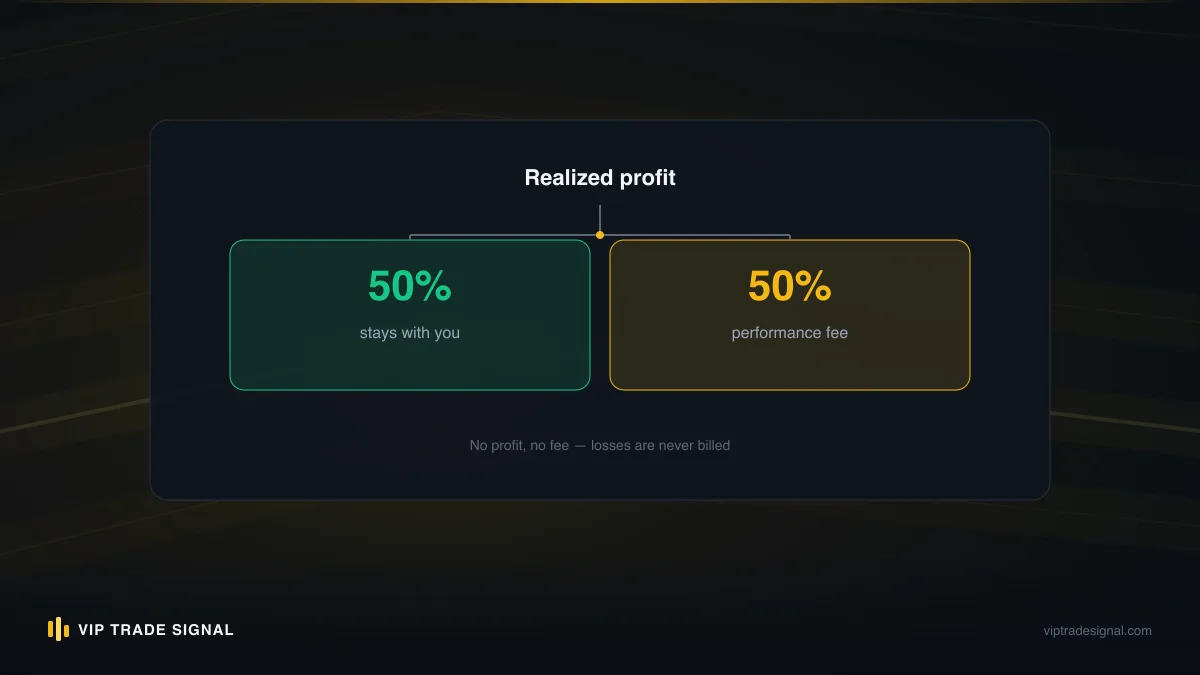
The legitimate version looks like this: you keep the master password to your own MT4/MT5 account, the manager gets trade-only access, fees are charged on realised profit only, and you can withdraw or pull access whenever you like. That's how we structure it — a flat 50% of realised profit, $200 minimum advance, and you hold the master password and the withdrawals, always. Fifty percent is the high end of the market and we say so on our pricing page; the trade-off is a low minimum and no fees on anything that isn't banked profit. High-water-mark hedge funds charge 20% on millions. We charge more on hundreds. That's the deal, stated out loud.
The predatory version looks superficially similar and is a different animal entirely. The "manager" asks for your login and password rather than investor access. Fees are charged on volume traded or on deposits, not profit — which means the manager earns by churning your account, win or lose. Guaranteed monthly returns get promised ("10-15% monthly, capital safe"), which is the single loudest alarm bell in retail trading. Nobody who can genuinely produce a guaranteed 10% monthly needs your $500. That return, compounded, turns $500 into $150,000 in five years. People who can do that manage their own money on an island.
And here's the ugly overlap with stream one: an unscrupulous manager who's also an IB earns rebates on every lot your account trades. So over-trading your account pays them twice — management fees on the churn and broker rebates on the volume. When your account finally dies, you were never the client. You were the fuel.
Revenue stream four: selling your attention
The fourth stream is the least damaging and the most visible: a big free channel is a media property, and media properties sell ads.
A forex channel with 50,000 members can charge anywhere from $100 to $2,000 for a pinned promotional post, depending on engagement. What gets promoted? Other signal channels, mostly. Prop firm discount codes (which pay affiliate commissions of 5-15% per sign-up). Trading courses. "Automated profit bots". Crypto presales, in the grubbier corners. Some channels earn more from shoutouts than from signals; the signals are just the reason the audience showed up.
You can spot an attention-monetised channel easily: the promotional posts outnumber the analysis, and the things being promoted get zero due diligence. The channel that shills a different "verified profitable EA" every fortnight is not vetting them. They're invoicing them.
This model is at least honest about what it is, in the way a billboard is honest. The signals from an ad-driven channel aren't necessarily poisoned by the model — the operator just doesn't care much whether they're good, because signal quality isn't what pays. Indifference is cheaper than malice, but your stop loss can't tell the difference.
The dark streams: deposit farming, B-book kickbacks, and your data
Everything above exists on a spectrum from fair to sleazy. These three don't. If you detect any of them, leave the channel that day.
Deposit farming. This is the CPA model with the mask off. The provider's entire economics run on deposit bounties, so the signals exist to trigger deposits and redeposits, not profits. The tells are behavioural: constant pressure to fund "before the next big move", promotions tied to deposit size ("deposit $1,000 for our elite signals"), and — the darkest tell of all — a shrug when you blow up, followed immediately by "fund again, the next setup is huge". A farmed account that dies and redeposits is worth a second bounty at some shops. Read that sentence again.
B-book kickbacks. Some unregulated brokers don't route your trades to any market — they take the other side themselves, which means your loss is literally the broker's revenue. That's a B-book. Now imagine a signal provider paid a percentage of referred clients' losses. It exists, mostly through offshore shells, and it inverts the entire relationship: the provider is now paid to give you losing signals, or at least signals with no stop and maximum lot sizes, which amounts to the same thing over a hundred trades. If a free channel insists on one specific unregulated broker you've never heard of and gets cagey when you ask to use your own, this is the smell you're smelling.
Data sales. The quietest stream. You joined the channel, maybe filled in a "free strategy session" form with your name, phone number and deposit size. That's a qualified lead — a person with money, interested in trading, demonstrably willing to act on strangers' advice. Lists of such people sell for real money to boiler rooms, "recovery agents" (who prey on people who've already lost), and worse. If you've ever wondered why your phone started ringing with investment offers a week after joining a signal group, you've found the invoice with your name on it. Not on it — it is you.
The common thread through all three: the provider profits when you lose, or profits identically whether you win or lose. Which is the whole ballgame, and the subject of the next section.
How the business model shapes the signals themselves
Here's the part most people miss. The revenue model isn't just a background detail — it reaches into the signals and bends them. Different incomes produce recognisably different signal styles, and once you know the shapes, you can often reverse-engineer the model from the signals alone.
A volume-rebate IB earns per lot traded. So the temptation is frequency: ten signals a day instead of two, "scalp" setups every hour, encouragement to trade every session. More trades, more lots, more rebate. A gold trader following twelve signals a day on a $1,000 account isn't trading; he's generating commission. If a channel's signal count looks like a slot machine's spin rate, you've found a volume shop. (For what it's worth, unlimited signals — which we offer — is only honest when paired with published losses and proper stops; volume with accountability is a service, volume without it is a meat grinder. If you're sizing gold trades on a small account, our guide to gold lot sizing on small accounts shows how quickly over-frequency compounds into ruin even with decent signals.)
A deposit farmer earns per funded account, so the signals skew toward drama: huge targets, tight windows, "last chance" framing, and lot-size suggestions far too big for the stated account size — because a fast double-or-nothing produces either a screenshot for the ads or a redeposit. Either outcome pays.
A funnel operator earns on VIP conversions, so the free signals skew toward unfalsifiability: wide zones, missing stops, after-the-fact winners. The free tier can't be allowed to be genuinely useful or nobody upgrades.
And a subscription provider earns on renewals, which is the one model where the incentive points the same direction as yours: you renew if the service helps you, so the signals need stops, honest results, and survivable risk. Not because subscription operators are saints — because the model only pays if you're still solvent and still subscribed next month.
The signal is downstream of the incentive. Always. You can't read a provider's heart, but you can read their P&L, and the P&L writes the signals.
Incentive alignment: which models can be honest
Let's rank them properly. The question for each model isn't "is the operator a good person" — you can't know that. The question is: what happens to the provider's income when you lose money? That single question sorts the entire industry.
| Revenue model | Provider earns when... | If you blow up, provider... | Can it be honest? |
|---|---|---|---|
| Subscription | You renew | Loses your renewal | Yes — best natural alignment |
| Profit-share management | You bank realised profit | Earns nothing | Yes — aligned, if you keep control |
| Disclosed IB, regulated broker | You keep trading | Loses the rebate stream | Yes, with discipline on frequency |
| VIP funnel | Free members upgrade | May earn more (desperation converts) | Rarely — model rewards manufactured FOMO |
| Ads/shoutouts | The audience stays big | Doesn't care | Sort of — indifferent, not aligned |
| Deposit farming (CPA-driven) | You deposit and redeposit | Earns again on the redeposit | No |
| B-book kickbacks | You lose | Gets paid | No — actively opposed to you |
| Data sales | You hand over details | Already got paid | No |
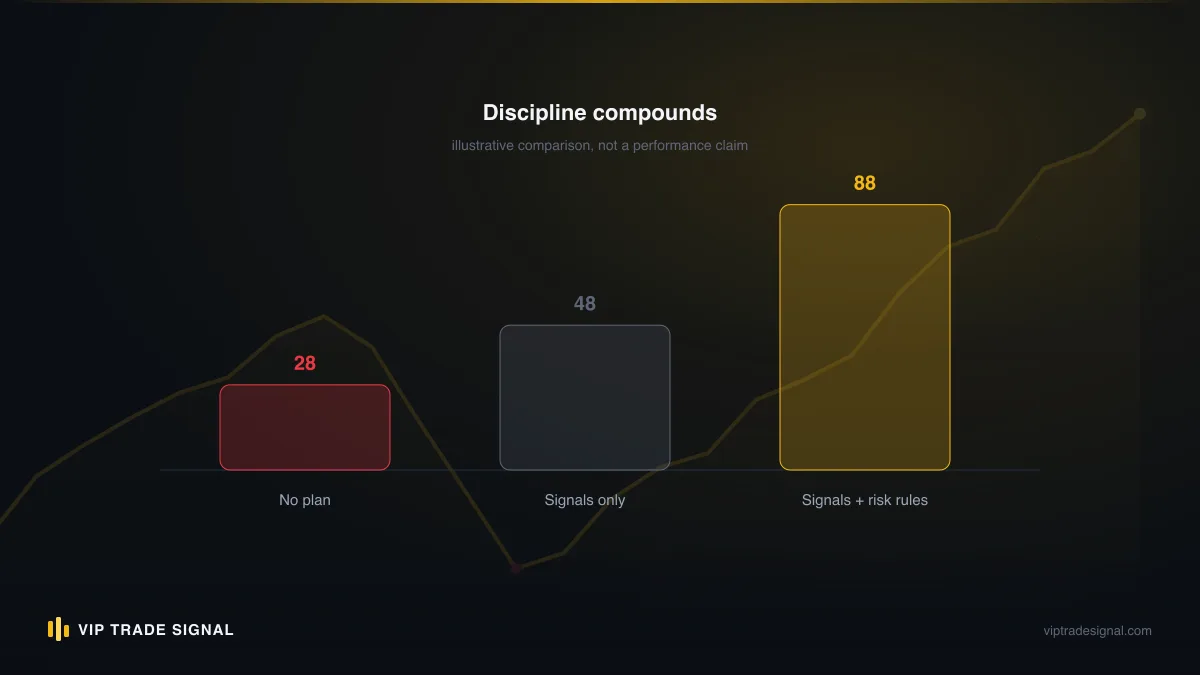
Notice something about the top three rows: in every aligned model, the provider's income dies when your account dies. Subscription, profit-share, and honest IB rebates all depend on you surviving as a trader. That's not virtue. It's structure. And structure is the only thing you can actually verify from outside.
Notice something else: broker sponsored free trading signals — the disclosed IB model — sit in the honest column, which surprises people who've been burned by free channels. The model isn't the poison. The disclosure, the broker quality, and the trade frequency are where it goes right or wrong. A provider who names the arrangement, partners with regulated brokers you'd have picked anyway, and doesn't machine-gun signals to farm volume is running a fair business. A provider who hides the arrangement has already told you what else they'll hide.
A complication you'll meet in the wild: almost nobody runs one model in isolation. Real providers stack them — IB rebates plus a VIP tier, subscriptions plus managed accounts, ads plus everything. Stacking isn't automatically sinister; a business with two aligned income streams is sturdier than one with a single stream, and sturdier businesses have less incentive to squeeze anyone. The rule for hybrids is to score each stream on the same question — what happens when you lose — and let the worst stream set the grade. A channel with honest subscriptions and undisclosed B-book kickbacks isn't half honest. It's a kickback shop with a respectable-looking storefront, and the storefront exists precisely to launder the back room.
One more honesty note, since we're ranking models: even the aligned ones can't rescue you from the market itself. Gold is violently volatile, most retail accounts lose money, and losing streaks happen to every desk, including ours. Alignment means your provider suffers alongside you when it goes wrong, not that it won't go wrong.
Our revenue, itemised: the transparency benchmark
We've spent two thousand words dissecting other people's income, so fairness demands we put our own on the table, line by line. This is the entire list. There is no line nine.
- Broker rebates (the disclosed IB stream). Trade our gold signals through a partner account at Exness, XM, IC Markets or Vantage with $250+ maintained, and the signals cost you nothing; the broker pays us a volume rebate instead. Disclosed here, disclosed on the site, disclosed when you sign up. These are large regulated brokers you might well have chosen anyway, and you trade on their standard terms — the rebate comes out of the broker's margin, not a widened spread.
- Subscriptions. $99 a month, flat, unlimited XAU/USD signals, for anyone who'd rather use their own broker and keep the relationship purely cash-for-service. Nothing extra behind it. There is no $299 "elite tier" waiting once you're in — the thing you buy is the thing there is.
- Account management. We trade your own MT4/MT5 account for a flat 50% of realised profit, $200 minimum advance. You keep the master password and the withdrawals. No profit banked, nothing owed beyond the advance.
- Drawdown recovery. For accounts floating roughly $5k-$10k underwater: 50% of recovered profit above a baseline we record together at the start. No recovery guarantees. We turn down accounts where honest recovery isn't realistic, because a fee earned on false hope costs more in reputation than it pays in cash.
Two things about this list, and then we'll stop talking about ourselves, because this is an anatomy lesson and not an advert.
First, yes — 50% profit splits and $99 a month sit at the high end of the market, and we've never pretended otherwise. The trade is low minimums and pay-as-you-go everything: no lock-ins, no fees on unrealised anything, no charge when there's no profit. You're paying boutique rates for a walk-in service. Some people should take that deal and some shouldn't, and the numbers are public so you can decide.
Second, and more importantly: every closed signal we've ever issued is published at /signals/history, losers included, and the whole revenue structure above is on the about page where it's been since day one. We're not showing you this because we're special. We're showing you this because this is what the disclosure should look like from anyone, and now you have a live specimen to compare against. Ask your current provider for their version of this section. The response — the itemised list, or the deflection — tells you nearly everything.
Ten questions that expose a provider's real model
You don't need to be an investigator. You need ten minutes and the nerve to ask direct questions in a channel where everyone else is posting rocket emojis. Here's the interrogation list, with what each answer reveals.
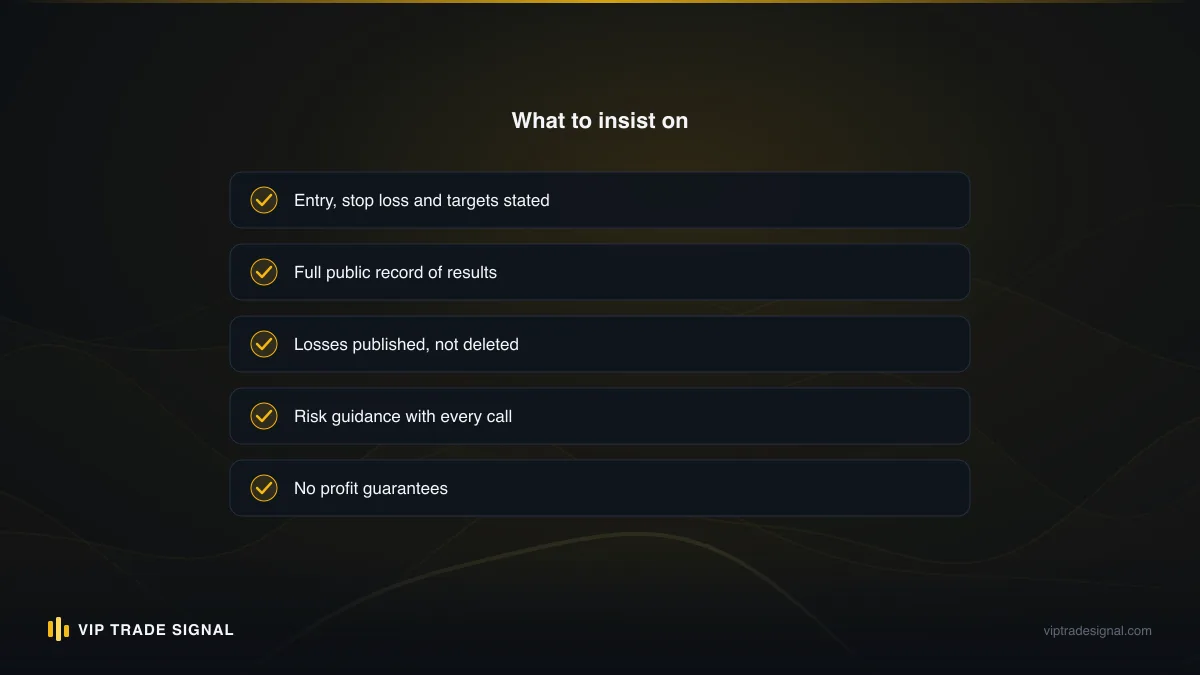
- "How does this service make money?" The master question. An honest operator answers in one breath. Watch for the vague — "we're building a community" — and the offended. Offence at a fair question is an answer.
- "Are you an IB for the broker you recommend?" If yes and they say so plainly: fine, possibly good. If the answer dodges, assume yes and undisclosed.
- "Can I follow your signals with my own broker?" The single fastest test in this article. "Of course" means the signals are the product. "Our signals only work with Broker X" means the deposits are the product — signals don't know what broker you're using.
- "Where's your full history, losses included?" Not screenshots. A running record. No record, no service — cherry-picked winners are the industry's oldest trick, and we've broken down exactly how Telegram gold channels stage them.
- "What's in the VIP tier that isn't in free?" "More of the same signals" is honest. "The real signals" is a confession about the free tier.
- "Do free signals include stop losses?" A signal without a stop isn't incomplete. It's a hook.
- "Is the recommended broker regulated, and by whom?" FCA, ASIC, CySEC — verifiable in five minutes on the regulator's own register. "International licence" from a PO box in the Comoros is not regulation, it's stationery.
- "Do you charge management fees on volume or deposits?" Anything other than "realised profit only" means they're paid to churn you.
- "Who keeps the master password in managed accounts?" If not you, walk. There is no legitimate reason a manager needs withdrawal rights to your money.
- "What happens if I lose money in month one?" The honest answer includes the words "that can happen" and describes risk controls. The dishonest answer includes the word "guaranteed" and describes a fantasy.
Print the list if you have to. And notice what it doesn't include: any question about win rate, pips per month, or last week's screenshots. That's the marketing layer. You're auditing the plumbing.
Choosing providers by business model, not marketing
Once you accept that the model writes the signals, provider selection stops being about charisma and starts being a filtering exercise. The marketing layer — the Lambo photos, the "94% accuracy", the countdown timers — carries no information. It's produced by the same three agencies for half the channels in the industry anyway. The model layer is where the truth lives, and here's the practical filter, in order:
First, eliminate the opposed models. Anything with deposit-farming tells, broker-locking, guaranteed returns, requests for your account password, or fees decoupled from your profit goes in the bin regardless of how good the signals look. You cannot out-trade a provider whose income requires your loss. Danny, from our opening — the trader down $370 at a mystery broker — didn't lose because the analysis was bad. He lost because he was standing on the wrong side of the ledger, and the analysis was written for the ledger's benefit.
Second, demand the disclosure. From the survivors, keep only those who state their revenue model unprompted, in public, in specifics. Not "we may receive compensation" buried in a footer. Itemised, like the section above. In our experience the providers willing to publish their income structure and their full losing trades are a single-digit percentage of the industry. Good. That's your shortlist doing itself.
Third, check the alignment under stress. Ask the month-one-loss question and read the answer twice. Then look at their published history during a losing streak — every real desk has them — and see whether the losses are posted at the time, with the same formatting and the same calm, as the wins. A provider's behaviour during drawdown is their character; everything else is their advertising.
Fourth, and only fourth, evaluate the signals. Stops on everything, sizing that respects a small account, frequency that looks like judgement rather than volume farming. By this stage you're choosing between honest operators, which is a luxury problem, and mostly a matter of style and market fit.
Notice the order. Signal quality is the last filter, not the first, and that inversion is the entire skill. Most traders audition signals for weeks while never once asking who's paying for them. Ten minutes on the model saves you the weeks.
The alignment scorecard
Let's end with something you can actually use tonight. Open your current signal channel — free or paid — and score it. One point per yes.
- The provider states, specifically and publicly, how they make money.
- You can follow the signals with any regulated broker you choose.
- Full trade history is published, losses included, updated as trades close.
- Every signal carries an entry, a stop, and targets. No exceptions.
- Nobody has ever messaged you privately pushing a deposit, an upgrade, or "account recovery".
- Managed-account fees, if offered, are charged on realised profit only, with you holding the master password.
- The provider talks about losing — theirs and yours — in public, unprompted, without being cornered.
- The recommended broker (if any) is regulated somewhere you've heard of, and the IB relationship is disclosed.
Seven or eight: you've found one of the rare aligned operators — free or paid, IB-funded or subscription, the model is working for you. Five or six: usable, but watch the missing items, because that's where the model leaks. Four or under: you are the inventory, and the only question left is which shelf you're on.
Here's the uncomfortable close, and we mean it as a compliment to your intelligence rather than a sales line: the answer to "how do free signal providers make money" was never really about them. It's about you noticing that "free" is a price like any other, denominated in spreads, deposits, upgrades or data instead of dollars, and then deciding — with the ledger open in front of you — which price you're actually willing to pay. Sometimes the honest answer is a disclosed broker partnership. Sometimes it's $99 in cash. Sometimes it's walking away from signals entirely and learning to trade your own plan.
Any of those can be right. What's never right is not knowing which one you chose. Danny knows now. It cost him $370 and six weeks. This article was cheaper.