There's a moment every new trader has. You've just found a Telegram channel with 40,000 members, a green-tick energy about it, and a pinned post promising "free forex signals daily, no registration, no catch". The last ten posted trades all show profit. The admin seems friendly. And a little voice in your head says: why would anyone give this away?
Listen to that voice. It's the smartest thing in the room.
We run a signal desk for a living, and part of our own service is, in fact, free, through a broker arrangement we'll dissect openly later, because it's one of the four business models this entire article is about. That's precisely why we can write this piece without squirming. Free forex signals are not a myth and not automatically a trap. But "free" is never the price. It's the marketing. Somewhere under every free channel there is a revenue line, and once you know how to find it, you can predict how the channel will behave, what it will pressure you to do, and whether following its trades will quietly cost you more than a paid subscription ever would. Most people never look. They judge a free channel by its last ten screenshots, which is like judging a used car by its paint.
So let's look under the bonnet properly. Who pays, how much, through what mechanism, and what that means for the trade ideas landing on your phone at 2pm.
The four business models behind free forex signals
Every free signal channel we have ever examined, and we've examined a lot of them out of professional paranoia, runs on one of four engines. Occasionally two at once. Never zero.
Model one: the funnel. The free channel exists to sell you something else. A "VIP" tier, a course, a mentorship, a prop-firm discount code. The free signals are the shop window. This is the most common model by a mile and it isn't inherently dishonest, though the execution usually is, for reasons we'll get to.
Model two: the broker-sponsored channel. The provider earns a rebate from a broker every time you trade: an introducing broker (IB) arrangement. You never pay the provider directly. The broker pays them out of the spread and commission your trades generate. This is the model our own free tier runs on, and it has real trade-offs worth understanding rather than hiding.
Model three: advertising and audience farming. The channel is a media property. Forty thousand members is an asset you can sell shoutouts into, cross-promote other channels to, or eventually flog wholesale. The signals are content, in the way a horoscope is content. Accuracy is not the product; attention is.
Model four: the con. The free group exists to identify people with money and separate them from it. Fake account managers, "deposit matching", recovery scams, romance-adjacent grooming that starts with a gold trade and ends with a fake exchange. This one isn't a business model with trade-offs. It's theft with a chart on top.
The reason this taxonomy matters is simple: each model creates different incentives, and incentives predict behaviour far better than track records do. A funnel channel is incentivised to make free look almost good enough. A broker channel is incentivised to make you trade often. An audience farm is incentivised to make you stay subscribed and emotional. A con is incentivised to make you trust a stranger with a deposit. Once you've identified the engine, you know exactly which lie to watch for.
We wrote a longer teardown of the economics in our piece on how free signal channels actually make money, if you want the accounting-level version. Here we'll stay practical: how each model looks from the inside of the channel, and how it treats you.
Free as a funnel: the teaser channel
The funnel channel has a rhythm you'll recognise within a week. Free members get two or three signals daily, often on gold because XAU/USD moves enough intraday to produce dramatic screenshots. The wins get posted in large font with fire emoji. The losses get posted quietly, late, or not at all. And every few hours: "VIP members caught 180 pips this morning. Link in bio."
Notice what the free tier is engineered to do. It cannot be good enough that you stay free forever, or the funnel fails. It cannot be so bad you leave. So it sits in a deliberately maintained zone of almost: decent-looking entries, vague exits, results just fuzzy enough that you believe the paid tier must be where the precision lives.
Here's the part almost nobody says out loud. The VIP tier of a funnel channel usually runs the same analysis as the free tier. Same person, same charts, same coin-flip edge or lack of one. What you're buying is earlier delivery and tighter formatting. We've spoken with traders who paid $150 a month for a VIP room and discovered its signals appearing in the free channel forty minutes later, word for word. The upsell wasn't better trading. It was a head start on the same trade.
A few tells that you're standing in a funnel rather than a service:
- The free channel posts results as screenshots of MT4 profit rows, cropped so you can't see lot size, account balance, or the losing positions below.
- Losses are described as "manipulation", "stop hunt", or simply skipped, while wins get pip counts to the decimal.
- The pinned message is about the paid tier, not the methodology.
- Nobody will show you a complete, dated record of every closed call. Ask for one. The reaction to that question tells you nearly everything. A genuine desk publishes the full ledger the way we do at /signals/history, losses sitting right there next to wins, because the ledger is the product.
Funnels aren't fraud. Selling an upgrade is legitimate. But a funnel's free tier is a marketing asset, and marketing assets are curated. Trade one with the same scepticism you'd bring to a free sample handed out at a supermarket by the person who owns the shop.
Broker-sponsored free signals: how IB deals actually work
This model deserves the longest look, partly because it's the least understood and partly because it's ours.
The mechanics: brokers pay for order flow. When you open an account through an introducing broker link and trade, the broker rebates a slice of the spread or commission back to the introducer. On gold the numbers are meaningful. A one-lot XAU/USD round trip might generate somewhere in the region of $10–$20 of raw trading cost depending on the broker and account type, and the IB rebate can be a substantial fraction of that. A signal provider with a few hundred active followers trading a couple of lots a week each is earning a real monthly income without charging anyone a subscription.
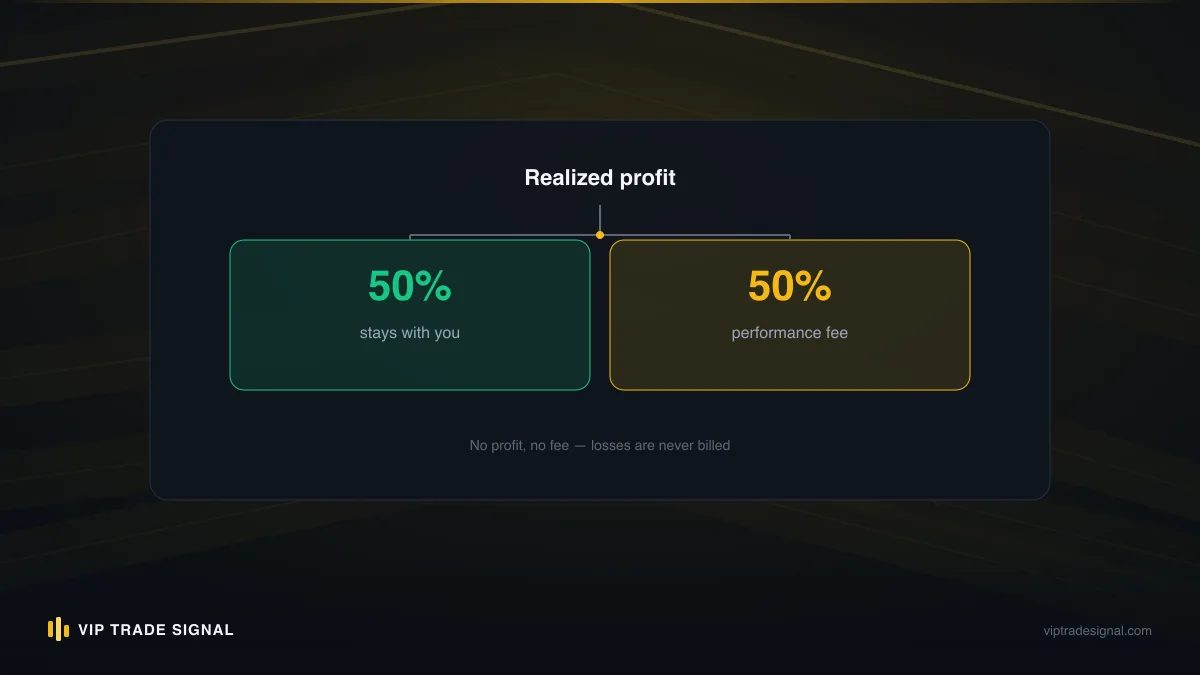
So the trader pays nothing extra. The spread you'd pay anyway becomes the funding mechanism. That's the honest version, and when it's disclosed, it's arguably the cleanest free model there is: the provider only earns while you keep trading, which means they only earn while you keep your account alive, which loosely aligns their interest with your survival.
Loosely. Be an adult about the conflict, because it's real: an IB earns per trade, not per winning trade. A rebate-funded provider has a standing temptation to overtrade you. Ten mediocre signals a week rebate better than three good ones. The shabby end of this market gives in to that temptation completely: channels pushing six "scalps" a day on 20-pip stops, churning followers' accounts into rebate income until the account dies, then recruiting fresh deposits to replace it. If a free channel requires you to join a specific broker AND floods you with high-frequency calls AND badgers you about your trading volume, you're not a client. You're livestock.
The test that separates the honest version from the churn machine is disclosure plus a public ledger. Does the provider say plainly "we earn a rebate from this broker"? Do they publish every closed signal, dated, wins and losses, so you can check whether the trade count looks like a strategy or an invoice? Do they let you follow the identical signals through a paid route instead, so the broker path is a choice rather than a trap? Our own arrangement works exactly that way: the same unlimited gold signals cost $99 a month directly, or nothing through a partner broker with a $250+ balance maintained. We'll walk through the honest trade-offs of that route near the end.
The scam version: free groups that farm deposits
Model four gets its own section because it hurts people at a different order of magnitude. A bad funnel wastes $150. A deposit-farming operation takes five figures and, in the worst cases we've heard about, retirement money.
The playbook is depressingly standardised. A free group posts signals for a few weeks, often stolen from other channels, building the appearance of a track record. Then the pivot: an admin messages you directly. Perhaps you're "selected" for account management. Perhaps there's a "deposit bonus" if you fund through their special link. Perhaps a helpful senior trader offers to run your account to "recover" earlier losses. The destination is always the same: money moving somewhere you don't control, usually an unregulated broker that is functionally the scammer's own back office, or a crypto wallet with a professional-looking dashboard painted over it. The dashboard shows profits. The withdrawal button shows excuses. First a tax, then a fee, then silence.
A few hard rules will keep you out of essentially all of it:
- Nobody legitimate DMs you first. Ever. Real desks are drowning in inbound; they don't cold-message members at 11pm asking about your capital.
- Your money never moves to a broker you didn't independently verify. Regulated entity, checkable licence, withdrawal tested with a small amount before anything serious goes in.
- Anyone managing your account gets trading access only. When we manage client accounts, the client keeps the master password and the only person who can withdraw is the client. Any "manager" who needs your withdrawal rights or wants funds sent to them directly is not managing an account. They're emptying one.
- Guaranteed returns end the conversation. "10% weekly, assured" is not ambitious marketing. It's the signature of fraud, because no honest participant in this market can promise you anything. We say this as people who trade for a living: losing weeks are part of our own published record.
The cruellest detail is that these groups often run genuinely free, genuinely okay signals for months. The signals were never the product. You were. Which is why "the free calls have been decent" is not, on its own, evidence of anything.
Judging a free channel in 14 days
Suppose a channel passes the smell test. No DMs, no deposit pressure, business model identifiable. It still might just be bad at trading. Here's the evaluation we'd run before a single live dollar follows it, and two weeks is genuinely enough to reach a verdict. Not on profitability, but on honesty and process, which matter more.
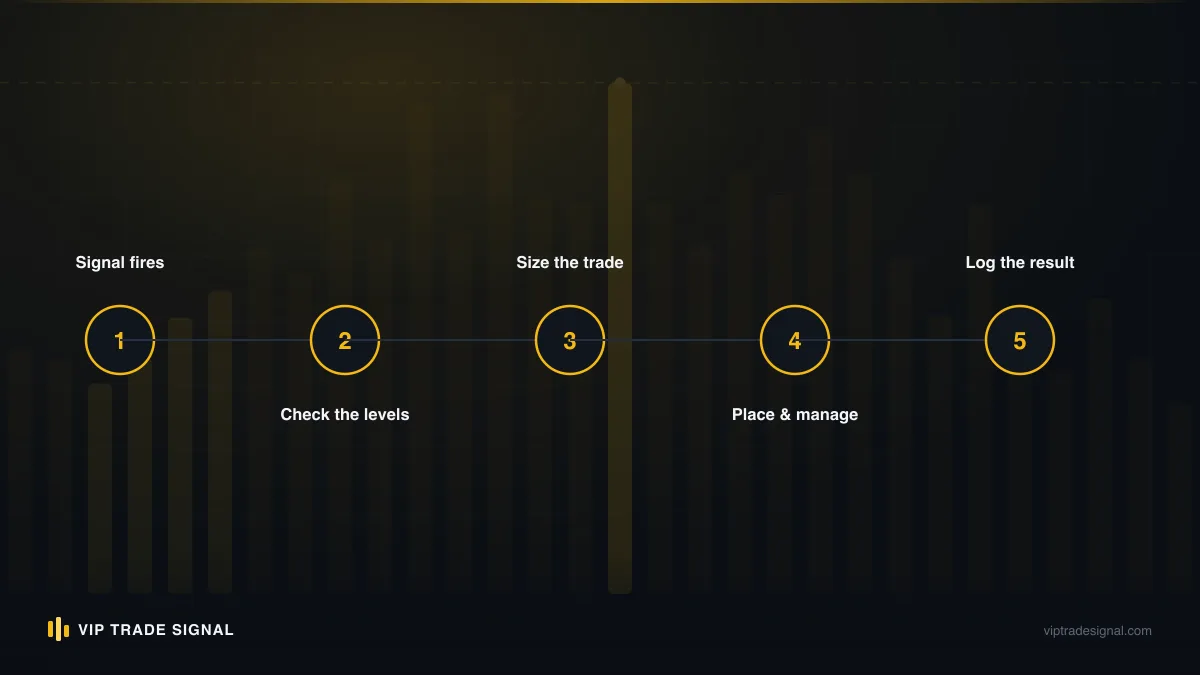
Days 1–3: log everything, trade nothing. Every signal into a spreadsheet the moment it lands: timestamp, pair, direction, entry, stop, targets. If a signal arrives without a stop, that's not a data point, that's the verdict. A provider who won't specify where they're wrong isn't providing signals; they're providing suspense.
Days 4–7: check the record against your log. When the channel posts its results, compare them with what you wrote down. Do posted entries match sent entries? Do losses appear in the recap at all? A channel that logged -35 pips honestly on a Tuesday is rarer, and worth more, than one showing ten straight wins. Count signals too. Fifteen calls a week on one pair is not analysis, whatever else it is.
Days 8–12: demo-follow with realistic friction. Execute each signal on demo, at the moment you actually saw it, not the moment it was sent. That gap matters and we'll come back to it. Use the position size you'd actually trade. If you're working a small gold account, size it the way we lay out in our lot-size guide for small accounts, because a 0.50-lot demo fantasy tells you nothing about your 0.03-lot reality.
Days 13–14: verdict on process, not P&L. Two weeks of results is statistical noise; anyone can flip heads seven times. What two weeks does reveal: whether stops exist, whether losses get owned, whether the posted record matches the delivered record, whether the trade frequency serves a strategy or a rebate. Score those four, and be ruthless. A channel that fails honesty in fourteen days will not develop honesty in month six. You just have more money at stake by then.
Most channels fail this test by day five. That's not cynicism. That's the base rate, and knowing it going in is what stops you from lowering the bar because the Telegram group has nice energy.
Free trials vs permanently free: which is safer
These two get lumped together and they shouldn't be, because the incentive clocks run in opposite directions.
A forex signals free trial is a sales window. Seven or fourteen days in the paid room, then a card form. The provider's incentive is to make those exact days look spectacular, and the grubby end of the industry has techniques for that: multiple entries around a level with only the winner marked as "the" signal, targets adjusted after the move, weekly cohorts staggered so at least one cohort's window catches a hot streak that becomes the testimonial. None of this requires the provider to be able to trade. It requires them to be able to schedule.
A permanently free channel, whatever its engine, at least can't optimise for a window. Its record accumulates in front of you and it has to survive being watched for months by people with spreadsheets. That doesn't make it good. It makes it harder to stage.
Our honest ranking of safety, most to least:
| Route | Who pays | Main risk to you |
|---|---|---|
| Permanently free, broker-disclosed, full public ledger | Broker rebate | Overtrading pressure; broker choice narrowed |
| Permanently free funnel with honest loss reporting | Future upgraders | Mediocrity; delayed delivery vs the paid tier |
| Paid trial with verifiable full history | You, shortly | A staged fortnight; cancel-friction |
| Free channel, model unidentifiable | Unknown | Everything, because you can't predict behaviour |
| Any channel that DMs you about deposits | You, catastrophically | Total loss |
The pattern in that table is worth saying plainly: transparency ranks above price. A paid service with a complete public history is safer than a free one without, and a free one with the ledger beats both on cost. What you can verify matters more than what you're charged.
The question is never "how much does this signal cost?" It's "what does this provider need me to do, and what happens to me when I do it?"
If you're weighing the paid route seriously, we've put the full head-to-head in free vs paid forex signals. The short version is that paying doesn't buy accuracy, it buys accountability, and only sometimes.
Signals without registration: what you give up
"Free forex signals without registration" is one of the most-searched phrases in this niche, and the appeal is obvious. No email harvested, no broker link, no phone number for a "manager" to find you on WhatsApp later. Open Telegram, read the call, close Telegram. As a way to observe the industry, it's genuinely the safest possible posture. Nothing about you exists to be monetised.
As a way to trade, it comes with costs people don't price in.
First, you're at the back of the delivery queue by design. Public, no-registration channels are where funnel content goes after the paying and registered members have had it. On EUR/USD a ten-minute delay is an annoyance. On gold it's a different trade. XAU/USD can travel $8 in ten minutes on an ordinary London afternoon; the entry posted at 3,317 is a market order at 3,325 by the time you see it, and the original stop is now either absurdly tight or invalid. You didn't take the signal. You took its shadow.
Second, no registration means no relationship, which means no recourse and no accountability in either direction. Nobody owes you an explanation of a losing streak. There's no support line when a signal's formatting is ambiguous at the worst possible moment. "Buy zone 3,310–3,318": which end, with what stop? You're reading a broadcast, not receiving a service, and broadcasts are edited for the audience, not for you.
Third, and least obvious: anonymous audiences get the provider's laziest work. It's human nature and desk economics at once. The trades that get careful annotation, updated management, and honest post-mortems flow to wherever the provider's income lives. The public channel gets the headline calls and the silence afterwards.
Where does that leave the no-registration route? Use it as a reading room. It's an excellent, zero-risk way to study how providers communicate, to practise your fourteen-day evaluation on live material, and to learn what gold signal formatting looks like when it's done properly versus theatrically. Just be clear-eyed that the moment real money follows those broadcasts, you're trading delayed, unsupported, second-tier information, and the fact that it cost nothing will be no comfort at all at the wrong end of an $8 slip.
Why free followers get worse fills
This deserves its own section because it's the hidden tax nobody itemises, and it often outweighs every visible cost in this article.
A signal is a perishable good. Its value decays from the second it's generated, because the market that produced the setup keeps moving. Every layer between the analyst's decision and your click — writing the message, posting to the paid room, syndicating to the free room, your phone buzzing, you opening the app, you deciding, you typing the order — spends some of that value. Paid and broker-registered followers sit closer to the source. Free followers sit at the end of the pipe.
Run honest numbers on it. Say a gold signal is worth, on average, a 2R outcome executed at the stated entry with a $4 stop distance. A delayed fill $2 worse doesn't cost you $2. It costs you half your reward-to-risk: your effective stop is wider or your target nearer, and the 2R trade you evaluated becomes a 1R trade you're actually in. Compound that across fifty trades a year and a "free" channel with a systematic ten-minute delay can underperform the identical signals delivered promptly by more than any subscription fee ever charged. The signals were fine. Your version of them wasn't.
There's a second-order effect too. Popular free channels move the market they're calling, microscopically but measurably, at exactly the moment you're trying to enter. Forty thousand people receiving "buy gold now, sl 3,309" within ninety seconds are competing with each other for the same fills. The earliest readers eat the clean price. The crowd behind them is the reason the price runs away from the level. In a paid room of two hundred, you're near the front of a short queue. In a free room of forty thousand, you are the queue.
None of this means free delivery makes profit impossible. Slower styles survive delay well; a swing signal with a $30 stop on gold barely notices a $2 slip. But it does mean the same provider, same analysis, same risk model produces genuinely different results for the front and back of the pipe. When someone shows you a track record, the only version that describes your future is the one measured from where you'll be standing.
A word on free gold signals specifically
Everything above applies to any pair, but since gold is all we trade, we'd be dodging our own subject if we didn't say it: free gold signals are a different animal from free EUR/USD signals, and the differences all point the same direction.
Gold is the marketing department's favourite instrument, and for the same reason it's the follower's most dangerous one: range. XAU/USD routinely covers $20–$40 in a session, which means a channel posting free xauusd signals can generate spectacular-looking pip counts on demand. "Gold +500 pips this week" sounds like mastery. It's often just volatility wearing a rosette. With a wide enough stop and gold's ordinary daily travel, a coin flip produces that screenshot several weeks a year. The instrument flatters bad providers more than any major pair, which is exactly why so many funnel and farm channels lead with it. When you're evaluating a free gold channel, mentally divide every advertised pip figure by the stop distance behind it. A 400-pip winner against a 350-pip stop is a 1.1R trade in a party hat.
The volatility cuts the other way too. That $8-in-ten-minutes delay problem we walked through earlier is a gold problem first and foremost; a free EUR/USD follower ten minutes late loses a little edge, while a free gold follower ten minutes late during the London–New York overlap is frequently taking a different trade than the one that was sent, at a level the analyst never approved, with the original stop rendered meaningless. If you're determined to follow free gold calls, favour the slower ones, swing entries with $25–$40 stops that shrug off slippage, and treat any free channel firing intraday gold scalps at a broadcast audience as structurally unfollowable, however good the analysis. The format and the delivery speed contradict each other, and the follower is where the contradiction gets paid for.
And spreads: gold's cost of trading varies between brokers far more than the majors do, sometimes by a factor of two or three at news time. A rebate-funded channel that herds everyone into one broker deserves an extra question on gold specifically: is that broker's XAU/USD spread actually competitive, or is the "free" service being funded by you paying $0.35 a lot more than you needed to, a hundred times a year? Look the spread up yourself, live, during London hours. Two minutes of checking, and it converts the vaguest cost of free into an actual number you can compare against a subscription.
When free signals are genuinely the right choice
After three thousand words of caveats, let's be fair: there are situations where free is not merely acceptable but correct, and pretending otherwise would be its own kind of dishonesty.
When you're learning to read the market, not trying to beat it. The best use of free signal channels has nothing to do with following them. Watching a competent analyst call levels on gold, then watching what the market does to those levels, is a live education you'd struggle to buy. Keep the spreadsheet, skip the trades, and six months of free channels will teach you more about support, liquidity and failed breakouts than most courses.
When your account is too small for any fee to make sense. Arithmetic, not ideology. A $300 account risking a sensible 1% has $3 of room per trade. Even a modest $50 monthly subscription needs seventeen clean R of profit just to cover itself, a preposterous hurdle. At that size, a disclosed broker-funded free route or a public channel used cautiously is the only structure where the maths isn't broken before you start. Pay fees from an account that can absorb fees.
When you're auditioning providers. You should never pay for month one of anything in this industry without watching it for free first, whether through a public tier, a trial, or a published history. Free observation is due diligence. Any provider who makes observation impossible has answered your question.
When the free route is the same product. This is the case we obviously have a stake in, so weigh our bias accordingly: when a provider delivers the identical signals, at identical speed, to broker-registered members as to paying ones, "free" stops being a tier and becomes a payment method. You're funding the service through spread rebates instead of a card. Whether that's the better deal depends entirely on your trading volume and whether the partner brokers suit you, which is a real decision with real numbers, not a no-brainer in either direction.
What all four cases share: the free signals are serving your plan, rather than substituting for one. The moment a free channel becomes the strategy, the thing you check instead of thinking, you've left all four safe harbours, whatever the channel's quality.
When paying, or a broker route, beats free
The mirror image, because the strongest argument against free signals was never "free equals scam". It's that the best free option is often the third-best option available to you.
Paying beats free when delivery speed is the edge. If you're following intraday gold calls, you now know why the back of the pipe is expensive. $99 a month for front-of-queue delivery is cheap insurance the moment your position sizes make a $2 fill difference cost more than $99 across a month of trades. For a 0.01-lot account, it isn't. For a half-lot trader, it isn't close.
Paying beats free when accountability is the product. A provider you pay owes you a complete record, an explanation of drawdowns, and support when a signal is ambiguous. You're not owed any of that by a broadcast. Some people don't need it. If you've been trading three years and use signals as a second opinion, fine. If a losing fortnight would leave you anxious and improvising, the relationship is worth more than the fee.
The broker route beats both when the fee hurts but the trading is real. Fund $250 with a partner broker, maintain it, receive the full service free. That's our structure through the broker route, and Exness, XM, IC Markets and Vantage are the partners we work with. The honest trade-offs, stated as plainly as we can: your broker choice narrows to that list; the $250 needs to stay maintained, which is a commitment, not a formality; and we earn rebates on your trading, which is a conflict you should hold us accountable for. Our answer to the conflict is structural rather than rhetorical: unlimited signals means we gain nothing by inflating trade counts for rebates, and every closed call sits publicly at /signals/history where an overtrading pattern would be visible to anyone within a month. Check us against our own fourteen-day test. We'd expect nothing gentler.
And sometimes nothing beats walking away. If you cannot yet size a position, place a stop, and survive five straight losses without doubling down, no signal source at any price is the missing piece. The signals industry, free and paid alike, is built on people reaching for trade ideas when what's actually missing is risk control. That purchase always disappoints, because it's the wrong aisle.
The checklist before you act on any free signal
Print this, or don't, but run it. Every line is one of this article's scars compressed to a sentence.
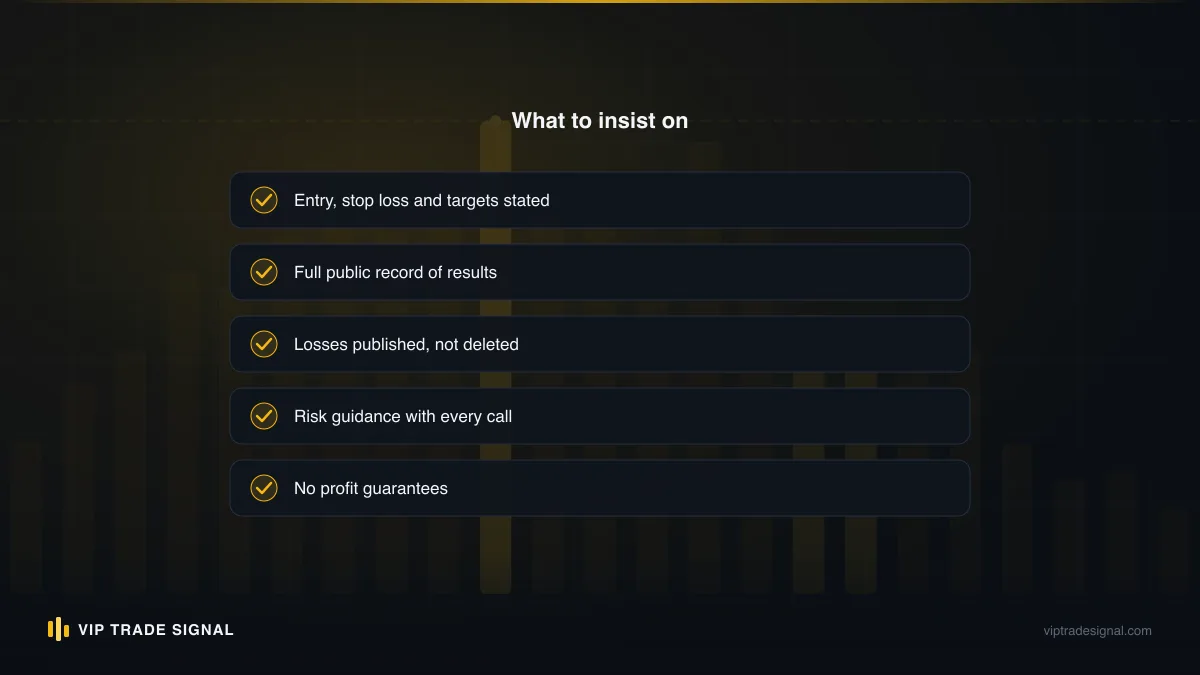
Before joining:
- Can you name the business model? Funnel, broker rebate, audience farm, or unknown. Unknown is a no.
- Is there a complete, dated, public record including losses? Screenshots of green rows don't count.
- Has anyone from the channel ever DM'd members first? One report of it is disqualifying.
- Are returns promised or "guaranteed" anywhere? Same answer.
Before following a single trade:
- Did you log signals for two weeks and check the posted record against your own? Honesty fails fast; give it the chance to.
- Does every signal carry a stop at publication? No stop, no trade, no exceptions.
- Have you measured the delay between send time and your realistic reaction time, and repriced the signals accordingly?
- Is your position sizing yours, set from your account and your 1%, not from whatever lot size the channel shouts?
Before sending money anywhere, ever:
- Is the broker one you verified independently, regulated, with a withdrawal you've personally tested?
- Does anyone other than you have withdrawal rights or your master password? If yes, stop reading checklists and go fix that today.
Ten lines. Perhaps twenty minutes of actual work plus a fortnight of patience. Against that, weigh what the unlucky version costs: a churned account, a farmed deposit, or a year spent faithfully executing the back-of-the-pipe shadow of someone else's decent trades.
Free forex signals are neither a gift nor a con. They're a market, with the same rule as every market: if you can't see the price, you're the one paying it. Find the engine, run the fourteen days, keep your withdrawal rights, and free can be a perfectly rational way to trade. That includes, we'd argue with declared self-interest, our own broker-funded version of it. And if you look under the bonnet of a channel and still can't work out who's paying? Close the tab. There's always another channel, but you only get so many accounts.