A trader we'll call Dan messaged us from Manchester last year with a question that took him four months and about £900 to arrive at: "How do I check if a signal provider is FCA regulated?" He'd been burned by a Telegram channel that plastered "FCA COMPLIANT" across its banner, took his subscription money, posted three weeks of suspiciously perfect wins, and vanished. He assumed there was a register he'd failed to check. There wasn't. That's the uncomfortable truth at the centre of this whole topic.
If you're searching for forex signals UK traders can actually trust, you've probably run into the same wall Dan did. The marketing says "regulated". The FCA register says nothing. And nobody in the industry has much incentive to explain the gap, because the gap is where a lot of money gets made.
So let's explain it properly. This piece covers what UK law actually says about signal services, why "FCA regulated signals" is almost always a fiction, how spread betting changes the execution picture for UK traders in a way it does nowhere else on earth, what HMRC thinks about your profits, and how to vet a provider when the usual "check the regulator" advice simply doesn't apply. We run a signal service ourselves, we're not UK-based, and we'll be straight with you about what that means too.
Are forex signals legal in the UK? The actual rules
Short answer: yes, receiving and following forex signals is legal in the UK. You can subscribe to a signal service, copy its trades into your own account, and nobody from the FCA is coming to knock on your door. Following signals is just you making your own trading decisions with input from someone else, which is no more illegal than reading a newsletter.
The more interesting question is whether providing signals is a regulated activity. And here UK law gets genuinely nuanced, in a way most providers either don't understand or pretend not to.
Under the Financial Services and Markets Act 2000, "advising on investments" is a regulated activity. If a firm gives you a personal recommendation about a specific investment, tailored to your circumstances, it generally needs FCA authorisation. But most signal services don't do that. They broadcast the same generic trade idea to everyone on the list: buy gold at 3,310, stop at 3,296, targets above. No one asked about your account size, your risk tolerance, or whether you can afford to lose the money. That broadcast, one-to-many, non-personalised structure is usually treated as generic information rather than personal advice, which typically keeps it outside the authorisation requirement.
There's a second layer, though, and it bites harder: the financial promotions regime under section 21 of FSMA. Broadly, communicating an invitation or inducement to engage in investment activity in the UK is restricted unless the promotion is made or approved by an authorised firm, or an exemption applies. The FCA has been noticeably more aggressive about this since its crackdowns on unauthorised "finfluencers" pushing CFD trading on Instagram and TikTok. Signal sellers who market aggressively to UK consumers are swimming closer to that line than most of them realise.
What does this mean for you, practically? Three things. Following signals: fine. A provider claiming FCA authorisation it doesn't have: a criminal offence on their part, and a screaming red flag for you. And a provider that carefully avoids personal recommendations, includes honest risk warnings, and doesn't pretend to a regulatory status it lacks: operating in a legal but unregulated space, which is where nearly the entire industry actually lives.
We should say clearly, since we're touching law here: this is a trader's working understanding, not legal advice. If you're planning to run a signal business touching UK customers, pay a solicitor. It's cheaper than the alternative.
The "FCA regulated signals" myth, dissected
Type "best forex signal providers UK" into Google and count how many results promise FCA-regulated signals within the first page. Now here's the test that dismantles almost all of them: go to register.fca.org.uk and search the provider's actual company name. Not their broker's name. Theirs.
You'll find nothing, nineteen times out of twenty. Because "FCA regulated signals" as a product category barely exists.
What these firms are actually doing is one of a few sleights of hand. The most common: borrowing their broker's regulation. "We work with FCA-regulated brokers" becomes, three lines of marketing copy later, "FCA-regulated service". That's like a takeaway claiming to be health-inspected because it buys meat from an inspected butcher. The broker's authorisation covers the broker's activities. It says precisely nothing about the Telegram channel telling you what to trade.
The second trick is registration-versus-authorisation confusion. Any company can register at Companies House for £50. Scammers show you a Companies House certificate, which proves only that someone filled in a web form, and let you assume it's an FCA credential. Different building, different register, wildly different meaning.
The third is the vaguest and most common: the word "regulated" floating in the copy with no regulator named at all. Regulated by whom? For what activity? Under what reference number? Silence. If a firm genuinely held FCA authorisation it would print its Firm Reference Number on everything it owns, because authorisation is expensive, slow to obtain, and commercially valuable. The absence of an FRN is the answer.
If a signal seller's regulation can't survive a two-minute search of the FCA register, it isn't regulation. It's typography.
Here's the uncomfortable corollary, and we'd rather say it than have you discover it later: because almost no signal provider is FCA-authorised, "find a regulated one" is useless advice for this market. Including for us. We're an overseas gold-signal service and we do not hold, and do not claim, FCA authorisation. The honest question isn't "who's regulated" — it's "who can prove their track record and who has an incentive structure that doesn't need you to lose". More on how to test that shortly.
What FCA regulation actually covers: your broker, not your channel
It helps to be precise about where the FCA's writ actually runs, because that's also where your real protections live.
Your broker is the regulated entity in your setup, assuming you use a UK-authorised one. That authorisation is not decorative. It means segregated client money, so your deposits sit apart from the firm's operating cash. It means Financial Services Compensation Scheme cover up to £85,000 if the broker fails. It means access to the Financial Ombudsman Service for disputes. And it means the FCA's product intervention rules apply to your account: leverage capped at 30:1 on major FX pairs and 20:1 on gold, negative balance protection so you can't lose more than your deposit, and a ban on the deposit bonuses offshore brokers use as bait.
None of that follows the signal. All of it follows the broker. Which produces a slightly counterintuitive conclusion: the regulatory status of your execution venue matters far more than the regulatory status of your signal source, because the venue is where your money actually sits.
There's a trade-off buried in here that UK traders argue about endlessly. Those FCA leverage caps are protection, but they're also constraint. At 20:1 on gold, controlling one standard lot around $3,300 requires roughly $16,500 of margin; an offshore broker offering 500:1 asks for a few hundred. That gap is exactly why so many UK traders drift offshore, and why so many blow up when they get there, because 500:1 doesn't make gold less volatile, it just makes your mistakes twenty-five times faster. Our view, having watched both populations: the FCA caps are mildly annoying for well-capitalised traders and genuinely life-saving for everyone else. A $30-40 daily range on gold is plenty of movement to make leverage caps survivable and excess leverage fatal.
So when you evaluate a UK setup, run two separate checks. Broker: on the FCA register, FRN matches, FSCS applies. Signal provider: unregulated almost by definition, so judged entirely on transparency and track record. Mixing those two checks up is the root mistake behind most of the horror stories we hear.
Spread betting vs CFDs: the UK's odd execution choice
Here's something genuinely unique about executing signals as a UK trader: you have two instruments for the same job, and the difference between them is mostly about tax.
Everywhere else in the retail world, you'd follow a gold signal with a CFD or a spot position. In the UK, you can also take it as a spread bet, which is economically near-identical — you're staking pounds per point of movement in XAU/USD — but legally structured as a bet. And bets, under long-standing UK treatment, are generally free of capital gains tax for recreational punters.
The mechanics differ just enough to matter when you're translating a signal:
| Spread betting | CFDs | |
|---|---|---|
| Position sizing | £ per point of movement | Lots / units of the instrument |
| Tax on profits | Generally none for recreational traders | Capital gains tax above the annual exempt amount |
| Losses | Cannot be offset against gains | Can be offset against capital gains |
| Currency exposure | Native GBP, no conversion | Gold P&L in USD, converted |
| Availability | UK and Ireland, basically | Worldwide |
| Signal translation | Convert stop distance in points to £/point stake | Convert to lot size directly |
A concrete translation, because this trips people up. Say a signal reads: buy gold 3,312, stop 3,298, target 3,340. That's a 14-dollar stop, which on most UK spread betting platforms is 140 points (they typically quote gold to one decimal). If you're risking £50 on the trade, your stake is £50 ÷ 140 ≈ £0.35 a point. Same trade as a CFD on a dollar account: $60-ish of risk on a $14 stop is about 0.04 lots. Same idea, same levels, different arithmetic. Get the arithmetic wrong and a sensibly-sized signal becomes an oversized one, which is the most common self-inflicted wound among new signal followers.
Which should you use? Opinionated answer: if you're a UK taxpayer trading modest size and you expect (hope) to be net profitable, spread betting's tax treatment is hard to argue with, and pricing on the big UK spread betting firms is tighter than it was a decade ago. If you're trading larger, or you want loss relief because you're realistic about the learning curve, or your provider's platform lives on MT4/MT5 — and ours does, our signals are formatted for MT4/MT5 execution — CFDs are the cleaner fit. Plenty of UK traders sensibly run both.
Tax on signal profits: the basics UK traders get wrong
Now the part everyone asks about at the pub and nobody wants to pay an accountant for. The usual caveat applies double here: we're traders, not tax advisers, and HMRC's view of your situation depends on facts we don't know. Treat this as a map of the terrain, then confirm your own route professionally.
The broad UK picture has three tiers. Spread betting profits are generally not taxable for the typical retail punter, because gambling winnings aren't taxed, and the flip side is that spread betting losses buy you no relief whatsoever. CFD profits fall under capital gains tax: you total your gains for the tax year, knock off allowable losses, and pay CGT on anything above the annual exempt amount, which has been cut to a fairly stingy £3,000 in recent years. That shrunken allowance matters more than people realise; a decade ago a hobbyist could realise £11,000+ of gains tax-free, and now even a modestly successful year of CFD trading can create a filing obligation. Keep your statements. Income tax treatment, where trading profits are taxed as income because trading is effectively your trade, is rarer than internet forums suggest; HMRC's "badges of trade" set a high bar, and the typical person following a paid forex signal service around a day job is very unlikely to cross it.
Two misconceptions worth killing. First: "spread betting is always tax-free" has a theoretical edge case — someone trading as an organised professional operation could, in principle, face argument, though in practice HMRC has little appetite to chase it because taxable status would let the many net losers claim relief. Second, and more dangerous: "my broker is offshore so HMRC can't see it". Wrong twice over. UK tax residents owe tax on worldwide gains regardless of where the broker sits, and the Common Reporting Standard means a growing pile of offshore account data lands on HMRC's desk automatically. Undeclared CFD gains through an offshore broker aren't clever, they're just late.
And one asymmetry that stings: subscription fees for signals are generally not deductible against capital gains. Your £80-a-month subscription comes out of post-tax pocket money. Factor that into whether a service is actually worth it at your account size — a question we've written about at length in free vs paid signal services.
UK-accessible brokers and execution quality
The broker decision splits UK traders into two camps, and the split maps almost exactly onto the leverage caps we covered earlier.
Camp one stays onshore with FCA-authorised firms: the established UK spread betting and CFD houses. You get FSCS cover, the Ombudsman, negative balance protection, and capped leverage. You give up leverage headroom and, usually, MT4/MT5 as the primary platform, since several big UK firms push their own platforms first. For signal following specifically, that platform point is a real friction: if your provider posts levels formatted for MetaTrader and you're executing on a proprietary web platform, every trade involves manual translation, and manual translation at 1:30pm on a data release is where slippage and fat fingers live.
Camp two goes to the large international MT4/MT5 brokers, several of which run FCA-authorised UK entities alongside their offshore ones. Here's the detail almost nobody checks: which entity is your account actually with? The same brand can onboard you under its UK entity, with all the FCA protections and caps, or under a Seychelles or Mauritius entity, with 500:1 leverage and roughly none of the protections. The onboarding flow sometimes nudges you offshore precisely because the leverage sells. Read the account opening documents and find the legal entity name. Two minutes, occasionally worth everything.
On raw execution quality for gold, the honest news is good: London is the centre of the world's gold market, and UK-accessible pricing on XAU/USD is generally excellent during London hours, with spreads on decent accounts running tight through the 8am-5pm window. Where execution degrades is exactly where it does everywhere: around high-impact US data, thin Asian hours, and the daily rollover. A signal service that expects you to enter at precise levels during those windows either doesn't understand execution or doesn't care about yours.
One practical note on our own model, since it's relevant to broker choice: our service is $99 a month, but it's free if you trade through one of our partner brokers (Exness, XM, IC Markets, Vantage) and keep $250 or more in the account, because the broker pays us instead of you. Some of those brands run UK-authorised entities, some serve UK clients from offshore entities, and the entity question above applies to them exactly as it does to everyone. We'd rather you pick the entity that suits your protection preferences than chase the subscription discount into an account structure you don't understand.
Vetting providers as a UK trader: the extra checks
Everything in our general provider-vetting playbook applies to UK traders — demand a full public track record, judge risk-reward not win rate, test on demo first — and we've covered the universal version elsewhere, including why free signal channels so often turn out to be marketing funnels. But trading from the UK adds a specific layer of checks that traders elsewhere can skip.
Run the FCA Warning List search first. The FCA maintains a public list of unauthorised firms it has received complaints about, and it's genuinely useful, because scam operations targeting UK consumers accumulate reports fast. Search the provider's name and any brand names they use. A hit is disqualifying. A miss proves nothing, since new scams take time to surface, but it's the cheapest check available.
Check whether they claim UK regulation they don't hold. You now know how: register.fca.org.uk, exact company name, look for an FRN. A provider honestly saying "we're not FCA regulated, almost no signal service is" has told you something true and slightly against interest, which is weak evidence of honesty. A provider claiming authorisation the register doesn't show has told you something false and self-serving, which is strong evidence of the other thing.
Look at how they handle the promotions question. Since the FCA tightened financial promotion rules, serious operators marketing to UK consumers carry prominent, specific risk warnings. A channel pushing "guaranteed daily profits" at a UK audience isn't just lying about trading, it's advertising its indifference to UK law.
Watch for the fake-London-office move. Scammers love a UK veneer: a virtual office address in Canary Wharf, a +44 number that redirects abroad, a Companies House registration a few months old. Search the address; if it's a mail-forwarding service hosting four hundred companies, weight it accordingly. A genuine overseas provider that says it's overseas beats a fake British one every single time.
Then apply the universal test: a complete, public, timestamped track record including losses. This is where we'll point at ourselves, once: every signal we've ever closed sits publicly on our signals page and history, wins and the losing streaks both, because a provider unwilling to show you its bad months is asking you to fund a story rather than a strategy. Any provider can match that standard. Note how few do.
Clone firms and recovery fraud: the scams aimed at Britain
UK traders face two scam varieties that deserve their own section, because both are sophisticated, both are booming, and both specifically exploit British trust in British institutions.
Clone firms are the nastier of the two. A scammer takes a genuine FCA-authorised company and copies it: same name or one letter off, same FRN quoted in emails, a website cloned pixel-for-pixel with the contact details swapped. When you dutifully check the FCA register, you find the real firm, the real FRN, everything legitimate, because you're checking the victim of the impersonation, not the entity emailing you. The FCA publishes clone warnings constantly and the pace hasn't slowed. The defence is specific: never contact a firm through details supplied in an email, ad, or message. Look the firm up on the FCA register yourself and use the switchboard number the register lists. If the person who contacted you balks at you calling back through the official number, you have your answer. Clone operations frequently arrive dressed as signal services or "managed account desks", which is why this belongs in a signals article.
Recovery fraud is the sequel scam, and it's uniquely cruel. Lose money to a signal scam and, weeks later, an email arrives from a "fund recovery specialist", sometimes claiming FCA or even Action Fraud affiliation, offering to claw your money back for an upfront fee of a few hundred pounds. It's the same scammers, or their colleagues, monetising their own victim list a second time. The tell is the upfront fee plus the unsolicited approach. Genuine routes to redress in the UK, the Ombudsman and FSCS among them, don't cold-email you and don't charge you fees to make a claim. A rule worth engraving somewhere: anyone who contacts you first, about money you lost, is almost certainly not on your side.
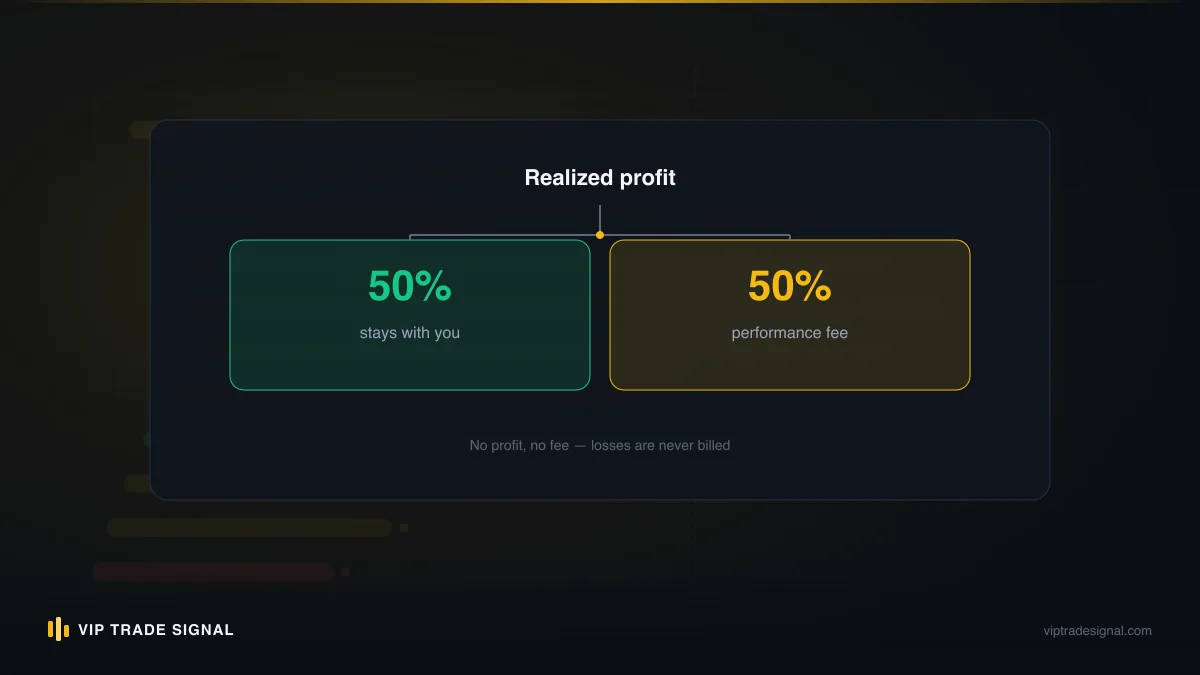
And a smaller, greyer UK-specific pattern: "signal groups" that are really unauthorised fund-gathering, where the channel drifts from posting trades to inviting you to "let our desk trade a pooled account". Pooling client money to trade is squarely regulated activity in the UK. An unregulated Telegram admin proposing it is proposing a crime with your deposit as the working capital. For clarity, since we run account management ourselves: our model is trading your own MT4/MT5 account, in your name, where you keep the master password and the only withdrawal rights, for a flat 50% of realised profit with a $200 minimum advance. The moment anyone, us included, asks you to move money out of an account you control, the conversation should end.
Reporting a scam: FCA, Action Fraud, and honest expectations
If the worst happens, the UK at least gives you a clearer reporting path than most countries. Use all of it, quickly, and with realistic expectations about what each step achieves.
- Your bank or card provider, immediately. This is the step with actual recovery odds. Card payments may be reversible through chargeback; bank transfers to UK accounts fall under the mandatory reimbursement rules for authorised push payment fraud that came into force in late 2024, which oblige banks to reimburse many APP fraud victims, subject to caps and conditions. Speed matters enormously here. Hours, not weeks.
- Action Fraud, the UK's national fraud reporting centre, online or on 0300 123 2040. Be honest with yourself about what this does: it feeds intelligence to the National Fraud Intelligence Bureau, and only a minority of reports become active investigations. You are mostly helping the pattern get spotted. Report anyway; the pattern is how the next Dan gets warned.
- The FCA, via its consumer helpline and ScamSmart pages. The FCA can't get your money back from an unauthorised offshore operation, but your report can put the firm on the Warning List, which is the mechanism by which your bad week protects strangers.
- The platforms: report the Telegram channel, the Instagram account, the ads. Takedowns are whack-a-mole, but friction has value.
What you should not expect: recovery from an offshore scam paid in crypto. That money has gone, and accepting it has gone is what inoculates you against the recovery-fraud sequel. What you can reasonably expect: a fighting chance on card and UK bank-transfer payments if you move fast, and the grim satisfaction of making the scam more expensive to run.
The better play, obviously, is the boring one: small first payments, monthly rather than annual subscriptions, demo-testing before live money. Scams are far easier to avoid at the checkout than to unwind afterwards.
How overseas providers, like us, serve UK clients
Time to answer the question you should be asking us: if FCA cover matters so much, what business does an overseas signal service have taking UK subscribers?
The honest answer is that the signal layer was never where regulatory protection lived, for anyone, anywhere. As we covered above, even a hypothetical London-registered signal seller would sit outside FCA authorisation for the generic-signals part of its business. So the choice for a UK trader was never "regulated signals vs unregulated signals". It's "which unregulated provider, executed through which broker, with what proof". The provider's job is to be verifiable; the broker's job is to be regulated. Keep those jobs separate and the structure is sound: your money sits with a broker you chose, under whatever protections that entity carries, and the only thing we ever hold is your subscription fee, capped at $99 for the month and cancellable.
What a serious overseas provider owes UK clients, specifically: no claims to UK regulatory status, ever. Clear identification of who and where the company actually is — ours is on the about page, not hidden behind a logo. Risk warnings that meet the spirit of UK promotion standards even where the letter doesn't reach us. Signals timed and structured so UK-hours traders can actually use them. And a track record you can audit before a pound leaves your account.
What we can't offer UK clients, said plainly: FSCS cover on anything, Financial Ombudsman jurisdiction over us, or any pretence that following gold signals is safe. Gold is a violently fast market; losing runs are a certainty of the strategy, not a malfunction of it; and most retail traders lose money, a commonplace the FCA obliges every UK broker to print because it's true. If a provider's marketing implies otherwise, UK-based or not, close the tab. The economics of who pays for "free" and cheap signal services, and why those economics so often work against the subscriber, are a whole subject of their own — we've pulled that apart in how free signal businesses actually make money.
Trading gold signals on UK hours: a realistic day
One genuine advantage of trading from Britain that rarely gets said out loud: for gold specifically, UK time zones are close to ideal. The world's gold market runs through London, and its most tradeable hours sit conveniently inside a British afternoon.
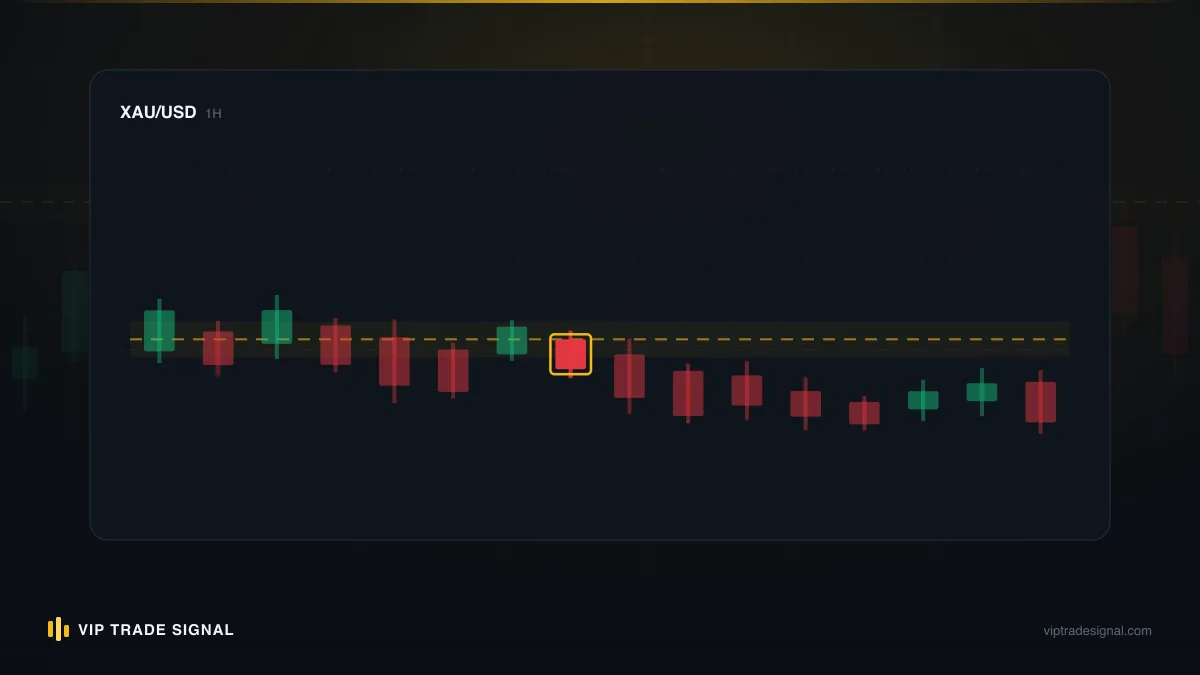
Walk through the day. The Asian session, roughly midnight to 7am UK time, is gold's quiet period: ranges compress, spreads widen a touch, and signals fired into that window fight thin liquidity. You should be asleep, and a provider spamming entries at 3am should make you wonder whose session they're actually trading for. From the 8am London open, participation arrives and gold starts to move properly; the 8am-11am stretch regularly sets the tone for the day. The main event is the London-New York overlap, about 1pm to 5pm UK time, when the two deepest sessions run simultaneously and the majority of gold's daily range often gets carved out. And embedded in that overlap is the most dangerous half-hour of the British afternoon: 1:30pm, when US economic data lands. A CPI or non-farm payrolls print at 1:30pm can move gold $30 in minutes, blow through stops with slippage, and turn a tidy setup into a coin flip.
For a UK signal follower this translates into a pleasantly civilised routine. Morning signals arrive with your commute or coffee. The high-value window sits after lunch, so even someone with a day job can often manage entries on a break, and pending orders at specified levels — the format we use, entry, stop, and targets stated in advance — mean you don't need to be glued to a screen at all. Evenings, from about 5pm as London closes, taper toward the late-US drift, and by 10pm the sensible UK gold trader is done.
Two UK-specific wrinkles to respect. The UK-US clock offset shifts twice a year, in the awkward weeks around late March and late October when British and American daylight-saving changes don't align, so "1:30pm data" temporarily isn't; check the calendar in those weeks rather than trusting habit. And know your provider's session honestly. A service whose signals cluster between 8am and 5pm UK time fits a British life. One that fires mostly in the Asian session will have you choosing between sleep and execution, and sleep-deprived execution is how good signals produce bad results.
The UK trader's setup checklist
Enough theory. Here's the sequence we'd give Dan if he could start again, in order, with nothing skipped.
- Pick your instrument first. Spread betting for the tax treatment if you're trading modest size on a UK platform; CFDs on MT4/MT5 if you want loss relief, direct lot-based execution of signals, or a platform match with your provider. Decide this before choosing a broker, because it narrows the field for you.
- Choose the broker and verify the entity. FCA register, matching FRN, and confirmation of which legal entity your account sits under. If you deliberately choose an offshore entity for leverage, do it knowingly, having priced in what you're giving up: FSCS, the Ombudsman, negative balance protection.
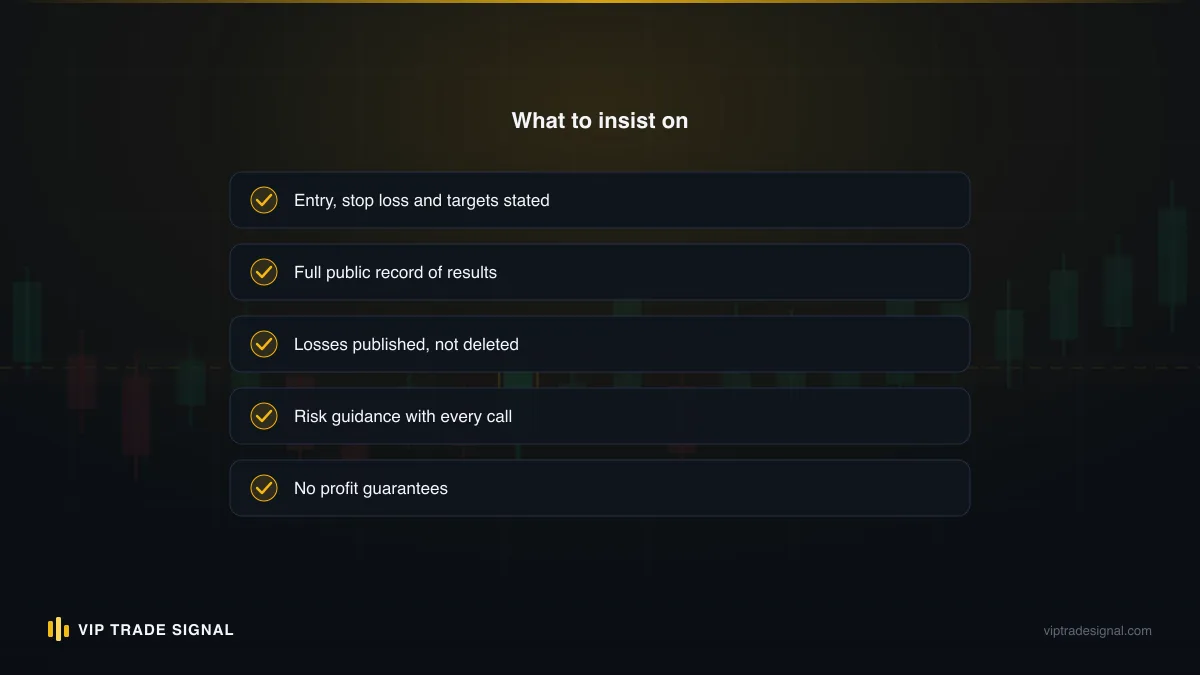
- Vet the provider with UK eyes. Warning List search. Register search for any regulation claims. Full public track record, losses included. No pooled-money invitations, no guaranteed returns, no fake London office. Real answers to real pre-sales questions — the sort of things we field on our FAQ — inside a day or two.
- Demo the workflow for a month. Not the signals' profitability, which one month can't establish, but the mechanics: do entries arrive at hours you can act on, do the levels translate cleanly to your platform's sizing, can you honestly execute this around your job?
- Size like the risk warnings are about you. Because they are. A £2,000 account risking 1% has £20 of room per signal; on a 140-point gold stop that's about £0.14 a point spread betting, or roughly 0.01-0.02 lots on a CFD. If that number feels insultingly small, your account is small, not the maths wrong.
- Set up your records from day one. CFD traders: every closed trade feeds a CGT computation, and the £3,000 exempt amount is easier to breach than it used to be. Spread bettors: keep statements anyway; future-you may need to demonstrate what happened.
- Start monthly, never annual. Pay-as-you-go pricing keeps the provider on a four-week performance leash. Any service confident in its next twelve months can prove it one month at a time.
Where does this leave you? Better positioned than most of the world, honestly. UK traders get strong broker protections, a functioning complaints machinery, uniquely favourable tax treatment on one whole execution route, and gold's prime hours falling inside their afternoon. What the UK does not get, because nowhere does, is a regulator vetting signal quality for you. That job stays yours. Do it the boring way: verify the broker on the register, verify the provider against its published history, size small, and let a monthly subscription and a public track record keep everyone honest. Ours is open at /signals, losses on display next to the wins, which is exactly the standard you should hold over anyone who wants your subscription, us included.