Somewhere right now, a trader with a $500 account is staring at a Telegram message that says "BUY GOLD NOW. TP 400 PIPS. 98% ACCURACY." He is going to take it. He is going to size it far too big, watch it go forty pips against him, panic, close it, and then watch price hit the target three hours later without him. Then he'll blame the signal.
We have watched that exact sequence play out hundreds of times, and the uncomfortable truth is that both parties were at fault. The channel was selling fantasy. The trader was buying it. Forex signals sit in a strange corner of retail trading where a genuinely useful tool shares a marketplace with some of the most shameless marketing in finance, and most guides on the subject are written by people trying to sell you a subscription in paragraph four.
We run a signal service ourselves, so read this with that in mind. But we also publish every closed trade, wins and losses, on a public page, which puts us in the small minority of forex signal providers with any incentive to tell you the truth about how this industry actually works. So here it is: the whole picture, including the parts that make our own business harder to sell.
What forex signals actually are (and are not)
A forex signal is a specific, actionable trade instruction sent from one trader (or system) to another. At minimum it names an instrument, a direction, an entry price or zone, a stop loss, and at least one take profit. That's it. Everything else is decoration.
Notice what's missing from that definition. A signal is not a prediction that price will definitely go somewhere. It is not financial advice tailored to you, your account size, or your sleep schedule. And it is emphatically not a substitute for knowing what you're doing, any more than a satnav is a substitute for knowing how to drive.
The honest way to think about forex trading signals is as outsourced trade identification. Someone else does the analysis, watches the sessions you can't watch, and hands you a structured idea. You still own every other part of the job: position sizing, execution, deciding whether this trade fits your account, and living with the result. A signal service that tells you otherwise is lying to you about what it can do.
There's a second thing signals are not: passive income. This phrase does more damage in retail forex than any other. Following signals is active work with real risk, done with money you can lose. Most retail CFD accounts lose money; that is a regulatory commonplace printed on every broker's homepage for a reason, and subscribing to a signal channel does not exempt you from it. What a good provider changes is the quality of the ideas you're executing. What it cannot change is the fact that some of those ideas, taken correctly and executed perfectly, will still lose. Losing is a feature of trading, not a malfunction.
Who should actually use signals, then? Three groups, in our experience. Traders with day jobs who can execute but can't sit through the London session. Newer traders who want to watch structured trades unfold in real time as a learning tool, with tiny size. And experienced traders who use an external signal as one input among several. The person signals serve worst is the one they're most aggressively marketed to: the broke, desperate beginner looking for a way to double $300 by Friday.
The anatomy of a real signal: entry, SL, TP
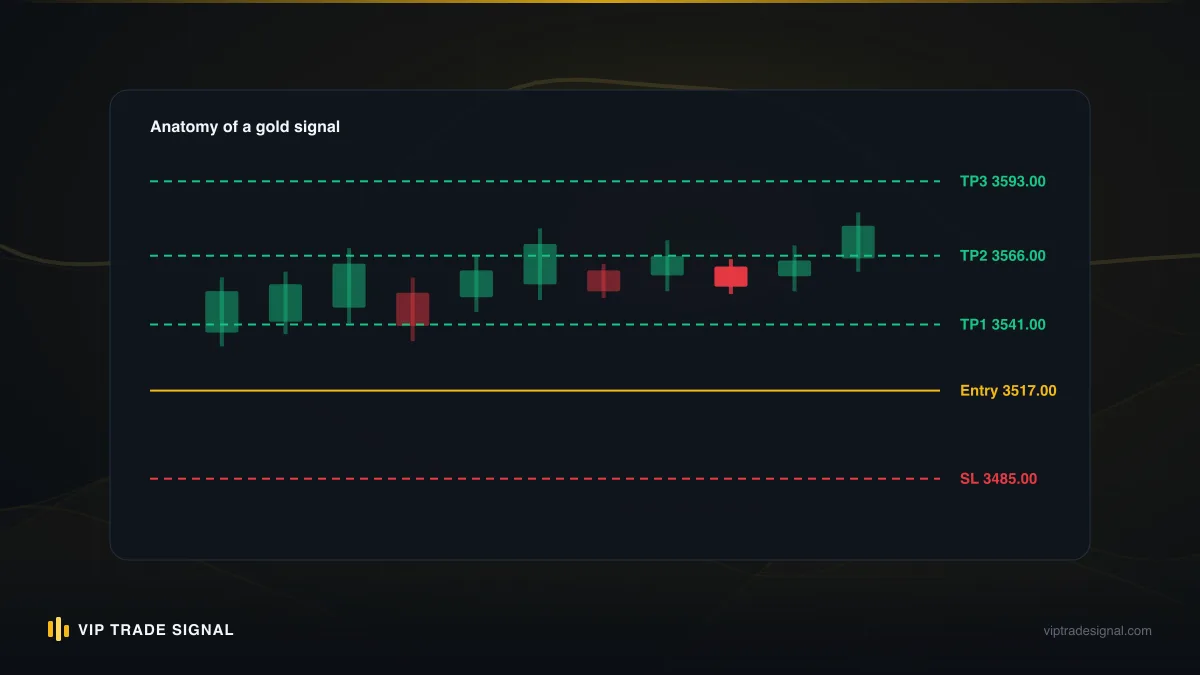
You can learn a lot about a forex signal provider from the format of a single message. A complete signal looks something like this:
XAU/USD SELL LIMIT 3,342 · SL 3,351 · TP1 3,330 · TP2 3,318 · Risk: max 1% · Reason: rejection at London high, dollar bid into CPI
Every element there is load-bearing. Walk through them.
The entry should be a price or a tight zone, with an order type. "Sell gold" is not an entry. Sell where? Now, at market? At a limit? A provider who won't commit to a number is a provider who can later claim any outcome as a win.
The stop loss is the single most diagnostic element of the whole message. A real trader thinks in terms of where the idea is wrong, and the SL is that line written down. Channels that send entries with no stop, or a "mental stop", or a stop so wide it's decorative (400 pips on a scalp, say) are telling you they don't want their losses measurable. In the example above, the stop is 9 dollars away on gold. On a $2,000 account risking 1%, that's $20 of risk, which at 9 dollars of stop distance means roughly 0.02 lots. You can do that arithmetic in ten seconds, and you should, every single time.
The take profits define the reward side. Two or three staged targets are common and sensible: bank some at TP1, move the stop, let the rest run. What matters is the ratio. If the stop is 9 dollars away and TP1 is 12 dollars away, you're being offered about 1.3R on the first target, which is fine if the win rate supports it. If the stop is 30 away and the target is 10 away, someone is manufacturing a high win rate by risking three to make one, and that arithmetic eventually eats the account.
The reasoning line is optional but revealing. One sentence of rationale ("rejection at London high") proves a human process happened. Its absence isn't damning on its own. Its presence, consistently, is a very good sign.
And then there's what happens after the message. Real providers manage the trade: they tell you when to move stops to breakeven, when to close early because the context changed, when a limit order should be cancelled because price ran without filling. A channel that fires entries into the void and never follows up is doing half the job and taking full credit.
Types of signals: scalping, intraday and swing
Signal styles differ mostly in holding time, and the differences matter more than beginners expect, because they determine whether you can physically follow the service at all.
Scalping signals target small moves, often held for minutes. They can look spectacular on a results graphic, but they're brutal to copy. A scalp that's fine at 3,341.2 may be a bad trade at 3,342.1, and by the time the notification reaches your phone and you reach your platform, the edge has often gone. Spread and slippage, trivial on a 100-pip swing trade, can be a third of the target on a scalp. Unless you're glued to your screen with fast execution, we'd honestly steer you away from scalping channels regardless of how good the trader behind them is.
Intraday signals open and close within a session or a day, typically targeting moves you can measure in tens of pips (or several dollars, on gold). This is the sweet spot for most working people: entries are usually limit orders you have minutes rather than seconds to place, and trades resolve before you sleep. Most of what we send falls here.
Swing signals hold for days or weeks. Wide stops, wide targets, far fewer messages. The awkward part is psychological rather than technical: sitting through two days of open drawdown on a position that is behaving completely normally takes a discipline most subscribers haven't built yet. Swing services also produce so few trades that judging them takes months. Fifteen trades tells you almost nothing.
A quick word on frequency, because "daily forex signals" is one of the most-searched phrases in this niche and it embeds a bad assumption. Markets do not produce good trades on a schedule. A provider committed to sending three signals every day will, on quiet days, send you three mediocre trades to justify the subscription. We'd rather send nothing for two days and then four signals in a busy London session than invent setups to fill a quota. When you evaluate a provider, ask whether their frequency looks like it follows the market or follows the marketing.
How legitimate providers generate signals
Where a signal actually comes from matters, partly because it demystifies the product and partly because the generation method predicts the failure mode.
Discretionary human analysis is the classic model: experienced traders reading price structure, session behaviour, positioning around news. Strengths: adaptable, context-aware, able to stand aside when conditions turn ugly. Weakness: it's only as good as the humans, it doesn't scale infinitely, and you cannot backtest a person. This is our model, for what it's worth, and we think it's the right one for a volatile instrument like gold, where context (a central bank speaker, a geopolitical headline) routinely overrides any pattern.
Systematic and algorithmic signals come from coded rules. Strengths: consistent, testable, emotionless. Weakness: every retail-grade system we have ever examined degrades when market character shifts, and the vendor rarely tells you which regime the backtest was fitted to. A strategy tuned on 2024's trending gold market met 2025's choppy ranges very differently. Beware, above all, the backtest with no live record: curve-fitting a strategy to past data until it shows 90% wins is a weekend's work for anyone with a laptop.
Copy-trading and PAMM-style arrangements aren't signals in the strict sense (trades replicate automatically), but they compete for the same customer. The subtle trap is lot-size mapping: a provider risking 0.5% per trade on a $200,000 account can map to something wildly different on your $1,000 account.
AI-generated signals deserve a special mention in 2026 because the label is everywhere. Some funds do serious machine-learning work. Almost nothing marketed to retail traders as "AI signals" resembles it. In most cases "AI" is a fresh coat of paint on the same old indicator mashups, applied because the word converts. Treat the label as marketing noise and judge the track record exactly as you would any other provider's, which is to say: demand the losses.
Whatever the method, one structural question cuts through all of it: does the provider trade their own signals with real money? A desk that eats its own losses writes different signals than a content operation that produces trade ideas the way a listicle farm produces articles. Ask directly. The hesitation in the answer is data.
Free vs paid vs broker-sponsored signals
The pricing model of a signal service tells you who the real customer is, and that determines everything downstream.
| Model | Typical cost | Who actually pays | The catch |
|---|---|---|---|
| Free public channel | £0 | You, later | The channel is a funnel: for a paid "VIP" tier, an affiliate broker, or a "managed account" pitch |
| Paid subscription | $30–$300/month | You, directly | Quality varies wildly; the fee guarantees nothing except the provider's incentive to keep you subscribed |
| Broker-sponsored | £0 to you | The broker, via spread on your volume | Fine when disclosed; rotten when the provider is paid per lot and starts inflating trade frequency |
Free channels are where most people start, and most of them are marketing funnels with a chart on top. The classic structure: a free channel posts screenshots of winners (real or otherwise), builds an audience, then upsells a VIP tier where the "real" signals supposedly live. The free tier's job is not to make you money. Its job is to convert you. We've written a full teardown of the economics in how free signal channels actually make money, and a survey of what's genuinely worth following for nothing in our guide to free forex signals, because free is not automatically a scam. It's just rarely what it appears to be.
Paid subscriptions at least align incentives partially: you pay, so keeping you subscribed requires keeping you reasonably happy. The going rate for live forex signals in 2026 runs from about $30 a month for high-volume channels of dubious provenance to $300 and up for services with an actual desk behind them. Price correlates with quality loosely at best. We've seen $250/month services that were repackaged free content, and the occasional $50 channel run by one genuinely skilled trader who simply didn't care about marketing.
Broker-sponsored access is the model that deserves more scrutiny than it gets, and we say that as a service that offers it. The mechanics: you open an account with a partner broker through the provider's link, the broker pays the provider a rebate on your trading volume, and you get the signals without a subscription fee. Done honestly, with the arrangement disclosed and signal frequency unchanged, it's a fair trade that saves subscribers real money. Done dishonestly, it creates a provider who profits from your volume rather than your outcomes, which is a quiet incentive to send more signals than the market justifies. Our own version: the service is $99/month flat, or free if you trade through one of our partner brokers (Exness, XM, IC Markets or Vantage) with at least $250 maintained; the full mechanics are on the pricing page. The signals are identical either way, and the frequency follows the market, not the rebate. You have no reason to take that on faith, which is exactly why the public record exists.
What a realistic win rate looks like
Here is the number that disqualifies most of the industry in one line: any forex signal provider advertising a win rate above roughly 90% is either lying, cherry-picking, or running risk-reward maths that will eventually destroy an account.
Win rate means nothing in isolation. A service can win 95% of trades and lose money; it simply risks 50 pips to make 5, collects a long string of small wins, and then gives it all back in two stopped-out trades. Casinos would recognise the structure. Conversely, a service winning 40% of the time can be comfortably profitable if the average winner is two and a half times the average loser. The only number that matters is expectancy: (win rate × average win) minus (loss rate × average loss). Positive expectancy, sustained over a large sample, is the entire game.
So what should you actually expect from a competent provider? Broad ranges, honestly stated: intraday services with roughly 1:1 to 1:1.5 reward-to-risk tend to live somewhere between 55% and 70% wins over a large sample. Swing services chasing 1:3 might sit at 35–45% and be excellent. Anything consistently above 80% deserves forensic suspicion of the risk-reward side. These are shapes, not promises; we're deliberately not quoting you a precise industry figure because no audited one exists, and anyone who quotes one invented it.
The other thing a realistic record contains is losing streaks. This surprises people, so let's put numbers on it. A strategy that wins 60% of the time will, over a few hundred trades, quite routinely produce a run of five or six consecutive losses through nothing but ordinary variance. Not because the provider broke. Because coins land tails five times in a row more often than intuition suggests. A signal service that has never shown a losing week is not showing you its trading; it's showing you its editing.
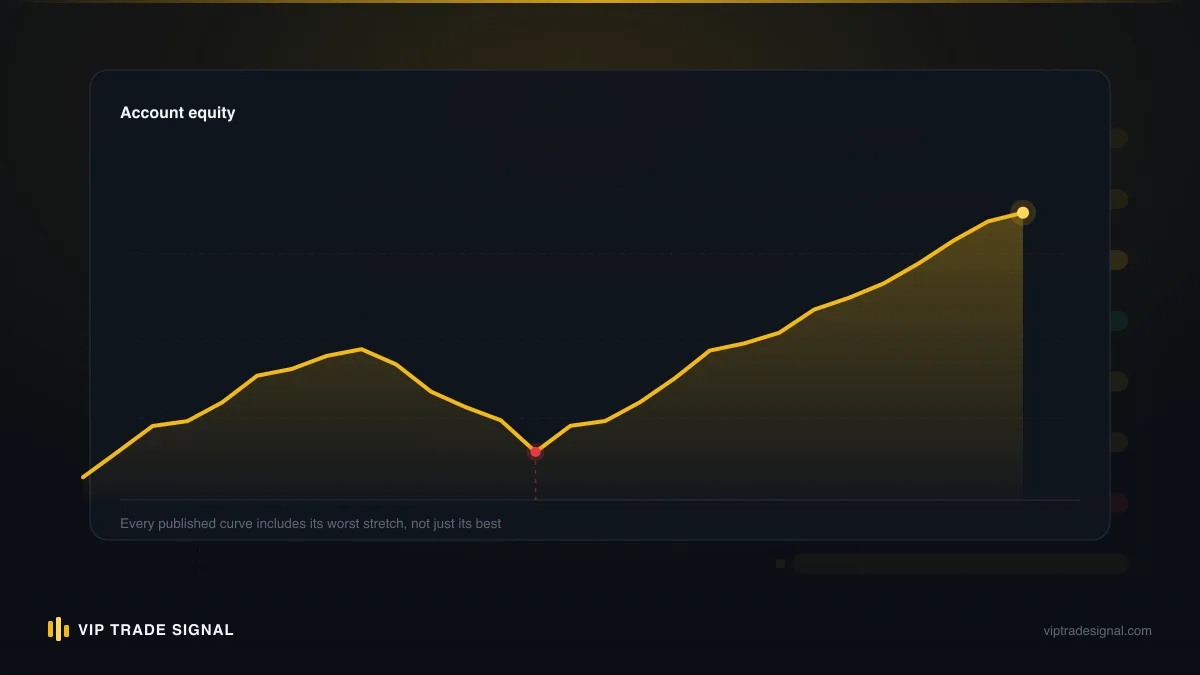
This is why we keep banging on about drawdown. The question "what's your win rate?" is the beginner's question. The practitioner's questions are: what's the worst peak-to-trough drawdown on record? How long was the longest losing streak? What happened to the signal frequency during it? A provider who answers those three without flinching is worth ten who answer only the first.
How to verify any provider's track record
Verification is where the honest and the fraudulent part ways, because faking a good story is free and faking a verifiable record is hard.
Rank the evidence like this, strongest first:
- Third-party verified tracking (Myfxbook, FX Blue) linked to a live account, with the account age and equity visible. Check it's a live account rather than demo, check the track record hasn't been conveniently restarted after a bad quarter, and check the drawdown figure, not just the return.
- A complete public trade log, timestamped, including every loss, that you can cross-check against a chart. Pull up five random entries and verify the price actually traded at the stated entry at the stated time. Takes fifteen minutes. Almost nobody does it.
- A long, uneditable message history in the channel itself, where you can scroll back and see calls made before the moves, losses acknowledged when they happened, and no suspicious gaps.
- Screenshots of winning trades. This is not evidence. A screenshot proves the existence of image-editing software and nothing else. In 2026, with demo accounts free and profit-screenshot generators a search away, a gallery of green P/L images is closer to a red flag than a credential.
There's one more test we'd put above all the passive checks: the forward test. Whatever record a provider shows you, paper-trade their signals yourself for 30 days before risking a pound. No editing, no survivorship, no benefit of the doubt. We'll come back to exactly how to structure this at the end, because it's the single habit that would kill most scam channels overnight if subscribers adopted it.
Our own answer to the verification problem is blunt: every closed signal we've ever sent sits on a public results page, wins and losses, and it stays there. Not because we're saints. Because we concluded years ago that in a market drowning in fabricated screenshots, verifiable honesty is a commercial moat. You should apply the same fifteen-minute chart-checking test to our history that we just recommended for everyone else's. Genuinely. A provider whose record can't survive that check has no record.
The red flags that mark a scam channel
After a decade of watching this space, the scams follow patterns so consistent you can practically grade a channel in five minutes. Any one of these should make you cautious. Two or more, close the tab.
- Guaranteed or near-guaranteed profits. "Risk-free", "can't lose", "guaranteed 500 pips weekly". Trading has no guarantees; anyone offering one is describing a product that does not exist.
- Win rates of 95–100%. Covered above. It's arithmetic, not cynicism.
- Lifestyle marketing. Rented Lamborghinis, airport lounge selfies, watch close-ups. Skilled traders exist who like nice cars, but a channel whose content is 70% lifestyle and 30% charts is selling a dream, and the dream is the product.
- Recovery services and "account doubling". Messages promising to recover your previous losses, often unsolicited, are a scam category of their own and frequently a second-round harvest of people already burned once.
- Pressure and scarcity. "Only 5 VIP slots left", countdown timers, "price doubles at midnight". Real desks don't run flash sales on risk.
- No stop losses, or stops added retroactively. If losing trades quietly vanish from the channel history while winners get pinned, you're watching the record being laundered in real time.
- Payment by gift card, crypto to a personal wallet, or Western Union. No legitimate subscription business in 2026 needs an Amazon voucher.
- Anonymous everything. No named humans, no company, no jurisdiction, no terms. When it goes wrong, and it will, there is nobody to hold to anything.
- DM-first outreach. Real providers are found; scammers hunt. An unsolicited "hey dear, do you trade gold?" message is a 100% reliable signal, just not the kind you want.
The deepest red flag is structural rather than cosmetic: a provider whose income depends on recruiting you rather than on trading well. Affiliate-stacked funnels, MLM-style referral tiers, channels that push you toward an unregulated broker you've never heard of. Follow the money. If the provider gets paid the moment you deposit, regardless of what happens to the deposit afterwards, your losses are their revenue and the signals are set dressing.
None of this means paid signals are a scam category wholesale. It means the burden of proof sits entirely on the provider, and the honest ones carry it willingly. Regulation also differs by country; UK readers dealing with FCA-regulated brokers have a somewhat different set of considerations, which we've covered separately in our guide for UK traders.
Risk management rules before you follow anyone
Everything up to here has been about choosing a provider. This section matters more, because a mediocre provider followed with good risk management loses you a little money slowly, while an excellent provider followed with bad risk management can still blow your account in a fortnight. We have seen it done. Twice by the same person.
The rules are old and boring and they work.
Risk a fixed fraction per trade, and make it small. One percent is the standard for a reason; 0.5% while you're evaluating anyone new. On a $2,000 account, 1% is $20. That number feels insultingly small to someone who came to trading to change their life, and that feeling is precisely the thing that destroys accounts. Run it forward: at 1% risk, a six-trade losing streak (which, remember, ordinary variance will produce) costs about 5.9% of the account. Annoying. Survivable. At 10% risk per trade, the same streak costs 47%, and you now need to nearly double the account just to get back to where you started. The maths of drawdown is viciously asymmetric: lose 50% and you need +100% to recover. Position sizing isn't a detail of following forex signals. It is most of the job you retain.
Derive the lot size from the stop, every time. Risk amount divided by stop distance gives position size, the same ten-second arithmetic from the anatomy section. The provider cannot do this for you, because the provider doesn't know your balance. Any service quoting fixed lot sizes to an audience of strangers is being careless with other people's money.
Cap total open risk. Three signals live at 1% each is 3% at risk simultaneously, and if they're all long gold in different clothes, it's really one 3% trade. Correlated positions are the quiet account-killer. Set a ceiling (2–3% total open risk is sane) and skip signals that would breach it. Skipping a signal is free.
Set a weekly circuit breaker. Down 5% on the week, stop, walk away until Monday. Not because the next signal is likelier to lose, but because you, on tilt, are likelier to size it wrong.
Never trade money you cannot lose. Rent money, borrowed money, the emergency fund: none of it belongs anywhere near leveraged gold. This is the least negotiable sentence in this article. Most retail accounts lose money, ours is a high-risk instrument even by forex standards, and no signal provider on earth changes that baseline. Anyone who tells you otherwise is selling something you shouldn't buy.
Do these five things and no signal service, good or bad, can hurt you beyond a bruise. Skip them and even the best forex signals in the world are just a slower route to the same ending.
Executing signals without wrecking the entry
There's a gap nobody talks about between a signal's theoretical performance and what subscribers actually bank, and most of that gap is execution.
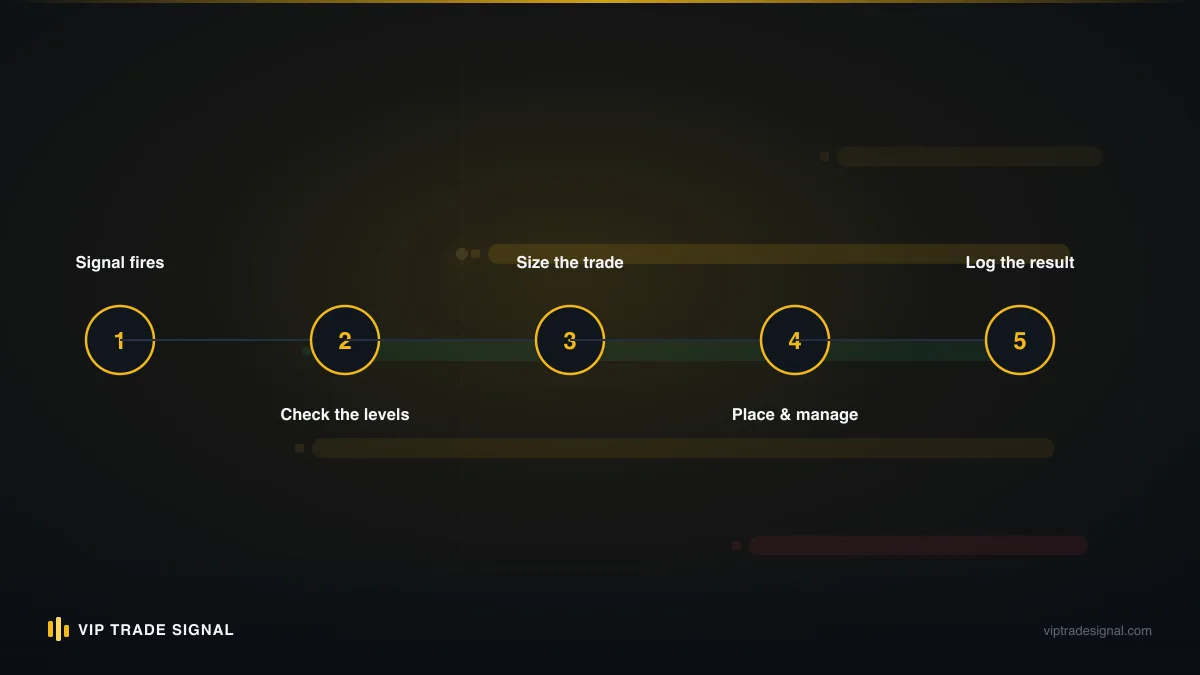
Start with latency. A signal is priced at the moment it's written. If it says "sell at market" and you see it forty minutes later, the trade that exists now is not the trade that was sent. This is why limit and stop orders are your friend: a "sell limit 3,342" is either still valid (price hasn't reached it, place it), already triggered (check where price sits relative to the stop and targets before doing anything), or expired (price ran without you; skip it). The discipline of checking the chart before touching the order ticket sounds trivial. It prevents the single most common way subscribers lose money on winning signals, which is entering late at a worse price with the original stop, turning a 1:1.5 trade into a 1:0.7 one.
Then spread. Gold spreads on a decent account run tight during London and New York and widen dramatically around news and the daily rollover. A signal with a 9-dollar stop budgeted for a 20-cent spread behaves very differently through a 1.5-dollar news spread. If you can't get filled within a reasonable distance of the stated entry, the correct action is to skip the trade entirely. Chasing is how "the provider's record" and "your record" become two unrelated documents.
A few habits that close most of the gap:
- Turn on actual push notifications for the signal channel, not the muted digest you check at lunch.
- Read the whole signal before placing anything. Entry type, stop, targets, any conditions.
- Check the live chart against the signal. Still valid? Place it with the size your risk maths dictates. Not valid? Skip, and log the skip.
- Set the stop and take profit in the order itself, at placement, not "in a minute". Platforms crash. Phones die. The stop lives on the server or it doesn't exist.
- Follow the management updates. If the desk says move to breakeven, move to breakeven. Freestyling exits on someone else's entries gives you the worst of both worlds.
And a word on partial closes, since staged targets confuse people: closing half at TP1 and moving the stop to entry is not cowardice, it's how the risk maths of a multi-target signal is designed to work. The subscribers who insist on holding full size for TP3 every time are volunteering for the exact drawdowns the structure was built to soften.
Why we only trade XAU/USD
Every signal we send is gold. No EUR/USD on quiet days, no exotic crosses to pad the message count, one instrument. Since this is the pillar guide, you deserve the reasoning rather than the slogan.
The first reason is depth of familiarity. Gold has a personality: how it behaves at the London open, how it breathes around US CPI and Fed pressers, where Asian-session liquidity tends to sit, how violently it punishes late breakout entries. A desk that watches one instrument every session for years accumulates a feel for that personality that no fourteen-pair generalist can match, for the same reason a cardiologist beats a GP at reading an ECG. Every hour we'd spend forming views on the yen is an hour not spent on the thing we're actually good at.
The second reason is volatility, stated honestly as a double-edged fact. Gold moves. Daily ranges of 30 to 60 dollars have been routine in recent years, which means intraday trades have genuine room to reach meaningful targets without needing heroic leverage. The same volatility punishes sloppy stops and oversized positions faster than any major pair, which is why the risk section above is not boilerplate. We picked the instrument for its range and we respect what that range does to the careless.
Third, focus is a filter against our own worst incentive. A multi-pair service that has promised daily forex signals can always find something that looks like a setup across fourteen charts. That's not an edge, it's a content pipeline. Committing to one instrument means some days there is genuinely nothing to send, and saying so. Fewer, better trades is a strategy; it's also, conveniently, the strategy a rebate-hungry provider would never choose.
Is single-instrument the only defensible model? No. Real multi-pair desks exist, usually staffed accordingly. But for a small desk being honest about its capacity, one deeply-known instrument beats ten shallowly-known ones, and we'd rather be the narrow specialist with a public record than the broad generalist with a brochure. You can see the current output of that philosophy on the signals page, and judge whether the specialisation shows.
A 30-day plan to test any provider safely
Here's the forward test promised earlier, laid out properly. It costs almost nothing, takes twenty minutes a day, and will tell you more about any forex signal provider (ours included) than every review site on the internet combined. Review sites in this niche are largely pay-to-play anyway; your own logged data has no sponsor.
Days 1–7: observe only. Join the channel. Place no trades, not even demo. Log every signal in a spreadsheet the moment it arrives: timestamp, instrument, direction, entry, stop, targets, and later, the outcome in R terms (a trade that risked 9 dollars and made 13 is +1.4R; a stop-out is −1R). Log the management updates too. Also log what you're really testing this week: completeness. Are stops always present? Do losses get acknowledged, or do losing signals quietly stop being mentioned?
Days 8–21: demo execution. Now take every signal on a demo account, using exactly the sizing rules from the risk section, at the moment you actually see the message. Not the moment it was sent. Your slippage, your delays, your time zone. You're measuring the gap between the provider's theoretical record and your executable one, and there is always a gap; the question is size.
Days 22–30: analysis, and maybe a toe in the water. Total the R. Look at the streaks, the frequency, the worst day. Compare your log against the provider's own claimed results for the same period; discrepancies are the entire finding. If, and only if, the numbers hold up, the final week can move to live execution at half your normal risk (0.5%), because demo fills flatter you and live psychology is a different sport.
Three outcomes are possible. The log shows a provider that roughly matches its public record: continue, at normal size, still logging. The log shows a modest gap: decide with open eyes whether the executable edge survives your latency. The log contradicts the public record: leave, and know you spent thirty days and nothing else finding out. Every one of those outcomes is a win compared to the default path, which is depositing on the strength of a screenshot.
One asterisk: a month is a decent filter and a poor verdict. Thirty days of intraday signals might give you 25–40 data points, enough to catch a fraud, nowhere near enough to certify an edge. Keep the log running after you go live. Ours runs permanently in public; yours can run permanently in private.
Where this leaves you
Strip away the marketing and the counter-marketing, and the honest position on forex signals in 2026 fits in a few sentences. Signals are a legitimate tool with a specific job: putting structured, risk-defined trade ideas in front of people who can't or shouldn't generate their own all day. The industry selling them is maybe one-tenth honest operators and nine-tenths funnels, and the two are separable in under an hour by anyone who checks stops, demands losses, and forward-tests before funding. The tool fails predictably when it's asked to be something it isn't: a substitute for risk management, a passive income stream, or a rescue plan for money that was never spare to begin with.
So, next moves, concretely. Pick at most two providers to evaluate. Run the 30-day log on both, simultaneously, observe-only first. Cap risk at 0.5% throughout, cap total open risk at 3%, and write your weekly circuit-breaker number down before the week starts. Check any provider's history against a chart for fifteen minutes before believing a word of it. And if a channel guarantees you anything at all, leave without a second read.
If you want to include us in that evaluation, good; that's precisely the process we built the service to survive. The record is public at /signals/history, the terms are flat and boring, and the FAQ answers the awkward questions before you have to ask them. But whether you ever send us a pound or not, hold everyone in this industry to the standard in this guide. The providers who deserve your subscription will pass it without complaint. The rest were never going to make you money anyway.