A trader messaged us last month asking a question that sounds simple and isn't: "Is $250 a month too much for signals?" He'd been quoted that by a channel with a slick landing page, a countdown timer, and a screenshot of somebody's Lamborghini. He had a $1,100 account.
Sit with that. At $250 a month, his subscription would cost 23% of his account every month. To break even on the fee alone he'd need roughly 23% monthly, a return professional fund managers would sell a kidney for annually. The signals could be genuinely brilliant and he'd still bleed out.
So how much do forex signals cost in 2026? The honest answer is anywhere from free to $500+ a month, and the number on the checkout page is the least interesting part of the question. What matters is what each price tier actually buys, which costs never appear on the invoice, and what the fee looks like next to your account size. We run a paid signal service ourselves, so we have a horse in this race. But we'll show you our pricing with the same scepticism we point at everyone else's, and you can judge.
How much do forex signals cost in 2026: a market survey
Spend an afternoon collecting prices across Telegram channels, Discord servers, MQL5 marketplace listings, copy-trading platforms and standalone signal websites, and the market sorts itself into recognisable bands. The borders are fuzzy, but they're real.
| Tier | Typical monthly price | What's usually inside |
|---|---|---|
| Free channels | $0 | Marketing funnels, delayed signals, upsell bait |
| Ultra-cheap | $10–$30 | Resold or copied signals, huge member counts, no accountability |
| Mid-market | $50–$150 | Where most honest independent services live |
| Premium | $200–$500+ | Sometimes genuine expertise; often just premium marketing |
| Profit-share / managed | % of gains | A different animal entirely; fees scale with results |
Two things jump out from any honest survey of this market. First, the spread is enormous: you can pay 50 times more for one service than another, and both are nominally selling the same thing: an entry price, a stop, and a target sent to your phone. Second, and this is the uncomfortable part, price predicts quality about as well as a coin flip. We've seen $15 channels run by careful traders who publish every losing trade, and $400 "institutional desks" that were one bloke in a rented office with a Canva subscription.
Why doesn't price sort the market the way it does for, say, laptops? Because there's no independent quality check. A laptop reviewer can benchmark a machine. A signal buyer usually can't verify a track record before paying, so sellers compete on marketing instead of results, and marketing budgets, not win rates, end up setting prices. Keep that in mind through everything that follows.
What ultra-cheap signals ($10–30) usually are
The bottom of the market is crowded, loud, and mostly worthless. Not always. Mostly.
Here's the economics, because the economics explain the behaviour. A $15/month channel with 2,000 subscribers grosses $30,000 a month. That's a serious business. Except the channels charging $15 rarely have 2,000 paying subscribers. They have 40. So the operator earns $600 a month, which is not enough to live on, which means signals are a side hustle, which means the moment life gets busy the signals get sloppy or stop. You're not paying for analysis at this tier. You're paying a tip jar.
The other common species down here is the reseller. Someone subscribes to a more expensive service, copies each alert into their own channel, and charges $19 for it. You get the same signals, delayed by two to fifteen minutes. In a slow swing-trade setup that delay might not kill you. In gold, where a news candle can travel $15 in ninety seconds, that delay routinely turns a decent entry into a terrible one. And when the source service bans the reseller, your channel goes quiet without explanation.
There's a third variety worth naming: the churn model. Signals designed not to make money but to look active: five to ten trades a day, tight targets that hit often, wide stops that hit rarely but catastrophically. The win rate screenshot looks superb. The equity curve, if anyone ever showed you one, would look like a staircase going up followed by a lift shaft going down. High trade frequency is the tell. Nobody has ten genuinely good ideas a day.
Are there honest $20 services? A few, usually new providers pricing low to build a track record. If you find one that publishes complete results including losers, answers direct questions, and doesn't spam upsells, it might be worth a small experiment. But go in expecting to be disappointed, because you probably will be. We wrote more about how to vet any provider, cheap or not, in our complete guide to forex signals.
The mid-market ($50–150): where honest services live
Between roughly $50 and $150 a month sits the most defensible part of the industry. That's not a coincidence; it's arithmetic again.
A service charging $99 with 150 subscribers grosses about $15,000 a month. That's enough to pay one or two experienced traders properly, cover software, and leave margin — without needing to churn thousands of members through a funnel. The operator can afford to care about retention, and retention in this business comes from one thing only: subscribers who stay because the signals, over months, help more than they cost. Mid-market economics reward honesty in a way the bottom of the market structurally can't.
That doesn't mean everyone at this price is good. It means the good ones tend to end up here. What should $50–150 a month actually get you? Our checklist, and we hold ourselves to it:
- A published, complete trade history — every closed signal, wins and losses, with dates and prices, not screenshots
- Full trade parameters on every alert: entry, stop loss, take profit levels. A signal without a stop is not a signal, it's a dare
- Sensible frequency: a handful of quality setups per week beats a firehose
- Some indication of the reasoning, even a sentence, so you learn rather than blindly follow
- A human who answers questions, and answers the awkward ones too
- No pressure tactics: countdown timers and "3 spots left" have no place at a service confident in its results
Notice what's not on the list: a high win rate. A 45% win rate with 2:1 average reward-to-risk makes money. A 90% win rate with inverted risk-reward loses it, slowly then suddenly. Any provider leading with win rate alone is telling you they think you can't do arithmetic.
The mid-market is also where you'll find honest specialisation. Services covering one instrument or one session deeply, rather than spraying alerts across thirty pairs. We're biased here — our entire service is XAU/USD and nothing else — but we'd argue the bias is earned. Depth beats breadth in a market this unforgiving.
Premium pricing ($200+): what justifies it, if anything
Above $200 a month you enter the velvet-rope tier: "inner circle" Discords, "institutional" rooms, mentorship-plus-signals bundles at $297, $397, $497. The pricing psychology is deliberate. At this level the price is the product — it signals exclusivity, and exclusivity sells because everyone quietly believes the real edge must be behind the expensive door.
Sometimes it is. To be fair to the top end, there are a few things that can genuinely justify premium pricing:
- Live trading rooms with real-time narration. Watching a competent trader manage a position — trail a stop, take partial profit, admit an idea has died — teaches things an alert never can. That's labour-intensive and worth paying for, if the trader is actually competent.
- Small deliberately-capped groups. A provider limiting membership to protect fill quality on their own entries has a real cost to recoup. Rare, but it exists.
- Structured education attached. If the $300 is mostly mentorship with signals as the practice material, judge it as education. Good education is expensive everywhere.
But here's the uncomfortable test we'd apply to any premium service: ask what, specifically, the extra $200 buys compared with a $99 service. If the answer involves the words "exclusive", "VIP" or "insider" without a concrete deliverable attached, you're paying for the door, not the room. And ask the killer question: where is the full trade history? Premium services fail this test at almost exactly the same rate as cheap ones, which tells you most of what you need to know about whether price buys accountability.
One more pattern from the top tier deserves sunlight: the tiered-upsell ladder. You join at $99, then discover the "real" signals live in the $249 tier, and the "whale" signals at $499. Each tier exists mainly to make the one below feel incomplete. A service that segments its own signal quality by how much you pay is openly telling you it withholds its best work from paying customers. Walk.
Hidden costs: spreads, slippage, and bad fills
Now for the part no pricing page mentions. The subscription fee is often not the biggest cost of following signals. Execution is.
Say you follow a gold service that averages 40 signals a month and you trade 0.10 lots per signal. Gold spreads on a decent raw-spread account run maybe 10–15 cents plus commission; on a poor standard account, 35–50 cents or worse. On 0.10 lots, every 10 cents of spread is $1. Take the difference between a good broker and a bad one at, say, 30 cents per trade round-trip: that's $3 per signal, $120 a month at 40 signals — potentially more than the subscription itself, silently deducted from every single trade whether it wins or loses.
Then there's slippage, and gold traders know this pain intimately. Signals often cluster around session opens and news windows because that's when setups form. It's also when spreads widen and fills degrade. If your provider's published entry was 3,318.50 and your fill was 3,319.40, you just paid 90 cents of invisible fee — on a trade with a $4 stop, that's a fifth of your risk gone before the trade breathes. Multiply across a year of trading and execution quality quietly decides whether a marginally profitable signal service is profitable for you.
The delay tax belongs here too. A signal fired at 14:32:05 that you see at 14:37 is a different trade. Some services quote performance from their own timestamped entries, which is fair, but your results will trail theirs by however much your delay and your broker cost you. This gap is the single biggest reason two subscribers to the same honest service can have opposite experiences.
Let's make the whole thing concrete with one worked month. A trader we'll call Sam subscribes to a $99 gold service, trades 0.10 lots per signal, and takes 35 signals in the month. His broker's standard account costs him about 35 cents of spread per trade against the 12 cents a raw account would have charged: 23 cents of excess, $2.30 per trade, $80.50 for the month. His average fill lags the published entries by 20 cents, some of which is unavoidable and some of which is his notification settings: call it another $70 across the month. His true cost of following the service wasn't $99. It was roughly $250 — and the extra $150 never appeared on any statement as a line item, because it was baked into every fill. When Sam judges whether the service "worked", he'll compare his P&L against the $99 he remembers paying, and he'll be wrong by 150%.
What to do about it, practically: trade signals on a low-spread account type even if the commission looks annoying (the maths almost always favours it for gold), turn phone notifications for the signal channel to maximum-priority, and track your own fills against the provider's published entries for a month. If your average entry is consistently worse by more than a small fraction of the typical stop distance, fix the execution before you blame or credit the signals.
Performance fees vs flat subscriptions vs profit splits
There are really three ways this industry charges, and they create very different incentives. Worth understanding before you pay anyone anything.
Flat subscriptions — the $99/month model — are predictable and simple. You know your cost, the provider knows their revenue. The weakness is obvious: the provider gets paid the same in a losing month as a winning one. The only pressure keeping them sharp is churn, which is why a published, warts-and-all track record matters so much under this model. It's the substitute for aligned incentives.
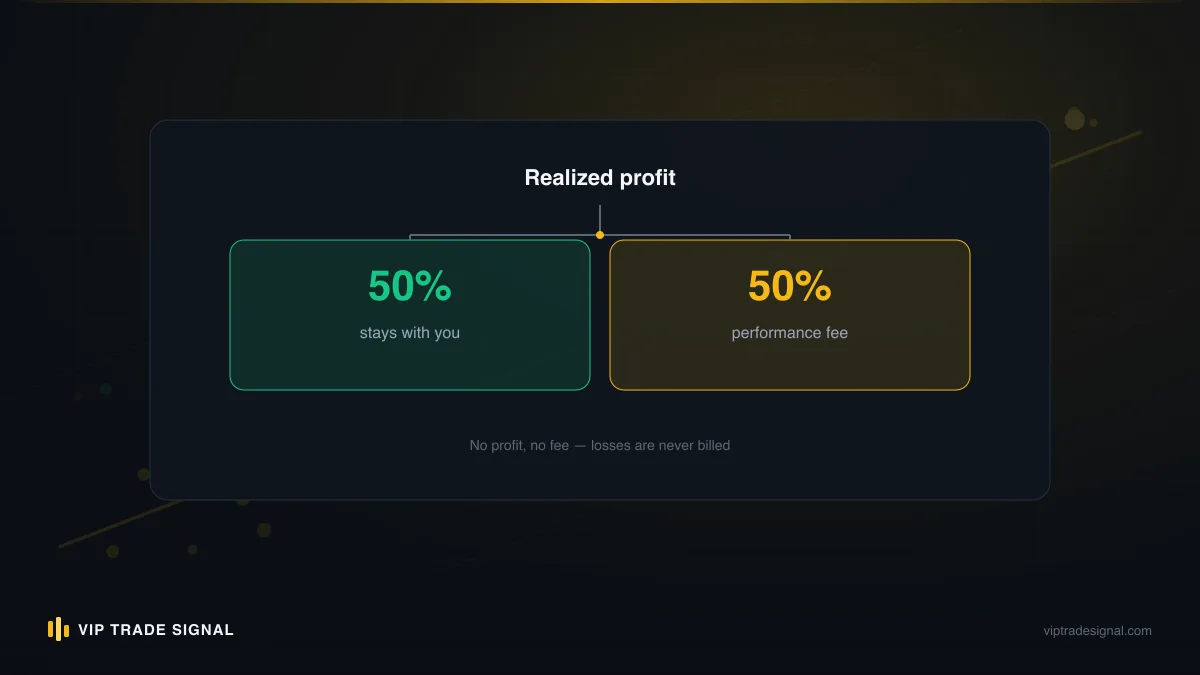
Performance fees charge a percentage of profits, usually on managed accounts rather than signal subscriptions. The industry-standard shape borrowed from hedge funds is 20–30% of gains, sometimes with a high-water mark. The alignment is real: no profit, no fee. The failure mode is also real: a manager paid only on upside is holding a free option on your account. Big win, they take a cut; big loss, they walk away and find another client. That asymmetry has incinerated a lot of retail accounts, which is why the structure around a performance fee — drawdown limits, who holds the passwords, whether losses carry forward before new fees accrue — matters far more than the headline percentage.
Profit splits are the blunter cousin: a flat share of realised profit, no management fee underneath. This is what we use for account management, and we'll break our version down properly below. The honest trade-off: a 50% split is expensive when things go well — genuinely, materially expensive — in exchange for costing nothing at all when they don't, and for a low entry minimum. Whether that trade is worth it depends entirely on your alternative. If you can access a 25%-of-profits manager who'll take your account size, take it. Most managers with real structure won't look at accounts under $25k–$50k. That gap in the market is what pay-as-you-go pricing exists to serve, and it's fair to say the fee reflects that.
The rule that cuts across all three models: fees you pay only from profit can never bankrupt you; fees you pay regardless can. Which is precisely why the next section exists.
Why 'lifetime access' pricing is a warning sign
Every so often you'll see it: "Lifetime VIP access — one payment of $499, normally $2,999." It feels like the savvy buy. It's usually the opposite, and the reason is cold business logic rather than cynicism.
A subscription business earns by keeping you happy month after month. A lifetime-deal business earns everything on day one. The moment your payment clears, you convert from customer to cost. Every alert they send you, every question you ask, is pure expense against revenue already spent. There is no financial reason to keep the service good for you, and the incentive gradient points one way: harvest a wave of lifetime buyers, let quality slide, rebrand, repeat. We've watched this exact film at least a dozen times. The channel doesn't even always die; it just fades into recycled setups and affiliate links for prop firms.
There's a legal wrinkle too, which almost nobody selling lifetime deals mentions. "Lifetime" in these offers means the lifetime of the service, not yours — and the fine print, where fine print exists at all, usually says so. When the operator shuts the channel eighteen months in, you have no recourse, no refund window left with your card provider, and no counterparty to chase. A monthly subscriber in the same collapse is out $99. The lifetime buyer is out the full $499 and a little bit of faith in humanity.
Lifetime pricing also tells you something about the operator's own confidence. Someone who believes their signals will be valuable in three years prices them monthly, because monthly is worth more. Someone selling three years upfront at a discount is telling you their own estimate of the service's lifespan. Believe them.
The softer version of this warning applies to long prepaid terms generally. Annual plans at a modest discount from an established service with years of published history — defensible, your call. Anything beyond a year, or any provider pushing hard for the long plan with aggressive discounting, is asking you to assume the business risk of their service staying good. That risk should sit with them, and the monthly price is the rent they pay for it.
Free-via-broker models priced in commissions
There's a fourth pricing model that deserves its own section because it's the one we lean on hardest, and because it's widely misunderstood as "free". It isn't free. It's paid differently.
The mechanics: a signal provider partners with brokers as an introducing broker (IB). You open your trading account through the provider's partner link, and the broker pays the provider a rebate out of the spread or commission on your trades. In exchange, the provider waives the subscription fee. Our version of this is straightforward: signals are free through a partner broker — Exness, XM, IC Markets or Vantage — if you keep $250 or more in the account; otherwise it's the flat $99.
So who's really paying? You are, in tiny slices, through the spread you'd mostly be paying anyway. And that's the crucial question to ask of any broker-model service: is the partner account more expensive than the account you'd choose yourself? If the provider forces you onto an inflated-spread account type to fatten their rebate, "free" becomes the most expensive tier on the menu — you're back to that hidden $120/month from the slippage section, just wearing a different hat. If the partner accounts are the broker's normal retail accounts at normal pricing, then the rebate comes out of the broker's marketing budget rather than your pocket, and the deal is about as close to genuinely free as this industry gets.
The incentive structure under this model is worth a hard look too. An IB paid per-lot earns more when you trade more, which could tempt a provider into over-signalling to juice volume. The defences against that temptation are the same as ever: a public trade history where you can count the frequency yourself, and stops on every trade. A provider churning twenty signals a day under a rebate model is milking you. One sending a few quality gold setups a week has chosen sustainability over volume, because a blown account generates precisely zero rebates from month two onward. Long-term, the IB model actually rewards keeping subscribers solvent — it's one of the few structures in this industry where the provider makes more money if you survive.
We've gone deeper on the whole free-signals ecosystem, including the genuinely predatory corners of it, in our piece on free forex signals.
Cost as % of account: the only number that matters
Here's the section that should have come first if pricing pages were honest. The absolute price of a signal service is meaningless. The price as a percentage of your account is everything.
Run the numbers on a $99/month subscription across account sizes:
| Account size | Fee as % of account per month | Monthly return needed just to cover the fee |
|---|---|---|
| $500 | 19.8% | ~20% |
| $1,000 | 9.9% | ~10% |
| $2,500 | 4.0% | 4% |
| $5,000 | 2.0% | 2% |
| $10,000 | 1.0% | 1% |
| $25,000 | 0.4% | 0.4% |
Look at the top row and be honest with yourself. Needing 20% a month before you earn your first dollar of actual profit isn't a headwind, it's a hurricane. Consistent 20% monthly returns don't exist outside of luck and marketing copy. Anyone trading a $500 account should not be paying $99 a month for signals — including ours, and we'll say that plainly even though it costs us subscribers to say it. This is exactly the situation the broker-funded route exists for: at $250+ maintained with a partner broker the cash fee drops to zero, which changes the arithmetic completely for small accounts.
Somewhere between $2,500 and $5,000, a $99 fee crosses into rational territory: a 2–4% monthly hurdle is demanding but within the range a disciplined approach can plausibly clear over time, with losing months along the way, because losing months are part of any real trading record. By $10,000 the fee is basically noise, and the quality of the signals — and of your execution — is the entire game.
Never ask whether signals are cheap or expensive. Ask what return they'd need to generate on your account before you keep a single dollar.
That one reframe filters the whole market for you. The $250/month service pitched at our reader with $1,100? A 23% monthly hurdle. Doesn't matter if the analyst is the second coming of Paul Tudor Jones; the structure loses. Meanwhile a $150 service on a $30k account carries a 0.5% hurdle, and the only question left is whether the signals are any good.
Negotiating and trials: what providers will actually do
Almost nobody negotiates with signal services. Almost everybody could. Providers run on churn maths — acquiring a subscriber costs real money in ads and content, so keeping or landing one at a discount usually beats losing them. That gives you more leverage than the checkout page implies.
What actually works, from watching this market for years and running a desk inside it:
- Ask for a trial before anything else. Reputable services offer a week or two, sometimes free, sometimes a token $7–15. A provider who refuses any trial while claiming excellent results is asking you to buy a car with the bonnet welded shut. If a trial genuinely can't be offered, a complete public trade history is the acceptable substitute — arguably a better one, since a two-week trial proves little either way about a strategy that plays out over months.
- Ask about a reduced rate for a longer commitment — but only after you've tested a month at full price, and never beyond a year for the reasons covered above.
- Time your ask. Providers quietly discount at quarter-ends and after losing streaks, when churn spikes. An honest service in a drawdown is often the best value in the market: the price is soft and the survivorship-biased channels have already gone quiet.
- Mention the alternative honestly. "I'm choosing between you and X" gets real responses from services confident in their edge, and bluster from the rest. The reaction is itself information.
What providers won't do, and shouldn't: refund losing trades, guarantee performance, or discount so deeply the service becomes the churn-funnel it was pretending not to be. Anyone guaranteeing profit to close a sale has told you everything; the only guaranteed thing in leveraged trading is that losses will visit. Leave.
One more practical note: whatever you agree, get the terms in writing inside the payment platform, not just a Telegram DM. Billing disputes with offshore signal sellers are not fights you win on vibes.
And run your trial like a trial, not like an audition you're rooting for. Log every signal the provider sends during the period — timestamp received, published entry, your actual fill, outcome — whether or not you take the trade with real money. Two weeks of that log tells you the service's real frequency, the honesty of its published entries, and your personal execution gap, which is more than most subscribers learn in a year of paying. It also strips out the psychology: it's remarkably easy to remember the three winners from a trial and forget the four losers, and remarkably hard to argue with your own spreadsheet.
Our pricing, fully broken down
We've spent nine sections pointing a torch at everyone else, so here's the same torch pointed at us. All of this lives on our pricing page, but the blog version comes with the reasoning attached.
Signals: $99/month, or free via a partner broker. One instrument — gold, XAU/USD — unlimited signals, every alert with entry, stop and take-profits. The $99 puts us squarely in the mid-market band we defended earlier, and we sit there on purpose: it's the price point whose economics reward retention over churn. The free route is the IB model described above — open your account through Exness, XM, IC Markets or Vantage via our partner link, keep at least $250 in it, and the subscription fee is waived while the broker's rebate carries the cost. Every closed signal we've ever issued, wins and losses both, is public at /signals/history. We'd rather lose the subscribers who leave after seeing a losing streak than keep the ones who'd panic during one.
Account management: flat 50% of realised profit, $200 minimum advance. We trade your own MT4/MT5 account; you keep the master password and full withdrawal control at all times — that part is non-negotiable in both directions. No profit in a period, no fee beyond the advance. And let's be direct about the number, because we said we would: 50% is at the very top of the industry's range. Traditional managers charge 20–30% of profits — and require account sizes and lock-ins that exclude nearly everyone reading this. Our split is high because the minimum is low and everything is pay-as-you-go: no management fee ticking away in losing months, no twelve-month commitment, no $50k door. If your account qualifies for a cheaper structure elsewhere, we'll say it here in print: that structure is cheaper. Take it.
Drawdown recovery: flat 50% of recovered profit above a jointly recorded baseline. For accounts floating roughly $5k–$10k underwater, we work the recovery and take half of what's clawed back above the baseline we both sign off on at the start. No recovery guarantees — anyone offering one for a leveraged account is lying to you, and it's a measure of this industry that the sentence even needs writing.
Common questions about how the tiers interact, what happens if you drop below the $250 broker minimum, and how the baseline gets recorded are answered on the FAQ. And the standing disclaimer that's also just the truth: we're not a licensed advisor, none of this is personalised investment advice, and gold trades with enough leverage to hurt you quickly if risk is ignored.
Budget framework: what you should pay at your account size
Time to make this concrete. Here's the framework we'd give a friend, by account size, with no reference to any particular provider — including us.
Under $1,000. Pay nothing in cash. Full stop. Every dollar of fixed monthly fee at this size is a structural tax you cannot outrun; the arithmetic from the percentage table is merciless. Your realistic options are free channels used strictly as learning material (with expectations set accordingly), a broker-funded service where the cash fee is zero, or — the option nobody selling anything will suggest — spending this stage on a demo account and a good book instead. Small accounts exist to teach you, not to generate income. Let them.
$1,000–$2,500. A cash subscription starts to be arguable at the very bottom of the market, but broker-funded routes still dominate the maths. If you do pay, cap it around $30–50 a month, demand a full published history before a dollar moves, and review the decision quarterly like the business expense it is: did the signals, after spreads and slippage, beat the fee? Your own trade log answers that, not the provider's marketing.
$2,500–$10,000. The mid-market opens up. $50–150 a month is now a 1–4% hurdle — demanding, survivable, honest. This is the zone where paying for quality genuinely beats scraping free channels, because the fee no longer dominates the outcome; execution and discipline do. One service, followed properly for six months, will teach and earn more than four services followed at random. Subscription-stacking is a beginner tell.
$10,000–$50,000. Fees fade into irrelevance and selection becomes everything. Pay for the best track record you can verify, regardless of whether that's $79 or $250. At this size also compare signal-following against managed alternatives and profit-share structures — the maths of each model shifts as the account grows, and what's right at $5k is often wrong at $40k. If you're UK-based, the regulatory wrapper around whoever you pay starts mattering more here too; we covered the specifics in our UK signals piece.
Above $50,000. You're past the retail signal market's design envelope. Traditional performance-fee management, capped small groups, or building your own process with paid signals as one input among several. At this level, honestly, a $99 subscription is a research expense, not a strategy.
Wherever you land, run the same three checks before paying anyone: the fee as a monthly percentage of your account, the complete trade history including losses, and your own measured execution gap after a month of tracking. Cheap forex signals that fail those checks are expensive. Expensive ones that pass them might be cheap. The price tag was never the cost — the cost is the fee, plus the spread, plus the slippage, minus what the signals actually deliver on your account, and only one of those four numbers is printed on the website.
Do the arithmetic before you do the subscribing. It's three minutes of long division, and it will save you more money than any signal ever will.