Somewhere right now, a man with a rented Lamborghini photo and a Telegram channel called something like "FX EMPIRE VIP" is telling four thousand strangers that yesterday's signals hit 380 pips. They didn't. There were no signals yesterday. The channel is eleven days old, the screenshots were built in a photo editor in about four minutes, and the whole operation exists to move you from a free channel to a $250 deposit at a broker you've never heard of.
We've spent years inside this industry, and here's the uncomfortable truth about forex signal scams: they're not rare bad actors in an otherwise decent market. They are the market, or most of it. The honest providers are the minority swimming in a sea of funnels, fake screenshots and recycled scripts. If you've ever typed "forex signals" into Telegram search, you've already been inside a scam funnel, whether you noticed or not.
This piece is the field guide we wish someone had handed us a decade ago. Not vague "be careful out there" advice, which protects nobody. We're going to name the seven scam architectures, walk through the actual scripts they run, explain the psychological hook each one is built on, and give you a screen you can run on any channel in about a minute. Then, because some of you reading this have already been hit, we'll cover damage control and where to report. Pour a coffee. This one's long, because the problem is.
Why forex signal scams are everywhere
Ask yourself why signal selling attracts fraud the way a dropped kebab attracts seagulls. It's not an accident. Four structural features make it close to the perfect scam environment.
First, the product is invisible until after you've paid. A signal is a claim about the future. You can't inspect it in advance the way you'd inspect a used car; you can only judge it after the trade closes, by which point your money is gone either way. Any market where quality can only be verified after purchase fills up with sellers who never intend to deliver quality.
Second, the results are trivially fakeable. A screenshot of a winning MT4 position takes minutes to fabricate and seconds to believe. There's no equivalent of a land registry or a company filing. Unless a provider publishes a complete, timestamped, tamper-evident record of every trade (and almost none do), you are trusting pixels.
Third, the audience self-selects for hope. People searching for signals are, disproportionately, people who've already lost money trading on their own and want a shortcut back. That's not a criticism. It's a description of who's in the room. And someone who's down $3,000 and desperate to recover it is, psychologically, the softest possible target for a confident stranger promising 90% accuracy.
Fourth, there's no gatekeeper. Anyone can open a Telegram channel tonight. No licence, no capital requirement, no identity check worth the name. A regulated broker has to answer to somebody; a signal channel answers to no one, can vanish in a keystroke, and can reopen tomorrow under a new name with the same stolen screenshots. We've watched the same scammer cycle through six channel names in a single year. Same profile photo. Same script. New victims.
Put those four together and the surprising thing isn't that forex signal scams are everywhere. It's that any honest providers survive at all.
The taxonomy: seven scam architectures
Almost every signal scam you'll ever meet is one of seven machines, sometimes bolted together. Learn the machines and you stop needing to evaluate each channel from scratch: you just identify which machine you're looking at.
| # | Architecture | The pitch | Where your money actually goes |
|---|---|---|---|
| 1 | Guaranteed-profit funnel | "90% win rate, guaranteed monthly returns" | Subscription fees for signals that are random or copied |
| 2 | Result-faking operation | Fabricated screenshots and edited history | Subscriptions, sold on evidence that never existed |
| 3 | VIP bait-and-switch ladder | Free channel → paid VIP → "inner circle" | Escalating tiers, each promising what the last one didn't deliver |
| 4 | Deposit-farming partnership | "Signals free — just join my broker" | Kickbacks on your deposits and losses at an unregulated broker |
| 5 | Half-and-half caller | Sends opposite signals to two groups | Fees from whichever half happened to win |
| 6 | Account-management grab | "Send us your login, we'll trade for you" | Your entire account, churned or withdrawn |
| 7 | Recovery scam | "We can get your lost funds back — small fee upfront" | The fee. Then another fee. Then another |
A few of these deserve immediate comment. The half-and-half caller (number five) is the most elegant fraud on the list, in a nauseating way. Run two channels of 1,000 people each. Tell one group to buy gold, the other to sell. One group is guaranteed a winner. Delete the losing channel, keep the winning one, split it in two, and repeat. After four rounds you have a small group of people who've watched you call four consecutive winners and would swear on their mother's life that you're a genius. They've seen it with their own eyes. That's the terrifying part: the evidence is real, and it proves nothing.
The account-management grab (number six) barely needs explanation, but people fall for it weekly. Any "manager" who asks for your master password (the one that permits withdrawals) is not managing your account. They're taking it. Legitimate arrangements use investor passwords or read-only access, and you keep control of withdrawals, always. On our own desk that's non-negotiable: clients keep the master password, full stop. Anyone who structures it the other way round has told you the plan.
The remaining architectures are meatier, so they get their own sections.
The guaranteed-profit funnel and its script
Start with the loudest one, because it's the one that catches the most beginners: the channel built entirely on guaranteed profit claims. This is your scam warning in its purest form. If a provider guarantees returns, you're done evaluating. Not "be cautious". Done. Close the tab.
Here's why the guarantee is dispositive rather than merely suspicious. Trading is probabilistic. A genuinely good gold strategy might win 55-65% of trades over a large sample, with losing streaks of five, six, eight trades scattered through it. Anyone who has actually traded knows this in their bones, the way a sailor knows the sea is wet. So a guarantee tells you one of two things: either the person has never really traded, or they have and they're lying to you deliberately. Neither is someone to pay.
But the guarantee is only the headline. The funnel underneath runs on a script so consistent you could set your watch by it. It goes roughly like this:
- The hook. An ad or a mass DM: lifestyle photos, a screenshot of a five-figure profit, "DM me 'PROFIT' to learn how". Sometimes it's a fake giveaway or a "mentorship spot" that's suspiciously always available.
- The warm-up. You're added to a free channel. For a week, you watch a stream of wins. Big green numbers. Fire emojis. Occasional testimonials from accounts created last month.
- The urgency close. "VIP closes tonight. Only 7 spots. Price doubles Monday." The countdown timer is the tell: real analysis doesn't expire at midnight.
- The extraction. You pay. Signals arrive, sourced from free channels or a coin flip. Some win, because roughly half of anything wins. The losers get quietly deleted or blamed on you: "you entered late", "you didn't follow my exact SL".
- The reset. When you complain or leave, you're blocked, and the operation carries on. Your $99 or $299 was the entire product.
Notice what never appears in that sequence: a full trade history. A losing month, acknowledged. A real name attached to a real company. The script has no slot for those things because they'd kill it.
One more detail worth knowing. The DMs are frequently not even human anymore. A lot of the "hey dear, I saw your profile, do you trade forex?" openers are automated, run across hundreds of accounts, and the operator only steps in once you've replied twice. You're not being recruited by a mentor. You're being processed by a pipeline.
Result-faking: screenshots, demos, and edited history
If the guarantee is the front door of the scam, faked results are the load-bearing wall. Strip them out and nearly every fraudulent channel collapses, because faked evidence is the only evidence they have. So it's worth understanding exactly how results get faked, in ascending order of sophistication.
At the bottom: pure image editing. Take a screenshot of a losing MT4 trade, change the red to green, nudge the numbers. Ten minutes in any editor. Millions of people have been convinced by images exactly this crude, because a screenshot feels like a photograph of reality. It isn't. It's pixels, and pixels are free.
One rung up: demo accounts presented as live. A demo account trades fake money with real prices, so the equity curve looks completely authentic, because in a sense it is. The trades happened; the risk didn't. There's no fear in a demo, no slippage that matters, no consequence, and crucially no reason not to bet 20% per trade. A demo run five times will produce at least one glorious curve. You'll be shown that one.
Higher still: selective history. Open ten small live accounts, trade them aggressively in different directions, blow up seven, and showcase the three that survived. Everything shown is genuine. The performance is still a fiction, because you're seeing survivors from a graveyard you'll never be shown. It's the half-and-half trick wearing a better suit.
And at the top: manipulated or backdated track records. MT4 investor access to an account where losing trades were made on a separate account, "verified" myfxbook widgets that link to nothing, or a paid actor's account rented for a month of screenshots. This tier fools even cautious people, which is why the defence can't be "look closely at the evidence". The defence has to be structural.
A screenshot is not a track record. A track record is every trade, timestamped, published before the outcome was known, losses included.
That standard (published before the outcome, complete, losses included) is the only one that can't be gamed by selection. It's why we publish every closed signal, wins and losses both, at our public signals history, and why we'd tell you to hold any provider (including us) to exactly that bar. Not because it makes marketing easy. It makes marketing harder, which is rather the point. A record you can only publish if it's real is the one credential a scammer can't rent.
A quick practical test you can run on any claimed history: find their worst month and their longest losing streak. If you can't, the history is curated. Every real trading record has ugly stretches. Ours does. Anyone's does. A record with no scar tissue is a record of nothing.
The VIP bait-and-switch escalation ladder
This one deserves its own section because it's the architecture most likely to catch people who think they're being careful. It doesn't ask for much up front. That's the trap.
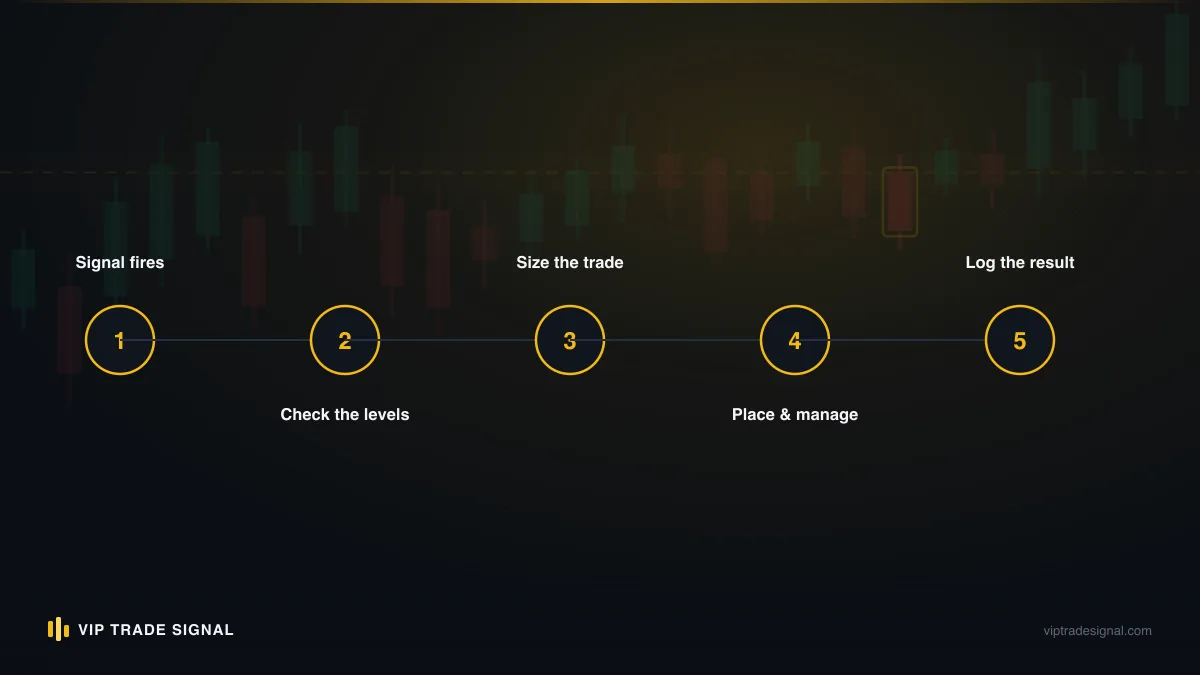
The ladder works like this. The free channel gives you occasional signals. Real ones, sometimes even decent ones, because the free tier is a shop window and shop windows get dressed properly. But the free signals arrive late, or without stop losses, or with a caption like "VIP members got this entry 40 pips earlier". Every free win is an advert for the paid tier. Every free loss is proof you need the paid tier, where, you're assured, the real accuracy lives.
So you pay for VIP. Say $150 a month. And VIP is... fine. Mixed. Some wins, some losses, roughly what a coin and a ruler would produce. But now the messaging shifts: the VIP channel starts referencing the "Inner Circle" or "Gold Mentorship". $500, limited seats, where the admin shares his personal trades. The tier you're on is never the tier where the magic happens. The magic is always one rung up, priced at whatever you haven't paid yet.
We've seen ladders with five rungs. Free, VIP at $99, Premium at $299, Mentorship at $997, and at the summit a "fund" that will "manage capital for select students", which is architecture six from the taxonomy wearing a graduation gown. A trader we'll call Dan climbed one of these ladders over eight months and spent about $2,400 on subscriptions before he ever tallied his actual trading results from the signals: down. Not catastrophically; down maybe $800. The subscriptions had cost him three times what the trading did. That's the quiet genius of the ladder. It doesn't need to blow up your account. It just needs to keep selling you the next rung.
The tell, once you know to look for it, is upward deflection. Any provider whose answer to "the signals aren't performing" is "upgrade" has told you the product is the ladder, not the signals. An honest service has one product at one price that either justifies itself or doesn't. (For what a sane price structure actually looks like across the industry, we've broken that down separately in what forex signals should cost; short version: pricing complexity is usually hiding something.)
Deposit-farming through fake broker partnerships
Now for the machine that catches people specifically because it looks free. "I don't sell signals," says the admin, wounded that you'd even ask. "My VIP is 100% free. Just sign up with my broker link and deposit $200."
Here's what's actually happening. Brokers pay introducing-broker (IB) commissions: a cut of the spread or commission on every trade you place, and sometimes, with the worst offshore shops, a share of your outright losses, because at an unregulated B-book broker your loss is literally the house's win. The "free" signal provider is being paid by the broker for delivering you, and then paid again every time you trade. You are not the customer in this arrangement. You're the crop.
And once your money sits at their partner broker, the signals mutate. Suddenly there are eight signals a day instead of two, because every trade you take pays the IB. Lot size recommendations creep up. Stop losses widen or vanish. The provider's incentive isn't your profit; it's your volume, and volume is maximised by making you overtrade until the account is churned to nothing. When it is, the message arrives on cue: "Tough market this week. Redeposit and we'll recover it."
Let's be precise about something, because it matters and because we'd be hypocrites not to be: broker-partnership funding is not inherently a scam. It's a payment mechanism, and we use a version of it ourselves. Our signals are $99 a month, or free if you trade with one of our partner brokers with $250 maintained. The difference between a legitimate arrangement and deposit farming comes down to three checkable things:
- The broker. Regulated, known names (in our case Exness, XM, IC Markets, Vantage) versus a no-name platform registered nowhere, with a website younger than your milk.
- The incentive shape. A flat arrangement that doesn't reward churning you, versus per-trade or loss-share kickbacks that pay the provider more the worse you do.
- Withdrawal reality. With a regulated broker, your money comes out when you ask. Deposit farms partner with brokers where withdrawals mysteriously "fail compliance" the first time you try.
The screen is simple: search the broker's name plus "regulator", plus "withdrawal problems". Fifteen minutes of reading. If the provider only works with one obscure broker and gets agitated when you suggest using your own (agitated is the tell), walk away. An honest provider cares that you can follow the signals. A farmer cares where you're planted.
Recovery scams: getting robbed twice
There's a special circle reserved for this one. You've been scammed. You're angry, embarrassed, and searching for help. And into that exact moment steps a "fund recovery specialist" who found your complaint on a forum or a Trustpilot review. They're so sorry this happened to you. They've recovered millions for victims. They have "contacts at the blockchain" or "legal partners" who can claw your money back. The fee is small relative to your loss, $300, maybe $500, payable upfront.
Stop. There is no service that recovers money from an anonymous Telegram scammer for a fee. The upfront payment is the entire business. Once you pay it, there'll be a complication requiring another payment: a "tax clearance", a "court filing fee", a "release charge". This continues until you stop paying. Recovery scammers deliberately trawl scam-victim communities because a person who's just lost $5,000 is provably willing to send money to strangers on the strength of a confident promise. You demonstrated the vulnerability; they're the second wave.
Some of these operations are run by the original scammers, selling your details onward or "recovering" you themselves under a new identity. Which is almost admirably efficient, in the way a tapeworm is efficient.
The legitimate recovery routes are boring and free: a chargeback through your card issuer, a dispute through your payment processor, a complaint to the broker's regulator if a regulated broker was involved, and a police report. We'll cover the exact sequence in the damage-control section below. None of those routes charges you a fee that scales with hope.
The psychology: hooks scammers use and why they work
Here's the part most scam guides skip, and it's the part that actually protects you. Knowing the architectures helps you recognise scams. Knowing the hooks helps you recognise the moment you're being worked, which matters more, because the next scam will have a fresh coat of paint and the same old hooks underneath.
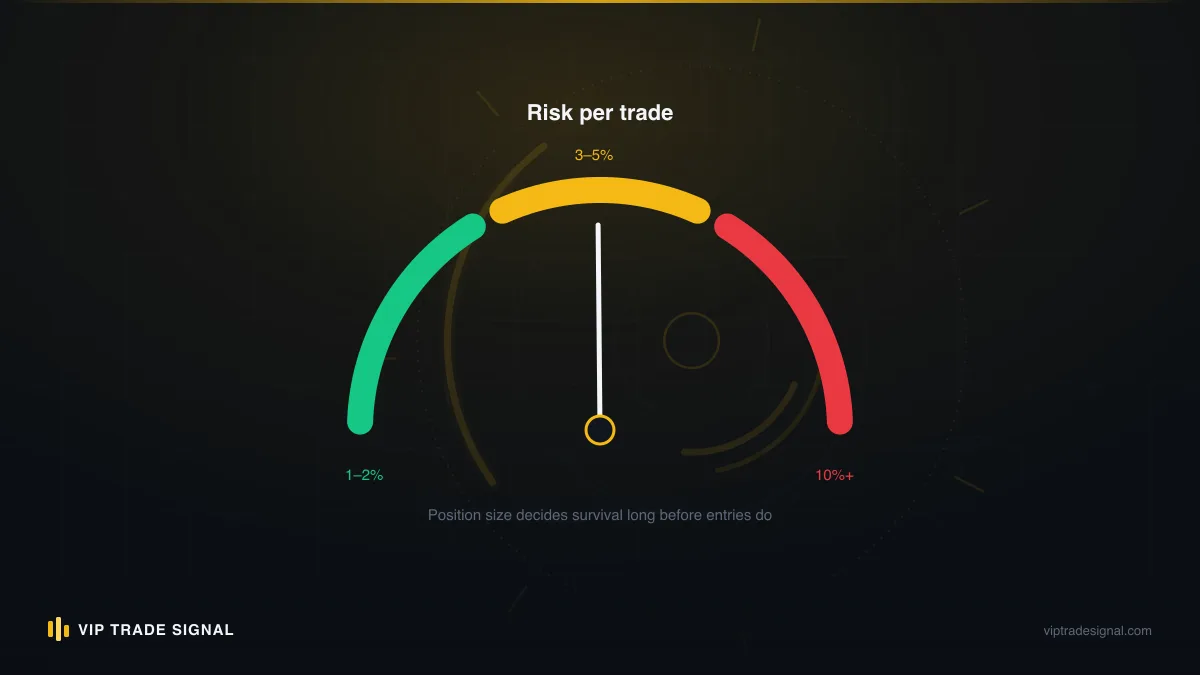
The recovery hook. The strongest one by a mile. If you're down money, whether from trading or from a previous scam, you're not evaluating a signal service, you're evaluating a way home. Scammers know that a person in a $4,000 hole doesn't ask "is this credible?", they ask "could this work?", and hope answers that question for them. If you notice yourself doing loss-math ("at 200 pips a week I'd be even by June"), that's the hook in your cheek. Ironically, this is exactly why we're blunt in our own drawdown work that there are no recovery guarantees, ever: anyone who does guarantee recovery is fishing this precise pond.
Social proof, manufactured. Humans trust crowds. So scammers buy the crowd: thousands of bot subscribers, comment sections of gratitude ("thanks boss, took +80 pips!") from accounts with no history, screenshots of full VIP groups. The crowd feels like verification. It's set dressing, and bots are bought by the thousand for pocket change.
Authority costume. The Bloomberg-terminal photos, the "ex-Goldman" bios that no employer will ever confirm, the watch, the airport lounge. None of it is checkable and all of it is doing the same job: making your brain file this stranger under "expert" before a single claim has been tested.
Urgency and scarcity. Spots that run out, prices that double at midnight, "last chance" pinned messages. Real analysis is not perishable and real services want you to take your time, because customers who decide slowly complain rarely. Manufactured deadline pressure exists for one reason: decisions made fast skip the checking stage. Scarcity is the scammer's answer to due diligence.
Sunk-cost gravity. Once you've paid a rung on the ladder, leaving means admitting the money's gone. Paying the next rung lets you keep believing it wasn't. This is why escalation ladders work on intelligent people: the smarter you are, the better the story you can tell yourself about why one more tier makes sense.
Intermittent wins. The cruellest hook, because it's built from real events. Even random signals win about half the time, and a genuine winning trade produces a genuine hit of validation. Slot machines run on precisely this schedule of reinforcement. A scam channel doesn't need to be right; it needs to be occasionally right, and probability supplies that for free.
Read that list again and notice something: not one hook attacks your intelligence. They attack hope, trust, embarrassment and momentum. Which is why "I'm too smart to get scammed" is itself a risk factor. The defence isn't cleverness. It's process: a fixed set of checks you run every time, especially when you don't feel like you need to.
The 60-second scam screen for any channel
So let's build the process. Here's how to avoid forex signal scams with a screen you can run in about a minute, before any money, any deposit, any DM reply. Ten questions, pass/fail, no judgement calls.
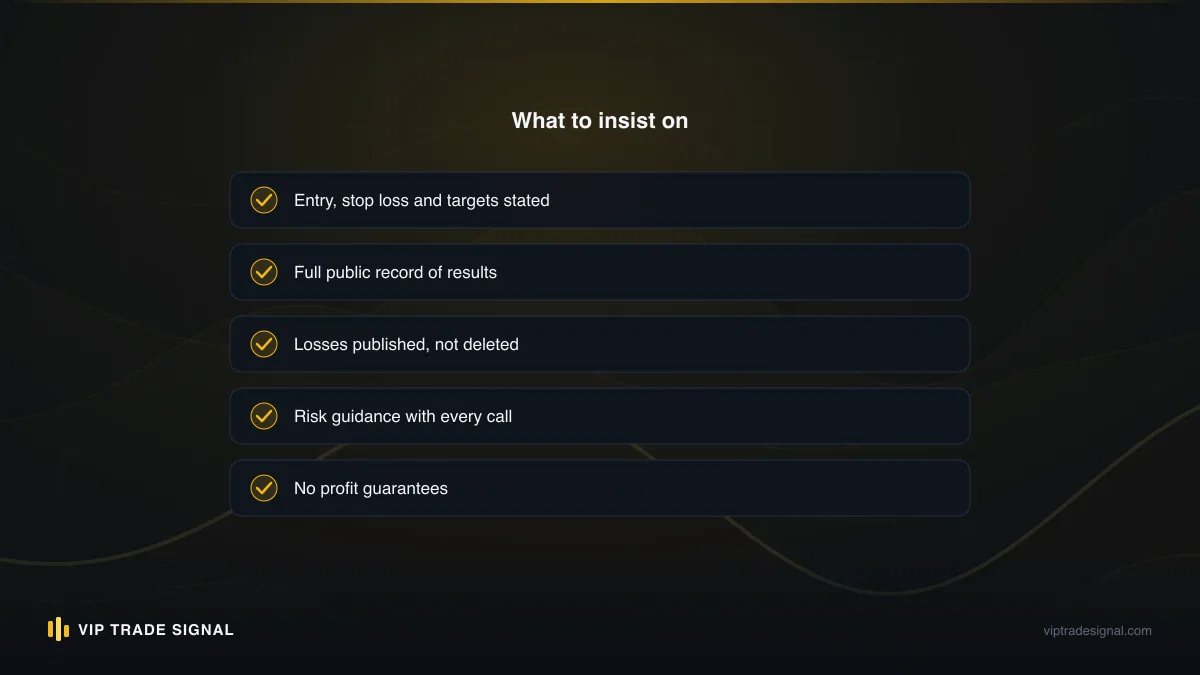
- Is there a full public trade history, every signal timestamped, losses included? Not screenshots. A complete record. No history, no money.
- Do they show losing trades and losing weeks without being asked? If every visible result is green, you're looking at marketing, not a record.
- Any guaranteed returns, "risk-free" language, or fixed monthly percentages? One instance is a hard fail. This isn't a yellow flag; it's the whole bonfire.
- Is there a real, checkable identity: a named company, a registration, an address, an about page that commits to facts? Anonymous admins have nothing to lose by robbing you. That's the point of the anonymity.
- Does every signal carry a stop loss and defined risk? Signals without stops aren't signals; they're lottery numbers with extra steps.
- Is the price a price? One product, one figure, versus a ladder of tiers where the real product is always one payment away.
- Are they pushing one specific unregulated broker, and do they bristle if you'd rather use your own? Bristling is the tell.
- Countdown timers, "3 spots left", price-doubles-tonight? Manufactured urgency is a fail. Real services will still exist on Thursday.
- How old is the channel, and does the age match the claims? "Five years of 90% accuracy" on a channel created in March is its own confession.
- Do the numbers pass the smell test? 90%+ win rates, 500 pips a week forever, accounts that supposedly double every month. If it outperforms the best funds in history from a Telegram channel, it isn't outperforming anything.
Scoring is deliberately brutal: any single hard fail on questions 1, 3, 4 or 5 ends the evaluation. The others are cumulative. Two or three fails and you walk. There is no channel so promising that it's worth overriding the screen, because the screen is exactly what the psychological hooks are designed to make you skip.
Total time: about sixty seconds once you've done it twice. Cheapest insurance in trading.
What honest providers do differently, point by point
Flip the field guide over. If those are the scam tells, what does the genuine article look like? This matters because learning how to identify real forex signal providers is a different skill from spotting fakes. Absence of red flags isn't presence of quality. Plenty of channels are merely useless rather than fraudulent, which is a low bar to celebrate clearing.
Real providers, the handful worth the name, share a cluster of behaviours that scammers structurally cannot copy:
They publish everything, before the outcome. The complete record, wins and losses, visible to non-payers. A scammer can fake a screenshot but can't fake a multi-year public ledger of timestamped calls, because faking it would require actually being right. At which point, congratulations, they're a signal provider.
They talk about losing. Unprompted. Honest services discuss losing streaks, drawdown, and position sizing more than they discuss winning, because managing the losing is the actual job. When we say a strategy can drop five trades straight, that's not humility theatre; it's the maths of any real edge, said out loud.
Their risk framing comes first. Every call has a stop. Every discussion assumes you're risking 1-2% per trade, so a $2,000 account has maybe $20-40 of room per signal, and they'd rather you sat out than oversized. Compare the scam version, where lot sizes only ever grow.
Their incentives are inspectable. You can trace exactly how they make money, and the tracing doesn't reveal a mechanism that pays them when you lose. On our desk that means being plain about it: signals are $99 a month or free via a partner broker with $250 maintained; account management runs at a flat 50% of realized profit with a $200 minimum advance, and you keep the master password and the withdrawals. Is 50% at the high end of the industry? Yes, and we say so; it's the trade-off for low minimums and pay-as-you-go with no profit, no fee. You may decide that's not for you. But you can see the whole machine, and a machine you can see is a machine that can't quietly farm you.
They answer hard questions in writing. A real service has a FAQ that addresses fees, losses, and cancellation in plain sentences, and support that doesn't evaporate when questions get pointed. Scammers handle hard questions with blocks and deletions, because their answers can't survive being pinned down.
They're boring. Genuinely. No Lamborghinis, no countdowns, no midnight deadlines. Real trading is a grind of small edges and managed losses, and honest marketing sounds like that grind. If a provider's channel reads like a casino floor, you already know which business they're in.
If you're earlier in the journey and want the full picture of how signal services work before choosing anyone, our complete guide to forex signals covers the mechanics from the ground up. And if you're evaluating providers from the UK specifically, where FCA rules change some of the calculus, there's a dedicated UK walkthrough worth your time.
If you've been scammed: damage control steps
Right. Some of you didn't find this article in time, and you're reading with that specific cold feeling in your stomach. First: you're not stupid. You were worked by a machine refined across thousands of victims, using hooks that catch doctors, engineers and, yes, traders. Shame is unhelpful and, worse, it's the exact emotion the recovery-scam wave feeds on. Set it down and move through this list in order, today.
- Stop all payments now. Cancel the subscription at the source, meaning your card or PayPal, not their site. If you paid by card, ask your bank to block further charges from the merchant and consider reissuing the card. If you gave them any account passwords, change them this minute and enable two-factor everything.
- If a "manager" has your trading account, lock them out. Change the master password, contact the broker's support directly, and withdraw what remains before anything else. Minutes matter here.
- File a chargeback. Card payments can be disputed ("services not as described" or fraud), typically within 120 days under both major card schemes' rules, sometimes longer. Bank transfers are harder but report to your bank anyway; some jurisdictions have reimbursement schemes for authorised push payment fraud. Crypto payments are, realistically, gone. File the reports regardless, because they feed investigations.
- Preserve everything before you get blocked. Screenshots of the channel, the DMs, payment receipts, wallet addresses, usernames, the broker link. Scammers delete evidence the moment a victim goes quiet or angry. Archive first, confront never. Confrontation gains you nothing and costs you the evidence.
- Report it (next section covers where and how).
- Expect the second wave. Within days or weeks, "recovery agents" will appear in your DMs or under your public complaints. Every single one is a scam. No exceptions, no matter how official the website looks. You now know why they found you.
- Tell someone. Publicly if you can bear it, privately if you can't. Each silent victim is a free run at the next one, and your write-up on a forum might be the search result that saves a stranger next Tuesday.
One honest note on expectations: recovery rates from anonymous offshore scammers are poor, and anyone who tells you otherwise wants a fee. The chargeback is your best shot; the reports are how the ecosystem slowly gets mapped. Do both, then protect what's left rather than chasing what's gone. Redepositing to "trade your way back" with anyone is how a $2,000 loss becomes a $6,000 one.
Reporting scams: platforms, regulators, communities
Reporting feels futile and mostly isn't, so here's where each report actually goes and what it achieves.
The platform. Report the channel or account on Telegram, Instagram, WhatsApp, wherever it lives. One report does little; reports plus documented complaints get channels removed, and removal costs scammers their most expensive asset: an aged channel with accumulated "proof". Make them rebuild.
Your national fraud body. In the UK, Action Fraud. In the US, the FTC at reportfraud.ftc.gov and the FBI's IC3 for internet crime. In Australia, Scamwatch. Elsewhere, your police cybercrime unit. Individual reports rarely trigger individual investigations, but aggregated reports set patterns, and patterns are what get operations taken down and payment rails cut.
The financial regulator. If a broker was involved (especially the "partner" broker), report to the regulator wherever it claims registration (FCA, ASIC, CySEC and so on), and check the regulator's warning list while you're there; you'll often find the broker already on it, which strengthens your bank dispute considerably. Regulators also maintain public warning registers precisely from these reports. Your complaint literally becomes tomorrow's red flag for someone else.
The payment rail. Fraud reports to your card issuer, PayPal, or bank do double duty: they support your own dispute and they raise the merchant's fraud score, which eventually gets scam merchants cut off from taking cards at all. That hurts them more than almost anything.
The communities. Forex Peace Army, Reddit's trading communities, Trustpilot, a plain blog post. Search engines are where the next victim will do their sixty seconds of checking, if anyone's written anything. Be factual, attach evidence, skip the rage. A calm, documented account outranks and outlasts a furious one.
None of these steps takes more than fifteen minutes. Together they're the closest thing this unregulated corner of the industry has to an immune system, and it only works when the people who got bitten contribute antibodies.
Where this leaves you
Let's land this somewhere useful rather than somewhere comfortable.
The signal industry is not going to clean itself up. There's no licence coming for Telegram channels, no regulator for anonymous admins, no algorithm that will reliably sort the callers from the con men. The filter is you, and the filter is process: the sixty-second screen, run every time, especially when the channel is exciting and the screenshots are green and something in you is already doing the loss-math. That feeling of "this could be the one" is not information about the provider. It's information about you, and scammers read it fluently.
So here's the standard we'd hold anyone to, ourselves included. Full public history, losses in the ledger, published before outcomes were known. Named identity with something to lose. Stops on every call. One price you can understand in one sentence. No guarantees anywhere, because guarantees are the one thing real trading cannot offer. If we ever fail that screen, leave, and we mean that literally, since our entire closed-signal record sits public at /signals/history for exactly this reason, bad weeks included.
And if you take one sentence from five thousand words, take this one: in signals, the evidence that can be faked will be faked, so trust only the evidence that can't. Everything else — the cars, the crowds, the countdowns — is set dressing on a machine that needs you to hurry.
Don't hurry. The market's open again tomorrow. The scammers hate that you know that.