Type "best forex signals" into Google and count how many of the top results are written by people who get paid when you sign up. Take your time. I'll wait.
That's the dirty secret of nearly every forex signal provider comparison you'll ever read: the ranking isn't a ranking, it's a commission table. Provider A pays 40% recurring, Provider B pays a flat $50, Provider C doesn't run an affiliate programme at all — and would you look at that, Provider A is "our top pick for 2026" while Provider C somehow didn't make the list. The prose is confident, the star ratings are shiny, and the methodology section, if one exists at all, is two sentences of nothing.
We run a signal service ourselves, so you should be suspicious of us too. Good. Stay suspicious. What I'm going to do in this piece is give you a scorecard — twelve specific, checkable metrics — and then run it against two of the best-known names in the business, Learn 2 Trade and 1000pip Builder, and then against our own service, scoring our weaknesses in the same table with the same pen. No affiliate links anywhere in this article. Nobody pays us a penny if you join either of those services, and frankly if the scorecard tells you one of them fits you better than we do, join them. A subscriber who picked us for the wrong reasons churns out in six weeks anyway.
Why most comparison sites are affiliate ads
Let's establish the incentive problem properly, because once you see it you can't unsee it.
Affiliate commissions in the signal industry commonly run 30–50% of the subscription, recurring, for as long as you stay subscribed. A review site that sends a provider 200 subscribers at $100 a month is earning real money — every month — from keeping that provider at the top of its list. Now ask yourself what happens when that provider has a horror month. Does the review get updated? Does the ranking drop? It does not. The review was never a measurement. It was a shop window.
You can spot these sites in about thirty seconds once you know the tells. The "review" describes the provider's features in the provider's own marketing language, sometimes word for word. Win rates are quoted without any source. The criticism section, when there is one, contains complaints so mild they function as compliments ("the sheer number of signals can feel overwhelming!"). And every single mention of the provider's name is a tracked link.
There's a second, subtler failure mode: comparisons that are honest but lazy. Somebody signs up for a free trial of six services, watches them for a fortnight, and writes 3,000 words. Two weeks of signals is statistical noise. A provider can look brilliant or terrible over ten trades and it tells you almost nothing — we've had fortnights where everything hit and fortnights where the market chewed through four stops in a row, and neither stretch described the service honestly. Any comparison built on a sample that small is astrology with a spreadsheet.
So the comparison you can actually trust is, unfortunately, the one you build yourself. The good news is that it's less work than it sounds, because most providers fail at the gate before you ever need to evaluate their trading.
The 12-metric scorecard: what actually predicts results
Here's the full scorecard. I'll go deep on the ones that matter most in the sections that follow, but you want the whole list in one place first.
- Verified track record — is there a full, public, third-party-checkable history of every signal, including losers? Pass/fail. Everything else waits behind this.
- Losses on display — not just "history exists" but whether losing trades are shown with the same prominence as winners, in the same feed, unedited.
- Stop loss on every signal — does each signal ship with a hard stop, and is the risk per trade definable before entry?
- Risk-reward stated honestly — are targets realistic relative to stops, or is it 200-pip targets with 20-pip stops that hit once a month and get screenshotted forever?
- Instrument focus — does the provider specialise, or do they fire signals across 30 pairs, crypto, and indices like a shotgun?
- Frequency versus quality — a stated philosophy about how many signals and why. "Unlimited" and "3 per day guaranteed" mean very different things.
- Delivery mechanics — how fast do signals reach you, on what channel, and can you actually act on them at your broker before the price has moved?
- Pricing transparency — the real cost, in plain numbers, on a public page. Including what happens when you want to leave.
- Marketing tone — Lamborghinis and "quit your job" energy, or plain talk about risk? This one predicts more than you'd think.
- Named humans — do you know who is actually trading? A real person with a findable history, or a logo and a stock photo?
- Support and community quality — do questions get answered, by someone who can read a chart, within hours rather than days?
- Educational context — does each signal come with reasoning you could learn from, or is it just numbers to obey?
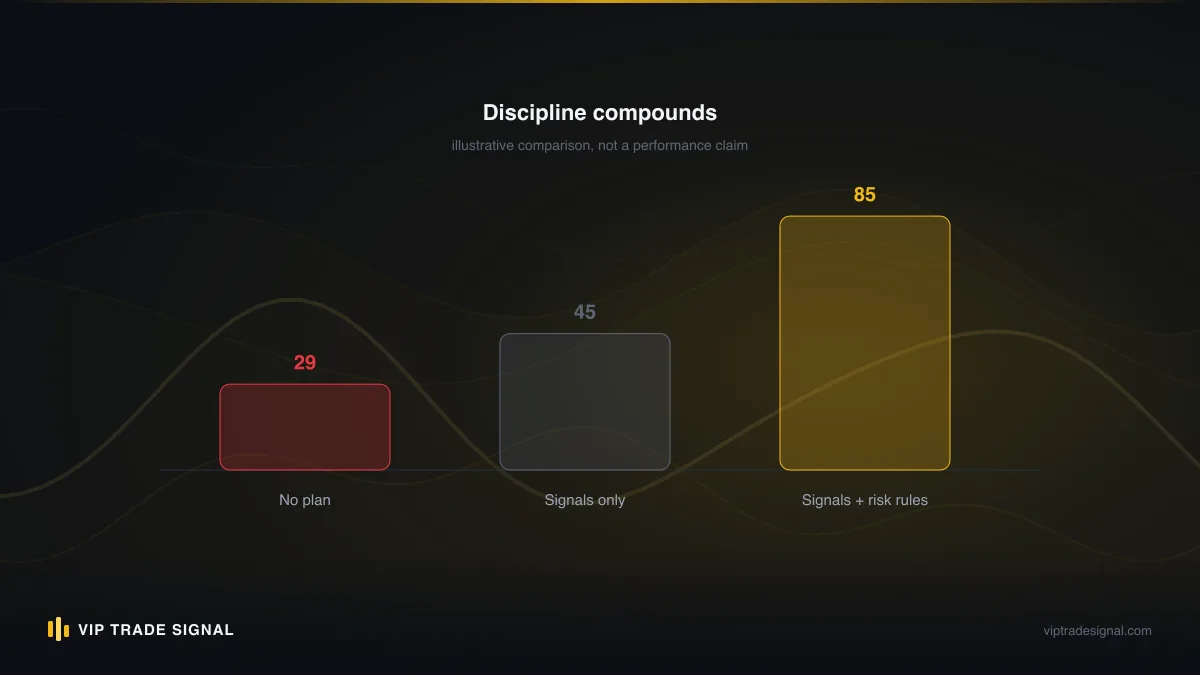
Notice what's not on the list: win rate. That's deliberate. A quoted win rate with no verified history behind it is worth exactly nothing, and even a genuine win rate is meaningless without the average win and average loss beside it. A service hitting 85% of trades can lose money hand over fist if the 15% of losers are four times the size of the winners. If you want the deeper mechanics of that arithmetic, our piece on what forex signals actually are and how to judge them walks through it slowly. For now: any list of forex signal providers ranked by accuracy alone, without expectancy, is ranking the wrong thing.
Weight the metrics however suits you, but in my experience the first four do about 80% of the work. Which brings us to the gate.
Track record verification: the pass/fail gate
Before you score anything else, apply this single filter: can I see every trade this provider has ever called, including the losers, in a form they cannot quietly edit?
If the answer is no, stop. Don't score the other eleven metrics. Don't weigh up the pricing or admire the Telegram channel's production values. A provider without a verifiable record isn't a candidate with one weak area; they're not a candidate at all, because every other claim they make rests on a foundation you can't inspect.
What counts as verification, in descending order of strength:
- A live third-party feed — Myfxbook or FX Blue linked to a real account, with the track record privileges set so the provider can't hide open trades or delete history. Check the "track record verified" and "trading privileges verified" badges specifically; an unverified Myfxbook page proves nothing.
- A complete public log on their own site — every signal, timestamped, wins and losses in one list, going back to the start. Weaker than third-party (they control the server) but honest providers keep it complete, and gaps are easy to spot if you screenshot it monthly.
- A free channel where signals post publicly before the outcome is known — you can verify in real time by watching for a few weeks and checking calls against the chart yourself.
And what does not count: screenshots of winning trades. Aggregate monthly pip counts with no trade list. "94% win rate" in the channel bio. Testimonials. A results page that only goes back three months when the service claims to be five years old. We wrote a whole piece on how to verify a signal track record and the ways sellers fake them, because the fakery is genuinely creative — demo accounts dressed as live ones, multiple channels calling opposite directions so one is always right, retroactively edited Telegram posts. The short version: if verification takes you more than ten minutes, that difficulty is itself the answer.
For what it's worth, this gate is why our own closed signals — every one, wins and losses — sit publicly at /signals/history. Not because we're saints. Because we know that any provider unwilling to do this is asking you to take their word for it, and in this industry the word is worthless.
Worked example: applying the scorecard to Learn 2 Trade
Right, let's use the thing. First up, Learn 2 Trade — one of the most heavily marketed names in the space, which is exactly why it appears in every affiliate listicle you've ever skimmed.
The honest caveat before I score anything: this is based on what's publicly visible as of early 2026, from the outside. Offerings change, and you should check the current state of anything here yourself rather than trusting a snapshot in a blog post — including ours.
What Learn 2 Trade does well, credit where due. It's a real company with an actual public presence, not an anonymous channel that appeared last Tuesday. There's a free Telegram channel, which matters: it means you can watch signals land in real time, before outcomes are known, and mark their calls against a chart for a month without spending anything. That's a legitimate verification route and more than most of the industry offers. The educational content on the site is broad, and delivery is prompt over Telegram.
Where the scorecard bites. Coverage is wide — forex majors and minors, crypto, indices, commodities — which under metric five reads as generalist, and generalists have to be genuinely excellent across many uncorrelated markets, which is rare. The marketing leans hard on quoted win-rate figures that, as far as I've been able to find, don't link to a complete, independently verified trade-by-trade history of the kind metric one demands; the free channel lets you verify forwards but not backwards. Signal volume is pitched as a feature, several per day across the paid tiers, and volume-as-feature usually correlates with signals generated to fill a quota rather than because the market offered something. And the site sits inside a large affiliate ecosystem, so a fair chunk of what you read about it elsewhere was written by people with a financial stake in your click.
Scored roughly: strong on delivery, presence, and the existence of a free verification window. Weak on the gate itself — a complete verified history — and on instrument focus. If you're considering them, the play is obvious: sit in the free channel for four to six weeks, log every signal yourself in a spreadsheet, and let your own data decide. Costs you nothing but attention.
Worked example: 1000pip Builder under the same lens
Now the other name from every listicle, and a genuinely interesting contrast: 1000pip Builder.
Same caveat as before — outside view, publicly visible information, check it yourself before acting.
The headline strength is exactly the thing Learn 2 Trade lacks: 1000pip Builder has long made independently verified results its central pitch, with a Myfxbook-tracked history as the anchor of the marketing. Under metric one, that's the right instinct and it deserves real credit. A provider who volunteers for third-party tracking is telling you something about their relationship with their own results, and after years of reading signal-seller marketing I can tell you it's a minority position. The service is also fronted by a named human being — a mentor figure whose identity is public — which clears metric ten, and the whole pitch is lower-volume, mentor-toned, closer to "here are my trades and my reasoning" than "SIGNAL BLAST 🔥". No emoji in their better material either, which I appreciate for petty personal reasons.
The scorecard still finds things to poke. Do the verification work properly rather than taking the badge at face value: check that the linked account is live rather than demo, that the tracking is current rather than a strong period from years back doing eternal duty on the homepage, and that the stated pip results come with position-sizing context, because "pips" as a headline unit can flatter a record — 500 pips gained on trades risking 100-pip stops is a very different achievement from 500 pips built on 25-pip stops, and pips don't pay for groceries, percentages do. Coverage is multi-pair rather than specialist, though narrower than the everything-plus-crypto shops. And the price sits at the premium end for a signals-only product, which is only a criticism if the record doesn't hold up — a point I'd also better apply to ourselves shortly.
Scored roughly: strong on the gate, strong on named humans and tone, moderate on focus, and dependent — as everything always is — on whether the verification survives your own ten minutes of checking rather than someone else's summary of it.
Learn2Trade vs 1000pip Builder head to head
Put them side by side and the comparison almost writes itself, because they fail and pass in nearly opposite places.
| Metric | Learn 2 Trade | 1000pip Builder |
|---|---|---|
| Verified full history | Weak — verify forwards via free channel | Strong claim — Myfxbook-anchored, verify it's current |
| Losses on display | Partial | Within the tracked account, yes |
| Instrument focus | Broad: forex, crypto, indices | Multi-pair forex, narrower |
| Signal volume | High, pitched as a feature | Lower, mentor-paced |
| Named humans | Corporate presence | Public named trader |
| Free verification route | Yes — free Telegram channel | Limited |
| Marketing tone | Loud, win-rate forward | Quieter, record-forward |
| Affiliate gravity around it | Heavy | Present but lighter |
So learn2trade vs 1000pip builder isn't really a question of which is "better" in the abstract. It's a question of which failure mode you'd rather manage. Learn 2 Trade gives you a free, real-time way to build your own evidence but asks you to do that work because the backward-looking record doesn't meet the gate. 1000pip Builder hands you a third-party record upfront but charges premium money and gives you less of a free look before committing.
If you forced me to pick a process rather than a provider: the free-channel-plus-spreadsheet month costs nothing and produces your own data, which beats anyone's marketing, mine included. But a current, live, privileges-verified Myfxbook account is the single strongest piece of evidence any provider can show you, and if the checking holds up, that's the rarer asset. Different tools for different levels of patience.
Scoring ourselves: where we win and where we lose
Now the part most comparison articles mysteriously skip. Same scorecard, same pen, pointed at us.
Where we score well, and I'll keep this brisk because you can check all of it rather than trusting the tone. Metric one and two: every closed signal we've issued is public at /signals/history, losers in the same feed as winners, no editing, no three-month memory hole. Metric three: every signal ships with a hard stop, always, no "manual close, trust us" trades. Metric five: we trade gold and only gold — XAU/USD, one market, studied obsessively — which is either our biggest strength or our biggest weakness depending on what you need, and I'll argue both sides in the next section. Metric nine: you will find no rented Lamborghinis in our marketing, and losses get discussed in our own posts out loud, because gold trading is high-risk and a service that won't say so is lying to you by omission.
Now the columns where we lose, honestly scored.
Diversification: fail, by design. If gold goes quiet and ranges for six weeks, we do not suddenly discover an opinion about USD/JPY to keep the signal count up. A subscriber wanting exposure across many markets should genuinely be looking at a multi-pair provider, or at running us alongside one. That's not false modesty; it's what metric five means when the specialisation cuts against you.
Price: high end, no apology but no denial either. We're $99 a month, which is above the industry's median for a signals subscription, and our pricing says so in plain numbers rather than hiding it behind a call. The mitigations are real — unlimited signals rather than a ration, and the fee drops to zero if you trade through a partner broker like Exness, XM, IC Markets or Vantage while keeping $250 or more in the account — but if you're comparing raw sticker price against a $35-a-month generalist channel, we lose that cell, and our piece on what signal services actually cost breaks down why cheap and expensive both fail in their own ways.
Third-party tracking: partial. Our history is complete and public on our own infrastructure, which is metric one's second tier, not its first. A provider-controlled log, however honest, is structurally weaker evidence than a Myfxbook feed we can't touch — on that specific cell, 1000pip Builder's approach beats ours and I'd rather say so here than have you notice it yourself and wonder what else we softened.
Track record length: shorter than the veterans. Names that have operated for a decade have survived more market regimes than we have. Longevity isn't proof of quality, but it is information, and we have less of it to show.
Any provider who can't tell you three specific things they're bad at is telling you one big thing: they haven't looked, or they have and won't say.
That's the whole reason this section exists. Read it as a template for the question you should put to any provider you're evaluating, ours included: where does your own service lose points, specifically? The answer — or the squirming — is worth more than any feature list.
Specialists vs generalists: the instrument-focus factor
I flagged instrument focus as a metric that cuts both ways, so let's actually argue it out, because it's the axis on which the three services in this article differ most.
The case for the generalist is opportunity. Markets take turns being interesting. Gold ranges while the yen trends; the yen sleeps while indices melt up. A provider watching thirty instruments always has somewhere to point, which means steadier signal flow and, in theory, exposure spread across uncorrelated moves. For a trader who wants the market covered broadly and treats signals as a stream of diversified ideas, that's a legitimate preference.
The case against the generalist is depth, and it's the side I sit on, for reasons that are obviously not neutral but are at least earned. Every instrument has its own personality. Gold's relationship with real yields, its behaviour around London and New York opens, the way it hunts stops under round numbers before reversing, how it trades during Fed weeks versus dead summer Fridays — that's years of pattern recognition in one market. Now multiply that by thirty instruments and ask how deep any one team's knowledge can actually run. Mostly it can't, and what you get instead is one generic strategy — some blend of indicators and support-resistance — stamped across every chart in the watchlist. The signal count stays healthy. The edge, if there was one, gets spread like too little butter.
There's also a quieter tell hiding in this metric: a generalist's signal flow makes performance harder to evaluate. Thirty instruments producing five signals a day gives you a blur of results across markets you can't contextualise. One instrument produces a record you can actually read — you can pull up the gold chart for any week of our history and see exactly what we saw, or didn't.
The practical resolution isn't tribal. If your account and your attention can only support one service, decide what you actually want exposure to and pick a provider whose focus matches it. If you want gold, a gold specialist; if you want broad forex, a forex house with a verified record across its pairs. What you shouldn't do is pick a generalist because the breadth feels like diversification. Five simultaneous signals from one strategy brain aren't diversified; they're one opinion wearing five hats.
Pricing models compared fairly
Signal pricing comes in about five shapes, and each shape carries its own incentive problem. Being fair to everyone, including the models we don't use:
Flat monthly subscription — the standard. $30 to $150 a month across the industry, with the two named providers in this article and ourselves all somewhere in that band. Clean incentive on the surface: the provider wants you to stay, so results matter. The subtler problem is that feeling active retains subscribers almost as well as being profitable, which is where quota signals come from.
Free, funded by broker partnerships — the provider earns a rebate from a partner broker on your trading volume instead of charging you. This is the model behind most "free VIP" channels and, in a transparent variant, half of our own pricing: $99 a month, or free if you trade through a partner broker with $250 maintained. The incentive risk is real and worth naming plainly — a provider paid on volume is tempted to generate volume. The test is whether the provider's signal frequency looks the same for paying and broker-funded members, and whether they'll tell you the arrangement exists at all. Buried disclosure is the tell. We wrote up the whole mechanism in how free signal services actually make money, and it applies to us as much as anyone.
Lifetime deals — a one-off $250-$500 for "lifetime access". Run. A provider with a durable edge would never sell it for a single payment; a provider planning to quietly wind down in eight months absolutely would. The incentive to keep performing evaporates the moment your payment clears.
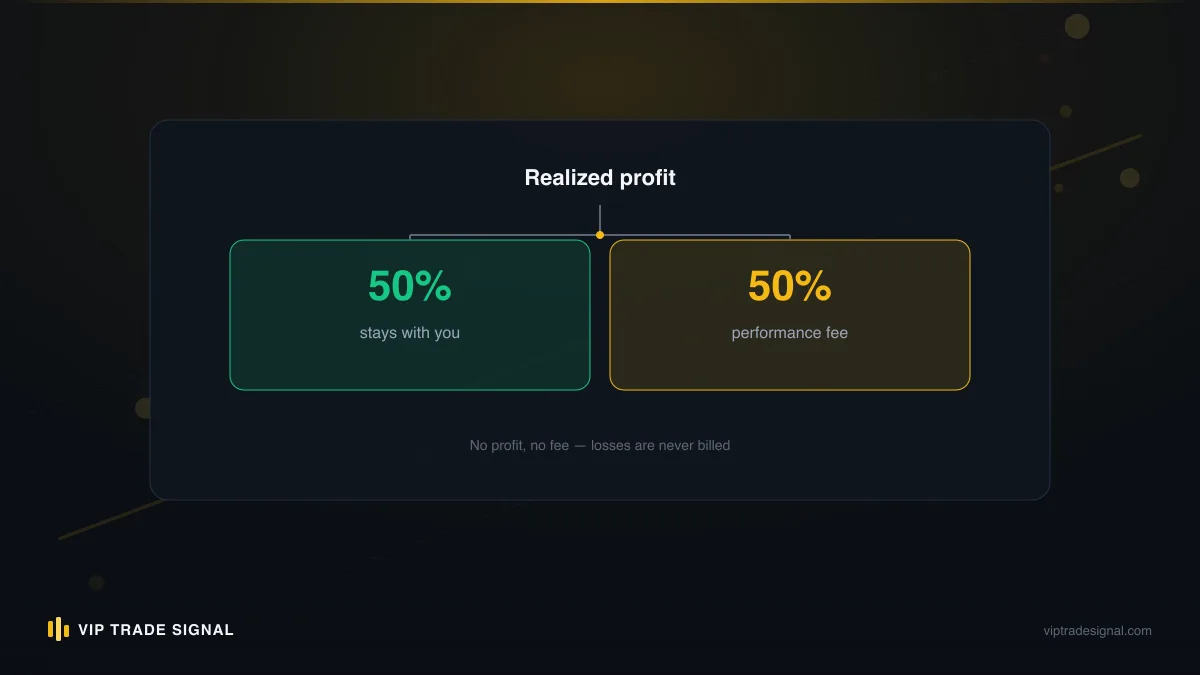
Profit-share — a percentage of what the signals make you, sometimes seen in managed variants. Aligns incentives better than anything above, but verify the accounting mechanism carefully, because "profits" is a word with many creative definitions. Our account-management side runs this way, 50% of realised profit only, precisely because we'd rather be paid when you are.
Pay-per-signal — rare, and rightly so: it pays the provider to fire as often as possible. The incentive design fails on contact.
The honest summary: there is no incentive-clean pricing model, ours included. What separates providers isn't the model, it's whether they'll describe their own model's failure mode to your face. You've now seen us do it twice in one article; hold everyone else to the same standard.
Community and support quality: how to test it
Metric eleven sounds soft next to track records and stop losses. It isn't, and here's the scenario that proves it.
It's 15:29 on a Wednesday, London time. You're in a long from this morning's signal, price is hovering a few dollars above your stop, and US data lands in sixty seconds that could throw gold $30 in either direction. You message the provider: are we holding through this? Now — what happens next? With a good service, someone who can read a chart answers in minutes with an actual instruction. With most services, you get silence until Thursday, or a reply from a support rep whose entire trading knowledge is a macros file, or worst of all a chirpy "please follow the signal as posted!" while the market takes your stop and keeps going.
You can test all of this before subscribing, and you should. During any trial or free period, run three probes. Ask a technical question about a specific past signal ("why was the stop on Tuesday's short placed above 3,385 rather than the session high?") and see whether the answer shows chart-reading or copy-paste. Ask an awkward one ("what was your worst month in the last year, and what happened?") and watch for squirm. Then ask something time-sensitive during a live session and clock the response speed. Fifteen minutes of effort, and it tells you more about the humans behind the channel than a month of their marketing.
Community is the adjacent signal. A healthy provider chat has members discussing losing trades openly, veterans answering newcomers, and admins who let mild criticism stand. An unhealthy one is a wall of rocket emoji, deleted questions, and testimonials from accounts created that week. Spend an evening scrolling back through the history of any channel you're considering — the moderation pattern around losing days is the most honest document the provider publishes. And if there's no scrollback because the channel restricts history, ask yourself what got cleaned.
One more thing worth probing while you're at it: who actually answers. A service where the trader himself appears in the chat, even occasionally, is structurally different from one where the trading and the community never touch. You can read more about how we run this on our about page, but the test above matters more than anything any provider writes about themselves.
Building your own comparison shortlist
Time to make this operational. Here's the process I'd run if I were starting from zero, with real timeframes attached.
Week zero: define what you're actually buying. Instrument exposure, risk appetite, how much attention you can give during your working day. A signal service that fires at 14:00 London is useless to someone in a meeting-heavy job unless they use pending orders. Write three sentences describing your situation before you look at a single provider — otherwise the marketing writes them for you.
Week one: gather candidates and apply the gate. Pull names from wherever — including the affiliate listicles, they're fine as a phone book, just not as a judge. For each candidate, run the verification check from earlier: complete public history, or live third-party tracking, or a free channel where you can watch calls land in real time. In my experience this single filter removes something like four out of five candidates in under an hour. Let it.
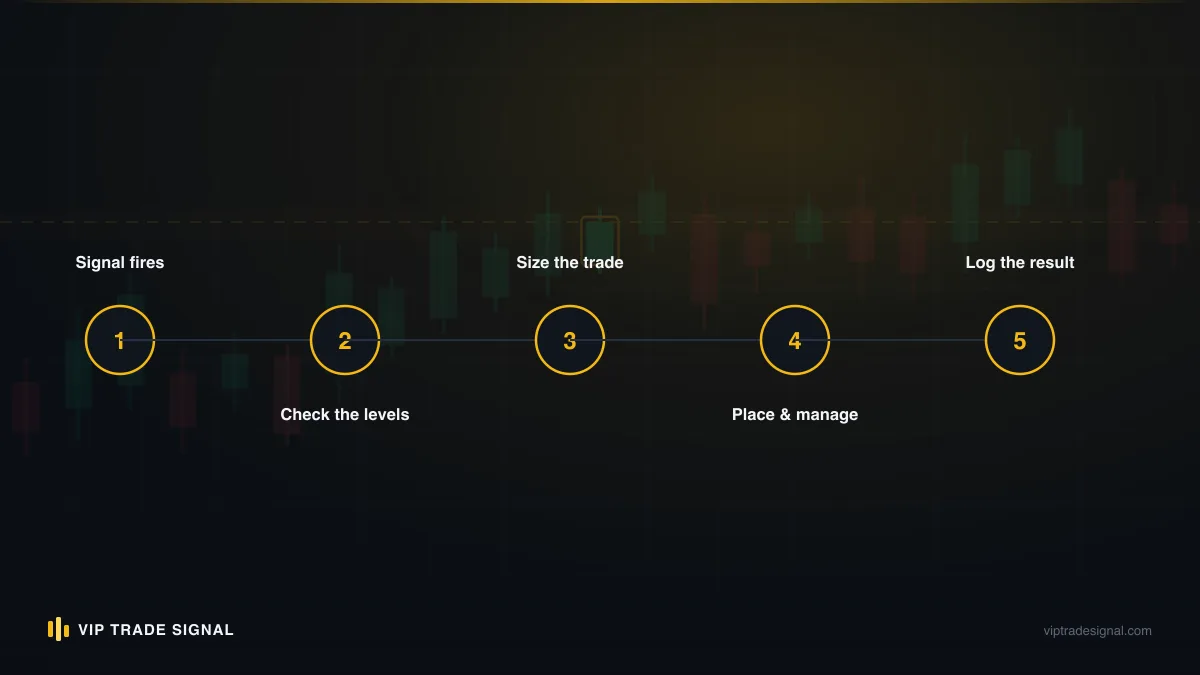
Weeks two to five: watch, don't trade. For the survivors — realistically two or three names — log every signal in a spreadsheet without risking a pound. Entry, stop, target, outcome, and time from alert to your phone. Twenty to thirty signals per provider is the minimum before the numbers start meaning anything; fewer than that and one lucky streak can invert your whole ranking.
Week six: score and decide. Run the twelve metrics with your own logged data filling in the performance cells. Then, and only then, subscribe to one — and trade it at half your intended risk for the first month, because live execution always finds friction that observation missed. Slippage, delayed alerts, your own hesitation at 2am. Budget for the difference.
Total elapsed time: about six weeks. Total cost: nothing but attention. I know six weeks feels glacial when a channel is posting wins daily and the fear of missing out is doing its work on you. But you're choosing where your risk capital takes its instructions from, possibly for years. Six weeks is what the decision costs when it's done properly. Six days is what it costs when the decision gets made twice.
Scorecard template to copy
Here's the whole framework compressed into a table you can copy into a spreadsheet this evening. Score each cell 0–2 (0 = fail or unverifiable, 1 = partial, 2 = clean pass), except the gate, which is pass/fail and ends the evaluation on a fail.
| # | Metric | The question to ask | Weight |
|---|---|---|---|
| 1 | Verified track record | Full history, losses included, checkable? | GATE |
| 2 | Losses on display | Same feed, same prominence, unedited? | High |
| 3 | Stops on every signal | Hard stop shipped with every trade? | High |
| 4 | Honest risk-reward | Stops and targets in realistic proportion? | High |
| 5 | Instrument focus | Specialist depth, or shotgun coverage? | Medium |
| 6 | Frequency philosophy | Why this many signals? Quota smell? | Medium |
| 7 | Delivery mechanics | Fast enough to act on at your broker? | Medium |
| 8 | Pricing transparency | Real numbers public? Easy exit? | Medium |
| 9 | Marketing tone | Risk spoken about, or Lamborghinis? | Medium |
| 10 | Named humans | Do you know who's trading? | Medium |
| 11 | Support quality | Chart-literate answers within the hour? | Low-Med |
| 12 | Educational context | Reasoning with each trade, or bare numbers? | Low-Med |
A few closing opinions, since you've read this far and earned the blunt version.
First: the gate does most of the work. If you take one thing from 5,000-odd words, take the habit of refusing to evaluate any provider whose full record you can't inspect. That habit alone puts you ahead of the overwhelming majority of signal buyers, who choose on vibes and screenshots.
Second: your own logged month of data beats every review ever written, including this one. We've shown you our scoring of Learn 2 Trade, 1000pip Builder and ourselves, and we've tried to be fair, but we are a competitor with a keyboard and you should treat this article with the same scepticism it's taught you to aim at everyone else.
Third: no provider passes all twelve. We don't — you watched us fail the diversification and third-party-tracking cells a few sections back. The point of the scorecard isn't to find a perfect service; it's to know exactly which imperfections you're accepting, at what price, with your eyes open. Losing trades will come from whoever you pick. That's not a flaw in the comparison. That's trading.
Run the gate on us first, if you like — the full history is at /signals/history, and the losses are right there in the feed. Then run it on everyone else, and see who else leaves the door unlocked.