Somewhere on Instagram right now, a man in a rented Lamborghini is holding a phone up to the camera. On the screen: an MT4 account showing $47,832 in closed profit for the week. The image will convince a few hundred people to send him money. It took him about four minutes to make, and no trade behind it ever existed.
We want to ruin that image for you. Permanently.
This article is a production manual in reverse. Fake profit screenshots and cherry picked results are manufactured using a handful of specific, repeatable methods — five, by our count, covering nearly everything you'll ever see — and once you know how each one is built, you can't un-know it. You'll scroll past a "results" channel and see the machinery instead of the money. That's the goal. Not vague scepticism, which is useless, but specific knowledge of how the sausage gets made, which is armour.
A warning before we start: some of what follows is uncomfortable, because a couple of these methods are things semi-honest services do without quite realising they've crossed a line. Cherry picking in particular is less a deliberate fraud than a slow slide. Doesn't matter. The effect on you, the person deciding where to send $99 or $250 or your whole account, is identical. Manufactured is manufactured.
The screenshot economy: why images convince and lie
Start with the psychology, because the whole scam rests on it.
A screenshot feels like evidence. It has the visual grammar of proof — numbers, timestamps, a platform interface you recognise — and your brain processes it the way it processes a receipt. Text claims trigger scepticism ("sure, mate, 90% win rate"). Images slide underneath it. This isn't a character flaw; it's how humans work. We evolved to trust what we see, and a rendered MT4 terminal is, technically, something you're seeing.
But think about what a screenshot actually is: pixels arranged on a screen, captured by the person who controls the screen. That's it. That's the entire evidentiary chain. There is no notary, no broker countersignature, no blockchain — a screenshot of a trading account carries exactly as much inherent proof as a screenshot of a text message, which is to say none, because anyone who has spent ten minutes with an image editor or, easier still, a browser's developer tools can produce a pixel-perfect fake.
And the economics are absurdly lopsided. A convincing fake takes minutes to produce and costs nothing. A genuine profitable track record takes years and survives losing months that would make most marketers weep. So ask yourself which one the market produces more of. If manufacturing proof is 10,000 times cheaper than earning it, and both look identical in a Telegram post, the feed you're scrolling is overwhelmingly the manufactured kind. Not partly. Overwhelmingly.
A screenshot is not evidence of trading. It is evidence that someone owns a phone.
The other thing the screenshot economy exploits is volume blindness. You don't see one fake; you see forty a day, across dozens of channels, all agreeing with each other. The repetition builds a background sense that lots of people are making easy money, and that background sense — not any single image — is what eventually moves your hand toward your wallet. Which is why the defence has to be structural, not case-by-case. You can't fact-check forty images a day. You can, however, learn the five moulds they're all cast from.
So let's go through them, in roughly ascending order of subtlety.
Method 1: demo accounts dressed up as live
The workhorse. The Ford Transit van of trading fraud.
Every broker on earth hands out demo accounts, instantly, for free, funded with whatever imaginary balance you like. $10,000. $100,000. Half a million. The platform looks identical to a live account because it is the identical platform — same charts, same order tickets, same profit column ticking up in that satisfying green. The only differences are a small "Demo" label in the account details and the minor detail that none of the money exists.
The label is the only obstacle, and it's barely one. On MT4 desktop, the account type appears in the terminal window title and in the Navigator panel — both easily cropped out of a screenshot. On mobile, it's even more discreet. Crop tight on the trade list, and a demo account is visually indistinguishable from a live one. Some sellers don't even crop; they count, correctly, on nobody looking.
There's a nastier variant worth knowing: demo accounts also let you trade with zero fear, which means the seller can swing enormous position sizes at news events. Take a $100,000 demo, throw 20 lots of gold at a Non-Farm Payrolls spike, and one side of that coin flip prints a five-figure profit screenshot. The other side blows up the demo — so you open a fresh demo and flip again. An afternoon of this reliably yields a folder of jaw-dropping "results". No skill was involved at any point. A pigeon pecking at the buy button would produce the same folder, given enough demos.
The tell, beyond the cropping itself: demo results are always suspiciously tidy. Real live accounts accumulate scar tissue — partial closes, odd lot sizes from position scaling, the occasional fat-finger entry. Demo screenshots tend to show clean round lots, dramatic single trades, and balances that started at implausibly round numbers. When every screenshot from a channel shows a different account balance, that's the fresh-demo cycle in action. One trader, forty accounts, zero dollars.
Ask a seller directly whether the account is live and watch what happens. Honest answer takes three words. Dishonest answer takes three paragraphs about how "results speak for themselves".
Method 2: mockup generators and the edited P&L
Method 1 at least requires opening a platform. Method 2 skips even that.
There are websites and apps — we won't name them, they're findable in seconds and that's rather the point — whose entire function is generating fake trading screenshots. You type in the pair, the direction, the lot size, the profit figure you'd like to have made, and it renders a pixel-accurate MT4 or MT5 trade card. Balance screenshots, deal history, withdrawal confirmations: all templated, all customisable, all free or nearly so. These tools exist nominally "for pranks". Their actual user base is signal sellers, and everyone involved knows it.
Then there's the manual route, which needs even less tooling than people assume. Open a broker's web terminal, press F12 for the browser's developer tools, click any number on the page, and type a new one. The page re-renders with your invented profit in the platform's own font, own spacing, own everything, because it is the platform's own rendering — you've just changed what it's rendering. Screenshot, done. No Photoshop skills, no artefacts for an image-forensics tool to find, because no image was ever edited. The lie happened upstream of the pixels.
This is why we'd gently steer you away from playing amateur forensic analyst with error-level analysis tools and compression artefacts. Yes, badly Photoshopped screenshots exist, and yes, sometimes you can spot a misaligned font or a smudged edge. But the competent fakes have no artefacts at all, so a "clean" result from an analysis tool tells you precisely nothing. Absence of evidence of editing is not evidence of absence of lying.
What actually catches Method 2 fakes is internal arithmetic, because generator-users are lazy and innumerate. Check whether the numbers agree with each other. A 0.50 lot gold trade moves roughly $50 per dollar of price movement; if the screenshot shows entry 3,310, close 3,318, and a profit of $2,400, someone typed a fantasy into a box, because the honest figure is about $400. Check the maths on every screenshot that matters to you. It takes thirty seconds and it torches a startling fraction of what's out there. The fakers can copy the fonts. They rarely bother to copy the multiplication.
Method 3: deleting the losers — cherry picked results at industrial scale
Now we leave outright forgery and enter the greyer, more common territory: every screenshot is real, and the overall picture is still a complete lie.
Here's the production process. A channel posts signals — perhaps ten a week. Some win, some lose, as trades do. Each winner gets a triumphant results post: screenshot, green number, a row of fire emojis. Each loser gets... nothing. Or, in the more diligent operations, the original signal message itself is deleted, so a newcomer scrolling the channel's history finds an unbroken corridor of wins stretching back months. Telegram makes deletion frictionless and traceless. There's no edit history, no tombstone, no "message removed". The loser simply never happened.
Sit with how effective this is. No image editing, no demo accounts, no fake anything at the level of individual posts. A regulator squinting at any single screenshot finds a genuine trade. The fraud lives entirely in the gaps — in the survivorship of the feed — which makes it both the hardest method to prove and the easiest to execute. We'd wager it's the single most common form of cherry picked trading results in the industry, precisely because the people doing it can half-convince themselves it isn't lying. They're just... curating. Highlighting the good bits. Every business does marketing, right?
No. If you sell trading signals, your losers are the product information. Hiding them is the equivalent of a used-car dealer disconnecting the odometer.
There's a scaled-up version of the same trick worth knowing: the multi-channel funnel. An operator runs, say, six channels under six names, each posting different (sometimes opposite) trades. After a few months, whichever channels happened to catch good runs get the marketing push; the duds are quietly abandoned. Followers of the surviving channel see a genuine, verifiable hot streak — and have no way of knowing they're looking at the lucky sixth of a portfolio designed so that something would look brilliant. It's the old stock-picking postal scam with a Telegram skin on it.
The defence is simple and absolute: never evaluate a channel by scrolling its history, because the history is editable. Only a feed where results are published to an append-only public page — every trade, timestamped at entry, left standing when it loses — counts as a track record. Everything else is a highlight reel, and you should treat a highlight reel with exactly the seriousness it deserves, which is none. We keep our own full history, losers included, at /signals/history, and honestly the main reason is this paragraph: it's the only format that can't be curated after the fact.
Method 4: TP1-counting and the partial-win shell game
This one is subtle enough that plenty of victims never work out they were had, even after losing money. It's an accounting trick, not an image trick.
Most gold and forex signals ship with multiple take-profit levels — TP1 close to entry, TP2 further out, sometimes a TP3 off in the distance — plus a stop loss. Sensible structure; we use it ourselves. The scam is in how outcomes get scored. Say a signal is: buy gold at 3,310, TP1 at 3,314, TP2 at 3,322, TP3 at 3,335, stop at 3,300. Price ticks up four dollars, touches TP1, then reverses hard and stomps through the stop.
What actually happened to a follower running the whole position: a small win on whatever fraction closed at TP1, a larger loss on the rest. Net negative trade, in most sizing schemes.
What the channel posts: "TP1 HIT ✅ +40 PIPS". A win. Full stop.
Run that scoring across a hundred trades and something magical occurs: because TP1 sits maybe 4 dollars from entry while the stop sits 10 away, price touches TP1 first on the majority of trades through sheer noise. A completely random entry generator — a literal coin flip — scored by TP1-touch produces a win rate north of 70%, often higher, while steadily bleeding real money. This is why 90 percent win rate claims are a red flag rather than a boast: with TP1-counting, a high win rate is compatible with, and frequently produced by, a losing strategy. The channel isn't even necessarily lying about the touches. It's lying with arithmetic, by counting a $40 win and a $500 loss as one win and zero losses.
The pips version is the same shell game in different packaging. "+2,000 pips this month!" sounds enormous until you notice the wins are counted to the furthest TP that was touched while losses are counted to... well, usually they're not counted at all (see Method 3), and even when they are, pips carry no position size. A hundred pips on 0.01 lots is $10 on gold. A fifty-pip loss on 0.50 lots is $250. Pip totals without lot sizes are not results. They're poetry.
Your defence: ask any provider one question — "if TP1 hits and then the stop is hit, how does that trade appear in your results?" The answer tells you everything. The honest answer involves the words "net" and "loss". If you want the deeper anatomy of multi-TP signals and what following one properly looks like, we've written that up separately in our piece on signal accuracy and what win rates actually mean.
Method 5: the big-lot casino screenshot
The last method involves genuinely real, genuinely live profits. And it's still a lie.
The recipe: take a small live account — $500, say — and trade it like a stolen credit card. Maximum leverage, oversized lots, one direction, ideally into a news release. On gold, 1 full lot on a $500 account means a $10 move settles the matter one way or the other within minutes. Most of these accounts die immediately. Fine. Fund another $500. And another. The moment one of the coin flips comes up heads three or four times running, the account shows $500 turned into $4,000 in a week — live, real, withdrawable, screenshot-ready.
That screenshot then earns far more than $3,500 in subscription revenue, because "I turned $500 into $4,000, join my VIP" is the most effective sales copy in retail trading. The dead accounts that funded it appear nowhere. You're looking at the surviving lottery ticket and being told it's a salary.
What makes Method 5 vicious is that it defeats the standard advice. "Ask for live proof"? It's live. "Check the withdrawal"? It withdraws. Even a genuine investor-password login shows a real account doing real things. The fraud is, once again, in what's missing: the graveyard of identical accounts that hit zero. One survivor out of eight attempts isn't a strategy. It's a slot machine with a marketing department.
The tells, fortunately, are loud once you know to listen. Absurd risk-per-trade — anything where a single position visibly risks 20%, 50%, or all of the account. Short account history, usually a few weeks, because these accounts are disposable by design. A closed-trade list dominated by two or three monster wins rather than a long grind of modest ones. And equity curves that go vertical, which real risk management makes essentially impossible: a trader risking a sane 1% per trade, the kind of sizing we bang on about constantly, simply cannot triple an account in a fortnight, and anyone showing you that either isn't risking 1% or isn't showing you everything.
Rented Lamborghini optional, but traditional.
Why 90 percent win rate claims collapse under arithmetic
Let's take the flagship claim of the entire fake-results industry and put it through the wringer properly, because it deserves its own section: the sustained 90% win rate.
First, the part the marketing relies on you never doing — connecting win rate to risk-reward. Win rate alone is meaningless. A strategy that wins 90% of the time while risking $100 to make $10 loses money: nine wins make $90, one loss takes $100, and you're negative before spreads. Casinos are built on this exact asymmetry. Any win-rate claim unaccompanied by average win size and average loss size is a number wearing a costume.
Second, the market-efficiency problem. A genuine 90% win rate at even 1:1 risk-reward would be an expectancy so monstrous that compounding it modestly turns thousands into millions within a few years. People with that edge do not sell it on Telegram for $50 a month. They don't need your $50, and every subscriber they add risks eroding the edge. The observation that someone is selling a 90% win rate is itself close to proof they don't have one. Real professional performance — the audited, career-making kind at funds — lives around 50-65% win rates with favourable risk-reward, and the people posting those numbers publicly are rare because honest numbers are terrible marketing.
Third, the streak arithmetic, which is where it gets fun. Suppose a service genuinely won 90% of independent trades. Losing streaks would be freakishly rare — the chance of even three consecutive losses is one in a thousand. Now look at any real published history, ours included: strings of two, three, four losses appear regularly, because markets have regimes and losses cluster. Any account claiming 90% while showing normal-looking clusters of losers is internally inconsistent. And any account claiming 90% while showing no losing streaks at all has simply deleted them, which returns us to Method 3.
Run the numbers the other way and the fraud becomes almost funny. Over 200 trades, a true 90% strategy would land between roughly 170 and 190 wins nearly every time — the binomial maths is unforgiving. Channels claiming 90% typically can't produce 200 consecutive verifiable trades at all, because 200 timestamped trades is exactly the sample size at which lies become checkable. The claim survives only in small, curated, editable samples. That's not a coincidence. That's the design.
So make this a reflex: 90%+ claims aren't a strong signal to investigate. They're a strong signal to leave. The claim itself is the disqualification.
Fake Myfxbook accounts and the verification theatre problem
"But they're verified on Myfxbook!" We hear this a lot, so let's be precise about what third-party verification does and doesn't prove, because fake Myfxbook accounts — or more accurately, misleadingly real ones — are the scammer's answer to a public that got wise to raw screenshots.
Myfxbook, FX Blue and similar services connect to a trading account and publish its statistics. Genuinely useful. Also genuinely gameable, in at least four ways.
One: unverified elements. Myfxbook separately verifies the track record and the broker connection; a page can look official while one or both badges are missing. Plenty of promoted accounts have "Track Record: Not Verified" sitting in plain sight, unread.
Two: demo accounts. Myfxbook happily tracks demos and labels them — in text the marketing simply never links to directly. The seller posts a widget image of the equity curve, not the page. The curve is real. The money isn't.
Three: the multi-account survivorship trick, again. Open ten live accounts, run wild strategies on all, link only the winner. The verification is genuine; the selection is the fraud. Verification badges authenticate an account, not the honesty of the person choosing which account to show you.
Four: short, violent histories. A verified live account that did 300% in six weeks with 80% drawdown along the way is verified, live, real — and a Method 5 casino account with a certificate stapled to it.
None of this means verification is worthless. It means verification is a floor, not a conclusion. A multi-year, fully verified live account with sane drawdown is meaningful evidence. A three-week verified rocket is a lottery ticket with paperwork. The badge tells you the numbers weren't typed into a generator; it tells you nothing about whether you're looking at the survivor of a graveyard. When we compare providers in our signal provider comparison guide, verification status is one column of several, and deliberately not the first.
Forensic checks anyone can run in five minutes
You will still, despite everything above, occasionally want to evaluate a specific claim. Here's the practical toolkit, ordered by effort.
Check the arithmetic first. Covered under Method 2, but it belongs at the top of any checklist because it's the highest-yield check per second spent. Lot size times price movement times contract size must equal the stated profit. On gold, 1.00 lot ≈ $100 per $1.00 of movement; 0.10 lot ≈ $10. If entry, exit, size and profit don't reconcile, you're done. No further analysis needed.
Check the spread and the fills. Real screenshots contain a market. Gold doesn't trade at identical bid and ask; entries at suspiciously round numbers (3,300.00 exactly, repeatedly) across many trades suggest invention, because live fills land on ragged prices. Same for trades apparently opened and closed at the same second with material profit, or entries sitting inside the day's high-low range shown on the very chart behind the trade ticket. You'd be amazed how many fakes show a closed buy trade profiting from a move the visible chart says never happened.
Check timestamps against reality. A profitable gold trade timestamped during the weekend, when the market is shut, is a confession. So is a "London session breakout" trade stamped 3 a.m. GMT. Cross-reference one or two claimed trades against a public price chart for that day — TradingView's replay makes this trivially easy. Did price actually travel from the claimed entry to the claimed exit that day? Roughly half the fakes we've checked over the years fail this alone, because inventing plausible price paths is harder than inventing profits.
Check the account's vital signs. Balance versus equity, leverage, account number, broker name, demo/live designation. Croppings that surgically remove exactly these fields are a pattern, and the pattern is the tell. An honest screenshot doesn't need careful framing.
Then stop. Seriously. Because here's the uncomfortable truth about forensics: a fake that passes all four checks is still a fake if it was made carefully, and Methods 3 through 5 produce "screenshots" that pass every forensic test ever devised, because the individual images are genuine. Forensics filters the lazy fraud. It cannot filter the structural fraud. For that, only one thing works — a complete, public, append-only record — which is why every road in this article keeps leading back to the same place.
Why honest results look boring
Here's a perverse dynamic we've watched play out for years: in a marketplace flooded with manufactured results, honest numbers look worse than fake ones. Obviously. That's the point of manufacturing them.
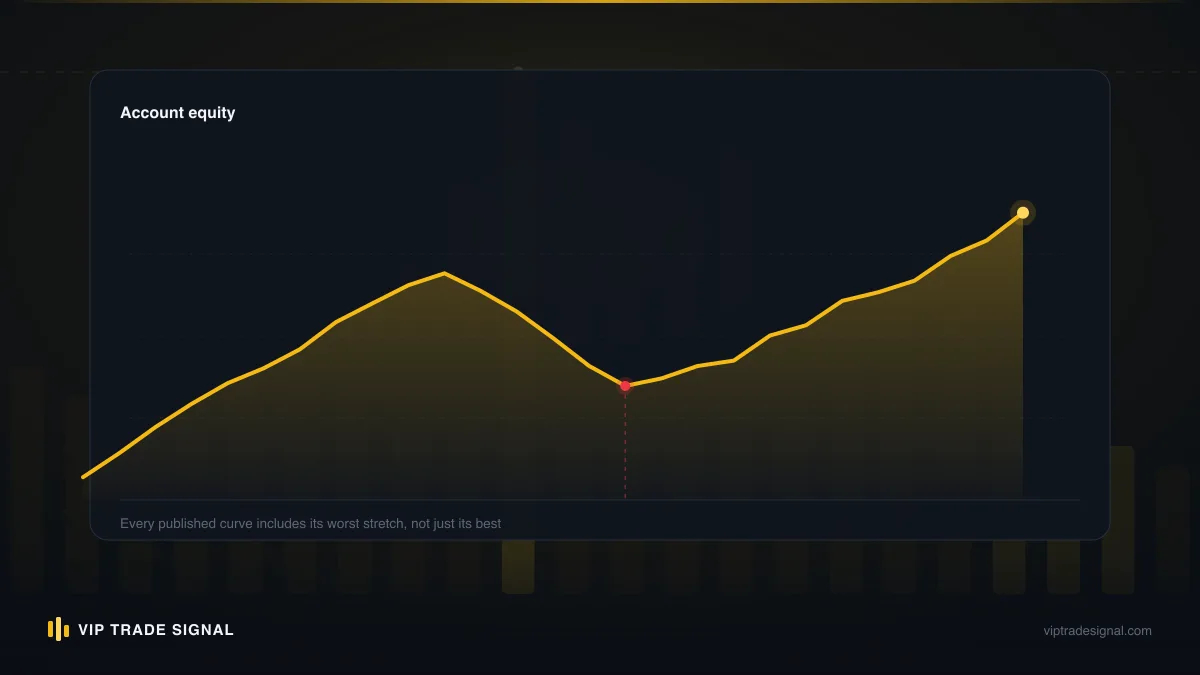
Real trading results have a texture to them. Win rates in the 50s and 60s. Losing trades scattered through every month, sometimes in ugly clumps of four or five. Whole months that finish red — not catastrophic, if risk is controlled, but undeniably negative, sitting there in the record like a dent in a car door. Equity curves that grind upward with wobbles rather than ascending in a laser line. Average wins somewhat larger than average losses, doing the quiet work that win rate gets the credit for.
Put that next to a curated feed showing 94% wins and a curve like a staircase to heaven, and the honest record loses the beauty contest every single time. A newcomer comparing the two "track records" side by side will pick the fake one, rationally, based on the information in front of them. The market for results actively punishes honesty. Which explains, if you've ever wondered, why so few services publish complete histories: it's not only that their results are bad. It's that even good real results look mediocre next to fiction, so publishing them feels like unilateral disarmament.
We think that's exactly backwards, and it's a hill we're happy to die on. The boring record is the credential. When you find a provider whose published history includes a -6% month, losing streaks, and trades that stopped out forty minutes after entry, you've found something rare: numbers that nobody would have chosen to invent. The ugliness is the watermark. Fiction is smooth because its author controls it; reality has jitter because nobody does.
So invert your instincts. Trained on a feed of fakes, your eye reads "boring and lumpy" as weak and "spectacular and smooth" as strong. Flip it. Spectacular and smooth is the costume fraud wears. Boring and lumpy is what money that actually compounds looks like from the inside — and if that sentence saves you from one Lamborghini funnel, this article has paid for itself.
What our own unedited history looks like
Since we've spent four thousand words telling you not to trust claims, ours included, let's be brief and structural about where we stand — you should verify, not believe.
VIP Trade Signal trades one instrument: gold, XAU/USD, nothing else. Every signal we close is published at /signals/history — entry, stop, take-profits, timestamps, outcome — and losers stay on the page forever, next to the winners, because an editable history is worth nothing and we'd rather have a track record that looks like trading than a highlight reel that looks like marketing. You'll find losing trades there. You'll find losing stretches there. If you ever visit and can't find a loss, assume we've been bought by someone dishonest and leave.
We'll also state the things this article says every honest service must state. Our results are not a promise of yours — execution, spreads, timing and sizing mean two people following identical signals finish with different numbers. Gold is violently volatile and trading it involves real risk of real loss; some months are negative and we say so out loud. Nothing we publish is personalised investment advice, because we're not a licensed advisor and won't pretend otherwise. The service costs $99 a month, or free if you trade with one of our partner brokers keeping $250+ on account — the full mechanics are on the FAQ, and the fuller story of who we are and why we run it this way is at /about.
That's the extent of the pitch. The record is public; judge it against everything above.
The screenshot skeptic's checklist
Everything in this article, compressed into something you can run in your head in under a minute the next time a green screenshot slides across your feed.
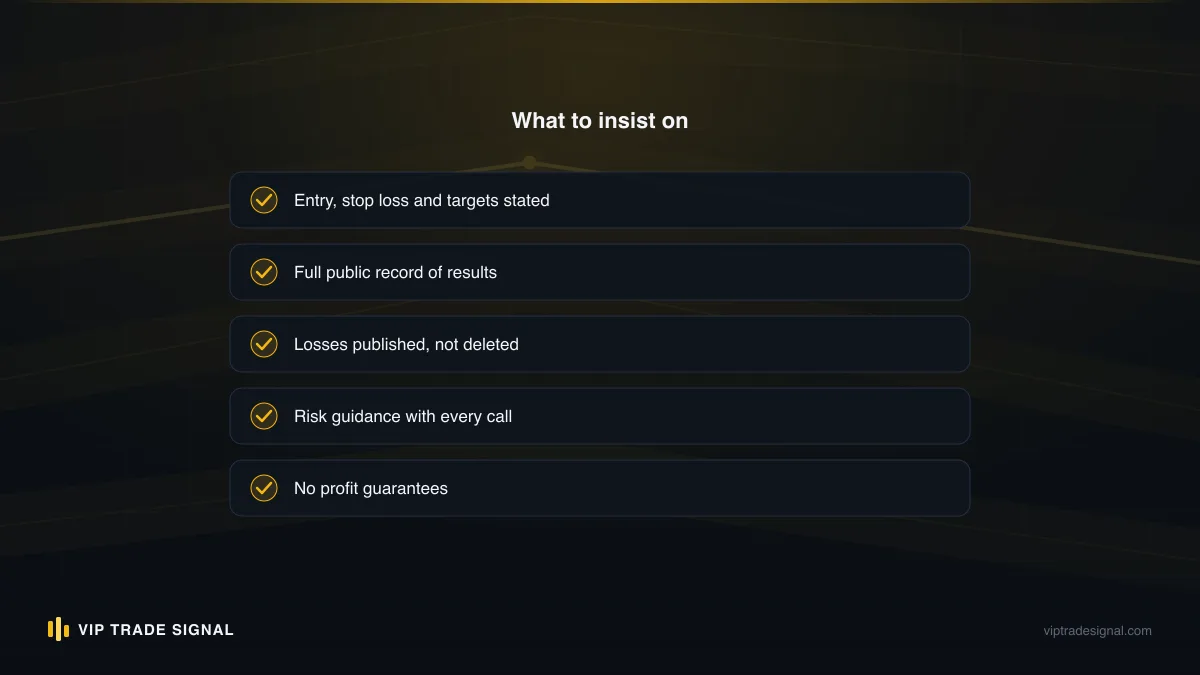
- Assume manufactured until proven otherwise. That's the base rate talking, not cynicism. Fakes outnumber real results because fakes are 10,000 times cheaper to produce.
- Does the arithmetic reconcile? Lot size × price move × contract value = stated profit. Thirty seconds. Kills half of everything.
- Live or demo — stated where, exactly? If the account type isn't visible and the seller won't show it, you have your answer.
- Can the history be edited? Telegram scrollback, Instagram highlights and screenshot folders are all curated media. Only an append-only public record counts. No record, no track record.
- How are multi-TP trades scored? Ask the TP1-then-stop question directly. "Net loss" is the only acceptable answer.
- Pips or money? Pip totals without lot sizes and losses are decoration.
- What's the risk per trade? Vertical equity curves and visible 30%+ single-trade swings mean you're looking at a casino account, however live it is.
- Is a win rate above 85% claimed anywhere? Then leave. The claim is the disqualification; there is no follow-up question worth asking.
- Verification: which badges, how long, what drawdown? A verified three-week rocket is still a rocket. Multi-year, both badges, sane drawdown — or it's theatre.
- Would anyone invent this? The final filter. Records containing red months and losing streaks pass. Records containing only glory fail.
Notice that only items two and three are about the image itself. That's deliberate. The strongest fakes contain no fake pixels — the lie lives in selection, scoring and survivorship — so a checklist obsessed with image forensics guards the wrong door. Guard the record, not the pixels.
Teaching a friend to spot fakes
One last thing, and it's the reason we'd ask you to share this piece rather than just file it away.
Everyone reading this knows someone in the blast radius. A brother-in-law who's been sending you TikToks of funded-account flippers. A colleague who joined a "VIP gold channel" last month and has gone slightly quiet about how it's going. The person these scams actually land on is rarely the person researching articles about them — you've already self-selected into the sceptical minority by being nine sections deep into this one. The victims are one social hop away from you, and a forwarded link at the right moment does more good than any amount of your own vigilance.
If you get five sentences of their attention, here's the version we'd give: Screenshots aren't evidence — anyone can make them in minutes, free, and most are made on demo accounts or with generator apps. The clever fakes are real trades with the losers deleted, so never trust a channel's scrollback; only a public page where losses stay published counts. A 90% win rate isn't impressive, it's the signature of a scam — real trading wins 50-something percent and has losing months. Anyone turning $500 into $4,000 in a week is showing you the one account that survived, not the seven that died. And nobody with a genuine money machine sells subscriptions to it on Telegram.
That's the whole immune system in a paragraph. It won't make anyone a trader, but it makes them a dramatically harder mark, and being a hard mark is worth more than most trading education. The economics of this industry are brutal and simple: manufactured results exist because they convert, and they convert because most people have never once been shown the production line. You have now. The screenshots will keep coming — tomorrow, in bulk, forever, because they cost nothing to make — but from today they should look different to you: not proof, not even claims really, just the visible output of one of five machines you can name on sight.
And if you're currently evaluating a specific provider and want the wider anatomy of how these operations run end to end — the funnels, the copiers, the broker kickbacks — our breakdown of forex signal scams picks up where this piece stops. Read that before you send anyone a penny. Then, whoever you end up following, us or anyone else, hold them to the only standard that survived this article: a public record they cannot edit, with the losses left in.