Ask ten traders whether forex signals work and you'll get two answers, both delivered with total confidence. The first: signals are a scam, full stop, run by failed traders selling hope to people who haven't blown an account yet. The second: signals are the shortcut, the way to skip five years of chart time and just copy someone who already figured it out. Both answers are wrong. Both are also popular, because both are simple, and the honest answer is not.
So do forex signals work? Here it is, up front, before the caveats: sometimes, for some people, under conditions you can actually list. Signals demonstrably work when the provider has a genuine edge, publishes complete results, sizes risk sanely, and the follower executes with discipline and enough capital to survive the losing streaks that will absolutely come. They demonstrably fail when any one of those conditions breaks. And the maddening part, the part that keeps this argument alive on every trading forum on the internet, is that the industry is structured to make the working conditions rare and the failing conditions common.
We run a signal desk, so you'd expect us to land on "yes." We're not going to. What we're going to do instead is walk through the evidence — the reasons the question is genuinely hard to answer, the biases that poison most of the data you'll see, the math that decides profitability regardless of what any marketing page says, and our own published win-loss history as one dataset among many. By the end you should be able to answer the question for your own situation, which is the only version of the question that matters.
The honest short answer: sometimes, conditionally
Let's kill the binary first. "Do forex signals work" is a question like "do restaurants make you sick." Some do. Most don't, or wouldn't if the diner didn't do something reckless on top. The category is not the answer; the specific instance is.
A trading signal is just a trade idea with an entry, a stop loss, and one or more take-profit levels, sent to you by someone else. That's the whole product. Whether it works decomposes cleanly into three separate questions, and the muddle in every online argument comes from mashing them together:
- Does the provider have an edge? Over hundreds of trades, do their signals produce a positive expectancy — average win times win rate, minus average loss times loss rate — after spread and commission?
- Can that edge survive transmission? Signals decay between the provider's screen and yours. Delay, slippage, missed trades, moved entries. A thin edge at the source can be a losing system by the time it reaches your account.
- Can you survive the edge? Even a genuinely profitable signal stream has losing weeks and losing months. If your account, your risk sizing, or your temperament can't sit through an eight-trade losing streak without doing something stupid, the edge is irrelevant. You'll never collect it.
A "yes" to all three and signals work, in the plain sense that your account grows over a meaningful sample of trades. A "no" to any one of them and they don't, no matter how good the provider is. That's why two people can follow the identical channel for the identical six months and one finishes up 11% while the other finishes down 30%. Same signals. Different answers to questions two and three.
Most of the industry's marketing is aimed at convincing you question one is the only question. It isn't even the most commonly failed one.
Why this question is hard to answer with data
You'd think somebody would have just... studied this. Taken a thousand signal services, tracked follower outcomes for two years, published the numbers. Nobody has, and it's worth being clear-eyed about why, because the absence of clean data is exactly the gap that both the scam narrative and the sales narrative rush to fill.
First problem: providers control their own reporting. There is no regulator auditing Telegram channels. A provider's track record is whatever the provider says it is, and the standard tricks are well documented — deleting losing calls, posting entries after the move, quoting the best take-profit level as if everyone caught it, screenshotting demo accounts. When the entity that generates the data also curates it, the data is marketing.
Second problem: follower results are private. Even for an honest provider, the outcomes that actually answer the question — what happened in the followers' accounts — are scattered across thousands of brokers and never aggregated. The provider genuinely doesn't know how their followers did. Neither do we, beyond what people tell us, and people who lost money mostly go quiet rather than report back.
Third problem: the population churns constantly. Signal services die young. A channel that launches, runs hot for four months on over-leveraged gold longs, then blows up and vanishes never enters anyone's dataset. The services old enough to study are, by definition, the ones that survived — which brings us to the bias that quietly rigs every piece of evidence you'll encounter in this space.
What we do have is indirect but consistent: broker risk disclosures across the EU and UK show that a substantial majority of retail CFD accounts lose money — the figures printed on the brokers' own websites typically sit somewhere between 60% and 80%. Signal followers are a subset of that population. There's no reason to think they beat the base rate by default, and some reason to think the most impulsive traders are over-represented among signal buyers. That's the honest starting prior: most people who tap "copy this trade" lose. The interesting question is what separates the ones who don't.
Survivorship bias: why you only hear from winners
Survivorship bias is the single most important idea in this entire article, so let's spend real time on it rather than nodding at the term.
Imagine 256 brand-new signal channels launch this month. Each one just flips a coin on gold — long or short, no analysis at all. After one month, roughly 128 of them happen to be profitable. After two months, 64. After six months, four channels are sitting on six consecutive winning months of pure luck. Those four don't know they're lucky. They think they're geniuses. And crucially, they're the only ones still posting screenshots, because the other 252 quietly deleted their channels or rebranded.
Now you, shopping for a signal provider, search around and find a channel with six straight green months and 900 five-star reviews from the followers who rode the streak. Every visible piece of evidence says this provider is brilliant. The 252 invisible failures — the base rate that would tell you this performance is exactly what chance produces — left no trace. You are not seeing a track record. You are seeing a lottery winner's autobiography.
A six-month winning streak with no published losses isn't evidence of skill. It's evidence of a delete button.
This isn't hypothetical. Channel recycling is standard practice in the seedier end of this industry: run five channels under five names, promote whichever one is currently hot, kill the cold ones. The survivors write the reviews, film the testimonials, and post the Lambo photos. The casualties are silent. Every "look how well signals work" claim you've ever seen was filtered through this machine, and so — less obviously — was every "signals never work" claim, because the loudest critics are people who picked from the survivor pool, got the inevitable reversion, and generalised from a sample of one.
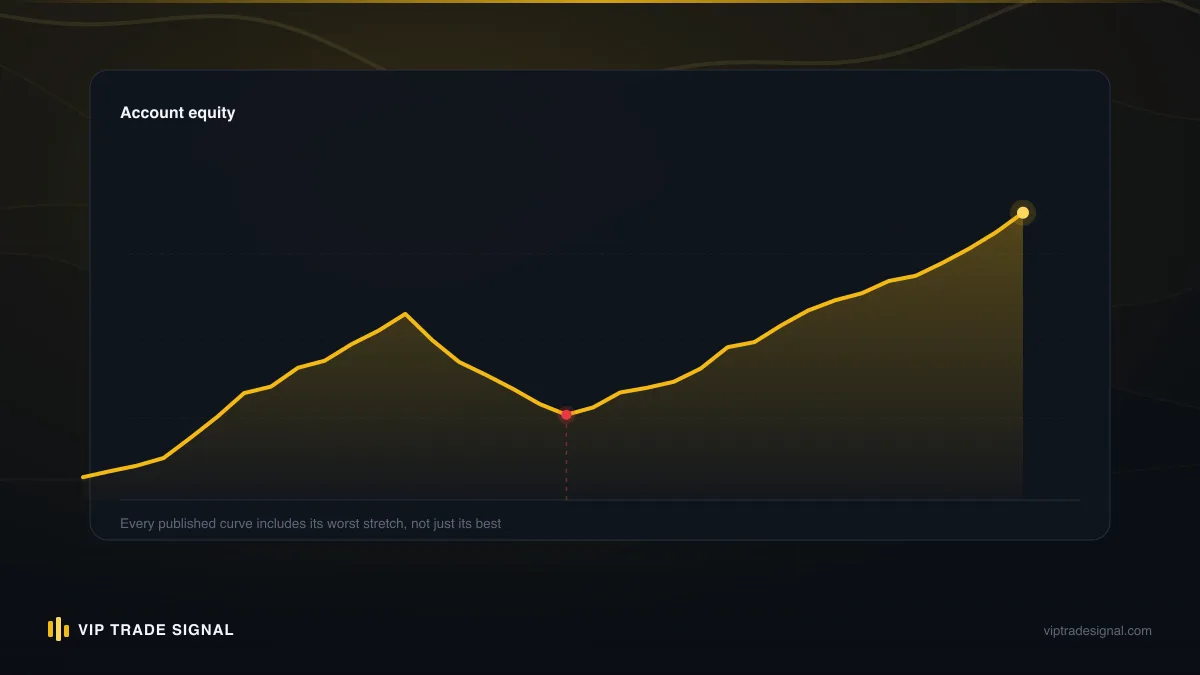
The antidote is boring and specific: only trust track records where the losses are permanently published alongside the wins, timestamped, unedited, with the full sequence intact. Not a monthly pip total. Every trade. If a provider won't show you their losing trades, they have answered your question, just not the way their sales page did. It's why we publish every closed signal, red ones included, at /signals/history — not out of nobility, but because a track record with the losses removed is not a track record, and we'd rather lose the customers who want to be lied to.
The conditions under which signals demonstrably work
Enough about why the evidence is dirty. Here's what the clean slice of it — verified myfxbook-style records, copy-trading platforms with audited fills, and the small population of services that publish complete histories — actually shows about when signals produce money in a follower's account. The conditions are surprisingly consistent.
Condition one: a real, modest edge at the source. The providers who last for years post win rates around 55–70% with average winners at least comparable to average losers, or lower win rates with fat winners. Nobody durable posts 90%. A 90%+ accuracy claim almost always means one of two things: the losses are hidden, or the strategy holds losers without stops until they either recover or destroy the account — which works right up until the one time it doesn't. A forex signal accuracy rate in the low 60s with disciplined 1:1.5 reward-to-risk is a genuinely strong service. It also looks unimpressive on a sales page, which tells you something about why sales pages look the way they do.
Condition two: defined risk on every single trade. Every signal carries a stop loss, and the provider never widens it mid-trade. The blow-ups in follower accounts overwhelmingly trace back to trades without stops or with "mental" stops that got renegotiated at the worst moment. On gold especially — a market that can travel $30 in an hour on a data print — an entry without a hard stop isn't a trade, it's an open-ended donation.
Condition three: the follower sizes positions like an adult. This is the condition most often failed, and it's failed on the follower's side, not the provider's. The followers who end up profitable risk a fixed small fraction — 0.5% to 2% of the account — per signal, every signal, regardless of how confident the message sounds. A $2,000 account risking 1% has $20 of room per trade; with a 400-point stop on gold that's a 0.05 lot position, and yes, that feels insultingly small, and yes, it's the size that lets you still be around in month seven when the equity curve finally pays. We've written a full piece on why lot sizing on a small gold account is the decision that dominates everything else, because it is.
Condition four: enough trades and enough patience for the edge to show. Edges are statistical. Thirty trades tells you almost nothing; a coin-flip system goes 19–11 over thirty trades about as often as a good system goes 11–19. The followers who succeed judge a service over 100+ trades and several months, and they pre-commit to that evaluation window before the first losing week arrives to tempt them out.
Condition five: clean execution. Signals delivered with pending orders at specified levels, or taken within a couple of minutes on a market that hasn't already run, at a broker with tight spreads on the instrument in question. More on this one shortly, because it's where a shocking amount of theoretical profit goes to die.
When all five hold, signals work — not spectacularly, not "quit your job by Christmas," but in the sense of a real edge compounding at retail scale. Something like 2–6% a month in good stretches, flat-to-negative months mixed in, drawdowns that occasionally sting. That's what "working" actually looks like. If that number disappoints you, the disappointment is worth examining, because it's the gap between that figure and the fantasy that funds most of this industry.
The failure modes: where follower results collapse
The failures are just as predictable as the successes, and this is genuinely good news — predictable failures are avoidable ones. In rough order of how much money each one incinerates:
Over-leverage. The number one killer, and it isn't close. The signal says risk 1%; the follower, three green trades into a hot streak, risks 10% because the channel "never loses." Then the normal, statistically inevitable four-trade losing run arrives and takes 35% of the account. The provider's record still shows a profitable month. The follower is gone. Nothing about the signals failed. The sizing did.
Cherry-picking signals. Followers skip trades that "don't look right," take the ones that feel comfortable, and in doing so convert a mechanical edge into a discretionary strategy run by the least experienced person in the chain — themselves. The cruel arithmetic: the scariest-looking signals (counter-trend entries after a scary candle) are often the highest-expectancy ones, so the filter doesn't just add noise, it selectively removes the best trades.
Revenge mode after losses. Doubling size to "win it back," or abandoning the service at the bottom of its drawdown and hopping to whichever channel is currently hot — which means systematically buying every service at its performance peak and selling at its trough. Signal-hopping is buying high and selling low, applied to providers instead of prices.
No stop, moved stop, widened stop. Covered above, still worth its own line, because a single stopless gold trade held through a trending week has ended more accounts than every scam channel combined. If you want to understand what an extended losing stretch does to an account and a mind — and how the maths of recovery gets ugly fast — our piece on drawdown, explained properly walks through it with real numbers.
Undercapitalisation. A $150 account following signals with 300–500 point stops on gold cannot size positions small enough to risk 1% at most brokers' minimum lot. So it risks 5–8% per trade by structural necessity, which means a perfectly ordinary losing streak is fatal. The signals were fine. The account was too small to hold them.
Notice what's absent from this list: "the provider was secretly bad." That happens — plenty of channels have no edge at all — but among followers of decent services, the collapse almost always originates on the follower's side of the screen. Which is uncomfortable — and, looked at the right way, good news, because your side of the screen is the only side you control.
Provider results vs follower results: the execution gap
Here's the effect almost nobody prices in: even with an honest provider and a disciplined follower, the follower's results are structurally worse than the provider's. Every time. The gap has a few components, and they stack.
Latency. The provider's timestamp is the moment the setup triggered on their screen. You see the message thirty seconds to five minutes later, depending on the platform and whether you were staring at your phone. On EUR/USD that might cost a pip. On gold during London or New York, five minutes can be $4–8 of movement — and the movement is biased against you, because signals fire when price is starting to go, meaning late entries are systematically worse entries, not randomly worse.
Spread and slippage. The provider's numbers are usually mid-price to mid-price. You pay the spread twice and eat slippage on stops during fast markets. On a signal targeting 40 points of profit, a 3-point spread plus a point of slippage is a 10% haircut on every winner before anything else goes wrong.
Missed trades. You were asleep. In a meeting. Driving. Over a month you catch perhaps 70–85% of signals, and the misses aren't random — the trades that fill instantly and run without you are disproportionately the clean winners, while the ones that hang around near entry long enough for you to join at leisure are disproportionately the chop.
Partial-close ambiguity. The provider banks half at TP1 and trails the rest; you either didn't, or did it differently. Multiply small divergences across a hundred trades and two accounts following "the same" signals barely resemble each other. We wrote a whole article on why your results differ from the provider's because it's the most common confused-and-slightly-accusatory email any honest signal desk receives.
Stack it up and a realistic transmission loss is 20–40% of the provider's stated edge — sometimes more for slow manual execution, less for pending-order entries taken at specified levels. The design consequence is blunt: a provider whose true edge is thin produces followers who lose money even when nobody lies and nobody misbehaves. The edge has to be fat enough to survive shipping. Mechanically, the best defence is executing with pending orders at the signal's stated levels rather than chasing at market — our guide to executing signals properly on MT4/MT5 covers the exact workflow, and it's worth twenty minutes of anyone's time.
What our own published history shows, losses included
Time to eat our own cooking. VIP Trade Signal is a gold-only desk — every signal we send is XAU/USD, one instrument, studied to the point of mild obsession — and every closed signal we've ever issued sits publicly at /signals/history, wins and losses, entry, stop, targets, outcome. Not a curated monthly summary. The actual sequence.
We're deliberately not going to quote a win-rate figure here, and the reason is the point: any number printed in an article goes stale the week after publication, and a static claim about a live record is exactly the genre of marketing this piece has spent two thousand words teaching you to distrust. Go look at the live page instead. What you will find there, guaranteed, because it's true of every real trading record in existence:
- Losing trades. Individually and in clusters. There are streaks of three and four consecutive stop-outs sitting in plain view, because that's what a roughly 60-something-percent-win-rate process produces from time to time, and pretending otherwise would make everything else on the page suspect.
- Losing stretches. Weeks where the running total went backwards. If you'd started following on the wrong Monday, your first fortnight would have been red. That's not a flaw in the record; it's the record working.
- Unremarkable-looking wins. Most winners are ordinary — a clean move from entry to first target. The occasional big runner exists, but no single trade carries the record, which is exactly what you want. A history carried by one monster win is a history one bad month from irrelevance.
Is our published history proof that signals work? No — and be suspicious of anyone whose own dataset conveniently proves their business model. It's one dataset: a few hundred trades, one instrument, one methodology, full sequence intact. What it demonstrates is narrower and more useful — that a signal record can be published completely, losses and all, and survive the exposure. Any provider who tells you full disclosure is impossible, or "would confuse members," is telling you what they'd need to hide.
The desk behind it is a handful of traders, not an algorithm farm — there's more on who we are and how the desk actually runs at /about if the provenance matters to you, and it should, because "who is actually issuing these trades" is a question shockingly few signal buyers ever ask.
The math of profitability: expectancy over win rate
If you take one technical idea away from this article, take this one, because it instantly disarms about 80% of signal marketing: win rate is not profitability. The number that decides whether signals make money is expectancy — what the average trade pays after everything.
The formula, using per-trade risk (R) as the unit:
Expectancy = (win rate × average win) − (loss rate × average loss)
Run three services through it. Say each risks 1R per trade:
| Service | Win rate | Avg win | Avg loss | Expectancy per trade |
|---|---|---|---|---|
| A ("92% accurate!") | 92% | 0.3R | 4.0R | (0.92 × 0.3) − (0.08 × 4.0) = −0.044R |
| B (honest grinder) | 58% | 1.5R | 1.0R | (0.58 × 1.5) − (0.42 × 1.0) = +0.45R |
| C (coin flip) | 50% | 1.0R | 1.0R | 0R, minus costs = negative |
Service A is the classic accuracy mirage: tiny take-profits banked constantly, occasional catastrophic losses on the trades held without a stop "until they come back." Ninety-two percent of its members' trades are winners, and its members lose money. Service B looks pedestrian on a sales page — it loses four trades in ten! — and it's the one that compounds. At 0.45R expectancy and 1% risk per trade, forty signals a month is roughly 18R of gross edge a month before the execution-gap haircut. Trim a third for latency, spread and misses and a disciplined follower is looking at high single digits monthly in a good stretch. Real, and modest, and a universe away from "double your account every month."
Two consequences worth sitting with. First, when a provider advertises accuracy without average win and average loss alongside it, they've given you one of three numbers and implied it's the whole equation. It never is. Second, expectancy is only visible over a sample — that same Service B will produce losing months from pure sequence variance, roughly one month in five or six, with nothing whatsoever wrong. If you don't know that going in, you'll quit inside a drawdown that the math fully predicted, and then tell people signals don't work. The math worked fine. The holding failed.
Are forex signals profitable for the provider? Follow the money
A question sharper readers always reach: if these signals are so good, why sell them? Wouldn't a profitable trader just... trade? It deserves a straight answer, because how a provider makes money predicts how they'll behave.
Partly it's a false dilemma — trading returns scale with capital, and a trader with a real edge but $30k of capital can rationally sell the edge alongside trading it; the two incomes aren't mutually exclusive, and subscription revenue is a lot less volatile than trading revenue. But the useful move is to sort providers by revenue model, because incentives write behaviour:
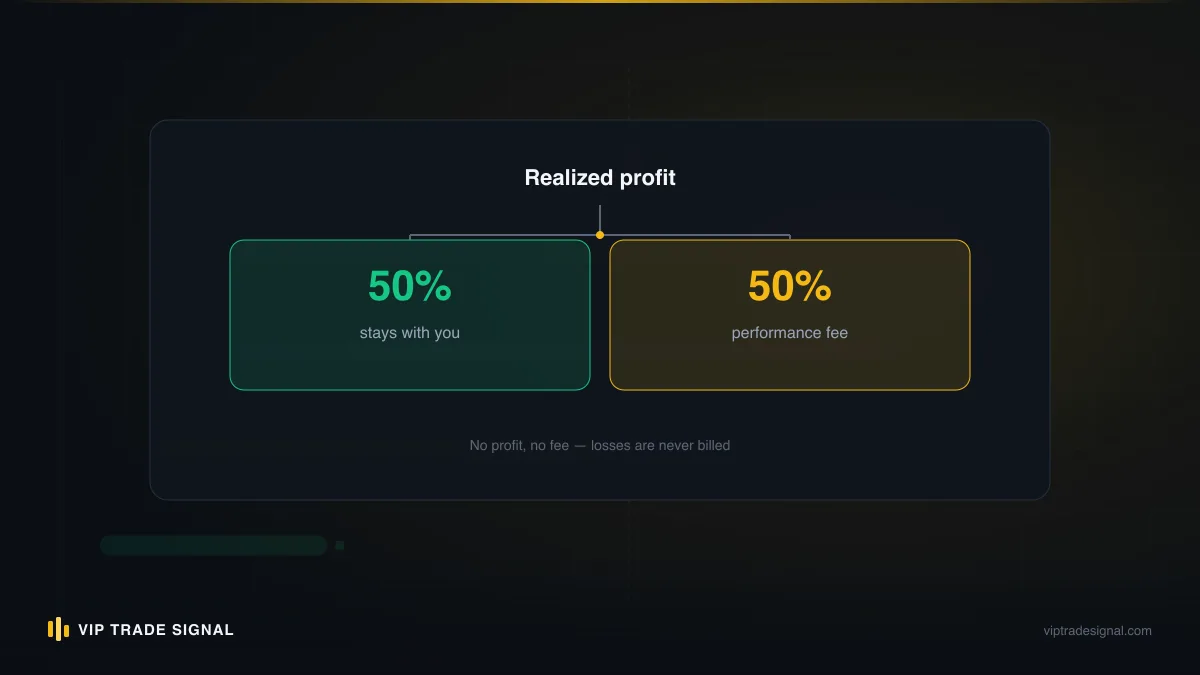
- Subscription providers earn when members renew, which means they earn when members survive. The incentive points toward sane risk and honest reporting, imperfectly but genuinely. This is our model at $99 a month for unlimited gold signals, or free if you trade with one of our partner brokers keeping $250+ on deposit — and yes, the partner-broker route means the broker pays us instead of you, which is a real conflict we'd rather name than have you discover.
- Pure IB (broker-rebate) channels earn per lot you trade, win or lose. The incentive points toward volume: more signals, bigger sizes, more churn. Some IB-funded channels are honest anyway. The structure isn't pulling them there.
- Upsell funnels give away signals to sell a $2,000 "mentorship." The signals are a lead magnet; their quality only needs to survive until checkout.
Do signal providers make money? The successful ones, yes — and the follow-up question that actually protects you is from what: your subscription and renewal, meaning your survival, or your trading volume and eventual replacement. Ask any provider how they're paid, in exactly those words, and grade the answer on how quickly and completely it comes.
Pros and cons, weighted honestly
Every pros-and-cons list you've seen on this topic weighs the items equally, which is how you get "saves time" sitting next to "you might lose your account" as if they belong on the same shelf. Weighted properly:
The heavyweight pro: signals let you participate in a strategy you couldn't yet build, with defined risk, while you learn. For someone with a job, a family, and 45 minutes a day for markets, a good signal service with disciplined sizing is a legitimately rational choice — better, frankly, than the same person forcing their own half-formed setups at 11pm.
The heavyweight con: signals outsource your entries but not your outcomes. Every failure mode in this article — sizing, cherry-picking, revenge trading, quitting in drawdown — remains yours, and following signals develops none of the skill needed to avoid them. You can follow signals for three years and be no better a trader than day one. If the provider vanishes tomorrow, you're back to zero.
Middleweight pros: enforced structure (a stop on every trade is more discipline than most self-directed beginners manage); a live education in how a professional frames entries and exits, if you study the signals rather than just tapping them; time efficiency that's real, though smaller than advertised once you account for being available to execute.
Middleweight cons: the execution gap, which taxes every follower; dependency risk; the psychological grind of losing money on trades you didn't choose, which is a different and for many people nastier feeling than losing on your own ideas — sitting through someone else's drawdown requires trust you haven't yet earned the evidence for.
Feather-weight and mostly noise: the monthly fee. People agonise over $99 a month while risking 5% a trade. On a $5,000 account, one percentage point of monthly performance is $50; the fee matters at $1,000 and becomes a rounding error at $20,000. Price the service against your account size, not against your feelings about subscriptions.
Who should not use signals at all
We turn people away, and not for charity — members who were always going to blow up become refunds and one-star reviews. Signals are the wrong tool, full stop, if any of these describes you:
- Your account is under about $500. The position-sizing arithmetic doesn't work; minimum lot sizes force you to over-risk structurally, and no provider can fix your broker's minimums. Save first. The market will still be here.
- You need the money. Rent money, wedding money, borrowed money. Risk capital means money whose loss changes nothing about your life. Anything else guarantees you'll trade the fear instead of the signal.
- You cannot follow a rule you disagree with. Signal-following is rule-following. If you already know you'll skip entries and widen stops, you'll get discretionary results with subscription overhead — the worst of both.
- You're looking for income this quarter. Signals compound risk capital over months. They do not pay salaries. Anyone selling you the salary version is selling the fantasy, not the tool.
- You want to become a trader. Genuinely a bad reason to buy signals as your main vehicle. Follow them as a study aid alongside your own demo work, fine. Follow them instead of learning and you're renting an outcome while building nothing.
There's no shame in any of these. There's considerable expense in ignoring them.
How to run your own 90-day evidence test
Everything above is our evidence. Here's how to generate yours, at a cost of roughly one evening of setup and three months of patience — which sounds like a lot until you compare it with the cost of skipping it.
- Pick one service and pre-register your rules. One provider, not three. Write down — actually write — your risk per trade (1% flat is fine), which signals you take (all of them, that's the point), and your evaluation window (90 days or 100 signals, whichever comes second). Deviations count as test failures, not judgment calls.
- Run the first month on demo or minimum size. You're testing transmission, not profit: can you actually receive and execute these signals with your schedule, your broker's spread, your time zone? A service that fires at 3am your time fails the test for you regardless of its record.
- Log every signal — including the ones you missed. Spreadsheet: date, entry, stop, target, provider's stated outcome, your actual outcome in R, and a missed/taken flag. The gap between the provider's column and yours is your personal execution tax, measured instead of imagined.
- Judge in R, monthly, and only at the end. Not in dollars (sizing noise), not daily (variance noise). After 100 signals you'll have a defensible estimate of your realised expectancy. Positive after costs: continue and consider sizing up gradually. Negative while the provider's column is positive: fix your execution before blaming the service. Both columns negative: leave, and lose nothing but a quarter and a small stake.
- Pre-write your quit conditions too. Example: "I stop if my logged results hit −15R, or if I catch the provider deleting a published loss — instantly, no appeal." Deciding exit rules before the drawdown is the entire trick; nobody decides well inside one.
Ninety days of this outperforms every review, every screenshot, and every article — including this one. It's also, not coincidentally, a test almost no one runs, which goes a long way toward explaining the outcome statistics of almost everyone.
Verdict framework: deciding for yourself
So, after five thousand words: do forex signals work? Yes — conditionally, modestly, and only when both halves of the arrangement do their job. They work when a provider with a real, published, loss-inclusive edge meets a follower with adequate capital, fixed fractional risk, and the temperament to sit through the losing stretches the math guarantees. They fail, predictably and preventably, when any of those pieces is missing — and in the wild, the follower-side pieces go missing more often than the provider-side ones, which is not what either the scammers or the cynics want you to believe.
Your decision reduces to four questions. Answer them in order and the verdict falls out on its own:
- Is the record real? Complete, timestamped, losses visible, live — not a highlight reel. No full history, no further questions.
- Does the math clear the shipping cost? Expectancy positive after spread, slippage and your realistic miss rate — not just a shiny win rate.
- Can your account hold the trades? Enough capital to risk about 1% per signal at your broker's minimum lot, using money you can lose without flinching.
- Will you actually follow the rules? Every signal, fixed risk, stops honoured, judged over 100 trades. Be brutally honest; this is the question people fail while acing the first three.
Four yeses: signals are a rational tool for you, and the remaining work is picking a provider whose incentives point at your survival. Any no: fix that first, because no provider on earth can out-signal a broken answer to questions three or four. Trading gold on leverage will lose you money in some weeks and some months whoever is calling the trades — that's the cost of admission, not a defect.
If you want to inspect a full, unedited record while you think — every win and every loss we've ever closed, in sequence — it's at /signals/history, and it will still be there, red trades intact, whenever you're ready to look. That's not a sales pitch. That's the standard. Hold everyone in this industry to it, us included.