Somewhere on your phone right now there are probably four or five signal channels you've joined "just to watch". One posts a screenshot of a 900-pip gold win every morning. Another has 40,000 members and a pinned message about a limited-time VIP offer. A third went quiet in March. You keep meaning to sit down and properly compare them, and you keep not doing it, because comparing them feels impossible. It is impossible, the way you're trying to do it.
Here's the problem with the usual approach to how to choose a forex signal provider: you end up building a mental spreadsheet with twenty channels down the side and twenty criteria across the top, and every cell is a judgement call. Win rate? They all claim 85%. Price? Meaningless without knowing what you get. Reviews? Written by affiliates. Four hundred fuzzy comparisons later, you pick the one with the nicest branding, which is exactly the thing that should count least.
So don't compare. Eliminate. This piece gives you a funnel with seven gates, run in a fixed order, where failing any single gate disqualifies a provider on the spot. No partial credit, no "but their Instagram is really good". Most providers die at gate one or two, which means the exhausting twenty-way comparison collapses into a short, clean shortlist — often a shortlist of one or two — before you've spent a penny. We run a signal service ourselves, and near the end I'll push us through the same funnel and show you where we pass and where, honestly, we wobble.
Why choosing badly costs more than the subscription
Let's put a number on the mistake before we fix it. Say you pick a bad provider charging $80 a month. The subscription over six months costs you $480. That's the small loss. The big one is what their signals do to your account while you're finding out they're bad.
A trader we'll call Dan funds a $3,000 account and follows a channel that posts entries with no stop losses — "we'll update you" is the risk management. Third week in, gold drops $40 in a session while Dan's at work, the update never comes, and the position he was told to "hold, it will recover" swallows $900. That's 30% of the account, gone to one trade from a channel he never vetted. The subscription was $99. The lesson cost nine times that, and the lesson wasn't even about trading. It was about vetting.
And there's a third cost, quieter than either: time. Every month you spend following a mediocre provider is a month you're not building the habits that actually compound — consistent risk per trade, honest journalling, learning to sit out. Bad signals don't just lose money. They teach you bad behaviour, because you copy what you watch. Follow someone who revenge-trades after a loss and inside two months you'll be doing it too, on your own trades, with your own money.
The flip side is worth saying plainly. A genuinely decent provider doesn't make choosing pointless — it makes choosing the highest-leverage decision you'll take this year, because whatever they do, good or bad, gets multiplied across every trade you copy. Whether signals can work at all for a disciplined follower is its own question, and we've argued the honest version of it in do forex signals actually work. Short answer: yes, conditionally, and every condition starts with "you picked someone real". Which brings us to the funnel.
The elimination funnel: seven gates in order
The design principle is simple: order the checks so the cheapest, most brutal filters come first. You can check gate one in ninety seconds from your sofa. Gate seven takes thirty days. If a provider fails gate one, you never spend the thirty days.
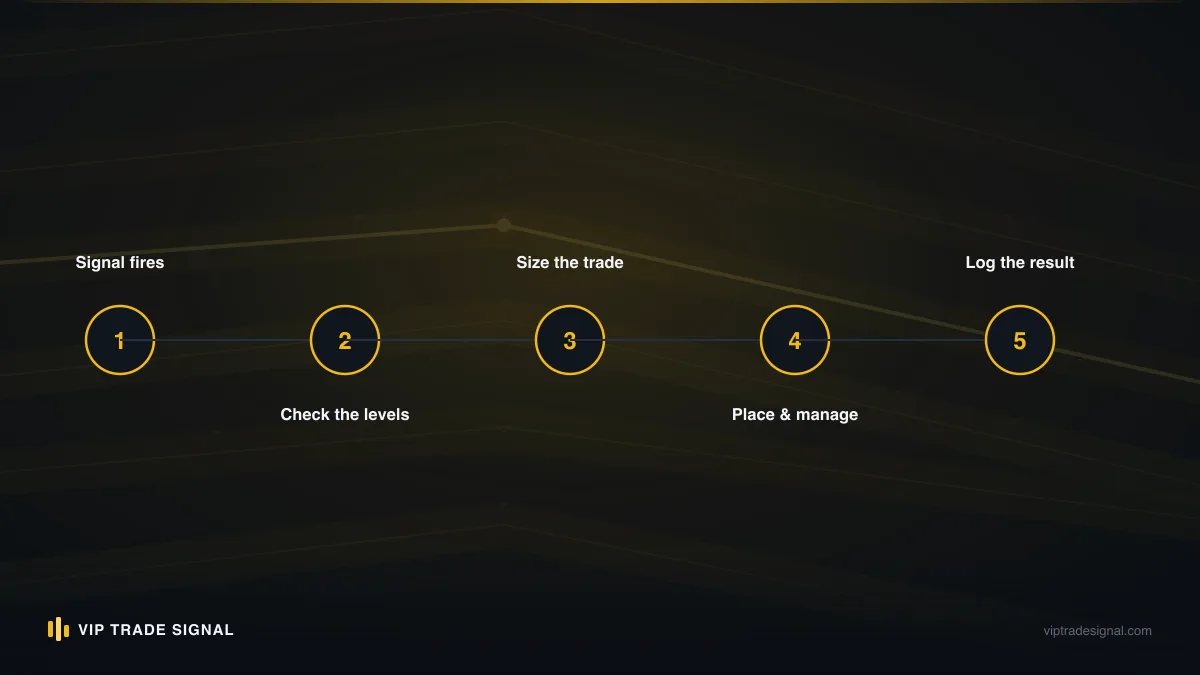
Here's the whole funnel at a glance:
| Gate | Question | Time to check | Typical survival rate |
|---|---|---|---|
| 1 | Is the full history public, losses included? | 2 minutes | Low — most die here |
| 2 | Can the results be verified independently? | 10 minutes | Lower still |
| 3 | Do they talk risk numbers before profit numbers? | 5 minutes | Moderate |
| 4 | Is the methodology and instrument focus clear? | 10 minutes | Moderate |
| 5 | Is pricing honest, with a clean exit? | 5 minutes | Moderate |
| 6 | Is communication responsive without being pushy? | A few days | High |
| 7 | Does a 30-day demo match their claims? | 30 days | This is the real exam |
Two rules govern how you use it. First: the order is fixed. It's tempting to skip ahead — "the pricing looks fair, I'll forgive the missing history" — and that temptation is precisely the loophole bad providers rely on. Second: a fail is a fail. Not a yellow flag, not a "watch closely". Out. The whole value of the funnel is that it removes discretion at the moments your judgement is weakest, which is when a slick channel is showing you a screenshot of someone else's yacht.
Those survival-rate labels aren't fabricated statistics, by the way — nobody audits the Telegram signal industry, so nobody has real numbers. They're a practitioner's honest impression after years of looking at these channels, and I'd stand behind the shape of them: the crowd thins fastest at the first two gates, because those are the gates that can't be faked with marketing spend.
Now let's walk each gate properly.
Gate 1: full history visible, losses included
The first question is embarrassingly simple. Can you, right now, without messaging anyone or paying anything, see every signal this provider has issued — including the losers?
Not highlights. Not a "results" page of cherry-picked screenshots. The full ledger: every entry, every stop, every target, every outcome, timestamped, in one place you can scroll from top to bottom. If the losing trades are missing, or the history conveniently starts three months ago after a "system upgrade", or results only appear as images posted after the trade closed — fail. Ninety seconds, next candidate.
Why is this gate first? Because it's the one thing an honest provider finds trivial and a dishonest one finds fatal. Publishing your full record costs nothing if the record is real. We publish every closed signal, wins and losses both, at our signals history page, and I can tell you the running cost of doing so: zero, plus occasionally having to look at a bad week in public. That mild discomfort is the entire price of honesty, and any provider unwilling to pay it has told you what their record looks like.
The screenshot economy deserves a special mention here because it's where most retail traders get taken. A screenshot proves nothing. MetaTrader results can be doctored in any image editor in four minutes; demo accounts screenshot identically to live ones; and even genuine screenshots are survivorship on a plate — you're seeing the trades they chose to show. But the deeper problem isn't forgery. It's selection. A channel that takes eight trades and screenshots the three winners hasn't faked anything, and has still lied to you completely.
A few specific things to look for once a full history exists:
- Gaps. A record with missing weeks usually had bad weeks. Honest records have ugly patches sitting right there in the open.
- Timestamps before the move. Signals should be visibly posted before entry, not narrated afterwards. "We caught this move" posted at 6pm about a 9am breakout is a story, not a signal.
- Losses that look like real losses. A history showing 96 wins and 4 losses isn't a green flag, it's a red one wearing green. Real trading over any meaningful sample includes losing streaks — three, four, five in a row. If the record never shows one, someone's editing.
And one caution in the other direction: a full public history is necessary, not sufficient. It gets a provider through gate one. It does not mean the results are real. That's gate two's job.
Gate 2: independently verifiable results
Here's where the crowd really thins. A public history hosted on the provider's own website is a claim. What you want next is corroboration the provider doesn't control.
The strongest version is third-party verification: a Myfxbook or FX Blue account linked to a live trading account, with the track record set to public and — crucially — the track-record verification actually enabled, not just the pretty equity curve. These platforms read directly from the broker's server, so the provider can't quietly delete a bad month. Even here, stay awake. Check whether it's a live account or a demo (both can be connected, and the badge is easy to miss). Check the account's age; a verified three-week record verifies three weeks of luck. Check that the strategy shown is the strategy sold — some providers verify a conservative account and sell signals from a wilder one.
Weaker but still useful corroboration includes long-running third-party forum threads where real subscribers post their own copies of the trades over months, and communities where results get discussed by people with no referral link in their bio. Which raises the awkward subject of forex signal provider reviews generally: treat the entire review ecosystem as compromised until proven otherwise. Most glowing reviews of signal services are written by affiliates earning a cut of your subscription, most review sites rank whoever pays them, and most Trustpilot pages in this niche are a bar fight between the provider's friends and one furious ex-subscriber. Reviews are, at best, a place to find specific factual claims you can then check yourself. They are never the verification.
What if a provider has a public history but no third-party verification at all? Then the burden shifts to gate seven — your own demo test becomes the verification — and you should weight everything else more sceptically in the meantime. We're candid that this describes us more than we'd like: our full ledger is public and timestamped, but self-hosted, and we tell prospective subscribers the same thing we'd tell you about anyone: don't take our word for it, forward-test us. A provider who encourages you to verify them independently is showing you something. A provider who bristles at the suggestion is showing you something too.
Learning how to identify real forex signal providers ultimately reduces to this one habit: never accept evidence the seller controls. Everything at this gate is a version of that sentence.
Gate 3: risk numbers, not profit numbers
Ask a provider one question: "What's your maximum drawdown?" Then watch what happens.
A real trader answers with a number, roughly and without flinching — "worst peak-to-trough was about 14% last autumn, took nine weeks to recover" — because anyone who has actually traded through a drawdown remembers it the way you remember a car crash. A marketer answers with pips. Or changes the subject to last month's wins. Or, my personal favourite, says "we don't really have drawdowns", which is the trading equivalent of a pilot saying they don't really have turbulence.
Profit numbers are the front of the shop. Risk numbers are the accounts. You want to see, stated or calculable from the history:
- Maximum drawdown, peak to trough, and how long recovery took. If drawdown is a fuzzy concept for you, fix that before you subscribe to anything — we've written a plain-English breakdown in drawdown explained, and it's the single most protective piece of knowledge a signal follower can carry.
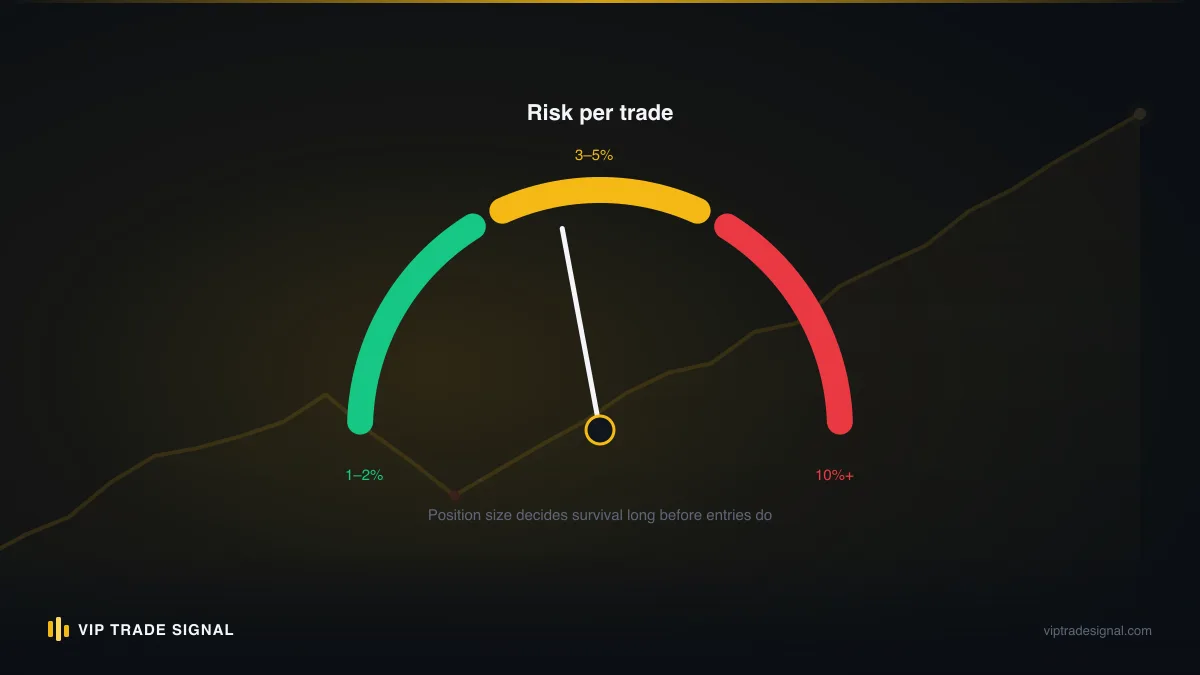
- Risk per trade. Every signal should come with a stop loss, and the provider should tell you what fraction of an account each trade risks at their suggested sizing. If the honest answer is "depends how confident we are", run. Confidence-based sizing is how accounts die.
- Average loss versus average win. A 90% win rate with winners of $30 and losers of $600 is a slow-motion ruin. The ratio matters more than the rate, and providers who quote only the rate know that.
- Losing-streak behaviour. Not whether streaks happen — they happen to everyone — but what the provider does during one. Do they cut frequency? Keep sizing flat? Or double down to "recover", which means they're now gambling with your copy of their tilt?
There's a reliable tell buried in the marketing language itself. Providers who advertise in dollars and percentages of profit — "turn $500 into $5,000" — are selling to people who think in jackpots. Providers who talk in risk units and R-multiples are talking to people who intend to survive. The vocabulary tells you who they think their customer is. Make sure it's not you.
Gate 4: clear methodology and instrument focus
You don't need a provider's exact system. You do need to understand, in one paragraph of plain speech, what kind of trading you'd be copying — because otherwise you cannot tell the difference between a losing streak that's normal for the method and one that means the method is broken.
So the gate-four question is: can they describe what they do without mysticism? "We trade London-session breakouts on gold with stops beyond the prior session's range, two to four setups a week" — that's an answer. "Our proprietary AI algorithm reads institutional order flow across all markets" — that's a fog machine. Notice the difference isn't sophistication. It's checkability. The first claim generates predictions you can audit against the public history: if they say two to four setups a week and the history shows nineteen, someone's lying. The second claim generates nothing you could ever catch them on, which is the point of phrasing it that way.
Instrument focus deserves its own paragraph, because it's a quiet quality signal most people miss. A channel calling trades on gold, GBP/JPY, US30, oil, and Bitcoin in the same week is almost always chasing whatever moved yesterday, and breadth like that is a marketing decision — more instruments means more screenshots — not a trading one. Specialists behave differently. They sit out. They know their one market's rhythm well enough to recognise when it isn't there. We went gold-only for exactly this reason, and the honest trade-off is real: some weeks XAU/USD offers nothing worth taking, and a specialist's channel goes quiet while the generalists next door are posting fireworks. Quiet weeks lose subscribers. They also protect them. You can read more about why we made that call on our about page, but you don't need our reasoning to apply the principle: narrow and explained beats broad and mysterious, every time.
One more sub-check while you're here: frequency honesty. Ask what a slow week looks like. A provider who promises signals every single day has promised to trade when there's nothing to trade, and you'll be the one funding the difference.
Gate 5: honest pricing with an exit
Pricing tells you about a business the way risk numbers tell you about a trader. The gate-five checks are quick:
Is the price a number? Public, fixed, stated before any conversation. If you have to DM someone to learn the cost, the cost is whatever they think you'll pay, and the conversation exists so a closer can work on you.
Is the exit clean? Month-to-month, cancel anytime, no lock-in. A provider confident in their next ninety days doesn't need to imprison you for them. Twelve-month contracts in this industry are an admission, and "lifetime access" one-off deals are usually a going-out-of-business sale that hasn't announced itself yet — the incentive to keep performing evaporates the moment your one payment clears.
Is the tier structure honest? Watch for the ladder: a cheap "basic" tier deliberately starved of the good signals, engineered to make you feel you're missing out, upsold to a "VIP inner circle" at ten times the price. If the provider's own structure implies their standard product is bait, believe them.
Where does the money actually come from? Some services are free because a partner broker pays them per referred client — which is a legitimate model with a real conflict of interest baked in: a provider paid per lot of your volume has a reason to want you trading more, not better. It can be done honestly, with the conflict disclosed and the incentives aligned by publishing the full record anyway. It's often done dishonestly, with churn as the business model. The disclosure is the difference.
On the numbers themselves: this market runs roughly from free to about $250 a month, with a crowded middle around $30–$100. We're at $99 a month — the high end of that middle — or free through a partner broker with $250 maintained, and I won't pretend the fee is modest, because it isn't; it's priced pay-as-you-go with low minimums, and the broker route exists for people who'd rather not pay cash at all. Both options, and the conflict-of-interest note above, are laid out on our pricing page. Judge them with the same squint you'd give anyone else's.
The general rule at this gate: every pricing structure is an incentive structure wearing clothes. Undress it. Then ask whose behaviour it rewards.
Gate 6: responsive, non-pushy communication
This gate takes a few days rather than minutes, and it's the last one before you commit a month of attention, so use it properly. Send the provider two or three genuine questions — what's your average risk per trade, how do you handle a signal when price runs before I see it, what happened in that rough patch in the history — and then grade the reply on two axes.
Axis one: substance. Did a human answer the actual question with specifics, or did you get a template about life-changing opportunities? A provider who can't explain their own product before taking your money will not become more helpful after. Slow but substantive beats instant and hollow; a real desk trades during the day and answers when it can. What you're checking isn't speed. It's whether anyone behind the curtain actually knows the material.
Axis two, and honestly the more diagnostic of the two: pressure. Count the pushes. "Price goes up Friday." "Only 3 VIP slots left." A follow-up within hours asking if you're "ready to change your life." Every one of these is the same message wearing different clothes: decide before you think. Legitimate providers can afford your due diligence — a month of scrutiny costs them nothing if the product is real. Scarcity theatre exists precisely because the product can't survive a slow look. The strongest single tell in this entire funnel might be this one: a good provider will tell you to test them on demo first. They'll say it unprompted, because it costs them a month of subscription revenue and buys them a subscriber who stays. A pushy one will tell you demo trading is for cowards and the move is happening now. That sentence, whenever you hear it, is the sound of gate six slamming shut.
While you're in their community, watch how they handle losers in public. A provider who posts a losing signal's outcome with the same promptness as a winner, no excuses, no deleted messages, is showing you their character during the easy times. You're subscribing for how they'll behave during the hard ones.
Gate 7: your own 30-day demo verification
Everything before this gate was reading about swimming. This is the pool.
The final gate is the only one where you generate the evidence yourself, which makes it the only evidence in the whole process that nobody could have staged for you. Take the surviving provider — by now there's rarely more than one or two — and follow their signals on a demo account for thirty days, executed exactly as a paying subscriber would. Same entries, same stops, same targets, same suggested sizing. Not "I'll just watch the channel"; watching without executing lets your memory do the cherry-picking, and your memory is on their side. Log every trade in a boring spreadsheet: signal time, your fill, stop, target, outcome, and — this column matters most — slippage between their quoted entry and the price you could actually get.
What you're testing, specifically:
- Does the live experience match the public record? Signals should arrive before the move, at executable prices. If their history says one thing and your month says another, your month wins.
- Can you physically follow them? A provider whose entries come at 3am your time, or expire within ninety seconds, may be genuinely good and still useless to you. Fit is a real criterion, not a consolation prize.
- What does a normal bad patch feel like? With luck, your thirty days will include a losing streak. I mean that — you want one in the sample, because how the provider behaves during it, and how you feel following it with pretend money, is the cheapest preview you'll ever get of the real thing.
- Does your demo P&L roughly rhyme with their claims? Not match — spreads, timing and your own hesitation guarantee a gap, and that gap is worth understanding in its own right. But rhyme. A provider claiming steady gains while your faithful demo copy bleeds is a fail, whatever the excuse.
Thirty days is the minimum, not the target. It's a small sample and a lucky month can flatter anyone; if you can bear sixty, take sixty. And when the demo passes, don't leap to full size. Go live at half your intended risk for another month, because the last variable — your own nerve with real money on the line — is one no demo can test.
If a provider fails here after passing six gates, you'll be tempted to rationalise, because you've invested a month. Don't. The funnel's final rule is the same as its first: a fail is a fail.
Scoring the survivors: fit for your capital and schedule
Suppose two providers make it through all seven gates. Congratulations — you've done more due diligence than 95% of signal subscribers ever will. Now, and only now, comparison becomes legitimate, because you're comparing verified things instead of claims. But the comparison isn't "which is better". It's "which fits me" — and fit runs on three axes.
Capital. Signal maths changes with account size. On a $500 account, a $99 subscription needs a 20% monthly return just to cover itself before you make a penny — a figure no honest provider will promise, because sustained returns like that aren't a subscription, they're a unicorn. The same fee on a $10,000 account needs 1%. Neither provider is better or worse; your capital decides which pricing model, and which risk profile, is even arithmetically sane for you. Free-via-broker models flip the equation for small accounts, at the cost of the conflict of interest we covered at gate five. Do the division for your actual balance before you compare anything else.
Schedule. Your demo month already told you this. A London-session breakout service is worthless to someone in a timezone where London opens at 3am, unless they can run pending orders. A style that needs you at the screen within two minutes of each alert doesn't fit a warehouse shift. Be ruthless here — a slightly worse provider you can actually follow will beat a slightly better one you keep missing, every month, forever.
Temperament. This is the one people skip. Some verified providers run wide stops and long holds; you'll sit through days of open drawdown per trade. Others scalp with tight stops and a lower win rate; you'll eat frequent small losses. Both can be profitable. Only one will match your ability to sleep. Your demo log tells you which trades you hesitated on — hesitation is your temperament filing an objection, and live, those objections get expensive.
One alternative worth a sentence at this stage: if what you actually discovered in the demo month is that you don't want to execute trades at all, the honest answer might not be signals but automation or management — a different set of trade-offs we've mapped in EA vs signal service. Better to realise that now than three subscriptions from now.
Where we pass and fail our own funnel
It would be cowardly to hand you an elimination framework and exempt ourselves from it, so here's VIP Trade Signal walked through its own gates, wobbles included.
Gate 1 — pass. Every closed signal we've issued is public at /signals/history, losses sitting in the ledger next to the wins, timestamped. This one we'd stake anything on.
Gate 2 — partial, honestly. Our history is public and posted before the moves, but it's self-hosted rather than broker-verified through a third-party platform, and by this article's own rules that means you should treat it sceptically and lean on gate seven. We tell people exactly that: run us on demo for a month. If we ever bristle at being forward-tested, hold us to this paragraph.
Gate 3 — pass. Every signal carries a stop loss, we state suggested risk per trade, and we'll talk about our drawdowns with anyone who asks, in numbers, without a subject change.
Gate 4 — pass, by design. Gold only. XAU/USD, nothing else, unlimited signals when the market offers setups and quiet when it doesn't. Some weeks are thin. We've decided we can live with that better than we can live with calling five markets badly.
Gate 5 — pass with a caveat you should weigh. $99 a month, public, cancel anytime, or free through a partner broker (Exness, XM, IC Markets, Vantage) with $250 maintained. The caveat: $99 is the expensive end of the mid-market, our minimums are low and everything is pay-as-you-go, and the broker route carries the standard referral conflict of interest — we've disclosed it, but disclosure doesn't dissolve it. Judge accordingly.
Gate 6 — pass on pressure, human on speed. No countdown timers, no fake scarcity, and we'd rather you tested us for a month than paid us today. Response times are those of a small desk that trades during sessions: sometimes hours, not seconds.
Gate 7 — yours to run. Nothing we write here can pass this gate for us, which is rather the point of the gate.
So: five clean passes, one partial, one that's structurally out of our hands. That's an honest scorecard, and if a competitor showed you a cleaner one with third-party verification attached, this framework says you should weigh that in their favour. We can live with that too. Losses are normal, trading gold on leverage is genuinely high-risk, and no provider — us included — turns that risk into a certainty. Anyone who says otherwise just failed gate three.
Your printable due-diligence checklist
Here's the whole funnel compressed into something you can run against any provider this week. Print it, or keep it open in a tab while you scroll their channel. Score pass/fail only. No maybes — a maybe is a fail that hasn't admitted it yet.
The whole method in one line: never accept evidence the seller controls, and never skip a gate because the branding is nice.
Gate 1 — Full history
- [ ] Every signal ever issued is publicly visible without paying or messaging
- [ ] Losses appear in the record, including visible losing streaks
- [ ] No unexplained gaps; timestamps precede the moves
Gate 2 — Independent verification
- [ ] Third-party verified live account (Myfxbook/FX Blue), or you commit to treating gate 7 as the verification
- [ ] Verified account is live, not demo, and covers a meaningful period
- [ ] No reliance on screenshots or affiliate reviews as evidence
Gate 3 — Risk first
- [ ] They state maximum drawdown as a number, unprompted or when asked
- [ ] Every signal includes a stop loss and suggested risk per trade
- [ ] Average loss vs average win is knowable from the record
Gate 4 — Clear method
- [ ] One plain paragraph explains what they trade, when, and roughly why
- [ ] Instrument focus is narrow, or breadth is convincingly justified
- [ ] Claimed frequency matches the history's actual frequency
Gate 5 — Honest pricing
- [ ] Price is public and fixed; no DM-to-discover pricing
- [ ] Cancel anytime; no long lock-ins or "lifetime" deals
- [ ] Revenue model (including broker referrals) is disclosed
Gate 6 — Clean communication
- [ ] Specific questions get specific answers from someone who knows the product
- [ ] Zero pressure tactics: no countdowns, fake scarcity, or "decide now"
- [ ] They welcome — ideally suggest — a demo test before you pay
Gate 7 — Your demo month
- [ ] 30+ days of faithful demo execution, every signal, logged
- [ ] Live experience matches the public record, at prices you could get
- [ ] Results roughly rhyme with claims, and the style fits your schedule and nerve
Twenty-one boxes. A provider worth your money ticks essentially all of them, and the remarkable thing — the thing that makes this whole exercise worth an evening of your time — is how few will. That's not cynicism talking. It's arithmetic: an industry with no licensing, no audit requirement, and an endless supply of hopeful newcomers will always carry more sellers than traders. The funnel exists because you can't fix the industry, but you can make yourself a hard target inside it.
Run us through it. Run everyone through it. And whatever you do, don't skip gate seven because six passes felt like enough — the demo month is where every remaining lie goes to die, including the ones you're telling yourself about how ready you are. Thirty days of pretend money is the cheapest education in this business. The expensive version teaches the same lesson with your account balance, and it doesn't offer refunds.