Somewhere on your phone right now there is probably an advert for a forex robot that "made 8,412% in backtesting" sitting two thumb-scrolls away from a Telegram channel promising "90% accurate VIP signals". Both want your money. Both are selling the same fantasy, which is that someone or something else has solved trading and will hand you the answer for a modest fee.
The forex EA robot vs signal service question gets asked constantly, and it is usually asked the wrong way. People frame it as a technology decision: is the machine smarter, or is the human? After years on a signal desk, and after watching more expert advisors die on live accounts than I can honestly count, I can tell you the technology is nearly irrelevant. EAs fail. Signal services fail. They just fail differently, and the difference in failure modes, not the difference in intelligence, is what should drive your choice.
So this piece is not going to crown a winner. It is going to show you how each one breaks, what the AI wave genuinely changes (less than the marketing says), and the single filter that quietly eliminates about 95% of both categories before you spend a pound.
The automation spectrum: nobody is fully manual anymore
Start by throwing out the binary. "Robot vs human" makes a nice headline, but real trading services sit on a spectrum, and knowing where a service sits tells you what can go wrong with it.
At one end you have the fully automated expert advisor: a compiled program, usually running on MetaTrader 4 or 5, that scans price data, decides entries and exits on its own rules, and fires orders with no human in the loop. You buy a licence, attach it to a chart, and in theory it trades while you sleep.
At the other end sits the classic human signal service. An analyst, or a desk of them, watches the market, forms a view, and sends you a message: instrument, direction, entry, stop loss, take profits. You place the trade yourself. Your hands stay on the wheel, for better and very often for worse.
Between those poles sits almost everything you will actually encounter:
- Semi-automated EAs that find setups but wait for you to click confirm.
- Human signals with automated execution, where a copier tool reads the analyst's message and places the trade on your account within seconds.
- Algorithm-assisted analysts, where software screens for conditions and a human decides which setups actually go out. This is closer to how most serious desks, including ours, actually work.
- Copy trading, which is really a signal service wearing an automation costume: a human trades, software mirrors it onto your account.
Why does the spectrum matter? Because each notch along it swaps one risk for another. Move toward full automation and you remove human discipline problems but inherit software fragility and curve-fitting. Move toward full manual and you remove the software risk but reintroduce the most unreliable component in any trading system, which is you at 2am deciding the stop loss is "probably too tight". Manual vs automated forex signals is not a purity contest. It is a question of which failure you would rather manage.
How EAs work, and how they are sold
Under the bonnet, a retail EA is rarely exotic. Most are a handful of technical conditions stitched together: a moving average cross, an RSI threshold, a session filter, maybe an ATR-based stop. The code checks conditions on every tick or every candle close, and when the conditions line up, it trades. That is it. The "artificial intelligence" in the product name is usually an if-statement in a trench coat.
There is nothing wrong with that in principle. Simple rules can work. Banks and funds run systematic strategies at enormous scale. The problem is not that retail EAs are automated; it is how they reach you.
An institutional quant strategy gets built by a team, tested against decades of data with realistic costs, run on paper, then run small, then scaled, with someone paid to kill it the moment it decays. A retail EA gets built by one person, backtested until the equity curve looks like a ski jump, wrapped in a sales page, and sold at $199 to a thousand buyers before anyone has watched it survive six live months.
Notice the business model. The EA vendor's income is licence sales, not trading profit. Once you grasp that, the marketing makes perfect sense: the backtest is the product. A beautiful ten-year backtest sells licences whether or not the thing ever earns a live dollar. The vendor has already been paid by the time you find out. Some sellers sweeten it with "verified" Myfxbook accounts, and we will get to why those need forensic reading, but the core incentive never changes. They profit when you buy, not when you win.
Human signal sellers have their own rotten incentives, believe me, and we will be just as rude about them shortly. But the EA market has a specific poison the signals market lacks: a backtest can be manufactured to order, and most buyers cannot tell a manufactured one from a real edge.
Curve-fitting: why backtest champions die on live accounts
Here is the single most important concept in this whole comparison, and if you take one thing from this article, take this.
Suppose I give you ten years of gold price data and a strategy with six adjustable settings: two moving average periods, an RSI level, a stop distance, a take profit multiple, and a trading-hours window. How many combinations can you test? Millions. And among millions of combinations tested against one fixed slice of history, some will look spectacular by pure chance, the same way that if you flip 10,000 coins, a few will land heads twelve times running. Those coins are not skilled. They are lucky, and their luck is already spent.
That is curve-fitting, or over-optimisation if you prefer the polite term. The strategy has not learned the market; it has memorised one particular past. It knows that a 47-period average with a 13-pip trailing stop happened to dodge the 2020 crash and catch the 2024 rally. The moment live price does something the training data never did, and gold does something new roughly every fortnight, the memorised answers stop matching the questions.
The live result follows a pattern anyone who has hung around EA forums knows by heart. Month one is fine, sometimes great. Month two wobbles. Month three the drawdown starts, and it does not look like the tidy 8% maximum drawdown from the backtest, it looks like a staircase heading into the basement. The vendor's support channel fills with "is anyone else seeing losses?", the vendor releases "v2.3 with improved filters" (a fresh curve-fit), and the cycle resets with new buyers.
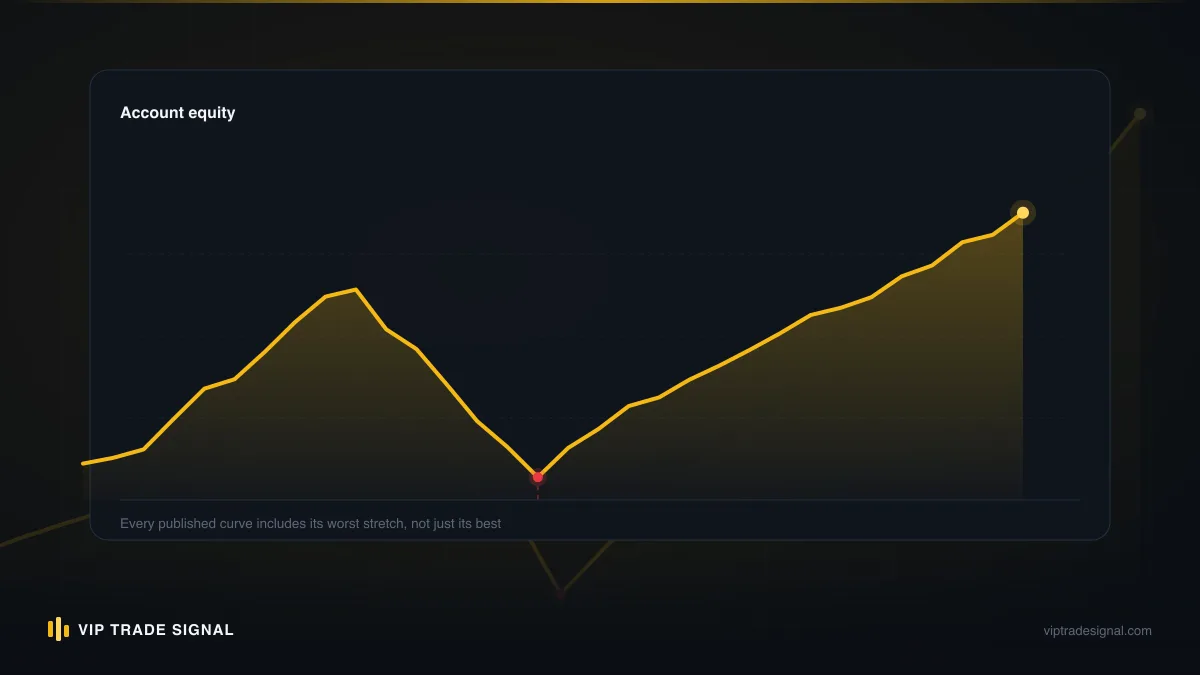
A few honest signs separate a genuinely tested strategy from a memorised one. Out-of-sample testing, where the rules were built on one period and validated on data they never saw. Walk-forward analysis. Modest, believable metrics: a real edge might win 45-55% of trades with sensible reward-to-risk, not 92% with a straight-line equity curve. And live results, on a real account, over at least a year, that roughly resemble the backtest. Ask an EA vendor for those four things and watch how fast the conversation changes.
None of this means algorithmic trading is fake. It means the algorithmic forex products marketed to retail traders are overwhelmingly selected for how they look, not how they work, because looking good is what sells licences. Algorithmic forex signals explained honestly would say: the maths is fine, the incentives are broken.
How human signal services fail differently
Now let me turn the same harsh light on my own side of the fence, because human signal services fail constantly too. They just fail through different doors.
Door one: opacity. The modal Telegram signal channel posts its wins as screenshots and lets its losses evaporate. Ninety pips banked gets a trophy graphic; the two stopped-out trades before it simply never get mentioned again. Without a complete public record you are not evaluating a track record, you are evaluating a highlights reel, and highlights reels are how casinos advertise too. We have written before about how fake profit screenshots are manufactured, and the short version is that a convincing one takes about four minutes.
Door two: the funnel. Most free channels exist to push you toward a partner broker, where the channel earns a cut of your spread on every trade. Once that is the business, volume beats quality. Twelve mediocre signals a day earn more than two good ones. The signal is not the product; your trading volume is.
Door three: you. This one stings, but it is real. Even a genuinely decent human signal service delivers its edge through a fallible pipe, namely the subscriber. You see the signal forty minutes late and enter at a worse price. You skip a trade because the last two lost, and of course the skipped one wins. You widen a stop "just this once". Two subscribers can follow the same twelve months of signals and end up with completely different results, and the difference is almost always execution and discipline, not the signals. It is why the same service gets five-star and one-star reviews simultaneously, and both reviewers are telling the truth.
Door four: key-person risk. An EA runs identically on its worst day and its best. A human analyst has a divorce, a losing streak that gets in his head, a fortnight of revenge-trading his own drawdown. Desks with process and more than one analyst dampen this. One-man channels do not.
So tally it up honestly. EAs fail through curve-fitting and fragility. Humans fail through opacity, incentives, subscriber discipline, and being human. When people ask about AI trading signals vs human analyst signals expecting one column to be clean, they are shopping for a comfort blanket, not a comparison.
Robots fail like machines and humans fail like humans. Your job is not to find the category that never fails. It is to find the rare operator, in either category, who shows you their failures.
AI signals: what is genuinely new, what is rebranding
Every EA vendor rewrote their sales page around 2023. The "algorithm" became "AI". The "strategy" became "a neural network". Prices went up. So it is worth being precise about what machine learning actually changes in this space, because it is not nothing, but it is much less than the ads suggest.
What is genuinely new: modern models are better at digesting messy inputs. Parsing news sentiment, weighing many indicators at once without a human hand-coding every rule, adapting position filters to volatility regimes. On a professional desk, these are useful screening and risk tools. We use software to flag conditions on gold all day; no serious desk in 2025 stares at naked charts out of stubbornness.
What is rebranding: the core problem has not moved an inch. A machine-learning model trained on past prices can curve-fit even more efficiently than a hand-tuned EA, because it has thousands of parameters instead of six. More parameters means more capacity to memorise noise. The failure mode did not go away with AI; it got a bigger engine. And financial markets are close to a worst case for prediction models anyway: the signal-to-noise ratio is dreadful, the rules of the game shift (regimes change, correlations break), and any edge that is found gets arbitraged smaller by everyone else's models finding it too.
There is also a plain logic test that applies to every "AI signals" product, and it never stops being relevant. A model that reliably predicted short-term gold moves would be worth billions run quietly with real capital. It would not be rented to strangers for $79 a month. The willingness to sell it to you is itself information about how well it works.
Does that mean dismiss anything labelled AI? No. It means the label tells you nothing. Judge an AI signal product exactly as you would judge a human one: by a complete, timestamped, public record of every closed trade, losses included. The evaluation method is identical because the failure you are screening for, flattering selective evidence, is identical.
Marketplace forensics: reading EA stats like a sceptic
Say you are browsing the MQL5 marketplace or an EA review site anyway. Fine. Here is how to read the stats the way a desk trader does rather than the way the sales page hopes you will.
Backtest quality first. MetaTrader's own tester has modelling-quality settings, and plenty of published backtests use fast, low-fidelity tick modelling that misses the intrabar spikes which would have hit stops in reality. On gold, where a news candle can travel $15 in seconds, low-quality modelling flatters results enormously. If the vendor does not state 99% modelling quality with real tick data and variable spreads, assume the backtest is decorative.
Look for the martingale signature. A high win rate, tiny average wins, occasional huge losses, and an equity curve that is eerily smooth until one cliff: that is a system doubling down on losers or holding them without stops. Grid and martingale EAs post 90%+ win rates right up until the day they donate the account to the market. Check the maximum drawdown and, crucially, the largest single loss relative to the average win. If one loss can eat thirty wins, you have found the trapdoor.
Live record or nothing. A Myfxbook or FX Blue link is the minimum, and then verify inside it: is the track record verified AND the broker verified? Is it a real account or a demo? How long has it run, and through how many different market regimes? Ninety days of live results on a $500 cent account proves roughly nothing. Two years through a rate-cycle change starts to mean something.
Count the reviews that matter. Marketplace reviews cluster in week one, when buyers are grading the purchase experience and the backtest. Sort by recent and read what people say at month six. That is where EAs go to be honest.
One more habit worth stealing from desk traders: check whether the vendor trades their own product. Not "a company account", their money, at a size that matters to them, visible in the same verified record. A developer running his own EA on $50,000 of personal capital for two years is making a very different statement from one running it on a $300 demo. The industry phrase is skin in the game, and its absence is rarely an accident. People who built something that works tend to use it. People who built something that sells tend to sell it.
Ten minutes of this filtering kills most candidates. Which is the point. The occasional survivor might be worth a small, watched experiment, and I mean small: money you can lose without changing your month.
What each option actually costs
Price tags mislead in both directions here, so let us lay the real economics side by side for a trader with, say, a $2,000 account.
| EA robot | Signal subscription | Managed / profit-split | |
|---|---|---|---|
| Upfront | $50–$500 licence, often one-off | $0–$250/month | Usually an advance against the split |
| Hidden running cost | VPS at $15–$40/month, updates, your monitoring time | Your time and execution slippage | The split itself, typically 30–50% of profit |
| Cost when it loses | Full trading losses, licence unrecoverable | Full trading losses plus fees paid | Losses are yours; a fair operator earns nothing on them |
| Scales with account? | No, flat cost | No, flat cost | Yes, proportional |
The EA looks cheapest on paper. A one-off $300 licence against a rolling $99 subscription seems obvious, until you add the VPS you need for 24/5 uptime, the replacement licences when v1 dies and v2 launches, and, the big one, the losses a curve-fit system delivers before you accept it is broken. A $300 EA that grinds a $2,000 account down 40% before you pull it cost you $1,100, not $300.
Signal subscriptions are the transparent middle: you know the monthly figure, and on a small account the percentage sting is real. $99 a month is nearly 5% of a $2,000 account monthly, which means the signals must clear a serious hurdle just to break even. We are blunt about this with our own service; the maths is on our pricing and signals page, and it is also why we offer the free route through a partner broker, since a $250 broker balance makes more sense than a cash subscription at that account size. Our fees sit at the high end of the market, and the honest reason is that our minimums are low and everything is pay-as-you-go, which is a trade-off, not a favour.
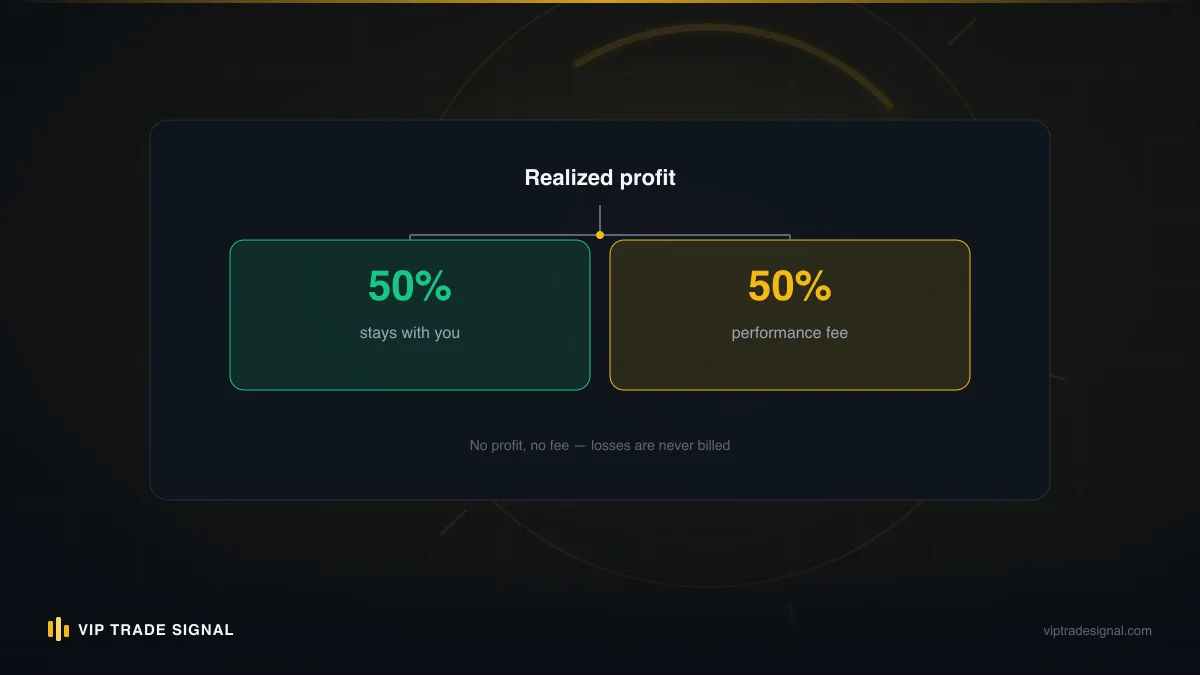
Profit splits are the only model where the operator eats when you eat. That alignment is worth a lot, provided the baseline is recorded properly and the split only applies to realised profit above it. Anyone charging a split on unrealised or unverified profit is running a different business than the one they describe.
Whichever model you pick, one rule survives contact with all of them: total costs, including plausible losses, must fit inside risk you can carry. Gold trading, leveraged, can and does produce losing months for everyone. Anyone who prices their product as if losses are impossible has already told you everything.
The monitoring burden: "set and forget" is neither
The EA pitch that lands hardest with busy people is passive income while you sleep. Attach the robot, close the laptop, check the yacht brochures. And I understand the appeal, truly, because the alternative sounds like a part-time job. But ask anyone who has actually run EAs on live money what their routine looks like.
They check the VPS daily, because Windows servers reboot for updates and a stopped terminal means orders left unmanaged. They watch broker connectivity, because a dropped connection during a gold spike can leave a position stopless. They read the economic calendar, because most sensible EA operators switch their robots off before Non-Farm Payrolls and Fed decisions, which rather undermines the automation. They track performance against the backtest, deciding week by week whether a drawdown is normal variance or the beginning of the decay curve, which is a genuinely hard statistical judgement that the EA cannot make about itself.
That last one is the killer. An EA will not tell you when it is broken. It will trade its broken rules with perfect confidence all the way to zero. The most important decision in running any automated system, the decision to turn it off, is manual, permanent, and yours.
Signals carry their own burden, and it is differently shaped: you must be reachable, or use automated execution so you are not chained to notifications. Placing a full signal, entry, stop, and both take-profits, takes about ninety seconds on MT5 once you have done it a few times, and we have a full walkthrough on executing signals on MT4 and MT5 if that is the part that intimidates you. Call it fifteen focused minutes a day for a typical flow of signals.
So the real comparison is not "work vs no work". It is ninety seconds of attention per trade, versus a daily infrastructure check plus a permanent low-grade statistical vigil. Neither is passive. Anyone selling passivity is selling to people who will not check.
Why EAs struggle on gold specifically
Since our desk trades XAU/USD and nothing else, we should talk about the instrument, because gold is close to a hostile environment for the way retail EAs are built.
Most EAs are optimised on major currency pairs, and the tidy behaviours they rely on, consistent average daily ranges, mean-reversion inside sessions, stable spreads, are exactly what gold refuses to provide. XAU/USD can run a $10 range on a dull Tuesday and $60 on a CPI day. Spreads that sit at 15-20 cents in the London session can gap to multiples of that in the rollover hour or around news. An EA whose stop distances and lot sizing were tuned to EUR/USD's temperament walks into gold like a club cricketer facing a 95mph bowler. The technique that worked at the weekend does not transfer.
The specific ways gold kills robots, in rough order of body count:
- News spikes through stops. Gold's reaction to US data is violent and occasionally gapped. Systems with tight stops get executed at prices far worse than the stop level, so the backtested "max loss per trade" is fiction.
- Regime whiplash. Gold alternates between grinding trends and vicious ranges, sometimes within one week. Trend-following settings and mean-reversion settings are opposites; a curve-fit EA is tuned for whichever regime dominated its data.
- Session personality. Asian-session gold and New York gold are practically different instruments. EAs that ignore session context trade the quiet hours' logic into the loud hours' chaos.
- Martingale acceleration. Grid systems that survive months on a slow pair meet a $40 one-way move on gold and reach their margin limit in an afternoon.
Can automation work on gold? At institutional level, with adaptive sizing and real research budgets, plainly yes. From a $199 marketplace robot, the odds are poor enough that we would call it what it is: a lottery ticket with a monthly VPS fee. This is a large part of why we kept humans in the final decision on our own desk. Software screens; a person who has watched gold behave badly for years decides what actually goes out.
The transparency filter that beats both hype cycles
Time to deliver on the promise from the top of the article. If technology does not separate the trustworthy from the rubbish, what does?
Transparency does. Specifically, one question, asked of every EA, every human channel, every AI product, before any question about win rates or methods:
Can I see every closed trade, timestamped, losses included, in a record the seller cannot edit after the fact?
Sit with how much work that single question does. A curve-fit EA cannot survive it, because its live record diverges from its backtest within months and the divergence is on display. A cherry-picking Telegram channel cannot survive it, because the highlights reel becomes a full ledger with all the stopped-out trades staring back. A rebadged "AI" product cannot survive it, because the neural-network story stands or falls on the same boring ledger as everything else. Every dishonest operator in this industry, whatever their technology, depends on controlling which results you see. Full-record transparency removes that control, and they know it, which is why so few offer it.
The honest version has a recognisable shape. Every signal or trade published before or at entry, not reconstructed afterwards. Losses shown with the same prominence as wins. Long history through different market conditions, not a hot quarter. Independent verification where possible. We hold ourselves to this: every signal our desk has closed, red and green alike, sits publicly at /signals/history, and there are losing trades on that page today, because there always are and always will be. I would honestly rather you spent twenty minutes reading our losses than two minutes reading anyone's wins.
Flip the filter around and it becomes a sorting machine for the whole market. Do not ask "EA or signals?" Ask "who, in either category, shows me everything?" That question shrinks a thousand candidates to a handful, and every one of the handful is worth more of your attention than the 995 it eliminated.
Hybrid setups: robots executing human decisions
One arrangement deserves its own section because, quietly, it is the best of both machines for a lot of people: human analysis, automated execution.
The mechanics are simple. A signal copier, several reputable ones exist for Telegram-to-MT4/MT5, reads the analyst's message the second it lands and places the trade on your account with the specified stop and targets. The human does what humans still do better on gold, reading context, sitting out garbage conditions, judging news risk. The software does what software does better: acting in two seconds without emotion at 3am, never widening a stop out of hope, never skipping a valid signal out of fear.
Look at the failure lists from earlier and notice what this setup deletes. From the EA column: curve-fitting gone, because no algorithm is making trade decisions. From the human column: subscriber discipline gone, late execution gone, the 2am temptation gone. What remains is the quality of the analyst, which is exactly the thing the transparency filter lets you check, and a modest set of software risks (copier misconfiguration, VPS uptime) that are real but mundane and testable on a demo account first.
It is not magic. You are still fully exposed to the analyst's losing streaks, executed with perfect robotic fidelity, and you must size the copier's risk settings properly before switching it on, because automation amplifies configuration mistakes as efficiently as it amplifies good signals. Set risk per trade at the copier level, cap simultaneous positions, and run it on demo for two weeks before real money touches it. Details on copiers and account setup live in our FAQ if you want the practical checklist, and your choice of broker matters more than people think for execution speed on gold; we compared the main partner options in Exness vs XM vs Vantage for gold.
But as a structure, human judgement delivered at machine speed is the one combination where the strengths genuinely stack instead of the weaknesses.
Choosing for your account: a decision matrix
Different traders should land in different places, and pretending otherwise is how bad guides end. So here is the honest sort, by situation rather than by product.
You have under $1,000 and you are new. Neither, yet. Not because the tools cannot work, but because at this size, costs and mistakes are proportionally enormous and you have no way to judge quality. Trade a demo, follow a transparent service's public history without paying, and learn what a full ledger of wins and losses actually looks like across a few months. That education is free and worth more than any licence.
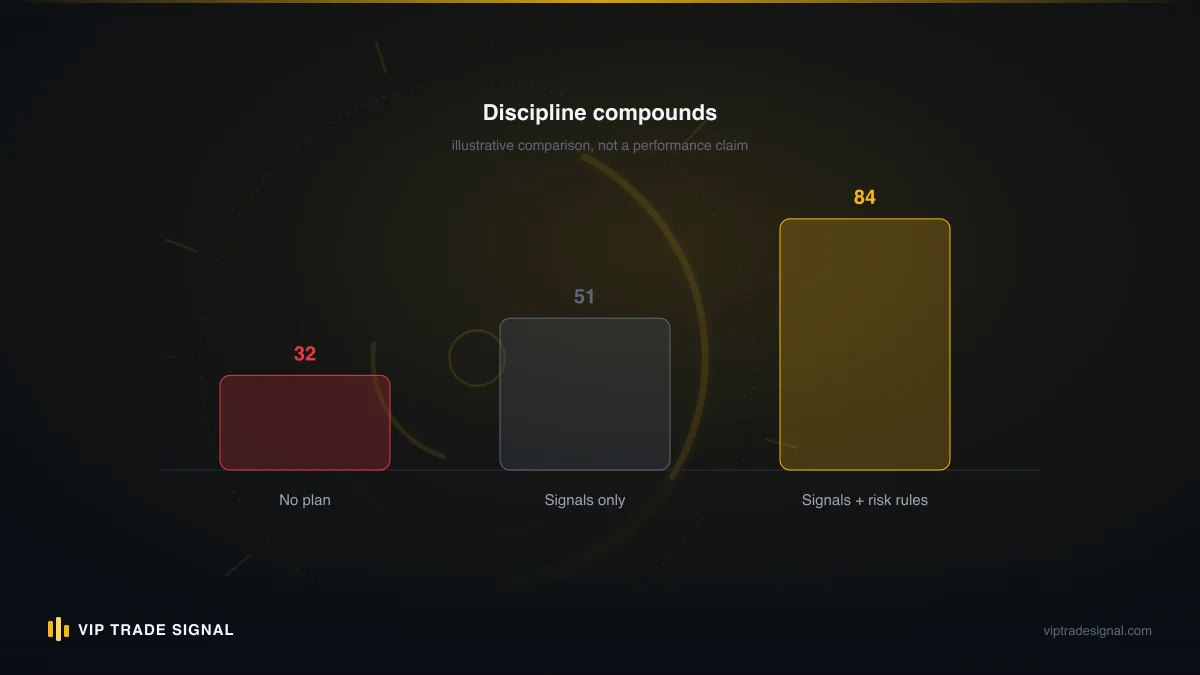
You have $1,000–$5,000 and a day job. A transparent signal service with a copier is the strongest fit. Human judgement on the analysis, automation on the execution, full record checkable before you commit. Take the free-via-broker route if one exists, because subscription drag is real at this size. Risk 0.5–1% per trade and treat the first month as a paid audition where the service proves itself on small size.
You have $5,000-plus and genuine interest in systems. You can afford a real EA experiment if it fascinates you, and some people simply enjoy this, but run it like an experiment, not a purchase: demo first, then the smallest viable live size, hard monthly drawdown limit, pre-written kill criteria, and the expectation that it probably decays. Meanwhile keep serious money on the approach whose full history you have verified.
You have money but genuinely zero time. Then even a copier setup needs occasional supervision you may not give it, and account management with aligned incentives, a profit split on realised gains above a recorded baseline, with you keeping the master password and withdrawal control, is the structure built for your situation. Vet the operator with exactly the same transparency filter. No public record, no keys to anything.
You are drawn to whatever promises the most while asking the least. Then I will be blunt, because someone should be: you are the customer every curve-fit EA and every screenshot channel is designed for, and the sooner that stings, the cheaper your education gets.
Where this leaves you
Strip the branding off and the forex EA robot vs signal service debate collapses into something much simpler than the forums make it. Robots are not smarter than analysts, and analysts are not wiser than robots. Both categories are mostly rubbish, both contain a working minority, and the working minority in each announces itself the same way: a complete public record and pricing that admits losses exist.
So do not pick a technology. Pick a standard, and hold every candidate to it regardless of what powers their trades. Ask for the full ledger. Read the losses first. Check that the incentives pay the operator when you win rather than when you sign up. Size your risk as if the next month will be a losing one, because sometimes, whoever or whatever is trading, it will be.
And if a seller, human or robot or "AI", reacts to those requests with excuses about proprietary secrets or screenshots of a Lamborghini, you have your answer without spending a penny. The market for trading products runs on hope. The traders who last run on evidence. Decide which economy you want to shop in, and everything downstream, EA or signals or hybrid, gets a great deal easier to judge.