Nobody in this industry gives you anything for free. That is not cynicism, it is accounting. When you see brokers with free forex signals (or a signal provider offering free access "through our partner broker"), money is moving somewhere, and it helps enormously to know where before you open the account. We can tell you exactly where, because we run this model ourselves and we are going to lay out our side of the ledger in this article, line by line, including what we earn when you trade.
Here is the short version. Brokers pay signal providers a commission on the trading volume their referred clients generate. That commission comes out of the spread and fees you were going to pay anyway. Structured honestly, it is a genuinely decent deal for the trader: same trading costs you'd pay at that broker regardless, signals included. Structured dishonestly, it becomes a machine for churning small accounts to death, because the provider gets paid on your volume whether you win or lose.
Both versions exist. Both use nearly identical marketing. The whole point of the next five thousand words is teaching you to tell them apart.
Brokers with free forex signals: two different products, one label
Search for brokers with free forex signals and you will get two completely different products mashed into one results page, and almost nobody bothers to separate them.
The first is broker-built signals: analysis tools the broker itself provides inside its platform or client area. Exness has its analytics and signal feeds. XM runs daily technical outlooks and a research desk. Most large brokers license third-party analysis from firms like Trading Central or Autochartist and rebrand it as their own "trading signals". These are genuinely free in the sense that they come bundled with the account, no strings, no minimum. They are also, in our blunt experience, closer to weather reports than trade instructions. What you get is a probability-flavoured commentary on what price might do, usually without a specific entry, without a stop, and without anyone standing behind the outcome.
The second is broker-funded providers: independent signal services (like ours) that charge a subscription, but waive it if you trade through their partner broker. The signals themselves are the provider's own: real entries, real stops, real targets, a real track record you can audit. The broker isn't producing anything. The broker is paying for it, indirectly, via an Introducing Broker commission on your trading volume.
These two products get confused constantly, and the confusion is profitable for the wrong people. A trader who thinks "signals from a regulated broker must be legitimate" will extend that trust to a random Telegram channel that merely partners with a regulated broker. The broker's licence covers the broker's conduct. It says exactly nothing about the signal provider bolted onto the side.
Keep the two categories separate in your head. Everything below deals mostly with the second one, because that is where both the best deals and the worst abuse live.
What Exness and the big brokers actually give you in-platform
Worth being fair here, because the in-platform stuff is not useless; it is just a different product than people imagine.
Exness trading signals, in the client area, are technical-analysis snapshots: support and resistance zones, pivot levels, pattern recognition on major pairs and gold, refreshed through the day. XM publishes daily research, webinars, and a signals section covering entry zones on majors. IC Markets and Vantage both offer Trading Central integration on live accounts, which gives you pattern-based "signals" with indicative levels.
Three honest observations from years of watching traders use these:
- They are analysis, not instructions. A typical entry reads like "XAU/USD may test resistance at 3,340; a break could target 3,362." May. Could. There is no position size, often no hard stop, and no accountability when the level fails, because it was never a trade recommendation in the legal sense. That vagueness is deliberate: it keeps the broker outside the regulatory perimeter of investment advice.
- Nobody publishes their record. Ask a broker for the twelve-month win rate and average risk-reward of its in-platform signals and you will get silence, because nobody is tracking it, including them. Compare that with any serious independent provider, where a public trade history is the entire basis of the business. Ours sits at /signals/history with every closed trade, the losing ones included, because a track record with the losses removed is fiction.
- The incentive is engagement, not accuracy. Brokers earn on volume. In-platform signals exist to give you reasons to trade today. That does not make each individual signal wrong. It does mean the stream will never tell you "nothing worth trading this week, sit on your hands", which is frequently the correct call, and one a decent human desk will actually make.
There's a version of this that works, mind. A trader who already runs their own gold analysis can treat the broker feed as a cheap sense-check: if Trading Central's levels line up with yours, fine, mildly reassuring; if they don't, worth a second look at your chart before committing. That is a real use. What doesn't work is the passive version, where someone with no framework of their own takes the 8am pattern alert as an instruction, sizes it by gut feel, and holds it with no stop because the alert never mentioned one. The feed was built to be commentary. Trading commentary as instructions is how commentary gets people hurt.
Use broker analytics the way you'd use a newspaper's market section: context, levels worth watching, a second opinion. Just do not confuse it with a signal service, because it lacks the two things that define one: precise, accountable trade instructions, and a public record of how they turned out.
How IB-funded free signal access actually works
Now the interesting model, the one we run. The plumbing is called an Introducing Broker arrangement, IB for short, and it is decades old, far older than Telegram signal channels.
The mechanics, step by step:
- A signal provider signs an IB or partner agreement with a broker. Exness, XM, IC Markets and Vantage are the big four in this space, for reasons we will get to.
- The provider gets a referral link or partner code. You open your trading account through it. Nothing about your account is different: same spreads, same execution, same regulatory protections as any direct client of that broker.
- Every time you trade, the broker pays the provider a slice of the revenue your trade generated, typically quoted per lot, and on gold it commonly lands somewhere in the range of a few dollars to around $10 per standard lot depending on broker, account type and the partner's tier.
- In exchange, the provider waives its subscription fee for as long as your account stays linked and above whatever minimum the deal requires.
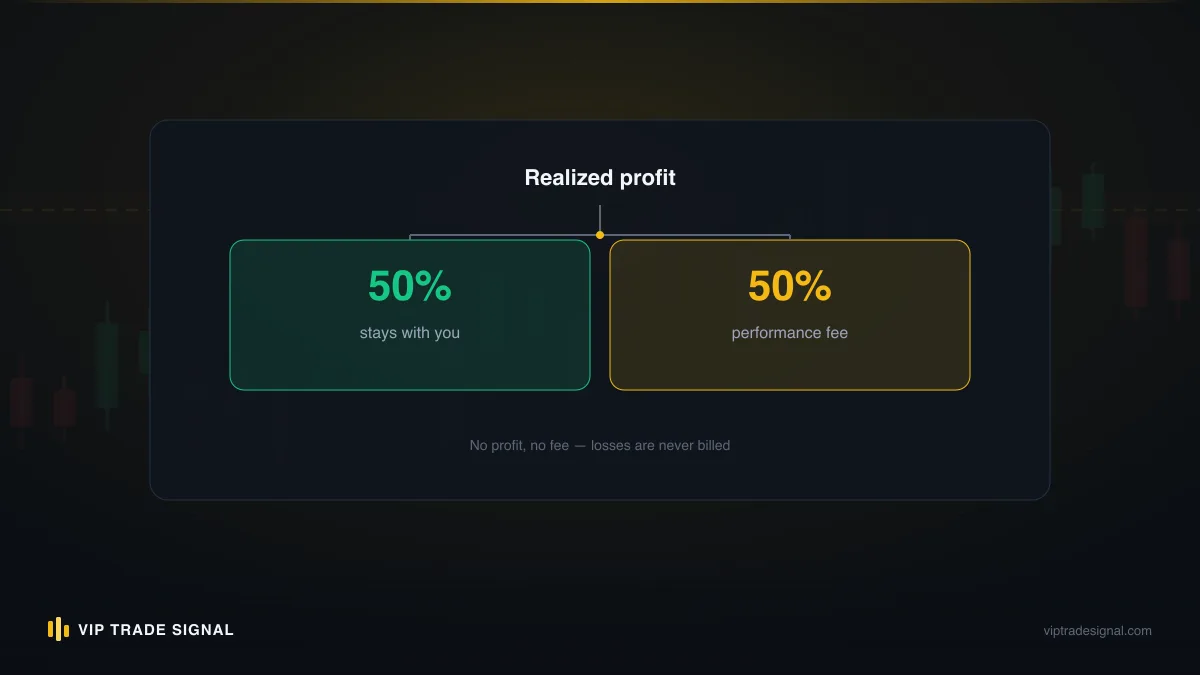
The money you "save" on the subscription is really a redirection. You were always going to pay a spread. Part of that spread was always going to be broker profit. Under an IB deal, the broker shares some of its cut with the provider who brought you in. If (and this is the load-bearing if) the provider's partner spreads are the same as direct spreads, the arrangement costs you nothing extra. You pay what you'd have paid anyway, and the signal service is funded out of the broker's marketing budget instead of your card.
That last clause deserves a hard look every single time. Some brokers offer partners a choice: standard commission on normal spreads, or a higher commission funded by a markup on the client's spread. The first version is the honest one. The second quietly makes you fund your "free" signals through worse pricing on every trade, and you will never see it unless you compare quotes against a direct account. Any provider worth following will tell you flatly which version they run. We run the first. If a provider dodges the question, you have your answer.
What the provider earns, and why volume is the whole game
Let's put real numbers on this, using generic figures so nobody mistakes them for a promise.
Say a provider earns roughly $8 per standard lot of gold traded by referred clients, a plausible mid-range figure across the big four. A follower with a $1,000 account, trading our kind of signal flow at sane risk, might put through 4-8 standard-lot-equivalents in a month once you add up all the partial positions. Call it 6 lots. That is around $48 of commission from that client, that month.
Against a $99/month subscription, the broker route pays the provider less per small client, not more. The economics only work because of three things: volume aggregates across many followers, larger accounts trade larger sizes, and clients who stay for years are worth far more than one card payment. A provider whose signals keep accounts alive earns commission for years. A provider whose signals blow accounts up in eight weeks earns eight weeks of commission and then needs fresh victims.
Sit with that for a second, because it is the most important sentence in this article.
The IB model pays honest providers to keep you trading for years — and pays dishonest ones to make you trade recklessly for months. Same plumbing, opposite businesses.
The variable that decides which business a provider is actually in is not the commission rate. It is the risk profile of the signals. A desk that signals 1-2% risk per trade with hard stops is planting an orchard. A channel screaming "GOLD BUY NOW 10 LOTS" at a $2,000 account is strip-mining. Both are IBs. Only one wants you solvent next year.
This is also why we are gold-only. XAU/USD is liquid, trades in volume, and moves enough that a disciplined desk can generate steady signal flow without inventing setups. A provider covering 28 pairs "so there's always a trade" is telling you, whether they realise it or not, that their revenue model needs constant activity more than their strategy does.
The conflict of interest, said out loud
Every provider paid per lot has a conflict of interest. Including us. Anyone in this model who claims otherwise is either lying or hasn't thought about their own incentives, and honestly it's hard to say which is worse.
The conflict: our income rises with your trading volume. More trades, bigger sizes, more commission. The temptation baked into the model is to over-signal: to find a reason to be in the market every session, to nudge followers toward larger lots, to keep positions churning. Nobody has to twirl a moustache. The incentive gradient just quietly rewards activity.
How an honest desk manages it, concretely:
- Risk rules that cap volume. We tell followers to risk 1-2% per trade and we mean it. A $1,000 account risking 1% on a 300-pip gold stop is trading about 0.03 lots. That number is terrible for our commission and correct for your survival, and we publish it anyway. The moment a provider's sizing guidance conveniently maximises their per-lot income, run.
- A public record that includes losses. Over-signalling shows up in a full history as a bloated trade count and a decaying average outcome. You cannot hide churn from a complete ledger, which is precisely why most channels never publish one. Every closed signal of ours is at /signals/history for exactly this reason.
- A paid alternative at the same service level. Our subscribers at $99/month get the identical signal stream as broker-route followers. If we over-signalled to farm volume, our paying subscribers, who generate no commission, would be getting the same degraded product, and they would leave. Running both routes on one signal feed handcuffs the conflict: the feed has to be good enough to be worth paying for, or the paid side collapses and takes our credibility with it.
None of this deletes the conflict. It fences it. Your job as a follower is to check the fences exist before you trust the field: ask about spread markups, demand the full history, and compare the sizing guidance against what would actually maximise the provider's income. Ten minutes of questions, and most of the rot in this industry fails at question one.
Churn-and-burn: the abusive version
Now the ugly cousin, because it is everywhere and it is wearing the same suit.
The churn-and-burn operation works the IB plumbing in reverse. Instead of signals funded by sustainable trading, it manufactures trading to farm commission, with the account's death priced in from the start. The playbook is depressingly standard:
- Free signals advertised loudly, usually on Telegram or Instagram, usually with screenshots of enormous wins and a lifestyle montage.
- Mandatory sign-up through their broker link, often an unregulated or offshore broker you have never heard of, because obscure brokers pay the fattest commissions and ask the fewest questions.
- A pressured minimum deposit, typically $500-$2,000, with a countdown timer or a "slots closing" line to stop you thinking.
- Signals engineered for volume: five to fifteen trades a day, oversized lots recommended outright, stops either absent or so wide the account is one bad session from a margin call.
- When the account dies (weeks, usually), the channel blames "market conditions" or your "weak hands", and invites you to redeposit for the "recovery plan". Some earn a second commission on the redeposit.
Picture a trader we'll call Dan. Dan finds a Telegram channel with 40,000 members and a pinned post of a Lamborghini key fob resting on a MT4 screenshot. The signals are free; he just has to open an account at a broker registered in a jurisdiction he cannot find on a map, deposit $1,000, and send the account number to the admin. Week one goes well; the channel calls two winners and Dan is up $180. Week two brings a "high-confidence" gold trade at 2 lots, no stop mentioned, and a nonfarm payroll print that removes $700 in eleven minutes. By week five the account is a memory and the admin is offering him the $2,500 "inner circle recovery programme". Dan's story is invented. The pattern is not. We hear a version of it most months, usually from someone arriving at our door still convinced the signals themselves were good and the fault was theirs.
The tell is never the free part. Free-via-broker is a legitimate structure, as we've spent half this article explaining. The tells are around the edges: the broker choice, the deposit pressure, the trade frequency, the sizing advice, and the total absence of a verifiable losing trade anywhere in the marketing. A provider who has never published a loss has never published the truth. It is that simple, and it has never once been wrong as a filter in all the years we've watched this space.
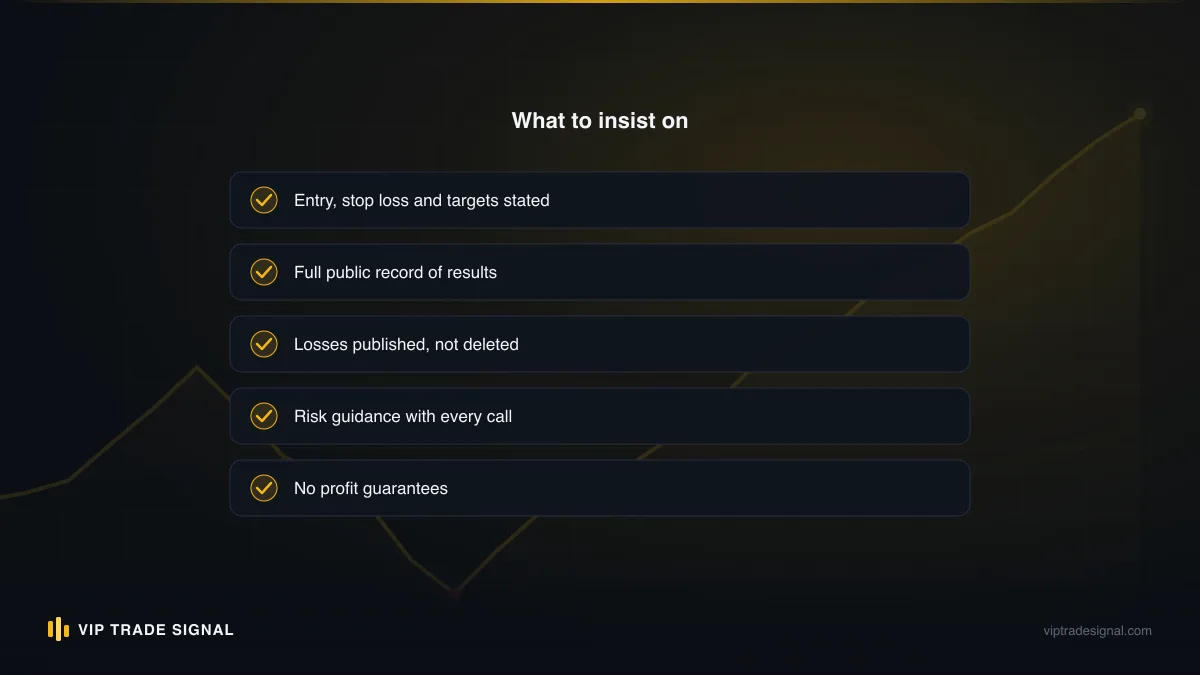
One more tell that deserves its own paragraph: broker exclusivity with a broker you cannot verify. Legitimate providers partner with large, regulated, name-brand brokers because their followers demand decent execution, and because the provider's income depends on those followers surviving. Deposit farms steer you to whatever bucket shop pays 3x commission, because survival was never the plan. If the "partner broker" isn't licensed by a regulator you can look up in five minutes (FCA, ASIC, CySEC, FSCA), the signals are not the product. Your deposit is.
What actually matters in a broker when you follow signals
Suppose the provider checks out. The broker still matters more than most followers realise, because signal trading has a specific execution profile: you are entering at levels chosen by someone else, often minutes after they chose them, frequently around news-adjacent volatility, and always on the same instrument as hundreds of other followers. Four things dominate.
Spread on your instrument. For us that means gold, and gold spreads vary wildly: from around 10-15 cents on a good raw-spread account to 35-50 cents on a standard account at the same broker, and worse elsewhere. A signal targeting 400 pips of movement can tolerate a mediocre spread. A tighter intraday signal cannot. Over 100 trades a year, the difference between a 15-cent and a 40-cent effective spread on one lot is real money, quietly compounding against you. A low spread broker for XAUUSD is not a luxury for a gold signal follower; it is the second-biggest edge you control, after position sizing.
Execution speed and slippage. When a signal fires and price is moving, a 400-millisecond fill and a 3-second fill are different trades. Slippage on entry eats your reward; slippage on the stop inflates your loss. Market-execution brokers with deep liquidity (most of the reason the big four are the big four) keep this tolerable. Thin brokers around a US data release do not.
Stop-out policy and margin treatment. Gold moves. An account following gold signals will see floating drawdown as a matter of routine (we wrote a whole piece on living with drawdown), and the broker's margin-call and stop-out levels decide how much routine turbulence your account can absorb before the broker force-closes you at the worst possible price.
Withdrawal friction. The boring one that only matters when it matters. A broker who pays out in hours is a counterparty; a broker who invents verification hurdles when you request a withdrawal is a warning you ignored. Test it early with a small withdrawal, before there is anything meaningful at stake.
Notice what is not on the list: bonuses. Deposit bonuses are almost universally tied to volume requirements that lock your money behind lots you haven't traded yet, which, for a signal follower on someone else's schedule, is a trap dressed as a gift. Skip them.
Why minimum deposits exist ($250 in our case)
The minimum deposit attached to free-via-broker offers looks, at first glance, like the same pressure tactic the scammers use. Sometimes it is. So here is the honest arithmetic behind ours, and a yardstick for judging anyone else's.
We waive the $99/month subscription for accounts opened under our partner links at Exness, XM, IC Markets or Vantage, provided the account maintains $250 or more. Why the floor?
First, commission reality. A $50 account trading correct risk generates almost no volume, which means almost no commission, which means we are providing a paid service for nothing indefinitely. That is not virtue, it is a business model with a hole in it, and businesses with holes in them eventually plug the hole in ways that hurt their users, usually by over-signalling. The floor keeps the honest version of the model solvent.
Second, and genuinely more important: below a certain balance, following gold signals correctly is arithmetically impossible. Gold signals need stop room; 200 to 400 pips is normal for a swing entry. On a $100 account, even the minimum lot size of 0.01 turns a 300-pip stop into a 3% loss; one normal losing streak of four or five trades and the account is functionally dead before the strategy ever had a chance to express itself. At $250, a 0.01-lot position with a 300-pip stop risks about $3 — a hair over 1%. Tight, but survivable. That is not a marketing number; it is the smallest account on which the maths of gold signal-following stands up. Our FAQ covers the mechanics of the floor and what happens if a drawdown takes you under it.
The yardstick for anyone else's minimum: does it scale with the arithmetic of the instrument, or with the provider's commission appetite? A $250-$500 floor on a gold service is defensible on pure survival maths. A $2,000 "VIP tier" minimum with countdown timers is a commission target with a story stapled to it.
And to be plain about the alternative: if you would rather not link a broker at all, you pay the $99 and trade wherever you like. Both routes are laid out side by side on our pricing page. Nobody should ever feel herded toward a broker, including ours.
Comparing the big four for gold signal execution
The four brokers we partner with (Exness, XM, IC Markets, Vantage) are the four for boring reasons: size, regulation across multiple serious jurisdictions, deep gold liquidity, and IB programmes that pay standard commission without marking up client spreads. They are not identical, though, and which one suits you depends on how you trade the signals.
A candid sketch, as of the time of writing (spreads and account types change; verify current numbers yourself before opening anything):
| Factor | Exness | XM | IC Markets | Vantage |
|---|---|---|---|---|
| Typical gold spread (raw/pro-type account) | Very tight, often among the lowest | Moderate | Tight, commission-based | Tight, commission-based |
| Standard-account gold spread | Competitive | Wider | Competitive | Competitive |
| Execution profile | Fast, instant and market options | Reliable, occasionally slower in news | Fast, strong depth | Fast |
| Withdrawals | Notably quick, often minutes | Standard, 1-2 days | Standard | Standard |
| Minimum deposit practicality | Very low entry | Low | Higher on raw accounts | Low |
| Best suited to | Small accounts, frequent withdrawals | Traders who value hand-holding and education | Larger accounts wanting raw pricing | A balance of the above |
Our unglamorous take: for a $250-$1,000 gold account following signals, Exness's combination of tight gold pricing, tiny minimum lots and fast withdrawals makes it the default choice for most of our broker-route followers, and it is the one we get asked about most. IC Markets edges ahead for larger accounts that can meet the raw-account minimum and want commission-based pricing. XM's spreads on standard accounts cost a little more per trade, which its followers accept for the support and educational wrapper. Vantage sits comfortably in the middle of everything.
But the honest headline is that the differences between these four are a rounding error next to the difference between any of them and the offshore brokers that deposit farms push. Best broker for following gold signals is a question where getting into the right category is 95% of the answer, and fine-tuning within it is the last 5%.
Questions to ask any provider offering free-via-broker
Before you click anyone's partner link, ours included, put these to them in writing and keep the answers. A legitimate operation answers all seven without flinching. Most operations fail by question three.
- Which broker, and under which regulator? Then verify the licence on the regulator's own register, not the broker's website. Five minutes.
- Are partner-account spreads identical to direct-account spreads? The markup question. Demand a yes or no. "Our clients get special conditions" is not a no; it is often the opposite.
- What do you earn per lot, roughly? They do not owe you the contract, but a provider who refuses to acknowledge that they earn anything is hiding the basic shape of the deal, a bad sign for everything else they'll tell you.
- Where is your full closed-trade history, including losses? Screenshots are not a history. A channel of green checkmarks is not a history. A complete, dated ledger is. We keep ours public because we'd never follow anyone who didn't, and neither should you. Our guide to choosing a signal provider goes deeper on auditing a record.
- What risk per trade do you tell followers to use, in numbers? If the answer is a percentage between 0.5 and 2, good. If it is a lot size with no reference to account balance, walk away: fixed lot sizes across all account sizes is how small accounts die.
- What happens if my balance drops below the minimum? The honest answer is something boring: subscription resumes, or a grace period. The dishonest answer is a redeposit push with urgency attached.
- Can I pay instead of using your broker? A provider whose service is worth anything will happily take the subscription. One that only exists behind a broker link, and gets cagey when you offer to simply pay, is telling you where the real product is. It isn't the signals.
Print the list if you have to. The forty minutes this takes has saved more accounts than any indicator ever written.
Our partner setup, disclosed line by line
Time to eat our own cooking. Here is our arrangement, stated as plainly as we can manage, because we think this level of disclosure should be the price of admission for the entire model.
- What we run: a gold-only signal service. XAU/USD, nothing else, unlimited signals, every one with entry, stop and targets. Every closed trade is published at /signals/history, wins and losses both.
- The two routes in: $99/month paid directly, or free access via a partner broker. Same signals, same timing, same everything. Full details of the broker route live at VIP via broker.
- The partner brokers: Exness, XM, IC Markets, Vantage. All four regulated in multiple serious jurisdictions. We chose them for execution quality on gold first and commission second, in that order, and we will drop any of them if that ordering ever inverts.
- The condition: open your account through our partner link and maintain $250 or more in it. That is the whole condition. No volume requirements, no minimum trades per month, no lock-in on your funds.
- What we earn: a per-lot commission from the broker on your trading volume, paid out of the broker's own revenue share. Rates vary by broker and account type; the order of magnitude is single-digit dollars per standard lot on gold. Your spreads are the broker's standard partner-programme spreads, which at these four are the same as direct spreads. We do not take, and would refuse, any markup-funded commission tier.
- What we do not do: we do not hold your money, we never ask for your account password, we do not require deposits beyond the $250 maintenance floor, and we do not tell you which lot size to trade beyond publishing our risk framework of 1-2% per trade. Your account, your broker, your withdrawals, always.
- The conflict, restated: yes, we earn more when you trade more. The fences are the ones described above: public history, fixed risk guidance, and a paid tier riding the identical feed. Judge us against them.
And the risk sentence, said in the flow rather than in small print, because the style of the disclosure matters as much as the content: gold is a violently volatile instrument, our signals lose regularly and always will, losing streaks of five or more happen to every strategy we have ever seen, and no arrangement of brokers, commissions or subscriptions changes any of that. If a month of red would damage money you cannot spare, the correct position size is zero.
Choosing your route: direct pay or broker path
So which way in, assuming you've decided a signal service belongs in your trading at all? That prior question is worth an evening with do forex signals actually work before you spend a pound on anyone.
Take the broker path when: you were going to open (or already hold) an account at one of the big four anyway; your balance sits comfortably above the minimum; and the maths of your trading means the subscription saving is meaningful. For a $500 account, $99 a month is a brutal 20% monthly hurdle before the first trade; the broker route exists almost precisely for this person. You pay nothing beyond the trading costs you'd pay regardless, and you keep the $1,188 a year.
Pay directly when: you have a broker relationship you like and don't want to move; your account is large enough that $99 is noise; or you simply prefer the cleaner incentive of being a customer rather than a commission source. Some traders think sharper about a service they write a monthly card payment to. That is a legitimate reason and we'd never argue with it.
Take neither when: the provider fails the seven questions, the broker fails the regulator check, or your own capital situation fails the honesty check. No route into a signal service fixes an account too small to size correctly or a trader not ready to sit through drawdown.
The uncomfortable truth we'll leave you with is that "free" was never the interesting word in this whole arrangement. Trading costs money at every broker on earth; the only choices are what you get bundled with the costs and who is being straight with you about the bundle. Brokers with free forex signals, done honestly, hand you a professional signal desk paid for out of a marketing budget. Done dishonestly, they hand your deposit to a stranger with a countdown timer. The plumbing is identical. The paperwork, the published losses, and the answers to seven blunt questions are how you tell the difference. And now you know exactly what to look for, including when you're looking at us.