Every list of the best forex signal providers you have ever read was written by someone with a financial stake in where you land. Affiliate sites rank whoever pays the highest commission. Review aggregators rank whoever bought the top slot. And providers who write their own rankings — which is what this is — rank themselves first and hope you don't notice.
So let's not do that. This is a ranking of forex signal provider types and category winners for 2026, written by people who run a signal service, with the conflict of interest printed in the first hundred words rather than buried in a footer. We will tell you exactly how we scored things, where we rank ourselves, and — this is the part almost nobody does — the categories where competitors beat us outright. Because they do. We run a gold-only desk. If you want twelve currency pairs and a copy-trading pipe, we are genuinely not your best option, and pretending otherwise would make everything else on this page worthless.
One more thing before the table. We are not going to print the names of specific competitor firms and assign them star ratings. Not because we're being coy, but because we can't verify their internal numbers, and a review built on a provider's own marketing claims is just their advert with our logo on it. What we can do — and what's actually more useful — is show you the profiles that win each category, what the winner in that category looks like from the inside, and how to check whether any specific provider you're eyeing matches the profile. Teach a reader to rank, and they stop needing lists.
How this ranking works (and our conflict of interest)
First, the conflict, stated plainly. VIP Trade Signal is a gold-only signal service. We charge $99 a month, or nothing if you trade through one of our partner brokers with $250 or more maintained in the account. We also run account management and drawdown recovery. Every ranking decision on this page could, in theory, be bent to funnel you towards us.
Here is how we've tried to keep it straight. We rank ourselves in exactly one category, we say so when we get there, and we openly concede the categories where we don't compete. We link our full closed-signal history at /signals/history — wins and losses, nothing curated — so you can apply our own methodology to us and see whether we'd survive it. If a ranking article won't submit its author to its own scoring system, close the tab.
Second, what "best" means here. It does not mean highest claimed win rate. Win rate is the single most gamed number in this industry — any provider can hit 90% winners by taking 10 pips of profit against 100 pips of risk, and plenty do. It doesn't mean biggest Telegram channel either; subscriber counts are bought for pennies. Best, for our purposes, means the provider most likely to leave a disciplined follower better off after twelve months, net of fees, accounting for the risk taken to get there. That's a harder thing to measure. Hence the methodology section, which is longer than you'd like and exactly as long as it needs to be.
Third, scope. We're covering paid services, free channels, broker-funded models and copy-trading providers, because in 2026 the lines between them have blurred to the point where ranking only "classic" subscription services would miss half the market.
Ranking methodology: weighting the 12 metrics
We score providers across twelve metrics, grouped into four buckets. The weights are below, and you're welcome to disagree with them — the point of publishing weights is that you can re-run the ranking with your own.
| Bucket | Metric | Weight |
|---|---|---|
| Verifiability | Full public history (wins and losses) | 15% |
| Verifiability | Third-party or timestamped verification | 10% |
| Verifiability | Drawdown history disclosed | 8% |
| Trade quality | Risk-reward on published levels | 10% |
| Trade quality | Stop-loss on every signal, no exceptions | 10% |
| Trade quality | Realistic entry fills (no repainted prices) | 7% |
| Economics | Total cost vs. plausible account benefit | 10% |
| Economics | No pressure to upsell or deposit | 5% |
| Economics | Refund or exit terms | 5% |
| Operations | Delivery speed and reliability | 8% |
| Operations | Signal frequency honesty (quality over volume) | 7% |
| Operations | Support that answers hard questions | 5% |
Notice what dominates: a third of the total score is verifiability. That's deliberate. A provider with mediocre but fully published results beats a provider with spectacular claims and no receipts, every single time, because the second provider's numbers are fiction until proven otherwise. Most retail traders lose money — that's the industry commonplace, and it applies to signal followers too — so the honest question is never "who claims the best returns" but "whose claims can I actually check."
The trade-quality bucket needs one comment. Risk-reward on published levels means we look at the actual distance from entry to stop versus entry to target on real signals, not the marketing page. A service advertising "1:3 average RR" whose last forty signals average 1:0.8 fails this metric regardless of what the banner says. And "stop-loss on every signal" is binary. One signal without a stop, ever, and the metric scores zero. A provider willing to send you into gold — a market that can move $40 in an hour on a Fed headline — without a stop is not a provider, they're a liability with a subscription fee.
The economics bucket is where our own fees get uncomfortable, and we'll face that squarely in the self-ranking section. Short version: we're at the expensive end, and the methodology doesn't spare us for it.
Best overall multi-pair providers
If you want one subscription covering majors, crosses, gold and indices, the winners in 2026 share a recognisable shape. They are established desks — five years or older — with a team of named analysts rather than one anonymous "head trader" avatar, publishing between three and eight signals a day across markets, with a documented track record on a third-party verification platform.
The best of this breed do three things that the pretenders don't. They publish losing streaks in their history without deleting them. They specialise their analysts — one person covering EUR/USD and one covering gold, rather than one guru claiming mastery of fourteen instruments. And they cap their own signal volume, because they understand something the churn-merchants never will: a subscriber following twenty signals a day across ten pairs isn't diversified, they're just tired.
What should you expect to pay? The credible multi-pair tier runs roughly $60–$150 a month for standard delivery, more for faster tiers or added analysis. Anything dramatically cheaper is usually recycled from a free channel; anything dramatically dearer had better come with something structural, like managed execution.
How do you separate the real desks from the costumes? Two field tests work well. Ask a pre-sales question that requires an analyst rather than a salesperson — "how did your GBP/JPY calls handle the last BoJ surprise?" — and watch whether the answer contains actual trades or actual adjectives. Then check the history for clusters: a real multi-pair desk shows losing days where correlated positions all got hit together, because that's what happens when the dollar rips and you're carrying three dollar-adjacent longs. A history with losses always politely spaced out, never clustered, has been edited by someone who doesn't understand what real losses look like.
And here's the concession we promised. We do not compete in this category. At all. We trade one instrument, XAU/USD, and a trader who wants broad market coverage will be better served by a good multi-pair desk than by us. That's not humility, it's arithmetic — you can't rank first in a race you didn't enter.
The honest caveat about the whole category, though: multi-pair breadth is a benefit that most retail traders overestimate. Say you're running a $3,000 account risking 1% per trade. That's $30 of risk capital per position. Spreading that across six pairs doesn't make you safer; it makes each position too small to matter and multiplies the correlation risk you didn't know you had, because EUR/USD, GBP/USD and gold all lurch together when the dollar moves. Breadth suits bigger accounts and traders who genuinely follow multiple markets. For everyone else it's mostly a bigger menu at the same restaurant.
Best for gold and XAUUSD specifically
Gold is where this article stops being a survey and becomes an argument, because gold in 2026 is not a currency pair with extra steps. It's a different animal. Daily ranges that dwarf the majors, violent reactions to US data, session personalities so distinct that the same setup means different things at 3am and 3pm London. A generalist desk sending one gold signal among eight forex calls is applying forex logic to a metal that punishes forex logic.
So the best gold signal providers are, almost without exception, specialists. The profile: a desk that trades only gold or gold-plus-one, publishes full history, sets stops wide enough to survive gold's noise (a 15-pip stop on XAU/USD is a donation, not a trade), and adjusts its behaviour around data releases rather than pretending NFP Friday is a normal Friday. They also tend to talk about lot sizing constantly, because gold's pip value catches new followers off guard — the trader who sizes a gold position like a EUR/USD position finds out about the difference the expensive way.
Yes, this is our category, and yes, we rank ourselves in it — the full argument comes two sections down, so you can weigh the conflict properly before accepting the claim. What we'll say here is category-level: whoever you pick for gold, demand the specialist profile. Ask when they widen or skip signals around FOMC. Ask what their average stop distance is in dollars of gold movement. Ask to see the losing trades from their worst month. A real gold desk answers all three without flinching, because losing months are part of trading gold and anyone who claims otherwise has either never had one or never shown one. If timing matters to your schedule, our piece on the best time to trade gold covers why the London–New York overlap dominates and what that means for when signals actually arrive.
One warning specific to this niche. Gold's trendiness has spawned a wave of Telegram channels that are pure marketing funnels — screenshot factories posting "+2000 pips today" collages with no entries, no timestamps, no losses. The gold category has the best specialists and the worst cowboys in the whole industry, sometimes on the same page of search results. The methodology above is how you tell them apart.
Best for beginners and small accounts
Rank this category by a different first question: not "who has the best signals" but "who will do the least damage while you learn." A beginner following a world-class provider badly loses money faster than a beginner following a decent provider well.
The winning profile for beginners has four traits, in order of importance:
- Complete signals. Entry, stop-loss and take-profit on every message, in numbers, not vibes. "Buy gold now, manage accordingly" is not a signal, it's a shrug.
- Explicit risk guidance. The provider states a risk-per-trade percentage and shows the lot-size arithmetic, rather than assuming you know it. On a $500 account risking 1%, that's $5 per trade — and there is a real question about whether gold's stop distances even fit that budget, which an honest provider will discuss rather than dodge.
- Low signal frequency. Two to four signals a day, maximum. A beginner cannot process fifteen. Nobody can, honestly, but a beginner especially.
- Patient support. Someone who will answer "what does SL mean" without contempt, in hours not days.
Notice that track record ranks below all four. Controversial, maybe. But a beginner's first six months are about building the habit of consistent execution — taking the signal, sizing it correctly, honouring the stop — and a provider who teaches that habit is worth more than three extra percentage points of win rate they'll squander through misexecution anyway.
Small accounts deserve one hard number. If you're starting with $200–$500, the monthly fee is a bigger enemy than the losing trades. A $99 subscription against a $300 account needs a 33% monthly return just to cover itself, which is fantasy as a sustained expectation. This is precisely where broker-funded free access earns its place — and precisely where you should read the next section twice.
A quick scenario to make the beginner criteria concrete. Take a trader we'll call Sam: $600 account, day job, checking the phone at lunch and after work. Sam subscribes to a hyped channel firing twelve signals a day. He catches four of them, hours late, at prices that no longer resemble the entries, and by week three he's inventing his own exits because the management updates arrived while he was in a meeting. Sam didn't fail because the signals were bad. Sam failed because the service's shape didn't fit his life, and no win rate survives being executed at the wrong prices half the time. The right beginner provider for Sam sends three signals in the sessions Sam can actually see. Fit beats pedigree.
Best free and broker-funded options
Free signals divide into three species, and only one is worth your time.
The first species is the marketing funnel: a free Telegram channel whose real product is the paid "VIP" tier, and whose free signals are structured to make the paid tier look necessary. The second is the affiliate churn operation: free signals from anyone willing to open an account under the channel's broker link, where the channel earns per-lot commission whether you win or lose — which means their financial incentive is your trading volume, not your outcome. Overtrading isn't a bug in that model. It's the revenue line.
The third species is the broker-funded partnership done in the open: the provider tells you plainly that the broker pays them, states what you must deposit and maintain, and — this is the tell — delivers the same signals to free and paid users. That last clause is everything. If the free tier gets delayed or degraded signals, you're not a customer, you're an advert for the upgrade.
We run the third model ourselves, and the honesty rules of this page require the mechanics in full view: our service is $99 a month, or free if you trade with a partner broker (Exness, XM, IC Markets or Vantage) keeping $250 or more in the account, because the broker pays us a share of spread revenue. Same signals, same timing, both tiers. The conflict in that model is real — we earn more when you trade more — and our defence is the public history plus the fact that unlimited-signal desks with fixed subscription options have less incentive to churn you than pure per-lot affiliates do. Judge for yourself whether the defence holds. The wider pattern behind these arrangements, including how to read a broker partnership's fine print before you deposit, gets a full treatment in our guide to brokers with free signals.
For the category ranking: the best free option in 2026 is a transparent broker-funded specialist, followed distantly by genuinely free community channels run as loss-leaders by educators. The affiliate churn operations rank below "no signals at all," because no signals at all doesn't cost you money.
Best for automation and copiers
The fastest-growing corner of the market, and the second category where we'll concede defeat before you ask.
The automation tier splits into two models. Signal-to-copier services push messages through a Telegram copier or API bridge into your MT4/MT5, executing within seconds of publication; copy-trading platforms mirror a master account's trades directly onto yours, proportionally sized. The best providers here are built for automation from the ground up — machine-readable signal formats, consistent message structure that never breaks the parser, published maximum slippage figures, and explicit rules about what happens to open positions if the feed drops.
That last point is the one nobody checks until it hurts. Picture a copier faithfully opening your trades but failing to receive the "close early" update because Telegram hiccuped during a New York data spike. Your position is now unmanaged in a fast market. The serious automation providers have answers to this — server-side stops on every trade, redundant delivery channels, kill-switch procedures. The casual ones have a shrug and a support ticket queue.
The winning profile: a provider with verified myfxbook-style tracking of the master account, sub-five-second average delivery, a documented copier setup guide, and — crucially — position sizing expressed in risk percentage rather than fixed lots, so a $1,000 follower and a $50,000 follower carry proportionate risk instead of identical exposure.
Where do we stand? We deliver signals for human execution. You can bolt a third-party copier onto our feed, and some subscribers do, but we haven't built a native execution pipe, and a purpose-built automation provider will beat us on latency and hands-off convenience. That's concession number two. Our counterargument — that gold's news spikes make blind automation more dangerous than it looks, and that a human deciding whether to take a signal into FOMC is a feature rather than friction — is genuinely held. But it's an argument, not a ranking, and in the automation category we lose. If you're weighing app-based delivery against raw Telegram feeds, our comparison of the best forex signals apps walks through where each delivery method actually helps.
Where we rank ourselves and why
Time to score ourselves against our own twelve metrics, in public, with the uncomfortable bits left in.
Verifiability. This is our strongest bucket, and it's the reason we felt entitled to write this article at all. Every closed signal we've ever issued sits at /signals/history — entries, stops, targets, outcomes, the losing weeks alongside the winning ones. No screenshots, no curation, no deleted months. We'd score ourselves near the top of the bucket, and more importantly, you don't have to take our word for it, because the whole point of a public history is that our word stops mattering.
Trade quality. Every signal carries a stop, always has. Our risk-reward profile is visible in the history rather than claimed here — go and compute it; it moves with market conditions and any fixed number we printed today would be stale by spring. What we will claim is structural: gold-only focus means our stops are built for gold's volatility rather than adapted from forex habits, and our signal frequency flexes with conditions rather than hitting a daily quota. Some quiet days we send little. A desk that always finds signals is a desk that manufactures them.
Economics. Here's the wince. At $99 a month we sit at the high end of the specialist tier, and the free route requires maintaining $250 with a partner broker, which is a real commitment. Our reasoning — low minimums, no long lock-ins, everything pay-as-you-go, unlimited signals rather than metered tiers — is laid out at /pricing, and it is honestly why the fee is what it is. But the methodology says total cost versus plausible benefit, and for a $400 account, the arithmetic doesn't favour our paid tier. It barely favours anyone's paid tier. If that's your situation, use the broker-funded route or don't subscribe to anything yet.
Operations. Delivery via Telegram within seconds of the desk's decision, support that will answer the hard questions (including "why did last Tuesday's short get stopped"), and no native automation pipe — see the concession above.
So: in the gold category, we believe we rank first among providers whose records we can actually see, which is a claim with a built-in asterisk — there may be a better gold desk out there hiding a brilliant record, but a hidden record scores zero in our methodology, and we're comfortable with that rule even when it flatters us. Across multi-pair, automation, and rock-bottom-budget categories, we rank behind the specialists in those niches, and we've told you what to look for instead. And a standing reminder that no ranking removes: gold trading is high-risk, losing streaks happen to every desk including ours, and no provider — us included — should ever be followed with money you can't afford to lose. That's not compliance boilerplate. That's the desk talking.
Providers we could not verify (and why they're excluded)
The most common question we get about rankings: "why isn't [famous channel] on the list?" Usually because they failed verification, and it's worth showing you what failure looks like, because the patterns repeat with almost comic reliability.
The screenshot portfolio. A channel whose entire track record is cropped MT4 screenshots of winning trades. Screenshots prove nothing — not that the trade was called in advance, not that a signal was sent, not even that the account is real, since demo and live terminals look identical in a crop. Excluded.
The vanishing history. Channels that delete losing signals within hours. You can catch this by saving the message IDs of every signal for a week and checking which ones still exist on Sunday. When we've run that exercise on popular channels, the shrinkage was not subtle. Excluded, obviously.
The pip-collage accountants. "+3,450 pips this month" graphics with no per-trade breakdown. Pip totals without stop distances and position sizes are meaningless — 3,450 pips of profit earned while risking 6,000 pips of stops is a losing strategy wearing a party hat. Excluded until they publish trades, not totals.
The unverifiable veterans. This one stings, because some are probably decent. Long-running services with loyal followings that simply never built a public record — results shared only in private member chats, history available "on request" but never delivered. We can't rank what we can't see, and "trust the community" is how every Ponzi in history stayed upright for as long as it did. Not accused of anything; just excluded.
A hidden track record isn't a neutral fact about a provider. It's a decision they made, every month, not to show you.
If a provider you love is in that last group, do them and yourself a favour: ask them to publish. The good ones sometimes do, once enough subscribers ask. The bad ones will explain at length why publishing is impossible, and the length of that explanation is its own data point.
How rankings change: our re-review schedule
A ranking with no expiry date is a fossil. Providers decay — the analyst who built the record leaves, the desk gets bought by a marketing operation, success bloats the subscriber base until fills degrade. The 2024 winner running unchanged in 2026 is the exception, not the rule.
So this page runs on a schedule. Every quarter, we re-check the category profiles against what the verifiable market is actually doing: fee levels, delivery standards, whether the verification bar has moved (it keeps moving — timestamped third-party tracking was rare in 2022 and is table stakes in 2026). Once a year, around November, we rewrite the whole thing, and the publication date in the header is the honest date of the last full pass, not a quietly bumped "updated" stamp on stale text. If you're reading this more than fifteen months after that date, treat it as history rather than advice.
Two triggers force an off-schedule review. First, a structural change in our own service — pricing, instruments, delivery — because our conflict disclosures have to stay current or they're worse than useless. Second, credible reader reports that a category profile has rotted: if the broker-funded model, say, becomes dominated by a new kind of churn scheme, the section gets rewritten mid-cycle rather than waiting for November.
What doesn't trigger a change: our own good or bad months. A ranking that quietly demoted competitors whenever our equity curve dipped would be exactly the kind of document this page exists to replace. Methodology first, results applied to it second, feelings nowhere.
Switching providers without losing a month
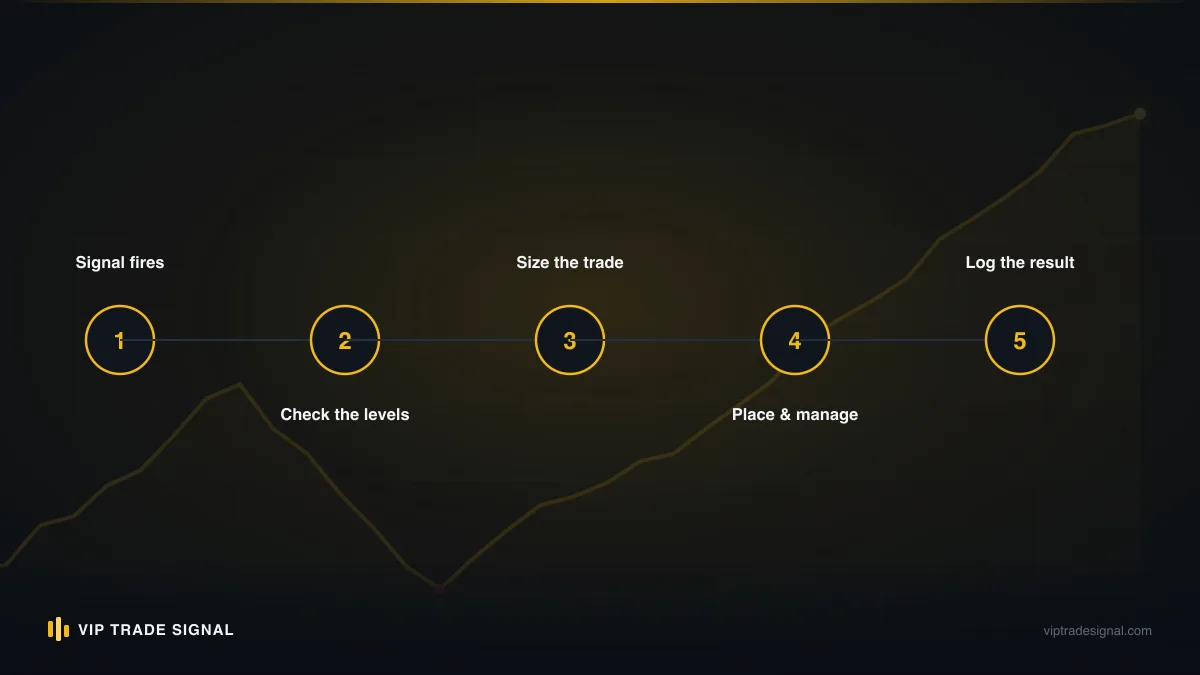
Suppose this article convinced you your current provider fails the methodology. Don't rage-quit tonight. Bad exits cost more than bad providers, and there's a right order to this.
Step one: close the loop on open trades. Any position opened on your current provider's signal gets managed to completion under their guidance — or closed manually at your discretion — before you unsubscribe. The worst switching outcome is an orphaned trade whose management updates you can no longer see. If you run a copier, disable new-trade copying first and let existing positions resolve.
Step two: overlap on paper. Run the new provider alongside the old one for two to four weeks, executing the new signals on demo or simply logging them, while your live account winds down the old service. This costs you a few weeks of patience and buys you the answer to the question that actually matters: not "is their history good" but "can I, with my schedule and my timezone, execute their signals as published?" A brilliant New York-session provider is useless to someone asleep during New York.
Step three: audit the mechanics before funding. Confirm the delivery channel works on your phone, the message format is one you parse instantly, and the risk guidance translates to your account size. On a small gold account this step is not optional — check that their typical stop distances fit your risk budget at the minimum lot size, because if a standard signal's stop implies $18 of risk and your 1% budget is $8, no win rate fixes that mismatch.
Step four: only then move money. Fund the new arrangement, cancel the old one, and diary a 90-day review where you compare your executed results — not the provider's published ones, yours — against what you expected.
The whole sequence takes a month. Traders skip it because a month feels long. Then they spend three months and several hundred dollars discovering what the overlap fortnight would have shown them for free. Slow is cheap here.
Making the final call for your situation
Rankings end where your circumstances begin, so let's finish the way a desk would — by situation, not by superlative.
You trade multiple pairs on a mid-sized account ($5,000+). Go to the multi-pair specialists, apply the twelve metrics, and weight verifiability even harder than we did. You have enough capital for breadth to mean something. We're not your provider, and we've been saying so all article.
You trade gold, or want to. Demand a specialist, demand the full public history, and put any candidate — including us — through the three questions from the gold section: data-release policy, average stop distance, worst month on display. Our history is open at /signals/history precisely so you can run that audit before deciding whether the free broker route or the $99 tier makes sense for your account size.
You're a beginner with under $1,000. Fees first, signals second. Broker-funded free access from a transparent provider, two to four complete signals a day, and a written risk plan before the first trade. And accept, before you start, that the realistic first-year goal is executing consistently without ruin — not doubling the account. Most retail traders lose money; the ones who eventually don't are the ones who survived long enough to get good.
You want full automation. Purpose-built copier providers with verified master-account tracking, sub-five-second delivery, and server-side stops. Test the feed-failure scenario before funding. We concede this category and we mean it.
You're not sure signals suit you at all. Then the best forex signal providers on earth won't help yet, and that's fine. Take a month, follow one transparent free feed, log every signal without trading it, and see whether the rhythm fits your life. Signals amplify a trader's discipline in whichever direction it already points.
The last word goes to the method, not the list. Every ranking on this page will age; the twelve metrics won't, or at least will age far slower. Verifiability, trade quality, economics, operations — score any provider on those four, refuse to accept claims where records should be, and you'll make a better choice than any listicle can make for you. Including this one. Especially this one — we wrote it, and you should never fully trust the shopkeeper's guide to the market. Check the history, run the numbers, and decide like it's your money on the line. Because it is.