A trader we'll call Dan spent two years following EURUSD signals with reasonable discipline. Not rich, not broke. Then he joined a gold channel, applied the same lot sizes he'd always used, and lost 40% of his account in eleven days. The signals weren't even bad. His sizing was.
That story, in some version, is the most common one we hear from people who arrive at our desk. XAUUSD signals look identical to forex signals on the surface: an entry, a stop loss, a few take-profit levels, sent to your phone. But gold is not a forex pair. It just lives next to them in your MT5 watchlist, and that proximity fools people into treating a 200-pip-a-day instrument like a 60-pip one.
We trade gold and only gold, so we have strong views on this, and a public record at /signals/history where you can check whether those views survive contact with the market. This piece is the long version of what we tell every new subscriber before their first trade: what a real gold signal contains, how to read one, why the stops are the width they are, and how to size a position so that a normal losing week stays normal. None of it guarantees you money. All of it reduces the number of ways you can lose it unnecessarily.
Gold is its own animal, whatever your broker's menu says
Start with raw movement. A quiet day on EURUSD might cover 50-70 pips. A quiet day on gold covers $15-$20, which in gold's pip convention (one pip = $0.10 of price movement) is 150-200 pips. On a lively day, a US CPI release or a geopolitical headline, gold can travel $50-$80 top to bottom. That's the range EURUSD might need three weeks to cover, compressed into a single London-to-New-York session.
Volatility isn't the only difference, though it's the loudest one. Gold also behaves differently in character. Forex majors are a tug-of-war between two economies; most days that tug-of-war is boring. Gold is a barometer for fear, real interest rates, central bank buying and the dollar all at once, which means it trends harder when it trends and whipsaws more viciously when it doesn't. It respects round numbers with an almost superstitious devotion (3,300, 3,350, 3,400), it loves running stops just beyond an obvious level before reversing, and it treats Asian-session liquidity as a rumour.
And the practical consequence is blunt: a signal methodology built for EURUSD, with 25-pip stops and 40-pip targets, gets shredded on gold. The stop is inside the instrument's random noise. You can be right about direction and still get stopped out three times before the move happens. This is why generic "all pairs" signal channels tend to quietly perform worst on their gold calls, and it's a large part of why we dropped everything else and specialised. One instrument, studied obsessively, beats eight instruments watched casually. That's an opinion. Our closed-trade history is where you test it.
There's also a structural point people miss. Gold's spread, as a fraction of its daily range, is actually decent during London and New York, often better than some minor forex pairs. The instrument is not expensive to trade. It is expensive to trade badly, because every mistake is amplified by the range. Keep that asymmetry in mind for the rest of this article; nearly everything below is about managing it.
What a proper XAUUSD signal must include
A gold signal is a complete trade instruction or it is noise. The minimum contents, non-negotiable:
- Direction and order type. Buy or sell, and whether it's a market execution or a pending order (buy limit, sell limit, buy stop, sell stop). "Gold looking bullish" is commentary, not a signal.
- A precise entry price or zone. "Buy 3,342-3,345" is workable. "Buy now" sent to 800 people who open the message across a four-minute window is a lottery on gold, because price can move $3 in that window.
- A hard stop loss, as a price. Not "manage your risk", not "mental stop". A number you can type into the order ticket before you click anything.
- Take-profit levels, ideally staged. TP1, TP2, TP3, each a price. One target is acceptable; three is better on gold because the instrument frequently gives you the first $8 and then takes back the next $20.
- Enough context to size the trade. The stop distance in dollars of price movement, so you can calculate your lot size. Any provider who never discusses sizing is leaving you to blow yourself up politely.
Notice what's not on the list: a confidence percentage, a "signal strength" score out of ten, a rocket emoji. Those are decoration. A signal with a 92% confidence badge and no stop loss is worth exactly nothing, and a plain-text message with all five elements above is worth following, at least provisionally, while you verify the sender's track record.
There's a sixth element that separates serious providers from the rest: management updates. Gold trades evolve. A proper service tells you when to move the stop to breakeven after TP1, when a setup is invalidated before entry, when to close early because the context changed. If the channel goes silent between the entry message and the "TP3 HIT ✅" screenshot, someone is curating your view of reality. We covered how to spot that curation in our guide to verifying a signal track record, and it applies double to gold, where the swings between entry and target are big enough to hide almost anything.
Reading a gold signal: entry, stop, and the three TPs
Here's a representative signal, the shape ours take and the shape any decent gold signal with TP and SL should take:
SELL XAUUSD 3,368-3,371 (sell limit) · SL 3,379 · TP1 3,360 · TP2 3,349 · TP3 3,334
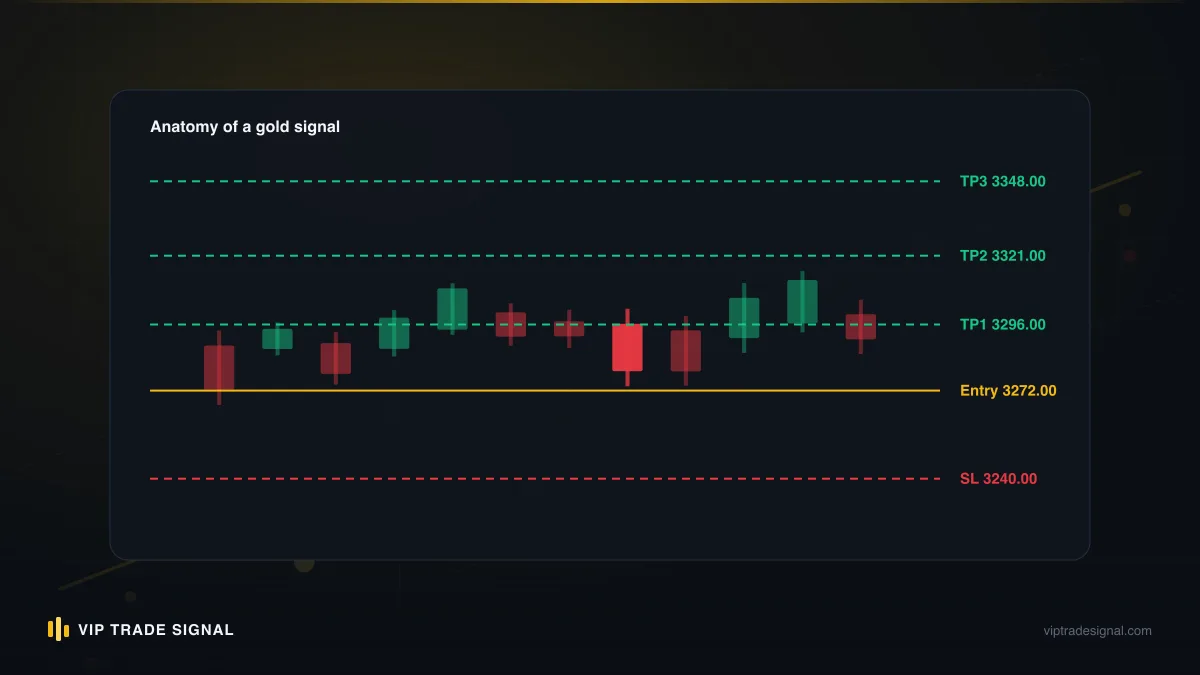
Walk through it slowly, because each number carries information.
The entry zone, not a single price. 3,368-3,371 is a $3 band. On gold, quoting a single tick as your entry is false precision; the zone tells you the analysis is about an area of interest (in this example, likely a resistance shelf from earlier in the week) rather than a magic number. It also means subscribers who see the message at slightly different times can still get a fill inside the intended zone. A sell limit means the order sits above current price waiting for the market to come up into the zone. If price never gets there, the trade never happens, and that's fine. Missed trades cost nothing.
The stop at 3,379. Measure it: from the worst entry (3,368) that's $11 of adverse movement, or 110 pips in gold convention. From the best entry, $8. That width is deliberate, and the next section is entirely about why. What matters at reading time is that you now know your exact worst case per lot before you commit: a standard lot on gold moves $100 per $1 of price, so 0.10 lots with an $11 stop risks about $110. If $110 is more than roughly 1-2% of your account, your size is wrong, not the signal.
Three targets, three jobs. TP1 at 3,360 is close, roughly $8-$11 from the entry zone, and its job is to pay for the trade and let you move the stop to breakeven. TP2 at 3,349 is the meat of the move. TP3 at 3,334 is the runner, the target that only gets hit on the days gold really commits, and those days are exactly the ones that make a monthly ledger work. A common split is closing a third of the position at each level, though closing half at TP1 and letting the rest work is defensible on an instrument this spiky.
The arithmetic of staged exits matters more than people think. Suppose the trade above fills at 3,369 and gold drops to 3,352 before ripping back up through the entry. A one-target trader aiming for 3,334 watches $17 of open profit evaporate into a breakeven or a loss, then posts something bitter in the channel. The three-target trader banked TP1 and TP2 on two-thirds of the position and got stopped at breakeven on the rest. Same signal, same market, entirely different month. The exit structure isn't decoration on a gold signal; on many weeks it is the edge.
One more reading habit worth building: convert everything into your account's currency before entering, every time, even when you're rushing. Entry to SL in dollars of price, times $100 per full lot, times your lot size. Ten seconds of arithmetic. It is the single highest-value habit a signal follower can have, and almost nobody does it consistently after the first week.
Why gold stop losses are wider, and why tight ones are a lie
Every few months someone messages us: "Your stops are 100+ pips, my old forex channel used 30. Why so wide?" The honest answer is that a 30-pip stop on gold isn't a tighter stop. It's a donation.
Think about what a stop loss is for. It's the line where your trade idea is proven wrong. For that line to mean anything, it has to sit outside the market's ordinary breathing. On EURUSD, ordinary breathing might be 15-20 pips of wiggle around a level. On gold, the same wiggle is $4-$8, which is 40-80 pips, on a calm day. Put your stop 30 pips away and you haven't defined where you're wrong; you've defined a point where random noise takes your money regardless of whether the idea was right. You will watch, over and over, gold tag your stop by 20 cents and then run $25 in your original direction. That's not bad luck. It's a stop placed inside the noise band, doing exactly what physics says it will.
So a proper gold stop lives behind structure: beyond the swing high or low that anchors the setup, past the round number that price would need to break to invalidate the idea, with a small buffer for the stop-run wick that gold loves to paint. On an intraday setup that usually lands between $8 and $15 of price distance. On a swing setup, $20-$35. Providers who advertise "tight 20-pip stops on gold" are selling you a high-frequency donation scheme with good branding.
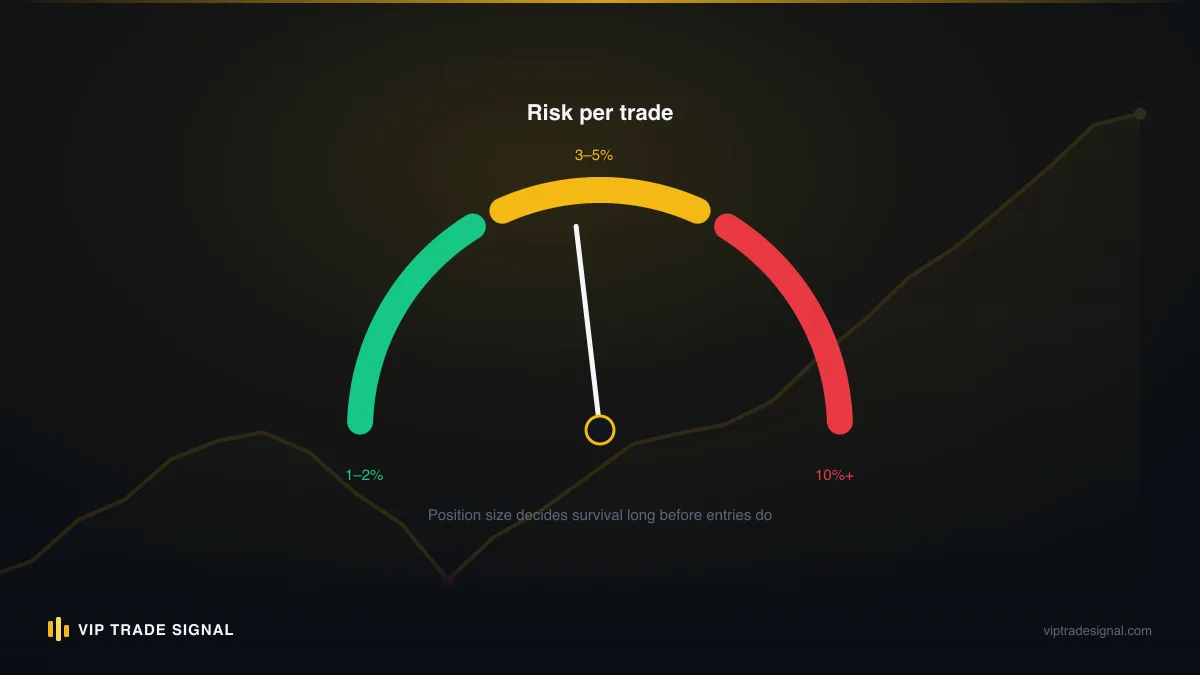
But, and this is the part that redeems the whole arrangement, a wide stop is not the same as big risk. Risk is stop distance multiplied by position size. Widen the stop, shrink the size, and the dollars at risk stay identical. A $10 stop at 0.10 lots risks $100. A $25 stop at 0.04 lots risks $100. The wide-stop trade survives the noise and gives the idea room to work; the tight-stop trade at the same dollar risk dies to a wick. Traders who refuse wide stops on gold aren't managing risk. They're managing their feelings about the word "100 pips", and the market charges heavily for that.
The corollary cuts the other way too. A wide stop with an unchanged lot size is how Dan, from our opening, lost 40% in eleven days. His old channel risked 30 pips at 0.20 lots, about $60 a trade on EURUSD. His gold channel's stops averaged $12 of price, and at his habitual 0.20 lots that's $240 per losing trade, four times the risk he thought he was taking, on an instrument that loses in clusters. Which brings us to sizing.
Position sizing for gold: the mistake that empties accounts
If you take one section of this article seriously, make it this one. In our experience the majority of blown accounts among gold signal followers trace back not to bad signals but to lot sizes imported from forex habits.
The mechanics, once, cleanly. On XAUUSD, one standard lot (100 oz) gains or loses $100 for every $1.00 the gold price moves. So:
| Account | Risk at 1% | Signal stop distance | Correct lot size |
|---|---|---|---|
| $500 | $5 | $10 | 0.005 (many brokers round to 0.01) |
| $1,000 | $10 | $10 | 0.01 |
| $2,000 | $20 | $10 | 0.02 |
| $5,000 | $50 | $12 | 0.04 |
| $10,000 | $100 | $15 | 0.06-0.07 |
Read that table again and notice how small the numbers are. A $2,000 account, risking a sane 1% on a normal $10 gold stop, trades 0.02 lots. Two micro-lots. Most new followers guess 0.10 or 0.20 because that's what forex channels normalised, and at 0.20 lots that same stop-out costs $200, a tenth of the account, per trade. String together four losers, which any honest gold strategy will do several times a year, and the account is down 40% inside a fortnight. The signals could have a perfectly respectable win rate over the quarter. The subscriber never survives to see it.
The formula deserves to live somewhere you can see it: lot size = (account × risk %) ÷ (stop distance in dollars × 100). For the $2,000 example: (2,000 × 0.01) ÷ (10 × 100) = 0.02. Do this before every single trade, or better, once per evening for the typical stop width of your provider, so the number is pre-decided when the signal lands and adrenaline is arguing for more.
Two sizing habits specific to gold. First, size to the actual stop on the actual signal, not to a habitual number, because gold stop widths vary a lot between scalp setups and swing setups and a fixed lot size means your real risk silently triples on the wide-stop trades. Second, when in doubt round down. The difference between 0.02 and 0.03 lots feels like nothing on a winning day and is the difference between a 12% and an 18% drawdown on a bad fortnight. Nobody ever blew an account by rounding down.
And leverage deserves one blunt paragraph. Brokers offer 1:500 on gold, which means a $1,000 account can open 1.5 lots. Can, in the sense that a car can do 140mph into a wall. Leverage determines what the broker permits, not what your survival permits. Ignore the maximum entirely; the formula above is the only sizing input that matters.
Spread and slippage on XAU/USD by session
Gold's cost of trading is not one number. It's a schedule, and the schedule matters because the same signal executed at 9am London and 11pm London can differ by several dollars of round-trip cost.
During London and New York hours, a decent broker quotes gold at $0.15-$0.35 of spread, sometimes tighter. As a fraction of a $20 daily range, that's genuinely cheap. But watch what happens after New York closes. Liquidity drains, and through the Asian session the spread on many brokers drifts to $0.50-$0.80. Around the daily rollover (5pm New York), it can spike past $2.00 for a few minutes on retail feeds. A signal filled in that window starts $2 behind before the market has expressed any opinion at all, and a stop loss sitting near price can get clipped purely by the spread widening, no real selling required.
Then there's news. Nonfarm payrolls, CPI, FOMC. Gold can reprice $10-$20 in the first minute after a big release, and during that minute spreads blow out and market orders fill wherever the liquidity happens to be, which is routinely $1-$3 from the quoted price. Slippage also visits your stop loss: a stop at 3,379 in a fast market might fill at 3,381, and that extra $2 per lot is real money that no backtest ever showed you.
The practical rules that fall out of this are short. Prefer signals issued during London and New York overlap, when gold is cheapest and most orderly. Treat any signal that arrives during the rollover window or deep Asia with suspicion, or at minimum check the live spread before clicking. Pending orders (limits at defined prices) beat market orders for entries because your fill price is capped, though note that stops are always market orders once triggered, so slippage on the exit can't be engineered away, only sized for. And if your provider routinely fires market-execution signals into news candles, that's not aggression, it's carelessness with your money. Our own desk sits flat through the top-tier releases more often than not, and the quiet weeks that policy produces are visible, unglamorously, in the signals history.
Scalp, intraday, or swing: three different animals in one instrument
"Gold signals" is a category the way "food" is a category. The holding period changes everything: stop width, target distance, how often your phone buzzes, and what kind of subscriber can realistically follow along.
Scalps hold for minutes to a couple of hours. Stops of $3-$6, targets of similar size, several signals a day. They look attractive because the stops are small and the action is constant, but they are the hardest signals to follow profitably: entries are stale within ninety seconds, spread eats 5-10% of every target, and you need to be at a screen when the message lands. A scalp signal followed four minutes late is frequently a different trade with a worse expectancy. If you have a job, be honest that you cannot execute these well.
Intraday signals hold for hours, occasionally into the next session. Stops of $8-$15, targets of $8-$40 across the TP ladder, usually one to three signals a day. This is the sweet spot for most followers and it's where the bulk of our own output sits: enough stop width to survive the noise, entries as zones with pending orders so a fifteen-minute delay rarely matters, and a trade frequency a working adult can actually mirror.
Swing signals hold for days to weeks. Stops of $20-$40, targets of $40-$150, a few signals a month. The psychological tax is different in kind: you will watch $30 of open profit halve on a pullback and be told that's normal, because it is. Swing following fails not on execution but on nerve, usually at the exact moment holding was correct.
A provider mixing all three styles into one feed without labels is handing you a sizing nightmare, because your lot size must change threefold between a $5 scalp stop and a $30 swing stop and most followers won't recalculate. If your provider does mix styles, demand labels, and pre-compute a lot size for each style. We went deeper on how holding style interacts with an actual method in our XAUUSD trading strategy guide, which is worth reading before you pick a signal style to follow, since the right style is mostly a function of your schedule and your temperament rather than of the market.
How we generate gold signals: process, not magic
Every provider claims an edge. Most describe it in fog: "advanced AI algorithms", "institutional order flow", "20 years of experience". So here is ours in plain terms, partly because transparency is the brand and partly because knowing how a signal is built changes how sensibly you can follow it.
The process is levels first, then confluence, then risk, then a decision. Each evening the desk maps the structure that matters for the next day: the prior day's high and low, the week's high and low, untested zones where price accelerated away, and the round numbers gold gravitates to. That map is boring and repetitive, which is rather the point. Against it we read the daily and 4-hour trend, because counter-trend gold trades need to clear a much higher bar, and we overlay the calendar, since a lovely technical setup an hour before FOMC is not a setup, it's a coin toss wearing a chart.
A trade only becomes a signal when a level, the trend context and the session timing agree, and when the stop that structure demands still leaves a target worth having. That last filter kills more setups than any other: if the logical stop is $14 away and the realistic target is $10, the trade is negative-expectancy at any win rate we can honestly claim, so it dies in the notebook. Perhaps the most useful thing to understand is how many almost-signals never get sent. On a typical week, the chart offers a dozen tempting configurations and two to four become signals. The discipline isn't in the entries. It's in the deletions.
No magic anywhere in that description, you'll notice. No proprietary indicator, no algorithm that "predicts" gold. A repeatable process, applied by people who do nothing else all day, with every outcome published. That's the whole pitch, and it's also the ceiling of what any honest provider can pitch.
Realistic accuracy and drawdown for gold signals
Now the section that marketing departments skip. What results should you actually expect from good XAUUSD signals?
Not 90% accuracy. Anyone advertising it is either lying, counting only TP1 touches as wins while ignoring stopped trades, or running no stop loss at all and carrying huge floating losses that haven't detonated yet. On gold, that third pattern is epidemic: a channel can print "wins" for months by simply refusing to close losers, right up until a $60 trend move margin-calls everyone simultaneously.
Honest gold signal performance, measured properly (every closed trade counted, wins and losses, in R terms or dollars), tends to look like a win rate somewhere between 45% and 65% depending on how the TP ladder is counted, with the profit coming from the asymmetry between staged targets and single stops rather than from being right constantly. Losing streaks of four to six trades happen several times a year to any method with real stops. Losing weeks are routine. Losing months happen, and a provider whose published history contains no losing month has a published history you should distrust on sight.
Drawdown deserves numbers too. Following a disciplined gold service at 1% risk per trade, a 6-10% peak-to-trough drawdown is an ordinary season, not a crisis, and 15% is the kind of stretch that a good year still absorbs. At 3% risk per trade the same signal stream produces 20-30% drawdowns, which most humans cannot sit through without abandoning the method at the bottom. The signals are identical in both cases. The risk setting decides whether the subscriber survives the statistics, which is why we bang on about sizing in every third message and why this article spent 600 words on it.
Judge any provider, including us, on closed-and-published results over months, not on screenshots. Our full ledger, losers included, is at /signals/history, and the honest summary of it is: profitable process, imperfect record, visible drawdowns. If a competitor shows you something shinier, ask to see the losing trades. The reaction to that question tells you nearly everything.
Choosing a gold signal provider: the checklist
Condensing the above into something you can act on. Before paying anyone, or trading even a free channel's calls, run this list:
- Full published history, losses included. Not screenshots. A running ledger, ideally on a page they can't quietly edit, covering months. No history, no money.
- Gold-specific evidence. A multi-pair channel should show you its XAUUSD results separately. Many are carried by forex trades while their gold calls bleed.
- Every signal carries a price-level SL and staged TPs. One "no SL, trust the setup" message in the archive is disqualifying. One.
- Stops sized for gold. Typical intraday stops of $8-$15, swing stops wider. Routine sub-$5 stops on non-scalp signals mean the provider hasn't traded through much.
- Sizing guidance exists. They talk about percent risk and lot calculation somewhere prominent. Silence on sizing is negligence dressed as minimalism.
- Signals timed to liquid sessions, entries as zones or pendings, not market orders fired into news candles or the Asian graveyard.
- Losing periods discussed openly. Scroll their channel to a bad week. Did they narrate it, or did the channel go mysteriously quiet for five days?
- A price that makes sense. Real analysis costs money to produce. Free channels have a business model, and you're usually the product being resold to a broker; we wrote up how that works in our piece on account management scams and the adjacent funnels.
- No profit promises. Words like "guaranteed", "risk-free" or fixed monthly percentages are not marketing enthusiasm. They're the tell.
Where do we sit against our own list? Gold only, every closed trade public, staged TPs and hard stops on everything, $99/month or free if you trade through a partner broker with a maintained balance, details on the broker route here. We're at the expensive end of the market and we don't pretend otherwise; the trade-off we offer is low minimums and a record you can audit before spending anything. Hold us to item 7 especially. Bad weeks get narrated.
The gold signal scams that keep working
The scams evolve their costumes, not their skeletons. Four patterns account for most of the damage we see.
The doubled channel. A "free VIP" gold channel posts vague zones to 30,000 members. Whatever gold does, half the archive looks right in hindsight, and screenshots of the lucky half become ads for the paid tier. Variant: two paid channels, one told to buy and one to sell, with the losing channel quietly deleted. If a track record consists of screenshots rather than a persistent, dated ledger, assume this pattern until proven otherwise.
The no-stop martingale. The channel's win rate is dazzling because losers are never closed; they're averaged into, doubling size at each level down. On gold this works right up until the day it catastrophically doesn't, because gold's trends run further than any martingale ladder survives. The tell is language: "hold", "adding at 3,340", "recovery trade", and an absence of stop losses in the message history.
The recovery vulture. After a blow-up, an account "manager" appears offering to recover your losses for an upfront fee, often claiming they'll trade your account with special gold signals. The fee vanishes, or worse, the account does. Anyone who contacts you first about recovering losses is running this play. No exceptions we've ever seen.
The results-rental. A slick website shows a verified-looking myfxbook or MQL5 widget. Look closer: the account is a $100 demo, or the history is three weeks old, or the widget links to a different account name. Verification tools verify what they're pointed at, and scammers point them carefully.
The common thread is manufactured certainty. Real gold trading, done well, involves visible losses, stated risk, and a provider who sounds slightly boring about it. The moment a channel makes you feel like you've found free money, the correct move is to leave, and the difficulty is that this is precisely the moment leaving feels hardest.
Following XAUUSD signals on a small account
Plenty of people ask whether following gold signals on $300-$1,000 is even worth doing, and the industry's honest answer is more encouraging than you'd guess, with caveats that matter.
The mechanics work. At 0.01 lots, a $10 gold stop risks $10, which is 2% of a $500 account, slightly hot but survivable, and 1% of $1,000, which is textbook. Micro-lots mean a small account can follow the same signals as a $50k account with identical geometry, just fewer dollars. What a small account cannot do is follow every signal from a high-frequency provider, take 3-5% risk to "grow faster", or withstand its owner's impatience. The maths of a $500 account is that a good quarter makes perhaps $40-$80 at sane risk. That number disappoints people into 5% risk per trade, and 5% risk per trade turns a routine four-loss streak into a 20% hole and, more often than anyone admits, into a deleted app and a swearing-off of trading entirely.
So the small-account playbook is short and unheroic. Risk 1%, maybe 2% if the account is money you could genuinely lose without flinching. Round lot sizes down. Skip signals whose stops are too wide to size at your broker's minimum lot; on a $300 account, a $30 swing stop at 0.01 lots is $30, or 10%, and the right move is to sit that trade out entirely rather than take it oversized. Treat the first three months as a paid education in execution: your goal is to end the quarter having followed the process exactly, with the P&L a secondary score. Small accounts don't die from smallness. They die from being asked to behave like big ones.
And pick your access route with the account size in mind. Paying $99/month against a $500 account means the fee is 20% of capital per month, which no signal stream on earth reliably outruns; that's exactly the situation the free-via-broker route exists for, where the service costs nothing while you keep $250+ with a partner broker and your fixed costs drop to spread. The full details of what our gold signals include are on the service page, but honestly, the route matters more than the provider at this account size. Fixed costs are the silent killer of small accounts, ours included.
Where this leaves you
Strip everything above down to what you'd write on a note stuck to your monitor, and it's this:
Gold moves three to five times more than the majors, so everything imported from forex (stops, lots, patience) needs rescaling before it touches XAUUSD. A real gold signal is five numbers: direction, entry zone, stop, staged targets, and the stop distance that lets you size it. Wide stops with small lots beat tight stops with big lots, every year, on this instrument. Your lot size is a formula, not a feeling. Sessions matter; spread at 11pm is not spread at 2pm. And every provider claim is unverifiable except one, a complete published record of closed trades, so make that the first thing you check and the hill you're willing to be annoying on.
The uncomfortable truth underneath it all is that the signal is the smaller half of the outcome. Two subscribers can follow the identical stream of XAUUSD signals for a year and finish with opposite results, decided entirely by sizing, patience through drawdown, and whether they skipped the trades their account couldn't afford. We can send you our best work, and we do, publicly graded at every step. What happens between your phone buzzing and your order ticket closing is yours.
Start there. Check a provider's full history, ours or anyone's. Pre-compute your lot size for a $10 stop and a $25 stop tonight, before any signal is live and arguing with you. Then follow one month of signals at half the risk you think you can handle, and see whether the process, not the promise, earns the second month. Gold will still be moving $20 a day when you're ready. It's not going anywhere.