Ask a managed account provider what they trade and you'll usually get a shopping list. Majors, minors, indices, oil, a bit of crypto when it's moving. Sounds impressive. It's usually a warning sign, because nobody is genuinely good at eleven instruments, and a manager who trades everything is mostly telling you they'll chase whatever moved yesterday.
We went the other way. Our desk runs xauusd account management and nothing else. One instrument, gold against the dollar, traded in your own MT4 or MT5 account, with a flat 50% share of realized profit and a $200 minimum advance. You keep the master password. You keep the withdrawal rights. If a month closes flat or down, the advance is the only thing we've been paid.
This piece is the long version of that pitch, and it's honest enough to include the parts that don't flatter us. Gold is a violent instrument. Managed accounts lose money in some months, ours included, and anyone who tells you otherwise is selling something worse than a bad service. But if you want a managed account at all, we think a specialist desk with published results beats a generalist with a glossy deck, and the next five thousand words are the argument.
Why specialise an entire managed account in one metal
Start with a question most providers hope you never ask: how many instruments can one desk actually know?
Not "have a chart open for". Know. As in, know that gold's spread at 11pm London routinely triples. Know how it behaves in the hour before a US CPI print versus the hour after. Know which round numbers attract stop clusters and which get sliced through like they're not there. That kind of knowledge comes from watching one market through thousands of sessions, and it does not transfer. A trader who deeply knows EUR/USD does not automatically know gold; the correlations, the session rhythm, the news sensitivity, the sheer size of the average daily range are all different animals.
The maths of attention is brutal. A desk covering ten instruments gives each one a tenth of its screen time, a tenth of its post-trade review, a tenth of its pattern library. A gold-only desk pours all of it into one place. Every losing trade we review is a gold trade. Every playbook we refine is a gold playbook. After a few years of that, the compounding is real, and it shows up in the one place it matters: how the account handles the ugly days.
There's a second, less obvious benefit. Specialisation makes us auditable. Because everything we do is XAU/USD, you can check any trade on our record against a single chart. No hiding a bad month in an exotic cross you'd never think to verify. Every closed signal our desk publishes sits at /signals/history, wins and losses in the same table, and a managed client can line their statement up against the same market. Generalist managers are hard to audit precisely because their activity sprawls. Ours doesn't.
And yes, there's a cost. Specialisation means concentration. When gold chops sideways for three weeks, we don't have a "well, cable was trending" consolation prize. We sit on our hands, which is cheaper than forcing trades but feels like nothing is happening. If you can't tolerate quiet stretches, that matters, and we'll come back to it in the section on who this is wrong for.
Gold's personality: volatility, sessions and news
Gold is not a big forex pair with a shinier name. It moves differently, and the difference is the whole reason a gold managed account needs its own risk rules.
Size first. A normal day in EUR/USD might span 60 to 80 pips. A normal day in gold spans $20 to $40, and on a hot news day $60 or more, which in pip terms is several hundred. One standard lot of gold moves $100 per $1 of price. Position sizes that feel conservative on a currency pair will empty a small gold account in an afternoon. This is the single most common way retail traders die on this instrument: they bring forex sizing to a metal that moves three times as hard.
Sessions matter more than most people think. Gold in the Asian session is usually a polite, range-bound thing, drifting on thin volume. London open wakes it up. The London-New York overlap, roughly 1pm to 5pm UK time, is where the majority of the day's range gets built, and it's where our desk does most of its work. Trading gold at 3am because a signal channel in another timezone fired one off is how you pay double spread to enter a market that isn't moving.
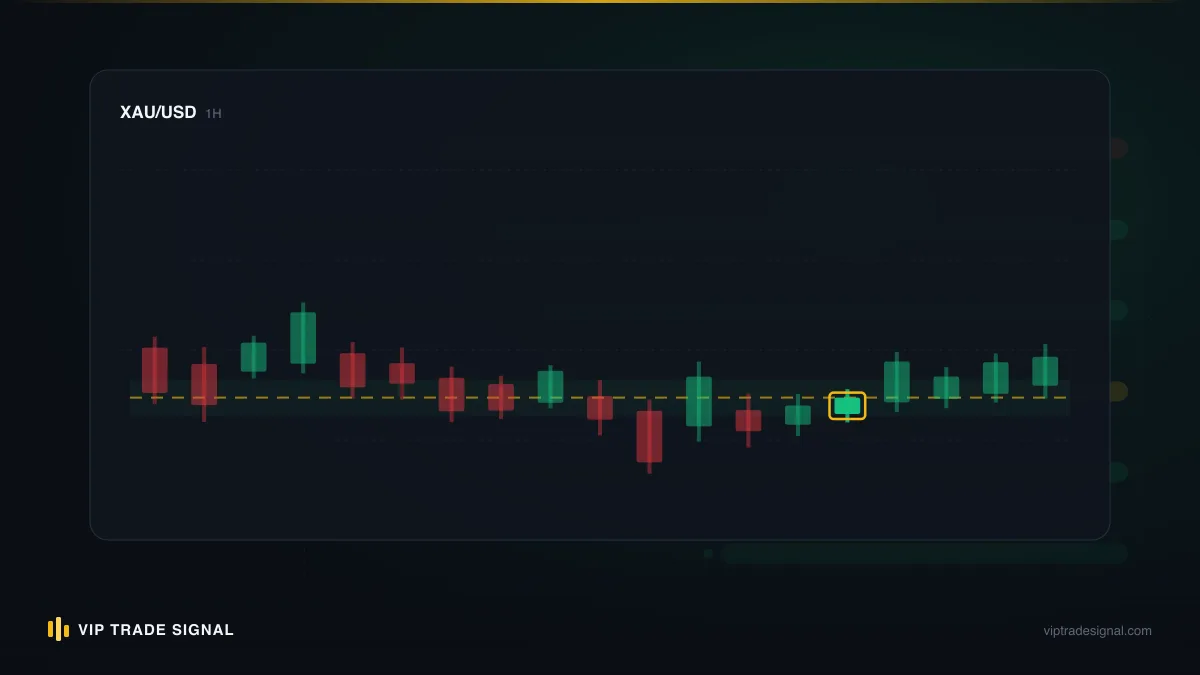
Then there's news. Gold is a macro sponge. Non-farm payrolls, CPI, FOMC, and any headline containing the word "tariff" or a central banker's surname can move it $30 in minutes, sometimes in both directions before picking one. A generalist desk treats these as occasional hazards. For us they are the terrain. We know which prints we stand aside for, which we trade the aftermath of, and, crucially, which pending orders need pulling before the number hits. That last habit alone has saved clients more money than any entry technique we own.
None of this makes gold unbeatable. It makes gold unforgiving of sloppiness, which is a different thing. Volatility cuts both ways: the same $40 range that wrecks an oversized position is what makes sensible targets reachable in hours rather than days. The instrument isn't the risk. The sizing is.
What XAUUSD account management means in practice
Strip the marketing off and a managed account is a simple arrangement: you own the account, we trade it, we split what it makes. But the details are where clients get hurt in this industry, so let's be precise about ours.
You open (or already have) an MT4 or MT5 account at your broker, in your name, with your money. You give us trade-only access, typically via the investor-to-trader permission structure your broker supports, and you keep the master password. That last clause is not a courtesy. It means we can place and manage trades but we cannot withdraw, cannot change your account settings, and cannot lock you out. If you wake up one morning and want out, you change the password and it's over. No exit interview required.
From there, the desk trades your account alongside its book. Same analysis, same setups, sized to your equity. You'll see every position in your own terminal in real time, not in a monthly PDF designed to smooth over the rough patches. Some clients watch every trade. Most check in weekly. A few genuinely look once a month, which is fine, because the statement is always there and it never lies.
What we are not: a pooled fund, a PAMM, or anything where your money leaves your broker. We've written before about why pooled structures create bad incentives, and if you're weighing structures it's worth reading our piece on alternatives to PAMM accounts before you commit to anyone, us included. The short version is that when money is pooled, the manager's risk decisions serve the pool's marketing, not your account. When the account is yours, the incentives straighten out considerably.
And what we are legally: not a licensed financial advisor. Nothing here is personalised investment advice. Gold CFDs are leveraged products and a majority of retail accounts that trade them lose money. A managed account changes who presses the buttons, not the nature of the risk.
How a gold-only book differs from multi-pair management
On paper, a multi-pair managed account sounds safer. Diversification, right? Eggs, baskets, the usual. In practice, retail multi-pair management often delivers the opposite, and it's worth understanding why before you pick a structure.
The diversification argument assumes the instruments are genuinely uncorrelated and the manager is genuinely competent in each. Neither is usually true. Risk currencies, indices and metals all tend to lurch together when the dollar moves hard, so a book that looks spread across eight charts can be one concentrated dollar bet wearing eight hats. Meanwhile the manager's actual skill is spread thin, and the losing pairs quietly get more attempts because, well, there's always another market open somewhere.
Here's the honest comparison as we see it:
| Multi-pair managed account | Gold-only managed account | |
|---|---|---|
| Manager's expertise per instrument | Divided across many markets | Concentrated in one |
| Correlation risk | Hidden; positions often move together | Explicit; you know your exposure is gold |
| Auditability | Hard; activity sprawls across charts | One chart checks every trade |
| Quiet periods | Rare; something is always "in play" | Real; some weeks have few trades |
| Overtrading temptation | High | Structurally limited |
| Concentration risk | Feels lower, often isn't | Openly high, sized accordingly |
Notice the last row. We're not claiming a gold-only book has less risk. It has more honest risk. You know exactly what you're exposed to, you can watch it on one chart, and the sizing rules are built for that concentration rather than pretending diversification will absorb mistakes. We'd rather run a book whose danger is visible than one whose danger is dressed up as balance.
The quiet-period row deserves a word too. A multi-pair manager can always find a trade, and that is exactly the problem, because activity is what clients mistake for effort. A gold desk in a dead gold week has nothing worth doing, and the discipline to do nothing is, in our experience, the single rarest skill in retail money management. Fewer trades, better trades, and a fee model that only pays on profit rather than activity. Which brings us to risk.
Risk architecture for a gold-only book
Concentrating a whole account in one volatile metal without a hard risk frame would be lunacy. So the frame comes first, and it has three layers.
Per-trade risk. Every position has a stop loss at entry. Not a mental stop, not a "we'll manage it", an actual order resting at the broker. Risk per trade is a small, fixed percentage of account equity, typically in the 0.5% to 1% region depending on account size and the client's agreed settings. On a $5,000 account at 1%, that's $50 of risk per trade. If the setup needs a $10 stop distance on gold, the position is 0.05 lots, and it does not get rounded up because the setup "looks strong". Conviction is not a sizing input. Equity is.
Per-day risk. Losing trades cluster. Anyone who has traded through a trending news day knows how three good-looking setups can all fail in the same four hours. So the book has a daily stop: when the day's realized losses reach a set threshold, the desk is done until tomorrow. No revenge trades into the New York close, no "one more to get it back". The maths of drawdown is merciless enough without emotional acceleration; three 1% losses in a day is survivable, ten is a crater.
Account-level limits. Above the daily layer sits an equity floor, a drawdown level at which trading pauses entirely and we talk to you before anything else happens. This is the layer most retail managers skip, because pausing means admitting the month is lost. We'd rather lose a month than an account. Deep holes are geometrically expensive to climb out of: a 10% drawdown needs 11% to recover, but 30% needs 43%, and at 50% you need a double just to get home.
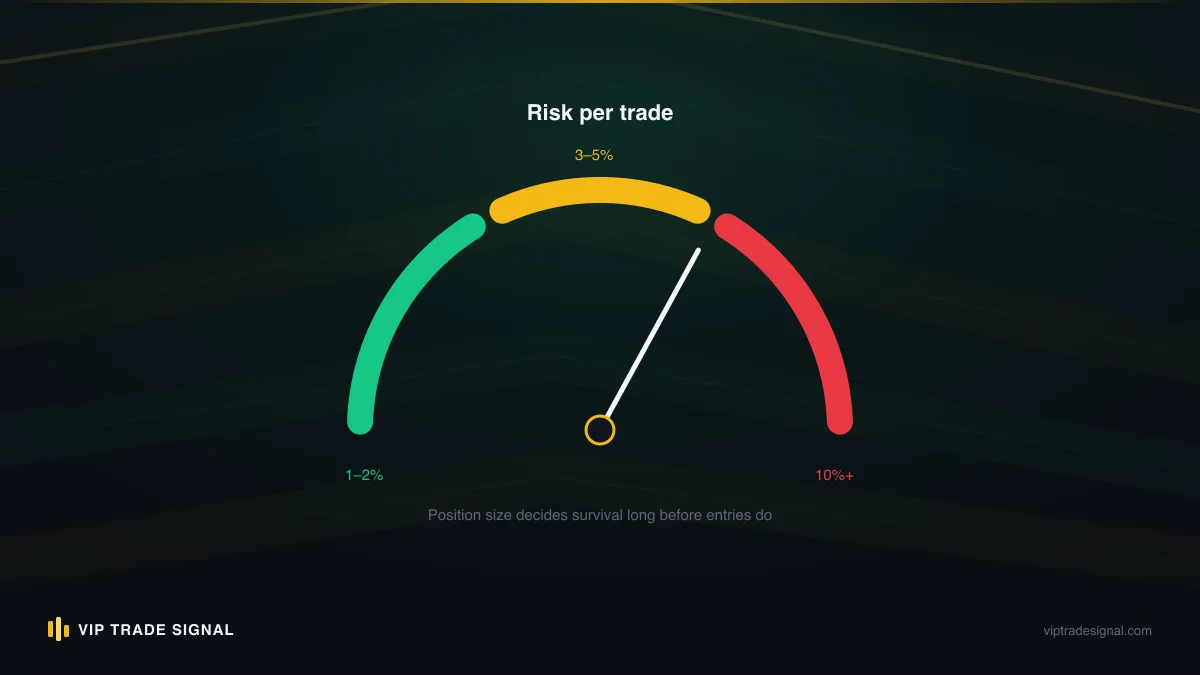
The per-trade stop protects a trade. The daily stop protects a week. The equity floor protects the relationship.
One more structural point. Because we only get paid on realized profit, there's a version of this business where a manager swings huge size hoping to bank a monster month, knowing the downside lands on you. The profit-split model has that flaw baked in across the whole industry, and we won't pretend otherwise. Our answer is the architecture above plus custody: the limits are agreed in writing before the first trade, you can see every position live, and you hold the master password. A manager who resists hard limits, or wants custody of your funds, has told you which version of the business they're running.
Our model: flat 50% of profit, a $200 advance, your custody
Here's the commercial arrangement in full, because a fee model you have to email three times to understand is a fee model hiding something.
The split. We take a flat 50% of realized profit. Realized means closed trades, actual banked gains, not floating paper profit that evaporates before month end. If the account finishes a settlement period up $600 in closed profit, $300 is ours and $300 stays yours. If it finishes down, we're owed nothing on the period, and there is no negative balance rolling forward against you as a debt. The losses are losses; they're real and we say so.
The advance. There's a $200 minimum advance to start. Think of it as a commitment fee that gets absorbed into the profit share as results are banked. It exists for one honest reason: managing an account costs desk time from day one, and a small advance filters out the tyre-kickers who'd otherwise open twenty accounts across twenty managers and let nineteen die of neglect. If $200 feels like a lot, we'd gently point out that a manager charging nothing upfront is pricing their own time at zero, and you should wonder why.
Custody. Repeated because it's the load-bearing wall: the account is yours, at your broker, master password in your hands, withdrawals under your control at all times. We hold trade-only access and nothing else.
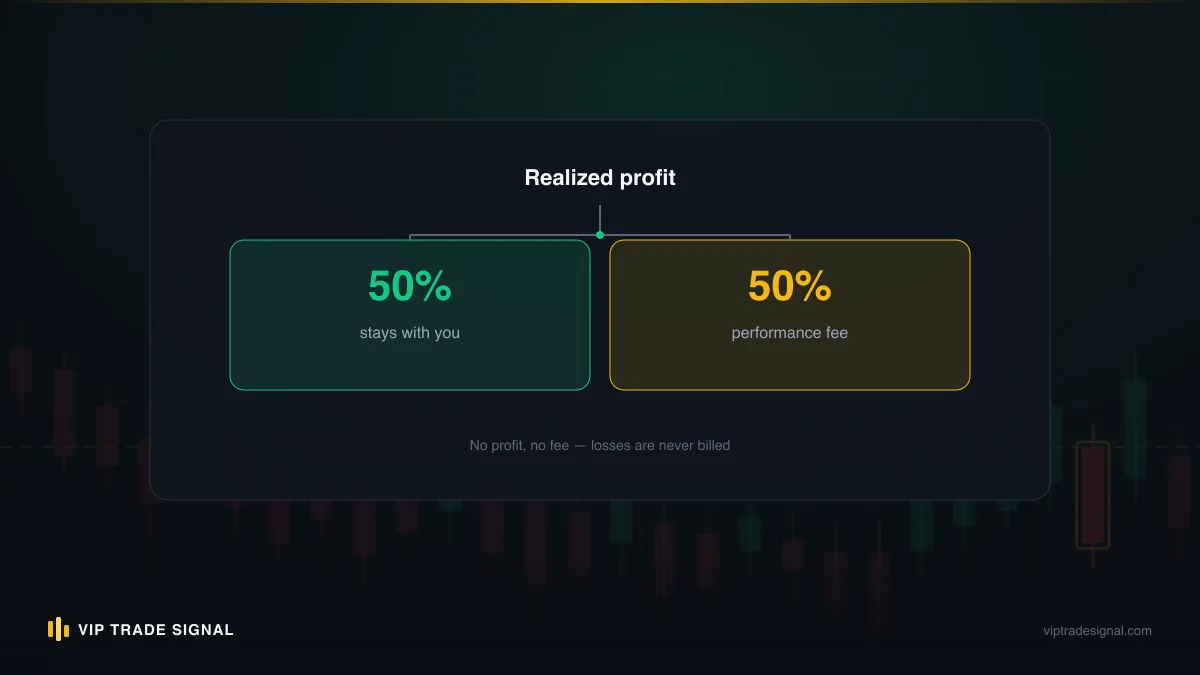
Is 50% high? Against hedge fund convention, yes. The classic institutional model is "2 and 20", 2% of assets annually plus 20% of profits, but that model needs six or seven figures under management to function. Ours is built for accounts starting in the hundreds and low thousands, pay-as-you-go, with no annual management fee scraping your balance in flat months. On a small account, a flat split with no asset fee routinely costs less in a mediocre year than 2-and-20 would, and in a losing year it costs you the advance and nothing more. We're at the high end on the split because we're at the low end on everything else, and we think that trade is the right one for retail-sized accounts. The full numbers live on our pricing page with nothing hidden in a tooltip.
The deeper point about a pure profit split is alignment. An asset-based fee pays the manager for existing. A split pays the manager for closed, banked results, and pays nothing for churn, activity theatre or a good story. We eat what we kill, and some months the plate is empty. That's the deal, on both sides of it.
The broker route and the monthly route
A quick detour into how people usually arrive at managed accounts with us, because most don't start here.
Our signal service, which is also gold-only, runs on two tracks: $99 a month paid directly, or free through a partner broker (Exness, XM, IC Markets or Vantage) with a $250+ balance maintained through our partner link. The broker route exists because for most people it's simply the cheaper path to the same signals, and we'd rather be paid a rebate by a broker than a subscription by you.
Account management is a separate arrangement with its own terms: the 50% split and the $200 advance apply regardless of which broker you use. But the routes interact in a useful way. A good number of our managed clients started as signal subscribers, spent a few months watching how the desk actually trades, checked the record against the chart, and only then handed over the keys. We think that's the correct order of operations. Following our signals for a while costs you $99 a month at most, often nothing, and it answers the only question that matters about a prospective manager: what do they actually do when a trade goes wrong?
If you're broker-shopping anyway, spreads and execution quality on gold vary more between brokers than most people realise, and they compound over hundreds of trades. We keep notes on that in our guide to the best brokers for managed accounts; a $0.30 difference in average gold spread is a real tax on an actively traded account.
What a typical month looks like, losses included
Marketing for managed accounts loves the highlight reel. Here's the unedited version, built as an illustrative scenario rather than a performance claim, because inventing precise return figures is exactly the disease this industry has and we're not adding to it.
Say a client, call her Dana, runs a $4,000 account at 1% risk per trade. Over a month the desk takes perhaps 15 to 25 gold trades, concentrated in the London-New York overlap, with quiet days skipped entirely. A normal month contains all of the following:
- Clean winners. Trades that hit their target more or less as planned. Satisfying, and rarer than the losers plus scratches combined.
- Losers. Full stop-outs at roughly $40 each on Dana's settings. There will be several. In a bad week, several in a row. This is the part every honest manager admits and every dishonest one hides.
- Scratches and small wins. Trades closed early around breakeven when the move stalls or news risk approaches. Individually forgettable, collectively they're where drawdowns go to die.
- Nothing days. Sessions where the desk takes no trade at all. Sometimes a full week of them when gold compresses into a range that offers no edge.
Whether the month nets positive depends on the spread between winners and losers, and no month is guaranteed. We've had months where a single trending week paid for the quarter, and stretches where the account ground sideways while the daily stop earned its keep. Losing months happen to every desk that trades long enough, full stop, and the measure of a manager is not their absence but their depth. A losing month that stays shallow, inside the agreed limits, is the system working. A losing month that craters through them is the system failing, and you'd see it live in your own terminal, not three weeks later in a massaged report.
This is also why we publish. Every closed signal from the desk sits in the open at /signals/history, red rows next to green ones, and you're welcome to scroll back through the ugly patches before you send anyone an advance. If a manager you're considering can't show you their losers, you haven't seen their track record. You've seen their brochure.
Trade frequency scales with account size in a way that surprises new clients. A $2,000 account at 0.5% risk generates smaller position sizes and, often, fewer trades taken, because the desk is more selective about which setups clear the bar when each one matters more relative to the account. A $10,000 account at the same percentage risk can absorb more setups without any single trade threatening the month. Neither approach is wrong; they're the same risk framework producing different activity levels because the framework is built around percentage of equity, not a fixed trade count we're contracted to deliver. If a provider promises you a specific number of trades per week regardless of market conditions, ask what happens on the weeks gold does nothing — because either they trade anyway to hit the quota, or the promise was never really about your risk.
Who this is wrong for
We'd rather turn the wrong client away in a blog post than in a refund email, so, plainly, gold-only account management is a poor fit if any of the following describes you.
You can't afford to lose the money. Not "would prefer not to". Cannot afford. Gold CFDs are leveraged, volatile, and capable of losing real money inside the agreed limits. Rent money, emergency funds and borrowed money have no business in any managed trading account, ours included. This isn't compliance boilerplate; it's the difference between a drawdown being uncomfortable and being catastrophic.
You need withdrawals on a schedule. If you're hoping a $2,000 account will pay your phone bill monthly, the sizing maths doesn't support it and no honest manager will pretend it does. Managed trading is an attempt to grow risk capital, with variance, over quarters and years. It is not an income product.
You'll panic at the first red week. Some clients watch every trade tick against them and feel each one physically. Nothing wrong with that wiring, but it makes managed accounts miserable, because you will see losing trades, probably in your first week. If a 4% drawdown will have you changing the password at midnight, you'll lock in the bottom of a normal fluctuation and hate the whole experience. The psychology of watching someone else trade your money is genuinely harder than most people expect.
You want diversification from one provider. We do one thing. If your plan needs positions across bonds, equities and currencies, we're a component at most, and honestly you're describing a portfolio, not a managed forex account. Our roundup of the best managed forex accounts covers structures we don't offer, and we'd rather you read it than squeeze the wrong shape into our box.
You're drawn to the guarantee-shaped promises elsewhere. If a competitor is offering "10% monthly, guaranteed", we can't match that, because it's fiction. Anyone guaranteeing returns in leveraged trading is lying to you, and the polite version of this paragraph doesn't exist.
Still here? Then the practical question is what starting actually involves.
Onboarding: from inquiry to first trade
The process is deliberately short, because a manager who needs six weeks of ceremony to place a trade is billing you for theatre. It runs like this:
- The conversation. You reach out through the account management page and we talk: account size, broker, risk tolerance, what you're expecting. If expectations and reality don't match, this is where we say so and part as friends. It happens regularly and it's the cheapest failure point in the whole pipeline.
- The paperwork. A short written agreement covering the 50% split, the $200 advance, the risk limits for your account (per-trade percentage, daily stop, equity floor), and the fact that either side can end the arrangement at any time. Plain language. If a clause needs a lawyer to decode, we've failed at the drafting.
- The access. You set up trade-only access on your MT4 or MT5 account. You keep the master password; we never ask for it, and you should treat any manager who does as radioactive. If your current broker makes gold expensive to trade, we'll say so and suggest alternatives, but the choice of broker stays yours.
- The baseline. We record the starting equity together, in writing. Every future profit calculation runs from a number both sides agreed on while sober and friendly, which is precisely when you want to agree on numbers.
- The first trade. Usually within a few days, market permitting. If gold is mid-chop, the first trade waits for a setup worth taking, and a slow start is a feature. The worst possible opening move for a new account is a forced trade taken to look busy.
Total elapsed time from first message to live desk coverage is typically under a week. The pacing after that is set by the market, not by a calendar that promises activity.
Leverage, lot sizing and drawdown limits: straight answers
The questions every prospective client asks, answered without the usual fog.
How much leverage does the account need?
Less than your broker will offer you. Brokers advertise 1:500 or more on gold; the desk's actual exposure is set by the risk-per-trade rule, not by the maximum the platform allows. Leverage in our model is plumbing, not throttle: enough headroom that margin never interferes with a properly sized position, which for most accounts means anything from 1:100 upward is ample. If you've been sold the idea that more leverage means more profit, unlearn it before it costs you. Leverage determines how fast a mistake compounds, nothing more.
How are lot sizes calculated?
From equity and stop distance, every time. Risk amount equals equity times the agreed percentage; lot size equals that risk amount divided by the stop distance in dollars per lot. A $3,000 account at 1% risking $30 on a trade with an $8 stop runs about 0.03-0.04 lots. As the account grows, size grows with it; as it draws down, size shrinks, which automatically slows the bleed exactly when slowing matters most. Fixed lot sizes that ignore equity are how small accounts die, and we don't use them.
What's the maximum drawdown before you stop?
Agreed per client before the first trade, recorded in the agreement, and typically well inside the level where recovery maths turns cruel. When the floor is hit, trading pauses and we talk. What we will never do is trade through the floor because we "feel a reversal coming", and we will never promise a drawdown can't happen. It can. The limits exist to cap its depth, not to abolish it, and anyone claiming to have abolished drawdown is either not trading or not telling the truth.
Can I trade the account myself at the same time?
Please don't. Two uncoordinated hands on one account wreck the risk maths for both. If you want to trade your own ideas, run a second account for them; plenty of clients do exactly that, and the separation keeps both records honest.
Who handles the tax reporting?
You do, and we're not being evasive by saying so — we're not accountants, we're not licensed to give tax advice, and the correct treatment of trading gains varies enormously by country, residency status and even account type. What we can offer is the raw material: your broker's own statement, showing every trade we placed with timestamps and closed P&L, which is the same document any accountant would ask for regardless of which jurisdiction's rules apply. Some clients treat gold CFD gains as capital gains, some as income, some hold the position in an account structure that changes the answer entirely, and we've seen enough variation across clients to know better than to guess on your behalf. If tax treatment materially affects whether this arrangement makes sense for you, that's worth a conversation with a professional in your own jurisdiction before you fund the account, not after the first profitable quarter.
What happens if I want out mid-month?
You change the password. That's genuinely the whole procedure. Any realized profit already banked in the period settles per the split, open trades are closed or handed over as you prefer, and nobody owes anybody an apology. The exit being this easy is not an accident; it's the strongest incentive we have to keep earning the mandate every week.
Who pays the overnight swap on gold?
You do, because it's your account, and we size around it rather than pretending it doesn't exist. Gold carries a real overnight financing cost, and it isn't symmetric: long positions typically pay more to hold overnight than short positions, and the number moves with prevailing rates, so it's worth checking your specific broker's current swap schedule rather than trusting a number from an old forum post. For a desk running mostly intraday setups this is a minor drag, a few dollars here and there, but a handful of our clients ask us to keep positions genuinely flat overnight specifically to avoid it, and we accommodate that preference when it's stated upfront. It's a small line item next to the spread and the profit split, but "small" and "zero" aren't the same thing, and a manager who never mentions it either doesn't know or is hoping you won't ask.
What if the broker itself is the problem?
This is the risk we can influence least, and we say so plainly rather than pretending trade-only access solves everything. We don't custody your funds, which protects you from us, but it does nothing to protect you from a broker that requotes badly, delays withdrawals, or runs into its own trouble. That's precisely why the choice of broker is yours, not ours, and why our guide to best brokers for managed accounts exists as a starting point rather than a mandate. Regulated brokers with segregated client accounts and a long operating history are the baseline we'd want for our own money; a broker offering suspiciously generous bonuses or an unclear regulatory footprint is a risk we can flag but not eliminate on your behalf. Due diligence on the broker is the one piece of this arrangement that stays entirely in your hands, and it should.
The question to ask before you hand anyone your account
Strip away the branding and every managed account decision comes down to one question: when this goes wrong for a while, and it will, what exactly happens to my money and who controls it?
Run that question against any provider, us included. Does the manager hold your funds, or do you? Are the risk limits written down, or vibes? Is the track record public with the losses left in, or a screenshot of a good fortnight? Is the fee earned on banked profit, or charged on your balance for showing up? Can you leave in five minutes, or is there an exit process designed to exhaust you?
Our answers: your custody, written limits, published history at /signals/history with every red row intact, a flat 50% of realized profit with a $200 advance, and an exit that takes one password change. High fee on the split, low commitment everywhere else, one instrument done properly rather than eleven done adequately.
We're comfortable being measured against that list, and frankly we'd like more of the industry to be forced to answer it. If gold-only management sounds like your shape of risk, read the detail on the account management service page, scroll the losing trades in the history first, and then talk to us. And if it doesn't, no hard feelings; the worst client for a gold desk is one who never wanted to own a gold book in the first place.