There's a moment in every managed account conversation where the client asks the wrong question first. They ask about the manager's returns. They ask about the fee split. Sometimes they ask about strategy. Almost nobody asks the question that decides whether they can get their money back in a hurry: which broker is this account sitting with, and who chose it?
Here's the uncomfortable truth about handing your trading account to someone else. Once the manager has trading access, most of the protections you thought you had are gone. They can open positions you'd never take. They can size trades badly. The one thing they cannot do — if you've set things up properly — is move money out of the account or stop you moving it out yourself. And every bit of that residual protection lives at the broker level.
So if you're looking for the best brokers for managed accounts, stop thinking about it as a shopping trip for tight spreads. Think of it as choosing the vault your money sits in while a stranger holds the keys to the trading terminal. The vault matters more than almost anything else, and this guide ranks broker selection criteria in strict order of how much protection each one actually buys you.
Why broker choice matters more in a managed account than in self-trading
When you trade your own account, a mediocre broker mostly costs you money in small, survivable ways. A wider spread here, some slippage there, a requote at a bad moment. Annoying, measurable, rarely fatal. You're present for every trade, you see every fill, and if something smells wrong you close everything and leave.
A managed account changes the maths completely. You're not watching every trade. You might check the account twice a week, or twice a month. The person executing has interests that overlap with yours but don't match them — a manager on a profit split wants gains, sure, but they don't feel your losses the way you do. And the failure modes stop being "I paid an extra half-pip" and start being "I can't withdraw" or "the account was drained through a mechanism I didn't understand."
Think about what the broker actually controls in this arrangement. The broker holds the money. The broker decides who gets trading access and through what mechanism — investor passwords, limited power of attorney, MAM/PAMM structures. The broker processes withdrawals and enforces (or doesn't enforce) the rule that money only goes back to the account it came from. The broker's regulator decides whether there's anyone to complain to when things go sideways.
The manager, by contrast, controls only the trades. That's a real risk — a bad manager can lose your money one position at a time, fully within the rules. But it's a bounded, visible risk. You can watch the equity curve and pull access the moment you don't like it. Broker risk is different. It's invisible right up until the day it isn't, and by then it's usually too late to do anything about it.
That's why the ranking below is deliberately upside-down compared with how most broker reviews are written. Review sites rank by spreads and bonuses because those are easy to compare in a table. We're ranking by protective value: what stops the worst outcomes, in order. Regulation and fund segregation first. Withdrawal reliability second. Execution third. Platform and access mechanics fourth. Manager convenience dead last — and yes, that's on purpose.
Criterion 1: regulation and segregated client funds
Everything starts here. Not because regulation makes a broker honest — it doesn't, and plenty of regulated brokers have behaved badly — but because regulation determines what happens when things go wrong. An unregulated broker that decides not to pay you is a dead end. There's no ombudsman, no compensation scheme, no license worth losing. Your recourse is a strongly worded email.
Regulators are not interchangeable, and it's worth knowing the rough tiers. At the top: the FCA in the UK, ASIC in Australia, CySEC in Cyprus for EU coverage, and a handful of others like the FSCA in South Africa and Dubai's DFSA that have grown real teeth. These regulators impose capital requirements, mandate segregated client funds, run compensation schemes (the FCA's FSCS covers up to £85,000 per person, for instance), and actually pull licenses. In the middle: newer or lighter regimes that do genuine supervision but with less enforcement history. At the bottom: the offshore letterbox jurisdictions — St. Vincent and the Grenadines is the classic, along with the Marshall Islands and a few Caribbean flags — where "regulated" means someone filed incorporation paperwork.
A wrinkle to understand: most large brokers operate multiple entities. The same brand might run an FCA-regulated entity for UK clients and a Seychelles entity for everyone else, and the offshore entity typically offers higher leverage precisely because it isn't bound by the strict rules. Your protections come from the entity your account is opened with, not the brand name on the website. Check the account opening documents, not the homepage footer. This catches out more people than any other detail in this article.
Segregated funds deserve their own paragraph because the phrase gets thrown around loosely. Proper segregation means client money sits in bank accounts legally separate from the broker's operating funds. If the broker goes bust, segregated client money isn't part of the insolvency estate — creditors can't touch it. Commingled funds, by contrast, are just the broker's money with your name pencilled next to a number. When a commingling broker fails, clients queue up behind the landlord and the payroll company.
For a managed account specifically, this criterion does double duty. A properly regulated broker also constrains the manager. Tier-one regulators require formal LPOA documentation before a third party can trade a client's account, which creates a paper trail. They enforce return-to-source withdrawal rules. They give you somewhere to file a complaint that the broker actually fears. An offshore broker constrains nobody, which is exactly why certain managers prefer them.
Criterion 2: withdrawal reliability — and why you test it before it matters
Ask around any trading forum and you'll find the same pattern in broker horror stories. Deposits are instant. Withdrawals are where brokers show you who they really are.
A good broker processes withdrawals in one to two business days, back to the funding source, with maybe one identity check the first time. A bad broker discovers "additional verification requirements" the moment you ask for money back. Suddenly they need a notarised utility bill. Then a bank statement. Then the compliance team is reviewing your account, which takes ten business days, which becomes twenty. None of these steps is individually outrageous, and that's the point — withdrawal friction is designed to be deniable.
In a managed account this matters twice over. First, the obvious way: withdrawal is your emergency exit. If the manager starts trading in a way you hate, your move is to pull trading access and, often, pull funds. An exit that takes three weeks isn't an exit; it's a hostage negotiation. Second, the subtle way: some of the worse manager-broker arrangements rely on withdrawal friction. If the manager earns rebates from the broker on your trading volume, a broker that makes leaving painful keeps the volume flowing.
So test it. Before any manager touches the account, run this drill: deposit an amount you'd be genuinely annoyed to lose but not damaged by — $300, say. Wait for it to clear. Then, without placing a single trade, withdraw $100. Note three things: how long it took, whether any surprise requirements appeared, and whether the money came back to the exact source it left from. Then place two or three tiny trades and withdraw again, because some brokers treat traded accounts differently from untraded ones (occasionally for legitimate anti-money-laundering reasons, but you want to see the difference in practice).
If a $100 withdrawal takes eight days and two support tickets, imagine what $8,000 will take after a profitable quarter. You've just bought that information for the price of a little patience, and it's the cheapest due diligence you'll ever do.
One more thing to verify while you're at it: return-to-source enforcement. Ask support, in writing, whether withdrawals can ever be sent to a third party or to a payment method that didn't fund the account. The answer you want is a flat no. This single policy is what makes the "manager can't steal the money" claim true in practice, and we've written up exactly how that mechanism works in can a forex account manager withdraw your money if you want the full anatomy.
Criterion 3: execution quality and gold spreads
Now, and only now, do we get to the stuff broker reviews usually lead with. Execution matters — it just matters less than the two criteria above, because bad execution costs you money gradually while bad regulation or blocked withdrawals can cost you everything at once.
That said, in a managed account execution costs compound in a way that self-traders sometimes miss. A manager trading actively on your account might do 40, 60, 80 round trips a month. Every one of those crosses the spread. If your manager trades gold — ours does nothing else — the difference between a broker quoting XAU/USD at a 15-cent spread and one quoting 45 cents is not small. On a standard lot, that 30-cent gap is $30 per round trip. At 50 trades a month, you're handing the wide-spread broker roughly $1,500 a month that neither you nor your manager ever sees as a loss on any single trade. It just quietly erodes the equity curve, and on a profit-split arrangement it erodes the manager's income too, which is why competent managers care about this even when clients don't.
Gold specifically deserves scrutiny because it's the instrument where broker quality varies most. Majors like EUR/USD are commoditised — nearly everyone quotes them tightly. XAU/USD spreads range from genuinely excellent to frankly abusive, and they behave differently around news. Watch a broker's gold spread during a US CPI release or an FOMC statement. Some hold within a reasonable band; others blow out to two or three dollars for minutes at a time, which will destroy any strategy using stops of normal size. If your manager holds positions through news — or worse, gets stopped during spikes — spread behaviour under stress matters more than the calm-market number on the comparison table.
Slippage and stop treatment come next. Ask whether the broker offers positive slippage as well as negative (honest ones pass both through). Ask whether stops are executed at the level or at the next available price, and what happened to client stops during the last big gap. You won't always get straight answers, which is itself an answer.
And keep some perspective. A manager whose strategy only works on a 12-cent spread doesn't have much of a strategy. Execution quality should be good enough not to distort results — it doesn't need to be perfect, and chasing the absolute tightest spread at an otherwise questionable broker is exactly the trade-off this ranking exists to talk you out of.
Criterion 4: MT4/MT5 support and access controls
Platform choice sounds like a technical footnote. In managed accounts it's actually a protection question, because the platform determines how access is granted and — more importantly — how it's revoked.
MetaTrader 4 and 5 remain the default for account management for one architectural reason: the two-password system. The master password controls everything — trading, and the ability to change both passwords. The investor password grants read-only access: anyone holding it can watch every trade, every position, the full history, but can't place an order or touch a setting. This split is what makes trust verifiable. You can hand out the investor password to a prospective manager's referee, an auditor, or your suspicious brother-in-law, and nobody's money moves.
For an MT4 broker for account management, the checklist looks like this: full MT4 or MT5 support (not a proprietary platform with an MT-flavoured skin), instant client-side password changes through the terminal itself, and no broker policy that lets a "linked" third party retain access after a password change. That last one matters. Under a plain password arrangement, changing your master password revokes the manager's access in about ten seconds, from your phone, with no permission needed from anyone. That instant, unilateral kill switch is the single best safety feature in the whole arrangement, and it only exists if the broker's platform supports it cleanly.
Be warier of proprietary platforms for managed work. Some are decent trading tools, but access control on them is whatever the broker built, which is usually designed around the broker's convenience rather than yours. If revoking a manager means emailing support and waiting for a human, you've swapped a ten-second kill switch for a ticket queue. In a fast drawdown, that difference is measured in money.
A quick word on copy-trading infrastructure as an alternative: some brokers offer social or copy platforms where "management" means auto-copying a master account. Different beast, different risks, different article — the short version is that copying gives you per-trade control but no discretionary judgement. For classic discretionary management, MT4/MT5 with clean password mechanics is still the standard, and there's a reason virtually every legitimate manager works on it.
Criterion 5: LPOA support and management-friendliness
Last on the list, deliberately: how easy the broker makes life for the manager. This matters — you don't want an arrangement held together with workarounds — but it's ranked fifth because features that serve the manager only help you when everything above this line already checks out.
The formal mechanism at good brokers is the Limited Power of Attorney. It's a document, lodged with the broker, that authorises a named third party to trade your account and nothing else — no withdrawals, no address changes, no closing the account. The better brokers have a standard LPOA process: a form, an identity check on the manager, a record on file. This is genuinely useful to you, not just to them. It creates an audit trail, it means the broker formally knows a third party is trading (so nobody can later call it a breach of terms), and it can be revoked through the broker independently of any password mechanics.
MAM and PAMM accounts are the industrial version — structures where a manager trades one master account and results are allocated across many client sub-accounts proportionally. If you're evaluating a manager who runs a MAM, look at which brokers offer them, because MAM support is generally a feature of serious, better-regulated brokers; the infrastructure is expensive and offshore shops rarely bother. That said, MAMs concentrate power with the manager and reduce your per-account visibility, so they trade convenience against control. For a first engagement with a manager you don't know, an individual account under LPOA or password access keeps you closer to your own money.
Practical manager-friendliness questions worth asking a broker directly: Do you support LPOA, and can the client revoke it unilaterally? Do you allow EAs and automated trading (relevant if the manager uses any automation)? Are there restrictions on trading style — some brokers still quietly penalise scalping or news trading, and a manager whose style breaches broker terms puts your account at risk of voided trades. None of these should override the top of the pyramid. All of them are worth ten minutes with support's live chat before you commit.
The "use my broker only" red flag — sinister versus merely practical
Here's the scenario that prompted half this article. You approach a manager, or one approaches you (worse), and early in the conversation they say: "You'll need to open an account with Broker X. It's the only one we work with." Broker X is a name you've never heard of, regulated — if the word applies — in a jurisdiction you'd struggle to place on a map.
Sometimes this is sinister. The classic structures, in ascending order of ugliness. One: the manager is an introducing broker for Broker X and earns a rebate on every lot you trade, which means they get paid whether you win or lose — a quiet incentive to overtrade your account into the ground. Two: Broker X is a B-book operation that profits directly from client losses, and the "manager" is effectively working for the house, churning accounts until they're empty. Three, the true horror story: Broker X isn't a broker at all but a fabricated platform showing fabricated numbers, and your deposit went to the scammer's wallet the day you funded. In version three, the beautiful account statements you're admiring are a video game. People have watched fake balances "grow" for months while the money was long gone.
Sometimes, though, broker restriction is practical rather than predatory. Legitimate managers can't realistically support every broker on earth. MAM structures only exist at specific brokers. Execution and spreads on the manager's instrument genuinely vary, and a gold-focused manager reasonably refuses to trade at a broker quoting 60-cent spreads. Supporting five brokers instead of twenty-five is a defensible operational choice.
So the flag isn't "the manager has broker preferences." The flag is the combination: a single mandatory broker, that is unknown or offshore, plus resistance when you propose a well-regulated alternative. Run this test: name two or three tier-one-regulated brokers that support the manager's platform and ask if any would work. A legitimate manager either says yes or gives you a specific, checkable technical reason why not ("our MAM only runs at these two brokers" — verifiable with one email to the broker). A predator has to say no, because the unknown broker is the business model. Their reaction to that one question tells you nearly everything. We've covered the wider trust question — what access to grant and what never to grant — in can someone trade my forex account, which pairs naturally with this piece.
If the manager needs your money at one specific unknown broker, the broker isn't a detail of the arrangement. It is the arrangement.
How to stress-test a broker with a small deposit
Due diligence reads well in articles and rarely gets done, so here's a version compressed enough that you might actually do it. Total cost: a couple of weeks of elapsed time, a few dollars in spreads, and maybe a payment fee. Against handing five figures to a management arrangement, it's the best-value fortnight in finance.
- Verify the entity, not the brand. Find the exact legal entity on your account agreement, then look that entity up on the regulator's own register — the FCA register, ASIC's professional register, CySEC's list. Not the broker's website; the regulator's. Confirm the entity is authorised for the services it's offering you. Five minutes, and it filters out a shocking number of pretenders.
- Open the account yourself. Never through the manager's link if you can avoid it, and never letting the manager handle the paperwork. Their referral link may be fine — plenty of legitimate services use partner arrangements openly — but the account, the email on it, and every password should be created by you, on your devices.
- Deposit small. Enough to trade a micro lot with sensible margin — $200 to $500. Note the deposit method, because that's where withdrawals must return.
- Trade a little. Two or three tiny trades on the instrument your manager will trade. Watch the spread at a quiet hour and during one news event. Check the fills against the chart.
- Withdraw most of it. The main event. Request a withdrawal of the bulk of the balance and time it. One to three business days to the original source, no invented requirements: pass. Anything that involves the word "bonus", a sudden document request, or a two-week silence: fail, and be grateful you found out at $300.
- Interrogate support once. One live-chat session with three questions: can withdrawals ever go to a third party (want: no), can I change my master password anytime without notice (want: yes, instantly), do you support LPOA revocable by the client (want: yes). Save the transcript.
Only after a broker passes all six do you fund at real size and grant anyone trading access. And even then, fund in stages. There's no rule that says the whole allocation goes in on day one; a manager who performs for two months on $2,000 will still be there when you add the rest.
Broker types to avoid entirely, whatever the manager says
Some brokers fail the test before you run it. If any of the following describes the broker attached to a management offer, the answer is no — not "let me investigate further", just no.
Unregulated or letterbox-regulated brokers. If the only license is from a jurisdiction whose regulator has never fined anyone, you have no license at all in any sense that matters. This is the bulk of the do-not-touch list on its own.
Brokers you cannot deposit-test. Some operations only accept crypto deposits, or bank transfers to oddly named third-party companies. Crypto deposits deserve special caution in this context: they're irreversible, hard to trace, and break return-to-source protection completely, since "the funding source" is just a wallet address. A regulated broker offering crypto as one option among cards and bank transfers is one thing. A "broker" that accepts only crypto is a wallet with a website.
Platforms that came with the relationship. If you met the "manager" on Telegram, Instagram or a dating app and they introduced you to a trading platform you'd never heard of, you are in the opening act of a pig-butchering scam. The platform will show wonderful gains right up until withdrawal time, when a "tax" or "unlock fee" appears. No legitimate manager sources clients through romance chat.
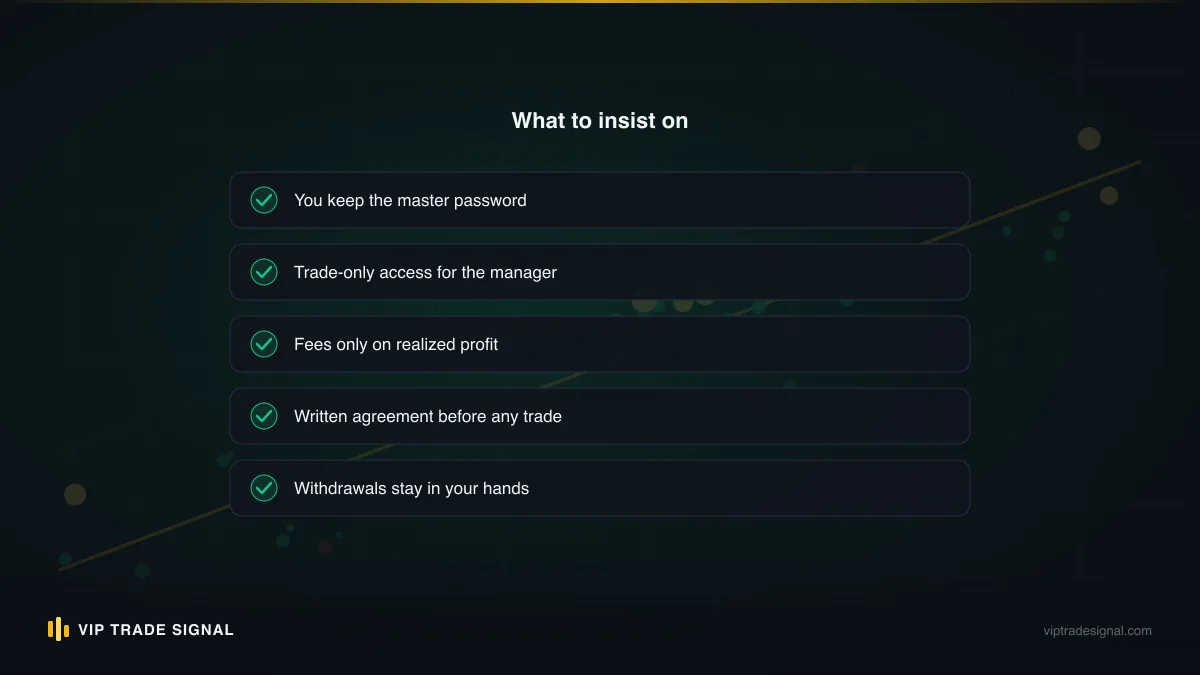
Brokers where the manager controls the account credentials. Not strictly a broker type, but it belongs here: any arrangement where the manager opens the account, holds the master password, or receives withdrawals is over before it starts, regardless of how good the broker is. The structure is the problem.
Brokers with a fresh domain and no history. A trading brand that registered its website eight months ago and already has a "trusted since" badge is telling you what it thinks of your attention span. Broker failures and exit scams cluster hard in young, offshore, aggressively marketed operations. Boring and old is a feature.
None of this means every offshore trader is a criminal or every new broker a scam. It means the base rates are bad enough, and your position in a managed account exposed enough, that you don't need to be the person who finds the exception. There are plenty of brokers with real regulation and a decade of drama-free withdrawals. Choose from that pool and lose nothing.
What "your money never moves" actually requires from the broker
It's worth pausing on the phrase every honest management service uses, ours included: your funds stay in your own broker account. That sentence is only as true as the broker behind it, and it's worth spelling out the machinery, because clients sometimes treat it as a slogan when it's actually a checklist.
For funds to genuinely stay in your own broker account, under your control, four things must all be true at the broker level. The account is in your name, opened with your identity documents — so the broker's legal relationship is with you, not the manager. Withdrawals return only to the source that funded the account — so even a manager who somehow phished your master password can't redirect money to themselves. You hold the master password and can change it instantly — so trading access is a privilege you grant and revoke, not a right the manager owns. And the broker is regulated somewhere that makes all of the above enforceable rather than decorative.
Remove any one leg and the stool tips over. An account in the manager's name means it was never your money in any legal sense. A broker that pays withdrawals to arbitrary third parties turns password theft into cash theft. A platform without client-side password control turns your kill switch into a support ticket. And an offshore broker makes the first three promises exactly as binding as the broker feels like being that week.
This is also the honest answer to "why do managers care which broker I use" in its legitimate form. A manager staking their reputation on the claim that clients' funds are safe needs brokers where that claim is mechanically true. When we take on management clients, the conversation about broker choice happens before the conversation about strategy, for precisely this reason — the strategy question is only interesting once the custody question is boring.
How the broker route works with our service, for what it's worth
Cards on the table, briefly, since this site belongs to a signal and management service and you deserve to know how we handle the exact issues this article raises.
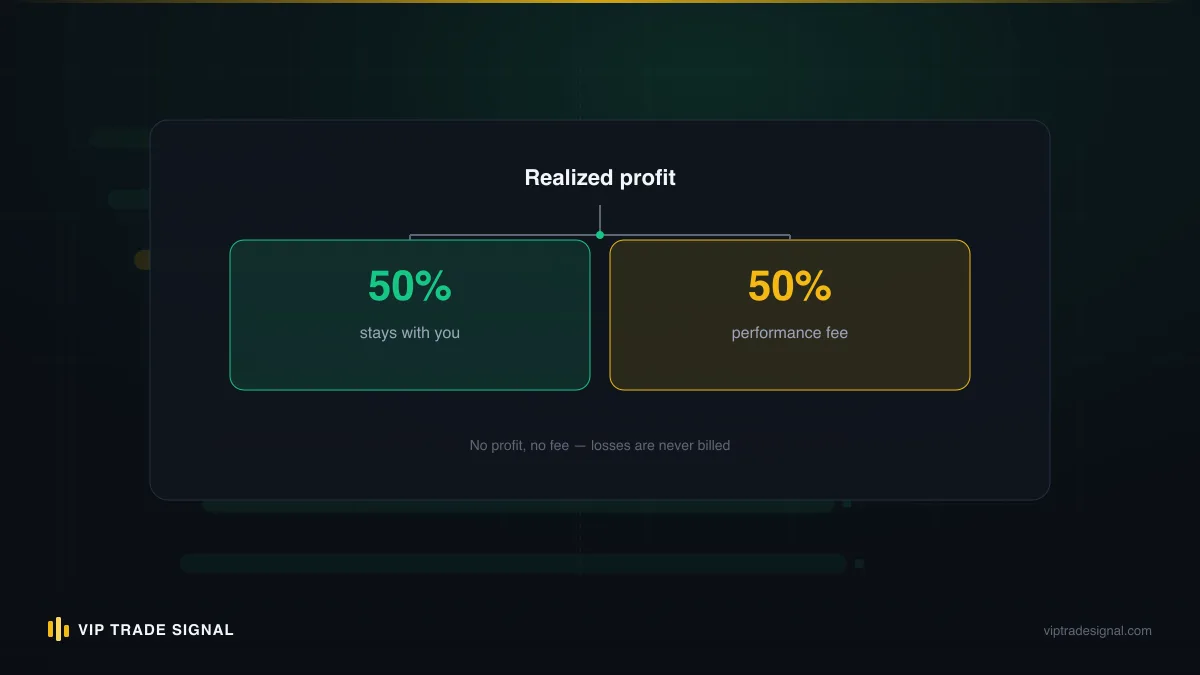
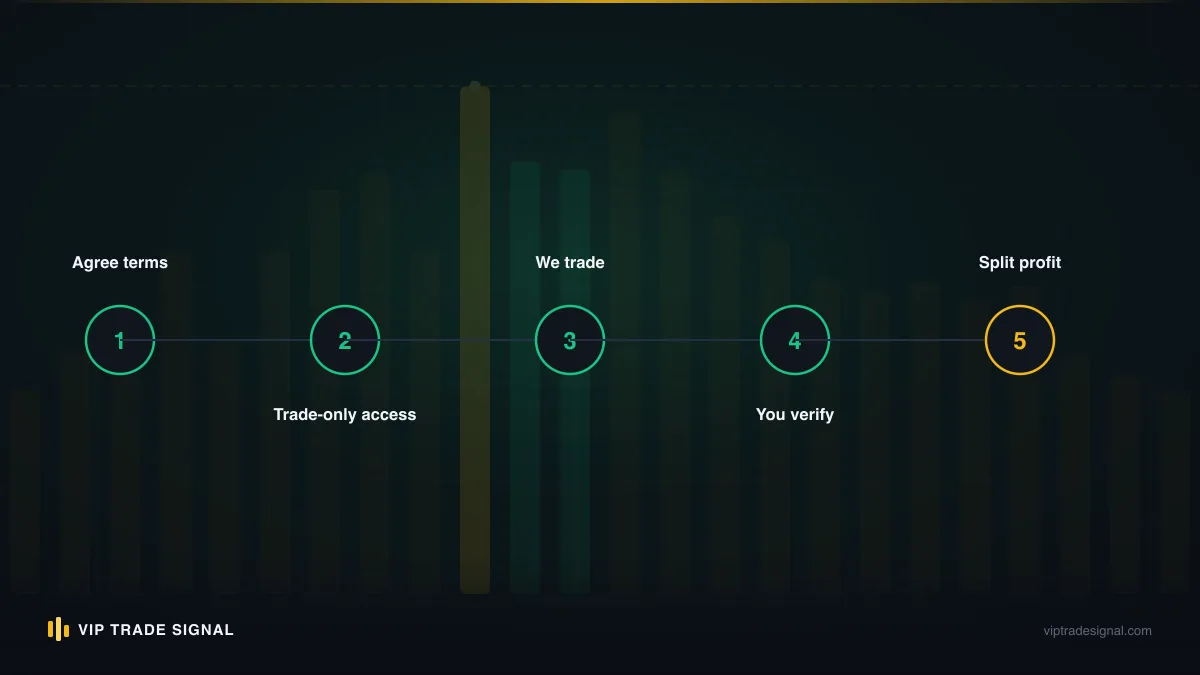
Our account management service trades your own MT4 or MT5 account. Your name, your broker login, your master password — we work from trading access you can revoke in seconds, and we never ask for withdrawal rights because no legitimate manager needs them. The fee is a flat 50% of realized profit with a $200 minimum advance, which is at the high end of the industry, and we say so plainly: you're paying for low minimums and pay-as-you-go terms rather than locking six months of fees into a cheaper headline rate. In losing periods there is no profit and therefore no performance fee, and losing periods happen — gold is a volatile instrument and nobody trades it without drawdowns.
On the signal side, there's a broker angle too: the $99/month VIP signal fee is waived if you trade through one of our partner brokers — Exness, XM, IC Markets or Vantage — with $250 or more maintained in the account. Those four aren't a random list. They're large, multi-regulated brokers with proper MT4/MT5 support, workable gold spreads and long withdrawal track records, which is the standard this whole article has been arguing for. The mechanics of the arrangement are laid out at VIP via broker, and yes, we earn a partner commission on that route — that's the business model, stated out loud rather than buried, and it only works for us long-term if the brokers treat you properly.
Do we insist you use one specific broker? No, and after the red-flag section above you know why we'd better not. For management we work with any broker that clears the bar this article sets: real regulation, your name on the account, return-to-source withdrawals, clean password mechanics, and gold spreads that don't eat the strategy. If your existing broker passes the six-step test, keep it. If you're comparing management services more broadly, our rundown of the best managed forex accounts covers how to weigh fees and structures once the broker question is settled. And the FAQ answers the smaller mechanical questions — access, revocation, what happens at the end of a losing month — in one place.
The order matters: where this leaves you
If you take one structural idea from this piece, take the ranking itself. Most people choose managed account brokers in exactly the reverse order of protective value: they start with whatever broker the manager suggested (criterion five), glance at spreads (criterion three), and never seriously check regulation or test a withdrawal (criteria one and two). That ordering feels efficient because it starts with the decision that's already been made for you. It's also how nearly every managed account disaster begins.
Flip it. Regulation and segregation first, because they decide whether anything else is enforceable. Withdrawal reliability second, tested with real money at small size, because your exit is worth more than your entry. Execution and gold spreads third, because costs compound under an active manager but only matter once your money is actually retrievable. Platform mechanics fourth, because MT4/MT5's password system is your kill switch and you want it in your hand, not in a ticket queue. Manager convenience fifth, because a manager worth hiring can work within a safe structure, and a manager who can't work within a safe structure has told you something more important than any track record.
Your homework, if you're currently evaluating an arrangement, fits on an index card. Look up the broker's actual legal entity on the regulator's own register tonight. Run the $300 deposit-and-withdraw drill this week. Ask the manager whether a tier-one broker of your choosing would work, and listen less to the answer than to the temperature of it. Confirm, in writing, that withdrawals only ever return to source. Change your master password once, just to prove you can, and time it.
Five checks. A fortnight, at most. Managed accounts can be a perfectly reasonable way for someone without time or skill to have their capital traded — but only inside a structure where the worst case is a losing streak rather than a vanished balance. The manager determines whether you make money. The broker determines whether you keep it. Choose accordingly, and in that order.