Type "best managed forex accounts" into Google and count how many of the results are actually reviews. Go on, we'll wait. What you'll find is a wall of top-10 lists, each one ranking the same handful of providers, each one stuffed with affiliate links, and almost none of them written by anyone who has ever handed a live account to a stranger and watched the equity curve wobble.
That's not an accident. The managed forex account industry pays some of the fattest referral commissions in retail finance, and the "review" sites rank whoever pays. The list you're reading isn't a shortlist of the best forex account management services. It's a rate card.
So this article does something different. We're not going to give you a ranked list at all. We're going to give you the scoring rubric — the six factors that actually separate a provider worth trusting from one that will quietly grind your balance down to margin-call territory — and then we'll score ourselves against it, honestly, weak spots included. By the end you'll be able to build your own shortlist in an afternoon, and you'll be able to smell an affiliate funnel from three paragraphs away.
Why most "best managed forex accounts" lists are ads
Here's how the sausage gets made. A provider — call them AlphaFX Capital, because there's always a name like that — wants inflows. They can't advertise "guaranteed 15% monthly" on Google without getting banned, so they do the next best thing: they pay review sites a cut of every referred deposit, usually somewhere between 10% and 30% of fees generated, sometimes a flat bounty per funded account.
The review site then writes a "Best Managed Forex Accounts 2026" article. AlphaFX goes at number one. The write-up mentions "consistent returns" and "professional traders" and links to a signup page four times. There is no methodology section, because there is no methodology. There is a star rating, because star ratings look like diligence.
And the tell — the thing you can check in thirty seconds — is what the list doesn't talk about. Affiliate lists almost never discuss:
- Custody. Whose name is on the broker account? This is the single most important question in the entire industry and the lists skip it.
- Losing periods. Every real trading operation has them. A list that only quotes winning months is quoting marketing material.
- Exit terms. How do you leave? How fast? What does it cost? Silence here is deliberate.
- What happens in a drawdown. Not if. When.
We run an account management desk ourselves, so you should apply exactly the same scepticism to us. That's rather the point of this article. We'd genuinely prefer you judge us with a hard rubric than choose us because we ranked well on a site we could have paid.
One more thing before the rubric. Managed forex accounts are high-risk full stop. Even a competent, honest manager will hand you losing months, and an account trading leveraged FX or gold can fall a long way faster than a stock portfolio ever would. If the money you're thinking of allocating is money you can't watch drop 20% without losing sleep, the best managed account for you is no managed account. Nothing below changes that.
The six-factor rubric
After years around this industry — on both sides of it — we think every provider question you could ask collapses into six factors:
- Verified performance. Can they prove the results, or just describe them?
- Custody. Is it your broker account or theirs?
- Fees. Does the structure pay them for winning, or for existing?
- Risk discipline. What are the drawdown rules, and are they written down?
- Transparency. Do they publish losses, or only highlights?
- Communication and exit. Can you see what's happening, and can you leave?
Score each factor 0 to 5. Anything scoring 0 on custody or verified performance is disqualified outright, no matter how well it does elsewhere — those two are load-bearing. A total of 22+ across the six is a provider worth a serious conversation. Under 15, walk away. Between the two, dig deeper before you fund anything.
The rest of this piece works through each factor: what good looks like, what bad looks like, and the specific questions that make a bad provider squirm.
Factor 1: verified performance — what counts as proof
Start here, because it filters out half the industry immediately.
"Verified" has a specific meaning, and it is not a screenshot. A screenshot of an MT4 terminal can be produced by a demo account, a photo editor, or a live account cherry-picked from a stable of twenty — the manager runs twenty accounts with different strategies, nineteen blow up, and the survivor becomes the marketing. That last one even has a name in the fund world: survivorship selection. Retail managed forex account providers do it constantly and it's almost impossible to detect from the outside, which is why screenshots are worth nothing.
What actually counts as proof, roughly in descending order of strength:
- A live, investor-password-verified feed on Myfxbook, FXBlue or similar, connected to a real account, running for at least twelve months, with the track record privacy settings open. Check that the "track record verified" and "trading privileges verified" badges are both green — one without the other means the data feed can be doctored.
- Read-only investor access to a live account they'll give you directly. Ten minutes of scrolling the trade history tells you more than any brochure.
- A public log of every closed trade, wins and losses, timestamped, going back far enough to include at least one rough patch.
And what doesn't count: PDFs of returns. Testimonials. "Audited by" claims from firms you can't find. Percentages quoted without the account size (a 40% return on a $500 account is $200 — a good month at the pub, not a track record). Anything that only shows monthly aggregates, because aggregates hide the intramonth drawdown that would have made you close the account had you seen it live.
Two subtler checks while you're in there. First, look at the shape of the equity curve. A curve that rises in a smooth, nearly straight line is not a sign of skill — it's the signature of grid and martingale systems, which bank tiny wins for months and then donate the whole account back in a week. Real discretionary trading looks lumpy. It has flat spells and dips. If it looks too clean, it is.
Second, compare average win to average loss. If the average losing trade is four or five times the average winner, you're looking at someone who cuts profits and lets losses run — the strategy equivalent of a ticking clock.
We publish every closed signal — wins, losses, the ugly weeks — at /signals/history, and we'd argue any provider who won't do the equivalent has made a choice about what you're allowed to see. That choice tells you everything.
Questions to ask: How long is the live verified record? Can I have read-only access before funding? What was your worst peak-to-trough drawdown, in percent, and when? (A provider who can't instantly name their worst drawdown either doesn't track it or doesn't want to say. Both are answers.)
Factor 2: custody — your broker account or theirs?
If you take one thing from this article, take this: the best managed forex accounts are the ones where the money never leaves your name.
There are two custody models in this industry, and they are not close.
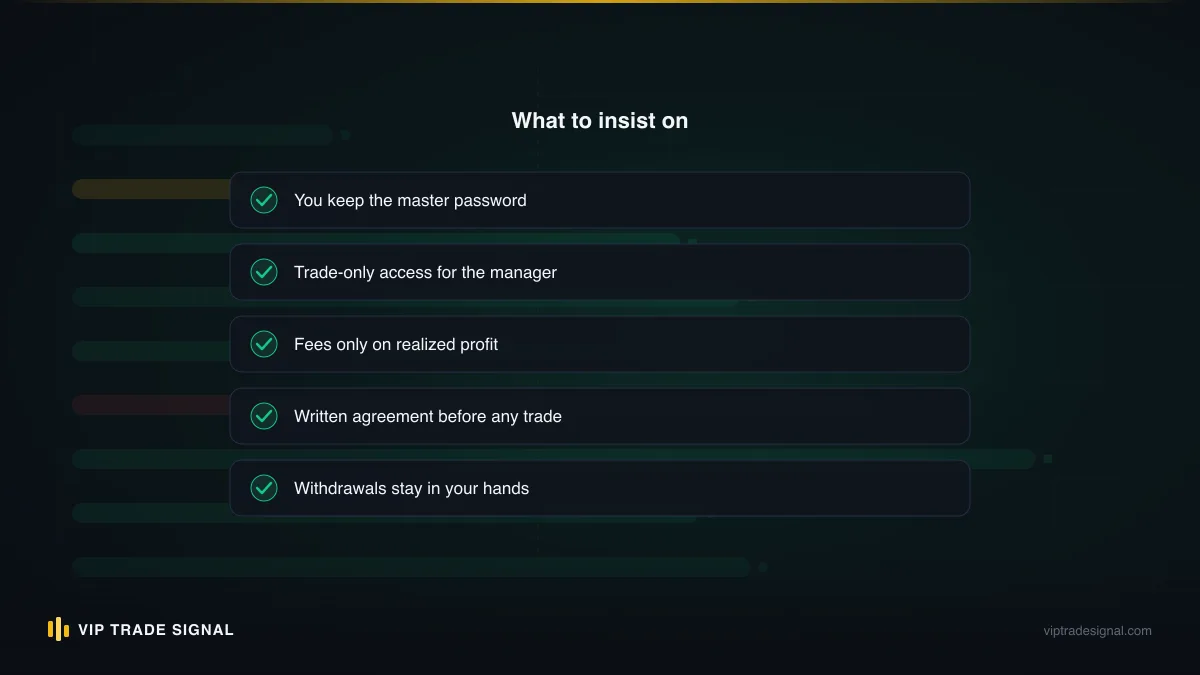
Model one: your account. You open a trading account at a regulated broker, in your name, with your ID. The manager gets trading access only — via a limited power of attorney, a copier, or the trading password — while you keep the master password and the sole ability to withdraw. If the relationship sours, you change the password and it's over in ninety seconds. The worst a bad manager can do is trade badly, which is bad enough, but your capital was never in their hands.
Model two: their account, or a "pool". You wire money to the provider, or to a master account they control, and they allocate you "units" or a "share". This is the model behind essentially every managed forex disaster you've ever read about. Once your money is in their structure, your withdrawal is a request, not a right. Requests get delayed. Delays get excuses. Excuses get a Telegram channel that stops posting.
There's a legitimate version of model two — real, regulated PAMM and MAM structures at established brokers, where the broker (not the manager) holds the funds and enforces the allocation. Those can be fine, and for larger allocations they're standard. But the burden of proof is high: you want the broker's regulation checked at the regulator's own website, not the broker's, and you want the PAMM to be a named product of that broker, not a phrase in the manager's pitch deck.
The unlicensed version — "send USDT to this wallet and we'll trade it" — is not a managed account. It's a donation with extra steps.
One caveat that people miss: even under model one, trading access is real power. A manager with your trading password can't withdraw, but they can over-leverage, revenge-trade, or margin-call the account. We've written up exactly what a manager can and can't do with each level of access in what a forex account manager can actually withdraw, and it's worth ten minutes before you hand credentials to anyone — including us. There's a companion piece on whether you should let someone trade your account at all if you're still at that earlier question.
For the record: our model is your MT4/MT5 account, your broker, your master password, your withdrawals, always. We wouldn't run it any other way, partly on principle and partly because we don't want the regulatory weight of holding client money. Honest self-interest aligns nicely here.
Questions to ask: Whose name is on the broker account? Do I keep the master password? Can I withdraw without your involvement? What regulator covers the broker, and what's the licence number? (Then check the number. Two minutes on the regulator's register. People skip this and it's the whole ballgame.)
Factor 3: fee structures, ranked from fairest to worst
Fees are where incentives live, and incentives predict behaviour better than promises do. Rank the common structures from best-aligned to worst:
| Structure | How it works | Whose side is it on? |
|---|---|---|
| Performance fee on realized profit | Manager takes a % of closed, banked profit only | Yours — they eat what they kill |
| Performance fee with high-water mark | % of profit above the previous peak | Yours, even more so — no re-charging for recovered losses |
| Performance + small management fee | % of profit plus 1-2% of balance annually | Mixed — tolerable at scale, watch the ratio |
| Management fee only | Flat % of your balance, win or lose | Theirs — they're paid for gathering assets, not growing them |
| Per-lot / volume rebates | Manager earns from the broker per trade placed | Actively against you — pays them to churn |
That last row deserves its own paragraph, because it's the quiet engine of most "free account management" offers. If a manager earns a rebate per lot traded, their income scales with volume, not profit. Overtrading isn't a failure mode of that model; it is the model. An account can be churned to zero while the manager books a tidy month. When someone offers to manage your account for free, the fee didn't disappear — it moved somewhere you can't see it.
Now, what's a fair performance fee? Hedge funds classically ran 2-and-20 — 2% management, 20% of profits — on institutional money with institutional minimums. Retail managed forex account providers typically quote 20% to 40% of profits. We charge a flat 50% of realized profit, with a $200 minimum advance, and yes, that's the high end of the market. We're upfront about why: our minimums are low, everything is pay-as-you-go, and there's no management fee, no lock-in and no charge at all in a losing period. On a small account, a manager charging 25% of profits plus 2% of balance annually can easily cost you more in a flat year than we would — because in a flat year we cost you nothing. Run the arithmetic for your account size before deciding which structure actually stings; the full breakdown is on our pricing page. For some account sizes we're the expensive option. For a $2,000 account that would be dead weight to a percentage-of-AUM shop, we're often the only honest option.
The word realized is doing heavy lifting up there, and you should make every provider define it. A fee charged on floating profit is a fee charged on trades that haven't finished losing yet. Insist that fees are calculated on closed, banked profit — and if there's a high-water mark, ask to see the clause in writing, because "we operate a high-water mark" said on a call and a high-water mark in a signed agreement are different animals.
Questions to ask: Is the fee on realized or floating profit? Is there a high-water mark, in writing? Any management fee, and on what balance? Do you receive anything from the broker per trade? (Watch the face on that last one.)
Factor 4: drawdown rules and risk discipline
Every account that gets managed will spend time underwater. The question that separates providers isn't whether drawdowns happen — it's whether the rules for handling them were written before the drawdown or invented during it.
A provider with real risk discipline can answer, on the spot and in numbers:
- Risk per trade. "We risk 0.5% to 1% of equity per position" is an answer. "We manage risk dynamically" is a fog machine.
- Maximum open exposure. How many correlated positions at once? Three longs on gold is one trade wearing three hats.
- A hard drawdown stop. At what peak-to-trough loss does trading pause and a human conversation happen? 15%? 20%? If there's no number, the number is 100%.
- Stop-losses on every position. Ask to see them in the trade history. A manager who trades without stops is a manager who will eventually hold one losing position all the way down while telling you it's about to turn.
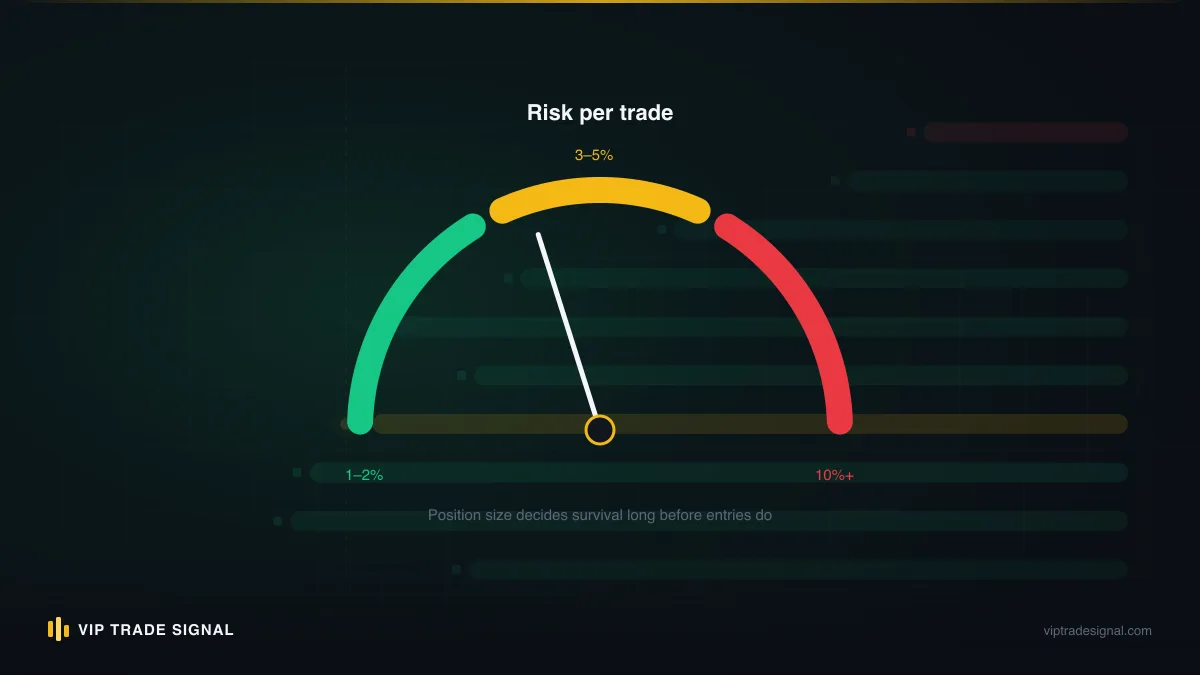
Here's a concrete scenario, because abstractions don't cost anything. Say you hand over a $5,000 account. At 1% risk per trade, a losing trade costs $50 and even a nasty ten-trade losing streak — which happens to good strategies, roughly every year or two — leaves you around $4,520 and fully in the game. At 10% risk per trade, the same streak leaves you near $1,740, down 65%, and the manager now needs to nearly triple what's left just to get you back to even. Same strategy, same streak, completely different survival odds. Position sizing isn't a detail of risk management; at retail account sizes it more or less is risk management.
And be especially wary of the recovery pitch. When an account is already down, some providers propose doubling position sizes "to get it back faster". That's martingale logic and it works right up until it removes the account from existence. A manager's response to a drawdown tells you more than their response to a winning streak ever will: the good ones cut size when losing. The dangerous ones add.
One asymmetry worth naming out loud, since it applies to every performance-fee provider including us: the manager shares your upside but not your downside. Their worst case is unpaid work; yours is lost capital. Written drawdown rules are how you cap that asymmetry, which is exactly why the providers without them prefer vibes.
Questions to ask: What's the risk per trade, as a number? What drawdown level triggers a pause and a conversation? Show me stop-losses in the historical trades. What changed, specifically, during your worst losing streak?
Factor 5: transparency — do they publish losses?
This one has the best ratio of diagnostic power to effort of anything in the rubric. It takes thirty seconds to check and it's nearly impossible to fake over time.
Go to the provider's site, or their channel, or wherever they publish results. Now look only for losses. Not the review-video wins, not the "+180 pips on gold" posts — the losing trades, the losing weeks, the month that finished red.
If you can't find any, one of two things is true. Either they've never had a losing trade, which means they've either traded for a fortnight or they're lying. Or they have losses and chose to hide them, which means every number they do show has been through the same filter. There is no third option, and both of the real ones disqualify.
A provider's losing trades are the only part of their marketing you can trust, because nobody fakes those.
The honest pattern looks different, and you'll know it when you see it. Losses posted with the same formatting and the same promptness as wins. Drawdown stated as a number, not a euphemism ("a challenging period of consolidation" — we've genuinely seen an account half-blown described that way). Rough patches acknowledged in the moment rather than airbrushed into the annual summary. Full history browsable back to the start, not just a rolling highlight reel of the last sixty days.
Watch out for the soft-fake version too: a provider who posts a token loss now and then — small, old, safely surrounded by wins — to buy credibility for the highlight reel. The tell is proportion. Real trading produces losers at a rate no marketing department would choose. If a channel shows 95 wins for every 5 losses, either the wins are tiny and the losses huge (check the money, not the count), or the feed is curated. Usually both.
Transparency also extends backwards. Search the provider's name plus "review", plus "scam", plus "withdrawal". Skim the third page of results, where the SEO polish runs out. Check whether the company name, the domain age and the claimed history line up — a "decade of excellence" claimed by a domain registered fourteen months ago is a short story with a plot hole. None of this is exotic diligence. It's twenty minutes, and it filters brutally.
Questions to ask: Link me to your three worst losing weeks. What's the biggest single losing trade in the published history? Why should I believe the published record is complete?
Factor 6: communication and exit terms
The last factor is the boring one, which is why it gets skipped, which is why it's where people get hurt.
Communication first. Before funding, a provider should tell you what you'll see and how often — and "you can watch every trade live in your own terminal" is the gold standard, which is one more argument for the your-account custody model. During the relationship, you want trade-level visibility (not just monthly summaries), a named human who answers questions, and — this is the acid test — proactive contact when things go badly. Anyone can send the good-month email. The provider who messages you first about a losing week, with numbers and a plan, is showing you the culture. The one who goes quiet in drawdowns and chatty in winning streaks is showing you theirs.
A specific red flag: providers who discourage you from looking. "Don't check the account daily, it'll only stress you out" sounds like kindly advice and sometimes even is — but from a manager it's also exactly what you'd say if the intramonth swings would horrify the client. You're an adult with your own money on the line. Look whenever you like.
Exit terms second. Ask, before you fund, precisely what leaving looks like:
- How much notice, if any?
- Are there open positions at exit, and who decides when they close?
- Any exit fee, "administration" charge, or clawback?
- Under the your-account model: confirm, in writing, that you can revoke trading access unilaterally, any day, by changing the password.
Lock-in periods deserve particular suspicion in retail forex. Real funds have redemption windows because they hold illiquid assets. A retail manager trading spot gold on MT5 holds positions measured in hours or days — there is no liquidity reason your capital needs to be committed for six months. A lock-in on a liquid strategy exists for one purpose: to stop you leaving during the drawdown that the marketing said wouldn't happen.
Under our model the exit terms are structurally simple, and we prefer it that way: it's your account, so leaving means changing your master password and telling us. No notice period, no exit fee, no negotiation. Any provider on the your-account custody model should be able to say the same sentence. If they can't, ask what exactly is stopping you.
Questions to ask: What do I see, and how often? Who contacts me in a losing week — you or me? Walk me through leaving: steps, timeline, cost.
Applying the rubric: a worked example (including us)
Rubrics are only useful once you've watched one run, so let's score two providers: a composite of the offers that land in trading inboxes every week — call them AlphaFX Capital again — and us, scored as coldly as we can manage.
AlphaFX Capital. Their site shows monthly returns of 8-12% as a table of green numbers, no live verification link. Custody is a "secure pooled investment account" — you wire funds to them. Fees are 30% of profits, calculation basis unspecified. Risk is "managed by our expert team using advanced algorithms". Losses are not published anywhere. Exit is "quarterly redemption windows subject to processing".
Scored: performance 1 (numbers exist, proof doesn't), custody 0, fees 2 on paper but unverifiable, risk 1, transparency 0, exit 1. And per the rubric, the zero on custody ends the analysis regardless of the total. It doesn't matter if their returns are real. You can't check, and you can't leave. Disqualified.
Us — VIP Trade Signal's account management desk. Marking our own homework is awkward, so here are both columns.
Where we score well: custody is the clean model — our account management service trades your own MT4/MT5 account, you keep the master password and the sole ability to withdraw, and you can revoke access in a minute, any day. Transparency: every closed signal our desk generates is public at /signals/history, losses included, and the account management side trades the same gold-only approach. Fees are performance-only on realized profit — no management fee, no charge in losing periods. Exit is password-change simple.
Where we lose points, honestly: our 50% performance fee is the highest number in this article, and while we think the structure justifies it at small account sizes — you pay nothing to exist, only on banked profit — a $50,000 account can likely negotiate better economics elsewhere, and we'd rather say that than have you discover it. We're gold-only, so if you want a diversified multi-pair book, we are structurally the wrong desk, full stop. And we're a signals-and-management shop, not a licensed asset manager — nothing we do is personalized investment advice, and an investor for whom regulated advice matters should weight that factor at zero for us and choose accordingly.
Call it roughly 4-4-3-4-5-5 by our own reckoning — with the fee score the one you should stress-test hardest, because it's the one we're least neutral about. That's the honest shape of us: strong on custody and transparency, priced at the top of the market, narrow by design.
Notice what the exercise did, though. It converted "do I trust these people?" — a feeling, easily manufactured — into six checkable claims. That's the whole trick. Run it on three providers and the differences stop being vibes.
The shortlist template you can copy
Here's the process, start to finish, for building your own shortlist of managed forex account providers. Budget two or three evenings — for a decision about handing someone your capital, that's cheap.
- Gather 5-8 candidates from anywhere — yes, even the affiliate lists, which are fine as a phone book and useless as a verdict.
- Run the instant disqualifiers (next section). Expect to lose half the list in twenty minutes.
- Score the survivors 0-5 on each factor. Use only what you can verify: live feeds, written terms, regulator registers, published history. A claim you can't check scores as if it were absent, because functionally it is.
- Apply the thresholds. Zero on custody or verified performance: out, whatever the total. 22+: serious conversation. Under 15: out. In between: dig further before a single pound moves.
- Interview the finalists with the questions from each section above. You're grading the manner as much as the answers — numbers delivered instantly read very differently from numbers assembled defensively.
- Ask for the agreement before funding and check the fee basis (realized?), the high-water mark, the exit terms and the custody language against what you were told. Any daylight between the call and the contract is itself a scoring event.
- Start small and treat the first quarter as a paid audit. Fund the minimum, watch trade-level behaviour against the stated rules — risk per trade, stops, drawdown response. Consistency for a quarter earns more capital. And even then, keep the allocation to money whose loss you could absorb, because a managed account is still a leveraged trading account and no rubric repeals that.
A note on that last step: starting small means compounding does the later lifting, and it's slower than your ambition wants. That's fine. We've written about what compounding a forex account realistically looks like, and the short version is that survivable-and-slow beats impressive-and-dead every time anyone has checked.
Provider types to exclude on sight
Finally, the pre-filter. Some pitches don't merit the rubric because the category is rotten regardless of the individual. Close the tab on:
- Guaranteed or "target" monthly returns. "10% monthly, guaranteed" is a mathematical tell — that's roughly 214% a year compounded, and nobody who could do it reliably would need your $2,000. Guaranteed returns in leveraged trading aren't optimistic. They're fictional.
- Crypto-only deposits to a personal wallet. Not a custody model. A trapdoor.
- Instagram and Telegram DM outreach. Competent managers have waiting capital; they don't cold-message strangers under a photo of a rented Lambo. The pitch finding you is itself the red flag.
- Recovery-fee stackers. "Send more to unlock withdrawals" is the second act of every pig-butchering script ever run. No legitimate provider charges you to access your own money.
- No losing trades anywhere. Covered above. Disqualifying on its own.
- Pressure mechanics. Countdown timers, "two slots left", bonus-for-funding-today. Real capacity constraints exist in fund management; they are never marketed with urgency bars.
- Refuses your-account custody without a regulated PAMM alternative. If the only door is a wire to their structure, and the structure isn't a named product of a broker you can verify with a regulator, that's not a managed account offer. It's a custody transfer dressed as one.
None of these are subtle. That's the strange comfort of this industry: the schemes that take the most money use the oldest tells, because the tells keep working on people who were never shown the list. Now you've been shown the list.
Where this leaves you
The phrase "best managed forex accounts" implies a question with a universal answer, and there isn't one. The best provider for a $2,000 account testing the waters is a different animal from the best provider for a $100,000 allocation that wants regulated multi-asset management — different custody needs, different fee arithmetic, different everything. Anyone selling you a single ranked list is flattening that away, usually because flat lists are what affiliates can sell.
What does generalize is the rubric. Verified performance, or it didn't happen. Your name on the account, or your money is a request away from gone. Fees on realized profit, or the incentives are pointed at you. Written drawdown rules, published losses, and an exit that takes minutes. Six factors, two evenings, and you'll have done more genuine diligence than the authors of every top-10 list you'll ever read — combined, and we're not entirely joking.
Score us while you're at it. Our custody model, our flat 50%-of-realized-profit fee and our $200 minimum are all laid out on the account management page, and our full closed-signal record — the red weeks very much included — is at /signals/history. If we come through your rubric looking like the right fit for your account size and your appetite for a gold-only book, we should talk. If we don't, the rubric did its job, and honestly, we'd rather lose you at the scoring stage than after a misunderstanding with your money in the middle.
Either way: run the rubric before the wire. Every time. The providers worth having will pass it without flinching — and the rest were counting on you never asking.