Somewhere right now, an investor is staring at a PAMM dashboard that stopped updating three days ago, wondering whether the manager is on holiday or in Dubai with everyone's money. That is the moment most people start searching for alternatives to PAMM accounts, and honestly, it usually comes later than it should.
The uneasiness is rational. A PAMM (percentage allocation money management) works by pooling your funds with other investors' funds under one master account that a manager trades. Your money leaves your control the moment it's allocated. You can watch the equity line. You cannot touch the trades, you often cannot withdraw mid-cycle, and if the manager decides to swing for the fences to recover a bad month, you're along for the ride whether you like it or not.
We run an account management desk ourselves, so let's be clear about the angle here: we don't operate PAMMs, we trade clients' own accounts, and we think that structure is better for most retail investors. That's an opinion with an obvious commercial interest attached, so we're going to argue it properly, trade-offs stated out loud, rather than just assert it. There are five real alternatives to a PAMM, and the honest way to rank them is by a single question: how much custody and control do you keep?
Why investors go looking for alternatives to PAMM accounts
Nobody leaves a PAMM that's quietly compounding at a sensible pace. People leave, or never join, because of a handful of structural problems that have nothing to do with any individual manager's skill.
The first is custody. In a PAMM, your capital physically sits in the manager's master account or in a broker-side allocation tied to it. The manager cannot usually withdraw your money to their own bank account (the broker's architecture prevents that, at reputable brokers anyway), but your money is still pooled, still allocated, still one legal or technical dispute away from being frozen. When a broker running PAMM infrastructure goes under, and smaller offshore ones do more often than the industry likes to admit, investors discover exactly how many layers sit between them and their cash.
The second is the trading-period lock. Most PAMMs settle in cycles: monthly, sometimes weekly, occasionally quarterly. Want out mid-cycle? Tough, usually. You wait for rollover, and if the manager is deep in floating drawdown when the cycle ends, you crystallise the loss at the worst possible moment or you stay in and hope. Neither option feels like control because neither is.
The third is opacity. You see an equity curve and a percentage return. You do not see position sizing, you rarely see open trades in real time, and you almost never see whether that lovely smooth curve is built on grid-and-martingale mechanics that will look wonderful for eleven months and then delete two years of gains in an afternoon. We have watched that film several times. The ending doesn't change.
The fourth, and the one people underrate, is the incentive mismatch. A PAMM manager's income scales with assets under management. More investors, bigger pool, bigger performance fees on a bigger base. That pushes managers toward marketing and toward return-chasing, because a flashy month recruits more capital than a boring safe one. The investors who arrive after the flashy month are, statistically, the ones who fund the drawdown.
Put those together in one story and it looks like this. A trader we'll call Sam allocates $5,000 to a PAMM ranked third on his broker's leaderboard: 140% over eighteen months, drawdown listed at a civilised 12%. Month one returns 4%. Month two, 6%. Month three, the dashboard shows minus 31% and Sam learns three things in the same afternoon. The listed drawdown was closed-trade drawdown and ignored floating losses. The manager had been averaging into a losing gold short for six weeks. And his withdrawal request sits in a queue until the trading period ends in nineteen days. Nothing about that sequence required a dishonest manager. It required only a normal PAMM, a normal losing streak, and the standard settlement mechanics doing exactly what the fine print said they would.
None of this means every PAMM is a trap. Some are run well by disciplined people at properly regulated brokers. But the pamm account disadvantages listed above are baked into the structure, not the individuals. And structure is the thing you can actually choose. So let's choose.
The axis that actually matters: custody and control
You can compare investment structures on a dozen dimensions: fees, minimums, returns, regulation, effort. Most comparison articles do, and most end up as a mush of "it depends". We're going to rank on one axis first and treat everything else as secondary: how much custody and control does the investor retain?
Custody means: whose name is on the account, who holds the withdrawal rights, and can you get your money out today without anyone's permission. Control means: can you see every trade, can you cap the risk, and can you pull the plug mid-position if something looks wrong.
Ranked on that axis, the five alternatives stack like this:
- Direct management in your own account (LPOA). Funds never leave your broker account; you keep withdrawal rights and the master password.
- MAM accounts. Pooled execution but individual sub-accounts; partial custody, limited control.
- Copy trading. Your account, your money, but trade selection fully outsourced and mirrored automatically.
- Signal services. You keep everything, including the obligation to press the buttons yourself.
- Regulated funds and ETFs. Custody handed to an institution, but a regulated, insured, boring institution.
Notice something odd about that list: the alternative with the most control (signals) demands the most work from you, and the one with the least control (funds) is arguably the safest for a certain kind of investor. Custody and control aren't free. They cost either effort or fees, and the right choice depends on which currency you'd rather pay in. Keep that trade in mind as we go through each one properly.
Alternative 1: direct management in your own account
This is the managed forex account vs pamm distinction that trips up half the people searching for either term, so let's nail it down. In a direct managed account, you open a trading account at a broker of your choosing, in your name, funded with your money. You then grant a manager trading access: either a limited power of attorney (LPOA) document or, more commonly at the retail level, the account's investor-to-trader arrangement where the manager receives trading credentials while you keep the master password.
The difference from a PAMM is total. Your money never pools with anyone else's. Your broker relationship is yours. You can log in any evening and see every open position, every lot size, every stop. And (this is the part that matters at 2am when doubt strikes) you can withdraw your funds or revoke the manager's access unilaterally, today, without waiting for a settlement cycle or asking anyone's permission. The manager trades; the manager cannot touch the money. If you've ever wondered whether a forex account manager can withdraw your money, the clean answer in this structure is: not if it's set up properly, because withdrawal rights live with the master password and the master password lives with you.
That's the custody case. Now the trade-offs, because there are real ones.
First, minimums and fees tend to be higher per pound managed. A PAMM can accept $100 from a thousand investors because the pooling does the aggregation. A manager trading individual accounts does individual work, sizing for your balance and managing your specific drawdown, so most desks set minimums in the thousands and charge performance fees at the top of the range. Ours is a flat 50% of realized profit with a $200 minimum advance, which is high-end pricing, and we say so plainly: you're paying for a low entry point, no lock-in, and pay-as-you-go terms rather than for cheapness. A 20-30% performance fee with a $25,000 minimum and a quarterly lock is the more traditional shape. Different trades, not different honesty.
Second, your control cuts both ways. Because you can interfere (close trades, withdraw margin mid-position, panic at a floating loss) some clients do, and interference mid-strategy is how a coherent plan becomes an incoherent one. Any manager worth hiring will tell you the deal upfront: watch everything, touch nothing while a strategy is live, and use your power as an off-switch, not a steering wheel.
Third, you carry the diligence burden alone. In a PAMM you at least get the broker's ranking table, flawed as those are. With direct management you must verify the manager's track record yourself, real account history rather than screenshots, and check the drawdowns as hard as the returns. Losing months are part of trading gold, forex, anything leveraged; a manager who claims otherwise is the manager to avoid. Our own account management service exists precisely in this structure, and even for us the correct client behaviour is: verify first, fund second. We've written before about what the better managed account desks actually look like if you want the fuller diligence checklist.
On the custody axis, though, nothing else comes close. Your name, your account, your password, your exit.
Alternative 2: MAM accounts, or pooling lite
A mam account forex structure (multi-account manager) sits one rung below. It's often mentioned in the same breath as PAMM, and brokers love blurring the two, but the plumbing differs in a way that matters.
In a MAM, each investor holds an individual sub-account at the broker, in their own name. The manager trades a master account, and the platform mirrors those trades into every sub-account according to an allocation method: proportional by equity, fixed lots, or a custom ratio per client. So when the manager buys 10 lots of gold, your sub-account might receive 0.4 lots, your neighbour's 1.2, each scaled to the balance behind it.
That individual-sub-account detail buys you two real things a PAMM doesn't offer. Your money sits in an account bearing your name rather than in a communal pot, which improves your legal position if anything goes wrong at the broker. And you typically get real-time visibility of your own positions, because they're literally your positions, mirrored into your account, not a percentage claim on someone else's.
Some MAM setups add per-client risk parameters: a maximum leverage on your sub-account, or an equity floor that detaches you from the master if breached. When those exist and actually work, a MAM starts to feel like a halfway house between pooled and direct management.
But (and here's where "pooling lite" earns the name) control remains largely ceremonial. You cannot close an individual trade in your sub-account without breaking the mirror. Detaching mid-position usually means crystallising whatever floating P&L you're carrying at that instant. Withdrawal terms are looser than a PAMM's cycle-lock but still commonly gated by notice periods. And you inherit the master account's behaviour wholesale: if the manager runs 30 positions of martingale ladder, your tidy little sub-account runs a scaled copy of the same ladder. The mirror doesn't filter for sanity.
The other quiet issue is allocation fairness. Fixed-lot allocation on mixed account sizes means a $2,000 sub-account and a $50,000 one take the same absolute risk per trade, ruinous for the small account and trivial for the large one. Proportional allocation fixes that on paper, but partial fills and slippage on the master account get distributed somehow, and "somehow" is a word to interrogate before you sign. Ask the broker, in writing, how partial fills allocate. The pause before they answer tells you plenty.
One more practical note on fees, since MAM pricing hides a wrinkle PAMM pricing doesn't. Most MAM managers charge a performance fee per sub-account with a high-water mark, which sounds investor-friendly until you realise the high-water mark resets if you detach and re-attach. That is a thing people do after drawdowns, which is precisely when the mark was protecting them. Detach at minus 15%, re-attach a month later, and you'll pay performance fees on the recovery back to your own old equity. Read the fee clause twice. Then read it again after a losing month, when it suddenly means something.
Verdict: a MAM is a genuine improvement on a PAMM for custody, a marginal one for control, and a sensible choice mainly when the specific manager you want only operates through one. Choose the manager first, then tolerate the structure. Never the reverse.
Alternative 3: copy trading — control kept, discipline outsourced
Copy trading is the structure most people actually mean when they say they want a PAMM alternative, even if they don't know it yet. Your account, at your broker or on a platform like the big social-trading networks, stays entirely yours. You select a trader to copy; the platform mirrors their trades into your account automatically, scaled to a proportion you set. You can pause copying, close copied positions manually, cap the allocation, and walk away at any moment.
On paper that's nearly as much control as direct management. In practice the copy trading vs pamm comparison is less flattering than it looks, for three reasons that only show up after you've done it a while.
Reason one: the leaderboard problem. Copy platforms rank traders by recent returns because recent returns are what recruits copiers. Recent returns are also the single most misleading statistic in retail trading. A trader who doubled their account in six months almost certainly did it with position sizing that will, given enough time, produce the mirror-image result. The leaderboard is a survivorship engine. The blown accounts fall off it silently, and the current top ten are disproportionately the lucky tail of an aggressive cohort. Sorting by lowest maximum drawdown instead of highest return improves your odds more than any other single click on those platforms. Almost nobody does it.
Reason two: execution drift. Your copied trade fills after the master's, at your broker's spread, with your slippage. On slower pairs this barely matters. On gold around a news release, the master might be in at 3,318 and you at 3,321, and if their stop was 30 points wide, you've silently taken on 10% worse risk-reward on every such trade. Multiply across a year and two accounts running the "same" strategy diverge meaningfully. The master's published curve is not your curve. Ever.
Reason three, and the big one: copy trading outsources discipline while leaving temptation fully armed. You can interfere at any time, so people do. They pause copying after three losses (right before the recovery), un-pause after a hot streak (right before the drawdown), manually close the winner early and let the copied loser run. The structure gives you a steering wheel and the statistics say most people crash with it. A PAMM at least handcuffs you to the manager's plan; copy trading hands you the handcuff key and dares you to use it hourly.
If you do go the copy route, three settings do most of the protective work and take five minutes to configure. Cap the copy allocation at a fixed sum, never "copy proportionally to my whole balance": the trader you copy today is not the trader you diligenced if their style drifts, and a cap contains the damage. Enable the platform's copy-stop-loss where one exists, set somewhere around 20-25% of the allocated sum, and treat it as final. If it triggers, the relationship is over, no re-entries on a hunch. And copy at least two uncorrelated traders rather than one. Not because diversification makes copy trading good, but because it stops one person's bad quarter from being your entire result. None of this fixes the leaderboard problem or the drift. It just means the mistakes arrive in survivable sizes.
Copy trading works best for the investor with genuine self-restraint, a small allocation they treat as one sleeve of a portfolio, and the patience to judge a copied trader over six months rather than six trades. That investor exists. Be honest about whether it's you.
Alternative 4: signal services, maximum control for maximum effort
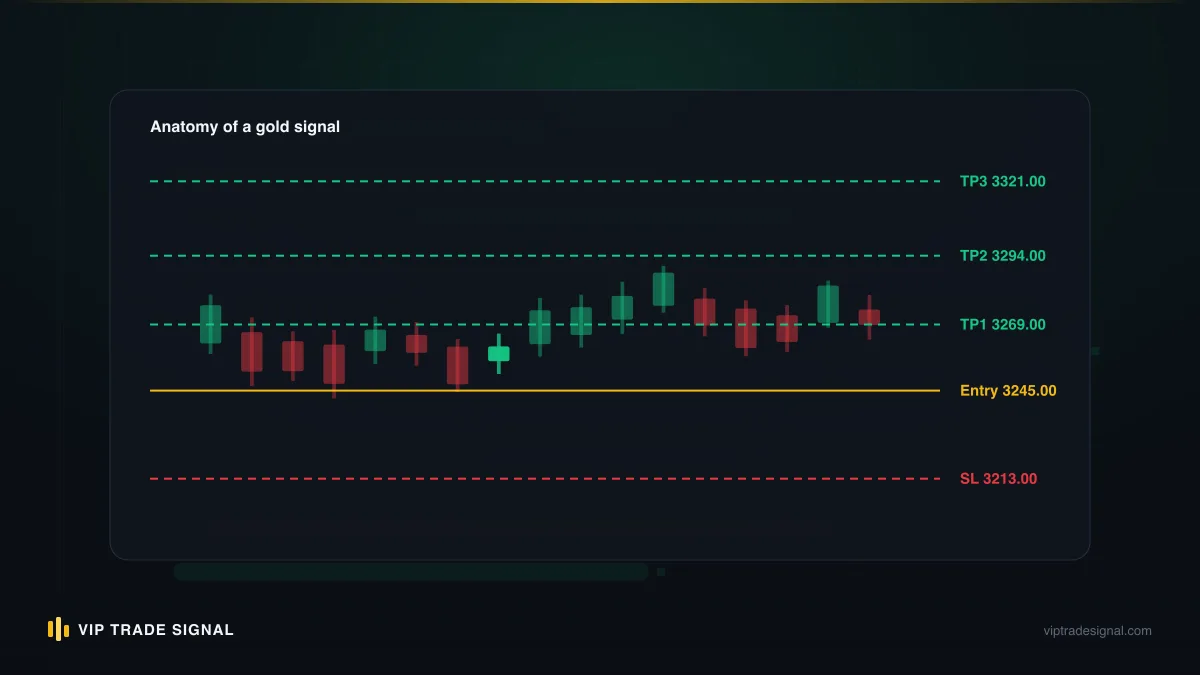
Now the far end of the control spectrum. A signal service delegates nothing but the analysis. Someone sends you the trade (instrument, direction, entry, stop, targets) and every other decision remains yours: whether to take it, what size, when to move the stop, when to bank it. Your money never even shares a room with anyone else's. There is no custody question at all because nothing is delegated except an opinion.
That makes signals the purest PAMM alternative on our axis, and also the most demanding. You need to be at or near the screen when signals land, or use pending orders intelligently. You need to size positions yourself, and position sizing, not entry selection, is where most followers quietly bleed. A $2,000 account risking 1% has $20 of room per trade; on a gold signal with a 300-point stop, that's 0.06 lots, and the follower who takes 0.5 lots "because the setup looked strong" has converted a 1% risk into an 8% one without noticing. The signal was identical. The outcomes weren't.
You also need to filter providers ruthlessly, because the signal industry's floor is somewhere in the basement. Most signal Telegram channels are marketing funnels with a chart on top: free tips as bait, an upsell to a "VIP" tier, and a track record that exists only in cherry-picked screenshots. The one non-negotiable test is whether the provider publishes every closed signal, losers included, in a form that can't be quietly edited. We publish ours (the full closed history, wins and losses, sits at /signals) not because we're saints but because a signal service that hides its losers is asking you to buy a story, and stories are free. Ours runs gold only, XAU/USD, unlimited signals at $99 a month, or free through a partner broker if you hold $250+ with one of them. Losing signals happen every month. Anyone telling you otherwise, in this business, is selling something worse than signals.
The honest trade-off summary: signals give you everything a PAMM takes away (custody, visibility, sizing control, an instant exit) and charge you in attention, discipline, and execution skill. If you have the hours and the temperament, it's the strongest structure on this list. If you don't, it's a way to underperform the very signals you're paying for, one mistimed entry at a time.
Alternative 5: regulated funds and ETFs for the risk-averse
The last alternative points the opposite direction, and it deserves a fair hearing precisely because it hands custody away, but to a different class of counterparty entirely.
A regulated fund (a UCITS vehicle, a currency or managed-futures ETF, a properly authorised CTA programme) takes your money into pooled custody just as a PAMM does. The difference is everything wrapped around the pool: independent custodians holding the assets, audited accounts, a regulator with actual teeth, daily liquidity in the case of ETFs, and compensation schemes if the institution itself fails. A PAMM at an offshore broker offers none of that. Your protection there is the broker's software and your own vigilance.
The price of all that safety is threefold. Returns from regulated FX and managed-futures vehicles are, bluntly, modest. These are diversifiers, not lottery tickets, and a good year might be high single digits. Fees are lower than performance-fee structures (an ETF might charge 0.4-0.9% annually) but you pay them in flat years too. And control rounds to zero: you can redeem, and that is the entire toolkit. No trade visibility, no sizing input, no manager relationship. You own units, not positions.
So why does it make the list? Because a decent fraction of people searching for PAMM alternatives shouldn't be in delegated leveraged trading at all. If the money in question is money you cannot afford to see down 30% (house deposit, emergency fund, next year's school fees) then no structure on this list fixes that, and the regulated, boring, liquid option is the honest recommendation. Leveraged gold and forex trading is high risk in every wrapper. The wrapper changes who holds the risk and how visibly; it never removes it. We'd rather say that and lose a client than skip it and deserve to.
The five side by side
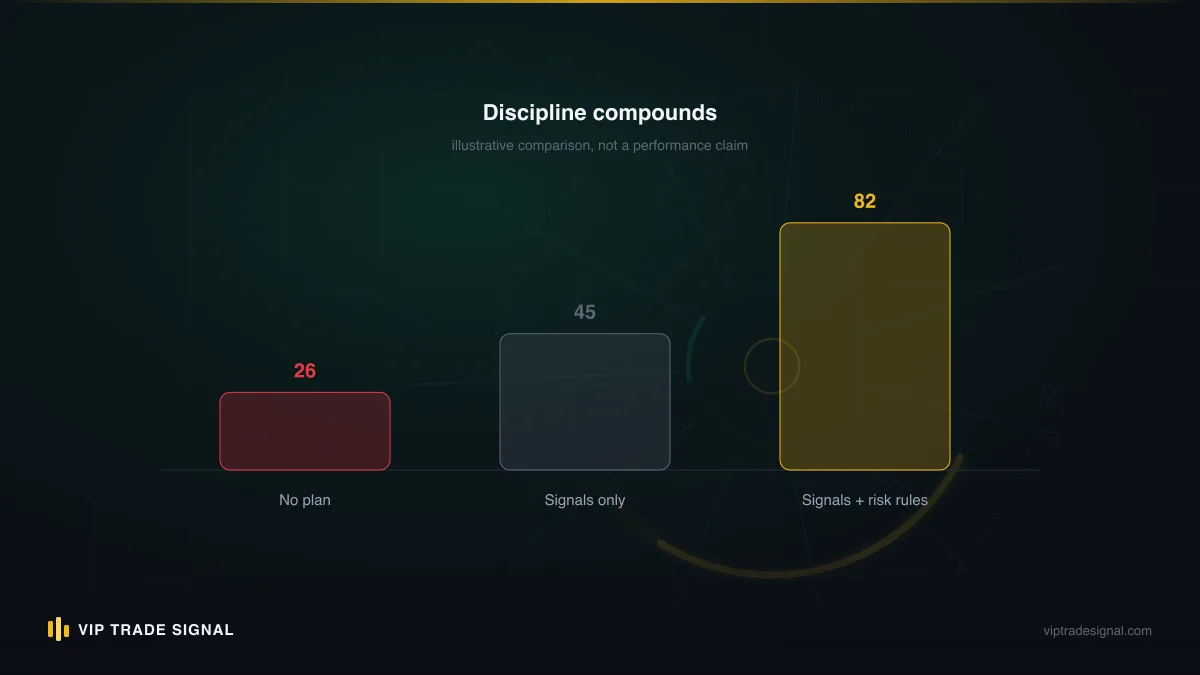
Here's the whole comparison in one place, PAMM included as the baseline, across the seven dimensions that actually decide the choice.
| Dimension | PAMM (baseline) | Own-account (LPOA) | MAM | Copy trading | Signals | Regulated fund/ETF |
|---|---|---|---|---|---|---|
| Custody of funds | Pooled, manager's master | Yours entirely | Your sub-account | Yours entirely | Yours entirely | Institutional custodian |
| Withdraw anytime | Cycle-locked | Yes | Usually, with notice | Yes | Yes | ETF yes; funds vary |
| See every trade live | Rarely | Yes | Yes (mirrored) | Yes | Yes (you place them) | No |
| Can intervene mid-trade | No | Yes (shouldn't) | Barely | Yes | Fully | No |
| Effort required | Minimal | Low | Low | Low-medium | High | Minimal |
| Typical cost shape | 20-50% perf. fee | Perf. fee, higher % | Perf. fee | Spread markup / fee share | Flat subscription | 0.4-2% annual |
| Regulatory protection | Broker-dependent, often thin | Broker-dependent | Broker-dependent | Platform-dependent | N/A (your account) | Strong |
Read the table vertically and a pattern jumps out: no column wins every row. Own-account management and signals dominate on custody and visibility; funds dominate on protection; copy trading and MAM split the difference and pay for it by excelling at nothing. Which is exactly why the next question isn't "which is best" but "which failure mode can you live with".
Matching the alternative to your situation
Structures don't fail in the abstract. They fail against a specific person's balance, temperament and available hours. So match on those.
You have $2,000-$10,000, a full-time job, and no desire to trade yourself. Direct own-account management is built for you, provided you accept the fee logic. At this account size the traditional 25%-fee-$25k-minimum desks won't take you, PAMMs will (that's their pitch), and the choice narrows to a low-minimum own-account desk or copy trading. We'd argue for the own-account route on custody grounds alone, since your money stays behind your password, but go in clear-eyed that low minimums are financed by high performance fees. Ours is 50% of realized profit; that is the top of the market, and it buys no lock-in, a $200 minimum advance, and your name on everything.
You have the same balance and two hours an evening. Signals become viable and possibly better. You'll pay a flat $99 a month (or nothing, via the broker route) rather than half your profits, keep every decision, and learn something durable in the process. The catch is that the whole structure lives or dies on your execution discipline. If this is your first year around leverage, expect the tuition to be paid in small losing trades. Budget for it. Everyone pays it.
You have $50,000+ and want diversification, not a project. Split it. A regulated managed-futures or gold-linked ETF sleeve for the bulk, and (if you want active FX exposure at all) a strictly capped allocation to a verified manager or copy relationship you've diligenced over months. The single worst move at this balance is concentrating it in one unregulated pooled vehicle because the equity curve looked smooth. Smooth curves are the industry's favourite costume.
You're already in a PAMM and merely uneasy, not burned. Don't lurch. Uneasy is a research trigger, not a fire alarm. Spend a cycle collecting facts: the manager's full history including 2022-style drawdown periods, the broker's regulatory status, the actual withdrawal mechanics tested with a small partial redemption. If everything checks out, staying is a defensible choice. Plenty of PAMMs are run honestly. If anything smells off, the next section is yours.
Your account is already deep underwater with a manager. A different problem, and one where switching structures mid-drawdown usually makes things worse, because a new manager inherits a wounded balance and every incentive to over-trade it back. What a stuck account needs first is honest triage: a recorded baseline, a hard cap on further risk, and a recovery plan measured in months, not a heroic fortnight. We run a separate drawdown desk for exactly that shape of account, roughly $5k-$10k of floating loss, priced as 50% of recovered profit above a jointly recorded baseline. The first thing we tell every enquiry is that no recovery is guaranteed. Some accounts are too far gone, and the honest answer there is to stop the bleeding, not to chase it.
The structure you choose decides your worst day, not your best one. Pick for the worst day.
Whatever your situation: the broker under the structure matters nearly as much as the structure. A perfect LPOA arrangement at a bucket-shop broker is still a bucket-shop relationship. We keep a separate piece on which brokers suit managed setups, where regulation, segregation of client funds, and execution quality do the heavy lifting.
Migrating out of an existing PAMM cleanly
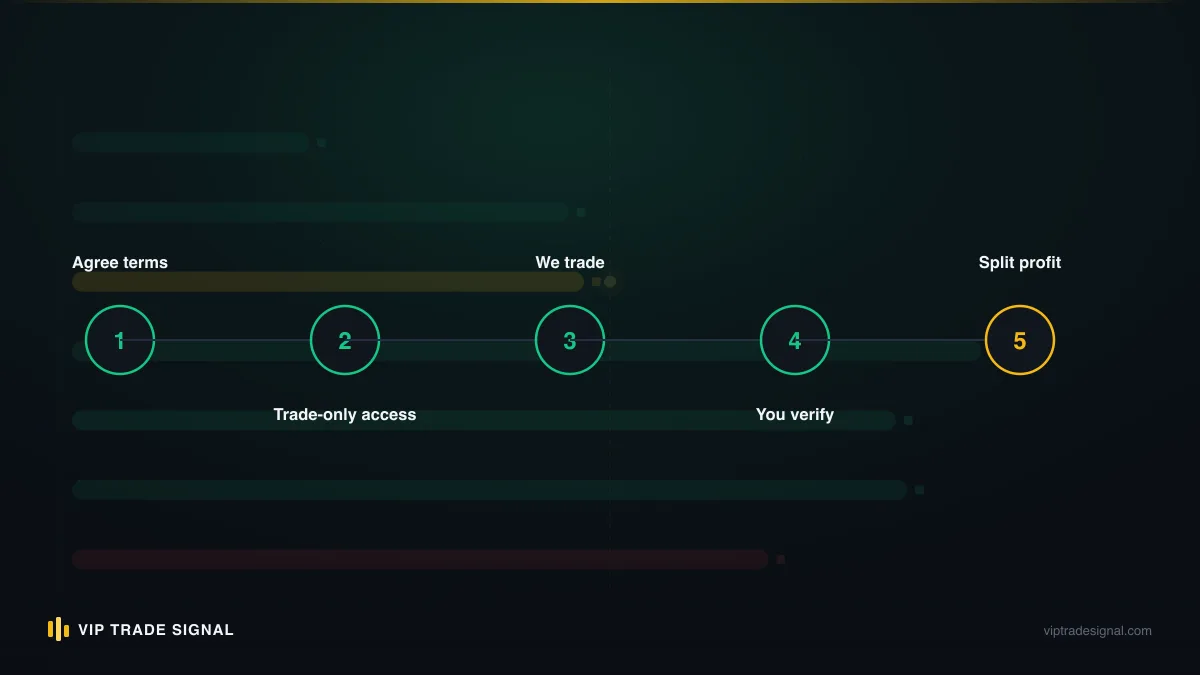
Deciding to leave is the easy half. Leaving without donating money to the exit is the half people botch, so here's the sequence we'd follow, in order, no steps skipped.
- Read your investment agreement before touching anything. Find the trading-period end date, the notice requirement for withdrawal, and any early-exit penalty. Some PAMMs charge 1-3% for mid-cycle exits; others simply refuse them. Know which you're in.
- Time the exit to a settlement rollover, not an emotion. Submitting withdrawal mid-cycle while the manager carries floating losses either locks in your share of that loss or gets queued anyway. Flag your full withdrawal for the next rollover and let the cycle close it out.
- Withdraw to your own bank account, fully, before opening anything new. Not to another product at the same broker, however convenient the internal transfer looks. Cash in your bank is the only state in which your capital is unambiguously yours; pass through it deliberately. If the withdrawal drags past the stated processing window, escalate in writing immediately. Delays are data.
- Open the new account in your own name at a broker you chose. Your jurisdiction, your regulator, your paperwork. If the new manager "recommends" one specific obscure broker and gets cagey about alternatives, that is a rebate arrangement wearing a suggestion costume. Reputable desks work at multiple regulated brokers, ours included.
- Grant limited access, keep the master password, and confirm the boundary in writing. Trading credentials to the manager; master password and withdrawal rights to you; the fee terms and any baseline figures recorded where both parties can see them. One email that says "you trade, I hold withdrawals, fee is X of realized profit" prevents ninety percent of future disputes.
- Start smaller than your PAMM allocation and scale on evidence. Whatever you had pooled, begin the new arrangement with a fraction of it. A manager's real behaviour in your account over two or three months (sizing, stop discipline, how they handle a losing week) is worth more than any track record PDF. Add capital when the evidence earns it. And if it doesn't? You're one password change from done, which is rather the point of the whole migration.
The full move typically takes four to eight weeks door to door, most of it waiting on the PAMM cycle. Slow is fine. Slow with your capital in your own name at the end of it is the win condition.
Where this leaves you
Strip the branding off every structure in this piece and you're left with one trade repeated five ways: control exchanged for convenience, at varying rates. A PAMM sits at the convenience extreme and charges you custody for it. Signals sit at the control extreme and charge you effort. Everything else is a point on the line between.
Our position, stated with the bias disclosed and the trade-offs on the table: for a retail investor with a modest account who wants their trading delegated, direct management in an account they own is the structure that fails most gracefully. Not the cheapest. Performance fees at the low-minimum end of the market are steep, ours very much included. Not the safest in absolute terms either, because leveraged gold trading can and does produce losing months no matter whose name is on the account, and anyone promising otherwise should be walked away from at speed. But when something goes wrong, and over a long enough horizon something always does, the own-account investor changes a password and moves on. The PAMM investor joins a queue.
So here's the hard question to sit with before you move a single pound: if your manager vanished tomorrow, what exactly would you do first? If the honest answer is "log into my own account and revoke access", you've chosen well. If it's "email support and hope", you already know what needs to change. Choose the structure whose worst day you can survive, verify the human being behind it against a public record of wins and losses, start small, and keep the master password where it belongs. With you.