Open your trade history right now and sort by duration. Go on, actually do it. If you're like most retail traders — and we've looked inside a lot of accounts on this desk — you'll find the same lopsided picture: your winning trades lived for minutes or hours, and your losing trades lived for days, weeks, sometimes months. The worst one is probably still open.
Nobody plans this. Nobody sits down on a Sunday night and writes "strategy: bank profits instantly, marry every loser" into their trading journal. And yet that's the strategy almost everyone ends up running, because the question of why traders hold losing trades too long has nothing to do with intelligence and everything to do with wiring. Three separate, lab-verified biases — loss aversion, the sunk cost fallacy, and the disposition effect — all push in the same direction on a live account. Each one alone is enough to skew your decisions. Together they're the reason a $10,000 account can end up 60% underwater on a single gold position that "just needs to come back a bit".
This article walks through each bias, shows you exactly how it shows up in a real trading account (stops deleted, hedges placed, statements left unopened), and then gives you a mechanical countermeasure for each. Not a pep talk. Mechanics. Because the one thing we've learned managing drawdown accounts is that willpower loses to wiring every single time, and the only traders who beat this pattern are the ones who stopped trying to out-discipline it and started building rules that don't need discipline at all.
Why traders hold losing trades too long: the pattern in the data
Let's put an illustrative trader on the table. Call him Sam. Sam trades gold, $5,000 account, no fixed system but a decent eye for levels.
Monday, Sam goes long XAU/USD from 3,310. By lunchtime it's at 3,318 and he's up $80 on his lot size. He closes it. Why wouldn't he? Eighty dollars is eighty dollars, the market's been choppy, and there's a small, warm certainty in banking it that no open profit can match. Trade duration: four hours.
Wednesday, Sam goes long again from 3,340. This time gold drops. By Thursday he's $80 down — exactly the mirror of Monday's trade. Does he close it? Of course not. It's "a temporary pullback". By the following week he's $260 down and has moved his stop. By month's end the stop is gone entirely, the position is $700 underwater, and Sam has stopped checking the account before bed because it ruins his sleep. Trade duration: still counting.
Same trader. Same market. Same dollar amount at the decision point. Completely opposite behaviour — and here's the uncomfortable part: Sam's behaviour is the norm, not the exception. Brokers see it across their whole book. We see it in nearly every account that arrives at our drawdown management desk: a graveyard of small green trades and one or two enormous red ones doing all the damage.
The maths of this pattern is brutal in a way that isn't obvious until you write it down. Say your winners average $80 and your losers average $700 because you hold them so long. You now need almost nine winning trades to pay for one loser. A trader with a genuinely good 60% win rate still bleeds out under that structure. The win rate was never the problem. The hold times were.
And hold times aren't set by your strategy. They're set by how your brain processes losses. Which brings us to the first and heaviest piece of wiring.
Loss aversion: why losses hurt roughly twice as much
Loss aversion is the granddaddy of behavioural finance findings, and unusually for trading psychology, it isn't pop science. Kahneman and Tversky demonstrated it across decades of experiments: humans feel the pain of a loss somewhere around twice as intensely as they feel the pleasure of an equivalent gain. Losing $500 hurts about as much as winning $1,000 feels good. The exact multiple varies by person and by study, but the asymmetry itself shows up everywhere researchers have looked — in students, in professional traders, in monkeys trading tokens for grapes.
Sit with that for a second, because everything else in this article flows from it.
If losses hurt twice as much as gains feel good, then closing a losing trade isn't a neutral administrative act. It's choosing to take the most painful thing your trading brain can experience, right now, voluntarily. Holding the loser, by contrast, keeps the pain in a strange suspended state — it's there, but it hasn't been confirmed. Your brain treats an open loss the way you treat an unopened letter from the tax office. The bad news doesn't fully count until you look.
This is loss aversion in trading in its purest form, and it explains both halves of Sam's pattern at once. He banks the $80 winner fast because a small certain gain beats the risk of watching a gain turn into a loss — the single most aversive sequence a trader can experience. And he holds the $700 loser because closing it converts suspended pain into confirmed pain, at double intensity.
Notice something important: at no point does Sam make a decision about gold. He thinks he's analysing the market. He's actually managing his own anticipated feelings, using his trading account as the instrument. The chart is set dressing.
A few ways loss aversion shows up that you might recognise:
- You check a winning trade every few minutes but "give the loser room" by not looking at it for a day.
- You feel genuine physical relief when a loser gets back to breakeven — and close it instantly there, for nothing, after risking hundreds.
- You'd rather hold a position 40% down for three months than be flat and admit the 40% today.
- Your finger hovers over the close button on a red position and simply will not press it, while the same finger closes green positions with no hesitation at all.
That breakeven behaviour deserves its own sentence, because it's the tell. A trader who rides a position from -$600 back to $0 and closes it there has just told you, in data, that the trade was never about the market. If the setup was valid, breakeven is a terrible exit. The only thing breakeven offers is the removal of pain. That's what was being traded.
The sunk cost fallacy on a trading account
Loss aversion explains why closing hurts. The sunk cost fallacy explains why the hurt gets bigger the longer you hold — why a trade that would have been easy to close at -$100 becomes impossible to close at -$1,000.
The sunk cost fallacy in trading works exactly like it does everywhere else in life: we weigh money and effort already spent as a reason to spend more, even though the spent portion is gone regardless of what we do next. It's why people finish terrible films, why companies pour a second $10 million into a failing project to "protect" the first $10 million, and why a trader who has already sat through six weeks of drawdown feels that closing now would make those six weeks meaningless.
Listen to the language. It's always the same:
"If I close now, I've lost all that for nothing."
Read that back slowly, because it contains the entire fallacy in eleven words. The loss already happened. It happened in the market, tick by tick, over six weeks. Closing the position doesn't create the loss — it just updates a number on a statement from "floating" to "realised". The money left when price moved, not when you clicked. But the sunk cost machinery doesn't care, because it isn't doing accounting. It's protecting a story: the story where you were right. As long as the position stays open, the story has a chance of a happy ending. Close it, and the story ends with you being wrong, six weeks of stress purchased for nothing.
Here's where it compounds nastily with trading specifically. In most areas of life, sunk costs are static — the money you spent on the concert ticket doesn't grow. On a trading account, the sunk cost grows every day the trade moves against you, which means the thing being protected gets bigger, which means the pressure to keep protecting it gets stronger. At -$100 you're protecting a small mistake. At -$2,000 you're protecting your self-image as a competent trader. At -$5,000, on a $10,000 account, you're protecting the whole identity, and traders at that depth will do almost anything except close. We know, because accounts at exactly that depth are the ones that end up on our desk, and the position at the centre of it is almost never a fresh trade. It's an old one that has been fed.
Fed how? Usually by averaging down — adding size at worse prices to "improve the entry". We've written a whole piece on why averaging down feels so logical and works out so badly, but in sunk cost terms it's simple: every addition is a payment made to keep the story alive. And each payment raises the stakes of the ending.
The cruel elegance of sunk cost is that it recruits your work ethic against you. The traders most vulnerable to it are not the lazy ones. They're the ones who did the analysis, who had a thesis, who put real thought into the entry — because they have the most invested in being right. The lazy trader shrugs and closes. The diligent one holds, and holds, and researches fresh reasons to hold.
The disposition effect: the data across millions of trades
You could reasonably ask whether all this is just a tidy story. It isn't, and this is the part of the article where the evidence gets heavy.
The pattern of holding losers and selling winners has a formal name in the finance literature — the disposition effect — and it has been measured, not theorised. Terrance Odean's famous study went through tens of thousands of retail brokerage accounts and found that investors were substantially more likely to sell a position showing a gain than one showing a loss. Follow-up studies have replicated the disposition effect in trading across day traders in Taiwan, futures traders in the US, Finnish stock investors, Israeli fund investors, and — in the studies closest to home for us — retail forex traders, where the effect shows up about as strongly as anywhere researchers have looked. Millions of trades, multiple countries, multiple decades. The lopsided hold-time pattern you found in your own history at the top of this article is one small tile in an enormous, well-documented mosaic.
Two details from this research are worth carrying around in your head.
First, the behaviour is costly, not just quirky. Odean found that the winners people sold went on to outperform the losers they kept. Let that land: not only were traders realising gains early and deferring losses, the market then punished the specific choice. The held losers kept losing. The sold winners kept winning. Cutting winners and holding losers isn't a neutral style preference — it's a systematic transfer of money from your account to the market.
Second, and more hopeful: the effect is weaker in more experienced traders and dramatically weaker in traders who use automatic exit orders. It isn't destiny. It's a default. Defaults can be overridden — but, tellingly, the override that works in the data is mechanical (orders placed in advance), not motivational (trying harder in the moment). Hold that thought; it's the entire back half of this article.
One more thing the disposition effect research settles: this isn't about market knowledge. The effect shows up in professionals. It shows up in people who can recite loss aversion chapter and verse. Knowing the name of the bias gives you roughly zero protection at the moment your gold long is 300 points underwater and your cursor is drifting towards the stop loss to "give it more room". Which is exactly the moment we should look at next.
"It's not a loss until I close it" — the sentence that rewires everything
Every trader has said it. Most of us have believed it. And it's worth slowing down on this one sentence, because it's the mental move that converts three abstract biases into concrete account damage.
"It's not a loss until I close it" performs a quiet reclassification. A floating loss stops being information — the market telling you, with your own money, that your thesis is wrong so far — and becomes a pending decision that you can simply decline to make. Under this framing, holding isn't a choice with costs. It's the absence of a choice. You haven't lost; you just haven't decided yet. You could stay undecided for months. Some accounts we inherit have been "undecided" for over a year.
The reclassification is false on every level that matters:
- It's false to your broker. Margin is calculated on floating P/L. A big enough "not-yet-loss" triggers a very real margin call.
- It's false to your equity. The account's spendable, withdrawable, compounding value is equity, not balance. A $10,000 balance with $4,000 floating down is a $6,000 account wearing a $10,000 name badge.
- It's false to your opportunity cost. The margin locked under a dead position is capital that can't take the next valid setup. Traders holding one big loser routinely miss months of ordinary trades because there's no free margin to place them.
- And it's false to your own attention. An open loser is a background process that never stops running. It colours every other trade you take — usually by making you snatch at small profits elsewhere to "offset" the wound, which, you'll notice, is the disposition effect eating itself.
But the framing survives because it's doing exactly what loss aversion wants: deferring confirmed pain. And once it's installed, it starts driving behaviour that would look insane from the outside. The trader stops opening the platform's statement view. Notifications get muted. One trader we worked with had covered the floating P/L column with a strip of tape on his monitor. He could still trade around the position — he just couldn't bear to see it. That's not a metaphor for denial. That's denial, in hardware.
The step past denial is action — protecting the not-yet-loss with escalating interventions. That escalation has a shape, and it's so consistent from account to account that we can practically read it off a statement like tree rings.
The escalation ladder: stop removed, size added, hedge placed
Almost no account arrives in deep trouble in one step. There's a ladder, each rung individually small and defensible, and it goes like this.
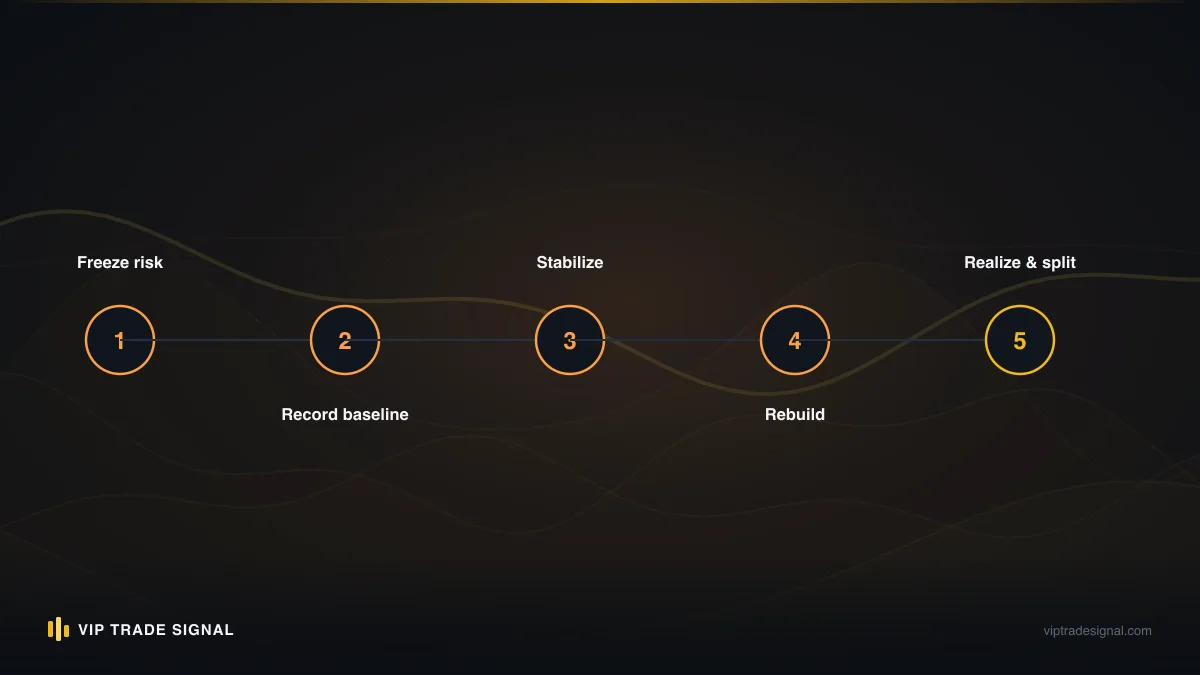
Rung one: the stop gets widened. Price approaches your stop and you move it, just once, just a bit, because the level "was slightly too tight" and the setup "is still valid". Cost so far: small. Precedent set: enormous. You've established that stops are negotiable at the moment of maximum pressure — which is the only moment that stops exist to handle.
Rung two: the stop gets deleted. Widening becomes tedious after the second or third time, so it goes entirely. The internal narrative upgrades from trade to conviction: "I'm not getting wicked out by manipulation; I'll manage it manually." Nobody manages it manually. In the disposition effect data, remember, automatic exit orders were the thing that most reliably shrank the bias — so this rung removes precisely the protection the evidence says works.
Rung three: size gets added. Averaging down. The trade is now underwater enough that a return to the original entry feels far away, so the goal quietly shifts from "be right" to "get back to breakeven", and adding size at better prices moves the breakeven closer. It also doubles the speed at which further adverse movement destroys the account, a detail the narrative skips.
Rung four: the hedge. The position is now too big and too deep to close (sunk cost, at full volume) but too painful to watch bleed (loss aversion, ditto), so the trader opens an opposite position of equal size and "locks" the loss. Floating P/L stops moving. Relief is immediate and real. And it's the most expensive relief in retail trading, because a locked hedge is just a realised loss that you're paying swap on, wearing double margin for, and — worst of all — that still requires the one decision you've been avoiding all along, except now it's two decisions, with legs, that must be unwound in a sequence. If you want the full autopsy of where locked hedges and their cousins lead, our piece on zone recovery and why the maths eventually catches you walks through it properly.
Rung five: the account stops being looked at. Not closed. Just... not looked at. Deposits sometimes continue, feeding margin to a position nobody will examine. This is the rung where accounts sit for months, and it's usually the state they're in when someone finally emails us.
Read the ladder again and notice what every rung has in common: each one is an action taken to avoid a smaller, earlier version of the same pain. The stop was removed to avoid a $150 loss. The account is eventually down $6,000. Every single rung was pain-avoidance, and every single rung bought pain at a markup. That's the house style of these three biases. They never present the bill up front.
So much for diagnosis. Willpower, as promised, is not the treatment. Here's what actually is.
Countermeasure one: decision rules written before entry
The whole trick — genuinely, the entire game — is that you are two different people. There's the calm version of you that exists before the trade, and the flooded version that exists at -$400 with loss aversion screaming. The calm one makes good decisions and has no power at the critical moment. The flooded one has all the power and makes terrible decisions. Every effective countermeasure works the same way: the calm one writes the rules and removes the flooded one's authority to change them.
Concretely, before every entry, three things get written down — not decided in your head, written, in a journal or even a notes app:
- The invalidation price. Not "where I'd get worried" — the price at which the trade thesis is factually wrong. If you're long gold from 3,340 because 3,325 is holding as support, then a clean break of 3,325 is your thesis ending. Write the number.
- The hard stop, placed in the platform, immediately. At or beyond the invalidation price, sized so the loss is a fixed small fraction of the account — on this desk we're loud about 0.5–1% per gold trade, for reasons covered at length in our XAU/USD risk management guide. A $5,000 account risking 1% loses $50 when it's wrong. Nobody's identity is invested in $50.
- The time stop. A maximum hold. If the trade hasn't done what it was supposed to do within, say, three sessions, it closes regardless of P/L. Time stops are wildly underrated, and they exist precisely to kill the "undecided" state before it can take root. A trade that can't expire can rot.
Then the load-bearing rule, and it needs to be exactly this blunt: no rule written before entry may be modified while the position is open, in the losing direction, ever. Tighten a stop? Fine. Widen one? Never. Take profit early per a pre-written condition? Fine. Delete a stop because "it's about to bounce"? That's the flooded trader forging the calm one's signature.
Does this feel rigid? Good — rigid is the point. The research on the disposition effect found the bias collapsing in traders who used automatic exits, and the reason is mechanical: an order that executes at 3,324.8 without consulting you cannot be talked out of it, because there is no conversation. You've moved the decision from the moment of maximum bias to the moment of minimum bias. That one relocation is worth more than every psychology book you'll ever read.
And yes, you will sometimes get stopped out and watch price reverse to where you'd have profited. It will sting, and the flooded trader will file it as evidence that stops are for suckers. Log those trades honestly for six months and compare their cost against one rung-four hedge. We've never seen the comparison go the flooded trader's way. Not once.
Countermeasure two: the "would I open this now?" test
Rules-before-entry protects new trades. But you might be reading this with a position already three weeks old and deep red, from back before you had rules. For that, there's a simple, slightly savage question that reframes the whole thing:
"If I were flat right now, with this account's current equity, would I open this exact position at this price?"
Not "do I think gold comes back eventually". Not "can I afford to wait". Would you — today, fresh, with no history — sell short or buy long here, in this size, with your money? Because that is precisely what holding is. Every hour you hold a position, you are re-purchasing it at the current price with your current equity. The market does not know your entry price. Your entry exists in exactly one place in the universe: your head. (Fine — your head and your statement. Neither of which moves price.)
The test works because it surgically strips out the two things the biases feed on. Sunk cost needs history — the test deletes the history. Loss aversion needs the loss to be yours, already attached to you — the test hands the position to a stranger. What's left over is just a market question: is this a good trade at this price? And market questions, unlike identity questions, have answerable forms: is the original thesis still intact, is the level that justified entry still holding, would your written rules permit this entry today at today's price?
If the answer is yes — genuinely yes, yes with a stop attached — then holding is a decision, made cleanly, and you should also be at peace writing a new stop for it right now. Notice how often the "yes" evaporates the moment a stop is required. A conviction that can't tolerate a stop loss isn't a conviction. It's a hostage situation.
If the answer is no, you already know what the position is. It's a trade you're only in because you were in it yesterday. That is the sunk cost fallacy, stated as a schedule.
Run the test on every open position once a week, same day, same time, written answers. Weekly matters: run it daily and the flooded trader answers; never run it and rung five arrives on its own. The written part matters too, because six months of your own "yes, because it'll bounce" entries, read back to back, is the most persuasive psychology course you will ever take, and you wrote it yourself.
Countermeasure three: third-party accountability
Here's an honest limit of countermeasures one and two: you administer them. The same brain that removed the stop can suspend the rule that forbids removing stops. Self-accountability has a single point of failure, and the failure mode is you, flooded, at 2 a.m., certain that this time is different.
So the third countermeasure is structural: put another set of eyes on the account, with standing permission to say the thing you don't want to hear.
The cheapest version costs nothing. Find one trading friend — one is enough — and agree to exchange full statements weekly. Not highlights. Statements. The effect kicks in before your friend says a word, because behaviour changes when it knows it will be seen. Deleting a stop is easy in private. Deleting a stop when Dave will see it deleted on Sunday, and will ask the "would you open it now?" question in the group chat, is a different act with a different price. Psychologists call this an implementation of social commitment; traders call it not wanting to look like a muppet in front of Dave. Both work.
A step up: give someone your written rules and explicit authority to hold you to them. "If you ever see a position of mine without a stop, message me the word STOP and I close 50% within the hour, no discussion." The pre-agreed script matters. In the flooded moment you cannot negotiate terms — the terms must already exist.
And there's the professional version. Signal services, at their best, are accountability infrastructure as much as analysis: someone else defines the entry, the stop, and the target before you're emotionally in the trade, which means the exit was never yours to unpick. It's one of the quieter reasons every closed signal we issue — the losses very much included — sits in public at our signal history, and why we're upfront about who we are and how we get paid: a service that hides its losers is running the same "it's not a loss until they see it" psychology this article is about, at the business level. And for accounts past the point of self-rescue — floating $5,000 to $10,000 down, hedged, stuck — a third party isn't a luxury any more; unwinding a wreck while emotionally inside it is close to impossible, which is roughly the entire reason our drawdown desk exists. No recovery is ever guaranteed, there or anywhere — anyone promising otherwise is lying to you — but a structured unwind by someone with no ego in the position beats another six months of hoping.
Whichever tier fits, the principle is identical: the biases operate in the dark, and they are remarkably shy in company.
Unwinding a position you've held far too long
Suppose the diagnosis fits and the test came back "no". You're holding something old, big and red. What now — market-close the lot at 9 a.m. and be done?
Sometimes, honestly, yes. If the position is a modest fraction of the account, ripping the plaster off beats an elaborate scheme. But for deep positions there's a real problem with the all-at-once exit: it maximises the psychological shock, and traders who take a huge single realised loss have a documented tendency to do something dreadful straight afterwards — revenge-trading double size to "win it back" that afternoon. The unwind has to survive your own reaction to it. So for anything serious, we stage it.
Cap it first. Before any closing, place a hard stop on the whole position at the level where the account becomes unrecoverable — the disaster line. This feels pointless ("I'm closing anyway") and isn't: it converts an unbounded problem into a bounded one, and bounded problems get solved by calmer people.
Close in scheduled tranches. A third now. A third at a written date this week. The final third at a written date next week. Dates, not prices — price-based tranches ("I'll close some on the next bounce") hand control straight back to hope. Calendar-based tranches execute regardless, which is the point. Each tranche realises a survivable slice of pain instead of one annihilating lump, and by the second one, most traders report the strange discovery that realised losses hurt less than the floating version did. The dread was the heavy part. It usually is.
Unwind hedges by the legs, with the cap on first. A locked hedge unwinds as: disaster stop on the losing leg, then close the profitable leg, then tranche the loser as above. Never the reverse order, and never "waiting for the right moment to release the hedge" — that moment is a unicorn, and people graze margin away for months hunting it.
Quarantine the freed capital. Whatever margin comes back does not trade for two weeks. Write it down as a rule before tranche one. The freed money will feel like a fresh stake and the wound will demand it be used; two weeks of forced cash is the countermeasure to the revenge trade, pre-signed by the calm version of you.
Then do the debrief — once. One page: entry thesis, the rung-by-rung history of what you overrode, total realised cost, and the single rule that would have capped it earliest. Ours is almost always "the stop stays". Yours probably will be too. File it where you'll see it, and don't relitigate the trade after that. Rumination is just sunk cost running in reverse, spending present attention on money that's already gone.
Where this leaves you
One more time, because it's the sentence this whole article folds into: the loss happens in the market; closing just tells you the truth about it.
Loss aversion will keep making red positions hurt double — that's wiring, and it isn't going anywhere. Sunk cost will keep whispering that six weeks of holding must not "be for nothing". The disposition effect will keep its thumb on the scale, and the research says it presses on professionals too. You don't beat any of this by becoming a harder, colder person. Frankly we've never met the trader who managed that. You beat it by arranging things so the flooded version of you is never left alone in a room with the close button and a story.
So, the short list, in order of leverage:
- Sort your history by duration tonight and look at the pattern with your own eyes. Yours, not Sam's.
- Run the "would I open this now?" test, in writing, on every currently open position. Anything that fails gets a scheduled, tranche-based exit with dates on a calendar.
- From the next trade onward: invalidation price, hard stop in the platform, time stop — all written before entry, none modifiable in the losing direction. Ever.
- Show your statement to one other human being every week.
None of this is glamorous. It will cost you the occasional stop-out that reverses, and the flooded trader will invoice you for each one loudly. Pay it anyway. The alternative isn't the occasional $50 sting — it's the slow, months-long, statement-hiding version, and if you've read this far with a position open in another tab, you already know exactly what that costs. And if that position is past the point where you can face unwinding it alone, that's a solvable problem too — it's what a drawdown desk is for. But whether you use ours, a friend named Dave, or a stop loss you finally leave where you put it: get the decision out of the flooded trader's hands. He's had the account long enough.