Here is a thing almost nobody admits: the account that dies from one insane trade is rare. We've watched hundreds of retail accounts fail over the years, ours included back in the early days, and the pattern is nearly always the same. Not one catastrophic bet. Six or seven slightly-too-big ones, spread over a fortnight, each of them defensible on its own.
That is what overleveraging in forex actually looks like from the inside. It doesn't feel reckless while you're doing it. It feels efficient. You have 1:500 leverage, the broker let you open the position, the margin calculator said fine, and the trade even made money the first three times. Then gold moves $40 against you on a Tuesday afternoon, your margin level drops through the floor, and the platform starts closing your trades for you at the worst prices of the week.
We want to walk through the whole chain in this piece, lot size to margin to margin call to forced stop-out, with real arithmetic. Mostly on gold, because that's all we trade at VIP Trade Signal and because gold punishes oversized positions faster than any major pair. If you've ever looked at an open position and felt your stomach do something, this is for you.
The lie traders tell themselves about leverage
The lie has a few versions, but the most common one goes like this: "Leverage doesn't increase my risk, my stop loss controls my risk. Leverage just lets me use less margin."
It's a seductive argument because it's technically half true. If — and this is a cathedral-sized if — you always size your position off a fixed cash risk and you always honour your stop, then the leverage number on your account is mostly cosmetic. A trader risking $20 per trade risks $20 per trade whether the account offers 1:30 or 1:2000.
But that's not how humans use leverage. In practice, the leverage available shapes the position sizes people choose. Give a trader a $1,000 account with 1:30 leverage and the platform physically won't let them open more than about 0.09 lots of gold. Give the same trader the same $1,000 with 1:1000 and suddenly 2 lots is possible, and possible has a way of becoming normal. The constraint disappears, and with it goes the last external check on position size.
The second version of the lie is quieter: "I'll only use the high leverage occasionally, when I'm really confident." Confidence is precisely the state in which you should trust yourself least with size. The trades we've been most certain about over the years have roughly the same hit rate as the ones we merely liked. The difference is that the certain ones were bigger, so the losers hurt more.
And the third version, the one that actually digs the drawdowns: "I'm in a hole, so I need bigger positions to climb out faster." We'll come back to that one, because it deserves its own section. It's the mechanism behind almost every account we see arrive at our drawdown management desk five figures underwater.
What overleveraging in forex actually means in numbers
Definitions first, because "too much leverage" is useless without a number attached.
What is overleveraging? It is not a leverage ratio. It's a relationship between three things: your position size, your account equity, and the normal volatility of the instrument you're trading. You are overleveraged when an ordinary adverse move (not a crash, not a black swan, just a normal bad day) takes an extraordinary bite out of your equity.
Let's put figures on it with gold, since gold is our whole world. One standard lot of XAU/USD is 100 ounces. Every $1 move in the gold price is $100 of profit or loss per lot. Gold routinely moves $20 to $40 in a day; on a hot data day, $60 or $80 is nothing special.
Now take a $2,000 account:
| Position | $ per $1 move | A normal $30 adverse day | % of account |
|---|---|---|---|
| 0.02 lots | $2 | −$60 | 3% |
| 0.10 lots | $10 | −$300 | 15% |
| 0.50 lots | $50 | −$1,500 | 75% |
| 1.00 lot | $100 | −$3,000 | dead, and then some |
Look at that third row for a second. Half a lot on a $2,000 account is not a lottery ticket, it's not martingale, it's not anything a trader would describe as crazy. Plenty of people trade it every day. And a single ordinary $30 move against it removes three quarters of the account. That's what overleveraging means in numbers: your position is sized so that normal volatility is lethal.
Our rough rule of thumb on the desk: work out what a routine daily range against you would cost, in dollars, and divide by your equity. Under 2%, you're sized like someone who intends to be here next year. Between 2% and 5%, you're aggressive and you'd better be honest about it. Over 5%, the market doesn't need to do anything unusual to hurt you badly; you've done the hard part for it.
Notice that leverage ratio never appeared in that calculation. A 1:2000 account trading 0.02 lots is conservative. A 1:30 account maxed out on margin is not. The ratio is the enabler; the position size is the crime.
From lot size to margin level: the chain that snaps
Margin calls confuse people because brokers describe them in percentages of a number nobody watches. So let's build the chain link by link, with a concrete account.
Say you have $2,000, leverage of 1:500, and gold is trading at 3,300. You open 1 lot long.
Link one: margin. Required margin is contract value divided by leverage: 100 oz × $3,300 / 500 = $660. The platform sets that $660 aside. Your free margin is now $1,340. So far everything feels roomy.
Link two: equity. Your equity is balance plus floating P/L. At 1 lot, every $1 gold falls costs you $100 of equity. The balance figure (the comforting one) doesn't move at all. This is why traders in trouble stare at balance instead of equity. Balance is history; equity is the truth.
Link three: margin level. This is the number that kills you: equity divided by used margin, times 100. Right now it's $2,000 / $660 = 303%. Healthy-looking.
Link four: the margin call. Most brokers warn at 100% margin level and force-close at somewhere between 20% and 50%. Check yours; it's in the account specification you never read. At 100%, your equity has fallen to $660, meaning gold dropped $13.40. Thirteen dollars. Gold does that between breakfast and your second coffee.
Link five: stop-out. At a 30% stop-out level, the platform starts liquidating when equity hits $198, which is gold down about $18 from entry. Not down $18 on the week. Down $18 from your entry, at any moment, including for ninety seconds during a news spike before bouncing back to exactly where you'd have been profitable.
That last detail is the cruellest part of leverage and margin calls: the market doesn't have to close against you. It only has to touch the level. Overleveraged positions convert temporary noise into permanent loss, because the stop-out crystallises the drawdown at its very deepest point and hands the recovery to someone else.
Run the same chain at 0.10 lots and the stop-out sits roughly $180 away from entry. Sessions that cover $180 on gold are vanishingly rare, and even the freak days that get anywhere near it would have given you hours of chances to act first. Same account, same broker, same trade idea. The only difference is a zero.
Why gold punishes oversized positions faster than majors
We pivoted this whole service to gold-only, so we say this with affection: XAU/USD is the least forgiving major instrument a retail trader can oversize.
Three reasons. First, raw dollar volatility. EUR/USD's typical daily range is around 60 to 80 pips, which on a standard lot is $600 to $800 of movement. Gold's routine daily range of $25 to $40 is $2,500 to $4,000 per lot. Trade the same lot size on gold that you comfortably traded on euro and you have roughly quadrupled your risk without changing a single habit. We see this constantly with traders migrating from majors. Their sizing instincts are calibrated to the wrong instrument, and their first month on gold recalibrates them the expensive way.
Second, gold gaps and spikes harder. It's the market's fear gauge. When a headline lands (a rate surprise, say, or something geopolitical), gold doesn't drift to its new price, it teleports. Spreads widen from 20 cents to $2 or worse for a few minutes, and if your margin level was already thin, the widened spread alone can trigger the stop-out before the price has really gone anywhere. An oversized gold position isn't just exposed to direction; it's exposed to liquidity.
Third, gold trends with real momentum, which flatters oversized winners. This is subtle and nasty. A trader oversizes, catches one of gold's strong directional days, and makes 40% of their account in an afternoon. What did they just learn? All the wrong things. The win doesn't merely fail to teach caution; it actively finances the next, bigger position. Gold's generosity on the good days is exactly what makes its bad days so well attended.
None of this makes gold untradeable. It makes gold unforgiving of size errors specifically. A correctly sized gold position is a wonderful thing to hold. Every signal we publish carries a defined stop for precisely this reason, and the full record of how those play out, losers included, sits in our public signal history for anyone to inspect.
Three account autopsies: same trades, different sizes
Theory is fine. Let's run an experiment instead. Take a trader we'll call Dan (generic, invented, but assembled from a hundred real cases) with a $5,000 account, trading gold. Give him a perfectly ordinary sequence of ten trades: five winners averaging +$8 per ounce of movement captured, five losers averaging −$10, arriving in an unkind but realistic order: loss, loss, win, loss, win, loss, loss, win, win, win. Net movement across the sequence: −$10 of price, then the recovery. A mediocre fortnight. Survivable. Unless.
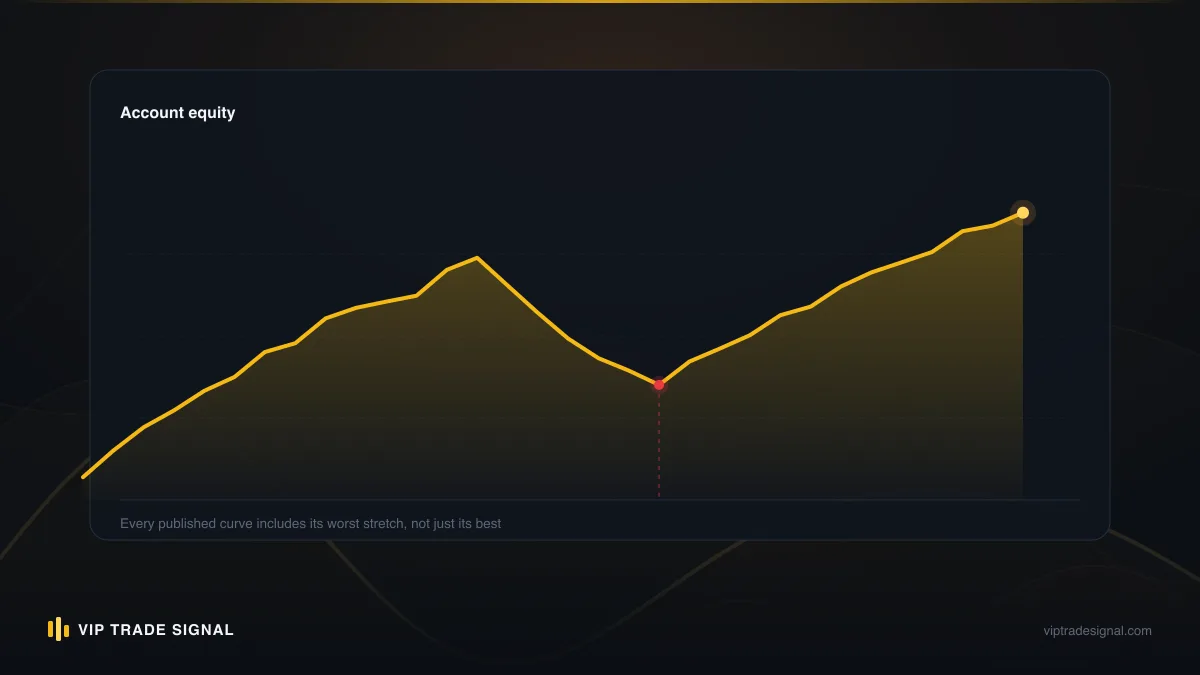
Autopsy one: Dan trades 0.05 lots throughout. Each loser costs about $50, each winner makes about $40. After the four early losses he's down roughly $170, or 3.4%. Annoying. He mentions it to nobody. The back half of the sequence claws most of it back and he ends the fortnight down about $60. A non-event. This is what proper sizing buys you: the ability to have a bad run and be bored by it.
Autopsy two: Dan trades 0.30 lots. Now each loser is around $300. Four losses in the first six trades and he's down roughly $1,100, or 22% of the account. Here's where the arithmetic of drawdown turns on him: a 22% loss needs a 28% gain to get back level, and the winners at this size make about $240 each. But Dan doesn't wait to find out, because Dan is human. Down 22%, he does what humans do.
Autopsy three: Dan trades 0.30 lots and doubles after losses. This is the realistic version. After the fourth loss he goes to 0.60 "to recover faster". The fifth trade wins: $480 back, and a lesson learned in reverse. The sixth and seventh lose at 0.60: minus $1,200 more. He's now down around $2,300, nearly half the account, his margin level is genuinely tight, and the three winners that end the sequence, the ones that saved autopsy-one Dan, he either takes at panic-reduced size or misses entirely because he's stopped trusting the ideas. Final damage: a bit over 50%, needing a 100%+ run just to see his deposit again.
Same ten trade ideas. Same entries, same exits, same market. The difference between "boring fortnight" and "half the account gone" was never the trading. It was the sizing, and then the emotional cascade the sizing triggered. We've written before about how to climb out of a genuinely blown account, but the honest summary is that the climb is brutal and the best treatment is to never need it.
The 1-2% rule and what it really buys you
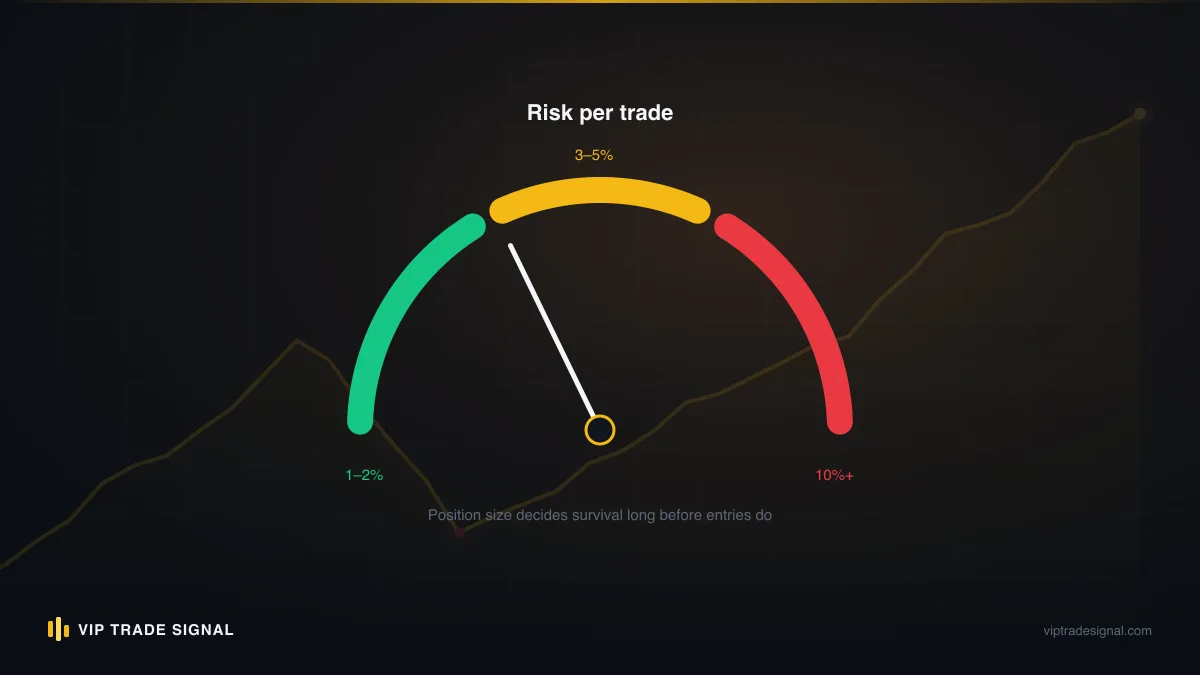
Everyone has heard the rule: risk 1% to 2% of equity per trade. Almost nobody follows it, partly because almost nobody has sat down and worked out what it actually purchases.
So let's price it. At 1% risk per trade, a run of five straight losers (and one will happen to you, this year, if you trade actively) costs about 4.9% of your account. At 2%, about 9.6%. Painful, recoverable, and crucially, survivable without changing anything. You can keep executing the same plan at the same size, which is the entire game during a losing streak.
At 10% risk per trade, five straight losers cost 41% of the account. At that depth, position sizes must shrink just to keep risk constant, recovery arithmetic turns hostile, and your decision-making, let's be honest, is no longer the decision-making of the person who made the plan.
There's a second thing the rule buys that gets less airtime: statistical room for your edge to show up. Any strategy's results arrive in streaks and clusters. If you have a genuine edge that plays out over 200 trades, but your sizing means a bad 15-trade stretch ends you, then you'll likely never survive long enough to collect. Small size is what lets the law of large numbers work for you instead of watching from the gallery while variance carries you out.
Is 1% sacred? No. It's a sensible default, not physics. A trader with three years of consistent records and a strategy whose worst historical streak is six losses can defend 2%, maybe a touch more. A trader in their first year, or anyone trading gold with sub-$20 stops, should treat 1% as a ceiling, not a target. And prop firm traders live under harsher maths again: a 5% daily loss cap means three 2% losers in a day is nearly game over, which is why the prop firm drawdown rules effectively force half-size on you whether you like it or not.
The 1% rule isn't there to make you rich slowly. It's there to make you impossible to kill quickly.
There's a compounding wrinkle worth naming too. Because percent risk is calculated off current equity, the rule automatically shrinks your positions in a drawdown and grows them in a good run. Down 10%, your 1% stake is 10% smaller in cash terms. The system is quietly pulling you back from the edge exactly when your instincts want to lean over it. Fixed-lot traders get none of this protection. Their risk per trade rises as a share of equity precisely as the equity falls, which is the arithmetic equivalent of accelerating into fog.
One mechanical note, because this trips people up: percent risk is stop distance times position size, not margin used. Risking 1% on a gold trade with a $10 stop on a $5,000 account means $50 of risk, which means 0.05 lots ($5 per $1 of movement × $10 stop). The margin that position uses is irrelevant to the risk calculation. Traders who size off margin ("I'll use half my free margin") aren't doing risk management at all. They're doing collateral management, which is a different job that mostly belongs to the broker.
Warning signs your current positions are too big
You don't need a spreadsheet to detect an overleveraged account. Your own behaviour tells you first, if you're willing to listen. In rough order of appearance:
- You check the position more than the market. When you're properly sized, you check gold to see what gold is doing. When you're oversized, you check to see what's happening to you. If you've refreshed the platform three times in ten minutes, the position is too big. This is the earliest and most reliable tell we know.
- Floating P/L changes your mood in real time. A correctly sized open trade is emotionally about as interesting as a parked car. If a $3 wiggle in gold moves you between hope and dread, the problem isn't your temperament. It's your lot size.
- You start negotiating with your stop. "It's about to bounce, I'll give it $5 more." That sentence is almost never spoken over a position whose loss would be trivial. Stop-widening is a size symptom wearing an analysis costume.
- You can't hold through a normal pullback. If routine retracements shake you out of trades that then work, your read might be fine and your size wrong. Plenty of "bad entries" are just positions too big to sit through the noise that was always going to happen.
- Margin level below 300% with one position on. Not a law, but a decent tripwire. If a single open trade drags your margin level under a few hundred percent, you've left yourself no room to be wrong slowly, and no room to add a second idea if one appears.
- You'd rather not say the lot size out loud. Seriously. If describing the position to a trader you respect would embarrass you, your own judgement has already ruled. You're just appealing the verdict.
A quieter seventh sign, from experience rather than any textbook: you stop journalling. Traders record trades they're proud of the sizing on. When the lot sizes drift north of defensible, the spreadsheet entries get thinner, then stop, because writing "0.80 lots on a $4k account" in your own handwriting makes it real. If your journal has a gap, the gap usually knows something.
Two or more of these at once and you're not reading a warning list any more, you're reading a description of your week. Cut the size. Not after this trade. On this trade. The market will still be there at half size, and so, more to the point, will you.
How brokers' high leverage offers change your behaviour
Time for an uncomfortable question: why do offshore brokers hand out 1:1000 and 1:2000 leverage to $200 accounts?
Not because they hate you. Because the numbers work. Most retail brokers with high-leverage offerings internalise a large slice of client flow, meaning when you lose, some counterparty within arm's reach of your broker is on the other side, and even purely A-booked brokers earn spread on every ticket. High leverage produces bigger tickets and shorter account lifespans with a burst of volume along the way. It is a feature designed around how people actually behave, not around how the risk-management chapter says they should.
Compare the regulatory world. European regulators cap retail gold leverage at 1:20. Australia's is similar. You can grumble about nanny-state trading (we did, at the time), but notice what the cap mechanically does: on a $2,000 account at 1:20, the margin for even 0.30 lots of gold at 3,300 is nearly $5,000. The platform simply refuses the oversized trade. The regulator has installed, from outside, the discipline the trader couldn't install from inside. It's crude. It also works: forced small sizing means normal volatility stays survivable, whatever the trader's intentions were.
Here's the behavioural trap in one sentence: available leverage becomes the anchor for what feels like a reasonable position. A trader on 1:30 who opens the maximum feels aggressive at 0.18 lots. A trader on 1:1000 can feel conservative at 1 lot ("I'm only using a tenth of my margin") while carrying five times the risk of the first trader's maximum. Same instinct, same self-image, wildly different exposure, and the only changed variable is a marketing decision made in a broker's product meeting.
Our advice, and it costs nothing: whatever leverage your broker gives you, do your sizing as if you had 1:20. Use the high leverage for what it's honestly good for, which is capital efficiency: holding sensible positions with less cash parked at a broker. And never let it near the sizing decision. The ratio should determine where your money sits, not how much of it you bet.
Deleveraging an account already deep in the red
Now the hard section, for the reader who didn't find this article in time. Your account is down 40%, 50%, maybe more, and it's floating: open positions underwater, margin level uncomfortable, every plan starting with the words "once it comes back".
First, the single most important sentence we can offer: the size that dug the hole cannot be the size that fills it. Every instinct screams the opposite. Bigger positions recover faster, mathematically, when they win. But you are currently the least qualified person in your own account, stressed, anchored to your old balance, and running on hope, and handing that person more size is how 50% drawdowns become closed accounts. We watch this sequence weekly. The blow-up is almost never the original losses. It's the recovery attempt.
The working order, when we take on a distressed account:
Cut floating risk to survivable, today. Not necessarily "close everything"; sometimes partial. If a full close feels impossible psychologically, halve every open position now and reassess in a week; a structured partial-close approach can take risk down without forcing an all-or-nothing decision you'll flinch from. What you cannot do is nothing. A floating loss on an oversized position isn't a paused problem, it's a growing one, because every day it stays open is another day one bad candle can force the stop-out.
Rebuild the sizing from current equity, not deposit. If $10,000 became $5,500, then 1% risk is $55 now. Yes, that means positions a third the size your ego is used to. Your ego didn't fund the account and won't refund it either.
Set the new maximum in lots, in writing, where you trade. Not a principle. A number. "Max 0.05 lots per position until equity crosses $7,000." Rules with numbers survive contact with a live chart; principles don't.
Expect recovery to take multiples of the time the drawdown took. The hole was dug at oversized speed and must be filled at correct-size speed. That asymmetry is the true cost of overleveraging, and no strategy tweak removes it.
We'll mention our own desk exactly once here: for accounts floating roughly $5k–$10k down, our drawdown management service works recovery on a flat 50% of profit above a baseline we record together at the start, and we will tell you in writing that no recovery is guaranteed, because it isn't, and anyone who says otherwise is selling you the second half of your account. The full risk picture is spelled out plainly in our risk disclosure; read it before you read anyone's sales page, including ours.
When high leverage is defensible (and when it never is)
Let's be fair to the tool, because leverage is a tool, and blanket condemnation is its own kind of laziness.
High leverage is defensible as capital efficiency for a properly sized trader. If you risk 1% per trade with hard stops and your sizing never references margin, then 1:500 simply means you can run your strategy with $2,000 at the broker instead of $20,000, keeping the balance somewhere safer and earning something. Given that broker failures happen (they do; look up any year's regulatory actions), holding less at the broker is a legitimate risk decision. The leverage isn't increasing your trading risk; it's reducing your custody risk. That's the strongest honest case for it, and it's a good one.
It's arguably defensible for defined-loss punts a trader can genuinely afford to lose: the $200 account someone treats explicitly as tuition, sized to be lost. We're lukewarm on this, because "money I can afford to lose" has a way of getting topped up, but at least the logic is internally consistent.
Where it is never defensible:
- As a substitute for capital you don't have. If your strategy needs $10,000 of risk capacity and you have $1,000, leverage doesn't bridge that gap. It hides it, briefly, and then invoices you.
- For recovery trading. Covered above. The hole and the shovel, etc.
- Because the win rate is high. A 90% strategy oversized still meets its 10% eventually, and at full size the 10% doesn't dent the account, it ends it. High win rates make overleveraging more tempting and precisely as fatal.
- On instruments you're new to. Every market's volatility has to be learned in your hands, not just your head. Gold especially. First fifty trades on anything new: half your normal size, minimum. Consider it the cover charge.
How much leverage is too much, then, as a final answer? The ratio itself is nearly unanswerable, and that's the point. The honest reframe: any position where a normal day's adverse range costs you more than about 2% of equity is too much, whatever the account's leverage setting says. Answer it per-trade, in dollars, every time, and the ratio becomes what it should always have been. Plumbing.
A sizing routine that takes ninety seconds per trade
Everything above compresses into a routine you can run before every single trade, in about the time it takes the kettle to boil. No spreadsheet heroics. Five steps.
Step one: equity, not balance (10 seconds). Read your current equity off the platform, including floating P/L. That's the only number your risk comes from. If equity and balance have drifted apart, that drift is information; don't average it away.
Step two: cash risk (10 seconds). Multiply equity by your risk percentage. $4,300 × 1% = $43. Write the actual number down, or at least say it. "Forty-three dollars." Vague risk is how size creeps.
Step three: stop distance in dollars of price (20 seconds). Where is the trade wrong? Not "where does the pain stop" but where the idea is invalidated. Say it's $12 below entry on a gold long. If you can't name the invalidation point, you don't have a trade yet; you have a mood.
Step four: divide (10 seconds). Cash risk ÷ (stop distance × $100 per lot). $43 ÷ ($12 × 100) = 0.036, so 0.03 lots, rounding down, always down. This number is the output of the process, never the input. The moment you catch yourself starting from a lot size and hunting for a stop that justifies it, you've reversed the machine, and the machine only works one way round.
Step five: the gut check (30 seconds). Before clicking: "If this hits the stop, I lose $43. Fine?" If genuinely fine, not gritted-teeth fine, actually fine, trade. If not, either the size is too big or the trade shouldn't exist. Both are useful answers, and both are cheaper now than later.
That's it. Every gold signal we send at VIP Trade Signal ships with entry, stop and targets precisely so this routine has its inputs ready (the stop distance is step three, done for you), and the whole closed record, red trades included, is public because a signal service that hides its losers is really selling you permission to oversize. But the routine doesn't need us. It needs ninety seconds and the humility to round down.
Where this leaves you
One last honest thing, and then a small assignment.
The honest thing: sizing correctly is boring, and the boredom is the product. Properly sized trading has no war stories. Nobody at the pub wants to hear that you risked 1%, lost it, risked 1% again, and finished the month up a little. The traders who follow this stuff for a decade end up with something better than stories, though. They end up with the account. Still there. Still compounding. Still theirs.
The assignment takes ten minutes tonight. Open your platform history and pull your last twenty trades. For each, work out what you actually risked as a percentage of the equity you had at that moment. Stop distance times size divided by equity, nothing fancier. Then answer three questions with the numbers in front of you. What was your worst single-trade risk? What would your worst five-trade streak have cost if every one had hit its stop? And would this month's you have survived it without changing size, plan, or sleep?
If those answers make you slightly ill, good. You found out on a spreadsheet, which is the only free place to find out. Halve your standard size starting tomorrow and run the ninety-second routine for one month. Not forever. One month. Then compare how you traded, how you slept, and what the equity curve did.
We'd bet quietly on all three improving. But you don't have to take a signal desk's word for it. The arithmetic in this article doesn't care who wrote it, and it will still be true the next time gold drops $30 before lunch and every overleveraged account on your broker's book finds out, once again, exactly where the stop-out level lives.
Yours doesn't have to be among them. That part, unusually for this business, is entirely within your control.